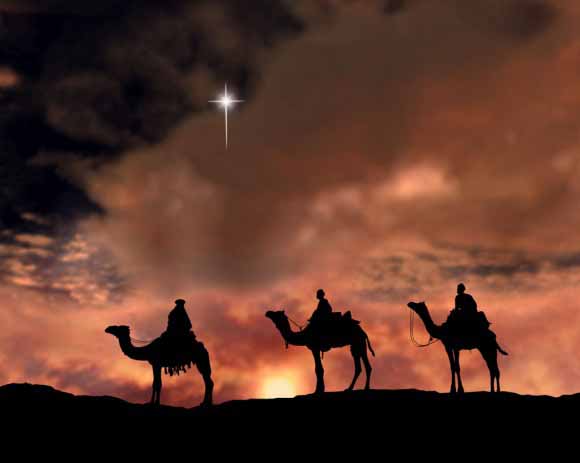
According to Ancient Astronaut Theory, the Star of Bethlehem was a ufo and goes along with the journey of the Magi.
The Star of Bethlehem, also called the Christmas Star, is a star in Christian tradition that revealed the birth of Jesus to the Magi, or "wise men", and later led them to Bethlehem. According to the Gospel of Matthew, the magi were men "from the east" who were inspired by the appearance of the star to travel to Jerusalem.
There they met King Herod of Judea, and asked where the king of the Jews had been born. Herod then asked his advisers where a messiah could be born. They replied Bethlehem, a nearby village, and quoted a prophecy by Micah. While the magi were on their way to Bethlehem, the star appeared again. Following the star, which stopped above the place where Jesus was born, the magi found Jesus with his mother, paid him homage, worshipped him and gave gifts. They then returned to their "own country".
Many Christians see the star as a miraculous sign to mark the birth of the christ (or messiah). Some theologians claimed that the star fulfilled a prophecy, known as the Star Prophecy. In modern times, astronomers have proposed various explanations for the star. A nova, a planet, a comet, an occultation, and a conjunction (gathering of planets) have all been suggested.
Many scholars question the historical accuracy of the story and argue that the star was a fiction created by the author of the Gospel of Matthew.
The subject is a favorite at planetarium shows during the Christmas season, although the Biblical account suggests that the visit of the magi took place at least several months after Jesus was born. The visit is traditionally celebrated on Epiphany (January 6) in Western Christianity and on Christmas (December 25) in Eastern Christianity.
Some people feel the Star of Bethlehem was a comet, shooting star, or perhaps a UFO.
The Magi linked the appearance of a star to the birth of a "King of the Jews."
In Hellenistic astrology, Jupiter was the king planet and Regulus (in the constellation Leo) was the king star. As they traveled from Jerusalem to Bethlehem, the star "went before" the magi and then "stood over" the place where Jesus was. In astrological interpretations, these phrases are said to refer to retrograde motion and to stationing, i.e., Jupiter appeared to reverse course for a time, then stopped, and finally resumed its normal progression.
In 3-2 BC, there was a series of seven conjunctions, including three between Jupiter and Regulus and a strikingly close conjunction between Jupiter and Venus near Regulus on June 17, 2 BC. "The fusion of two planets would have been a rare and awe-inspiring event", according to a paper by Roger Sinnott. This event however occurred after the generally accepted date of 4 BC for the death of Herod. Since the conjunction would have been seen in the west at sunset it could not have led the magi south from Jerusalem to Bethlehem.
Astronomer Michael Molnar has proposed a link between a double occultation of Jupiter by the moon in 6 BC in Aries and the Star of Bethlehem, particularly the second occultation on April 17. This event was quite close to the sun and would have been difficult to observe, even with a small telescope, which had not yet been invented.
Occultations of planets by the moon are quite common, but Firmicus Maternus, an astrologer to Roman Emperor Constantine, wrote that an occultation of Jupiter in Aries was a sign of the birth of a divine king. "When the royal star of Zeus, the planet Jupiter, was in the east this was the most powerful time to confer kingships. Furthermore, the Sun was in Aries where it is exalted. And the Moon was in very close conjunction with Jupiter in Aries", Molnar wrote.
A celestial event is oftentimes the precursor to the fulfillment of a prophecy from god about great change on the planet and for humanity in general. This celestial sighting would have been part of a prophecy about the birth of a great prophet/king who would change the thinking of the world forever.
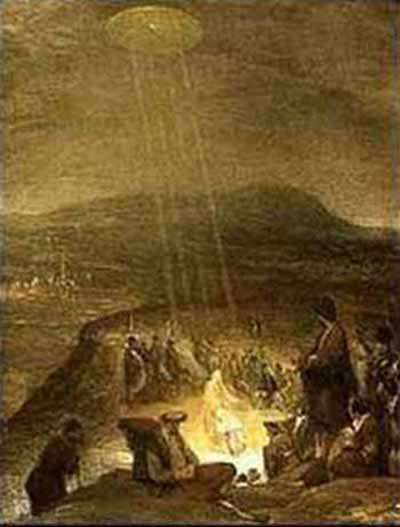
A disk shaped object is shining beams of light down on John the Baptist and Jesus - Fitzwilliam Musuem, Cambridge, England - Painted in 1710 by Flemish artist Aert De Gelder. It depicts a classic, hovering, silvery, saucer shaped UFO shining beams of light down on John the Baptist and Jesus. What could have inspired the artist to combine these two subjects?

17th century fresco of the crucifiction - Svetishoveli Cathedral in Mtskheta, Georgia.
Note the two saucer shaped craft on either side of Christ.


The picture on the right shows a red saucer shaped UFO seen near Jesus.
The painting hangs in the Academy of Florence.
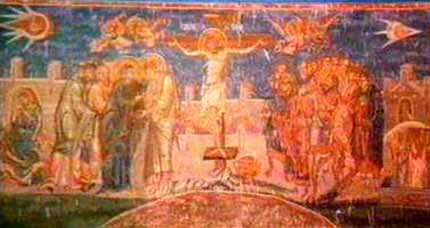
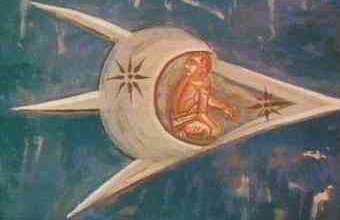
Frescos throughout Europe which reveal the appearance of space ships in the skies including this painting of 'The Crucifixion' - painted in 1350. It seems to depict a small human looking man looking over his shoulder - at another UFO as if in pursuit - as he flies across the sky in what is clearly a space ship. The leading craft is decorated with two twinkling stars, one reminiscent of national insignia on modern aircraft. This painting hangs above the altar at the Visoki Decani Monestary in Kosovo, Yugoslavia.
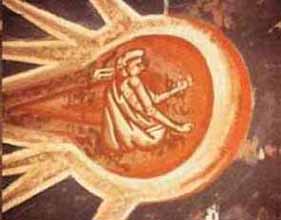
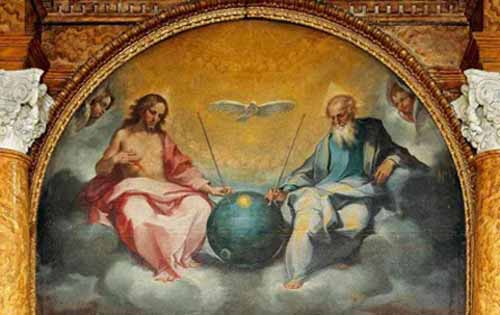
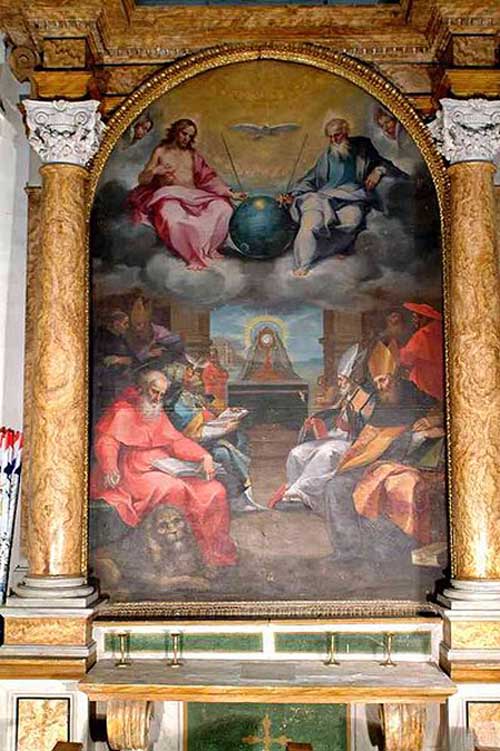
Today it hangs in the church of San Lorenzo in San Pietro, Montalcino, Italy.
What does the 'Sputnik satellite-like device' represent?
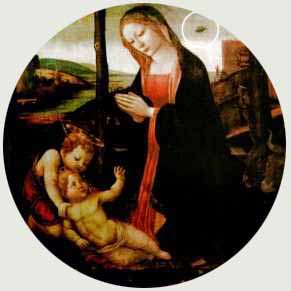
A fourteenth century fresco of the Madonna and Child depict on the top right side the image of a UFO hovering in the distance. A blow up of this fresco reveals tremendous details about this UFO including port holes. It seems to indicate a religious involvement between UFO's and the appearance of the Christ Child.
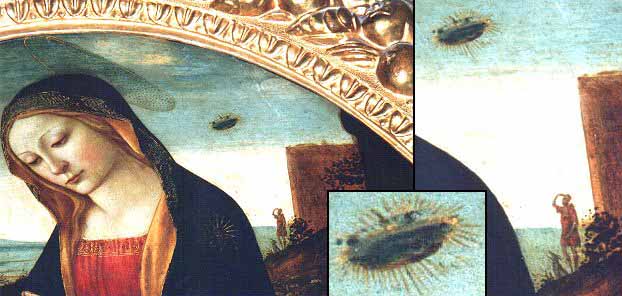
This painting is called "The Madonna with Saint Giovannino". It was painted in the 15th century by Domenico Ghirlandaio (1449-1494) and hangs as part of the Loeser collection in the Palazzo Vecchio. Above Mary's right shoulder is a disk shaped object. Below is a blow up of this section and a man and his dog can clearly be seen looking up at the object.
Bethlehem
Christianity
Christmas
Easter
Holy Grail
Jesus of Nazareth
Magi, Star of Bethlehem, Myrrh, Frankincense
Marion Apparitions
Mary Magdalene
Miracles: Bleeding, Weeping Icons, More
Mother Mary
Priory of Sion
Rennes le Chateau - Merovingian Kings
Revelations
Religious Art - Jesus and UFO's