People look at the sky for many reasons. It is both a map and a storyboard - a journey filled with endless possibilities for those who feel they were created by star travelers in the ancient past.
To the cosmologist stars are about creation and what lies beyond. We find mythological connections with the constellations, folklore, history, and archaeoastronomy that link humanity to the heavens, as if it is all connected by a sacred geometric stream of consciousness.
Some people stargaze as a healing tool or a way to remember human origins and destiny. Pseudoscience takes us to Astrology, Ancient Alien Theory, or perhaps an inner knowing that our souls traveled here from a distant star to which we may one day return. Whatever the reason, since the beginning of time, stars have always set our galactic course, and now play a role in its final outcome.
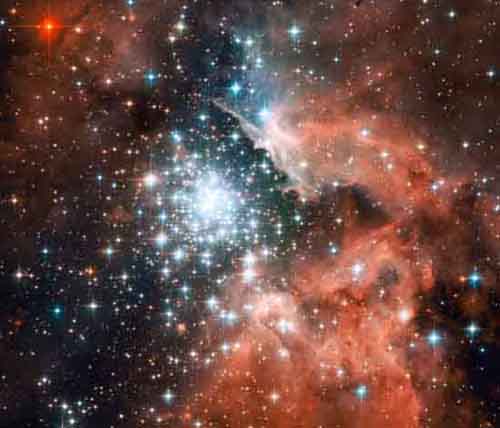
A star is a massive, luminous ball of plasma held together by gravity. At the end of its lifetime, a star can also contain a proportion of degenerate matter. The nearest star to Earth is the Sun, which is the source of most of the energy on Earth. Other stars are visible from Earth during the night when they are not outshone by the Sun or blocked by atmospheric phenomena.
Historically, the most prominent stars on the celestial sphere were grouped together into constellations and asterisms, and the brightest stars gained proper names. Extensive catalogues of stars have been assembled by astronomers, which provide standardized star designations.
For at least a portion of its life, a star shines due to thermonuclear fusion of hydrogen in its core releasing energy that traverses the star's interior and then radiates into outer space. Almost all naturally occurring elements heavier than helium were created by stars, either via stellar nucleosynthesis during their lifetimes or by supernova nucleosynthesis when stars explode. Astronomers can determine the mass, age, chemical composition and many other properties of a star by observing its spectrum, luminosity and motion through space.
The total mass of a star is the principal determinant in its evolution and eventual fate. Other characteristics of a star are determined by its evolutionary history, including diameter, rotation, movement and temperature. A plot of the temperature of many stars against their luminosities, known as a Hertzsprung-Russell diagram (H-R diagram), allows the age and evolutionary state of a star to be determined.
A star begins as a collapsing cloud of material composed primarily of hydrogen, along with helium and trace amounts of heavier elements. Once the stellar core is sufficiently dense, some of the hydrogen is steadily converted into helium through the process of nuclear fusion. The remainder of the star's interior carries energy away from the core through a combination of radiative and convective processes.
The star's internal pressure prevents it from collapsing further under its own gravity. Once the hydrogen fuel at the core is exhausted, those stars having at least 0.4 times the mass of the Sun expand to become a red giant, in some cases fusing heavier elements at the core or in shells around the core. The star then evolves into a degenerate form, recycling a portion of the matter into the interstellar environment, where it will form a new generation of stars with a higher proportion of heavy elements.
Binary and multi-star systems consist of two or more stars that are gravitationally bound, and generally move around each other in stable orbits. When two such stars have a relatively close orbit, their gravitational interaction can have a significant impact on their evolution. Stars can form part of a much larger gravitationally bound structure, such as a cluster or a galaxy.
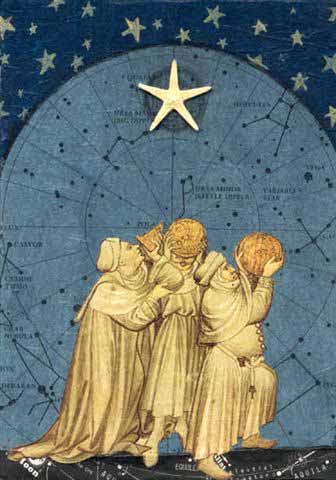
Historically, stars have been important to civilizations throughout the world. They have been part of religious practices and used for celestial navigation and orientation. Many ancient astronomers believed that stars were permanently affixed to a heavenly sphere, and that they were immutable.
By convention, astronomers grouped stars into constellations and used them to track the motions of the planets and the inferred position of the Sun. The motion of the Sun against the background stars (and the horizon) was used to create calendars, which could be used to regulate agricultural practices. The Gregorian calendar, currently used nearly everywhere in the world, is a solar calendar based on the angle of the Earth's rotational axis relative to its local star, the Sun.
The oldest accurately dated star chart appeared in ancient Egyptian astronomy in 1534 BC.
The earliest known star catalogues were compiled by the ancient Babylonian astronomers of Mesopotamia in the late 2nd millennium BC, during the Kassite Period (ca. 1531-1155 BC).
The first star catalogue in Greek astronomy was created by Aristillus in approximately 300 BC, with the help of Timocharis.
The star catalog of Hipparchus (2nd century BC) included 1020 stars and was used to assemble Ptolemy's star catalogue. Hipparchus is known for the discovery of the first recorded nova (new star). Many of the constellations and star names in use today derive from Greek astronomy.
In spite of the apparent immutability of the heavens, Chinese astronomers were aware that new stars could appear.
In 185 AD, they were the first to observe and write about a supernova, now known as the SN 185.
The brightest stellar event in recorded history was the SN 1006 supernova, which was observed in 1006 and written about by the Egyptian astronomer Ali ibn Ridwan and several Chinese astronomers.
The SN 1054 supernova, which gave birth to the Crab Nebula, was also observed by Chinese and Islamic astronomers.
Medieval Islamic astronomers gave Arabic names to many stars that are still used today, and they invented numerous astronomical instruments that could compute the positions of the stars. They built the first large observatory research institutes, mainly for the purpose of producing Zij star catalogues.
Among these, the Book of Fixed Stars (964) was written by the Persian astronomer Abd al-Rahman al-Sufi, who discovered a number of stars, star clusters (including the Omicron Velorum and Brocchi's Clusters) and galaxies (including the Andromeda Galaxy).
In the 11th century, the Persian polymath scholar Abu Rayhan Biruni described the Milky Way galaxy as a multitude of fragments having the properties of nebulous stars, and also gave the latitudes of various stars during a lunar eclipse in 1019.
The Andalusian astronomer Ibn Bajjah proposed that the Milky Way was made up of many stars which almost touched one another and appeared to be a continuous image due to the effect of refraction from sublunary material, citing his observation of the conjunction of Jupiter and Mars on 500 AH (1106/1107 AD) as evidence.
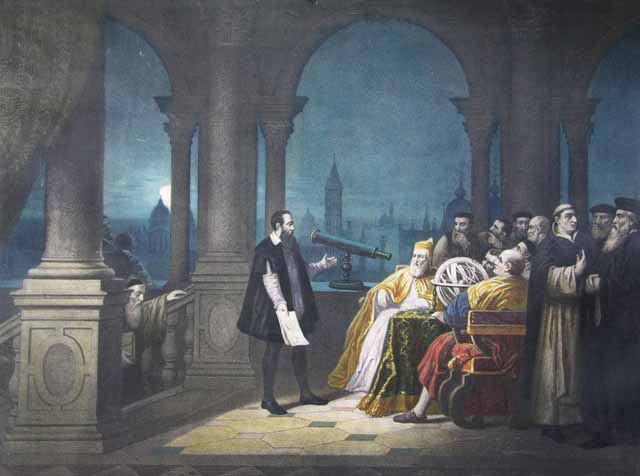
Early European astronomers such as Tycho Brahe identified new stars in the night sky (later termed novae), suggesting that the heavens were not immutable.
In 1584 Giordano Bruno suggested that the stars were like the Sun, and may have other planets, possibly even Earth-like, in orbit around them, an idea that had been suggested earlier by the ancient Greek philosophers, Democritus and Epicurus, and by medieval Islamic cosmologists such as Fakhr al-Din al-Razi.
By the following century, the idea of the stars being the same as the Sun was reaching a consensus among astronomers. To explain why these stars exerted no net gravitational pull on the Solar System, Isaac Newton suggested that the stars were equally distributed in every direction, an idea prompted by the theologian Richard Bentley.
The Italian astronomer Geminiano Montanari recorded observing variations in luminosity of the star Algol in 1667.
Edmond Halley published the first measurements of the proper motion of a pair of nearby "fixed" stars, demonstrating that they had changed positions from the time of the ancient Greek astronomers Ptolemy and Hipparchus. The first direct measurement of the distance to a star (61 Cygni at 11.4 light-years) was made in 1838 by Friedrich Bessel using the parallax technique. Parallax measurements demonstrated the vast separation of the stars in the heavens.
William Herschel was the first astronomer to attempt to determine the distribution of stars in the sky. During the 1780s, he performed a series of gauges in 600 directions, and counted the stars observed along each line of sight. From this he deduced that the number of stars steadily increased toward one side of the sky, in the direction of the Milky Way core. His son John Herschel repeated this study in the southern hemisphere and found a corresponding increase in the same direction. In addition to his other accomplishments, William Herschel is also noted for his discovery that some stars do not merely lie along the same line of sight, but are also physical companions that form binary star systems.
The science of stellar spectroscopy was pioneered by Joseph von Fraunhofer and Angelo Secchi. By comparing the spectra of stars such as Sirius to the Sun, they found differences in the strength and number of their absorption lines - the dark lines in a stellar spectra due to the absorption of specific frequencies by the atmosphere.
In 1865 Secchi began classifying stars into spectral types. However, the modern version of the stellar classification scheme was developed by Annie J. Cannon during the 1900s.
Observation of double stars gained increasing importance during the 19th century. In 1834, Friedrich Bessel observed changes in the proper motion of the star Sirius, and inferred a hidden companion. Edward Pickering discovered the first spectroscopic binary in 1899 when he observed the periodic splitting of the spectral lines of the star Mizar in a 104 day period. Detailed observations of many binary star systems were collected by astronomers such as William Struve and S. W. Burnham, allowing the masses of stars to be determined from computation of the orbital elements. The first solution to the problem of deriving an orbit of binary stars from telescope observations was made by Felix Savary in 1827.
The twentieth century saw increasingly rapid advances in the scientific study of stars. The photograph became a valuable astronomical tool. Karl Schwarzschild discovered that the color of a star, and hence its temperature, could be determined by comparing the visual magnitude against the photographic magnitude.
The development of the photoelectric photometer allowed very precise measurements of magnitude at multiple wavelength intervals. In 1921 Albert A. Michelson made the first measurements of a stellar diameter using an interferometer on the Hooker telescope.
Important conceptual work on the physical basis of stars occurred during the first decades of the twentieth century.
In 1913, the Hertzsprung-Russell diagram was developed, propelling the astrophysical study of stars. Successful models were developed to explain the interiors of stars and stellar evolution. The spectra of stars were also successfully explained through advances in quantum physics. This allowed the chemical composition of the stellar atmosphere to be determined.
With the exception of supernovae, individual stars have primarily been observed in our Local Group of galaxies, and especially in the visible part of the Milky Way (as demonstrated by the detailed star catalogues available for our galaxy).
But some stars have been observed in the M100 galaxy of the Virgo Cluster, about 100 million light years from the Earth. In the Local Supercluster it is possible to see star clusters, and current telescopes could in principle observe faint individual stars in the Local Cluster - the most distant stars resolved have up to hundred million light years away.
However, outside the Local Supercluster of galaxies, neither individual stars nor clusters of stars have been observed. The only exception is a faint image of a large star cluster containing hundreds of thousands of stars located one billion light years away - ten times the distance of the most distant star cluster previously observed.

In modern astronomy, a constellation is an internationally defined area of the celestial sphere. Historically, the term was also used to refer to a perceived pattern formed by prominent stars within apparent proximity to one another, and this practice is still common today.
The concept of the constellation was known to exist during the Babylonian period. Ancient sky watchers imagined that prominent arrangements of stars formed patterns, and they associated these with particular aspects of nature or their myths. Twelve of these formations lay along the band of the ecliptic and these became the basis of astrology. Many of the more prominent individual stars were also given names, particularly with Arabic or Latin designations.

As well as certain constellations and the Sun itself, stars as a whole have their own myths. To the Ancient Greeks, some "stars", known as planets, represented various important deities, from which the names of the planets Mercury, Venus, Mars, Jupiter and Saturn were taken. (Uranus and Neptune were also Greek and Roman gods, but neither planet was known in Antiquity because of their low brightness. Their names were assigned by later astronomers.)
Circa 1600, the names of the constellations were used to name the stars in the corresponding regions of the sky. The German astronomer Johann Bayer created a series of star maps and applied Greek letters as designations to the stars in each constellation. Later a numbering system based on the star's right ascension was invented and added to John Flamsteed's star catalogue in his book "Historia coelestis Britannica" (the 1712 edition), whereby this numbering system came to be called Flamsteed designation or Flamsteed numbering.
Under space law, the only internationally recognized authority for naming celestial bodies is the International Astronomical Union (IAU). A number of private companies sell names of stars, which the British Library calls an unregulated commercial enterprise. However, the IAU has disassociated itself from this commercial practice, and these names are neither recognized by the IAU nor used by them. One such star naming company is the International Star Registry, which, during the 1980s, was accused of deceptive practice for making it appear that the assigned name was official. This now-discontinued ISR practice was informally labeled a scam and a fraud, and the New York City Department of Consumer Affairs issued a violation against ISR for engaging in a deceptive trade practice.
Astrology Crystalinks
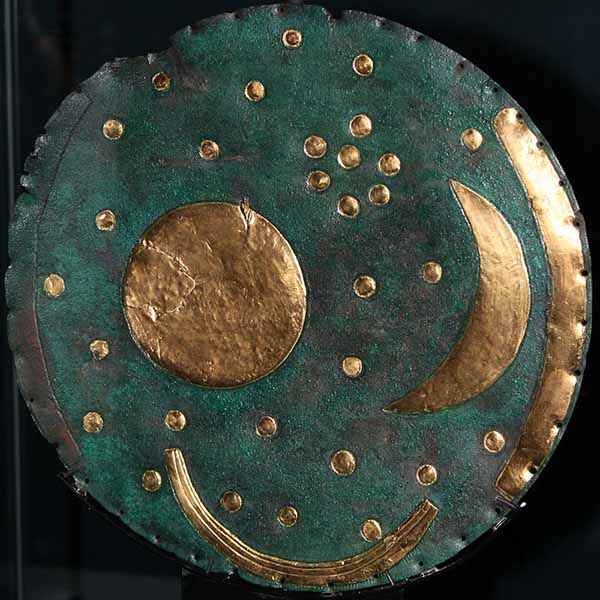
What Could Be The Earliest Map of The Sky Contains a Mystery Star
Science Alert - January 6, 2024
Could This Ancient Carved Disk Be The Oldest Ever Map Of The Stars?
IFL Science - January 4, 2024
As learned by star formation astronomers, stars are born in molecular clouds, large regions of slightly higher density of matter (though still less dense than the inside of an Earthly vacuum chamber), and form by gravitational instability inside those clouds triggered by shockwaves from supernovae.
High mass stars powerfully illuminate the clouds from which they formed. One example of such a nebula is the Orion Nebula.
Stars spend about 90% of their lifetime fusing hydrogen to produce helium in high-pressure reactions near the core. Such stars are said to be on the main sequence.
Small stars - called red dwarfs - burn their fuel very slowly and last tens to hundreds of billions of years, far longer than the time elapsed in the universe so far.
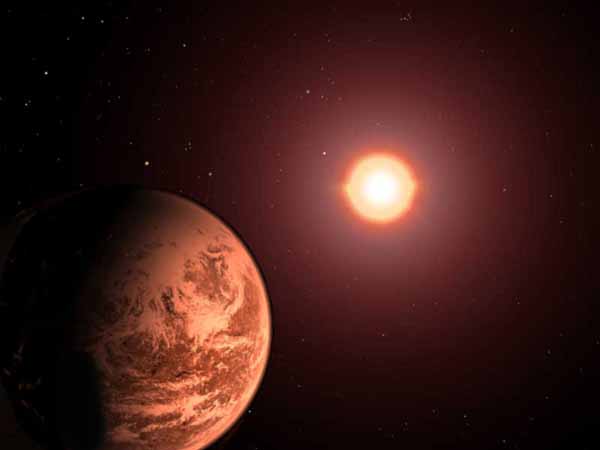
Red dwarfs are small stars that never really managed to get fired up. With masses of about 40% that of our sun, they are relatively cool, with a surface temperature of less than 3,200C, so they have a dimmer, reddish appearance. Red dwarfs collectively make up the vast majority of all stars in the universe. Stars that are smaller and dimmer still are known as brown dwarfs. These generally have a mass of less than 7% of our sun, making them too small to sustain hydrogen-burning fusion reactions at their core.
According to the Hertzsprung-Russell diagram, a red dwarf star is a small and relatively cool star, of the main sequence, either late K or M spectral type. They comprise the vast majority of stars and have a diameter and mass of less than one-third that of the Sun (down to 0.08 solar masses, which are brown dwarfs) and a surface temperature of less than 3,500 K. They emit little light, sometimes as little as 1/10,000th that of the sun. Due to the slow rate at which they burn hydrogen, red dwarfs have an enormous estimated lifespan; estimates range from tens of billions up to trillions of years.
Red dwarfs never initiate helium fusion and so cannot become red giants; the stars slowly contract and heat up until all the hydrogen is consumed. In any event, there has not been sufficient time since the Big Bang for red dwarfs to evolve off the main sequence.
The fact that red dwarfs remain on the main sequence while older stars have moved off the main sequence allows one to date star clusters by finding the mass at which the stars turn off the main sequence. In addition, the fact that no red dwarfs have evolved off the main sequence have been observed is evidence that the universe has a finite age.
One mystery which has not been solved as of 2004 is the lack of red dwarf stars with no metals (in astronomy a metal is any element other than hydrogen and helium). The Big Bang model predicts the first generation of stars should have only hydrogen, helium, and lithium. If such stars included red dwarfs, they should still be observable today, but are not. The conventional explanation is that without heavy elements, low mass stars cannot form and the first stars were extremely high mass population III stars which died quickly and produced the metals necessary for low mass stars to form later.
Red dwarf stars are believed to be the most common star type in the universe. Proxima Centauri, the nearest star to the Sun is a red dwarf, (Type M5, magnitude 11.0) as are twenty of the next thirty nearest. However, due to their low luminosity, few are known.
At the end of their lives, they simply become dimmer and dimmer, fading into black dwarfs - although none exist yet.
A black dwarf constitutes the remains of a Sun-sized star which has evolved to a black dwarf, or stellar remnant, subsequently cooled down such that it only emits black body radiation. None are known to exist in our universe, as the time taken for a white dwarf to cool to such a degree is hypothesized to be longer than the lifespan of the universe to date.
Even at the epoch when black dwarfs exist they will be extremely difficult to detect, emitting thermal radiation at a temperature not much above that of the cosmic microwave background radiation. One of the only ways to detect them may be through their gravitational influence.
Black dwarfs should not be confused with brown dwarfs, which are formed when gas contracts to form a star, but does not possess enough mass to initiate and sustain hydrogen nuclear fusion. (NB: what we now refer to as brown dwarfs were at times called black dwarfs in the 1960s.)
As most stars exhaust their supply of hydrogen, their outer layers expand and cool to form a red giant. In about 5 billion years, when the Sun is a red giant, it will subsume Mercury and Venus. Eventually the core is compressed enough to start helium fusion, and the star heats up and contracts. Larger stars will also fuse heavier elements, all the way to iron, which is the end point of the process.
An average-size star will then shed its outer layers as a planetary nebula. The core that remains will be a tiny ball of degenerate matter not massive enough for further fusion to take place, supported only by degeneracy pressure, called a white dwarf. It will fade into a black dwarf over very long stretches of time. In larger stars, fusion continues until collapse ends up causing the star to explode in a supernova.
This is the only cosmic process that happens on human timescales; historically, supernovae have been observed as "new stars" where none existed before. Most of the matter in a star is blown away in the explosion (forming nebulae such as the Crab Nebula) but what remains will collapse into a neutron star (a pulsar or X-ray burster) or, in the case of the largest stars, a black hole. The blown-off outer layers include heavy elements, which are often converted into new stars and/or planets. The outflow from supernovae and the stellar wind of large stars play an important part in shaping the interstellar medium.
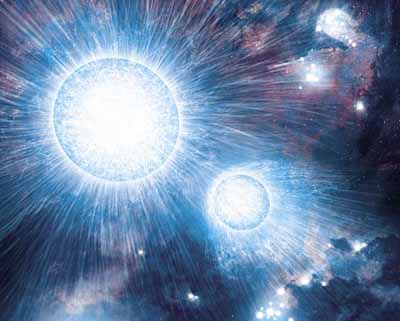
Astronomers Just Found The Smallest Yet Most Massive Dead Star Ever Discovered
Science Alert - July 1, 2021
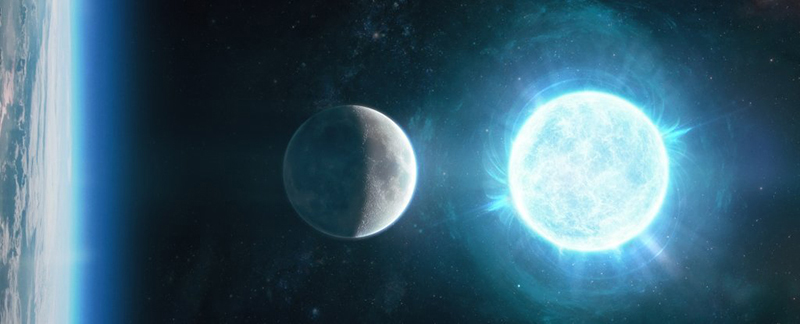
Contaminated white dwarfs: Scientists solve riddle of celestial archaeology Science Daily - March 26, 2014
A decades old space mystery has been solved by an international team of astronomers. The team put forward a new theory for how collapsed stars become polluted - that points to the ominous fate that awaits planet Earth. Scientists investigated hot, young, white dwarfs - the super-dense remains of Sun-like stars that ran out of fuel and collapsed to about the size of the Earth. It has been known that many hot white dwarfs' atmospheres, essentially of pure hydrogen or pure helium, are contaminated by other elements -- like carbon, silicon and iron. What was not known, however, was the origins of these elements, known in astronomical terms as metals.
A white dwarf, also called a degenerate dwarf, is a stellar remnant composed mostly of electron-degenerate matter. They are very dense; a white dwarf's mass is comparable to that of the Sun, and its volume is comparable to that of the Earth. Its faint luminosity comes from the emission of stored thermal energy. The nearest known white dwarf is Sirius B, 8.6 light years away, the smaller component of the Sirius binary star. There are currently thought to be eight white dwarfs among the hundred star systems nearest the Sun. The unusual faintness of white dwarfs was first recognized in 1910 by Henry Norris Russell, Edward Charles Pickering, and Williamina Fleming;, p. 1 the name white dwarf was coined by Willem Luyten in 1922.
White dwarfs are thought to be the final evolutionary state of all stars whose mass is not high enough to become a neutron star - over 97% of the stars in the Milky Way. After the hydrogenÐfusing lifetime of a main-sequence star of low or medium mass ends, it will expand to a red giant which fuses helium to carbon and oxygen in its core by the triple-alpha process. If a red giant has insufficient mass to generate the core temperatures required to fuse carbon, around 1 billion K, an inert mass of carbon and oxygen will build up at its center. After shedding its outer layers to form a planetary nebula, it will leave behind this core, which forms the remnant white dwarf. Usually, therefore, white dwarfs are composed of carbon and oxygen. If the mass of the progenitor is between 8 and 10.5 solar masses, the core temperature is sufficient to fuse carbon but not neon, in which case an oxygen-neonÐmagnesium white dwarf may be formed. Also, some helium white dwarfs appear to have been formed by mass loss in binary systems.
The material in a white dwarf no longer undergoes fusion reactions, so the star has no source of energy, nor is it supported by the heat generated by fusion against gravitational collapse. It is supported only by electron degeneracy pressure, causing it to be extremely dense. The physics of degeneracy yields a maximum mass for a non-rotating white dwarf, the Chandrasekhar limit - approximately 1.4 solar masses - beyond which it cannot be supported by electron degeneracy pressure. A carbon-oxygen white dwarf that approaches this mass limit, typically by mass transfer from a companion star, may explode as a Type Ia supernova via a process known as carbon detonation. (SN 1006 is thought to be a famous example.)
A white dwarf is very hot when it is formed, but since it has no source of energy, it will gradually radiate away its energy and cool. This means that its radiation, which initially has a high color temperature, will lessen and redden with time. Over a very long time, a white dwarf will cool to temperatures at which it will no longer emit significant heat or light, and it will become a cold black dwarf. However, the length of time it takes for a white dwarf to reach this state is calculated to be longer than the current age of the Universe (approximately 13.8 billion years), and since no white dwarf can be older than the age of the Universe, it is thought that no black dwarfs yet exist. The oldest white dwarfs still radiate at temperatures of a few thousand kelvins.
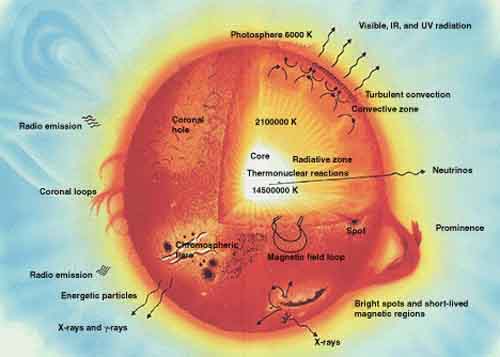
The interior of a stable star is in a state of hydrostatic equilibrium: the forces on any small volume almost exactly counterbalance each other. The balanced forces are inward gravitational force and an outward force due to the pressure gradient within the star. The pressure gradient is established by the temperature gradient of the plasma; the outer part of the star is cooler than the core. The temperature at the core of a main sequence or giant star is at least on the order of 107 K. The resulting temperature and pressure at the hydrogen-burning core of a main sequence star are sufficient for nuclear fusion to occur and for sufficient energy to be produced to prevent further collapse of the star.
As atomic nuclei are fused in the core, they emit energy in the form of gamma rays. These photons interact with the surrounding plasma, adding to the thermal energy at the core. Stars on the main sequence convert hydrogen into helium, creating a slowly but steadily increasing proportion of helium in the core. Eventually the helium content becomes predominant and energy production ceases at the core. Instead, for stars of more than 0.4 solar masses, fusion occurs in a slowly expanding shell around the degenerate helium core.
In addition to hydrostatic equilibrium, the interior of a stable star will also maintain an energy balance of thermal equilibrium. There is a radial temperature gradient throughout the interior that results in a flux of energy flowing toward the exterior. The outgoing flux of energy leaving any layer within the star will exactly match the incoming flux from below.
Most stars are identified only by catalogue numbers; only a few have names as such. The names are either traditional names (mostly from Arabic), Flamsteed designations, or Bayer designations.
The only body which has been recognized by the scientific community as having competence to name stars or other celestial bodies is the International Astronomical Union (IAU).
A number of private companies (e.g. the "International Star Registry") purport to sell names to stars; however, these names are not recognized by the scientific community, nor used by them, and many in the astronomy community view these organizations as frauds preying on people ignorant of how stars are in fact named. Read more
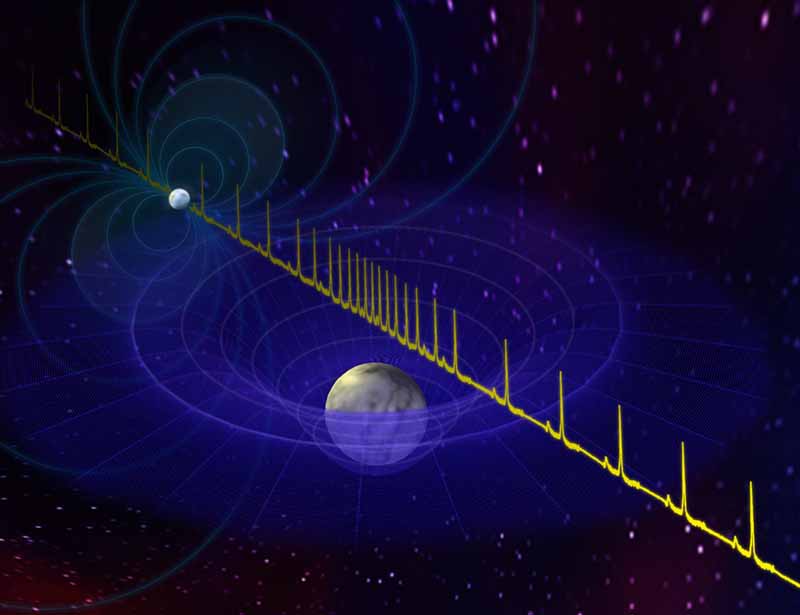
A neutron star is a type of stellar remnant that can result from the gravitational collapse of a massive star during a Type II, Type Ib or Type Ic supernova event. Such stars are composed almost entirely of neutrons, which are subatomic particles without electrical charge and a slightly larger mass than protons. Neutron stars are very hot and are supported against further collapse because of the Pauli exclusion principle. This principle states that no two neutrons (or any other fermionic particle) can occupy the same place and quantum state simultaneously.
Video: Astronomers discover most massive neutron star yet known PhysOrg - October 27, 2010
... a discovery with strong and wide-ranging impacts across several fields of physics and astrophysics. This neutron star is twice as massive as our Sun.
Scientists Spot a Black Hole-Neutron Star Pair Breaking the Rules of Cosmic Orbits SciTech Daily - March 17, 2026

A newly analyzed gravitational-wave event has revealed something unexpected about one of the Universe's most violent encounters. Scientists have found the first strong evidence that a black hole and a neutron star collided while moving along an oval shaped orbit instead of the nearly perfect circle that scientists had long expected. The finding challenges existing ideas about how these extreme cosmic systems form and evolve.
Forget stardust - it was star ice all along. Carl Sagan famously said that "We're all made of star stuff." But he didn't elaborate on how that actually happened. PhysOrg - December 16, 2025

An Exploding Star Just Changed What We Know About the Origins of Life SciTech Daily - December 4, 2025

"Why are we here?" remains one of the oldest questions humans have asked. One way scientists approach this is by examining how the elements that make up everything around us first formed. Many elements are known to arise within stars and in the explosive aftermath of supernovae, which scatter this material throughout space. However, the sources of several important elements have remained unclear. Scientists using the XRISM X-ray satellite have uncovered unexpectedly high amounts of chlorine and potassium in the Cassiopeia A supernova remnant, solving a long-standing mystery about the origins of these life-important elements.
Astronomers Discover a Star That Breaks the Rules Orbiting a Silent Black Hole SciTech Daily - November 26, 2025
Astronomers have uncovered clues to a red giant's chaotic past by detecting subtle stellar vibrations that hint at a long-ago collision and an unexpectedly rapid spin.
JWST may have found the Universe's first stars powered by dark matter Science Daily - October 14, 2025
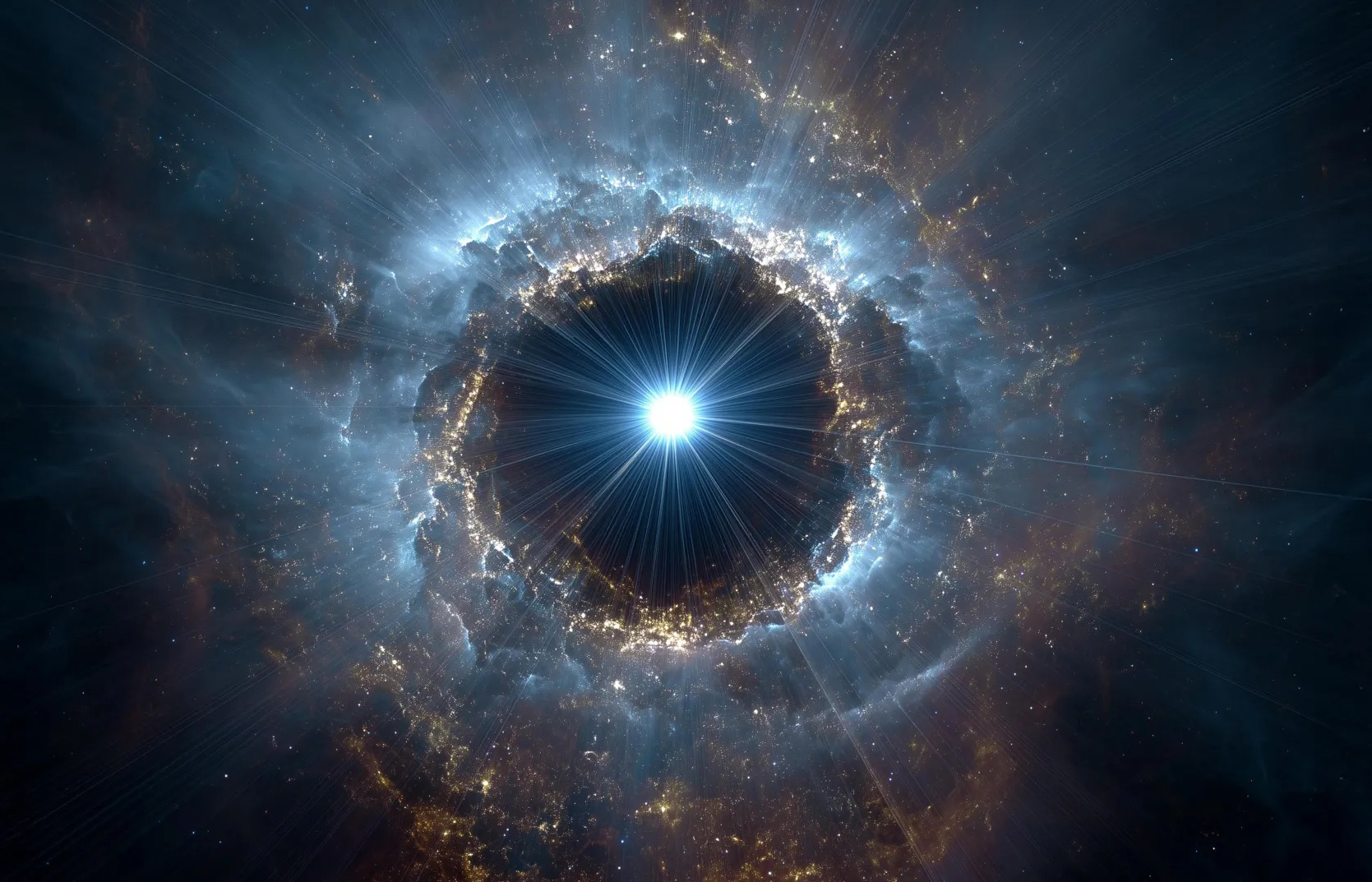
New observations from the James Webb Space Telescope hint that the universe's first stars might not have been ordinary fusion-powered suns, but enormous supermassive dark stars powered by dark matter annihilation. These colossal, luminous hydrogen-and-helium spheres may explain both the existence of unexpectedly bright early galaxies and the origin of the first supermassive black holes.
Astronomers discover doomed pair of spiraling stars on our cosmic doorstep PhysOrg - April 4, 2025

Astronomers have discovered an extremely rare, high-mass, compact binary star system only ~150 light years away. These two stars are on a collision course to explode as a type 1a supernova, appearing 10 times brighter than the moon in the night sky.
A Star Vanished And Was Mysteriously Replaced by a Black Hole Science Alert - November 11, 2024

Massive stars about eight times more massive than the Sun explode as supernovae at the end of their lives. The explosions, which leave behind a black hole or a neutron star, are so energetic they can outshine their host galaxies for months. However, astronomers appear to have spotted a massive star that skipped the explosion and turned directly into a black hole.
Once-in-a-lifetime nova explosion from T Coronae Borealis will create a 'new star' in the sky Live Science - August 2, 2024
Astronomers and stargazers are eagerly awaiting the appearance of a "new" star, which will burst into view in the skies any night now. The star, T Coronae Borealis (T CrB) or the "Blaze Star," is a nova that appears above our heads roughly every 80 years and will be visible with the naked eye, according to NASA. Situated roughly 3,000 light-years away in the Corona Borealis, or Northern Crown constellation, the nova is actually a pair of stars - an ancient red giant and an Earth-size white dwarf that is slowly stripping hydrogen from its companion.
NASA Will Soon Launch An Artificial Star Into Orbit Over The USA IFL Science - July 23, 2024

The Landolt mission - named for astronomer Arlo Landolt - will provide one for us when it launches in 2029, as it places a calibrated light source into orbit at a distance of 35,785 kilometers (22,236 miles) from the Earth.
Przybylski's Star Is Probably Our Best Candidate For Advanced Alien Civilizations IFL Science - July 3, 2024
One - HD 101065, or "Przybylski's Star" - has pretty much all other stars beat for its weirdness. Even if it isn't aliens (and we should assume that it is not, until all other natural explanations are exhausted), it could be doing something almost as cool.
The "Blaze Star" T Coronae Borealis - the "Northern Crown," between the constellations of Bootes and Hercules - is expected to erupt with a magnificent explosion sometime between now and September, becoming visible to the naked eye Live Science - June 21, 2024

The "Blaze Star" T Coronae Borealis is expected to erupt with a magnificent explosion sometime between now and September, becoming visible to the naked eye. Here's how to find it when it does.
Some of the oldest stars in the universe found hiding near the Milky Way's edge - and they may not be alone Live Science - May 17, 2024
Astronomers reanalyzed the chemical composition of three stars in the Milky Way's halo and found that they are between 12 and 13 billion years old. They may have also been stolen from other galaxies. Three alien stars circling the Milky Way could be some of the oldest ever found in the universe, a new study reveals. The ancient celestial objects may have been among the first to form after the Big Bang and were likely stolen by our galaxy during gravitational tugs-of-war billions of years ago.
Stellar winds of three sun-like stars detected for the first time PhysOrg - April 12, 2024
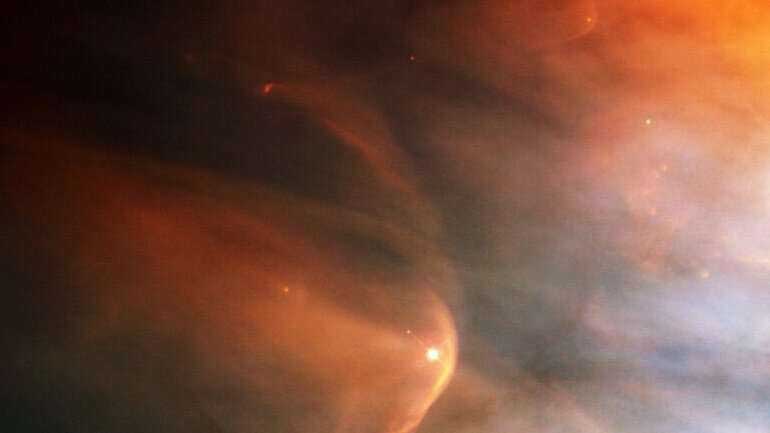
An international research team has for the first time directly detected stellar winds from three sun-like stars by recording the X-ray emission from their astrospheres, and placed constraints on the mass loss rate of the stars via their stellar winds.
So Long Polaris: The Earth Will Get A New North Star. Thousands of years ago Thuban (Age of Aquarius) was our North Pole Star and will be again IFL Science - April 11, 2024
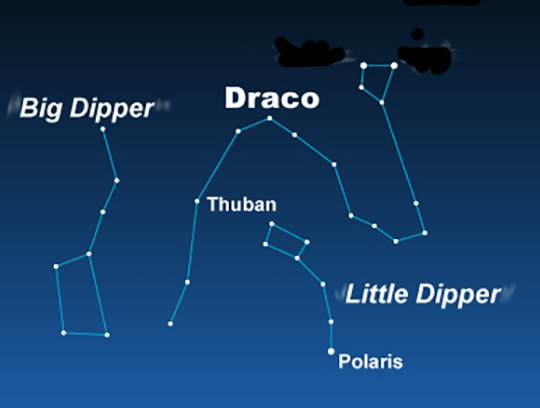
It would seem that in one way or another every ancient civilization was given the means to figure out the movements and precessions of the planets in our solar system. When we think of precession - it takes us to Precession of the Equinoxes and the position of the North Pole Star approximately every 13,000 Earth years.
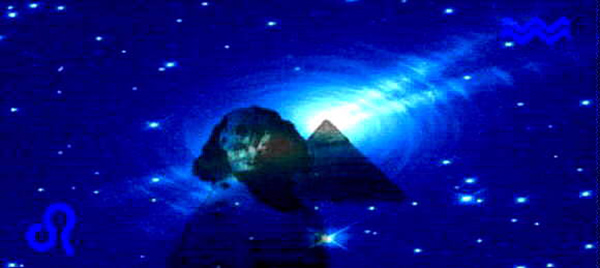
In the Age of Leo 13,000 years ago - many believed the Pyramids and Great Sphinx were built when the North Pole Star was Thuban. As the planets moved, it then became Polaris.
Depending who you ask, we are now full cycle back to the age of Aquarius when the North Pole Star again becomes Thuban - is a binary star system in Draco - historically significant as having been the North Pole Star from the 4th to 2nd millennium BC. (Age of Aquarius).
Draco is the Latin word for serpent or dragon. It is a far northern constellation that is circumpolar - that is, never setting and can be seen all year from northern latitudes - for many northern hemisphere observers. It is one of the 88 modern constellations, and one of the 48 constellations listed by Ptolemy.
Thuban is a binary star system in the constellation Draco and is historically significant as having been the north pole star from the 4th to 2nd millennium BC.

This takes us full circle to ancient symbolism - the Ouroboros, creation myths and storylines in the Simulation of Reality.

"Slaying the Dragon" - The Age of Leo is ending.

Leo - Omega - End of Human Biogenetic Experiment
Astronomers detect unprecedented behavior from nearby magnetar PhysOrg - April 9, 2024
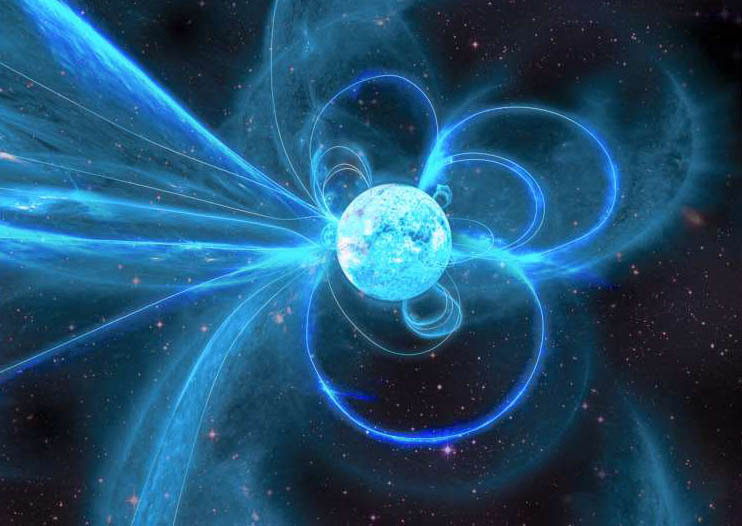
Researchers using Murriyang, CSIRO's Parkes radio telescope, have detected unusual radio pulses from a previously dormant star with a powerful magnetic field.
A wobbling magnetized star challenges the origin of repeating fast radio bursts PhysOrg - April 8, 2024
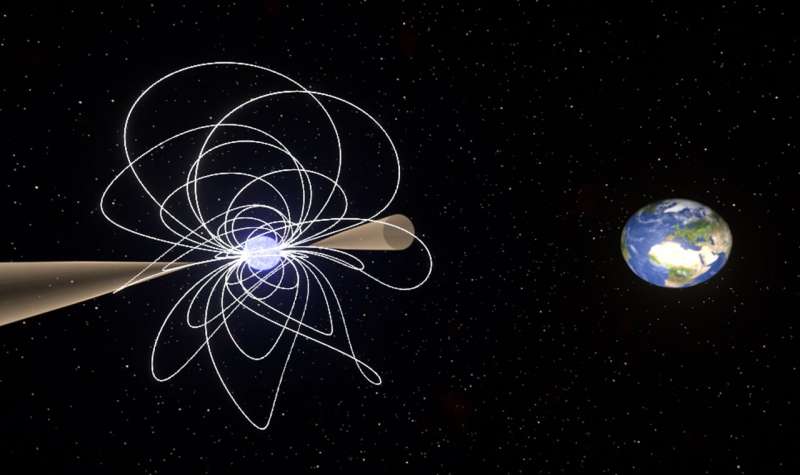
An international research team led by Gregory Desvignes from the Max Planck Institute for Radio Astronomy in Bonn, Germany, has used the Effelsberg and Jodrell Bank radio telescopes to observe the precessing magnetar XTE J1810-197 - a highly magnetized and ultra-dense neutron star - shortly after its X-ray enhanced activity and radio reactivation.
These Ancient Rivers of Stars Have Flowed Since The Milky Way Began Science Alert - March 23, 2024
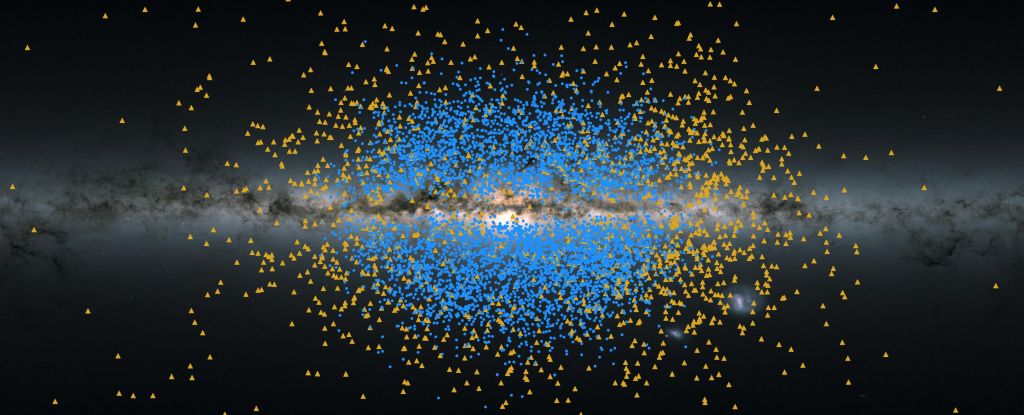
Relics of the Milky Way's birth have just been discovered hiding in plain sight. Towards the center of the galaxy, two streams of stars nearly as old as the Universe have been discovered circling the heart of the Milky Way. A new analysis based on data from the European Space Agency's Gaia telescope strongly suggests that these ancient streams existed before the Milky Way even had its spiral arms Ð when it was just a baby galaxy extending its first tendrils of stars out into the space around it.
'New star' as bright as the North Star will ignite in the sky this year Live Science - March 15, 2024
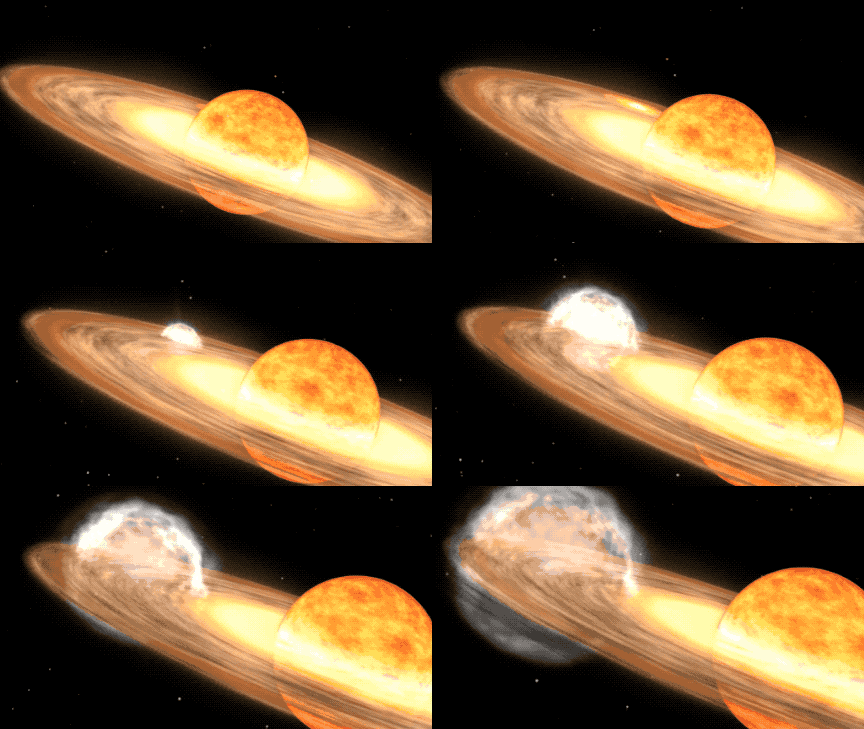
A nova outburst visible to the naked eye is expected to decorate the night sky this year with a "new star" that will briefly become as bright as the North Star, offering a once-in-a-lifetime stargazing opportunity.
Smallest Star Ever Discovered And It's Only A Tiny Bit Bigger Than Earth IFL Science - February 20, 2024
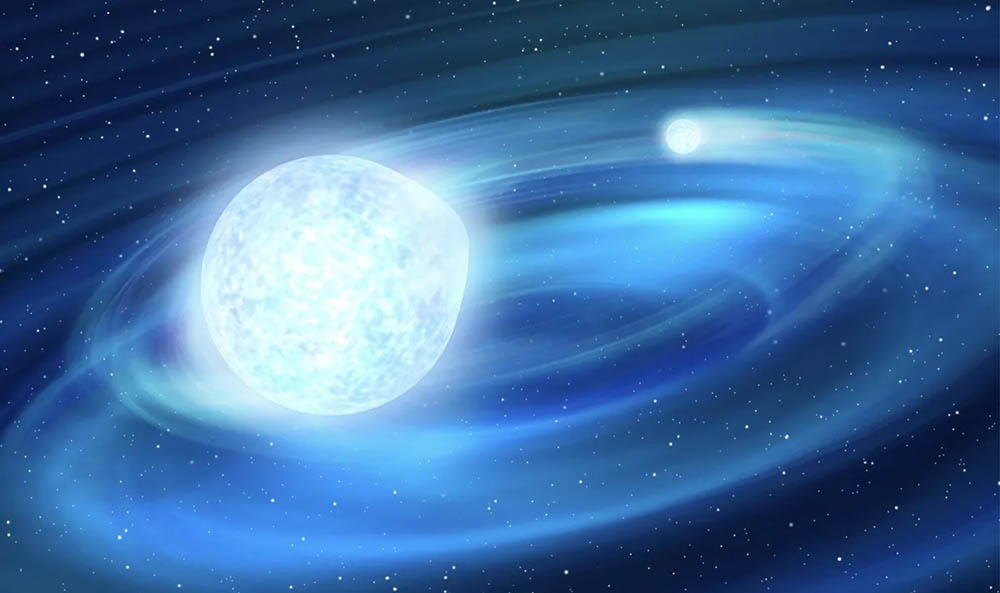
Astronomers have reported an incredible stellar discovery. Actually, they've reported two incredible discoveries: they have found the smallest star ever and it orbits its companion with the smallest known period for binary stars at just 20.5 minutes.
JWST Reveals Young Star Beta Pictoris Has a Surprising Second Disk
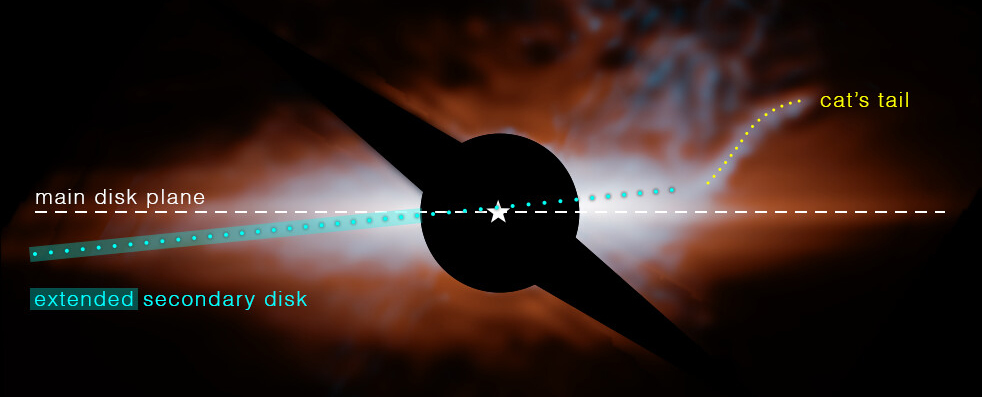
Beta Pictoris has been revealed by many telescopes, even Hubble, to be home to the most amazing disk. Enter James Webb Space Telescope and WALLOP, with its increased sensitivity and instrumentation a new, exciting feature emerges.
Could This Ancient Carved Disk Be The Oldest Ever Map Of The Stars? IFL Science - January 3, 2024
At first glance, this stone recovered from the site of an ancient hillfort in northern Italy appears to be just a simple disk. But, on closer inspection, its surface is peppered with chisel marks that an archaeologist and an astronomer now believe could be the oldest celestial map ever found.
Strange Helium Star Could Become One Of The Universe's Most Powerful Magnets IFL Science - August 18, 2023
The star HD 45166 has puzzled astronomers for a century. Dr Tomer Shenar got so fascinated with its existence that he has spent years trying to explain its nature. In the process, he may have solved an even bigger mystery: the source of the universe's most powerful magnets.
The Most Magnetic Star Ever Seen Could Be The Precursor to a Mysterious Object Science Alert - August 18, 2023
This peculiar beast has one incredibly powerful magnetic field, suggesting that when it finally pops its star clogs it will transform into something known as a magnetar.
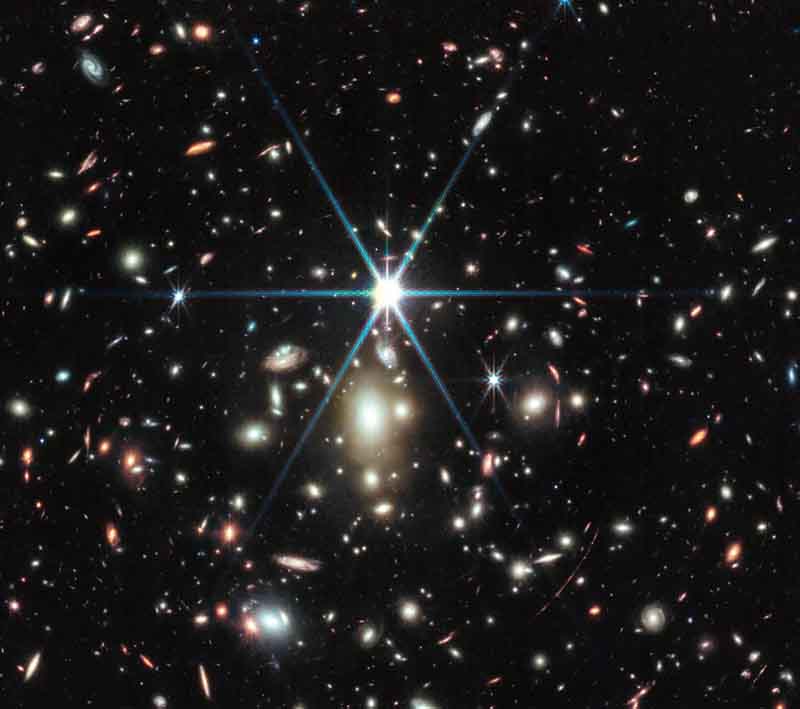
JWST Reveals Color Of The Most Distant Known Star - Bright Blue. Earendel is a type B star. IFL Science - August 9, 2023
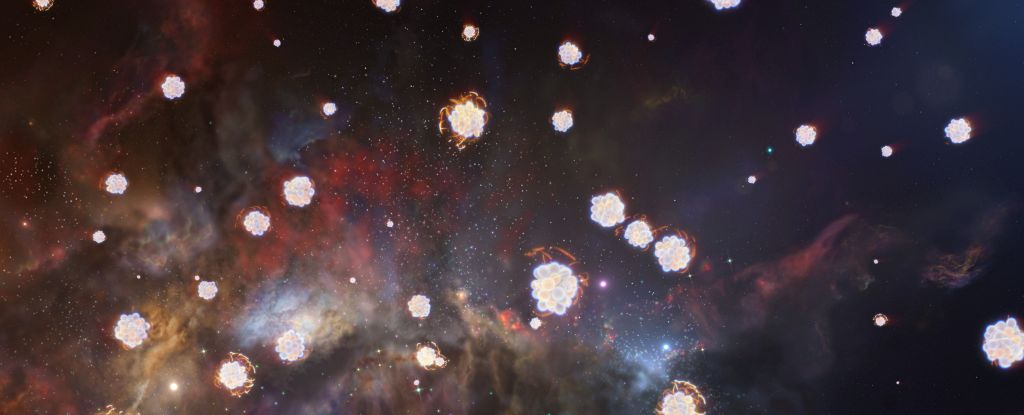
Invisible supernovas called 'bosenovas' may be exploding all around us, new research suggests Live Science - July 27, 2023
What happens when an invisible star dies? It erupts in an invisible explosion, of course. New research describes how these unseen 'bosenovas' may behave.
Strange star system may hold first evidence of an ultra-rare 'dark matter star' Live Science - May 24, 2023
Astronomers long thought that a peculiar star system observed by the European Space Agency's Gaia satellite was a simple case of a star orbiting a black hole. But now, two astronomers are challenging that claim, finding that the evidence suggests something far stranger: possibly, a never-before-seen type of star made of invisible dark matter.
Clouds of gas drifting through the early Universe have given astronomers a glimpse at what remains of the very first stars ever born Science Alert - May 4, 2023
Not the stars themselves; they are long gone, burning hot and fast before exploding in a blaze of supernova glory too distant for our instruments to detect. However, the material they leave behind in those explosions lays bare the products of the atomic fusion that took place in their cores.
Elusive 'Buchdahl Stars' are black holes without event horizons. These hypothetical stars are the densest objects in the universe that can exist without becoming full-fledged black holes Live Science - January 16, 2023
An elusive object in space has posed a riddle for scientists. It looks like a black hole. It acts like a black hole. It may even smell like a black hole. It has one crucial difference: It has no event horizon, meaning that you can escape its gravitational clutches if you try hard enough. But no one has ever observed one, leading to questions about whether the mysterious objects actually exist. Now, a physicist may have uncovered a new property of Buchdahl stars that could help to answer that.
NASA's Hubble finds spiraling stars, providing window into early universe PhysOrg - September 8, 2022
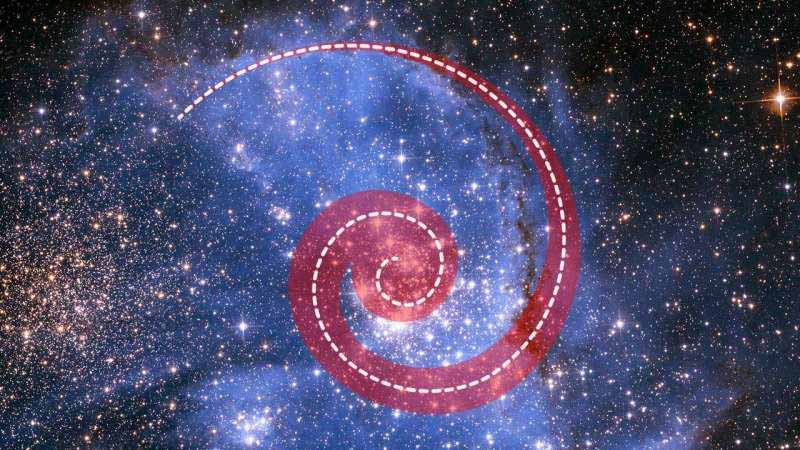
Nature likes spirals - from the whirlpool of a hurricane, to pinwheel-shaped protoplanetary disks around newborn stars, to the vast realms of spiral galaxies across our universe. Now astronomers are bemused to find young stars that are spiraling into the center of a massive cluster of stars in the Small Magellanic Cloud, a satellite galaxy of the Milky Way. The outer arm of the spiral in this huge, oddly shaped stellar nursery called NGC 346 may be feeding star formation in a river-like motion of gas and stars. This is an efficient way to fuel star birth, researchers say.
Star twinkles 18 times to form hexagonal pattern in new James Webb telescope image Science Alert - February 18, 2022
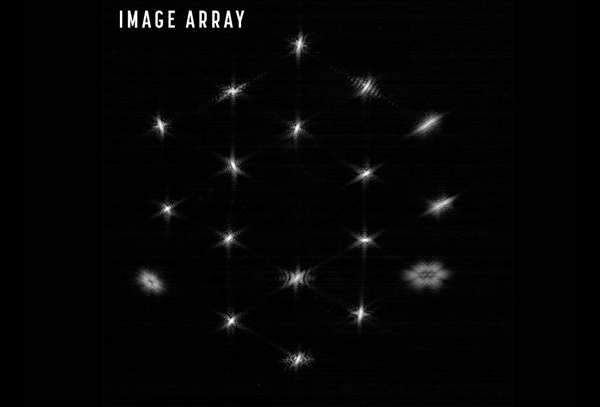
The James Webb Space Telescope finished the first major stage in its long process of aligning the observatory's 18-segmented primary mirror. A single star that the observatory looked at was deliberately rendered 18 times into a hexagonal shape. Eventually, those 18 images will perfectly align into a single, sharp focus, but the interim result portrays a star repeated perfectly in a hexagonal pattern reminiscent of a stunning celestial snowflake. The resulting image shows that the team has moved each of Webb's 18 primary mirror segments to bring 18 unfocused copies of a single star into a planned hexagonal formation.
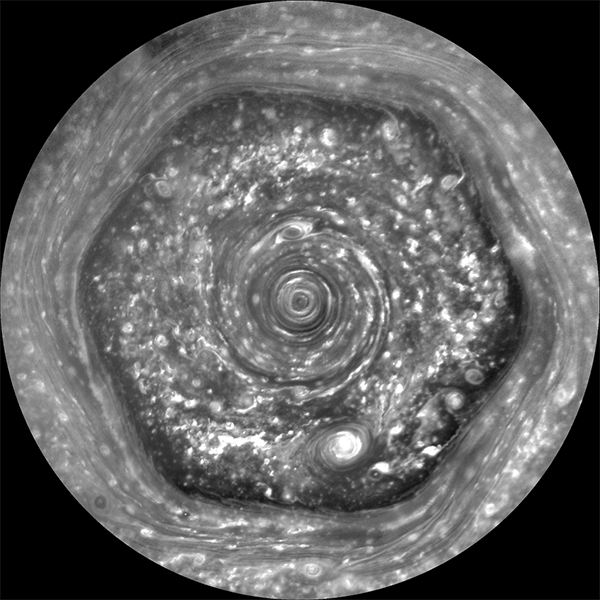
Also forming a hexagon in space is a cloud pattern around the north pole of the planet Saturn.
A 'monster' star 2 million times brighter than the sun disappears without a trace - where did it go? Live Science - June 30, 2020
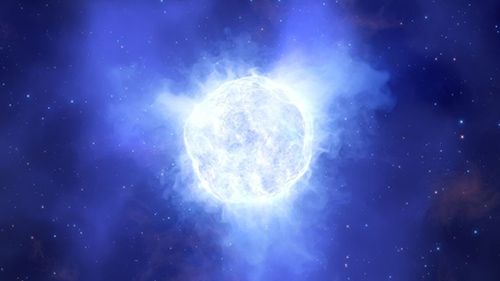
In 2019, scientists witnessed a massive star 2.5 million times brighter than the sun disappear without a trace. Now, in a new paper published today (June 30) in the journal Monthly Notices of the Royal Astronomical Society, a team of space detectives attempt to solve the case of the disappearing star by providing several possible explanations. Of these, one twist ending stands out: Perhaps, the researchers wrote, the massive star died and collapsed into a black hole without undergoing a supernova explosion first - a truly "unprecedented" act of stellar suicide.
Researchers reveal the story of the oldest stars and galaxies, compiled from 20 years of simulating the early universe PhysOrg - October 17, 2018
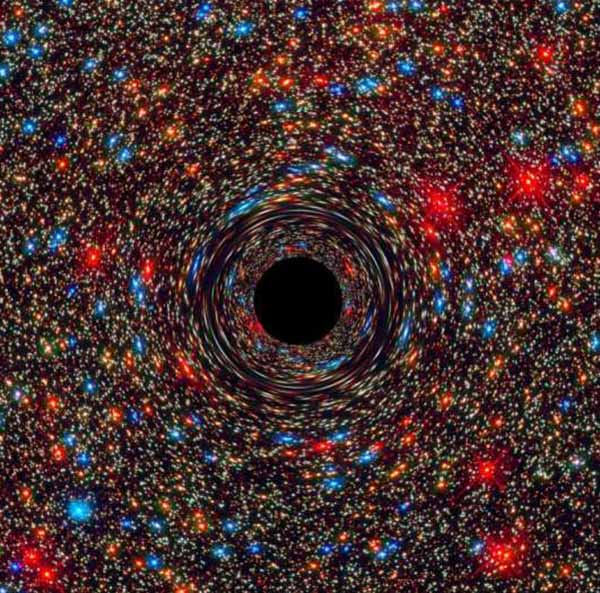
The Big Bang has captured our imagination like no other theory in science: the magnificent, explosive birth of our Universe. But do you know what came next? Code was created which allowed formation of the first stars in the universe to be modeled. These equations describe the movement and chemical reactions inside gas clouds in a universe before light, and the immense gravitational pull of a much larger but invisible mass of mysterious dark matter.
Spots on supergiant star drive spirals in stellar wind PhysOrg - October 24, 2017
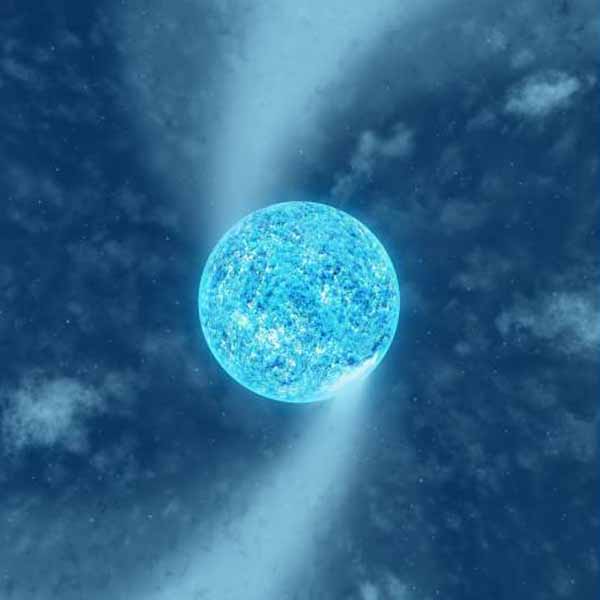
Massive stars are responsible for producing the heavy elements that make up all life on Earth. At the end of their lives they scatter the material into interstellar space in catastrophic explosions called supernovae - without these dramatic events, our solar system would never have formed. Zeta Puppis is an evolved massive star known as a 'supergiant'. It is about sixty times more massive than our sun, and seven times hotter at the surface. Massive stars are rare, and usually found in pairs called 'binary systems' or small groups known as 'multiple systems'. Zeta Puppis is special however, because it is a single massive star, moving through space alone, at a velocity of about 60 kilometers per second. "Imagine an object about sixty times the mass of the Sun, traveling about sixty times faster than a speeding bullet!" the investigators say.
Stellar 'Circle of Life' Captured in New NASA Photo Live Science - December 2, 2016
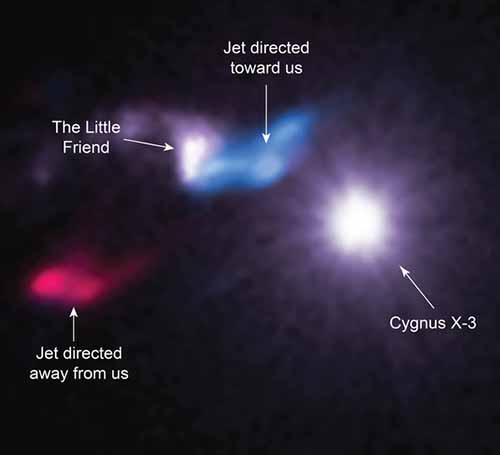
The life cycle of stars comes full circle in a new photo taken by NASA's Chandra X-ray Observatory and the Smithsonian's Submillimeter Array (SMA), which may reveal new clues for studying star evolution. The photo captures a large cloud called Cygnus X-3 and another smaller cloud, nicknamed the "Little Friend." Cygnus X-3 contains a massive, short-lived star that is slowly being eaten by a companion black hole or neutron star and, as a result, produces bright, powerful X-rays. The Little Friend, on the other hand, is a dense cloud of gas and dust that gives birth to new stars called a Bok globule. Take a video tour of the "Little Friend".
Scientists discover brightest early galaxy and likely first generation stars PhysOrg - June 17, 2015
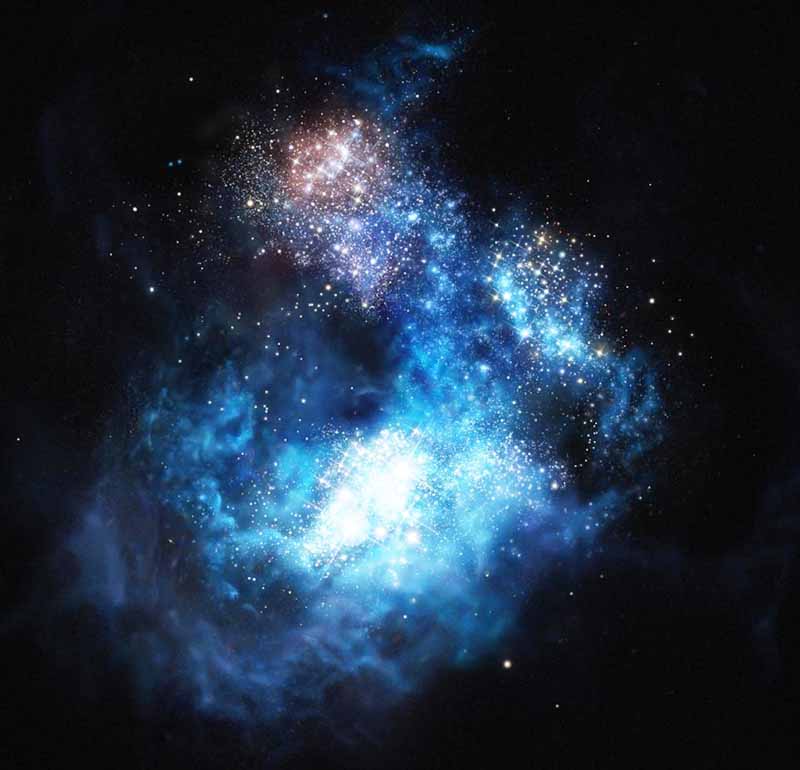
Astronomers using several of the largest telescopes on Earth and space have discovered the brightest galaxy yet found in the early Universe and have strong evidence that examples of the first generation of stars lurk within it. Astronomers have long theorized the existence of a first generation of stars known as Population III stars that were born out of the primordial material from the Big Bang. All the heavier chemical elements essential to life - including oxygen, nitrogen, carbon and iron - were forged in the bellies of stars. This means the first stars must have formed out of the only elements to exist prior to stars: hydrogen, helium and trace amounts of lithium.
Closest known flyby of star to our solar system: Dim star passed through Oort Cloud 70,000 years ago Science Daily - February 17, 2015
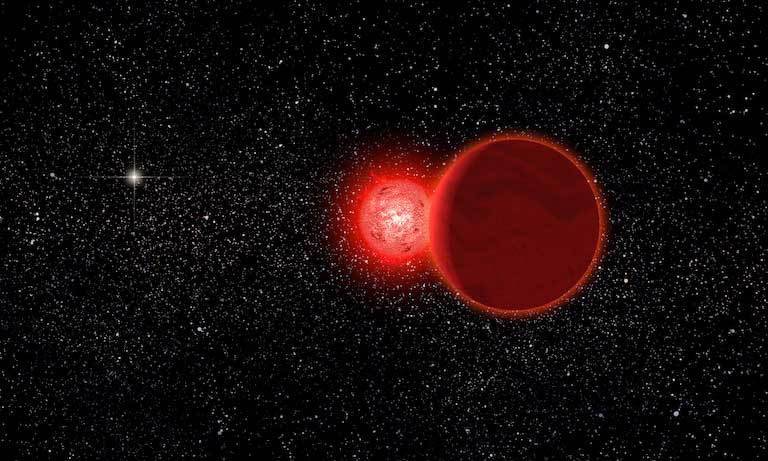
Astronomers from the US, Europe, Chile and South Africa have determined that 70,000 years ago a recently discovered dim star is likely to have passed through the solar system's distant cloud of comets, the Oort Cloud. No other star is known to have ever approached our solar system this close - five times closer than the current closest star, Proxima Centauri. They analyzed the velocity and trajectory of a low-mass star system nicknamed "Scholz's star."
Researchers find evidence of fractal behavior in pulsating stars PhysOrg - February 4, 2015
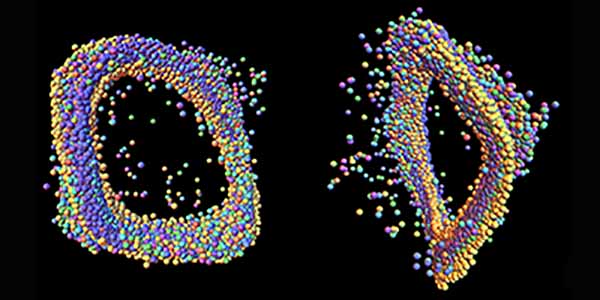
A team of researchers working at the University of Hawaii using data from the Kepler space telescope, has found that the oscillations made by a star conform closely to the golden mean further study showed that it also behaves in a fractal pattern. In studying the Kepler data, the team was able to track the pulses that emanated from the star over a period of four years taken at 30 minute intervals. They found that two of star KIC 5520878's pulsating frequencies occurred at 4.05 and a 6.41 hour cycles - which the team noted had a ratio of 1.58, which is close to 1.618, aka the Golden Ratio -famously found in nature and sometimes artistic renderings. Intrigued, they looked deeper and found that the frequencies conformed to fractal patterns separating the oscillations into their constituent parts revealed additional weaker frequencies, similar to the way, the team points out, that images of shorelines display craggy lines regardless of how close or far away they are viewed from.
Planck telescope puts new datestamp on first stars BBC - February 5, 2015
The first stars in the Universe lit up later than was previously thought. That is the conclusion of scientists working on Europe's Planck satellite, which has made the most precise map of the "oldest light" in the cosmos. Earlier observations of this radiation had suggested that the first generation of stars burst into life about 420 million years after the Big Bang. The new Planck data now indicates they fired up around 560 million years after the Universe got going.
The oldest star in the universe? Maybe, maybe not PhysOrg - February 14, 2014
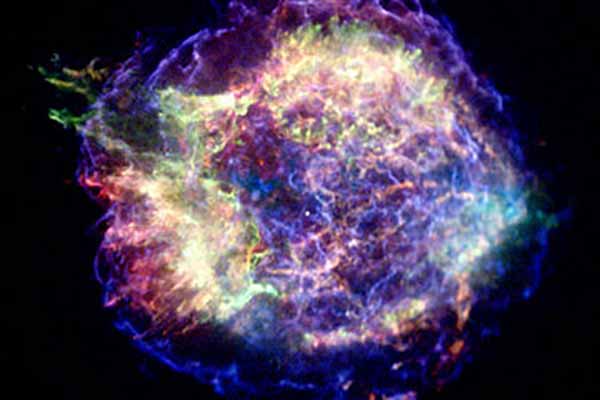
This week, the international media has trumpeted the discovery by Australian scientists of the oldest star in the universe, with the catchy name SMSS J031300.36-670839.3, formed in the almost pristine gas soon after the Big Bang. This would mean the star has been slowly burning away for almost 13.7 billion years. But this story may leave those that follow the scientific media scratching their heads slightly, as only six months ago the media telling us about HD 140283, the Methuselah Star, whose best-estimated age is almost 14.5 billion years. This formally makes HD 140283 older than the universe itself, but the uncertainty in the age, by about 800,000 years, could bring it back into line with our cosmological measurements for the universe's age.
First Black Hole Orbiting a 'Spinning' Star Science Daily - January 16, 2014
Scientists have discovered the first binary system ever known to consist of a black hole and a 'spinning' star - or more accurately, a Be-type star. Although predicted by theory, none had previously been found. Be-type stars are quite common across the Universe. In our Galaxy alone more than 80 of them are known in binary systems together with neutron stars. 'Their distinctive property is their strong centrifugal force: they rotate very fast, close to their break-up speed. It's like they were cosmic spinning tops.
Mystery Alignment of Dying Stars Puzzles Scientists Live Science - September 5, 2013
Dying stars that are among the most beautiful objects in the universe tend to line up across the night sky, and astronomers aren't sure why. These "cosmic butterflies" - actually a certain type of planetary nebula - all have their own formation histories, and they don't interact with each other. But something is apparently making them dance in step