Architecture in Ancient Rome
Baths - Thermae, Baths of - Caracalla, Diocletian, Trajan
Circus, Circus Maximus, Hippodrome
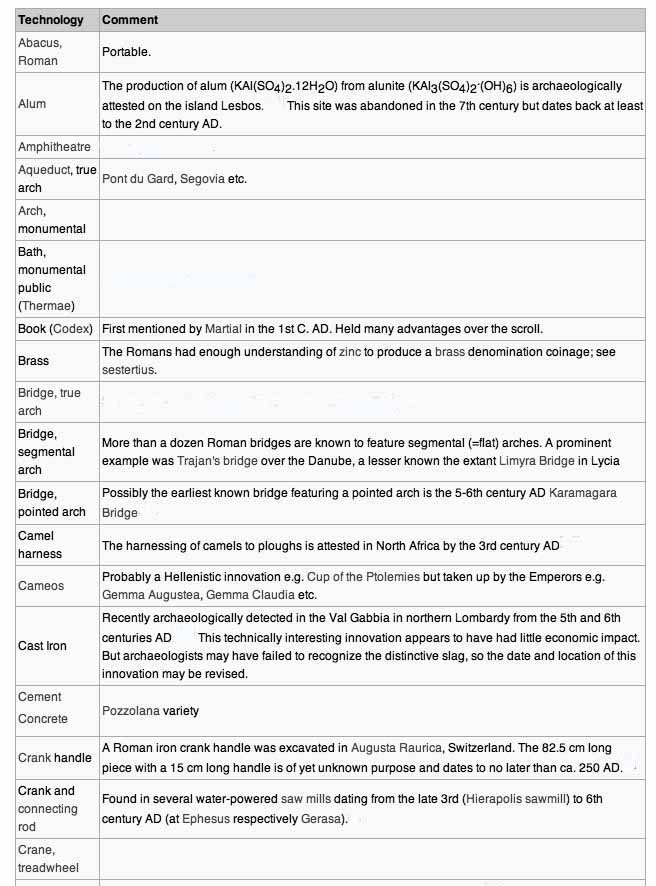
Ancient Rome boasted impressive technological feats, using many advancements that were lost in the Middle Ages and not rivaled again until the 19th and 20th centuries. An example of this is Insulated glazing, which wasn't invented again until the 1930s. Many practical Roman innovations were adopted from earlier Greek designs. Advancements were often divided and based on craft. Artisans guarded technologies as trade secrets.
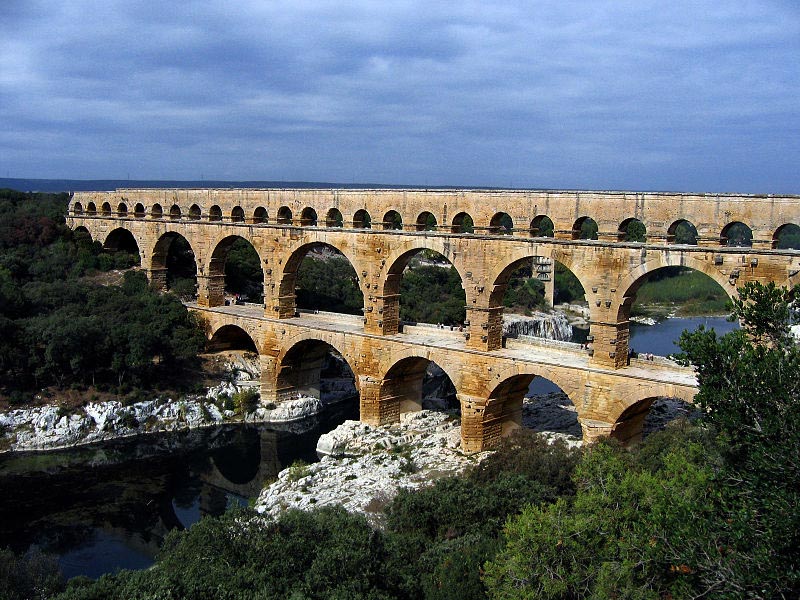
Roman civil engineering and military engineering constituted a large part of Rome's technological superiority and legacy, and contributed to the construction of hundreds of roads, bridges, aqueducts, baths, theaters and arenas. Many monuments, such as the Colosseum, Pont du Gard, and Pantheon, remain as testaments to Roman engineering and culture.
The Romans were renowned for their architecture, which is grouped with Greek traditions into "Classical architecture". Although there were many differences from Greek architecture, Rome borrowed heavily from Greece in adhering to strict, formulaic building designs and proportions. Aside from two new orders of columns, composite and Tuscan, and from the dome, which was derived from the Etruscan arch, Rome had relatively few architectural innovations until the end of the Republic.
In the 1st century BC, Romans started to use concrete, widely. Concrete was invented in the late 3rd century BC. It was a powerful cement derived from pozzolana, and soon supplanted marble as the chief Roman building material and allowed many daring architectural schemata.
Also in the 1st century BC, Vitruvius wrote De architectura, possibly the first complete treatise on architecture in history. In late 1st century BC, Rome also began to use glassblowing soon after its invention in Syria about 50 BC. Mosaics took the Empire by storm after samples were retrieved during Lucius Cornelius Sulla's campaigns in Greece.
Concrete made possible the paved, durable Roman roads, many of which were still in use a thousand years after the fall of Rome. The construction of a vast and efficient travel network throughout the Empire dramatically increased Rome's power and influence. It was originally constructed to allow Roman legions to be rapidly deployed. But these highways also had enormous economic significance, solidifying Rome's role as a trading crossroads - the origin of the saying "all roads lead to Rome". The Roman government maintained way stations that provided refreshments to travelers at regular intervals along the roads, constructed bridges where necessary, and established a system of horse relays for couriers that allowed a dispatch to travel up to 800 kilometers (500 mi) in 24 hours.
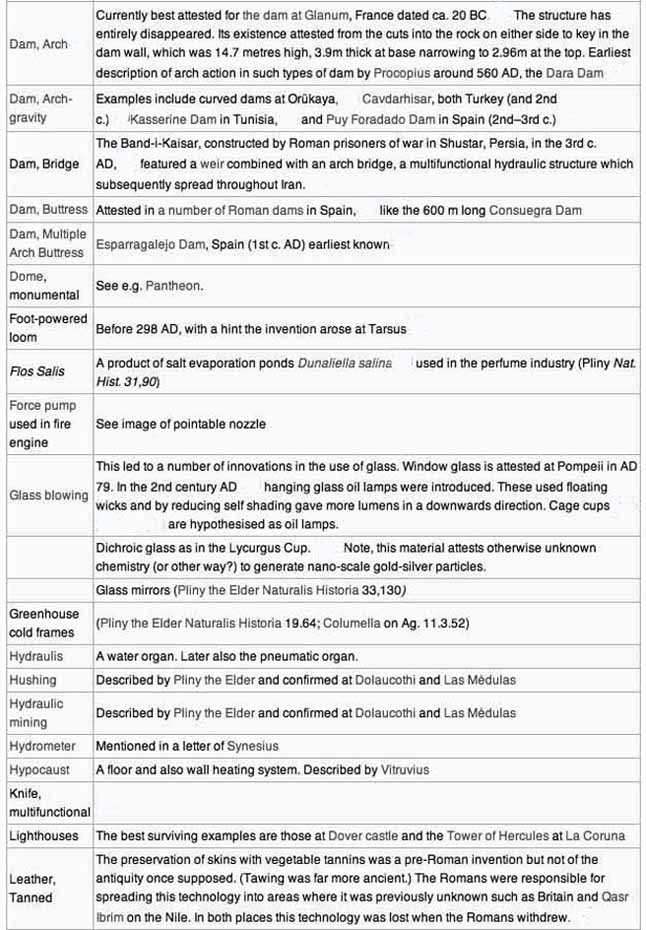
The Romans constructed numerous aqueducts to supply water to cities and industrial sites and to aid in their agriculture. The city of Rome was supplied by 11 aqueducts with a combined length of 350 kilometres (220 mi). Most aqueducts were constructed below the surface, with only small portions above ground supported by arches. Sometimes, where valleys deeper than 50 metres (165 ft) had to be crossed, inverted siphons were used to convey water across a valley.
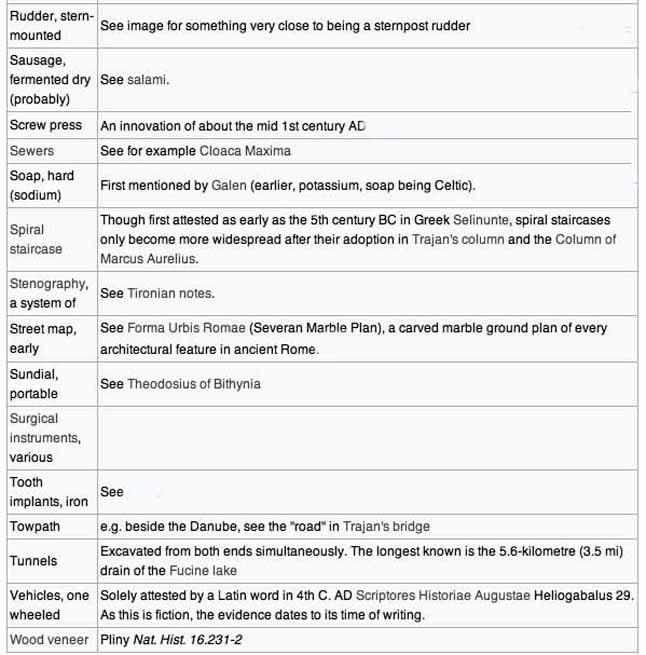
The Romans also made major advancements in sanitation. Romans were particularly famous for their public baths, called thermae, which were used for both hygienic and social purposes. Many Roman houses came to have flush toilets and indoor plumbing, and a complex sewer system, the Cloaca Maxima, was used to drain the local marshes and carry waste into the Tiber river.
Some historians have speculated that lead pipes in the sewer and plumbing systems led to widespread lead poisoning, which contributed to the decline in birth rate and general decay of Roman society leading up to the fall of Rome. However, lead content would have been minimized because the flow of water from aqueducts could not be shut off; it ran continuously through public and private outlets into the drains, and only a few taps were in use. Other authors have raised similar objections to this theory, also pointing out that Roman water pipes were thickly coated with deposits that would have prevented lead from leaching into the water.
7 Roman inventions: Incredible feats of ancient technology Live Science - February 9, 2022
The Romans were masters of early environmental engineering, for example using water and their knowledge of physics to produce energy for mills, according to the journal Nature. Meanwhile, down on the farm, they were able to maximize their crop yields By using crop rotations and the 'food, feed, fallow' system, according to the journal Agronomic Crops. Splitting farms into these three allotments ensured there were always crops ready to pick.
Archaeologists uncover rare 2,000-year-old sundial during Roman theatre excavation PhysOrg - November 8, 2017
A 2,000-year-old intact and inscribed sundial - one of only a handful known to have survived - has been recovered during the excavation of a roofed theatre in the Roman town of Interamna Lirenas, near Monte Cassino, in Italy. Not only has the sundial survived largely undamaged for more than two millennia, but the presence of two Latin texts means researchers from the University of Cambridge have been able to glean precise information about the man who commissioned it.
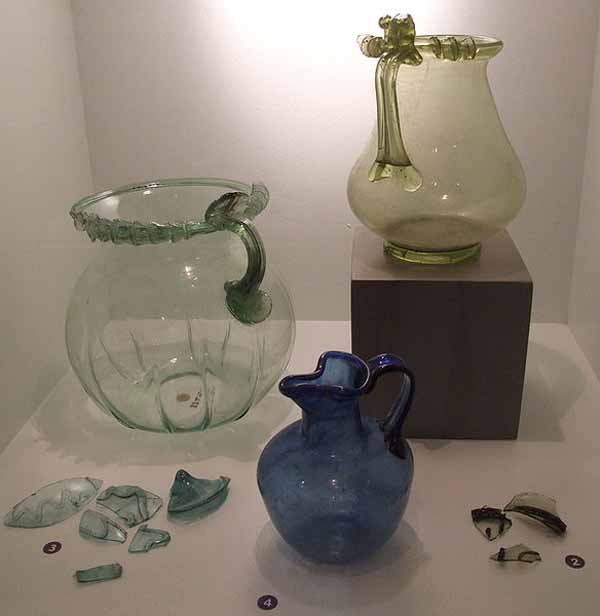
Glass from Pompeii
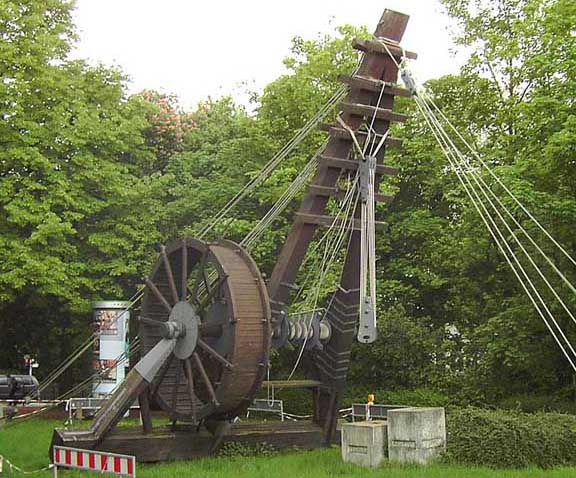
There were many types of presses to press olives. In the 1st century, Pliny the Elder reported the invention and subsequent general use of the new and more compact screw presses. However, the screw press was almost certainly not a Roman invention. It was first described by Hero of Alexandria, but may have already been in use when he mentioned it in his Mechanica III.
Cranes were used for construction work and possibly to load and unload ships at their ports, although for the latter use there is according to the Òpresent state of knowledgeÓ still no evidence. Most cranes were capable of lifting about 6-7 tons of cargo, and according to a relief shown on Trajan's column were worked by treadwheel.
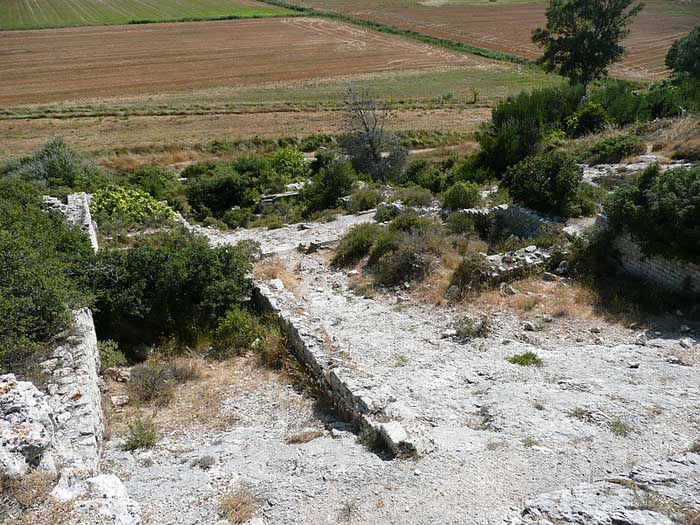
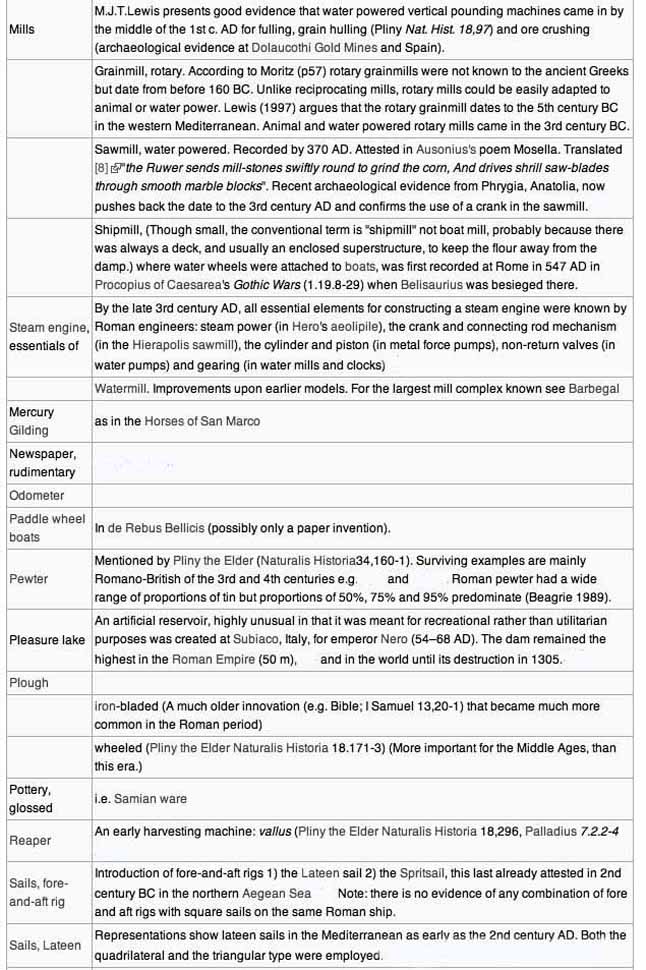
The sixteen overshot wheels at Barbegal are considered the biggest ancient mill complex.
Their capacity was sufficient to feed the whole nearby city of Arles.
Ancient Romans used water power - watermills being common throughout the Empire, especially to the end of the first century AD. They were used for corn milling, sawing timber and crushing ore. They exploited wood and coal for heating. There were huge reserves of wood, peat and coal in the Roman Empire, but they were all in the wrong place. Wood could be floated down rivers to the major urban centres but otherwise it was a very poor fuel, being heavy for its calorific value. If this was improved by being processed into charcoal, it was bulky. Nor was wood ever available in any concentration. Diocletian's Price Edict can give us a glimpse of the economics of transporting wood. The maximum price of a wagon load of 1,200 lbs of wood was 150 d.(denari).
The maximum freight charge per mile for the same wagon load was 20 d. per mile. Room heating was normally better done by charcoal braziers than hypocausts. But hypocausts did allow them to exploit any poor-quality smoky fuels like straw, vine prunings and small wood locally available. Hypocausts also allowed them to generate a humid heat for their baths.
The Romans worked almost all the coalfields of England that outcropped on the surface, by the end of the 2nd century (Smith 1997; 323). But there is no evidence that this exploitation was on any scale. After c.200 AD the commercial heart of the Empire was in Africa and the East where the climate severely limited timber growth. There was no large coalfield on the edge of the Mediterranean. Nevertheless, the Romans were the first culture to assemble all essential components of the much later steam engine.
With the crank and connecting rod system, all elements for constructing a steam engine (invented in 1712) - Hero's aeolipile (generating steam power), the cylinder and piston (in metal force pumps), non-return valves (in water pumps), gearing (in water mills and clocks) - were known in Roman times. However, the aeolipile was a reaction engine, inefficient as a stationary engine. The first useful steam engine did not use steam pressure at all, but followed up a scientific advance in understanding air pressure.
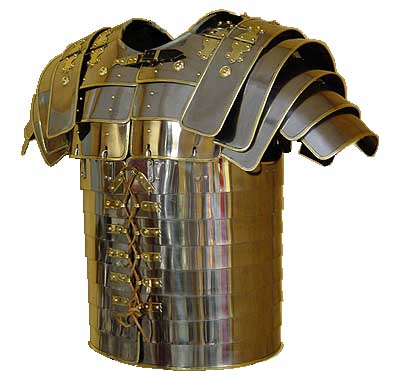
The Roman military technology ranged from personal equipment and armament to deadly siege engines. They inherited almost all ancient weapons.
While heavy, intricate armor was not uncommon (cataphracts), the Romans perfected a relatively light, full torso armor made of segmented plates (lorica segmentata). This segmented armor provided good protection for vital areas, but did not cover as much of the body as lorica hamata or chainmail. The lorica segmentata provided better protection, but the plate bands were expensive and difficult to produce and difficult to repair in the field. Overall, chainmail was cheaper, easier to produce, cheaper and simpler to maintain, was one-size fits all, and was more comfortable to wear - thus, it remained the primary form of armor even when lorica segmentata was in use.

The Roman cavalry saddle had four horns and was
believed to have been copied from Celtic peoples.
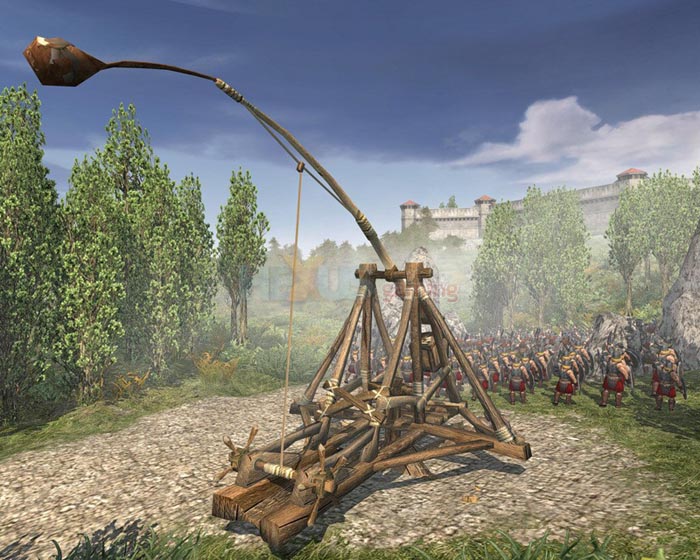
Roman siege engines such as ballistas, scorpions and onagers were not unique. But the Romans were probably the first people to put ballistas on carts for better mobility on campaigns. On the battlefield, it is thought that they were used to pick off enemy leaders.
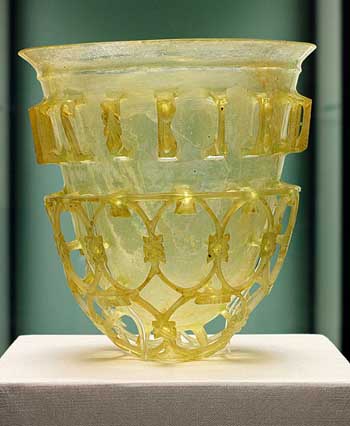
Roman Cage Cup from the 4th century AD. Hypothesized as a
loating wick oil lamp to give magical downwards lighting effects.
Roman technology was largely based on a system of crafts, although the term engineering is used today to describe the technical feats of the Romans. The Greek words used were mechanic or machine-maker or even mathematician which had a much wider meaning than now. There were a large number of engineers employed by the army. The most famous engineer of this period was Apollodorus of Damascus.
Normally each trade, each group of artisans - stonemasons, glass blowers, surveyors, etc. - within a project had its own practice of masters and apprentices, and many tried to keep their trade secrets, passing them on solely by word of mouth, a system still in use today by those who do not want to patent their inventions.
Writers such as Vitruvius, Pliny the Elder and Frontinus published widely on many different technologies, and there was a corpus of manuals on basic mathematics and science such as the many books by Archimedes, Ctesibius, Heron (a.k.a. Hero of Alexandria), Euclid and so on. Not all of the manuals which were available to the Romans have survived, as lost works illustrate.
Much of what is known of Roman technology comes indirectly from archaeology and from the third-hand accounts of Latin texts copied from Arabic texts, which were in turn copied from the Greek texts of scholars such as Hero of Alexandria or contemporary travelers who had observed Roman technologies in action.
Writers like Pliny the Elder and Strabo had enough intellectual curiosity to make note of the inventions they saw during their travels, although their typically brief descriptions often arouse discussion as to their precise meaning. On the other hand, Pliny is perfectly clear when describing gold mining, his text in book XXXIII having been confirmed by archaeology and field-work at such sites as Las Medulas and Dolaucothi.
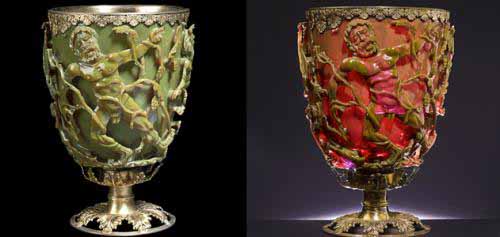
Goblet tricks suggests ancient Romans were first to use nanotechnology PhysOrg - August 27, 2013
Recent evidence suggests that the Roman craftsmen who created the Lycurgus Cup, a glass drinking goblet, used nanotechnology to cause the goblet to change color under different lighting. The cup's unique properties were first noted when it was brought to a museum in the 1950s - it wasn't until 1990, however, that researchers figured out how the color changers were brought about.
The goblet was created approximately 1,600 years ago, using a process whereby very tiny gold and silver particles were embedded in the glass. In normal lighting, the glass appears to have a jade background. When lit from behind, however, the green parts suddenly look ruby red. This is all courtesy of the way electrons vibrate when struck by photons - something the Romans could not have known. Yet, because other goblet pieces have been found with the very same mixture, it's clear they knew they were on to something. They actually used the color changing effects to create stories. The Lycurgus Cup, for example, depicts the story of King Lycurgus as he is caught up in a tangle of grapevines - penance for treachery committed against Dionysus, the god of wine in Greek mythology.