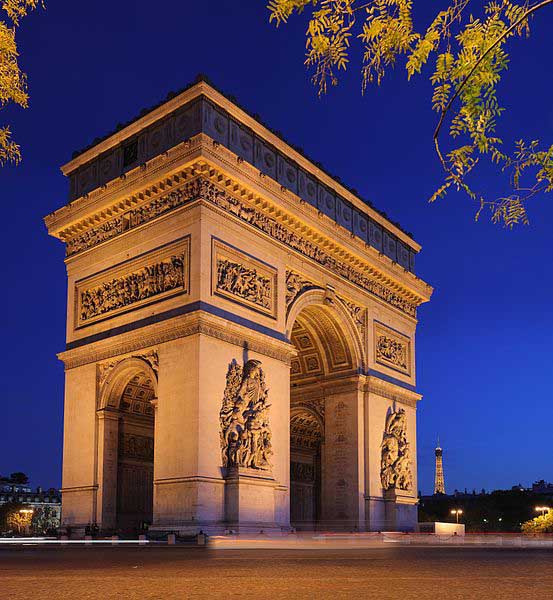
The Arc de Triomphe, Paris
The Arc de Triomphe, Paris
A triumphal arch is a monumental structure in the shape of an archway with one or more arched passageways, often designed to span a road. In its simplest form a triumphal arch consists of two massive piers connected by an arch, crowned with a flat entablature or attic on which a statue might be mounted or which bears commemorative inscriptions. The main structure is often decorated with carvings, sculpted reliefs and dedications. More elaborate triumphal arches may have multiple archways.
Triumphal arches are one of the most influential and distinctive types of architecture associated with ancient Rome. Thought to have been invented by the Romans, the triumphal arch was used to commemorate victorious generals or significant public events such as the founding of new colonies, the construction of a road or bridge, the death of a member of the imperial family or the accession of a new emperor.
The survival of great Roman triumphal arches such as the Arch of Titus inspired many post-Roman states and rulers, up to the present day, to erect their own arches in emulation of the Romans. Arches in the Roman style have been built in many cities around the world, most notably the Arc de Triomphe in Paris, the Siegestor in Munich and the Wellington Arch in London.
The origins of the Roman triumphal arch are unclear. Monumental gateways had already been in use for thousands of years by civilizations such as the Hittites, Assyrians, Babylonians and Myceneans. There were precursors to the triumphal arch within the Roman world; in Italy, the Etruscans used elaborately decorated single bay arches as gates or portals to their cities. Surviving examples of Etruscan arches can still be seen at Perugia and Volterra. The two key elements of the triumphal arch - a round-topped arch and a square entablature - had long been in use as separate architectural elements in ancient Greece.
The Greeks made comparatively little use of the arch, confining it to purposes such as structures such as tombs and sewers that were under external pressure, but made extensive use of entablatures in their temples. Entablatures were an essential part of the structural fabric of such buildings, as they were used to hold up the roofs. The great innovation of the Romans was to combine a round arch and a square entablature in a single free-standing structure. The columns became purely decorative elements on the outer face of arch, while the entablature, liberated from its role as a building support, became the frame for the civic and religious messages that the arch builders wished to convey.
The first recorded Roman triumphal arches were set up in the time of the Roman Republic. Generals who were granted a triumph were termed triumphators and would erect fornices or honorific arches bearing statues to commemorate their victories. A number of fornices were built in Rome during the Republican era. Lucius Steritinus erected two in 196 BC to commemorate his victories in Hispania. Another fornix was built on the Capitoline Hill by Scipio Africanus in 190 BC, and Quintus Fabius Allobrogicus constructed one in the Roman Forum in 121 BC. None of them survive today and little is known about their appearance.
Roman triumphal practices changed significantly at the start of the imperial period when the first Roman Emperor Augustus decreed that only emperors would be granted triumphs. The term fornix abruptly ceased to be used and was replaced by arcus, from which the English word "arch" is derived. Whereas Republican fornices were put up at the initiative and expense of the triumphator, without needing or requesting permission, imperial triumphal arches were erected for the triumphator by decree of the senate. The triumphal arch changed from being a personal monument to being an essentially propagandistic one, serving to announce and promote the presence of the ruler and the laws of the state. Arches were not necessarily built as entrances, but - unlike many modern triumphal arches - they were often erected across roads and were intended to be passed through, not round.
Most Roman triumphal arches were built during the imperial period. By the fourth century AD there were 36 such arches in Rome, of which three have survived - the Arch of Titus (AD 81), the Arch of Septimius Severus (203-205) and the Arch of Constantine (312). Numerous arches were built elsewhere in the Roman Empire. The single arch was the most common, but many triple arches were also built, of which the Triumphal Arch of Orange (circa AD 21) is the earliest surviving example. From the 2nd century AD, many examples of the arcus quadrifrons Ð a square triumphal arch erected over a crossroads, with arched openings on all four sides - were built, especially in North Africa. Arch-building in Rome and Italy diminished after the time of Trajan (AD 98-117) but remained widespread in the provinces during the 2nd and 3rd centuries AD; they were often erected to commemorate imperial visits.
Little is known about how the Romans viewed triumphal arches. Pliny the Elder, writing in the first century AD, was the only ancient author to discuss them. He wrote that they were intended to "elevate above the ordinary world" an image of an honored person usually depicted in the form of a statue with a quadriga. However, the designs of Roman imperial triumphal arches Ð which became increasingly elaborate over time and evolved a regularized set of features Ð were clearly intended to convey a number of messages to the spectator.
The ornamentation of an arch was intended to serve as a constant visual reminder of the triumph and triumphator. As such, it concentrated on factual imagery rather than allegory. The fa�ade was ornamented with marble columns, and the piers and attics with decorative cornices. Sculpted panels depicted victories and achievements, the deeds of the triumphator, the captured weapons of the enemy or the triumphal procession itself. The spandrels usually depicted flying Victories, while the attic was often inscribed with a dedicatory inscription naming and praising the triumphator. The piers and internal passageways were also decorated with reliefs and free-standing sculptures. The vault was ornamented with coffers.
Some triumphal arches were surmounted by a statue or a currus triumphalis, a group of statues depicting the emperor or general in a quadriga. The inscriptions on Roman triumphal arches were works of art in themselves, with very finely cut, sometimes gilded letters. The form of each letter and the spacing between them was carefully designed for maximum clarity and simplicity, without any decorative flourishes, emphasizing the Roman taste for restraint and order. This conception of what later became the art of typography remains of fundamental importance down to the present day.
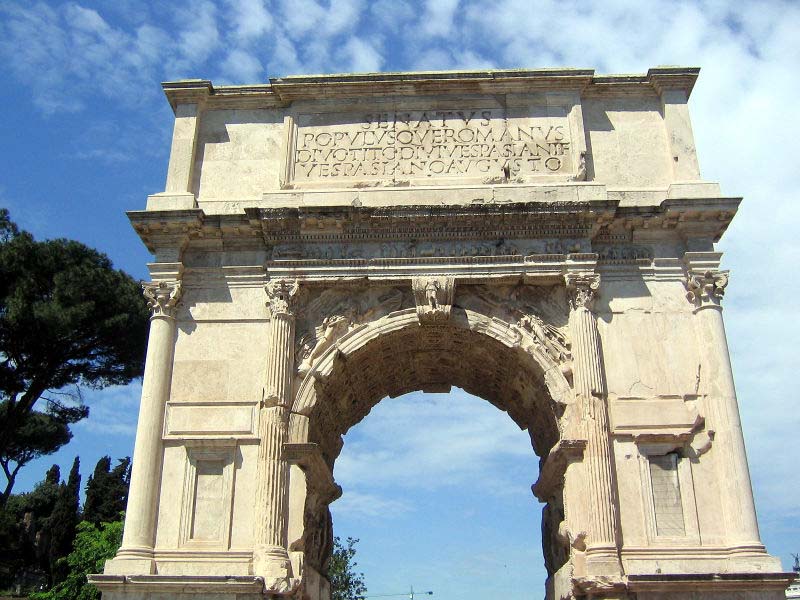
The Arch of Titus is a triumphal arch with a single arched opening, located on the Via Sacra just to the south-east of the Forum in Rome. It was constructed shortly after the death of the emperor Titus (born AD 41, emperor 79-81).
The arch commemorates Titus' capture and sack of Jerusalem in 70, which effectively terminated the Jewish War which had begun in 66 (the Romans did not achieve complete victory until the fall of Masada in 73).
The Arch of Titus is in three bays with an ABA rhythm, articulated with a massive order of attached columns that stand on a high ashlar basement. The capitals are Corinthian, but with prominent volutes of the Ionic order scrolling out above the acanthus foliage, the earliest example of the Composite order. Above the main cornice rises a high weighty attic on which is a central tablet bearing the dedicatory inscription.
The entablatures break forward over the columns and in the wide central bay. Flanking the central arch, the side bays now each contain a shallow niche like a blind pedicular window, a discreet early 19th century restoration. The soffit of the archway is deeply coffered with a relief of the apotheosis of Titus at the center. The sculptural program also includes two panel reliefs that line the passageway. Both commemorate the joint triumph celebrated by Titus and his father Vespasian in the summer of 71.
One of the panels depicts the spoils taken from the Temple, while the other depicts Titus as triumphator attended by various genii and lictors. The soffit of the arch depicts the apotheosis of Titus.
The sculpture of the outer faces of the two great piers was lost when the Arch of Titus was incorporated in medieval defensive walling. The attic of the arch was originally crowned by more statuary, perhaps of a quadriga pulled by elephants.Based on the style of sculptural details, Domitian's favored architect Rabirius, sometimes credited with the Colosseum, may have executed the arch. Without contemporary documentation, however, attributions of Roman buildings on basis of style are considered shaky.
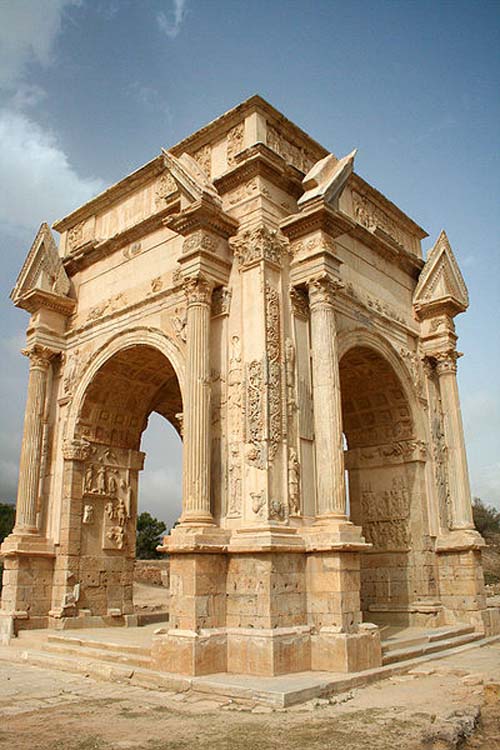
The Arch of Septimius Severus at Leptis Magna, a four-arched arcus quadrifrons
The white marble Arch of Septimius Severus at the northeast end of the Roman Forum is a triumphal arch erected in 204 AD to commemorate the Parthian victories of the Emperor and his two sons Caracalla and Geta in the two campaigns against the Partians, of 195 and 203. The three archways rest on piers, in front of which are detached Composite columns on pedestals. So much debris and silt eroded from the surrounding hills that the arch was imbedded to the base of the columns. The damage wrought by wheeled medieval and early modern traffic can still be seen on the column bases, above the bas-reliefs of the socles.
The arch was raised on a travertine base originally approached by steps from the Forum's ancient level. The central archway, with a richly coffered semicircular vault, has lateral openings to the side archways, a feature copied in many Early Modern triumphal arches. A staircase in the south pier leads to the summit, on which were statues of the Emperor and his two sons, in a quadriga or four-horse chariot, accompanied by with soldiers. Winged Victories are carved in relief in the spandrels.
The Arch stands close to the foot of the Capitoline Hill. A flight of steps originally led to the central opening, as they still do to the Arch of Trajan at Ancona. By the 4th century, erosion had raised the level of the Forum so much that a roadway was put through the Arch for the first time.
During the Middle Ages, repeated flooding of the low-lying Forum washed so much additional sediment and debris that when Canaletto painted it in 1742, only the upper half of the Arch showed above ground (illustration, above). The well-preserved condition of the arch owes a good deal to its having been incorporated into the structure of a Christian church. When the church was refounded elsewhere, the arch remained ecclesiastical property and was not dilapidated for other construction.
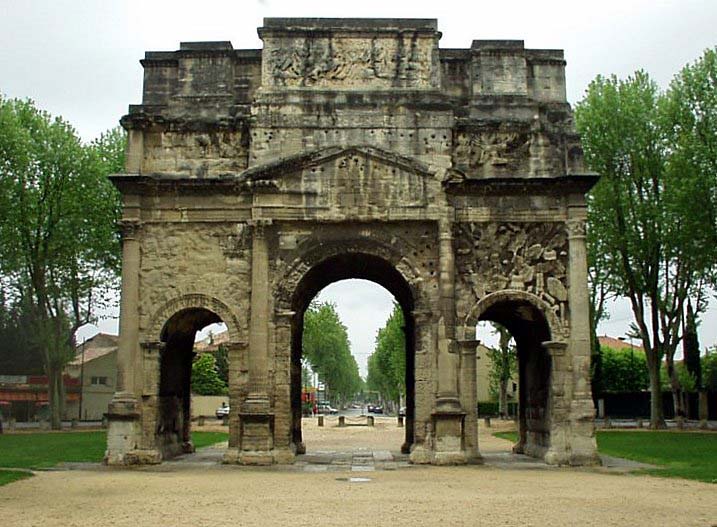
The Triumphal Arch of Orange (French: Arc de triomphe d'Orange) is a triumphal arch located in the town of Orange, southeast France There is debate about when the arch was built, but current research that accepts the inscription as evidence favors a date during the reign of Augustus (63 BC - AD 14). It was built on the former via Agrippa to honor the veterans of the Gallic Wars and Legio II Augusta.
It was later reconstructed by emperor Tiberius to celebrate the victories of Germanicus over the German tribes in Rhineland. The arch contains an inscription dedicated to emperor Tiberius in AD 27. On the northern (outward-facing) facade, the architrave and cornice have been cut back and a bronze inscription inserted, now lost; attempts at reconstructing its text from the placement of cramp holes for the projecting tines of its letters have not been successful. The arch is decorated with various reliefs of military themes, including naval battles, spoils of war and Romans battling Germanics and Gauls. A Roman foot soldier carrying the shield of Legio II Augusta is seen on the north front battle relief.
The arch was built into the town's walling during the Middle Ages to guard the northern entry points of the town. Architect Augustin Caristie studied the arch and carried out restoration work in the 1850s. The arch was originally constructed using large unmortared limestone blocks. It has three arches, the center one being larger than the flanking ones. The entire structure measures 19.57 meters long by 8.40 meters wide, standing to a height of 19.21 meters. Each facade has four semi-engaged Corinthian columns. The arch is the oldest surviving example of a design that was used later in Rome itself, for the Arch of Septimius Severus and the Arch of Constantine.
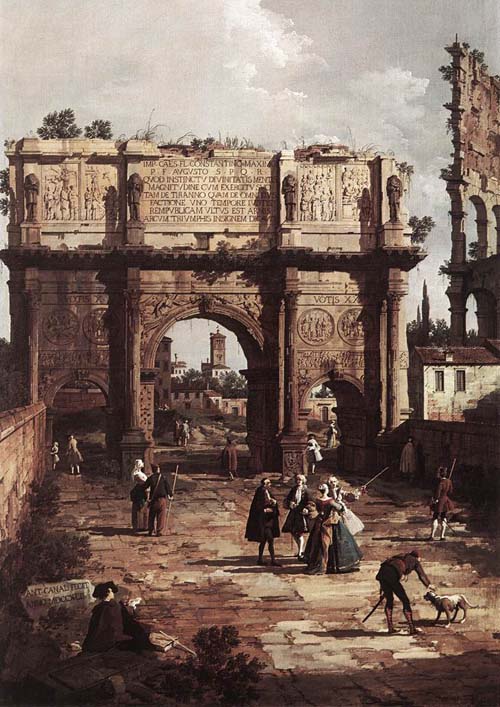
1742 Art
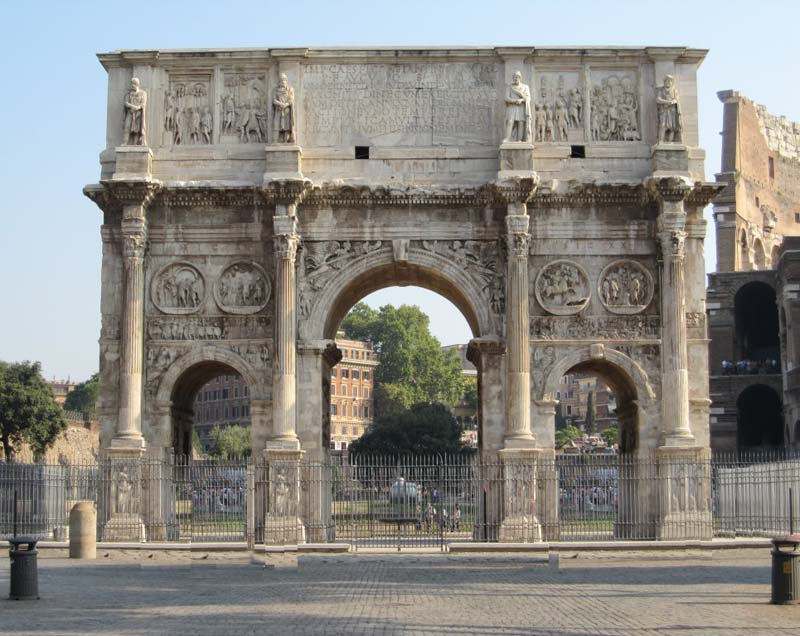
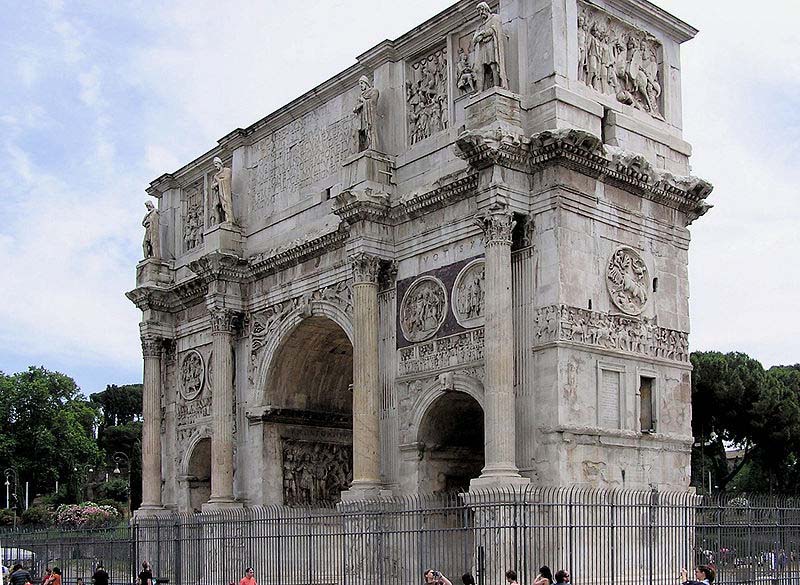
The Arch of Constantine (Italian: Arco di Constantino) is a triumphal arch in Rome, situated between the Colosseum and the Palatine Hill. It was erected to commemorate Constantine I's victory over Maxentius at the Battle of Milvian Bridge on October 28, 312 AD. Dedicated in 315, it is the latest of the existing triumphal arches in Rome, from which it differs by spolia, the extensive re-use of parts of earlier buildings.
The arch is 21 m high, 25.7 m wide and 7.4 m deep. It has three archways, the central one being 11.5 m high and 6.5 m wide, the lateral archways 7.4 m by 3.4 m each. The lower part of the monument is built of marble blocks, the top (called attic) is brickwork reveted with marble. A staircase formed in the thickness of the arch is entered from a door at some height from the ground, in the end towards the Palatine Hill.
The general design with a main part structured by detached columns and an attic with the main inscription above is modelled after the example of the Arch of Septimius Severus on the Roman Forum. It has been suggested that the lower part of the arch is re-used from an older monument, probably from the times of the emperor Hadrian (Conforto et al., 2001; for a defence of the view that the whole arch was constructed in the 4th century.
The arch spans the Via Triumphalis, the way taken by the emperors when they entered the city in triumph. This route started at the Campus Martius, led through the Circus Maximus and around the Palatine Hill; immediately after the Arch of Constantine, the procession would turn left at the Meta Sudans and march along the Via Sacra to the Forum Romanum and on to the Capitoline Hill, passing both the Arches of Titus and Septimius Severus.
During the Middle Ages, the Arch of Constantine was incorporated into one of the family strongholds of ancient Rome. Works of restoration were first carried out in the 18th century; the last excavations have taken place in the late 1990s, just before the Great Jubilee of 2000.
The decoration of the arch heavily uses parts of older monuments, which are given a new meaning in the context of the Constantinian building. As it celebrates the victory of Constantine, the new "historic" friezes illustrating his campaign in Italy convey the central meaning: the praise of the emperor, both in battle and in his civilian duties. The other imagery supports this purpose: decoration taken from the "golden times" of the Empire under Trajan, Hadrian and Marcus Aurelius places Constantine next to these "good emperors", and the content of the pieces evokes images of the victorious and pious ruler.
Another explanation given for the re-use is the short time between the start of construction (late 312 at the earliest) and the dedication (summer 315), so the architects used existing artwork to make up for the lack of time to create new art. As yet another possible reason, it has often been suggested that the Romans of the 4th century lacked the artistic skill to produce acceptable artwork and therefore plundered the ancient buildings to adorn their contemporary monuments. This interpretation has become less prominent in more recent times, as the art of Late Antiquity has been appreciated in its own right. It is possible that a combination of those explanations is correct.
Attic
Above the middle archway, the main inscription takes the most prominent place of the attic. It is identical on both sides of the arch.
Flanking the inscription on both sides, there are pairs of relief panels above the minor archways, 8 in total. They were taken from an unknown monument erected in honour of Marcus Aurelius, and show (north side, left to right) the emperor's return to Rome after the campaign (adventus), the emperor leaving the city and saluted by a personification of the Via Flaminia, the emperor distributing money among the people (largitio), the emperor interrogating a German prisoner, (south side, left to right) a captured enemy chieftain led before the emperor, a similar scene with other prisoners, the emperor speaking to the troops (adlocutio), and the emperor sacrificing pig, sheep and bull (suovetaurilia).
Together with three panels now in the Capitoline Museum, the reliefs were probably taken from a triumphal monument commemorating Marcus Aurelius' war against the Sarmatians from 169 Ð 175, which ended with his triumphant return in 176. On the largitio panel, the figure of Marcus Aurelius' son Commodus has been eradicated after the latter's damnatio memoriae. On top of each of the columns stand marble statues of Dacian prisoners from the times of Trajan, probably taken from the Forum of Trajan.
From the same time date the two large (3 m high) panels decorating the attic on the small sides of the arch, showing scenes from the emperor's Dacian Wars. Together with the two reliefs on the inside of the central archway, they came from a large frieze celebrating the Dacian victory. The original place of this frieze was either the Forum of Trajan, as well, or the barracks of the emperor's horse guard on the Caelius.
The general layout of the main facade is identical on both sides of the arch. It is divided by four columns of Corinthian order made of Numidian yellow marble (giallo antico), one of which has been transferred into the Basilica di San Giovanni in Laterano and was replaced by a white marble column. The columns stand on bases showing victory figures on front, and captured barbarians and Roman soldiers on the sides.
The spandrels of the main archway are decorated with reliefs depicting victory figures with trophies, those of the smaller archways show river gods. Column bases and spandrel reliefs are from the times of Constantine.
Above each lateral archway are pairs of round reliefs dated to the times of Emperor Hadrian. They display scenes of hunting and sacrificing: (north side, left to right) hunt of a boar, sacrifice to Apollo, hunt of a lion, sacrifice to Hercules, (south side, left to right) departure for the hunt, sacrifice to Silvanus, hunt of a bear, sacrifice to Diana. The head of the emperor (originally Hadrian) has been reworked in all medallions: on the north side, into Constantine in the hunting scenes and into Licinius or Constantius I in the sacrifice scenes; on the south side, vice versa. The reliefs, c. 2 m in diameter, were framed in porphyry; this framing is only extant on the right side of the northern facade.
Similar medallions, this time of Constantinian origin, are placed on the small sides of the arch; on the eastern side, showing the Sun rising, and on the western side, the Moon, both on chariots. The main piece from the time of Constantine is the "historical" relief frieze running around the monument under the round panels, one strip above each lateral archway and at the small sides of the arch. These reliefs depict scenes from the Italian campaign of Constantine against Maxentius which was the reason for the construction of the monument.
The frieze starts at the western side with the "Departure from Milan". It continues on the southern, "outward" looking face, with the siege of a city, probably Verona, which was of great importance to the war in Northern Italy; also on that face, the Battle of Milvian Bridge with Constantine's army victorious and the enemy drowning in the river Tiber. On the eastern side, Constantine and his army enter Rome; the artist seems to have avoided using imagery of the triumph, as Constantine probably did not want to be shown triumphant over the Eternal City. On the northern face, looking "towards" the city, two strips with the emperor's actions after taking possession of Rome: Constantine speaking to the citizens on the Forum Romanum, and distributing money to the people.
In the central archway, there is one large panel of Trajan's Dacian War on each wall. Inside the lateral archways are eight portraits busts (two on each wall), destroyed to such an extent that it is no longer possible to identify them.
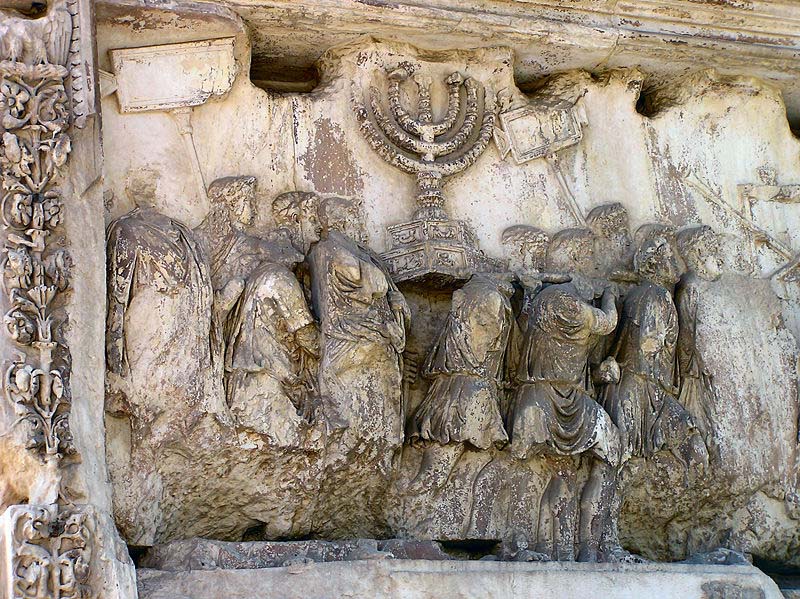
Titus' triumphal procession depicted on the Arch of Titus,
showing the loot captured from Jerusalem in 81 AD
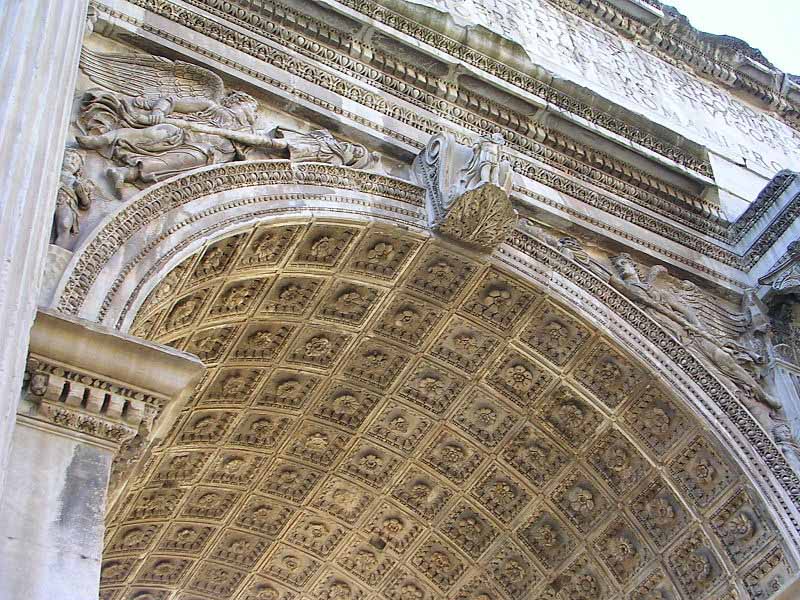
The elaborate carvings and coffered vault of the Arch of Septimius Severus
Roman triumphal arches remained a source of fascination well after the fall of Rome, serving as a reminder of past glories and a symbol of state power. At Lorsch Abbey, the triple-arched Torhalle was built in deliberate imitation of a Roman triumphal arch to signify continuity between the Carolingian Empire and its Roman predecessor. It was not until the coming of the Renaissance, however, that rulers sought to associate themselves systematically with the Roman legacy by building their own triumphal arches.
One of the earliest was the "Aragonese Arch" at the Castel Nuovo in Naples, erected by Alfonso V of Aragon in 1443, although like the later Porta Capuana this was engaged as part of the entrance to the castle. By the end of the 16th century the triumphal arch had become closely linked with court theatre, state pageantry and military fortifications. The motif of the triumphal arch was also adapted and incorporated into the facades of public buildings such as city halls and churches.
Temporary triumphal arches made of lath and plaster were often erected for royal entries. Unlike the individual arches erected for Roman conquerors, Renaissance rulers often built a row of arches through which processions were staged. They defined a space for the movement of people and denoted significant sites at which particular messages were conveyed at each stage.
Newly elected popes, for instance, processed through the streets of Rome under temporary triumphal arches built specially for the occasion. Arches were also built for dynastic weddings; when Charles Emmanuel I, Duke of Savoy married Infanta Catherine Michelle of Spain in 1585, he processed under temporary triumphal arches that asserted the antiquity of the House of Savoy and associated his dynasty, through the art and architecture of the arches, with the imperial Roman past.
Images of arches gained great importance as well. Although temporary arches were torn down after they had been used, they were recorded in great detail in engravings that were widely distributed and survived long after the original arches had been destroyed. The medium of engraving gave the viewer the opportunity to examine the allegories and inscriptions presented by the arches in a way that would not have been possible during the event.
Sometimes the arches depicted were not even real structures but existed entirely as imaginary representations of royal propaganda. One famous example was the Ehrenpforte Maximilians I by Albrecht Durer, commissioned by the Emperor Maximilian I. It was one of the largest prints ever produced, measuring 3.75 metres (12.3 ft) high and consisting of 192 individual sheets, depicting an arch that was never intended to be built. It was printed in an edition of 700 copies and distributed to be coloured and pasted on the walls of city halls or the palaces of princes.
The French led the way in building new permanent triumphal arches when the imperial ambitions of the Bourbon kings and Napoleon Bonaparte led to a spate of arch-building. By far the most famous arch from this period is the Arc de Triomphe in Paris, built from 1806-36, though it is consciously dissimilar from its Roman predecessors in omitting the customary ornamental columns - a lack that fundamentally changes the balance of the arch and gives it a distinctly "top-heavy" look. Other French arches more closely imitated those of imperial Rome; the Arc de Triomphe du Carrousel in Paris, for instance, is closely modeled on the Arch of Septimius Severus in Rome.
Triumphal arches have continued to be built into the modern era, often as statements of power and self-aggrandizement by dictators. Adolf Hitler planned to build the world's largest triumphal arch in Berlin. The arch would have been vastly larger than any previously built, standing 550 feet (170 m) wide, 92 feet (28 m) deep and 392 feet (119 m) - big enough for the Arc de Triomphe to fit into it 49 times. It was intended to be carved with the names of Germany's 1.8 million dead in the First World War. However, construction was never begun. North Korea's dictator Kim Il Sung built the world's largest triumphal arch in Pyongyang in 1982. It was designed to be substantially bigger than the Arc de Triomphe in Paris and was erected on the site where, on October 14, 1945, Kim Il Sung gave his first public speech to the North Korean people. It is decorated with sculptures and reliefs depicting "the triumphal returning of the victorious Great Leader to the country."
The form of the triumphal arch has also been put to other purposes, notably the construction of monumental memorial arches and city gates such as the Brandenburg Gate in Berlin or the Washington Square Arch in New York City. Although patterned after triumphal arches, these were built for quite different purposes - to memorialize war dead or to provide a monumental entrance to a city, as opposed to celebrating a military success or general.