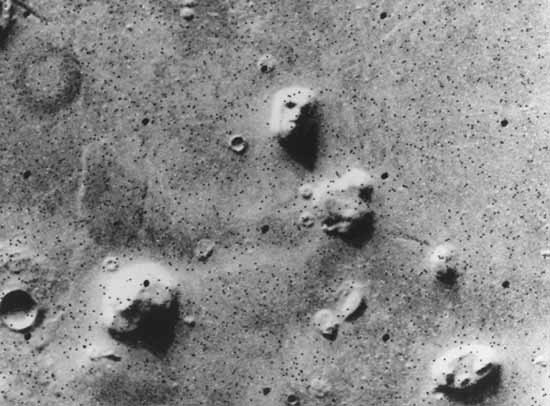
The face on Mars is actually a rock formation.
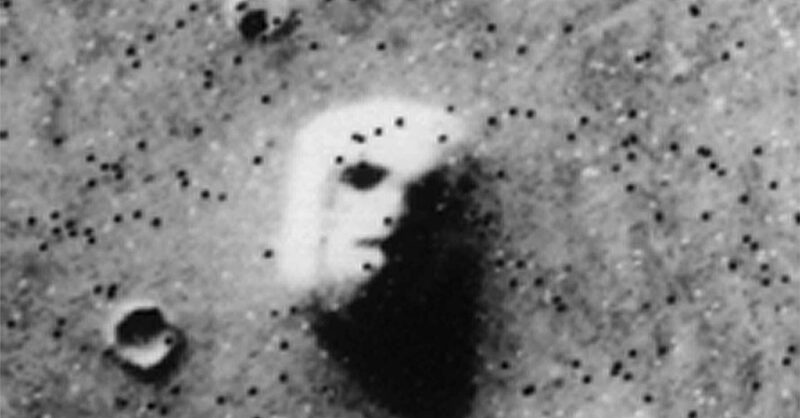
The face on Mars is actually a rock formation.
The image was captured by the Viking 1 orbiter and released by NASA/JPL on July 25, 1976. It is part of the Cydonia region.
Pareidolia or Scrying is a subjective way of defining abstract images. In this case we see the rock formation as a face whether human or alien.
Today, the "Face" is generally accepted to be an optical illusion, an example of pareidolia. After analysis of the higher resolution Mars Global Surveyor data NASA stated that a detailed analysis of multiple images of this feature reveals a natural looking Martian hill whose illusory face-like appearance depends on the viewing angle and angle of illumination.
Richard C. Hoagland, among other researchers, believe the Face on Mars to be evidence of a long-lost Martian civilization with other geological features such as pyramids which they argue are part of an ancient city complex city. They equate the Face with the Sphinx on Earth alongside pyramids aligning the Giza Plateau and the constellation Orion - constellations being another form of Pareidolia.
A Mars-Earth connection has always fascinated humans. Unless Earth is visited by extraterrestrials with answers - we will never know and will continue to speculate alongside theories of ancient aliens visiting planet Earth to create the human experiment - leaving behind megalithic monuments and other clues about creation. It's the old theory of Gods and/or aliens returning at the end of time (experiment) which is rapidly approaching.
Science or pseudoscience - this all comes down to the simulation our reality endlessly recreating algorithms or geometric patterns throughout the universe all connected in the Matrix or Illusion of Time.
"Face" On Mars Photographed By NASA's Mars Perseverance Rover IFL Science - October 10, 2024
These finds can be interesting, like a donut-shaped rock that may not be from the planet; or very interesting, like the incredibly unusual striped rock Perseverance recently found while climbing the Jezero Crater. They can also be a little silly, sending conspiracy theorists and people who haven't heard of pareidolia yet into frenzies. People have "seen" everything from bones and doorways to avocados. One of the latest rocks to capture people's attention, earning NASA's Image of the Week (September 22-28, 2024) in a public vote, is one that looks sort of like a human head. While fun to look at, the rock is less scientifically interesting than many other rocks found on the planet.
Martian Face Turns Out to be a Rocky Mesa PhysOrg - August 2, 2010
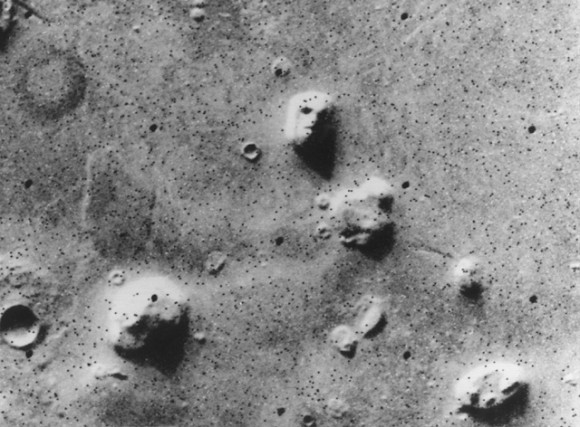
Technology has advanced a considerable amount since the original photo was taken, though. Now NASA has released a new image of the area - one that shows quite clearly that what looks like a face in the 1976 image is really just a rocky mesa.
3D Face on Mars NASA - April 21, 2007

Explanation: Get out your red/blue glasses and gaze down on this weathered mesa on Mars. Of course, described as a rock formation that resembles a human head in a 1976 NASA press release, this mesa is also famous as the Face on Mars. The sharp stereo image was created by combining high resolution pictures from cameras on two different spacecraft in Mars orbit - Mars Reconnaissance Orbiter and Mars Global surveyor. It shows rugged details of the approximately 2 kilometer wide, isolated hill - similar to mesa landforms on planet Earth - rising some 240 meters above the plains of the martian Cydonia region. This remarkable 3D view exaggerates the hill's vertical dimensions.
New Visage for Red Planet 'Face' BBC - September 21, 2006
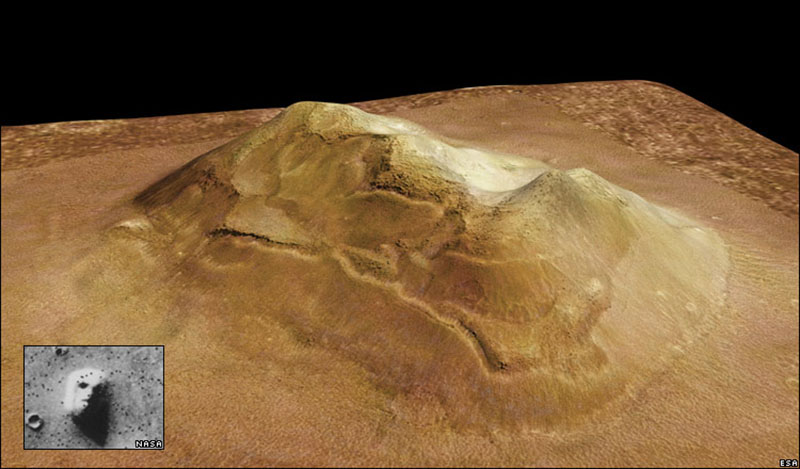
The Mars Express probe has photographed the classic surface feature on the Red Planet's surface known as "The Face". The mountain, which looks just like a human head with eyes, mouth and nostrils, was first pictured by the US Viking 1 Orbiter in 1976. The formation instantly became the stuff of myth and conspiracy theories, with some claiming it was evidence of an ancient Martian civilization.