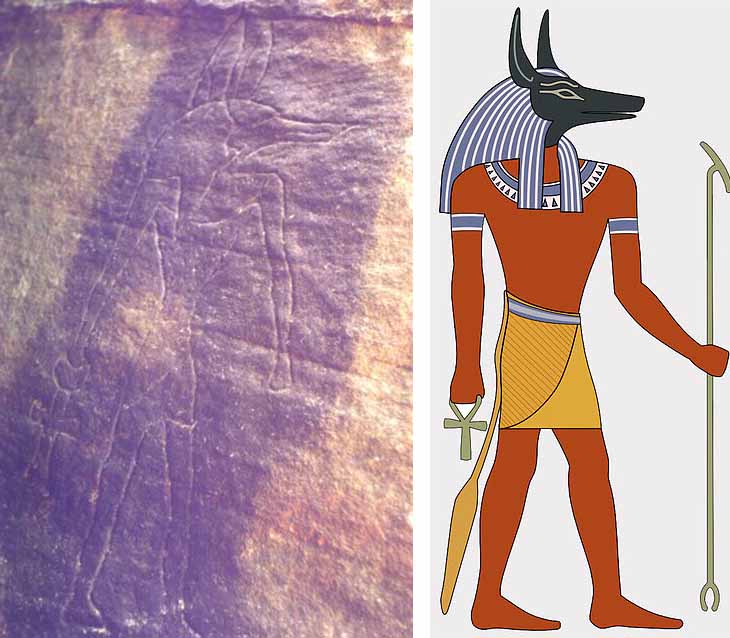
Did ancient Egyptians visit Australia in the distant past leaving messages carved in rock? If so, how did they get there? If we are to believe Ancient Alien Theory they flew between both lands in ships. Maybe ... Ancient artifacts, glyphs, and rock art depict ancient civilizations were curious people who visited parts of the world.
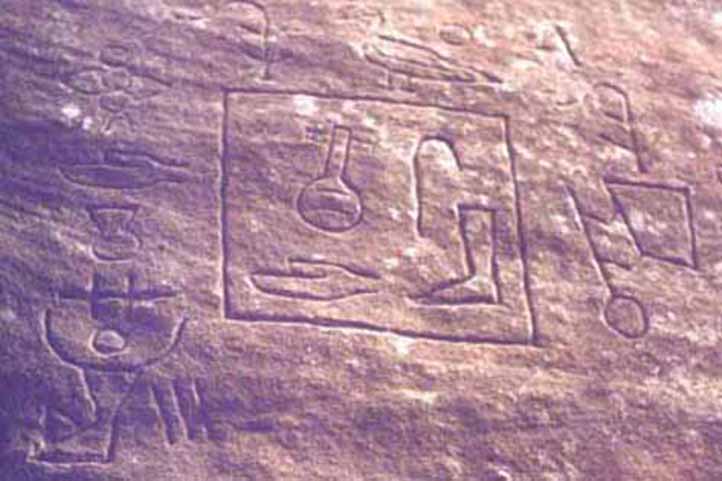
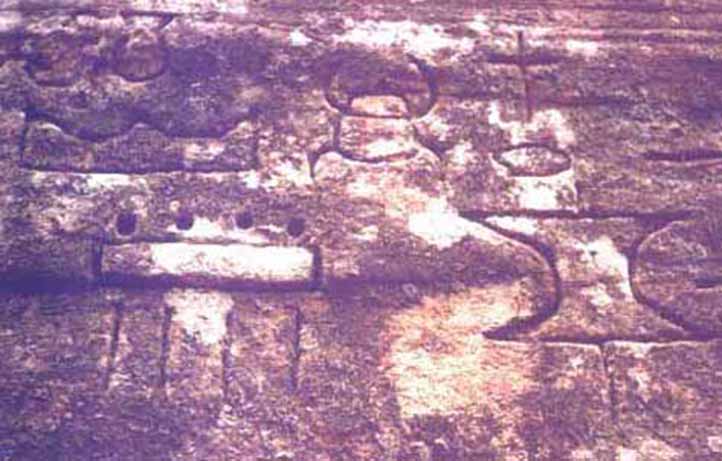
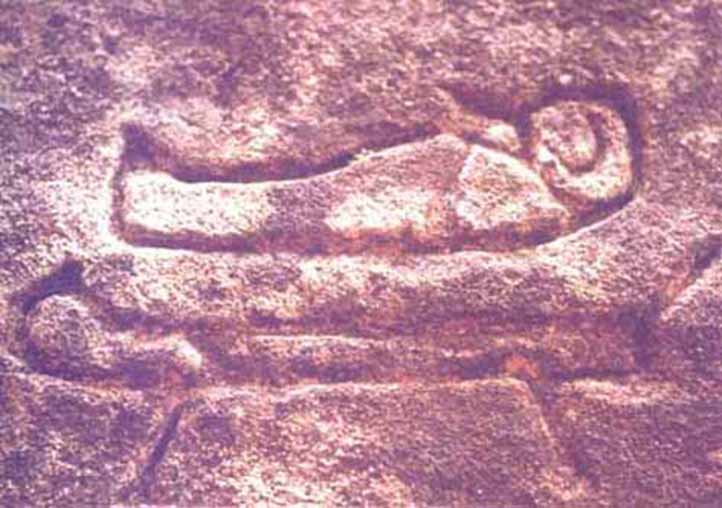
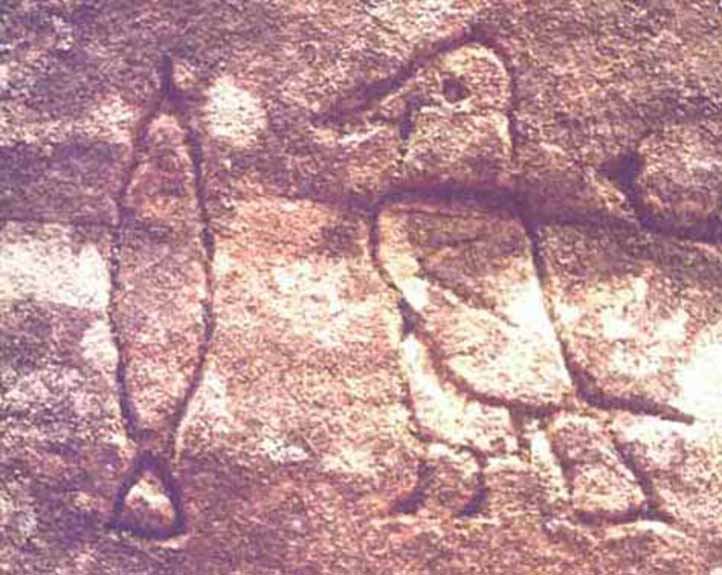
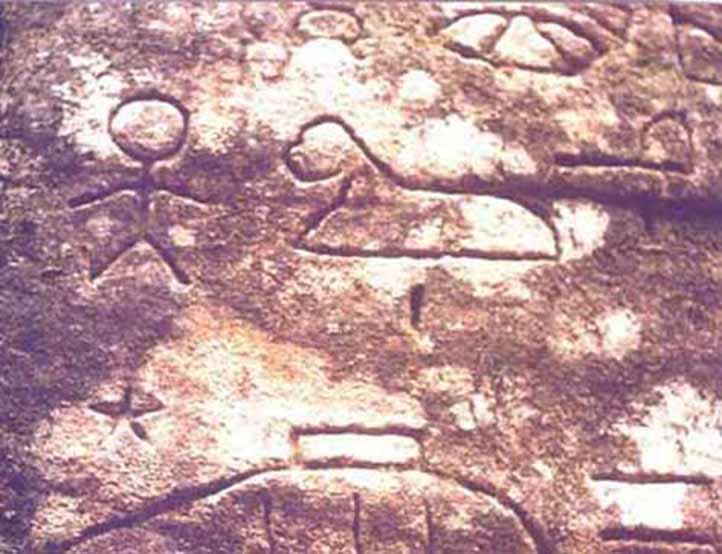
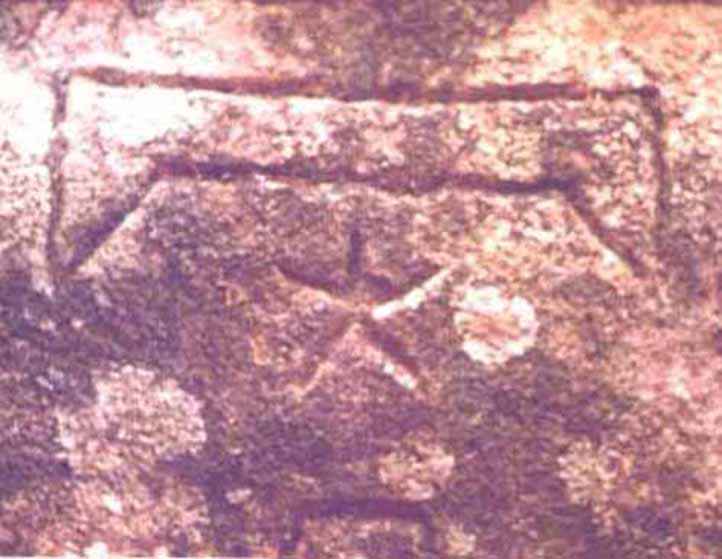
So what do we have that combines ancient voyagers with ancient aliens? Images carved in stone in Austral, among other places, show hieroglyphs like those found in Egyptian temples, caves, pyramids, etc. Some depict extraterrestrials with large heads - or helmets - and large dark eyes (Grays or Reptilians). At the end of one chamber in Australia - protected by the remaining section of stone roof - is a remarkable life-sized carving of the Egyptian god Anubis (above).
Visual observation of the site makes it obvious that the worn carvings exposed to the coastal weather would have to be several centuries to a thousand years old at least. When first found the site was completely overgrown with thick vegetation and filled in with smashed rock and a much higher soil line. A number of excavation attempts by interested parties have not turned up any artifacts or bodies but sophisticated and expensive laser scanning techniques have not been applied. There is significant evidence that the ancients were well aware of the Great South land. There were both Sumerian and Mayan legends of a "lost motherland" in the Pacific region.
Traveling to Australia ...
Australia appears under the name of "Antoecie" on the famous spherical world map of Crates of Mallos, even appearing on the Greek map of Eratosthenese in 239 BC. It seems fairly certain that the maritime civilizations of antiquity were quite capable of extensive ocean voyages, particularly the early Egyptians, as evidenced by Giza's remarkable Tomb of the Boat.
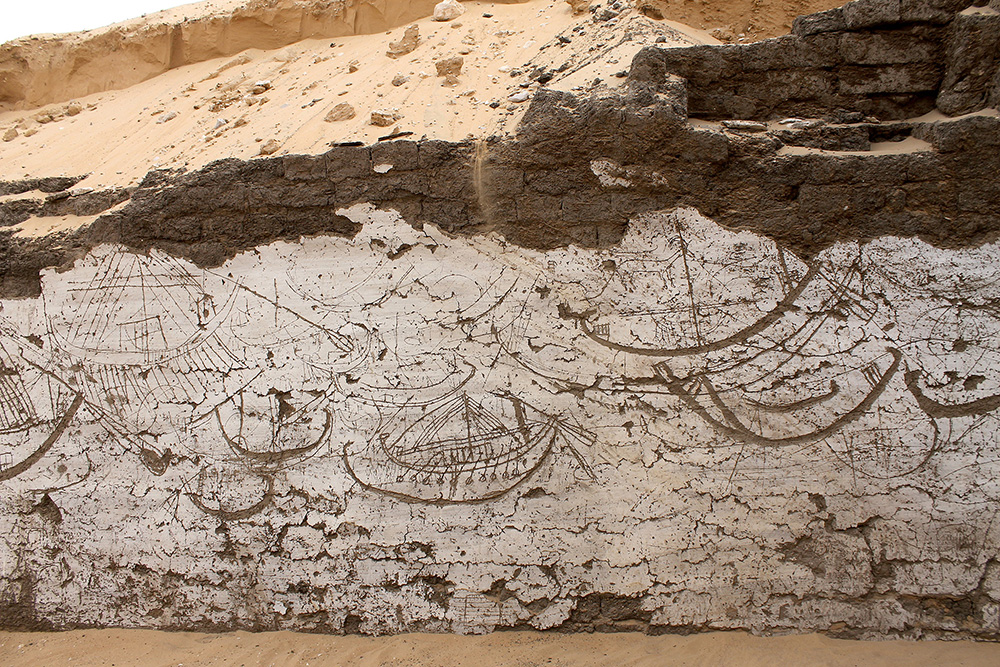
According to Cairo Times, in 1982, archaeologists working at Fayum, near the Siwa Oasis uncovered fossils of kangaroos and other Australian marsupials. There's also the unexplained set of golden boomerangs discovered by Prof. Howard Carter in the tomb of Tutankhamen 11/22/22.
The journey to Australia ... Egyptian Dynasties
Several rock walls chronicle the tragic saga of ancient explorers shipwrecked in a strange and hostile land, and the untimely death of their royal leader, "Lord Djes-eb". A group of three cartouches (framed clusters of glyphs) record the name of "RA-JEDEF" as reigning King of the Upper and Lower Nile, and son of 'Khufu' who, in turn, is son of the King 'Sneferu'. This dates the expedition just after the reign of King Khufu - known in the Greek as "Cheops" alleged builder of the Great Pyramid. Lord Djes-eb may have actually been one of the sons of the Pharaoh Ra Djedef, who reigned after Khufu. The hieroglyphic text was apparently written under the instruction of a ship's captain or similar, with the corner glyph on the wall displaying the title of a high official or chief priest. The scribe is speaking for his Highness, the Prince, from this wretched place where we were carried by ship. The expedition's leader, is described in the inscriptions as the King's son, 'Lord Djes-eb', who came to grief a long way from home. The hieroglyphics sketch his journey and his tragic demise. Burial rituals, prayers and preparations are allegedly described.
For two seasons he made my way westward, weary, but strong to the end.
Always praying, joyful, and smiting insects.
He, the servant of God, said God brought the insects.
Have gone around hills and deserts, in wind and rain, with no lakes at hand.
He was killed while carrying the Golden Falcon Standard up front in a foreign land, crossing mountains, desert and water along the way.
He, who died before, is here laid to rest.
May he have life everlasting. He is never again to stand beside the waters of the Sacred Mer. Mer meaning 'love'.
There was a moat around the pyramid called the "waters of Mer".
The second facing wall, which was much more seriously eroded, details the tragedy further.
This wall begins with the badly eroded glyph of a snake (Heft), with a glyph of jaws (to bite) and the symbol for 'twice'.
The snake bit twice.
Those followers of the diving Lord 'Khufu', mighty one of Lower Egypt, Lord of the Two Adzes, not all shall return.
We must go forward and not look back.
All the creek and river beds are dry. Our boat is damaged and tied up with rope.
Death was caused by snake.
We gave egg-yolk from the medicine-chest and prayed to Amen, the Hidden One, for he was struck twice.
We walled in the side entrance to the chamber with stones from all around.
We aligned the chamber with the Western Heavens.
The three doors of eternity were connected to the rear end of the royal tomb and sealed in.
We placed beside it a vessel, the holy offering, should he awaken from the tomb.
Separated from home is the Royal body and all others.
Here we find inscribed the extraordinary story of the death and burial of Lord Djes-eb one of the sons of the Pharaoh Ra Djedef.
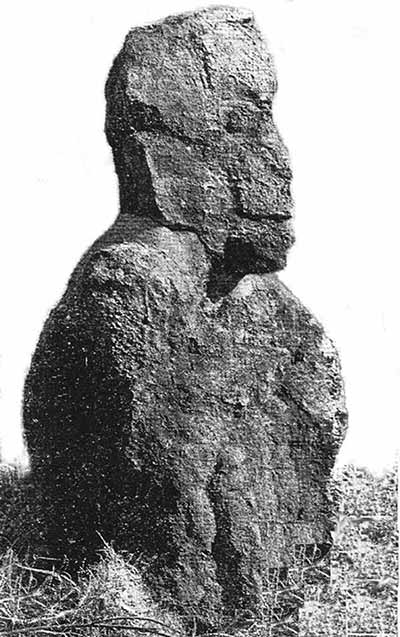
The statue was unearthed in 1966 on Mr Dal K. Berrys Wolvi Rd property. The ape is made of conglomerate iron stone and shows a squatting ape figure. It is believed to represent the Egyptian God Thoth in the form of a baboon. That sees like a bit of a stretch and makes little sense even from an evolutionary perspective.

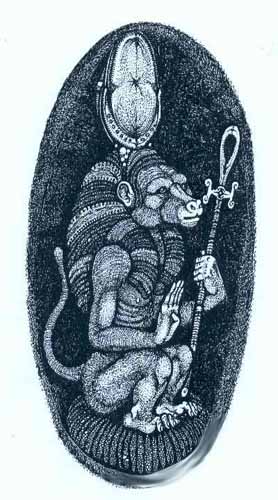
A smaller stone idol unearthed near the Gympie Pyramid is also believed to represent the Egyptian God Thoth in ape form clutching the Tau or the Cross of Life. This statuette is badly weathered with age. Thoth was the god of writing and wisdom, depicted as an ape by the Egyptians until about 1000 BC when he became an Ibis-headed human bodied deity who recorded the judgement of the souls of Amenti, the after world. Thoth's symbol was the papyrus flower.
An ancient Terraced Hill at least 6000 years old has been found on the outskirts of Gympie off Tin Can Bay Road. The Pyramidal structure is 100 foot high and consists of a series of terraces up to 4 feet tall and eight feet across constructed of small and larger lumps of stone. It was recorded by the first white man into the area in the 1850's.
A very small statuette of a squatting ape was found by Widgee Shire workman Mr Doug George from near Traveston crossing. Mr George picked up the rock while working near the bridge. This is also believed to be Thoth in ape form.
Unearthed at Noosaville on the Sunshine Coast, was an ancient Egyptian Jade Ankh or 'Cross of Life'
Toowoomba: A group of seventeen granite stones were found with Phoenician inscriptions. One had been translated to read "Guard the shrine of Yahweh's message" and "Gods of Gods". Another inscription reads, "This is a place of worship or Ra" and "Assemble here to worship the sun." Ra was the Egyptian sun god.
Rex Gilroy in 1978 identified ancient Masonic Egyptian symbols among aboriginal cave art several miles from the 1910 Ptolomy IV coin discovery site.
An Egyptian sun disc was discovered in 1950 carved into a cliff. The carving featured the outline of a chariot, showing one of its wheels.
Near Bowen carvings were found on rocks which looked like Egyptian hieroglyphs.
A scarab beetle carved from onyx was dug up near the Neapean River outside Penrith (NSW). Also at Penrith a 50 foot stepped pyramid exists. West of the Blue Mountains (NSW) a similar 'stepped pyramid' to the Gympie example exists. Although constructed of huge granite blocks stands about 100 feet tall.
In the central NSW late last century a cult was recorded among the aboriginals who worshipped a sky being called Biame. The soul judging functions of Biame were parallel to those Thoth who in Egyptian mythology conducted the spirits to Osiris, The god of the Dead, for judgement.
Beside the Hawkesbury River, very old aboriginal rock art depicts strange visitors to the continent, including people looking like Egyptians.
Aboriginal tribes of the NW Kimberley's still worship a mother-goddess identical to that once worshipped by Gympie district tribes and which resembles that of ancient middle east peoples. Kimberley tribes also include some groups bearing apparent middle east racial features and speak many ancient Egyptian words in their language.
In 1931 in the N.W. Kimberley's, Prof. A. P. Elkin, Professor of Anthropology at Sydney University came upon a tribe of Aborigines who had not met a white man before. The professor was astounded when tribal elders greeted him with Ancient Secret masonic hand signs. He was struck by the startling sematic features present in the natives. He discovered the Aborigines worshipped the sun. They also had an earth mother and Rainbow Serpent Cult. Later he discovered many of the words spoken were of Egyptian origin. This is the area of the famous Wandjina Cave Art. According to legend the Wanjina came from across the Indian Ocean in great vessels.
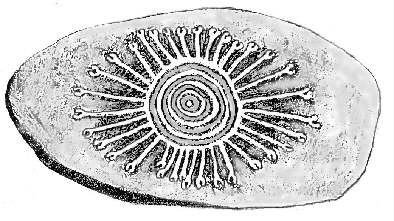
The Tjuringa sacred stones of the Kimberley region include a sun symbol identical to that of the Aten. The solar
deity worshipped in Egypt around 1000 BC. In Atonist art, the Sun was depicted as having little hands that reached
out to touch mankind. There was an Egyptian God named Aton connected to Akhenaten.
Arnhem land and Torres Strait peoples mummified their dead. On Darnley Island in Torres Strait, natives mummified their dead by removing their stomach contents. Then extracted the brains by making an incision through the nostrils with a bone instrument. After inserting artificial eyes of pearl shell, they embalmed the corpse and rowed it 2 miles westward out to sea in a canoe shaped like the 'Boat of Ra' of the Egyptians, for internment on an island of the dead. As if to imitate the Egyptians who ferried their dead across the Nile to the West bank tombs.
The natives of Arnhem Land also believed the soul was conducted to the after life in a canoe rowed by Willuwait the boatman of the dead. If the deceased had led a good life he was allowed to enter Purelko, the afterworld. If not, he was eaten by a crocodile. This belief is identical to the teachings of the Osirian religion of Egypt where Thoth conducted the spirits of the dead into the presence of Osiris for judgement. Here if the souls sins were outweighed by a feather, the body was devoured by the crocodile God Ba.
In 1875 the Shevert expedition retrieved a mummified corpse and an example of the canoe used in funerary rites from Darnley Island. World renowned medical scientist Sir Raphael Cilento who examined the corpse stated the incisions and method of embalming to be the same as those employed in Egypt during the 21st to 23rd dynasties over 2900 years ago.
On New Hanover Island, off the tip of New Ireland in 1964, an administration medical officer, Mr. Ray Sheridan discovered what appears to be the remains of an ancient sun-worshippers temple of Egyptian style. Among the monolithic stone blocks there was an idol, facing the rising sun with features half human, half bird it stood 6 feet tall and weighed four tons. Near there Ray Sheridan found the carving of a wheel complete with hub. The ruins reminded him of ancient Sun-worship temples he had seen in Egypt during WWII.
In 1931 Australian Anthropologist, Sir Grafton Elliot-Smith examined mummified remains in a New Zealand cave. He identified the skull as being that of an ancient Egyptian at least 2000 years old. A gold scarab was also dug up in the district on another occasion. His papers seen to have mysteriously disappeared from The Australian Academy of Science Library in Canberra.
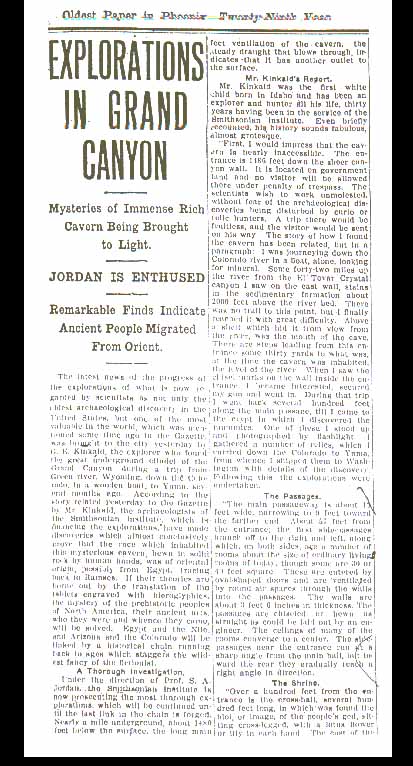
Egyptian Lost City in the Grand Canyon?