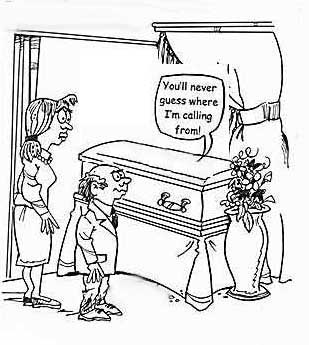
Call your loved one in the grave? NBC - February 4, 2009
A new trend includes placing a cell phone in the casket of a loved one who has crossed over to emotionally feel connected. These people should understand that there is continuity after death and the soul will visit from time to time. This is just another chapter in the human epoch to connect to/with the other side.
The world is in a global recession and declining. With that comes a need for humor. Today I found the NBC story above that begs for one-liners ... a Jay Leno moment. Here we go ... from the grave and 'outside the box'....
your lifetime warrantee has expired
you are no longer a mobile customer
no roaming charges
unlimited nights and weekends
no roll-over minutes
unlimited casket conference calling
no replacement parts
hands free dialing
we gave you an iphone with internet capabilities so you can read Ellie's Blog
the GPS has been disconnected - teleportation capabilities are available for an additional monthly fee
this is a pay-as-you-'go' plan
now your spouse has to listen to you
your lover showed up at the funeral ... she (he) will be joining you soon
at last I got your money ... your lawyer changed his number so don't bother ... he was in on it...
you can take your phone number into the next life
no more channeling ... dial direct
say it again ... you're breaking up
I can't hear you ... the line went dead
call me back ... I'm in a dead zone
dying to hear from you...

A casket, or a jewelery box is a receptacle for trinkets and jewels. It may take a very modest form, covered in leather and lined with satin, or it may reach the monumental proportions of the jewel cabinets which were made for Marie Antoinette, one of which is at Windsor, and another at Versailles, the work of Schwerdfeger as cabinet maker, Degault as miniature painter, and Thomire as chaser. Caskets are often made in precious materials, such as gold, silver or ivory. In ancient East Asia, caskets often made in wood, china, or covered with silk. Some of these caskets could be collected as decorative boxes.

A coffin - also known as a casket in North American English - is a funerary box used in the display and containment of deceased remains either for burial or cremation. In Taiwan, coffins made of crushed oyster shells were used in the 18th and 19th centuries. In Medieval Japan, round coffins were used, which resembled barrels in shape and were usually made by coopers. Cultures that practice burial have widely different styles of coffin. In some varieties of orthodox Judaism, the coffin must be plain, made of wood, and contain no metal parts nor adornments. These coffins use wooden pegs instead of nails. In China and Japan, coffins made from the scented, decay-resistant wood of cypress, sugi, thuja and incense-cedar are in high demand. In Africa, elaborate coffins are built in the shapes of various mundane objects, like automobiles or aeroplanes.

A sarcophagus is a funeral receptacle for a corpse, most commonly carved or cut from stone. The word "sarcophagus" comes from the Greek sarx meaning "flesh", and phagein meaning "to eat", hence sarkophagus means "flesh-eating"; from the phrase lithos sarkophagos the word came to refer to the limestone that was thought to decompose the flesh of corpses interred within it.

An ossuary is a chest, building, well, or site made to serve as the final resting place of human skeletal remains. They are frequently used where burial space is scarce. A body is first buried in a temporary grave, then after some years the skeletal remains are removed and placed in an ossuary. The greatly reduced space taken up by an ossuary means that it is possible to store the remains of many more people in a single tomb than if the original coffins were left as is. (Click for Persian, Roman Catholic, Jewish)
ALPHABETICAL INDEX OF ALL FILES