
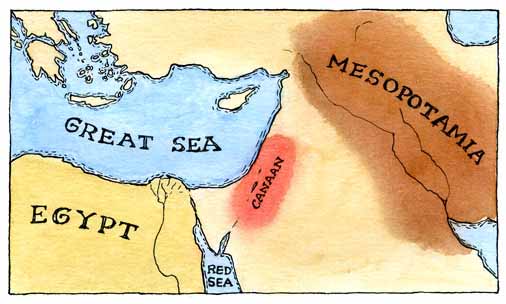
Canaan is a historical Semitic speaking region roughly corresponding to the Levant (modern-day Israel, Palestinian territories, Lebanon, and the western parts of Jordan and Syria). Canaan was of geopolitical importance in the Late Bronze Age Amarna period as the area where the spheres of interest of the Egyptian, Hittite Empire and Assyrian Empires converged. Canaan is historically attested throughout the 4th millennium BC; the later Amarna Letters use Kinahhu while sources of the Egyptian New Kingdom mention numerous military campaigns conducted in Ka-na-na.In modern usage, the name is often associated with the Hebrew Bible, where the "Land of Canaan" extends from Lebanon southward to the "Brook of Egypt" and eastward to the Jordan River Valley.
Much of the modern knowledge about Canaan stems from excavation in this area. Canaanite culture apparently developed in situ from the Circum-Arabian Nomadic Pastoral Complex, which in turn developed from a fusion of Near Eastern Harifian hunter gatherers with Pre-Pottery Neolithic B (PPNB) farming cultures, practicing animal domestication, during the 6200 BC climatic crisis.
Linguistically, the Canaanite languages form a group within the Northwest Semitic languages; its best-known member today is the Hebrew language, being mostly known from Iron Age epigraphy. Other languages in the Northwest Semitic Canaanite group include; Ugaritic, Amorite, Moabite and Edomite. The various Canaanite nations of the Bronze to Iron Ages are mentioned in the Bible, Mesopotamian (Assyrian and Babylonian), Hittite and Ancient Egyptian texts. The Late Bronze Age state of Ugarit (modern Ras Shamra in Syria) is considered quintessentially Canaanite archaeologically, even though its Ugaritic language does not belong to the Canaanite group proper.
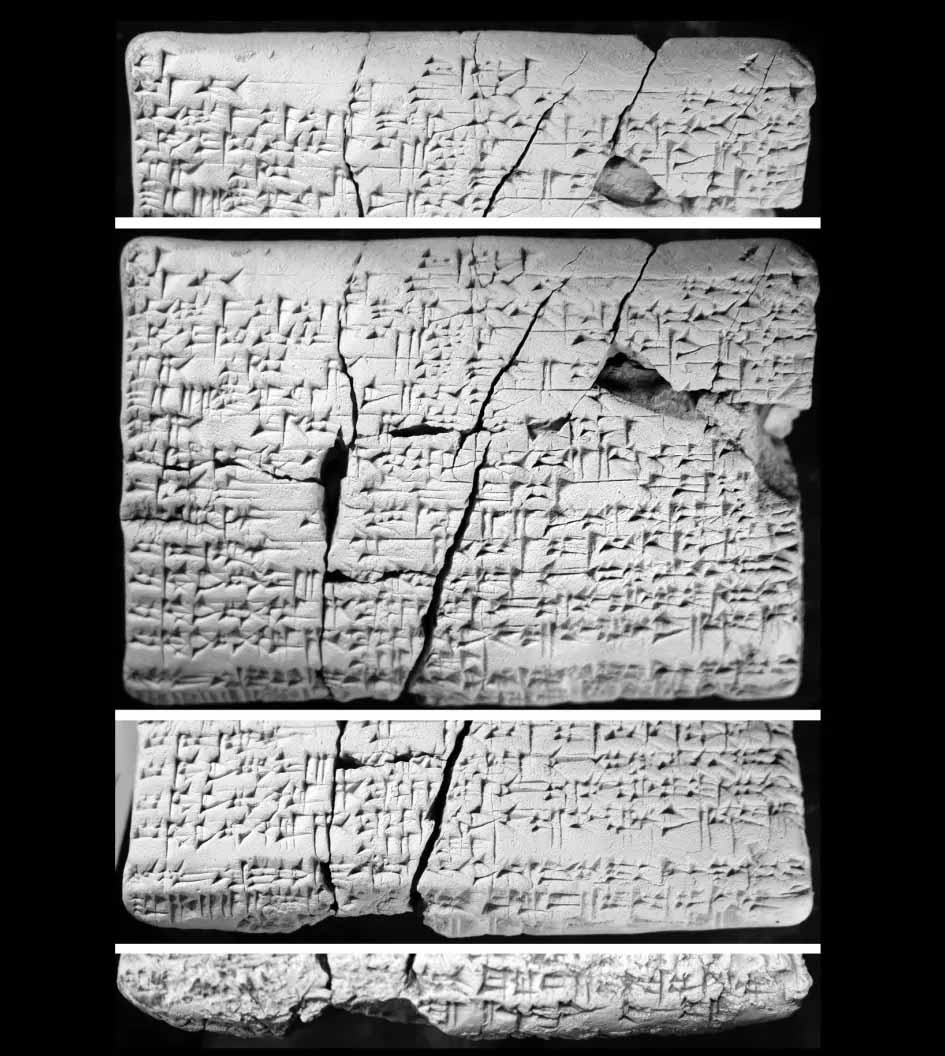
Two ancient clay tablets discovered in Iraq and covered from top to bottom in cuneiform writing contain details of a "lost" Canaanite language that has remarkable similarities with ancient Hebrew.
The tablets, thought to be nearly 4,000 years old, record phrases in the almost unknown language of the Amorite people, who were originally from Canaan - the area that's roughly now Syria, Israel and Jordan - but who later founded a kingdom in Mesopotamia. These phrases are placed alongside translations in the Akkadian language, which can be read by modern scholars.
In effect, the tablets are similar to the famous Rosetta Stone, which had an inscription in one known language (ancient Greek) in parallel with two unknown written ancient Egyptian scripts (hieroglyphics and demotic.) In this case, the known Akkadian phrases are helping researchers read written Amorite.
Prior to 3500 BCE: hunter-gatherer societies were slowly giving way to farming and herding societies, and early metal-working. By the Bronze Age large urban centres had developed. By the Early Bronze Age other sites had developed, such as Ebla (where an East Semitic tongue was spoken), which by ca. 2300 BC was incorporated into the Mesopotamian based Akkadian empire of Sargon the Great and Naram-Sin of Akkad (Biblical Akkad).
Sumerian references to the Mar.tu ("tent dwellers" - considered to be Amorite) country West of the Euphrates date from even earlier than Sargon, at least to the reign of the Sumerian king, Enshakushanna of Uruk. The archives of Ebla show reference to a number of Biblical sites, including Hazor, Jerusalem, and as a number of people have claimed, to Sodom and Gomorrah mentioned in Genesis as well. The collapse of the Akkadian Empire in 2154 BC saw the arrival of peoples using Khirbet Kerak Ware pottery, coming originally from the Zagros Mountains (in modern Iran) east of the Tigris.
The first cities in the southern Levant arose during this period. These "proto-Canaanites" were in regular contact with the other peoples to their south such as Egypt, and to the north Asia Minor (Hurrians, Hittites, Luwians) and Mesopotamia (Sumer, Akkad, Assyria), a trend that continued through the Iron Age. The end of the period is marked by the abandonment of the cities and a return to lifestyles based on farming villages and semi-nomadic herding, although specialised craft production continued and trade routes remained open.
Urbanism returned and the region was divided among small city-states, the most important of which seems to have been Hazor. Many aspects of Semitic Canaanite material culture now reflected a Mesopotamian influence, and the entire region became more tightly integrated into a vast international trading network. It was during this period too that Canaanites invaded the eastern Delta of Egypt, where, known as the Hyksos, they became the dominant power.
In Egyptian inscriptions Amar and Amurru are applied strictly to the more northerly mountain region east of Phoenicia, extending to the Orontes. In the Akkadian Empire, as early as Naram-Sin's reign (ca. 2240 BC), Amurru was called one of the "four quarters" surrounding Sumer, along with Subartu/Assyria, Akkad, and Elam. Amorite dynasties also came to dominate in much of Mesopotamia, including in Larsa, Isin and founding the state of Babylon in 1894 BC.
Later on, Amurru became the Assyrian/Akkadian term for the interior of south as well as for northerly Canaan. At this time the Canaanite area seemed divided between two confederacies, one centred upon Tel Megiddo in the Jezreel Valley, the second on the more northerly city of Kadesh on the Orontes River. One Amorite king of Babylonia,
Hammurabi (1792-1750 BC) founded the first Babylonian Empire, which lasted only as long as his lifetime. Upon his death, the Amorites were driven from Assyria, but remained masters of Babylonia until 1595 BC, when they were ejected by the Hittites.
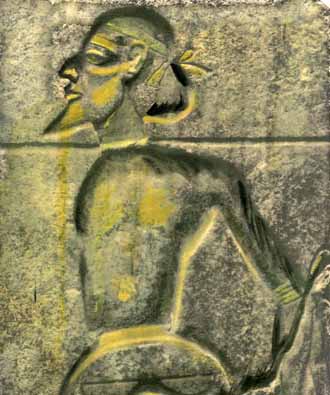
Wall relief from Egypt reveals an image of an ancient Canaanite
During the 2nd millennium BC, Ancient Egyptian texts use the term Canaan to refer to an Egyptian-ruled colony, whose boundaries generally corroborate the definition of Canaan found in the Hebrew Bible, bounded to the west by the Mediterranean Sea, to the north in the vicinity of Hamath in Syria, to the east by the Jordan Valley, and to the south by a line extended from the Dead Sea to around Gaza. Nevertheless, the Egyptian and Hebrew uses of the term are not identical: the Egyptian texts also identify the coastal city of Qadesh in north west Syria near Turkey as part of the "Land of Canaan", so that the Egyptian usage seems to refer to the entire levantine coast of the Mediterranean Sea, making it a synonym of another Egyptian term for this coastland, Retenu.
There is uncertainty about whether the name Canaan refers to a specific Semitic ethnic group wherever they live, the homeland of this ethnic group, or a region under the control of this ethnic group, or perhaps any of the three.
At the end of what is referred to as the Middle Kingdom era of Egypt, there was a breakdown in centralized power, the assertion of independence by various nomarchs and the assumption of power in the Delta by Pharaohs of the 17th Dynasty. Around 1674 BC, these Canaanites, whom the Egyptians referred to as "rulers of foreign lands" (Egyptian, Heqa Khasut), hence "Hyksos" (Greek), invaded Lower Egypt (northern Egypt), where they would rule for over a century.
Among the migrant Semitic tribes who appear to have settled in the region were the Amorites. In the Old Testament, the Amorites are mentioned in the Table of Peoples (Gen. 10:16Ð18a). Evidently, the Amorites played a significant role in the early history of Canaan. In Gen. 14:7 f., Josh. 10:5 f., Deut. 1:19 f., 27, 44, we find them located in the southern mountain country, while in Num. 21:13, Josh. 9:10, 24:8, 12, etc., we are told of two great Amorite kings residing at Heshbon and Ashtaroth, east of the Jordan. However, in other passages such as Gen. 15:16, 48:22, Josh. 24:15, Judg. 1:34, etc., the name Amorite is regarded as synonymous with "Canaanite" - only "Amorite" is never used for the population on the coast.
In the centuries preceding the appearance of the Biblical Hebrews, Canaan and parts of Syria became tributary to the Egyptian Pharaohs, although domination by the sovereign was not so strong as to prevent frequent local rebellions and inter-city struggles. Under Thutmose III (1479-1426 BC) and Amenhotep II (1427-1400 BC), the regular presence of the strong hand of the Egyptian ruler and his armies kept the Amorites and Canaanites sufficiently loyal.
Nevertheless, Thutmose III reported a new and troubling element in the population. Habiru or (in Egyptian) 'Apiru, are reported for the first time. These seem to have been mercenaries, brigands or outlaws, who may have at one time led a settled life, but with bad-luck or due to the force of circumstances, contributed a rootless element of the population, prepared to hire themselves to whichever local mayor, king or princeling prepared to undertake their support.
Although Habiru SA-GAZ (a Sumerian ideogram glossed as "brigand" in Akkadian), and sometimes Habiri (an Akkadian word) had been reported in Mesopotamia from the reign of Shulgi of Ur III, their appearance in Canaan appears to have been due to the arrival of a new state based to the north of Assyria based upon Maryannu aristocracy of horse drawn charioteers, associated with the Indo-Aryan rulers of the Hurrians, known as Mitanni.
The Habiru seem to have been more a social class than any ethnic group. One analysis shows that the majority were, however, Hurrian (a non Semitic group from Asia Minor who spoke a Language Isolate), though there were a number of Semites and even some Kassite adventurers amongst their number.
The reign of Amenhotep III, as a result was not quite so tranquil for the Asiatic province, as Habiru/'Apiru contributed to greater political instability. It is believed that turbulent chiefs began to seek their opportunities, though as a rule could not find them without the help of a neighboring king. The boldest of the disaffected nobles was Aziru, son of Abdi-Ashirta, a prince of Amurru, who even before the death of Amenhotep III, endeavoured to extend his power into the plain of Damascus. Akizzi, governor of Katna near Hamath, reported this to the Pharaoh, who seems to have sought to frustrate his attempts. In the next reign, however, both father and son caused infinite trouble to loyal servants of Egypt like Rib-Addi, governor of Gubla (Gebal), not the least through transferring loyalty from the Egyptian crown to that of the expanding neighboring Asia Minor based Hittite Empire under Suppiluliumas I.
Egyptian power in Canaan thus suffered a major setback when the Hittites (or Hatti) advanced into Syria in the reign of Amenhotep III, and became even more threatening in that of his successor, displacing the Amorites and prompting a resumption of Semitic migration. Abd-Ashirta and his son Aziru, at first afraid of the Hittites, afterwards made a treaty with their king, and joining with the Hittites, attacked and conquered the districts remaining loyal to Egypt. In vain did Rib-Addi send touching appeals for aid to the distant Pharaoh, who was far too engaged in his religious innovations to attend to such messages.
In the el Amarna letters (circa 1350 BC), some of which were sent by governors and princes of Canaan to their Egyptian overlord Akhenaten (Amenhotep IV) in the 14th century BC - commonly known as the Tel-el-Amarna tablets - are found, beside Amar and Amurru (Amorites), the two forms Kinahhi and Kinahni, corresponding to Kena' and Kena'an respectively, and including Syria in its widest extent, as Eduard Meyer has shown. The letters are written in the official and diplomatic Akkadian language of Assyria and Babylonia, though "Canaanitish" words and idioms are also in evidence.
From the late 14th century BC through to the 11th century BC, much of Canaan fell to the middle Assyrian Empire, with Assyrian kings forcing tribute on Caananite states and cities from central Syria as far as the Mediterranean. Arik-den-ili (c. 1307-1296 BC), consolidated Assyrian power in the Levant, he defeated and conquered Semitic tribes of the so-called Ahlamu group. He was followed by Adad-nirari I (1295-1275 BC) who continued expansion to the northwest, mainly at the expense of the Hittites and Hurrians, conquering Hittite territories such as Carchemish and beyond.
In 1274 BC Shalmaneser I ascended the throne, a powerful warrior king, he annexed territories in Syria and Canaan previously under Egyptian or Hittite influence, and the growing power of Assyria was perhaps the reason why these two states made peace with one another. This trend continued under Tukulti-Ninurta I (1244-1208 BC) and after a hiatus, Tiglath-Pileser I (1115-1077 BC) who conquered the Aramaeans of northern Syria, and thence he proceeded to conquer Damascus and the Canaanite/Phoenician cities of (Byblos), Sidon, Tyre and finally Arvad.
Just after the Amarna period a new problem arose which was to trouble the Egyptian control of Canaan. Pharaoh Horemhab campaigned against Shasu (Egyptian = "wanderers") or living in nomadic pastoralist tribes, who had moved across the Jordan to threaten Egyptian trade through Galilee and Jezreel. Seti I (ca. 1290 BC) is said to have conquered these Shasu, Semitic nomads living just south and east of the Dead Sea, from the fortress of Taru to "Ka-n-'-na". After the near collapse of the Battle of Kadesh, Rameses II had to campaign vigorously in Canaan to maintain Egyptian power. Egyptian forces penetrated into Moab and Ammon, where a permanent fortress garrison (Called simply "Rameses") was established.
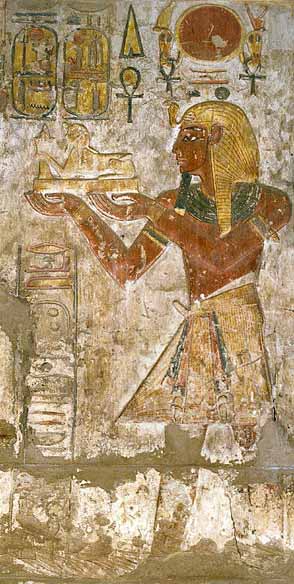
After the collapse of the Levant under the so called "Peoples of the Sea" Ramesses III (ca. 1194 BC) is said to have built a temple to the god Amen to receive tribute from the Levant. This was described as being built in Pa-Canaan, a geographical reference whose meaning is disputed, with suggestions that it may refer to the city of Gaza or to the entire Egyptian-occupied territory in Asia.
Some believe the "Habiru" signified generally all the nomadic tribes known as "Hebrews," and particularly the early Israelites, who sought to appropriate the fertile region for themselves. However, the term was rarely used to describe the Shasu. Whether the term may also include other related peoples such as the Moabites, Ammonites and Edomites is uncertain. It may not be an ethnonym at all; see the article Habiru for details.
By the Early Iron Age, the southern Levant came to be dominated by the kingdoms of Israel and Judah, besides the Philistine city-states on the Mediterranean coast, and the kingdoms of Moab, Ammon and Aram-Damascus east of the Jordan River, and Edom to the south. The northern Levant was divided into various petty kingdoms, the so-called Syro-Hittite states and the Phoenician city-states.
The entire region, was conquered by the Neo-Assyrian Empire during the 10th and 9th centuries BC, and would remain so until the end of the 7th Century BC. The Egyptians, then under a Nubian Dynasty, made a failed attempt to regain a foothold in the region, but were vanquished by the Assyrians, leading to an Assyrian invasion of Egypt and the destruction of the Kushite Empire. The Kingdom of Judah was forced to pay tribute to Assyria, and was eventually conquered by the Neo-Babylonian Empire during the 6th century BC.
After the Iron Age the periods are named after the various empires that ruled the region: Assyrian, Babylonian, Persian, Greek (Hellenistic) and Roman.
Canaanite civilization was a response to long periods of stable climate interrupted by short periods of climate change. During these periods, Canaanites profited from their intermediary position between the ancient civilizations of the Middle East Ancient Egypt, Mesopotamia (Sumer, Akkad, Assyria, Babylonia), the Hittites, and Minoan Crete to become city states of merchant princes along the coast, with small kingdoms specializing in agricultural products in the interior.
This polarity, between coastal towns and agrarian hinterland, was illustrated in Canaanite mythology by the struggle between the storm god, variously called Teshub (Hurrian) or Ba'al Hadad (Semitic Amorite/Aramaean) and Ya'a, Yaw, Yahu or Yam, god of the sea and rivers.
Early Canaanite civilization was characterized by small walled market towns, surrounded by peasant farmers growing a range of local horticultural products, along with commercial growing of olives, grapes for wine, and pistachios, surrounded by extensive grain cropping, predominantly wheat and barley.
Harvest in early summer was a season when transhumance nomadism was practiced - shepherds staying with their flocks during the wet season and returning to graze them on the harvested stubble, closer to water supplies in the summer. Evidence of this cycle of agriculture is found in the Gezer Calendar and in the Biblical cycle of the year.
Periods of rapid climate change generally saw a collapse of this mixed Mediterranean farming system; commercial production was replaced with subsistence agricultural foodstuffs; and transhumance pastoralism became a year-round nomadic pastoral activity, whilst tribal groups wandered in a circular pattern north to the Euphrates, or south to the Egyptian delta with their flocks.
Occasionally, tribal chieftains would emerge, raiding enemy settlements and rewarding loyal followers from the spoils or by tariffs levied on merchants. Should the cities band together and retaliate, a neighboring state intervene or should the chieftain suffer a reversal of fortune, allies would fall away or inter-tribal feuding would return. It has been suggested that the Patriarchal tales of the Bible reflect such social forms.
During the periods of the collapse of Akkadian Empire in Mesopotamia and the First Intermediary Period in Egypt, the Hyksos invasions and the end of the Middle Bronze Age in Assyria and Babylonia, and the Late Bronze Age collapse, trade through the Canaanite area would dwindle, as Egypt, Babylonia, and to a lesser degree Assyria, withdrew into their isolation.
When the climates stabilized, trade would resume firstly along the coast in the area of the Philistine and Phoenician cities. The Philistines, while an integral part of the Canaanite milieu, do not seem to have been ethnically homogenous with the Canaanites; the Hurrians (who spoke a language isolate), Hittites (Indo-European speakers), as well as the Semitic Aramaeans, Moabites, and Ammonites, are also considered "distinct" from generic Canaanites/Amorites, in scholarship or in tradition (although in the Biblical Book of Nations, "Heth", Hittites are a son of Canaan, despite the fact that it has been proven beyond doubt that the Hittites spoke an Indo-European language).
As markets redeveloped, new trade routes that would avoid the heavy tariffs of the coast would develop from Kadesh Barnea, through Hebron, Lachish, Jerusalem, Bethel, Samaria, Shechem, Shiloh through Galilee to Jezreel, Hazor and Megiddo. Secondary Canaanite cities would develop in this region. Further economic development would see the creation of a third trade route from Eilath, Timna, Edom (Seir), Moab, Ammon and thence to the Aramean states of Damascus and Palmyra. Earlier states (for example the Philistines and Tyrians in the case of Judah and Israel, for the second route, and Judah and Israel for the third route) tried generally unsuccessfully to control the interior trade.
Eventually, the prosperity of this trade would attract more powerful regional neighbours, such as Ancient Egypt, Assyria, the Babylonians, Persians, Ancient Greeks and Romans, who would control the Canaanites politically, levying tribute, taxes and tariffs. Often in such periods, thorough overgrazing would result in a climatic collapse and a repeat of the cycle (e.g. PPNB, Ghassulian, Uruk, and the Bronze Age cycles already mentioned).
The fall of later Canaanite civilization occurred with the incorporation of the area into the Greco-Roman world (as Iudaea province), and after Byzantine times, into the Muslim Arab and proto-Muslim Ummayad Caliphate. Western Aramaic, one of the two lingua francas of Canaanite civilization, is still spoken in a number of small Syrian villages, whilst Phoenician Canaanite disappeared as a spoken language in about 100 AD. A separate Akkadian-infused Eastern Aramaic is still spoken by the existing Assyrians of Iraq, Iran, northeast Syria and southeast Turkey.
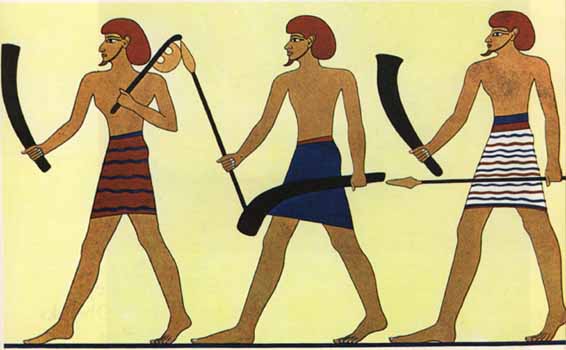
The Canaanites were the inhabitants of Palestine at the time
the Israelites, led by Joshua, entered the Promised Land.
Canaan and the Canaanites are mentioned some 160 times in the Hebrew Bible, mostly in the Pentateuch and the books of Joshua and Judges. Canaan first appears as one of Noah's grandsons, cursed with perpetual slavery because his father Ham had "looked upon" the drunk and naked Noah; God later promises Canaan's land to Abraham and eventually delivers it to the Israelites. The Biblical history has become increasingly problematic as the archaeological and textual evidence supports the idea that the early Israelites were in fact themselves Canaanites.
The Hebrew Bible lists borders for the land of Canaan. Numbers 34:2 includes the phrase "the land of Canaan as defined by its borders." The borders are then delineated in Numbers 34:3Ð12. The term "Canaanites" in Biblical Hebrew is applied especially to the inhabitants of the lower regions, along the sea coast and on the shores of Jordan, as opposed to the inhabitants of the mountainous regions. By the time of the Second Temple, "Canaanite" in Hebrew had come to be not an ethnic designation, so much as a general synonym for "merchant", as it is interpreted in, for example, Job 40:30, or Proverbs 31:24.
John N. Oswalt notes that "Canaan consists of the land west of the Jordan and is distinguished from the area east of the Jordan." Oswalt then goes on to say that in Scripture Canaan "takes on a theological character" as "the land which is God's gift" and "the place of abundance".
The Hebrew Bible describes the Israelite conquest of Canaan in the "Former Prophets" the books of Joshua, Judges, first and second Samuel, 1st & 2nd Kings. These five books of the Old Testament canon give the narrative of the Israelites after the death of Moses and Joshua leading them into Canaan
In 586 BC, the Israelites in turn lost the land to the Babylonians. These narratives of the Former Prophets are also "part of a larger work, called the Deuteronomistic History"
The part of the book of Genesis in the Hebrew Bible often called the Table of Nations describes the Canaanites as being descended from an ancestor called Canaan The son of Ham, the Grandson of Noah.
In the 6th century BC, Hecataeus of Miletus affirms that Phoenicia was formerly called XVA a name that Philo of Byblos subsequently adopted into his mythology as his eponym for the Phoenicians: "Khna who was afterwards called Phoinix". Quoting fragments attributed to Sanchuniathon, he relates that Byblos, Berytus and Tyre were among the first cities ever built, under the rule of the mythical Cronus, and credits the inhabitants with developing fishing, hunting, agriculture, shipbuilding and writing.
The southern highlands of the region were later named Judea after the kingdom of Judah, while the coastal region came to be known as Palaestina from the name of the Philistines. That name was extended to a larger area in the 2nd century, with the establishment of the Roman province of Syria Palaestina.
Saint Augustine also mentions that one of the terms the seafaring Phoenicians called their homeland was "Canaan". This is further confirmed by coins of the city of Laodicea in modern day Syria, that bear the legend, "Of Laodicea, a metropolis in Canaan"; these coins are dated to the reign of Antiochus IV (175-164 BC) and his successors. Augustine also records that the rustic people of Hippo retained the Punic self-designation Chanani.
The Bible reveals that Canaan was the fourth son of Ham and brother of Mizraim, who is Egypt. It was Canaan, the grandson of Noah who Noah had cursed in Genesis 9:25. The descendants of Canaan are listed in Genesis 10:15-19. The Canaanites actually became a general term for "all the inhabitants" of the land of ancient Israel, and especially to the tribe who dwelt west of the Dead Sea and had conquered the whole area east of the Jordan River.
The Canaanites worshipped Baal, and his wife Ashteroth, fertility deities. There religion involved temple prostitution, human sacrifice and orgies. These cursed people were eventually annihilated, for the most part, by the Israelites. The Lord commanded Israel to utterly destroy them, but they fell short. The Philistines became a deadly enemy throughout Israel's history.
The discovery of the Tell el-Amarna Letters reveal the name of Canaan (Kinakhna). The Greeks later identified this same name (Chna) with the Phoenicians. This wall relief discovery of an ancient Canaanite is important in the study of Biblical Archaeology. It confirms the Biblical account of the people know and the Canaanites. Many high places of Baal and Ashteroth have been excavated revealing their religious practices and child sacrifice.
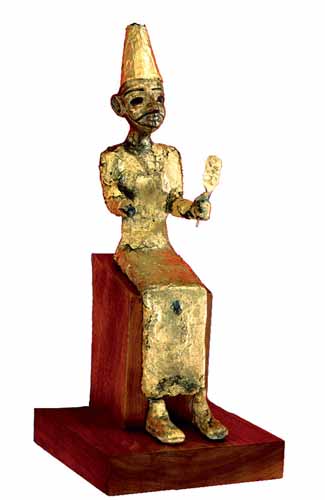
The chief of the pantheon and father of the gods worshipped by the Canaanites of Israel was El, who is portrayed here in gold-covered bronze. Excavated at Megiddo, Israel, it dates to 1400-1200 B.C.
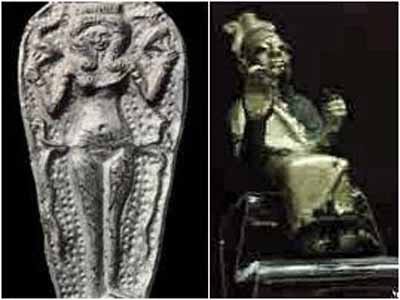
Central to the Semitic notion of deity is El, the old fatherly creator god and his consort, Athirat or Asherah. "Both were primordial beings, they had been there always." El, whose name simply meant 'god' was the creator and procreator, overseer of conception, who sired the gods, thus being also called 'Bull El' in continuity with the ancient bull god of fertility. Asherah and El thus form a creation hieros-gamos of male and female, representing the bull and the earth goddess we see emerging from the ancient continuum at Catal Huyuk. El is supposed to have gone out to sea and asked two Goddesses, one presumably being Athirat and the other possibly Anath to choose between being his spouses and being his daughters. They chose the former. Their offspring are Shaher and Shalem, the morning and evening stars, from which Lucifer, the light-bearer, takes his name.
Many of the archetypes we now perceive in Yahweh have their origin in El. He is an original creator god - the 'Creator of Created things', which definitely includes fertility, but may also include the creation of Heaven and Earth as with the Mesopotamian Marduk and Tiamat, whose own mythology may be partly derived from the older Canaanite myths.
El was the proverbial old man who is both a father and judge. He was a kingly and kindly figure, benevolent but not uninvolved. He was the god of decrees and the father of the reigning king. "It was his responsibility to ensure that equilibrium was preserved among all the conflicting and competing powers within it." He thus was respected by the other Gods - "Your decree El is wise, your wisdom is everlasting." "It was not for nothing that El was called 'the kindly and compassionate' - a design strangely reminiscent of 'Allah the Merciful, the Compassionate' in Islam. Not that El was inccapable of anger: transgressions in the community ... could provoke him - and then he would prompt neighboring powers to invade and conquer. To avert such calamities the king had to perform rites of expiation and offer sacrifices".
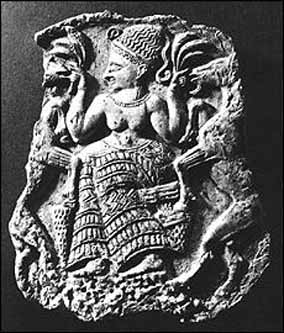
Athirat as Sea Goddess with Hathor headdress and El
Asherah, the Semitic name of the Great Goddess, whose origin differs from Astarte, was "in wisdom the Mistress of the Gods", called by the Sumerians Ashnan "the strength of all things", a "kindly and beautiful maiden."
The Canaanites called her "She who gives birth to the Gods" and as the "Lady who traverses the Sea" she is Goddess of both the Sea and Moon. In the Old Testament she is identified with her sacred groves.
Although Canaanite mythology varies from city to city, the discovery of extensive records at Ras Shamra of the city of Ugarit, gives us a uniquely detailed view of Canaanite Gods and Goddesses, dating from the author Elimelek around 1370 BC.
Kings traditionally ruled as intermediaries of the Gods in maintaining the fertility of the land.Despite siring the Gods and Goddesses, El and Asherah, no longer remain the only key players in the cosmic drama. As with Sumerian and many other mythologies a cosmic struggle for supremacy arises in which mortal combat occurs.
This weaves themes both of maintaining the cosmic order against the turbulent waters of chaos and the barren season of death and of combat associated with new deities arising from social and political change.
In the Canaanite myth, a new and possibly Akkadian outsider, whose name is Ba'al Haddad or Lord enters the situation in hated competition with Asherah and her children by El. He is a young, warlike god of wind and thunderstorms and thus fertility itself.
Unlike El, he is not judicious, frequently figuring in situations from which he must be saved. In this respect he displays a significant parallel to Dumuzi (Tammuz) among the Mesopotamians, which will prove to be of significance. He also has the hideous attribute of devouring his own children, consistent with infanticide practices of several semitic patron gods.
Initially Ba'al and Anat are members of El's court. Ba'al attacks El by surprise and castrates him, assuming the power of his fertility. In effect, Ba'al becomes the central intermediary of paternal cosmic order ... "it is Ba'al's responsibility to ensure El's benevolent intention is realized", but he does not replace the primal creative power of El.
El, who loves all the Gods, now calls on his children as chaos gods to avenge his displacement. His son Yamm, Lord of the Sea and the mythical ocean of chaos lying beyond the ordered world, terrorizes the gods into giving up Baal. But Ba'al refuses and conquers Yamm, Ba'al now emerging as the God who overcomes the waters of chaos.
Mot, the next offspring, who is Lord of the Underworld and the barren season then defeats Ba'al, enraging Ba'al's consort Anath, who ironically in the Ugarit form of the myth enters the fray as a Death Goddess upholding the paternal order.
When Mot refuses to revive Ba'al, Anath kills and dismembers him, scattering his remains over the land. Baal, now revived, undertakes a full-scale war against all the other gods, who are now referred to as the "Sons of Asherah," and is victorious.
The death of Mot is conceived in a seven year cycle as representing the end of seven years of drought and famine.In her role of Goddess of War and Death , Anath's lust for blood is unbounded: "Anat kills the people living in valleys, in cities and on the seashore and in the land of sunrise, until the cut off heads of soldiers were reaching to her belt and she was wading up to her waist in blood.
Violently she smites and gloats, Anat cuts them down and gazes; her liver exhaults in mirth ... for she plunges her knees in the blood of soldiers, her loins in the gore of warriors, till she has had her fill of slaughtering in the house, of cleaving among the tables."
After which, she, the Progenetress of Nations washed her hands of the blood of the slain, in dew and rain supplied by her brother Ba'al." (Walker 29, Cohn 1993 126)
Anath was fertilized by the blood of men, rather than semen, because her worship dated all the way back to the neolithic, when fatherhood was unknown and blood was considered the only substance which could transmit life.
Hecatombs of 100 men seem to have been sacrificed to Anath when her image was reddened with rouge and henna for the occasion. Like the Lady of the Serpent Skirt, Anath hung the shorn penises of her victims on her goatskin apron or aegis." "Anath's capacity to curse and kill made even the Heavenly Father afraid of her.
When El seemed reluctant to do her bidding, she threatened to smash his head and cover his grey hair and beard with gore. He hastily gave her everything she asked, saying 'Whoever hinders thee will be crushed' " (Walker 30).
In the mythical cycle, "Mot too is now revived and once again challenges Baal to single combat. In the midst of the fighting, however, the sun-goddess, Spsi (Shapash), intervenes, advising Mot that no further combat is needed because El is now on the side of Baal.
El, always patriarchal and judicious, has discerned that Baal in his defeat and resurrection has manifested a new form of order; as a patriarchal deity El must uphold this new order. The decree is made that Baal will rule during the seasons of fertility and Mot during the seasons of sterility and drought." There are many implications of this mythical cycle that underly the events of the Bible and overshadow and cast the die for the Christian heritage. Read more