Volcanism has played a major part in shaping not only planet Earth, but other places in our universe. Though other planets show signs of volcanic eruptions, most seemed to have erupted in the distant past and are inactive now. Both Mars and Venus have volcanoes much larger than any on Earth, and they have erupted huge amounts of lava onto their surfaces in the past.
The Earth's Moon has no large volcanoes and no current volcanic activity, although recent evidence suggests it may still possess a partially molten core. However, the Moon does have many volcanic features such as maria (the darker patches seen on the moon), rilles and domes.
The planet Venus has a surface that is 90% basalt, indicating that volcanism played a major role in shaping its surface. The planet may have had a major global resurfacing event about 500 million years ago, from what scientists can tell from the density of impact craters on the surface. Lava flows are widespread and forms of volcanism not present on Earth occur as well. Changes in the planet's atmosphere and observations of lightning have been attributed to ongoing volcanic eruptions, although there is no confirmation of whether or not Venus is still volcanically active. However, radar sounding by the Magellan probe revealed evidence for comparatively recent volcanic activity at Venus's highest volcano Maat Mons, in the form of ash flows near the summit and on the northern flank.
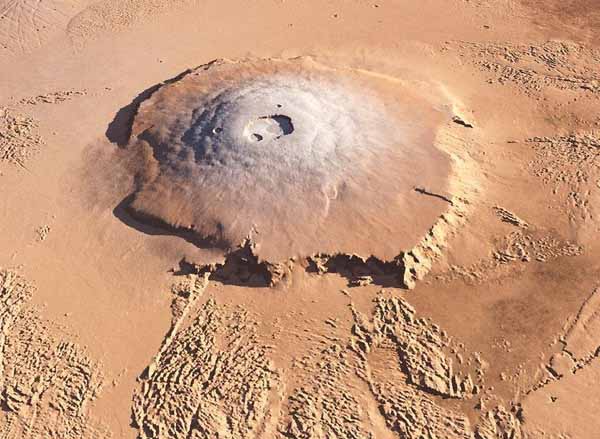
There are several extinct volcanoes on Mars, four of which are vast shield volcanoes far bigger than any on Earth. They include Arsia Mons, Ascraeus Mons, Hecates Tholus, Olympus Mons, and Pavonis Mons. These volcanoes have been extinct for many millions of years, but the European Mars Express spacecraft has found evidence that volcanic activity may have occurred on Mars in the recent past as well.
Jupiter's moon Io is the most volcanically active object in the solar system because of tidal interaction with Jupiter. It is covered with volcanoes that erupt sulfur, sulfur dioxide and silicate rock, and as a result, Io is constantly being resurfaced. Its lavas are the hottest known anywhere in the solar system, with temperatures exceeding 1,800 K (1,500 ¡C). In February 2001, the largest recorded volcanic eruptions in the solar system occurred on Io. Europa, the smallest of Jupiter's Galilean moons, also appears to have an active volcanic system, except that its volcanic activity is entirely in the form of water, which freezes into ice on the frigid surface. This process is known as cryovolcanism, and is apparently most common on the moons of the outer planets of the solar system.
In 1989 the Voyager 2 spacecraft observed cryovolcanoes (ice volcanoes) on Triton, a moon of Neptune, and in 2005 the CassiniÐHuygens probe photographed fountains of frozen particles erupting from Enceladus, a moon of Saturn. The ejecta may be composed of water, liquid nitrogen, ammonia, dust, or methane compounds. CassiniÐHuygens also found evidence of a methane-spewing cryovolcano on the Saturnian moon Titan, which is believed to be a significant source of the methane found in its atmosphere. It is theorized that cryovolcanism may also be present on the Kuiper Belt Object Quaoar. A 2010 study of the exoplanet COROT-7b, which was detected by transit in 2009, suggested that tidal heating from the host star very close to the planet and neighboring planets could generate intense volcanic activity similar to that found on Io.
Weird Volcanoes Are Erupting Across the Solar System Live Science - August 12, 2018
NASA's Juno spacecraft recently spotted a possible new volcano at the south pole of Jupiter's most lava-licious moon, Io. But this volcanically active moon is not alone in the solar system, where sizzling-hot rocks explode and ooze onto the surface of several worlds. So how do Earthly volcanoes differ from those erupting across the rest of the solar system? Let's start with Io. The moon is famous for its hundreds of volcanoes, including fountains that sometimes spurt lava dozens of miles above the surface, according to NASA. This Jupiter moon is constantly re-forming its surface through volcanic eruptions, even to this day. Io's volcanism results from strong gravitational encounters between Jupiter and two of its large moons, Europa and Ganymede, which shake up Io's insides.
The robotic NASA spacecraft Dawn entered orbit around Ceres on March 6, 2015. Pictures with a resolution previously unattained were taken during imaging sessions starting in January 2015 as Dawn approached Ceres, showing a cratered surface. Two distinct bright spots (or high-albedo features) inside a crater (different from the bright spots observed in earlier Hubble images) were seen in a February 19, 2015 image, leading to speculation about a possible cryovolcanic origin or outgassing.
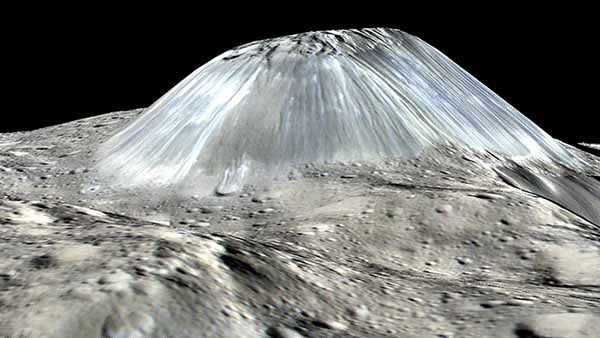
On March 3, 2015, a NASA spokesperson said the spots are consistent with highly reflective materials containing ice or salts, but that cryovolcanism is unlikely, however on 2 September 2016, published alongside six other studies, NASA scientists released a paper in Science that claims that a massive ice volcano called Ahuna Mons is the strongest evidence yet for the existence of these mysterious ice volcanoes.
On May 11, 2015, NASA released a higher-resolution image showing that, instead of one or two spots, there are actually several. On December 9, 2015, NASA scientists reported that the bright spots on Ceres may be related to a type of salt, particularly a form of brine containing magnesium sulfate hexahydrite (MgSO4á6H2O); the spots were also found to be associated with ammonia-rich clays. In June 2016, near-infrared spectra of these bright areas were found to be consistent with a large amount of sodium carbonate (Na 2CO 3), implying that recent geologic activity was probably involved in the creation of the bright spots.
Lonely Ice Volcano On Ceres May Have Once Had Company Live Science - February 6, 2017
The mystery of the dwarf planet Ceres' lonely ice volcano may have just been solved. NASA's Dawn probe discovered the 2.5-mile-high (4 kilometers) cryovolcano, named Ahuna Mons, in 2015. There's nothing else remotely like it on the 590-mile-wide (950 km) Ceres - a fact that has had scientists scratching their heads. The dwarf planet Ceres may once have harbored many ice volcanoes, all but one of which have flattened out and vanished into the dwarf planet's surface, a new study suggests.
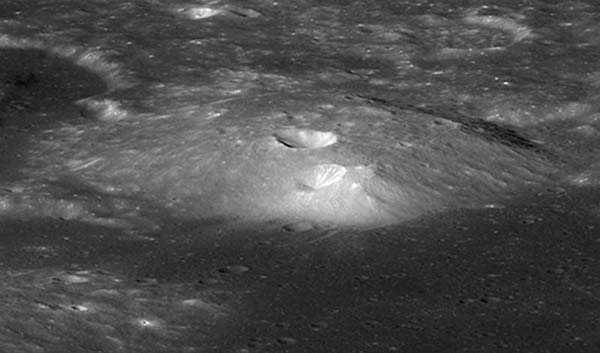
The Earth's Moon has no large volcanoes. However, vast plains of basaltic lavas cover much of the lunar surface. The earliest astronomers thought, wrongly, that these 'Plains were seas of lunar water'. Thus, they were called "mare " (pronounced "mahr-ay"). Mare means "sea" in Latin. In addition, other volcanic features also occur within the lunar mare. The most important are sinuous rilles , dark mantling deposits, and small volcanic domes and cones . Most of these features are fairly small, however. They form only a tiny fraction of the lunar volcanic record.
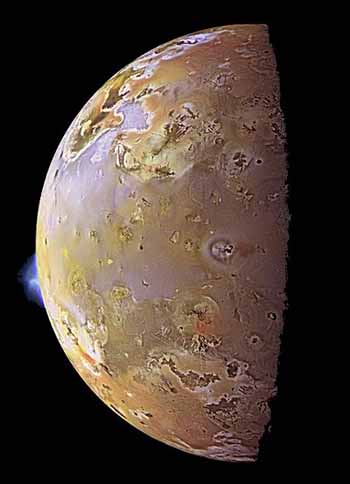
Volcanism on Io, a moon of Jupiter, produces lava flows, volcanic pits, and plumes of sulfur and sulfur dioxide hundreds of kilometres high. This volcanic activity was discovered in 1979 by Voyager 1 imaging scientists.
Observations of Io by passing spacecraft (the Voyagers, Galileo, Cassini, and New Horizons) and Earth-based astronomers have revealed more than 150 active volcanoes. Up to 400 such volcanoes are predicted to exist based on these observations. Io's volcanism makes the satellite one of only five known currently volcanically active worlds in the solar system (the other four being Earth, Venus, Saturn's moon Enceladus, and Neptune's moon Triton).
First predicted shortly before the Voyager 1 flyby, the heat source for Io's volcanism comes from tidal heating produced by its forced orbital eccentricity. This differs from Earth's internal heating, which is derived primarily from radioactive isotope decay.
Io's eccentric orbit leads to a slight difference in Jupiter's gravitational pull on the satellite between its closest and farthest points on its orbit, causing a varying tidal bulge. This variation in the shape of Io causes frictional heating in its interior. Without this tidal heating, Io might have been similar to the Earth's moon, a world of similar size and mass, geologically dead and covered with numerous impact craters.
Io's volcanism has led to the formation of hundreds of volcanic centres and extensive lava formations, making the moon the most volcanically active body in the Solar System. Three different types of volcanic eruptions have been identified, differing in duration, intensity, lava effusion rate, and whether the eruption occurs within a volcanic pit (known as a patera). Lava flows on Io, tens or hundreds of kilometres long, have primarily basaltic composition, similar to lavas seen on Earth at shield volcanoes such as Kilauea in Hawaii.
While most lavas on Io are made of basalt, a few lava flows consisting of sulfur and sulfur dioxide have been seen. In addition, eruption temperatures as high as 1,600 K (1,300 °C; 2,400 °F) were detected, which can be explained by the eruption of high-temperature ultramafic silicate lavas.
As a result of the presence of significant quantities of sulfurous materials in Io's crust and on its surface, some eruptions propel sulfur, sulfur dioxide gas, and pyroclastic material up to 500 kilometres (310 mi) into space, producing large, umbrella-shaped volcanic plumes.
This material paints the surrounding terrain in red, black, and/or white, and provides material for Io's patchy atmosphere and Jupiter's extensive magnetosphere. Spacecraft that have flown by Io since 1979 have observed numerous surface changes as a result of Io's volcanic activity.
Volcanoes on Io, a moon of the planet Jupiter, are believed to eject sulfur or possibly sulfur dioxide.
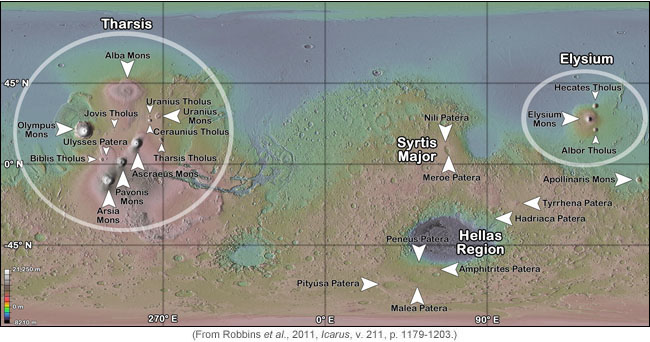
Scientists have never recorded an active volcano eruption on the surface of Mars, however, the European Space Agency's Mars Express orbiter photographed lava flows that must have occurred within the past two million years, suggesting a relatively recent geologic activity.
Volcanic activity, or volcanism, has played a significant role in the geologic evolution of Mars. Scientists have known since the Mariner 9 mission in 1972 that volcanic features cover large portions of the Martian surface. These features include extensive lava flows, vast volcanic plains, and the largest known volcanoes in the Solar System. Martian volcanic features range in age from Noachian (>3.7 billion years) to late Amazonian (< 500 million years), indicating that the planet has been volcanically active throughout its history and probably still is so today.
Volcanic plains are widespread on Mars. Two types of plains are commonly recognized: those where lava flow features are common, and those where flow features are generally absent but a volcanic origin is inferred by other characteristics.
Plains with abundant lava flow features occur in and around the large volcanic provinces of Tharsis and Elysium.
Flow features include both sheet flow and tube- and channel-fed flow morphologies. Sheet flows show complex, overlapping flow lobes and may extend for many hundreds of kilometers from their source areas.
Lava flows can form a lava tube when the exposed upper layers of lava cool and solidify to form a roof while the lava underneath continues flowing. Often, when all the remaining lava leaves the tube, the roof collapses to make a channel or line of pit craters (catena).
An unusual type of flow feature occurs in the Cerberus plains south of Elysium and in Amazonis. These flows have a broken platey texture, consisting of dark, kilometer-scale slabs embedded in a light-toned matrix. They have been attributed to rafted slabs of solidified lava floating on a still-molten subsurface. Others have claimed the broken slabs represent pack ice that froze over a sea that pooled in the area after massive releases of groundwater from the Cerberus Fossae area.
Both Earth and Mars are large, differentiated planets built from similar chondritic materials. Many of the same magmatic processes that occur on Earth also occur on Mars, and both planets are similar enough compositionally that the same names can be applied to their igneous rocks and minerals.
Volcanism is a process in which magma from a planet's interior rises through the crust and erupts on the surface. The erupted materials consist of molten rock (lava), hot fragmental debris (tephra or ash), and gases. Volcanism is a principal way that planets release their internal heat. Volcanic eruptions produce distinctive landforms, rock types, and terrains that provide a window on the chemical composition, thermal state, and history of a planet's interior.
Magma is a complex, high-temperature mixture of molten silicates, suspended crystals, and dissolved gases. Magma on Mars likely ascends in a similar manner to that on Earth. It rises through the lower crust in diapiric bodies that are less dense than the surrounding material. As the magma rises, it eventually reaches regions of lower density.
When the magma density matches that of the host rock, buoyancy is neutralized and the magma body stalls. At this point, it may form a magma chamber and spread out laterally into a network of dikes and sills. Subsequently, the magma may cool and solidify to form intrusive igneous bodies (plutons). Geologists estimate that about 80% of the magma generated on Earth stalls in the crust and never reaches the surface.
As magma rises and cools, it undergoes many complex and dynamic compositional changes. Heavier minerals may crystallize and settle to the bottom of the magma chamber. The magma may also assimilate portions of host rock or mix with other batches of magma. These processes alter the composition of the remaining melt, so that any magma reaching the surface may be chemically quite different from its parent melt.
Magmas that have been so altered are said to be "evolved" to distinguish them from "primitive" magmas that more closely resemble the composition of their mantle source. (See igneous differentiation and fractional crystallization.) More highly evolved magmas are usually felsic, that is enriched in silica, volatiles, and other light elements compared to iron- and magnesium-rich (mafic) primitive magmas.
The degree and extent to which magmas evolve over time is an indication of a planet's level of internal heat and tectonic activity. The Earth's continental crust is made up of evolved granitic rocks that developed through many episodes of magmatic reprocessing. Evolved igneous rocks are much less common on cold, dead bodies such as the Moon. Mars, being intermediate in size between the Earth and the Moon, is thought to be intermediate is its level of magmatic activity.
At shallower depths in the crust, the lithostatic pressure on the magma body decreases. The reduced pressure can cause gases (volatiles), such as carbon dioxide and water vapor, to exsolve from the melt into a froth of gas bubbles. The nucleation of bubbles causes a rapid expansion and cooling of the surrounding melt, producing glassy shards that may erupt explosively as tephra (also called pyroclastics).
Fine-grained tephra is commonly referred to as volcanic ash. Whether a volcano erupts explosively or effusively as fluid lava depends on the composition of the melt. Felsic magmas of andesitic and rhyolitic composition tend to erupt explosively. They are very viscous (thick and sticky) and rich in dissolved gases. Mafic magmas, on the other hand, are low in volatiles and commonly erupt effusively as basaltic lava flows.
However, these are only generalizations. For example, magma that comes into sudden contact with groundwater or surface water may erupt violently in steam explosions called hydromagmatic (phreatomagmatic or phreatic) eruptions. Also, erupting magmas may behave differently on planets with different interior compositions, atmospheres, and gravity fields.
The most common form of volcanism on the Earth is basaltic. Basalts are extrusive igneous rocks derived from the partial melting of the upper mantle. They are rich in iron and magnesium (mafic) minerals and commonly dark gray in color. The principal type of volcanism on Mars is almost certainly basaltic too.
On Earth, basaltic magmas commonly erupt as highly fluid flows, which either emerge directly from vents or form by the coalescence of molten clots at the base of fire fountains (Hawaiian eruption). These styles are also common on Mars, but the lower gravity and atmospheric pressure on Mars allow nucleation of gas bubbles to occur more readily and at greater depths than on Earth.
As a consequence, Martian basaltic volcanoes are also capable of erupting large quantities of ash in Plinian-style eruptions. In a Plinian eruption, hot ash is incorporated into the atmosphere, forming a huge convective column (cloud). If insufficient atmosphere is incorporated, the column may collapse to form pyroclastic flows. Plinian eruptions are rare in basaltic volcanoes on Earth where such eruptions are most commonly associated with silica-rich andesitic or rhyolitic magmas (e.g., Mount St. Helens).
Because the lower gravity of Mars generates less buoyancy forces on magma rising through the crust, the magma chambers that feed volcanoes on Mars are thought to be deeper and much larger than those on Earth. If a magma body on Mars is to reach close enough to the surface to erupt before solidifying, it must be big. Consequently, eruptions on Mars are less frequent than on Earth, but are of enormous scale and eruptive rate when they do occur. Somewhat paradoxically, the lower gravity of Mars also allows for longer and more widespread lava flows. Lava eruptions on Mars may be unimaginably huge. A vast lava flow the size of the state of Oregon has recently been described in western Elysium Planitia. The flow is believed to have been emplaced turbulently over the span of several weeks and thought to be one of the youngest lava flows on Mars.
The tectonic settings of volcanoes on Earth and Mars are very different. Most active volcanoes on Earth occur in long, linear chains along plate boundaries, either in zones where the lithosphere is spreading apart (divergent boundaries) or being subducted back into the mantle (convergent boundaries).
Because Mars currently lacks plate tectonics, volcanoes there do not show the same global pattern as on Earth. Martian volcanoes are more analogous to terrestrial mid-plate volcanoes, such as those in the Hawaiian Islands, which are thought to have formed over a stationary mantle plume.
The largest and most conspicuous volcanoes on Mars occur in Tharsis and Elysium regions. These volcanoes are strikingly similar to shield volcanoes on Earth. Both have shallow-sloping flanks and summit calderas. The main difference between Martian shield volcanoes and those on Earth is in size: Martian shield volcanoes are truly colossal. For example, the tallest volcano on Mars, Olympus Mons, is 550 km across and 21 km high.
It is nearly 100 times greater in volume than Mauna Loa in Hawaii, the largest shield volcano on Earth. Geologists think one of the reasons that volcanoes on Mars are able to grow so large is because Mars lacks plate tectonics. The Martian lithosphere does not slide over the upper mantle (asthenosphere) as on Earth, so lava from a stationary hot spot is able to accumulate at one location on the surface for a billion years or longer.
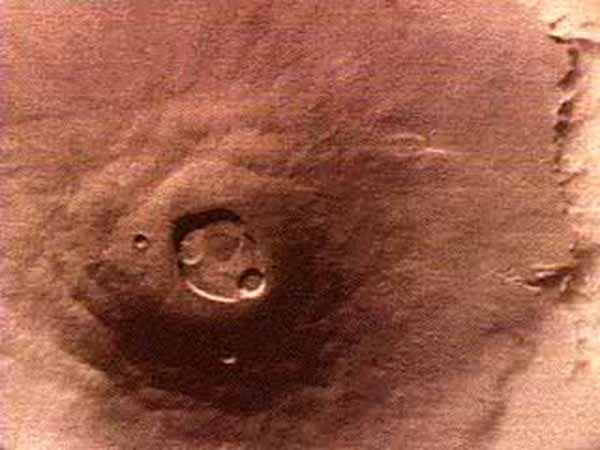
Olympus Mons is the youngest and tallest large volcano on Mars. It is located 1200 km northwest of of the Tharsis Montes, just off the western edge of the Tharsis bulge. Its summit is 21 km above datum (Mars "sea" level) and has a central caldera complex consisting of six nested calderas that together form a depression 72 x 91 km wide and 3.2 km deep.
As a shield volcano, it has an extremely low profile with shallow slopes averaging between 4-5 degrees. The volcano was built up by many thousands of individual flows of highly fluid lava. An irregular escarpment, in places up to 8 km tall, lies at the base of the volcano, forming a kind of pedestal on which the volcano sits. At various locations around the volcano, immense lava flows can be seen extending into the adjacent plains, burying the escarpment. In medium resolution images (100 m/pixel), the surface of the volcano has a fine radial texture due to the innumerable flows and leveed lava channels that line its flanks. Volcanism on Mars
Mars volcano, Earth's dinosaurs went extinct about the same time PhysOrg - March 20, 2017
Around the same time that the dinosaurs became extinct on Earth, a volcano on Mars went dormant, NASA researchers have learned. Arsia Mons is the southernmost volcano in a group of three massive Martian volcanoes known collectively as Tharsis Montes. Until now, the volcano's history has remained a mystery. But thanks to a new computer model, scientists were finally able to figure out when Arsia Mons stopped spewing out lava. According to the model, volcanic activity at Arsia Mons came to a halt about 50 million years ago. Around that same time, Earth experienced the Cretaceous-Paleogene extinction event, which wiped out three-quarters of its animal and plant species, including the dinosaurs.
Interesting Images
Neighboring volcanoes on Mars PhysOrg - April 4, 2011
ESA's Mars Express has returned images of mist-capped volcanoes located in the northern hemisphere of the red planet. Long after volcanic activity ceased, the area was transformed by meteor impacts that deposited ejected material over the lower flanks of the volcanoes.
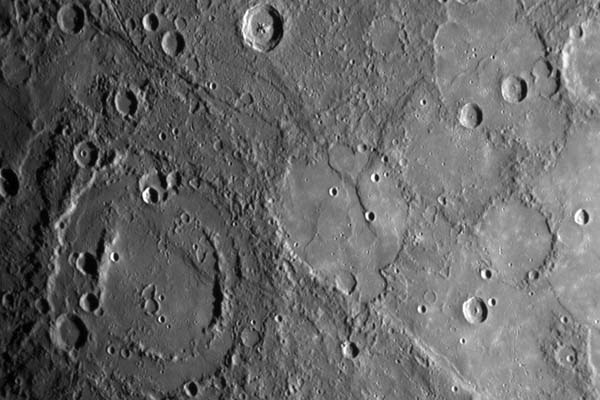
Many of Mercury's basins contain smooth plains, like the lunar mare, that are believed likely to be filled with lava flows. Collapse structures possibly indicative of volcanism have been found in some craters. Eleven volcanic domes were identified in Mariner 10 images, including a 7-km high dome near the centre of Odin Planitia. Odin Planitia is a large basin on Mercury located in the Tolstoj quadrangle at 23.3¡ N, 171.6¡ W. It was named after the Norse god Odin in 1976 by the IAU. A large volcanic dome 7 km in diameter and 1.4 km high is situated near the center of Odin.
Did Volcano on Mercury Erupt for a Billion Years? Live Science - December 8, 2013
Extra-terrestrial volcanism is every bit as stellar as its sounds. The Earth puts on its fair share of spectacular eruptions - but it's Earth's distant cousins who win the awards. Lava-scarred Venus has more volcanoes than any other planet we know; Olympus Mons, a treble Everest soaring above Mars' Northern Hemisphere, is the largest active peak in the solar system; while Saturn's frozen moon, Enceladus, where cryovolcanoes shoot towering streams of water through a crust of solid ice, must surely rank as the strangest. But what about the one place where you'd expect the ground to melt? Sitting just 36 million miles in front of our star, sun-baked Mercury receives a colossal dose of solar radiation with almost no atmosphere to soften the blast. It's perhaps not surprising, then, that alongside its thick coating of meteor scars, the gray, scorched crust also shows signs of damage from within. Since Mariner 10 first revealed its surface in the 1970s, conspicuously smooth plains - reminiscent of the lunar mare - suggested that in places, the impact craters had once been resurfaced by giant lava flows.
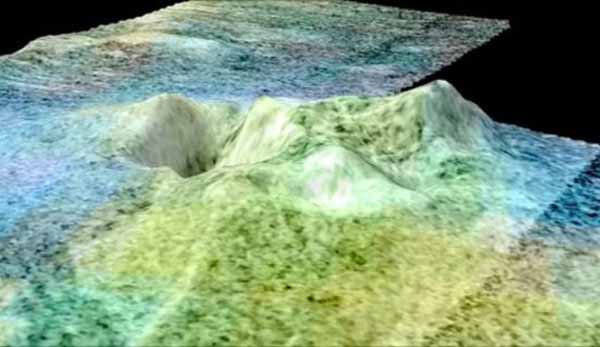
Saturn's moon Enceladus has geysers that spew water which have been photographed erupting by NASA's Cassini-Huygens spacecraft.
Another moon of Saturn, Titan, may also be volcanic (which would explain the satellite's dense atmosphere), as may be Neptune's moon, Triton.
'Ice volcano' identified on Saturn's moon Titan BBC - December 15, 2010
Scientists think they now have the best evidence yet for an ice volcano on Titan, the largest moon of Saturn. The Cassini probe has spotted a 1,500m-high mountain with a deep pit in it, and what looks like a flow of material on the surrounding surface. The new feature, which has been dubbed "The Rose", was seen with the probe's radar and infrared instruments. Titan has long been speculated to have cryovolcanoes but its hazy atmosphere makes all observations very difficult.
Ice Volcano Found on Saturn Moon Titan Space.com - April 1, 2011
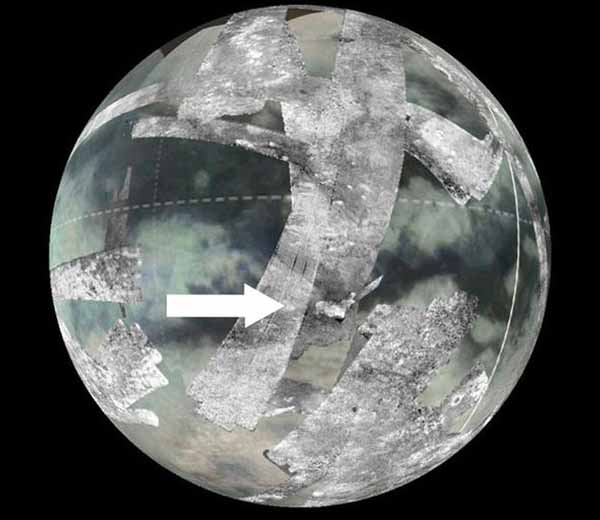
For the first time, scientists now have solid evidence for an ice volcano on Saturn's moon Titan, according to a new study. Instead of regular lava, the volcano may spew water ice, hydrocarbons or a variety of other materials into Titan's thick atmosphere, scientists said. Such an ice volcano's existence could help solve some mysteries about Titan's carbon cycle, researchers said, and it could increase the likelihood that life exists on the huge moon. This image shows the location of an area known as Sotra Facula on Saturn's moon Titan. The black and white swaths show data obtained by the radar instrument on NASA's Cassini spacecraft. The swaths were laid on top of a global composite image from Cassini's visual and infrared mapping spectrometer. Scientists believe the Sotra Facula region makes the best case for a cryovolcanic Ð or ice volcano Ð region on Titan.
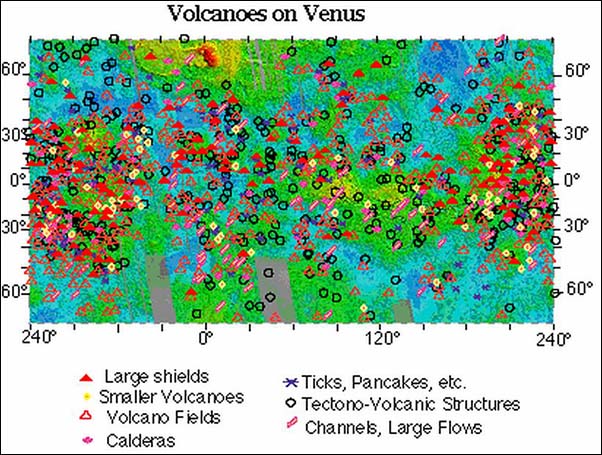
The surface of Venus is dominated by volcanism and has produced more volcanoes than any other planet in the solar system. It has a surface that is 90% basalt, and about 80% of the planet consists of a mosaic of volcanic lava plains, indicating that volcanism played a major role in shaping its surface.
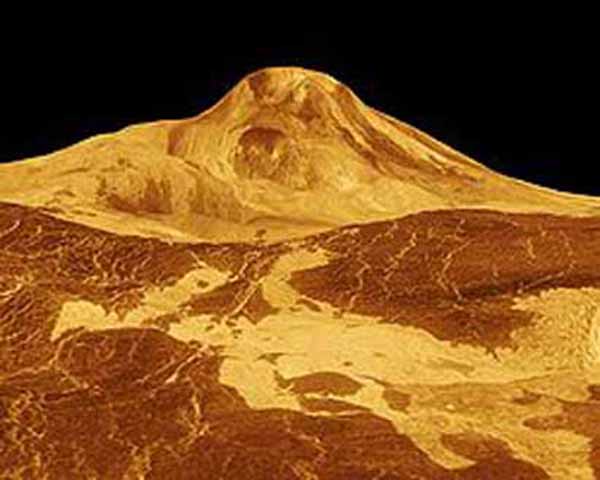
The planet may have had a major global resurfacing event about 500 million years ago, from what scientists can tell from the density of impact craters on the surface. Even though there are over 1,600 major volcanoes on Venus, none is known to be erupting at present and most are probably long extinct. However, radar sounding by the Magellan probe revealed evidence for comparatively recent volcanic activity at Venus's highest volcano Maat Mons, in the form of ash flows near the summit and on the northern flank.
Although many lines of evidence suggest that Venus is likely to be volcanically active, present-day eruptions at Maat Mons have not been confirmed.
In April 2010, Suzanne E. Smrekar et al. announced the discovery of three active volcanoes, which suggests that Venus is periodically resurfaced by lava flows.
Venus contains shield volcanoes, widespread lava flows and some unusual volcanoes called pancake domes and "tick-like" structures which are not present on Earth. Pancake dome volcanoes are up to 15 km (9.3 mi) in diameter and less than 1 km (0.62 mi) in height and are 100 times larger than those formed on Earth. They are usually associated with coronae and tesserae (large regions of highly deformed terrain, folded and fractured in two or three dimensions, believed to be unique to Venus). The pancakes are thought to be formed by highly viscous, silica-rich lava erupting under Venus's high atmospheric pressure.
The "tick-like" structures are called scalloped margin domes. They are commonly called ticks because they appear as domes with numerous legs. They are thought to have undergone mass wasting events such as landslides on their margins. Sometimes deposits of debris can be seen scattered around them.
On Earth, volcanoes are mainly of two types: shield volcanoes and composite or stratovolcanoes. The shield volcanoes, for example those in Hawaii, eject magma from the depths of the Earth in zones called hot spots. The lava from these volcanos is relatively fluid and permits the escape of gases. Composite volcanos, such as Mount Saint Helens and Mount Pinatubo, are associated with tectonic plates. In this type of volcano, the oceanic crust of one plate is sliding underneath the other in a subduction zone, together with an inflow of seawater, producing a gummier lava that restricts the exit of the gases, and for that reason, composite volcanoes tend to erupt more violently.
On Venus, where there are no tectonic plates or seawater, volcanoes are mostly of the shield type. Nevertheless, the morphology of volcanoes on Venus is different: on Earth, shield volcanoes can be a few tens of kilometres wide and up to 10 km (6.2 mi) high in the case of Mauna Kea, measured from the sea floor. On Venus, these volcanoes can cover hundreds of kilometres in area, but they are relatively flat, with an average height of 1.5 km (0.93 mi).
Other unique features of Venus's surface are novae (radial networks of dikes or grabens) and arachnoids. A nova is formed when large quantities of magma are extruded onto the surface to form radiating ridges and trenches which are highly reflective to radar. These dikes form a symmetrical network around the central point where the lava emerged, where there may also be a depression caused by the collapse of the magma chamber.
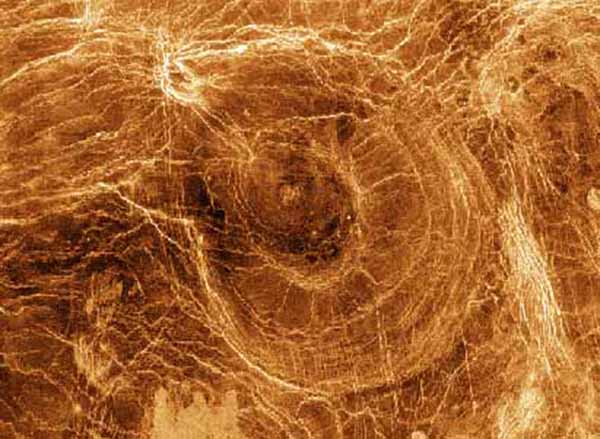
Arachnoids are so named because they resemble a spider's web, featuring several concentric ovals surrounded by a complex network of radial fractures similar to those of a nova. It is not known whether the 250 or so features identified as arachnoids actually share a common origin, or are the result of different geological processes. Read more