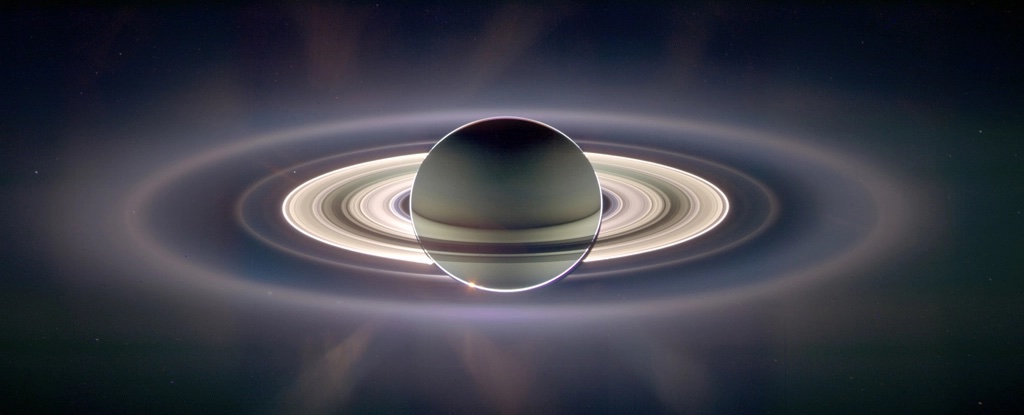
Saturn


Saturn is the sixth planet from the Sun and the second largest planet in the Solar System, after Jupiter. Saturn is named after the Roman god Saturn, equated to the Greek Cronus (the Titan father of Zeus), the Babylonian Ninurta and the Hindu Shani. Saturn's symbol represents the Roman god's sickle.

Saturn, along with Jupiter, Uranus and Neptune, is classified as a gas giant. Together, these four planets are sometimes referred to as the Jovian, meaning "Jupiter-like", planets. Saturn has an average radius about 9 times larger than the Earth's. While only 1/8 the average density of Earth, due to its larger volume, Saturn's mass is just over 95 times greater than Earth's.

Because of Saturn's large mass and resulting gravitation, the conditions produced on Saturn are extreme if compared to Earth. The interior of Saturn is probably composed of a core of iron, nickel, silicon and oxygen compounds, surrounded by a deep layer of metallic hydrogen, an intermediate layer of liquid hydrogen and liquid helium and finally, an outer gaseous layer.

Electrical current within the metallic-hydrogen layer is thought to give rise to Saturn's planetary magnetic field, which is slightly weaker than Earth's magnetic field and approximately one-twentieth the strength of the field around Jupiter.

The outer atmosphere is generally bland in appearance, although long-lived features can appear. Wind speeds on Saturn can reach 1,800 km/h, significantly faster than those on Jupiter.

Saturn has nine rings, consisting mostly of ice particles with a smaller amount of rocky debris and dust. Sixty-two known moons orbit the planet; fifty-three are officially named. This is not counting hundreds of "moonlets" within the rings. Titan, Saturn's largest and the Solar System's second largest moon (after Jupiter's Ganymede), is larger than the planet Mercury and is the only moon in the Solar System to possess a significant atmosphere.


   Eerie-sounding Radio Emissions From Saturn NASA - July 27, 2005


Music of the Rings


Cassini discovers music of the rings
New Scientist - November 9, 2004

Saturn's magnificent ring system - a huge disc resembling an old gramophone record - turns out to share another property with the LP: it constantly emits a melodic series of musical notes. The surprising discovery was made by radio and plasma wave detectors on board the Cassini spacecraft as it passed over Saturn's rings during its arrival at the planet in July. The tones are emitted as radio waves. Don Gurnett of the University of Iowa says his team reduced their frequencies by a factor of five to bring them into the range of human hearing. Gurnett says he was "completely astonished" when he heard the musical notes.

The tones are short, typically lasting between one and three seconds, and unlike the ethereal sliding tones associated with other cosmic processes, every one is quite distinct. The evidence suggests that each tone is produced by the impact of a meteoroid on the icy chunks that make up the rings.

Each hit, Gurnett says, creates a pulse of energy that is focused along the surface of a cone from the point of impact. By estimating the energy involved, he calculates that the impacting objects are about 1 centimetre across - although he cautions that his estimate could be out by as much as a factor of 10. Google Images


A Rough Comparison of the Sizes of Saturn and Earth

Due to a combination of its lower density, rapid rotation and fluid state, Saturn is an oblate spheroid; that is, it is flattened at the poles and bulges at the equator. Its equatorial and polar radii differ by almost 10% - 60,268 km versus 54,364 km.

The other gas planets are also oblate, but to a lesser extent. Saturn is the only planet of the Solar System that is less dense than water. Although Saturn's core is considerably denser than water, the average specific density of the planet is 0.69 g/cm3 due to the gaseous atmosphere. Saturn is only 95 Earth masses, compared to Jupiter, which is 318 times the mass of the Earth but only about 20% larger than Saturn.


Observing Saturn


Saturn's rings require at least a 15 mm diameter telescope to resolve and thus were not known to exist until Galileo first saw them in 1610. He thought of them as two moons on Saturn's sides. It was not until Christian Huygens used greater telescopic magnification that this notion was refuted. Huygens also discovered Saturn's moon Titan.

Some time later, Giovanni Domenico Cassini discovered four other moons: Iapetus, Rhea, Tethys and Dione.

In 1675, Cassini also discovered the gap now known as the Cassini Division.

No further discoveries of significance were made until 1789 when William Herschel discovered two further moons, Mimas and Enceladus. The irregularly shaped satellite Hyperion, which has a resonance with Titan, was discovered in 1848 by a British team.

In 1899 William Henry Pickering discovered Phoebe, a highly irregular satellite that does not rotate synchronously with Saturn as the larger moons do. Phoebe was the first such satellite found and it takes more than a year to orbit Saturn in a retrograde orbit.

During the early 20th century, research on Titan led to the confirmation in 1944 that it had a thick atmosphere - a feature unique among the solar system's moons.

Pioneer 11 Flyby

Saturn was first visited by Pioneer 11 in September 1979. It flew within 20,000 km of the planet's cloud tops. Low resolution images were acquired of the planet and a few of its moons; the resolution of the images was not good enough to discern surface features. The spacecraft also studied the rings; among the discoveries were the thin F-ring and the fact that dark gaps in the rings are bright when viewed towards the Sun, in other words, they are not empty of material. Pioneer 11 also measured the temperature of Titan. The Pioneer images of Saturn were significantly dimmer as the planet and its moons only receive 14.90 (Solar Irradiance) where Jupiter gets around 400. Camera technology would be improved in subsequent missions to the planet.

Voyager Flybys

In November 1980, the Voyager 1 probe visited the Saturn system. It sent back the first high-resolution images of the planet, its rings and satellites. Surface features of various moons were seen for the first time. Voyager 1 performed a close flyby of Titan, greatly increasing our knowledge of the atmosphere of the moon. It also proved that Titan's atmosphere is impenetrable in visible wavelengths; so, no surface details were seen. The flyby also changed the spacecraft's trajectory out from the plane of the solar system.

Almost a year later, in August 1981, Voyager 2 continued the study of the Saturn system. More close-up images of Saturn's moons were acquired, as well as evidence of changes in the atmosphere and the rings. Unfortunately, during the flyby, the probe's turnable camera platform stuck for a couple of days and some planned imaging was lost. Saturn's gravity was used to direct the spacecraft's trajectory towards Uranus.

The probes discovered and confirmed several new satellites orbiting near or within the planet's rings. They also discovered the small Maxwell Gap (a gap within the C Ring) and Keeler gap (a 42 km wide gap in the A Ring).

Cassini-Huygens Spacecraft

On July 1, 2004, the Cassini-Huygens space probe performed the SOI (Saturn Orbit Insertion) maneuver and entered into orbit around Saturn. Before the SOI, Cassini had already studied the system extensively. In June 2004, it had conducted a close flyby of Phoebe, sending back high-resolution images and data.

Cassini's flyby of Saturn's largest moon, Titan, has captured radar images of large lakes and their coastlines with numerous islands and mountains. The orbiter completed two Titan flybys before releasing the Huygens probe on December 25, 2004. Huygens descended onto the surface of Titan on January 14, 2005, sending a flood of data during the atmospheric descent and after the landing.

During 2005, Cassini conducted multiple flybys of Titan and icy satellites. Cassini's last Titan flyby started on March 23, 2008.

Since early 2005, scientists have been tracking lightning on Saturn. The power of the lightning is approximately 1000 times that of lightning on Earth.

In 2006, NASA reported that the Cassini probe found evidence of liquid water reservoirs that erupt in geysers on Saturn's moon Enceladus. Images had also shown particles of water in its liquid state emitted by icy jets and towering plumes.

Cassini probe photographs have led to other significant discoveries. They have revealed a previously undiscovered planetary ring, outside the brighter main rings of Saturn and inside the G and E rings. The source of this ring is believed to be the crashing of a meteoroid off two of the moons of Saturn.

In July 2006, Cassini images provided evidence of hydrocarbon lakes near Titan's north pole, the presence of which were confirmed in January 2007. In March 2007, additional images near Titan's north pole discovered hydrocarbon "seas", the largest of which is almost the size of the Caspian Sea.

In October 2006, the probe detected a 8,000 km diameter hurricane with an eyewall at Saturn's South Pole.

From 2004 to November 2, 2009, the probe discovered and confirmed 8 new satellites. Its primary mission ended in 2008 when the spacecraft had completed 74 orbits around the planet. The probe's mission was extended to September 2010 and then extended again to 2017, to study a full period of Saturn's seasons.


Exploration of Saturn


Saturn was first visited by Pioneer 11 in 1979. It flew within 20,000 km the planet's cloud-tops. Low-resolution images were acquired of the planet and few of its moons. Resolution was not good enough to discern surface features, however. The spacecraft also studied the rings; among the discoveries were the thin F-ring and the fact that dark gaps in the rings are bright when viewed towards the Sun, or in other words, they are not empty of material. It also measured the temperature of Titan.

In November, 1980, Voyager 1 probe visited the Saturn system. It sent back the first high-resolution images of the planet, rings, and the satellites. Surface features of various moons were seen for the first time. Voyager 1 performed a close flyby of Titan greatly increasing our knowledge of the atmosphere of the moon. However, it also proved that Titan's atmosphere is impenetrable in visible wavelengths, so no surface details were seen. The flyby also changed spacecraft's trajectory out from the plane of the solar system.

Almost a year later, in August, 1981, Voyager 2 continued the study of the Saturn system. More close-up images of Saturn's moons were acquired, as well as evidence of changes in the atmosphere and the rings. Unfortunately, during the flyby, the probe's camera stuck and some planned imaging was lost. Saturn's gravity was used to direct the spacecraft's trajectory towards Uranus.

The probes discovered and confirmed several new satellites orbiting near or within the planet's rings. They also discovered the small Maxwell and Keeler gaps.

On July 1, 2004 the Cassini-Huygens spacecraft performed the SOI (Saturn Orbit Insertion) maneuver and entered into orbit around Saturn. Before the SOI Cassini had already studied the system extensively. In June, 2004, it had conducted a close flyby of Phoebe sending back high-resolution images and data. The orbiter completed two Titan flybys before releasing the Huygens probe on December 25, 2004.

This image is an artist's impression of the descent and landing sequence followed by the European Space Agency's Huygens probe to Saturn's moon Titan.

Huygens descended onto the surface of Titan on January 14, 2005 sending flood of data during the atmospheric descent and after the landing. As of 2005, Cassini is conducting multiple flybys of Titan and icy satellites. The primary mission ends in 2008 when the spacecraft has completed 74 orbits around the planet.


Physical Characteristics

Saturn's shape is visibly flattened at the poles and bulging at the equator (an oblate spheroid); its equatorial and polar diameters vary by almost 10% (120,536 km vs. 108,728 km). This is the result of its rapid rotation and fluid state. The other gas planets are also oblate, but to a lesser degree. Saturn is also the only one of the Solar System's planets less dense than water, with an average specific density of 0.69. This is only an average value, however; Saturn's upper atmosphere is less dense and its core is considerably more dense than water.

Though there is no direct information about Saturn's internal structure, it is thought that its interior is similar to that of Jupiter, having a small rocky core surrounded mostly by hydrogen and helium. The rocky core is similar in composition to the Earth, but more dense. This is surrounded by a thicker liquid metallic hydrogen layer, followed by a liquid hydrogen/helium layer and a gaseous atmosphere in the outermost 1000 km. Traces of various volatiles are also present. The core region is estimated to be about 9Š22 times the mass of the Earth.

Saturn has a very hot interior, reaching 11,700 ”C at the core and it radiates 2.5 times more energy into space than it receives from the Sun. Most of this extra energy is generated by the Kelvin-Helmholtz mechanism (slow gravitational compression), but this alone may not be sufficient to explain Saturn's heat production. It is proposed that an additional mechanism might be at play whereby Saturn generates some of its heat through the "raining out" of droplets of helium deep in its interior, thus releasing heat by friction as they fall down through the lighter hydrogen.

Atmosphere

The outer atmosphere of Saturn consists of 96.3% molecular hydrogen and 3.25% helium. Trace amounts of ammonia, acetylene, ethane, phosphine and methane have also been detected. The upper clouds on Saturn are composed of ammonia crystals, while the lower level clouds appear to be composed of either ammonium hydrosulfide (NH4SH) or water. The atmosphere of Saturn is significantly deficient in helium relative to the abundance of the elements in the Sun.

The quantity of elements heavier than helium are not known precisely, but the proportions are assumed to match the primordial abundances from the formation of the Solar System. The total mass of these elements is estimated to be 19Š31 times the mass of the Earth, with a significant fraction located in Saturn's core region.

Cloud Layers

Saturn's atmosphere exhibits a banded pattern similar to Jupiter's (the nomenclature is the same), but Saturn's bands are much fainter and are also much wider near the equator. At depth, extending for 10 km and with a temperature of -23°C, is a layer made up of water ice. Above this layer is probably a layer of ammonium hydrosulfide ice, which extends for another 50 km and is approximately -93°C. Eighty kilometers above that layer are ammonia ice clouds, where the temperatures are roughly -153°C. Near the top of the atmosphere, extending for some 200 km to 270 km above the visible ammonia clouds, are gaseous hydrogen and helium.

Saturn's winds are among the Solar System's fastest. Voyager data indicate peak easterly winds of 500 m/s (1800 km/h). Saturn's finer cloud patterns were not observed until the Voyager flybys. Since then, Earth-based telescopy has improved to the point where regular observations can be made.

Saturn's usually bland atmosphere occasionally exhibits long-lived ovals and other features common on Jupiter. In 1990 the Hubble Space Telescope observed an enormous white cloud near Saturn's equator which was not present during the Voyager encounters and in 1994, another smaller storm was observed.

The 1990 storm was an example of a Great White Spot, a unique but short-lived phenomenon which occurs once every Saturnian year, roughly every 30 Earth years, around the time of the northern hemisphere's summer solstice.

Previous Great White Spots were observed in 1876, 1903, 1933 and 1960, with the 1933 storm being the most famous. If the periodicity is maintained, another storm will occur in about 2020.

In recent images from the Cassini spacecraft, Saturn's northern hemisphere appears a bright blue, similar to Uranus, as can be seen in the image below. This blue color cannot currently be observed from Earth, because Saturn's rings are currently blocking its northern hemisphere. The color is most likely caused by Rayleigh scattering.

Infrared imaging has shown that Saturn's south pole has a warm polar vortex, the only example of such a phenomenon known to date in the Solar System. Whereas temperatures on Saturn are normally -185°C, temperatures on the vortex often reach as high as -122°C, believed to be the warmest spot on Saturn.


The Rings of Saturn


An ultraviolet photo of Saturn's rings

Saturn is probably best known for its planetary rings, which make it one of the most visually remarkable objects in the solar system. See rings of Saturn for a list of the planet's rings.

The rings were first observed by Galileo Galilei in 1610 with his telescope, but he clearly did not know what to make of them. He wrote to the Grand Duke of Tuscany that "Saturn is not alone but is composed of three, which almost touch one another and never move nor change with respect to one another. They are arranged in a line parallel to the zodiac, and the middle one [Saturn itself] is about three times the size of the lateral ones [the edges of the rings]." He also described Saturn as having "ears." In 1612 the plane of the rings was oriented directly at the Earth and the rings appeared to vanish, and then in 1613 they reappeared again, further confusing Galileo.

The riddle of the rings was not solved until 1655 by Christiaan Huygens, using a telescope much more powerful than the ones available to Galileo in his time.

In 1675 Giovanni Domenico Cassini determined that Saturn's ring was actually composed of multiple smaller rings with gaps between them; the largest of these gaps was later named the Cassini Division.

The rings can be viewed using a quite modest modern telescope or with a good pair of binoculars. They extend from 6,630 km to 120,700 km above Saturn's equator, and are composed of silica rock, iron oxide, and ice particles ranging in size from specks of dust to the size of a small automobile. There are two main theories regarding the origin of Saturn's rings. One theory, originally proposed by Edouard Roche in the 19th century, is that the rings were once a moon of Saturn whose orbit decayed until it came close enough to be ripped apart by tidal forces. A variation of this theory is that the moon disintegrated after being struck by a large comet or asteroid. The second theory is that the rings were never part of a moon, but are instead left over from the original nebular material that Saturn formed out of. This theory is not widely accepted today, since Saturn's rings are thought to be unstable over periods of millions of years and therefore of relatively recent origin.

While the largest gaps in the rings, such as the Cassini division and Encke division, could be seen from Earth, the Voyagers discovered the rings to have an intricate structure of thousands of thin gaps and ringlets. This structure is thought to arise from the gravitational pull of Saturn's many moons in several different ways.

Some gaps are cleared out by the passage of tiny moonlets such as Pan, many more of which may yet be undiscovered, and some ringlets seem to be maintained by the gravitational effects of small shepherd satellites such as Prometheus and Pandora. Other gaps arise from resonances between the orbital period of particles in the gap and that of a more massive moon further out; Mimas maintains the Cassini division in this manner. Still more structure in the rings actually consists of spiral waves raised by the moons' periodic gravitational perturbations.

Data from the Cassini space probe indicates that the rings of Saturn possess their own atmosphere, independent of that of the planet itself. The atmosphere is composed of molecular oxygen gas (O2) and is thought to be a product of the disintegration of water ice from the rings into its components, oxygen and hydrogen.

The side of Saturn's rings that is lit by the Sun looks very different to the backlit side, which is darker overall and appears almost black in the thick B ring. From Earth, we cannot appreciate this because the Earth cannot view Saturn from an angle that displays the backlit side of the rings, and our only views of it are from spacecraft. In 2004, the Cassini spacecraft revealed the first views of the backlit side in 25 years.

Until 1980, the structure of the rings of Saturn was explained exclusively as the action of gravitational forces. The Voyager spacecraft found dark radial features in the B ring, called spokes, which could not be explained in this manner, as their persistence and rotation around the rings were not consistent with orbital mechanics. It is assumed that they are connected to electromagnetic interactions, as they rotate almost synchronously with the magnetosphere of Saturn. However, the precise mechanism behind the spokes is still unknown.

As of February 2005, the Cassini spacecraft has not observed any spokes in the rings, despite possessing imaging equipment of higher quality than the Voyagers'. It is possible that the spokes appear and disappear seasonally.

Rings of Saturn


Orbit and Rotation

The average distance between Saturn and the Sun is over 1 400 000 000 km (9 AU). With an average orbital speed of 9.69 km/s, it takes Saturn 10,759 Earth days (or about 21 1/2 years), to finish one revolution around the Sun.

The elliptical orbit of Saturn is inclined 2.48° relative to the orbital plane of the Earth. Because of an eccentricity of 0.056, the distance between Saturn and the Sun varies by approximately 155 000 000 km between perihelion and aphelion, which are the nearest and most distant points of the planet along its orbital path, respectively.

The visible features on Saturn rotate at different rates depending on latitude and multiple rotation periods have been assigned to various regions (as in Jupiter's case): System I has a period of 10 h 14 min 00 s (844.3°/d) and encompasses the Equatorial Zone, which extends from the northern edge of the South Equatorial Belt to the southern edge of the North Equatorial Belt. All other Saturnian latitudes have been assigned a rotation period of 10 h 39 min 24 s (810.76°/d), which is System II. System III, based on radio emissions from the planet in the period of the Voyager flybys, has a period of 10 h 39 min 22.4 s (810.8°/d); because it is very close to System II, it has largely superseded it.

A precise value for the rotation period of the interior remains elusive. While approaching Saturn in 2004, the Cassini spacecraft found that the radio rotation period of Saturn had increased appreciably, to approximately 10 h 45 m 45 s. The cause of the change is unknown - it was thought to be due to a movement of the radio source to a different latitude inside Saturn, with a different rotational period, rather than because of a change in Saturn's rotation.

Later, in March 2007, it was found that the rotation of the radio emissions did not trace the rotation of the planet, but rather is produced by convection of the plasma disc, which is dependent also on other factors besides the planet's rotation. It was reported that the variance in measured rotation periods may be caused by geyser activity on Saturn's moon Enceladus. The water vapor emitted into Saturn's orbit by this activity becomes charged and "weighs down" Saturn's magnetic field, slowing its rotation slightly relative to the rotation of the planet. At the time it was stated that there is no currently known method of determining the rotation rate of Saturn's core.

The latest estimate of Saturn's rotation based on a compilation of various measurements from the Cassini, Voyager and Pioneer probes was reported in September 2007 is 10 hours, 32 minutes, 35 seconds.


Saturn's Satellites (Moons)


The moons of Saturn are numerous and diverse, ranging from tiny moonlets less than 1 kilometre across, to the enormous Titan, which is larger than the planet Mercury. Saturn has sixty-two moons with confirmed orbits, fifty-three of which have names, and only thirteen of which have diameters larger than 50 kilometres.

Before the advent of telescopic photography, eight moons of Saturn were discovered by direct observation using optical telescopes. Saturn's largest moon, Titan, was discovered in 1655 by Christiaan Huygens using a 57-millimeter (2.2 in) objective lens on a refracting telescope of his own design. Tethys, Dione, Rhea and Iapetus (the "Sidera Lodoicea") were discovered in 1671-1672 by Giovanni Domenico Cassini. Mimas and Enceladus were discovered in 1789 by William Herschel. Hyperion was discovered in 1848 by W.C. Bond, G.P. Bond and William Lassell.

The use of long-exposure photographic plates made possible the discovery of additional moons. The first to be discovered in this manner, Phoebe, was found in 1899 by W.H. Pickering.

In 1966 the tenth satellite of Saturn was discovered by Audouin Dollfus, when the rings were observed edge-on near an equinox. It was later named Janus. A few years later it was realized that all observations of 1966 could only be explained if another satellite had been present and that it had an orbit similar to that of Janus. This object is now known as Epimetheus, the eleventh moon of Saturn. It shares the same orbit with Janus - the only known example of co-orbitals in the Solar System.

In 1980 three additional Saturnian moons were discovered from the ground and later confirmed by the Voyager probes. They are trojan moons of Dione (Helene) and Tethys (Telesto and Calypso).

Saturn has seven moons that are large enough to become spherical, and dense rings with complex orbital motions of their own. Particularly notable among Saturn's moons are Titan, the second largest moon in the Solar System, with a nitrogen-rich Earth-like atmosphere and a landscape including hydrocarbon lakes and dry river networks, and Enceladus, which emits jets of gas and dust and may harbor liquid water under its south pole region.

Twenty-four of Saturn's moons are regular satellites; they have prograde orbits not greatly inclined to Saturn's equatorial plane. They include the seven major satellites, four small moons which exist in a Trojan orbit with larger moons, two mutually co-orbital moons and two moons which act as shepherds of Saturn's F Ring.

Two other known regular satellites orbit within gaps in Saturn's rings. The relatively large Hyperion is locked in a resonance with Titan. The remaining regular moons orbit near the outer edge of the A Ring, within G Ring and between the major moons Mimas and Enceladus. The regular satellites are traditionally named after Titans and Titanesses or other figures associated with the mythological Saturn.

The remaining thirty-eight, all small except one, are irregular satellites, whose orbits are much farther from Saturn, have high inclinations, and are mixed between prograde and retrograde. These moons are probably captured minor planets, or debris from the breakup of such bodies after they were captured, creating collisional families.

The irregular satellites have been classified by their orbital characteristics into the Inuit, Norse, and Gallic groups, and their names are chosen from the corresponding mythologies. The largest of the irregular moons is Phoebe, the ninth moon of Saturn, discovered at the end of the 19th century.

The rings of Saturn are made up of objects ranging in size from microscopic to hundreds of meters, each of which is on its own orbit about the planet. Thus a precise number of Saturnian moons cannot be given, as there is no objective boundary between the countless small anonymous objects that form Saturn's ring system and the larger objects that have been named as moons.

At least 150 moonlets embedded in the rings have been detected by the disturbance they create in the surrounding ring material, though this is thought to be only a small sample of the total population of such objects.

Moons of Saturn


Saturn's North Pole Cloud Pattern Hexagon

A persisting hexagonal wave pattern around the north polar vortex in the atmosphere at about 78°N was first noted in the Voyager images. Unlike the north pole, HST imaging of the south polar region indicates the presence of a jet stream, but no strong polar vortex nor any hexagonal standing wave. NASA reported in November 2006 that the Cassini spacecraft observed a 'hurricane-like' storm locked to the south pole that had a clearly defined eyewall. This observation is particularly notable because eyewall clouds had not previously been seen on any planet other than Earth.

The straight sides of the northern polar hexagon are each approximately 13,800 km (8,600 mi) long, making them larger than the diameter of the Earth. The entire structure rotates with a period of 10h 39 m 24s, the same period as that of the planet's radio emissions, which is assumed to be equal to the period of rotation of Saturn's interior. The hexagonal feature does not shift in longitude like the other clouds in the visible atmosphere.

The pattern's origin is a matter of much speculation. Most astronomers seem to think it was caused by some standing-wave pattern in the atmosphere; but the hexagon might be a novel aurora. Polygonal shapes have been replicated in spinning buckets of fluid in a laboratory.


Saturn's Hexagon In the News ...


Saturn's Hexagon Comes to Light   NASA - January 22, 2012

It is unclear how an unusual hexagonal cloud system that surrounds Saturn's north pole was created, keeps its shape, or how long it will last. Originally discovered during the Voyager flybys of Saturn in the 1980s, nobody has ever seen anything like it elsewhere in the Solar System. Although its infrared glow was visible previously to the Cassini spacecraft now orbiting Saturn, in 2009 the mysterious hexagonal vortex became fully illuminated by sunlight for the first time during the Cassini's visit. Since then, Cassini has imaged the rotating hexagon in visible light enough times to create a time-lapse movie. The pole center was not well imaged and has been excluded. This movie shows many unexpected cloud motions, such as waves emanating from the corners of the hexagon. Planetary scientists are sure to continue to study this most unusual cloud formation for quite some time.


  Fluid clue to Saturn's Hexagon   PhysOrg - April 17, 2010
Watch the Video

An unusual hexagonal structure found in Saturn's atmosphere has been recreated in an Oxford laboratory.


Saturn's North Pole Hexagon Mystery Solved?   Discovery - April 15, 2010

The hexagon was first detected by the Voyager missions in the 1980s. Infrared mapping of the strange shape by Cassini in 2006 showed that it had survived for at least 25 years. The Oxford researchers made a model of Saturn's North Pole. A slowly-spinning cylinder of water represented Saturn's atmosphere, and a small, rapidly-spinning ring represented a jet stream. They added some fluorescent green dye, and got a pretty well-defined hexagon.

By playing with the speed of the ring, the researchers could make nearly any shape that they wanted. The greater the difference in speed between the water and the ring, the fewer sides the polygon had. The shape seems to be bound by eddies that slowly orbit and confine the inner ring into the polygon. Apparently, these shapes are not uncommon in fluid dynamics and can even be seen in hurricanes. This seems to be an example of a well-known phenomenon in one field being relevant to another in a completely unexpected way. But it takes a while for each community to be aware of the other one's results.

The Oxford researchers made a model of Saturn's North Pole. A slowly-spinning cylinder of water represented Saturn's atmosphere, and a small, rapidly-spinning ring represented a jet stream. They added some fluorescent green dye, and got a pretty well-defined hexagon.

By playing with the speed of the ring, the researchers could make nearly any shape that they wanted. The greater the difference in speed between the water and the ring, the fewer sides the polygon had. The shape seems to be bound by eddies that slowly orbit and confine the inner ring into the polygon.

Apparently, these shapes are not uncommon in fluid dynamics and can even be seen in hurricanes. This seems to be an example of a well-known phenomenon in one field being relevant to another in a completely unexpected way. But it takes a while for each community to be aware of the other one's results.


Saturn's Hexagon Comes to Light NASA December 14, 2009
It is unclear how an unusual hexagonal cloud system that surrounds Saturn's north pole was created, keeps its shape, or how long it will last. Originally discovered during the Voyager flybys of Saturn in the 1980s, nobody has ever seen anything like it elsewhere in the Solar System. Although its infrared glow was visible previously to the Cassini spacecraft now orbiting Saturn, over the past year the mysterious hexagonal vortex became fully illuminated by sunlight for the first time during the Cassini's visit. Since then, Cassini has imaged the rotating hexagon in visible light enough times to create a time-lapse movie. The pole center was not well imaged and has been excluded. This movie shows many unexpected cloud motions, such as waves emanating from the corners of the hexagon. Planetary scientists are sure to continue to study this most unusual cloud formation for quite some time.


Saturn's Mysterious Hexagon Emerges from Winter Darkness   Science Daily - December 10, 2009
After waiting years for the sun to illuminate Saturn's north pole again, cameras aboard NASA's Cassini spacecraft have captured the most detailed images yet of the intriguing hexagon shape crowning the planet. The new images of the hexagon, whose shape is the path of a jet stream flowing around the north pole, reveal concentric circles, curlicues, walls and streamers not seen in previous images. The last visible-light images of the entire hexagon were captured by NASA's Voyager spacecraft nearly 30 years ago, the last time spring began on Saturn. After the sunlight faded, darkness shrouded the north pole for 15 years. Much to the delight and bafflement of Cassini scientists, the location and shape of the hexagon in the latest images match up with what they saw in the Voyager pictures


A Mysterious Hexagonal Cloud System on Saturn NASA - March 27, 2007
Why would clouds form a hexagon on Saturn? Nobody is yet sure. Originally discovered during the Voyager flybys of Saturn in the 1980s, nobody has ever seen anything like it anywhere else in the Solar System. If Saturn's South Pole wasn't strange enough with its rotating vortex, Saturn's North Pole might now be considered even stranger. The bizarre cloud pattern is shown above in a recent infrared image taken by the Saturn-orbiting Cassini spacecraft. The images show the stability of the hexagon even 20 years after Voyager. Movies of Saturn's North Pole show the cloud structure maintaining its hexagonal structure while rotating. Unlike individual clouds appearing like a hexagon on Earth, the Saturn cloud pattern appears to have six well defined sides of nearly equal length. Four Earths could fit inside the hexagon. Although full explanations are not yet available, planetary scientists are sure to continue to study this most unusual cloud formation for quite some time.


Methane Rain Formed New Lake on Saturn Moon   National Geographic - January 30, 2009
Methane rains on Saturn's moon Titan may have created a new lake about four times the size of Yellowstone National Park, scientists say. The new lake covers about 13,000 square miles (34,000 square kilometers). It's part of a system of lake like features around Titan's south pole.


Cassini Images Bizarre Hexagon On Saturn Science Daily - March 27, 2007

This nighttime view of Saturn's north pole shows a bizarre six-sided hexagon feature encircling the entire north pole. The red color indicates the amount of 5-micron wavelength radiation, or heat, generated in the warm interior of Saturn that escapes the planet.


Hexagon Spied Around Saturn's Pole National Geographic - March 28, 2007
A new image from NASA's Cassini spacecraft offers the first direct view of a six-sided feature that encircles Saturn's north pole. The 15,000 mile-wide (25,000-kilometer-wide) cloud formation was initially spied during the Voyager missions in the 1980s. But scientists remain baffled by the atmospheric forces driving the unusual feature.


Saturn's Poles and Storms


Dragon Storm (dubbed so in September 2004 because of its unusual shape) is a large, bright and complex convective storm in Saturn's southern hemisphere. The Saturnian storm appears to be long-lived and periodically flares up to produce dramatic white plumes which then subside. The storm is a strong source of radio emissions.

Cassini Finds Mysterious New Aurora on Saturn Science Daily - November 12, 2008

Saturn has its own unique brand of aurora that lights up the polar cap, unlike any other planetary aurora known in our solar system. This odd aurora revealed itself to one of the infrared instruments on NASA's Cassini spacecraft.

Beneath the South Pole of Saturn NASA - October 27, 2008

What clouds lurk beneath Saturn's unusual South Pole? To help find out, the robotic Cassini spacecraft currently orbiting Saturn imaged the nether region of the gigantic ringed orb in infrared light. There thick clouds appear dark as they mask much of the infrared light emitted from warmer regions below, while relatively thin clouds appear much lighter. Bands of clouds circle Saturn at several latitudes, while dark ovals indicate many dark swirling storm systems. Surprisingly, a haze of upper level clouds visible towards Saturn's equator disappears near the pole, including over Saturn's strange polar vortex.

Mysterious Cyclones Seen at Both of Saturn's Poles National Geographic - October 15, 2008

Deep convective structures seen through the atmospheric haze - one of which has punched through to a higher altitude and created its own little vortex. "Little" is relative - the eye of the storm is surrounded by an outer ring of clouds that measures 2,500 miles (4,000 kilometers) wide. That's about five times the size of the largest cyclones, or hurricanes, on Earth.


Mythology


Saturn has been known since prehistoric times. In ancient times, it was the most distant of the five known planets in the solar system (excluding Earth) and thus a major character in various mythologies.

Babylonian astronomers systematically observed and recorded the movements of Saturn.

In Hindu astrology, there are nine astrological objects, known as Navagrahas. Saturn, one of them, is known as "Shani", judges everyone based on the good and bad deeds performed in life. In the 5th century CE, the Indian astronomical text Surya Siddhanta estimated the diameter of Saturn as 73,882 miles, an error of less than 1% from the currently accepted value of 74,580 miles, for which there exist several possible explanations.

Ancient Chinese and Japanese culture designated the planet Saturn as the Earth Star. This was based on Five Elements which were traditionally used to classify natural elements.

In ancient Hebrew, Saturn is called 'Shabbathai'. Its angel is Cassiel. Its intelligence or beneficial spirit is Agiel (layga) and its spirit (darker aspect) is Zazel (lzaz).

In Ottoman Turkish, Urdu and Malay, its name is 'Zuhal', derived from Arabic.

In ancient Roman mythology, the god Saturnus, from which the planet takes its name, was the god of the agricultural and harvest sector. The Romans considered Saturnus the equivalent of the Greek god Cronus. The Greeks had made the outermost planet sacred to Cronus, and the Romans followed suit. Ptolemy, a Greek living in Alexandria, observed an opposition of Saturn, which was the basis for his determination of the elements of its orbit.

Cronus was the ruling Titan who came to power by castrating his Father Uranus. His wife was Rhea. There offspring were the first of the Olympians. To insure his safety Cronus ate each of the children as they were born. This worked until Rhea, unhappy at the loss of her children, tricked Cronus into swallowing a rock, instead of Zeus. When he grew up Zeus would revolt against Cronus and the other Titans, defeat them, and banish them to Tartarus in the underworld. Cronus managed to escape to Italy, where he ruled as Saturn. The period of his rule was said to be a golden age on Earth, honored by the Saturnalia feast.

Beginning on December 17 of each year, during the festival known as the Saturnalia, the Golden Age was restored for seven days. All business stopped and executions and military operations were postponed. It was a period of goodwill, devoted to banquets and the exchange of visits and gifts. A special feature of the festival was the freedom given to slaves, who during this time had first place at the family table and were served by their masters.

Saturn (Cronus) is often depicted carrying a sickle like Father Time.

Ancient Alien Theory

Cronus is occasionally portrayed as a Reptilian

In Astrology Saturn rules Capricorn (December 21) (Mind, Consciousness)
December 21, 2012 Mayan Calendar Prophecy


In Greek mythology, Chronos in pre-Socratic philosophical works is said to be the personification of time. He emerged from the primordial Chaos. He is often mythologically confused with the Titan Cronus. He was depicted in Greco-Roman mosaics as a man turning the zodiac wheel. Often the figure is named Aeon (Eternal Time), a common alternate name for the god. His name actually means "Time", and is alternatively spelled Khronos (transliteration of the Greek), Chronos, Chronus (Latin version). Some of the current English words which show a tie to khronos/chronos and the attachment to time are chronology, chronic, and chronicle.

Suntelia Aion

The Milky Way Galaxy is the inspiration for the symbol of the Ouroboros. In mythology the Milky Way Galaxy keeps a 'great time cycle' that ends in catastrophic change. This refers to a serpent of light (Milky Way) residing in the heavens, who, when viewed at the galactic central point near Sagittarius, eats its own tail. Suntelia Aion refers to the sun (light) rising out of the mouth of the ouroboros (aion) on the winter solstice December 21, 2012. Ancient historians, and especially Plato, referred to a cycle of catastrophe at the End of that Age.


Astrology


In astronomy, the planet we now call Saturn because of Roman influence was called Khronos by the Greeks. It was the outermost planet god/deity, and was considered the seventh of the seven heavenly objects that are visible with the naked eye. Given that it had the longest observable repeatable period in the sky, which is currently around 30 years, it was thought to be the keeper of time, or Father Time, since no other objects had been seen or recorded to have a longer period. That is why it is often depicted as an elderly man with a long gray beard.

Chronos vs. Cronus

In Greek myth Chronos, also known as Aion or Aeon, was the god of the Ages (Golden to Brazen) and the Zodiac, parent, with Ananke (Inevitability), to the primordial Phanes, who hatched from the world-egg at the beginning of time; Cronus was the ruler of the Titans, as Titan god of time, born from Ouranos and Gaia, and father of Zeus.

Chronos is a personification of Time, his name is the ordinary Greek word for time. The confusion with Cronus, the Titan, is a Hellenistic invention, explaining Cronus through guesses at his etymology.

The planet Saturn was named after the Roman god equivalent. The Greeks had in turn borrowed this tradition from the east. Many academic works and encyclopedias conflate the two figures, or completely ignore the existence of Chronos, as a distinct and separate embodiment of time. The Britannica 11th Edition notes that Chronos means "time", and is often confused with Cronos, but never says that Chronos was a deity.


Saturn, Mythology, Greek God Chronus, Time


Saturn Return

Saturn Return in astrology is a phenomenon which is described as influencing a person's life development at 27 to 29 or 30-year intervals. These intervals or "returns" coincide with the approximate time it takes the planet Saturn to make one orbit around the sun, i.e. 2 1/2 years. It is believed by astrologers that, as Saturn "returns" to the degree in its orbit occupied at the time of birth, a person crosses over a major threshold and enters the next stage of life. With the first Saturn return, a person leaves youth behind and enters adulthood. With the second return, maturity. And with the third and usually final return, a person enters wise old age. These periods are estimated to occur at roughly the ages of 27-30, 58-60, 86-88 and so on.

The first Saturn return is most significant because it represents the first test of character and the structures a person has built his life upon. According to traditions, should these structures be unsound, or if a person is living out of touch with his true values, the Saturn return will be a time of upheaval and limitations as Saturn forces him to jettison old concepts and worn out patterns of living. It is not uncommon for relationships and jobs to end during this time of life restructuring and revaluation.

But the Saturn return is not all about painful endings. During this time astrologers note that goals are consolidated and people tend to gain a better vision of where they are going in life. There are added responsibilities and a person may reap the rewards from his hard work. Many major life milestones seem to happen around the ages of 29 and 30. This is why astrologers believe that the 30th birthday is such a major rite of passage because it marks the true beginning of adulthood, self-evaluation, independence, ambition, and self-actualization.

The planet Saturn represents many archetypes, such as Father Time, the Grim Reaper and his scythe, Chronos, and the Lord of Karma and teacher. It is the ruler of limitations, fears, seriousness, responsibilities, burdens, and lessons. While those concepts may come across as negative, Saturn also astrologically rules over civilization, government, structures, harvests, prestige, maturity, discipline and order.


Saturn Opposition

At age 44 one reaches Saturn Opposition when once again the need to create balance and change one's lfe comes to the fore.


Saturn in Your Sign

Saturn in your sign brings challenges and learning lessons - a good time for growth and to face issues by choice or because they must be confronted. Saturn transits and cycles can be considered cycles of achievement and maturity. When Saturn forms a hard aspect to a personal point in our chart, we might feel that everything is slowed down--we encounter delays, frustrations, and pressures. But these times also challenge us to face reality, thereby opening ourselves up to increased wisdom and the freedom that comes with living in truth.

Read More -- Saturn's Transit through Libra: 2009 to 2012


Saturn In the News ...


Lake detected near equator of Saturn's Titan   PhysOrg - June 13, 2012
In a surprise find, scientists say they have spotted hints of a methane-rich lake and several ponds near the equator of Saturn's biggest moon. Lakes were previously spied near Titan's polar regions. It was long thought that bodies of liquid could not exist near the tropics because they would evaporate. This discovery was completely unexpected because lakes are not stable at tropical latitudes.

Oxygen envelops Saturn's icy moon   BBC - March 1, 2012
A Nasa spacecraft has detected oxygen around one of Saturn's icy moons, Dione. The discovery supports a theory that suggests all of the moons near Saturn and Jupiter might have oxygen around them. Researchers say that their finding increases the likelihood of finding the ingredients for life on one of the moons orbiting gas giants.

Pictures: Saturn Moon Coated in Fresh Powder   National Geographic - October 5, 2011
Skiers, get your poles ready: Saturn's moon Enceladus appears to be cloaked in drifts of powdery snow around 330 feet (100 meters) thick, scientists announced this week.

Saturn's moon Enceladus spreads its influence   PhysOrg - September 22, 2011
Chalk up one more feat for Saturn's intriguing moon Enceladus. The small, dynamic moon spews out dramatic plumes of water vapor and ice -- first seen by NASA's Cassini spacecraft in 2005. It possesses simple organic particles and may house liquid water beneath its surface. Its geyser-like jets create a gigantic halo of ice, dust and gas around Enceladus that helps feed Saturn's E ring. Now, thanks again to those icy jets, Enceladus is the only moon in our solar system known to influence substantially the chemical composition of its parent planet.

Enceladus rains water onto Saturn   PhysOrg - July 26, 2011
ESA's Herschel space observatory has shown that water expelled from the moon Enceladus forms a giant torus of water vapor around Saturn. The discovery solves a 14-year mystery by identifying the source of the water in SaturnÕs upper atmosphere.

It's Raining on Titan   NASA - April 1, 2011

It's been raining on Titan. In fact, it's likely been raining methane on Titan and that's not an April Fools' joke. The almost familiar scene depicted in this artist's vision of the surface of Saturn's largest moon looks across an eroding landscape into a stormy sky.

Ice Volcano Found on Saturn Moon Titan   Space.com - April 1, 2011

For the first time, scientists now have solid evidence for an ice volcano on Saturn's moon Titan, according to a new study.

Ring 'ripples' in Saturn and Jupiter linked to comets   BBC - April 1, 2011
Scientists say that strange ripples observed in the ring systems of Saturn and Jupiter were caused by comets. The ripples, which the researchers say resemble the undulations of corrugated metal, were detected in both Saturn's rings and in Jupiter's lesser-known rings. The ripples in Jupiter's rings are believed to have been caused by the comet Shoemaker-Levy 9, which struck the planet in 1994.

Scarred by Comets: Rings of Saturn and Jupiter Show Signs of Impacts   Space.com - March 31, 2011
Strange formations in the rings around Saturn and Jupiter are the telltale marks of dramatic comet impacts that occurred in the last few decades, two new studies suggest. The newly discovered ripples show that bits of a broken-up comet likely plowed through Saturn's C ring, one of many around the planet, back in 1983 - an event that went undetected by astronomers at the time. Similar structures appeared in Jupiter's gossamer rings in 1994, when the comet Shoemaker-Levy 9 slammed into that gas giant's southern hemisphere, researchers said.

  Cassini sees seasonal methane rains transform Titan's surface   Live Science - March 17, 2011
Spring Rains Darken Saturn's Moon Titan   National Geographic - March 17, 2011
They probably won't bring May flowers, but April showers do fall on Saturn's largest moon Titan, according to a new study.

'Ice volcano' identified on Saturn's moon Titan   BBC - December 15, 2010

Scientists think they now have the best evidence yet for an ice volcano on Titan, the largest moon of Saturn. The Cassini probe has spotted a 1,500m-high mountain with a deep pit in it, and what looks like a flow of material on the surrounding surface. The new feature, which has been dubbed "The Rose", was seen with the probe's radar and infrared instruments. Titan has long been speculated to have cryovolcanoes but its hazy atmosphere makes all observations very difficult.

Saturn's magnetic field inflated by hot plasma explosions   PhysOrg - December 15, 2010
A new analysis based on data from NASA's Cassini spacecraft finds a causal link between mysterious, periodic signals from Saturn's magnetic field and explosions of hot ionized gas, known as plasma, around the planet.

Saturn's moon Rhea has thin atmosphere   BBC - November 26, 2010
Rhea, the second biggest moon of Saturn, has an atmosphere of oxygen and carbon dioxide, scientists say. It is incredibly thin, however. The density of O2, for example, is probably about five trillion times less dense than the oxygen that blankets Earth. The presence of an exosphere, as it is more properly called, was confirmed by instruments on the Cassini probe which orbits the ringed planet and its moons. Oxygen exospheres have been seen at Jupiter's moons Europa and Ganymede, but this is the first time such a detection has been made in the Saturnian system.

Saturn Moon Rhea Has Oxygen Atmosphere   National Geographic - November 25, 2010
An oxygen atmosphere has been found on Saturn's second largest moon, Rhea, astronomers announced Thursday - but don't hold your breath for colonization opportunities. For one thing, the 932-mile-wide (1,500-kilometer-wide), ice-covered moon is more than 932 million miles (1.5 billion kilometers) from Earth. For another, the average surface temperature is -292 degrees Fahrenheit (-180 degrees Celsius)

Saturn Moon Rhea Loses Its Ring, Gains a Mystery   National Geographic - August 6, 2010

Discovery of SaturnÕs Auroral Heartbeat   Science Daily - August 5, 2010
An international team of scientists led by Dr Jonathan Nichols of the University of Leicester has discovered that Saturn's aurora, an ethereal ultraviolet glow which illuminates Saturn's upper atmosphere near the poles, pulses roughly once per Saturnian day.

Life on Titan? New Clues to What's Consuming Hydrogen, Acetylene on Saturn's Moon   Science Daily - June 7, 2010

Probe sees 'Pac-man in Saturn's moon Mimas'   BBC - March 30, 2010

  What Saturn's rings tell us about the forces that formed the entire Solar System   BBC - March 12, 2010

Images show gushing geysers on Saturn moon   MSNBC - February 25, 2010

Like sprinklers hidden beneath the surface, a series of geysers - more than previously thought - are gushing water ice from fissures near the south pole of Saturn's icy moon Enceladus, new images reveal.

Saturn's magnetic field inflated by hot plasma explosions   PhysOrg - December 15, 2010
A new analysis based on data from NASA's Cassini spacecraft finds a causal link between mysterious, periodic signals from Saturn's magnetic field and explosions of hot ionized gas, known as plasma, around the planet.

Saturn Moon Rhea Loses Its Ring, Gains a Mystery   National Geographic - August 6, 2010

Discovery of SaturnÕs Auroral Heartbeat   Science Daily - August 5, 2010
An international team of scientists led by Dr Jonathan Nichols of the University of Leicester has discovered that Saturn's aurora, an ethereal ultraviolet glow which illuminates Saturn's upper atmosphere near the poles, pulses roughly once per Saturnian day.

Life on Titan? New Clues to What's Consuming Hydrogen, Acetylene on Saturn's Moon   Science Daily - June 7, 2010

Probe sees 'Pac-man in Saturn's moon Mimas'   BBC - March 30, 2010

  What Saturn's rings tell us about the forces that formed the entire Solar System   BBC - March 12, 2010

Images show gushing geysers on Saturn moon   MSNBC - February 25, 2010

Like sprinklers hidden beneath the surface, a series of geysers - more than previously thought - are gushing water ice from fissures near the south pole of Saturn's icy moon Enceladus, new images reveal.

Saturn's Eccentric Orbit Could Explain Moon's Lopsided Lakes   Space.com - December 14, 2009

Fog Seen on Saturn Moon Titan - A First   National Geographic - December 22, 2009
Earth-like fog shrouds chilly lakes on the south pole of Saturn's moon Titan, scientists say.

Scientists explain puzzling lake asymmetry on Titan   PhysOrg - November 29, 2009

Dark Side of a Saturnian Moon: Iapetus Is Coated With Foreign Dust   Science Daily - December 11, 2009
Iapetus is often called Saturn's most bizarre moon, due to its starkly contrasting hemispheres - one black as coal, the other white as snow.

New 8th ring detected around Saturn   BBC - October 7, 2009
New Saturn Ring Is Largest Known; May Solve Moon Puzzle   National Geographic - October 7, 2009

Saturn Lightning Storm Breaks Solar System Record   National Geographic - September 15, 2009

Saturn's Raging Storms   Thunderbolts - April 28, 2009

Saturn's New Moon in Transit NASA - March 19, 2009

Every 14 to 15 years, Saturn's rings are tilted edge-on to our line of sight. As the bright, beautiful rings seem to grow narrower it becomes increasingly difficult to see them, even with large telescopes. But it does provide the opportunity to watch multiple transits of Saturn's moons. During a transit, a sunlit moon and its shadow glide across the cloudy face of the gas giant. Recorded on February 24, this Hubble image is part of a sequence showing the transit of four of Saturn's moons. From left to right are Enceladus and shadow, Dione and shadow, and Saturn's largest moon Titan. Small moon Mimas is just touching Saturn's disk near the ring plane at the far right. The shadows of Titan and Mimas have both moved off the right side of the disk. Saturn itself has an equatorial diameter of about 120,000 kilometers.

New Saturn Moon: Tiny Gem Found in Outer Ring   National Geographic - March 3, 2009
A faint pinprick of light embedded in one of Saturn's outermost rings is now the 61st moon known to be circling the giant planet, astronomers announced today. Images taken by NASA's Cassini spacecraft over a 600-day stretch revealed the tiny moonlet moving in a partial ring known as a ring arc that extends about a sixth of the way around Saturn's faint G ring.

New lakes materialize on Saturn moon   New Scientist - February 2, 2009
A downpour of liquid methane seems to have created new lakes on Saturn's moon Titan, according to images taken by NASA's Cassini probe. More such activity could be revealed as the seasons change on the hazy moon.Methane makes up about 5% of Titan's thick atmosphere and is thought to rain down to the surface and then evaporate back into clouds in a cycle similar to the water cycle on Earth.

Saturn Moon Has Lake Effect Clouds?    National Geographic - December 16, 2008

Saturn's moon Titan has 'ice volcanoes'    BBC - December 16, 2008

Saturn: Titan's Volcanoes Give Cassini Chilly Reception    PhysOrg - December 16, 2008

Saturn: Enceladus has 'spreading surface' - very Earth-like    BBC - December 16, 2008

Photo: Saturn Moon "Mother Lode": Icy Jets Located National Geographic - August 15, 2008
Cassini returns close-up images of moon's 'tiger stripes' New Scientist - August 13, 2008
Probe gets close up to Enceladus BBC - August 13, 2008

Jupiter and Saturn full of liquid metal helium PhysOrg - August 6, 2008

Giant Lake Confirmed on Saturn's Moon Titan National Geographic - July 31, 2008

"Pinball" Collisions Seen in Saturn Ring National Geographic - June 4, 2008

Nonstop "Hurricane" Raging on Saturn's South Pole National Geographic - March 27, 2008

Dive Into Saturn Moon's Jets Shows Ingredients for Life National Geographic - March 27, 2008

Saturn: Icy Moon Tethys Had Ancient Underground Ocean National Geographic - March 24, 2008

Saturn: Icy Moon Tethys Had Ancient Underground Ocean National Geographic - March 24, 2008

Saturn Moon Titan May Have Underground Ocean National Geographic - March 21, 2008
Saturn moon may have hidden ocean BBC - March 20, 2008

Saturn moon 'once had ocean' BBC - March 14, 2008

Saturn Moon May Have Rings -- A First National Geographic - March 7, 2008

Saturn's Rings as Old as Solar System, Study Says National Geographic - December 13, 2007

Saturn's "Flying Saucer" Moons Made Mainly of Ring Dust National Geographic - December 6, 2007

Moonlet Study Sheds Light on Origins of Saturn's Rings National Geographic - October 24, 2007

New Lakes Discovered on Titan NASA - October 12, 2007

Source of Saturn moon Enceladus' mysterious jets pinpointed New Scientist - October 10, 2007

Iapetus

This false-color mosaic shows the entire hemisphere of Iapetus.
The Strange Tailing Side of Saturn's Iapetus NASA - October 10, 2007
2-Tone Saturn Moon Caught in Hi-Res National Geographic - October 9, 2007
The Strange Tailing Side of Saturn's Iapetus NASA - October 9, 2007
'Black and white moon' less grey BBC - October 9, 2007
Iapetus' mysterious dark side unveiled Science Daily - October 10, 2007
Sun to blame for mysterious blemishes on Saturn moon New Scientist - October 9, 2007

Saturn's Moon Iapetus Is The Yin-yang Of The Solar System Science Daily - September 18, 2007

Iapetus: 3D Equatorial Ridge NASA - September 15, 2007

Iapetus in Black and White NASA - September 14, 2007

Saturn's Mysterious G-ring Explained Space.com - August 4, 2007

Saturn's sixtieth moon discovered BBC - July 20, 2007

Saturn's "Walnut Moon" Mystery Solved National Geographic - July 19, 2007

Saturn "Sponge Moon" Has Ingredients for Life? National Geographic - July 5, 2007

Probe reveals seas on Saturn moon BBC - March 14, 2007
Saturn's Icy Moon May Have Been Hot Enough for Life, Study Finds National Geographic - March 14, 2007

Awesome image of Saturn from above NASA - March 6, 2007

Saturn Moon's Ice Geysers Create "Cosmic Graffiti" National Geographic - February 9, 2007

Liquid Lakes on Saturn's Titan NASA - February 7, 2007

'Proof' of methane (liquid) lakes on Titan BBC - January 4, 2007
Saturn Moon Has Lakes, "Water" Cycle Like Earth's, Scientists Say National Geographic - January 5, 2007

Mountain range spotted on Titan BBC - December 13, 2006

Huge 'hurricane' rages on Saturn BBC - November 10, 2006

NASA hurricane story with enlarged Image NASA

Faint new ring discovered around Saturn BBC - September 21, 2006

'Great lakes' seen on Titan moon BBC - July 25, 2006

Methane Rain Possible on Titan NASA - August 2, 2006

Saturn Moon Has Seas of Sand, Images Reveal National Geographic - May 7, 2006

Encore For Enceladus! Saturn Moon Ripe For Astrobiology Exploration Space.com - April 3, 2006
The discovery of apparent liquid water reservoirs erupting in Yellowstone-like geysers on Saturn's moon Enceladus has produced a gusher of questions.

Saturn Moon Has Water Geysers and May Support Life National Geographic - March 11, 2006

Saturn's rings gave birth to moons News in Science - December 22, 2005

Saturn Surprise: One Ring is Actually a Spiral Space.com - November 28, 2005

Shoreline Spotted on Saturn's Moon Titan Space.com - September 19, 2005

Titan moon occupies 'sweet spot' BBC - September 9, 2005

Saturn ring particles 'fluffy' BBC - September 5, 2005

Saturn moon Titan 'dry as a bone' BBC - August 4, 2005

Saturn rings have own atmosphere BBC - July 2, 2005

Huygens Team Releases First Enhanced Mosaics Of Titan Science Daily - May 17, 2005

Cassini Offers Insights Into Titan's Similarities With Earth Space Daily - May 13, 2005

Saturn Moon's Bizarre Geography Revealed by Spacecraft National Geographic - May 13, 2005

Cassini Finds a Watery Atmosphere on Saturn's Moon Enceladus Space.com - March 2005

Saturn's A Ring Has Oxygen, But Not Life Science Daily - March 2005

3 Newest Saturn moons given names - Methone, Pallene, and Polydeuces BBC - February 2005

Crater Face: 24 Surface Features Named on Saturn's Moon Phoebe Space.com - February 25, 2005

Twenty-four of the largest craters on Phoebe, the small, retrograde outer moon of Saturn have been assigned names by the International Astronomical Union.

Saturn's "Greatest Portrait Yet" National Geographic - February 2005

Measuring Wind Velocity BBC - February 2005

Check out Saturn's gorgeous Blue Rings!! National Geographic - February 2005

Astronomers Detect Saturnian Hot Spot Scientific American - February 2005

Saturn: Lapetus moon bulges at its sides BBC - January 10, 2005

Liquid 'suggested' on Titan BBC - October 29, 2004

New ring discovered around Saturn - F-Ring BBC - September 9, 2004


Scientists using the Cassini probe have found a new ring and one, possibly two, new objects orbiting Saturn. The discoveries are in the planet's contorted F-ring region, and look to be associated with Saturn's moon Atlas. University of London scientists working on the four-year mission say that confirmation of another moon would raise Saturn's tally to 34 satellites. The Cassini-Huygens mission is a joint venture of the US, European and Italian space agencies.

Cassini Reveals Saturn's Cool Rings Science Daily - September 3, 2004

The Cassini spacecraft has taken the most detailed temperature measurements to date of Saturn's rings. Data taken by the composite infrared spectrometer instrument on the spacecraft while entering Saturn's orbit show the cool and relatively warm regions of the rings.

Best Ever UV Images Of Saturn's Rings Hint At Their Origin, Evolution Science Daily - July 8, 2004

The best view ever of Saturn's rings in the ultraviolet indicates there is more ice toward the outer part of the rings, hinting at ring origin and evolution, say two University of Colorado at Boulder researchers involved in the Cassini mission.

Cassini Exposes Puzzles About Ingredients In Saturn's Rings Science Daily - July 8, 2004

Winds Measured On Titan To Help Robot Probe Science Daily - July 2004

This artist's conception shows Titan's surface with Saturn appearing dimly in the background through Titan's thick atmosphere of mostly nitrogen and methane. The Cassini spacecraft flies overhead with its high-gain antenna pointed at the Huygens probe as it nears the surface.

Probe sees Titan's methane clouds and large impact crater BBC - July 4, 2004

The Cassini-Huygens probe has seen what appear to be methane clouds and a giant impact crater on its first flyby of Saturn's biggest moon, Titan. The spacecraft used its instruments to peer through the haze of the moon's atmosphere to detect surface features in unprecedented detail. The images indicate there has been geologic activity of some kind on Titan.

Phoebe's Surface Reveals Clues To Its Origin Science Daily - June 15, 2004

Images collected during Cassini's close flyby of Saturn's moon, Phoebe, have yielded strong evidence that the tiny object may contain ice-rich material, overlain with a thin layer of darker material perhaps 300 to 500 meters (980 to 1,600 feet) thick.

Cassini pass reveals moon secrets BBC - June 14, 2004

The Cassini spacecraft, which is en route to Saturn, has made a close pass of the planet's mysterious moon Phoebe. The US-European spacecraft made its closest approach to the moon on Friday at 2156 BST at a distance of 2,078km. Images show a scarred moon pounded by massive impacts that tossed building-sized rocks out on to its surface.

Probe sees storms merge on Saturn BBC - April 2004
The Cassini spacecraft has caught two huge, swirling storms in the act of merging on Saturn. It is just the second time this has been seen, occurring as the probe nears Saturn to begin a four-year mission of exploration in orbit around the planet.

Colorful Saturn in close-up BBC - September 2003

This is Saturn, seen by the Hubble Space Telescope in different colored light, when the planet's rings were on display during their rare maximum tilt of 26 degrees towards the Earth.


ASTRONOMY INDEX


ALPHABETICAL INDEX OF ALL FILES


CRYSTALINKS HOME PAGE


PSYCHIC READING WITH ELLIE


2012 THE ALCHEMY OF TIME