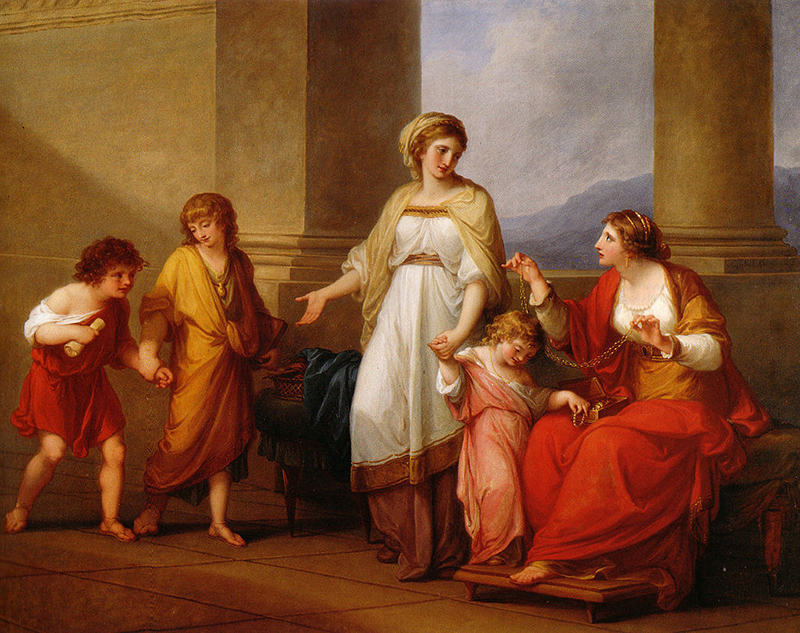
Many girls went to a public primary school. Ovid and Martial imply that boys and girls were educated either together or similarly, and Livy takes it for granted that the daughter of a centurion would be in school. Children of the elite were taught Greek as well as Latin from an early age. Children of both genders learned to behave socially by attending dinner parties and other events and participated in religious festivals singing formal compositions in a choir.
Among the upper classes, women seem to have been well-educated, some highly so, and were sometimes praised by the male historians for their learning and cultivation. Cornelia Metella, the young wife of Pompey the Great at the time of his death, was distinguished for her musicianship and her knowledge of geometry, literature, and philosophy. This degree of learning indicates formal preparation.
Because women took no official part in public life, the lives of boys and girls began to diverge dramatically after they formally came of age, and memorials to women recognize their domestic qualities far more often than intellectual achievements. The skills a Roman matron needed to run a household required training, and mothers probably passed on their knowledge to their daughters in a manner appropriate to their station in life, given the emphasis in Roman society on traditionalism.
Girls are depicted in Roman art as playing many of the same games as boys, such as ball, hoop-rolling, and knucklebones. Dolls are sometimes found in the tombs of those who died before adulthood. The figures are typically 15-16 cm tall, with jointed limbs, and made of materials such as wood, terracotta, and especially bone and ivory. Girls coming of age dedicated their dolls to Diana, the goddess most concerned with girlhood, or to Venus when they were preparing for marriage.
Freeborn women in ancient Rome were citizens (cives), but could not vote or hold political office. Because of their limited public role, women are named less frequently than men by Roman historians. But while Roman women held no direct political power, those from wealthy or powerful families could and did exert influence through private negotiations.
Exceptional women who left an undeniable mark on history range from the semi-legendary Lucretia and Claudia Quinta, whose stories took on mythic significance; fierce Republican-era women such as Cornelia, mother of the Gracchi, and Fulvia, who commanded an army and issued coins bearing her image; women of the Julio-Claudian dynasty, most prominently Livia, who contributed to the formation of Imperial mores; and the empress Helena, a driving force in establishing Christianity as the official religion of Rome.
As is the case with male members of society, elite women and their politically significant deeds eclipse those of lower status in the historical record. Inscriptions and especially epitaphs document the names of a wide range of women throughout the Roman Empire, but often tell little else about them. Some vivid snapshots of daily life are preserved in Latin literary genres such as comedy, satire, and poetry, particularly the poems of Catullus and Ovid, which offer glimpses of women in Roman dining rooms and boudoirs, at sporting and theatrical events, shopping, putting on makeup, practicing magic, worrying about pregnancy - all, however, through male eyes.
The published letters of Cicero, for instance, reveal informally how the self-proclaimed great man interacted on the domestic front with his wife Terentia and daughter Tullia, as his speeches demonstrate through disparagement the various ways Roman women could enjoy a free-spirited sexual and social life.
The one major public role reserved solely for women was in the sphere of religion: the priestly office of the Vestals. Freed of any obligation to marry or have children, the Vestals devoted themselves to the study and correct observance of rituals which were deemed necessary for the security and survival of Rome but which could not be performed by the male colleges of priests.
Noble woman came from, well, noble families. They were often those who could trace lineage to one of Romes former consuls or Emperors either through blood or marriage. These women were society's elite and attended banquets, festivals, and great occasions with pomp. At the gladiatorial games they had the better seating at nearly ground level.
For all this however, they had very little distinguishing them from common Roman freed women; from the plebeians of the lower classes. Both were focused on the home, on being a good wife, on making their husbands successful, on bearing children, and on raising strong children - especially sons. How true the Latin saying rings, et genus et formam Regina Pecunia donatur. (Queen money brings both family and beauty)
There were several things which marked a difference between a noble women and free women. For one, Noble women usually tried to have more children than the lower class did. This was mostly because of the added pressure to provide an heir.
Also the mortality rate of children was so high that even after having a son a noble women would want to have another lest the first die. It was common for only three children out of ten to survive childhood. Another thing that marked a difference between the classes was that on no account was a Noble woman to work outside of the home. It was considered highly improper and menial for the woman to help provide the families income, although in poorer families there was often little choice.
Some of the richer Roman women did run their own businesses and own property, especially towards the middle and end of the Empire. This was certainly not the norm but it did happen.
Freedwomen were freed slaves who owed a period of service, the terms of which might be agreed upon as a precondition of freedom, to her former owner, who became her patron. The patron had obligations in return, such as paying for said services and helping in legal matters. The patron-client relationship was one of the fundamental social structures of ancient Rome, and failure to fulfill one's obligations brought disapproval and censure.
In most ways, freedwomen had the same legal status as freeborn women. But because under Roman law a slave had no father, freed slaves had no inheritance rights unless they were named in a will.
The relationship of a former slave to her patron could be complicated. In one legal case, a woman named Petronia Iusta attempted to show - without a birth declaration to prove it - that she had been free-born. Her mother, she acknowledged, had been a slave in the household of Petronius Stephanus and Calatoria Themis, but Iusta maintained that she had been born after her mother's manumission. Calatoria, by now a widow, in turn argued that Iusta was born before her mother was free and that she had been manumitted, therefore owing her former owner the service due a patron. Calatoria could produce no documentation of this supposed manumission, and the case came down to the testimony of witnesses.
Uneducated or unskilled slaves had few opportunities to earn their freedom, and if they became free would lack means of supporting themselves. Therefore, a freedwoman in the workplace could have the advantage in training and skill over a woman born to a free family of working poor.
The status of freedwomen, like freedmen, varied widely. Caenis was a freedwoman and secretary to the Emperor Vespasian; she was also his concubine. He is said to have lived with her faithfully, but she was not considered a wife.
Both daughters and sons were subject to patria potestas, the power wielded by their father as head of household (familia). A Roman household was considered a collective (corpus, a "body") over which the pater familias had mastery (dominium). Slaves, who had no legal standing, were part of the household as property. In the early Empire, the legal standing of daughters differs little if at all from that of sons. If the father died without a will, the right of a daughter to share in the family property was equal to that of a son, though legislation in the 2nd century BC had attempted to limit this right. Even apart from legal status, daughters seem no less esteemed within the Roman family than sons, though sons were expected to ensure family standing by following their fathers into public life.
The pater familias had the right and duty to find a husband for his daughter, and first marriages were normally arranged. Technically, the couple had to be old enough to consent, but the age of consent was 12 for girls and 14 for boys, though in practice boys seem to have been on average five years older.
Among the elite, 14 was the age of transition from childhood to adolescence, but a betrothal might be arranged for political reasons when the couple were too young to marry, and in general noble women married younger than women of the lower classes. Most Roman women would have married in their late teens to early twenties. An aristocratic girl was expected to be a virgin when she married, as her young age might indicate. A daughter could legitimately refuse a match made by her parents only by showing that the proposed husband was of bad character.
In the early Republic, the bride became subject to her husband's potestas, but to a lesser degree than their children. By the early Empire, however, a daughter's legal relationship to her father remained unchanged when she married, even though she moved into her husband's home. This arrangement was one of the factors in the degree of independence Roman women enjoyed relative to those of many other ancient cultures and up to the early modern period: although she had to answer to her father legally, she didn't conduct her daily life under his direct scrutiny, and her husband had no legal power over her.
A daughter was expected to be deferential toward her father and to remain loyal to him, even if it meant having to differ with her husbands. "Deference" was not always absolute. After arranging his daughter's first two marriages, Cicero disapproved - rightly, as it turned out - of her choice to marry the unreliable Dolabella, but found himself unable to prevent it.
A daughter kept her own family name (nomen) for life, not assuming that of her husband. Children usually took the father's name. In the Imperial period, however, children might sometimes make their mother's family name part of theirs, or even adopt it instead.
Although the rights and status of women in the earliest period of Roman history were more restricted than in the late Republic and Empire, as early as the 5th century BC, Roman women could own land, write their own wills, and appear in court as their own advocates. The historian Valerius Maximus devotes a section of his work On Memorable Deeds and Speeches to women who conducted cases on their own behalf, or on behalf of others.
These women showed ability as orators in the courtroom, even though oratory was considered a defining pursuit of the most ambitious Roman men. One of these, Maesia Sentinas, is identified by her origin in the town of Sentinum, and not, as was customary, by her relation to a man. The independent Maesia spoke in her own defense, and was acquitted almost unanimously after only a short trial because she spoke with such strength and effectiveness. Since these characteristics were considered masculine, however, the historian opined that under her feminine appearance, she had a "virile spirit," and thereafter she was called "the Androgyne."
Maesia's ability to present a case "methodically and vigorously" suggests that while women didn't plead regularly in open court, they had experience in private declamation and family court. Afrania, the wife of a senator during the time of Sulla, appeared so frequently before the praetor who presided over the court, even though she had male advocates who could have spoken for her, that she was accused of calumnia, malicious prosecution. An edict was consequently enacted that prohibited women from bringing claims on behalf of others, on the grounds that it jeopardized their pudicitia, the modesty appropriate to one's station.
It has been noted that while women were often impugned for their feeblemindedness and ignorance of the law, and thus in need of protection by male advocates, in reality actions were taken to restrict their influence and effectiveness. Despite this specific restriction, there are numerous examples of women taking informed actions in legal matters in the Late Republic and Principate, including dictating legal strategy to their advocate behind the scenes.
An emancipated woman legally became sui iuris, or her own person, and could own property and dispose of it as she saw fit. If a pater familias died intestate, the law required the equal division of his estate amongst his children, regardless of their age and sex. A will that did otherwise, or emancipated any family member without due process of law, could be challenged. From the late Republic onward, a woman who inherited a share equal with her brothers would have been independent of agnatic control.
As in the case of minors, an emancipated woman had a legal guardian (tutor) appointed to her. She retained her powers of administration, however, and the guardian's main if not sole purpose was to give formal consent to actions. The guardian had no say in her private life, and a woman sui iuris could marry as she pleased. A woman also had certain avenues of recourse if she wished to replace an obstructive tutor. Under Augustus, a woman who had gained the ius liberorum, the legal right to certain privileges after bearing three children, was also released from guardianship. The role of guardianship as a legal institution gradually diminished, and by the 2nd century AD the jurist Gaius said he saw no reason for it. The Christianization of the Empire, beginning with the conversion of the Emperor Constantine in the early 4th century, eventually had consequences for the legal status of women.
During the classical era of Roman law, marriage required no ceremony, but only a mutual will and agreement to live together in harmony. Marriage ceremonies, contracts, and other formalities were meant only to prove that a couple had, in fact, married. Under early or archaic Roman law, marriages were of three kinds: confarreatio, symbolized by the sharing of bread (panis farreus); coemptio, "by purchase"; and usus, by mutual cohabitation. Patricians always married by confarreatio, while plebeians married by the latter two kinds. In marriage by usus, if a woman was absent for three consecutive nights at least once a year, she would avoid her husband establishing legal control over her. This differed from the Athenian custom of arranged marriage and sequestered wives who were not supposed to walk in the street unescorted.
The form of marriage known as manus was the norm in the early Republic, but became less frequent thereafter. Under this early form of marriage, the bride passed into the "hand" (manus) of her husband; that is, she was transferred from the potestas of her father to that of her husband. Her dowry, any inheritance rights transferred through her marriage, and any property acquired by her after marriage belonged to him.
Husbands could divorce on grounds of adultery, and a few cases of divorce for a wife's infertility are recorded. Manus marriage was an unequal relationship; it changed a womanÕs intestate heirs from her siblings to her children, not because she was their mother, but because in law her position was the same as that of a daughter to her husband. Under manus, women were expected to obey their husbands in almost all aspects of their lives.
The custom of manus fell out of favor by the 2nd century BC, when the conditions of marriage changed dramatically in a way that favored greater independence for women. So-called "free" marriage caused no change in personal status for either the wife or the husband. Free marriage usually involved two citizens, or a citizen and a person who held Latin rights, and in the later Imperial period and with official permission, soldier-citizens and non-citizens. In a free marriage a bride brought a dowry to the husband: if the marriage ended with no cause of adultery he returned most of it. So total was the law's separation of property that gifts between spouses were not recognized as such; if a couple divorced or even lived apart, the giver could reclaim the gift.
Divorce was a legal but relatively informal affair which mainly involved a wife leaving her husbandÕs house and taking back her dowry. According to the historian Valerius Maximus, divorces were taking place by 604 BC or earlier, and the law code as embodied in the mid-5th century BC by the Twelve Tables provides for divorce. Divorce was socially acceptable if carried out within social norms (mos maiorum).
By the time of Cicero and Julius Caesar, divorce was relatively common and "shame-free," the subject of gossip rather than a social disgrace. Valerius says that Lucius Annius was disapproved of because he divorced his wife without consulting his friends; that is, he undertook the action for his own purposes and without considering its effects on his social network (amicitia and clientela). The censors of 307 BC thus expelled him from the Senate for moral turpitude.
Elsewhere, however, it is claimed that the first divorce took place only in 230 BC, at which time Dionysius of Halicarnassus notes that "Spurius Carvilius, a man of distinction, was the first to divorce his wife" on grounds of infertility. This was most likely the Spurius Carvilius Maximus Ruga who was consul in 234 and 228 BC. The evidence is confused.
During the classical period of Roman law (late Republic and Principate), a man or woman could end a marriage simply because he or she wanted to, and for no other reason. Unless the wife could prove the husband was worthless, he kept the children. Because property had been kept separate during the marriage, divorce from a "free" marriage was a very easy procedure.
The frequency of remarriage among the elite was high. Speedy remarriage was not unusual, and perhaps even customary, for aristocratic Romans after the death of a spouse. While no formal waiting period was dictated for a widower, it was customary for a woman to remain in mourning for ten months before remarrying.
The duration may allow for pregnancy: if a woman had become pregnant just before her husband's death, the period of ten months ensures that no question of paternity, which might affect the child's social status and inheritance, would attach to the birth. No law prohibited pregnant women from marrying, and there are well-known instances: Augustus married Livia when she was carrying her former husband's child, and the College of Pontiffs ruled that it was permissible as long as the child's father was determined first. Livia's previous husband even attended the wedding.
Because elite marriages often occurred for reasons of politics or property, a widow or divorcˇe with assets in these areas faced few obstacles to remarrying. She was far more likely to be legally emancipated than a first-time bride, and to have a say in the choice of husband. The marriages of Fulvia, who commanded troops during the last civil war of the Republic and who was the first Roman woman to have her face on a coin, are thought to indicate her own political sympathies and ambitions: she was married first to the popularist champion Clodius Pulcher, who was murdered in the street after a long feud with Cicero; then to Scribonius Curio, a figure of less ideological certitude who at the time of his death had come over to Julius Caesar; and finally to Mark Antony, the last opponent to the republican oligarchs and to Rome's future first emperor.
The Greek observer Plutarch indicates that a second wedding among Romans was likely to be a quieter affair, as a widow would still feel the absence of her dead husband, and a divorcee ought to feel shame. But while the circumstances of divorce might be shameful or embarrassing, and remaining married to the same person for life was ideal, there was no general disapproval of remarriage; on the contrary, marriage was considered the right and desirable condition of adult life for both men and women.
Cato the Younger, who presented himself as a paragon modeled after his moral namesake, allowed his pregnant wife Marcia to divorce him and marry Hortensius, declining to offer his young daughter to the 60-year-old orator instead. After the widowed Marcia inherited considerable wealth, Cato married her again, in a ceremony lacking many of the formalities. Women might be mocked, however, for marrying too often or capriciously, particularly if it could be implied that sexual appetites and vanity were motives.
A concubine was defined by Roman law as a woman living in a permanent monogamous relationship with a man not her husband. There was no dishonor in being a concubine or living with a concubine, and a concubine could become a wife. Gifts could be exchanged between the partners in concubinage, in contrast to marriage, which maintained a strict separation of property.
Couples usually resorted to concubinage when inequality of social rank was an obstacle to marriage: for instance, a man of senatorial rank, and a woman who was a social inferior, such as a freedwoman or one who had a questionable background of poverty or prostitution. Two partners in love who lacked a right to connubium might enter into concubinage, or even a highborn woman who loved a man of low social status.
Concubinage differed from marriage chiefly in the status of children born from the relationship. Children had their mother's social rank, and not as was customary their father's. They thus were not subject to patria potestas.
Classical Roman law did not allow any domestic abuse by a husband to his wife, but as with any other crime, laws against domestic abuse can be assumed to fail to prevent it. Cato the Elder said, according to his biographer Plutarch, "that the man who struck his wife or child, laid violent hands on the holiest of holy things. Also that he thought it more praiseworthy to be a good husband than a good senator." Although modern definitions of what makes a good relationship between husband and wife might value different things, a man of status during the Roman Republic was expected to behave moderately toward his wife and to define himself as a good husband.
Domestic abuse enters the historical record mainly when it involves the egregious excesses of the elite. The Emperor Nero was alleged to have had his first wife (and stepsister) Claudia Octavia murdered, after subjecting her to torture and imprisonment. Nero then married his pregnant mistress Poppaea Sabina, whom he kicked to death for criticizing him. Some modern historians believe that Poppaea died from a miscarriage or childbirth, and that the story was exaggerated to vilify Nero. The despised Commodus is supposed also to have killed his wife and his sister.
Roman wives were expected to bear children, but the women of the aristocracy, accustomed to a degree of independence, showed a growing disinclination to devote themselves to traditional motherhood. By the 1st century AD, most elite women avoided breast-feeding their infants themselves, and hired wet-nurses. The practice was not uncommon as early as the 2nd century BC, when the comic playwright Plautus mentions wet-nurses casually.
Since a mother's milk was considered best for the baby, aristocratic women might still choose to breast-feed, unless physical reasons prevented it. If a woman chose to forgo nursing her own child she could visit the Columna Lactaria ("Milk Column"), where poor parents could obtain milk for their infants as charity from wet nurses, and those who could afford it could choose to hire a wet nurse. Licinia, the wife of Cato the Elder (d. 149 BC), is reported to have nursed not only her son, but sometimes the infants of her slaves, to encourage "brotherly affection" among them. By the time of Tacitus (d. 117 AD), breastfeeding by elite matrons was idealized as a practice of the virtuous old days.
The extent to which Roman women might expect their husbands to participate in the rearing of very young children seems to vary and is hard to determine. Family-values traditionalists such as Cato appear to have taken an interest: Cato liked to be present when his wife bathed and swaddled their child.
Large families were not the norm among the elite even by the Late Republic; the family of Clodius Pulcher, who had at least three sisters and two brothers, was considered unusual. The birth rate among the aristocracy declined to such an extent that the first Roman emperor Augustus (reigned 27 BC-14 AD) passed a series of laws intended to increase it, including special honors for women who bore at least three children (the ius trium liberorum). Those who were unmarried, divorced, widowed, or barren were prohibited from inheriting property unless named in a will.
Roman women were not only valued for the number of children that they produced, but also for their part in raising and educating children to become good citizens. To rear children for successful lives, an exemplary Roman mother needed to be well-educated herself.
One of the Roman women most famous for their strength and influence as a mother was Cornelia, the mother of the Gracchi. Julius Caesar, whose father died when he was only a young teen, had a close relationship with his mother, Aurelia, whose political clout was essential in preventing the execution of her 18-year-old son during the proscriptions of Sulla.
The educated and well-traveled Vibia Sabina (ca. 136 AD) was a grand-niece of the emperor Trajan and became the wife of his successor Hadrian; unlike some empresses, she played little role in court politics and remained independent in private life, having no children and seeking emotional gratification in love affairs.
Aristocratic women managed a large and complex household. Since wealthy couples often owned multiple homes and country estates with dozens or even hundreds of slaves, some of whom were educated and highly skilled, this responsibility was the equivalent of running a small corporation. In addition to the social and political importance of entertaining guests, clients, and visiting dignitaries from abroad, the husband held his morning business meetings (salutatio) at home.
The home (domus) was also the center of the family's social identity, with ancestral portraits displayed in the entrance hall (atrium). Since the most ambitious aristocratic men were frequently away from home on military campaign or administrative duty in the provinces, sometimes for years at a time, the maintenance of the family's property and business decisions were often left to the wives; for instance, while Julius Caesar was away from Rome throughout the 50s BC, his wife Calpurnia Pisonis was responsible for taking care of his assets.
When Ovid, Rome's greatest living poet, was exiled by Augustus in 8 AD, his wife exploited social connections and legal maneuvers to hold on to the family's property, on which their livelihood depended. Ovid expresses his love and admiration for her lavishly in the poetry he wrote during his exile. Frugality, parsimony, and austerity were characteristics of the virtuous matron.
One of the most important tasks for women to oversee in a large household was clothing production. At one time, the spinning of wool was a central domestic occupation, and indicated a family's self-sufficiency, since the wool would be produced on their estates. Even in an urban setting, wool was often a symbol of a wife's duties, and equipment for spinning might appear on the funeral monument of a woman to show that she was a good and honorable matron. Even women of the upper classes were expected to be able to spin and weave in virtuous emulation of their rustic ancestors - a practice ostentatiously observed by Livia.
Historians Called Them Housekeepers - but Roman Women Were Running Profitable Farms SciTech Daily - August 22, 2026
Across five centuries of Roman laws, literature, and grave inscriptions, female farm managers repeatedly appear in the surviving record. Yet modern historians have often treated them as housekeepers responsible for meals and domestic work, separate from the farmÕs productive operations.
-
"One of the most curious characteristics of that age," observed French classical scholar Gaston Boissier, "was that the women appear as much engaged in business and as interested in speculations as the men. Money is their first care. They work their estates, invest their funds, lend and borrow. We find one among Cicero's creditors, and two among his debtors." Although Roman society did not allow women to gain official political power, it did allow them to enter business.
Even women of wealth weren't supposed to be idle ladies of leisure. Among the aristocracy, women as well as men lent money to their peers to avoid resorting to a moneylender. When Pliny was considering buying an estate, he factored in a loan from his mother-in-law as a guarantee rather than an option. Women also joined in funding public works, as is frequently documented by inscriptions during the Imperial period. The "lawless" Politta, who appears in the Martyrdom of Pionius, owned estates in the province of Asia. Inscriptions record her generosity in funding the renovation of the Sardis gymnasium.
Because women had the right to own property, they might engage in the same business transactions and management practices as any landowner. As with their male counterparts, their management of slaves appears to have varied from relative care to negligence and outright abuse. During the First Servile War, Megallis and her husband Damophilus were both killed by their slaves on account of their brutality, but their daughter was spared because of her kindness and granted safe passage out of Sicily, along with an armed escort.
Unlike landholding, industry was not considered an honorable profession for those of senatorial rank. Cicero suggested that in order to gain respectability a merchant should buy land. Attitudes changed during the Empire, however, and Claudius created legislation to encourage the upper classes to engage in shipping. Women of the upper classes are documented as owning and running shipping corporations.
Trade and manufacturing are not well represented in Roman literature, which was produced for and largely by the elite, but funerary inscriptions sometimes record the profession of the deceased, including women. Women are known to have owned and operated brick factories.
A woman might develop skills to complement her husband's trade, or manage aspects of his business. Artemis the gilder was married to Dionysius the helmet maker, as indicated by a curse tablet asking for the destruction of their household, workshop, work, and livelihood. The status of ordinary women who owned a business seems to have been regarded as exceptional. Laws during the Imperial period aimed at punishing women for adultery exempted those "who have charge of any business or shop" from prosecution.
Some obvious occupations for a woman would be wet nurse, actress, dancer or acrobat, prostitute, and midwife - not all of equal respectability. Prostitutes and performers such as actresses were stigmatized as infames, people who had recourse to few legal protections even if they were free. Inscriptions indicate that a woman who was a wet nurse (nutrix) would be quite proud of her occupation. Women could be scribes and secretaries, including "girls trained for beautiful writing," that is, calligraphers. Pliny gives a list of female artists and their paintings.
Most Romans lived in insulae (apartment buildings), and those housing the poorer plebeian and non-citizen families usually lacked kitchens. The need to buy prepared food meant that "carryout" was a thriving business. Most of the Roman poor, whether male or female, young or old, earned a living through their own labor.
Women could neither hold political office nor serve in the army, but the mythology of the Republic recognized the patriotism, virtues, and self-sacrifice of women and censured self-serving and treacherous behavior.
During the civil wars that ended the Republic, Appian reports the heroism of wives who saved their husbands. An epitaph known as the Laudatio Turiae preserves a husband's eulogy for his wife, who during the civil war following the death of Julius Caesar endangered her own life and relinquished her jewelry to send support to her husband in exile. Both survived the turbulence of the time to enjoy a long marriage. Porcia, the daughter of Cato the Younger and wife of Brutus the assassin, came to a less fortunate but (in the eyes of her time) heroic end: she killed herself as the Republic collapsed, just as her father did.
The rise of Augustus to sole power in the last decades of the 1st century BC diminished the power of political officeholders and the traditional oligarchy, but did nothing to diminish and arguably increased the opportunities for women, as well as slaves and freedmen, to exercise influence behind the scenes.
One notable woman was Livia Drusilla Augusta (58 BC Š AD 29), the wife of Augustus and the most powerful woman in the early Roman Empire, acting several times as regent and being Augustus' faithful advisor. Several women of the Imperial family, such as Livia's great-granddaughter and Caligula's sister Agrippina the Younger, gained political influence as well as public prominence.
Women also participated in efforts to overthrow the emperors who abused their power. Shortly after Caligula's sister Drusilla died, her widower Marcus Aemilius Lepidus and her sisters Agrippina the Younger and Livilla conspired to overthrow Caligula. The plot was discovered, and Lepidus was executed. Agrippina and Livilla were exiled, and returned from exile only when their paternal uncle Claudius came to power after Caligula's assassination in 41 AD.
Women could also be motivated by less than noble causes. Claudius's third wife Valeria Messalina conspired with Gaius Silius to overthrow her husband in the hope of installing herself and her lover in power.
Tacitus immortalized the woman Epicharis for her part in the Pisonian conspiracy, where she attempted to gain the support of the Roman fleet and was instead arrested. Once the conspiracy was uncovered, she would reveal nothing even under torture, in contrast to the senators, who were not subjected to torture and yet raced to spill the details. Tacitus also praises Egnatia Maximilla for sacrificing her fortune in order to stand by her innocent husband against Nero.
Women were present at most Roman festivals and cult observances. Some rituals specifically required the presence of women, but their participation might be limited. As a rule women did not perform animal sacrifice, the central rite of most major public ceremonies, though this was less a matter of prohibition than the fact that most priests presiding over state religion were men. Some cult practices were reserved for women only, for example, the rites of the Good Goddess (Bona Dea).
Women priests played a prominent and crucial role in the official religion of Rome. Although the state colleges of male priests were far more numerous, the six women of the college of Vestals were Rome's only "full-time professional clergy." Sacerdos, plural sacerdotes, was the Latin word for a priest of either gender. Religious titles for women include sacerdos, often in relation to a deity or temple, such as a sacerdos Cereris or Cerealis, "priestess of Ceres", an office never held by men; magistra, a high priestess, female expert or teacher in religious matters; and ministra, a female assistant, particularly one in service to a deity. A magistra or ministra would have been responsible for the regular maintenance of a cult. Epitaphs provide the main evidence for these priesthoods, and the woman is often not identified in terms of her marital status.
The Vestals possessed unique religious distinction, public status and privileges, and could exercise considerable political influence. It was also possible for them to amass "considerable wealth." Upon entering her office, a Vestal was emancipated from her father's authority. In archaic Roman society, these priestesses were the only women not required to be under the legal guardianship of a man, instead answering directly and only to the Pontifex Maximus.
Their vow of chastity freed them of the traditional obligation to marry and rear children, but its violation carried a heavy penalty: a Vestal found to have polluted her office by breaking her vow was given food, water, and entombed alive. The independence of the Vestals thus existed in relation to the prohibitions imposed on them. In addition to conducting certain religious rites, the Vestals participated at least symbolically in every official sacrifice, as they were responsible for preparing the required ritual substance mola salsa. The Vestals seem to have retained their religious and social distinctions well into the 4th century AD, until the Christian emperors dissolved the order.
A few priesthoods were held jointly by married couples. Marriage was a requirement for the Flamen Dialis, the high priest of Jupiter; his wife, the Flaminica Dialis, had her own unique priestly attire, and like her husband was placed under obscure magico-religious prohibitions. The flaminica was a perhaps exceptional case of a woman performing animal sacrifice; she offered a ram to Jupiter on each of the nundinae, the eight-day Roman cycle comparable to a week. The couple were not permitted to divorce, and if the flaminica died the flamen had to resign his office.
Like the Flaminica Dialis, the regina sacrorum, "queen of the sacred rites," wore distinctive ceremonial dress and performed animal sacrifice, offering a sow or female lamb to Juno on the first day of each month. The names of some reginae sacrorum are recorded by inscriptions. The regina was the wife of the rex sacrorum, "king of the sacred rites," an archaic priesthood regarded in the earliest period as more prestigious than even the Pontifex Maximus.
These highly public official duties for women contradict the commonplace notion that women in ancient Rome took part only in private or domestic religion. The dual male-female priesthoods may reflect the Roman tendency to seek a gender complement within the religious sphere; most divine powers are represented by both a male and a female deity, as seen in divine pairs such as Liber and Libera. The twelve major gods were presented as six gender-balanced pairs, and Roman religion departed from Indo-European tradition in installing two goddesses in its supreme triad of patron deities, Juno and Minerva along with Jupiter. This triad "formed the core of Roman religion."
From the Mid Republic onward, religious diversity became increasingly characteristic of the city of Rome. Many religions that were not part of Rome's earliest state cult offered leadership roles for women, among them the cult of Isis and of the Magna Mater. An epitaph preserves the title sacerdos maxima for a woman who held the highest priesthood of the Magna Mater's temple near the current site of St. Peter's Basilica.
Although less documented than public religion, private religious practices addressed aspects of life that were exclusive to women. At a time when the infant mortality rate was as high as 40 percent, divine aid was solicited for the life-threatening act of giving birth and the perils of caring for a baby, with invocations directed at the goddesses Juno, Diana, Lucina, the di nixi, and a host of specialized divine attendants.
Male writers vary in their depiction of women's religiosity: some represent women as paragons of Roman virtue and devotion, but also inclined by temperament to excessive religious devotion, the lure of magic, or "superstition." Nor was "private" the same as "secret": Romans were suspicious of secretive religious practices, and Cicero cautioned that nocturnal sacrifices were not to be performed by women, except for those ritually prescribed pro populo, on behalf of the Roman people, that is, for the public good.
Roman women were not confined to their house as were Athenian women in the Archaic and Classical periods. Wealthy women traveled around the city in a litter carried by slaves. Women gathered in the streets on a daily basis to meet with friends, attend religious rites at temples, or to visit the baths. The wealthiest families had private baths at home, but most people went to bath houses not only to wash but to socialize, as the larger facilities offered a range of services and recreational activities, among which casual sex was not excluded. One of the most vexed questions of Roman social life is whether the sexes bathed together in public.
Until the late Republic, evidence suggests that women usually bathed in a separate wing or facility, or that women and men were scheduled at different times. But there is also clear evidence of mixed bathing from the late Republic until the rise of Christian dominance in the later Empire. Some scholars have thought that only lower-class women bathed with men, or those of dubious moral standing such as entertainers or prostitutes, but Clement of Alexandria observed that women of the highest social classes could be seen naked at the baths. Hadrian prohibited mixed bathing, but the ban seems not to have endured. Most likely, customs varied not only by time and place, but by facility, so that women could choose to segregate themselves by gender or not.
For entertainment women could attend debates at the Forum, the public games (ludi), chariot races, and theatrical performances. By the late Republic, they regularly attended dinner parties, though in earlier times the women of a household dined in private together. Conservatives such as Cato the Elder (234-149 BC) considered it improper for women to take a more active role in public life; his complaints indicated that indeed some women did voice their opinions in the public sphere.
Though the practice was discouraged, Roman generals would sometimes take their wives with them on military campaigns. Caligula's mother Agrippina the Elder often accompanied her husband Germanicus on his campaigns in northern Germania, and the emperor Claudius was born in Gaul for this reason. Wealthy women might tour the empire, often participating or viewing religious ceremonies and sites around the empire. Rich women traveled to the countryside during the summer when Rome became too hot.
Women in ancient Rome took great care in their appearance, though extravagance was frowned upon. They wore cosmetics and made different concoctions for their skin. Ovid even wrote a poem about the correct application of makeup. Women used white chalk or arsenic to whiten their faces, or rouge made of lead or caramine to add color to their cheeks as well as using lead to highlight their eyes. They spent much time arranging their hair and often dyed it black, red, or blonde. They also wore wigs regularly.
Matrons usually wore two simple tunics for undergarments covered by a stola. The stola was a long white dress that was cinched at the waist and which fell to the wearer's feet, secured by clasps at the shoulder. Wealthier women would decorate their stola further. When going out a woman wore a palla over her stola, which was held by a clasp at the shoulder. Women of questionable morals or young women were not permitted to wear a stola, and instead wore tunics. Wealthy women wore jewels such as emeralds, aquamarine, opal, and pearls as earrings, necklaces, rings and sometimes sewn onto their shoes and clothing.
In the aftermath of Roman defeat at Cannae, economic crisis provoked the passing of the Lex Oppia (215 BC) to restrict personal and public extravagance. The law limited women's possession and display of gold and silver (as money or personal ornament), expensive clothing and their "unnecessary" use of chariots and litters. Victory over Carthage flooded Rome with wealth and in 195 BC the Lex Oppia was reviewed.
The ruling consul, Cato the Censor argued for its retention: personal morality and self-restraint were self-evidently inadequate controls on indulgence and luxury. Luxury provoked the envy and shame of those less well-off, and was therefore divisive. Roman women, in Cato's view, had showed only too clearly that their appetites once corrupted knew no limits, and must be restrained. Large numbers of Roman matrons thought otherwise, and made concerted public protest. In 193 BC the laws were abolished: Cato's opposition did not harm his political career.
Later, in 42 BC, Roman women, led by Hortensia, successfully protested against laws designed to tax Roman women, by use of the argument of no taxation without representation. Evidence of a lessening on luxury restrictions can also be found; one of the Letters of Pliny is addressed to the woman Pompeia Celerina praising the luxuries she keeps in her villa.
Based on Roman art and literature, small breasts and wide hips were the ideal body type for women considered alluring by Roman men. Roman art from the Augustan period shows idealized women as substantial and fleshy, with a full abdomen and breasts that are rounded, not pendulous.
Prostitutes depicted in Roman erotic art have fleshy bodies and wide hips, and often have their breasts covered by a strophium (a sort of strapless bra) even when otherwise nude and performing sex acts. Large breasts were mocked as humorous or a sign of old age.
Young girls wore a strophium secured tightly in the belief that it would inhibit the growth of breasts, and a regimen of massaging the breasts with hemlock, begun while a woman was still a virgin, was thought to prevent sagging.
Breasts receive relatively minimal attention in erotic art and literature as a sexual focus; the breast was associated primarily with nursing infants and a woman's role as a mother. In times of extreme emotional duress, such as mourning or captivity in wartime, women might bare their breasts as an apotropaic gesture.
The practices and views in the Hippocratic Corpus regarding women's bodies and their perceived weaknesses were inadequate for addressing the needs of women in the Hellenistic and Roman eras, when women led active lives and more often engaged in family planning. The physiology of women began to be seen as less alien to that of men.In the older tradition, intercourse, pregnancy, and childbirth were not only central to women's health, but the raison d'etre for female physiology; men, by contrast, were advised to exercise moderation in their sexual behavior, since hypersexuality would cause disease and fatigue.
The Hippocratic view that amenorrhea was fatal became by Roman times a specific issue of infertility, and was recognized by most Roman medical writers as a likely result when women engage in intensive physical regimens for extended periods of time. Balancing food, exercise, and sexual activity came to be regarded as a choice that women might make. The observation that intensive training was likely to result in amenorrhea implies that there were women who engaged in such regimens.
In the Roman era, medical writers saw a place for exercise in the lives of women in sickness and health. Soranus recommends playing ball, swimming, walking, reading aloud, riding in vehicles, and travel as recreation, which would promote overall good health. In examining the causes of undesired childlessness, these later gynecological writers include information about sterility in men, rather than assuming some defect in the woman only.
Hypersexuality was to be avoided by women as well as men. An enlarged clitoris, like an oversized phallus, was considered a symptom of excessive sexuality. Although Hellenistic and Roman medical and other writers refer to clitoridectomy as primarily an "Egyptian" custom, gynecological manuals under the Christian Empire in late antiquity propose that hypersexuality could be treated by surgery or repeated childbirth.
Women could turn to prostitution to support themselves, but not all prostitutes had freedom to decide. There is some evidence that even slave prostitutes could benefit from their labor. Although rape was a crime, the law only punished the rape of a slave if it "damaged the goods," because a slave had no legal standing. The penalty was aimed at providing her owner compensation for the "damage" of his property. Because a slave woman was considered property under Roman law, forcing her to be a prostitute was not considered a crime.
Prior to Septimius Severus, women who engaged in acts that brought infamia to them as slaves also suffered infamia when freed. Sometimes sellers of female slaves attached a ne serva clause to the slave to prevent her from being prostituted. The Ne Serva clause meant that if the new owner or any owner after him or her used the slave as a prostitute she would be free. Later on the ne serva agreements became enforceable by law.
Prostitution was not limited to slaves or poor citizens; according to Suetonius (albeit in a possible exaggeration), Caligula when converting his palace into a brothel employed upper class "matrons and youths" as prostitutes. Although another possible exaggeration. Tacitus records that during one of Nero's feasts the prefect Tigellinus had brothels filled with upper class women. Prostitution could also be a punishment instead of an occupation, and women being sentenced to a spell working in a brothel is known.
ANCIENT AND LOST CIVILIZATIONS