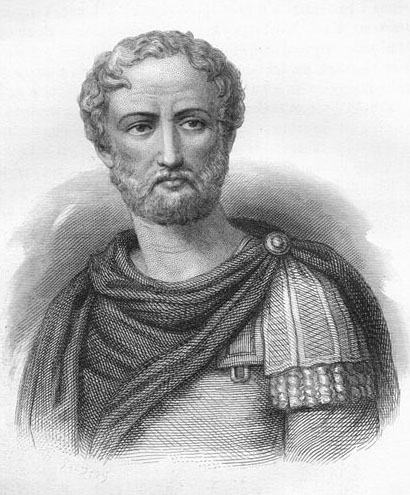
Gaius Plinius Secundus (23 AD - August 25, 79 AD), better known as Pliny the Elder, was a Roman author, naturalist, and natural philosopher, as well as naval and army commander of the early Roman Empire, and personal friend of the emperor Vespasian. Spending most of his spare time studying, writing or investigating natural and geographic phenomena in the field, he wrote an encyclopedic work, Naturalis Historia, which became a model for all such works written subsequently. Pliny the Younger, his nephew, wrote of him in a letter to the historian Tacitus:
Pliny's dates are pinned to the eruption of Vesuvius in August, 79, and a statement of his nephew that he died in his 56th year, which would make his birth in 23 AD.
Pliny was the son of an equestrian, Gaius Plinius Celer, and his wife, Marcella. Neither the younger nor the elder Pliny mention the names. Their ultimate source is a fragmentary inscription (CIL V 1 3442) found in a field in Verona and recorded by the 16th-century Augustinian monk Onofrio Panvinio at Verona. What the inscription says depends on the reconstruction, except that in all cases the names come through. Whether he was an augur and she was named Grania Marcella are less certain. Jean Hardouin presents a statement from an unknown source he claims was ancient that Pliny was from Verona and that his parents were Celer and Marcella. Hardouin also cites the conterraneity of Catullus.
Additional efforts to connect Celer and Marcella with other gentes are highly speculative. Hardouin is the only scholar to use his unknown source. How the inscription got to Verona is a mystery, but it could have arrived by dispersion of property at Pliny the Younger's then Tuscan (now Umbrian) estate at Colle Plinio, north of Citta di Castello, identified for certain by his initials in the roof tiles. He kept statues of his ancestors there.
Pliny the Elder was born in Como, not at Verona: it is only as a native of old Gallia Transpadana that he calls Catullus of Verona his conterraneus, or fellow-countryman, not his municeps, or fellow-townsman. A statue of Pliny on the facade of the Duomo of Como celebrates him as a native son. He had a sister, Plinia, who married into the Caecilii and became the mother of his nephew, Pliny the Younger, whose letters describe his work and study regimen in detail.
Two inscriptions identifying the hometown of Pliny the Younger as Como take precedence over the Verona theory. One (CIL V 5262) commemorates the younger's career as imperial magistrate and details his considerable charitable and municipal expenses on behalf of the people of Como. Another (CIL V 5667) identifies his father Lucius' village as Fecchio (tribe Oufentina) near Como. It is likely therefore that Plinia was a local girl and Pliny the Elder, her brother, was from Como.
Gaius was a scion of the Plinii gens. He did not take his father's cognomen, Celer, but assumed his own, Secundus. As his adopted son took the same cognomen, Pliny founded a branch, the Plinii Secundi. The family was prosperous; Pliny the Younger's inherited estates combined made him so wealthy that he could found a school and a library, endow a fund to feed the women and children of Como and own multiple estates around Rome and Lake Como, as well as enrich some of his friends as a personal favor. No earlier instances of the Plinii are known.
In 59 BC, only 82 years before Pliny's birth, Julius Caesar founded Novum Comum (reverting to Comum) as a colonia to secure the region against the Alpine tribes, whom he had been unable to defeat. He imported a population of 4500 from other provinces (not clear where) to be placed in Comasco and 500 aristocratic Greeks to found Novum Comum itself. The community was thus multi-ethnic and the Plinies could have come from anywhere; whether any conclusions can be drawn from Pliny's preference for Greek words, or Julius Pokorny's derivation of the name from north Italic as "bald" is a matter of speculative opinion. There appears to be no record of any ethnic distinctions in Pliny's time. The population prided itself on being Roman citizens.
Pliny the Elder did not marry and had no children. In his will he adopted his nephew, which entitled the latter to inherit the entire estate. The adoption is called a "testamental adoption" by writers on the topic, who assert that it applied to the name change only, but Roman jurisprudence recognizes no such category. Pliny the Younger was thus the adopted son of Pliny the Elder, but not in Pliny the Elder's lifetime. For at least some of the time, however, Pliny resided under the same roof with his sister and nephew (whose husband and father died young), as they were doing so when Pliny decided to investigate the eruption of Mount Vesuvius, and was sidetracked by the need for rescue operations and a messenger from his friend asking for assistance.
Pliny's father took him to Rome to be educated. Pliny relates that he saw Marcus Servilius Nonianus.
In 46 AD, at age 23, Pliny entered the army as a junior officer, as was the custom for young men of equestrian rank. Ronald Syme, Plinian scholar, reconstructs three periods at three ranks. Pliny's interest in Roman letters attracted the attention and friendship of other men of letters in the higher ranks, with whom he formed lasting friendships.
Later these friendships assisted his entry into the upper echelons of the state; however, he was trusted for his knowledge and ability as well. According to Syme, he began as a praefectus cohortis, a "commander of a cohort" (an infantry cohort, as junior officers began in the infantry), under Gnaeus Domitius Corbulo, himself a writer (whose works did not survive) in Germania Inferior.
In 47 AD he took part in the Roman conquest of the Chauci and the construction of the canal between the rivers Maas and Rhine. His description of the Roman ships anchored in the stream overnight having to ward off floating trees has the stamp of an eyewitness account.
At some uncertain date Pliny was transferred to the command of Germania Superior under Publius Pomponius Secundus with a promotion to military tribune, which was a staff position, with duties assigned by the district commander. Pomponius was a half-brother of Corbulo.
They had the same mother, Vistilia, a powerful matron of the Roman upper classes, who had seven children by six husbands, many of which children had imperial connections, including a future empress. Pliny's assignments are not clear, but he must have participated in the campaign against the Chatti of 50 AD, at age 27, in his fourth year of service. Associated with the commander in the praetorium he became a familiar and close friend of Pomponius, who also was a man of letters.
At another uncertain date Pliny was transferred back to Germania Inferior. Corbulo had moved on assuming command in the east. This time Pliny was promoted to praefectus alae, "commander of an ala", with responsibility for a cavalry battalion of about 480 men.
A distinction was still being made between legionaries and allied auxiliaries, even though all Italians were now Roman citizens. Pliny, being from north Italy, was an allied commander, like most of the cavalry at that time (but equal in rank, authority and benefits to Roman counterparts). He spent the rest of his enlistment there. A decorative phalera, or piece of harness, with his name on it has been found at Castra Vetera, a large Roman army and naval base on the lower Rhine river.
Pliny's last commander there, apparently neither a man of letters nor a close friend of his, was Pompeius Paulinus, governor of Germania Inferior 55-58 AD. Pliny relates that he personally knew Paulinus to have carried around 12,000 pounds of silver service on which to dine on campaign against the Germans (a practice which would not have endeared him to the disciplined Pliny).
According to his nephew, it was during this period that he wrote his first book (perhaps in winter-quarters when spare time was more abundant), a work on the use of missiles on horseback, De jaculatione equestri. It did not survive but in Natural History he seems to reveal at least in part its content: using the intelligence of the horse to assist the javelineer to throw missiles from its back. During this period also he dreamed that the spirit of Drusus Nero begged him to save his memory from oblivion. The dream prompted Pliny to begin forthwith a history of all the wars between the Romans and the Germans, which he was not to complete for some years.
Book I, Chapter 1 of Historia Naturalis dedicates the work to the emperor, Titus Flavius, son of Vespasian. In that dedication Pliny calls Titus an old messmate (the relationship of a contubernium, "sharing the same tent"): "you ... have regarded me as a fellow-soldier and a messmate. Nor has the extent of your prosperity produced any change in you ...." The problem with the passage is the 16-year difference in age between Pliny and the younger Titus.
At the time Titus was a military tribune. He could not have been a comrade, of the same rank as Pliny, in Germania Superior, as in 50 AD Titus was only 11 years old. Recourse to the later campaigns of Titus in the east lack evidence and do not fit the circumstances: Titus was the commanding general (not a lower-ranking comrade) while Pliny was either a private citizen or a general himself on assignment by Vespasian.
The duty in Germania Inferior is the only credible opportunity for Titus to have shared a contubernium with Pliny. Officers of the upper classes assumed a 10-year obligation (as opposed to the ordinary legionary's 20 or 25 years).Pliny's term would have been up in 56 AD at age 33. As his account of a solar eclipse, which occurred in Campania in 59 AD, appears to be an eyewitness account, he was probably a civilian at that time.[22] In 56 AD Titus was 17 years old. His father was not then emperor. The staff of a commander often shared quarters and mess with the commander, especially in the field. On the bare circumstances, Titus was a new officer on Pliny's staff toward the end of Pliny's service. The relationship between the two, one almost old enough to be the other's father, must have been as close as had been Pliny's with Pomponius.
At the earliest time Pliny could have left the service, Nero, the last of the Julio-Claudian Dynasty, had been emperor for two years. He did not leave office until 68 AD, when Pliny was 45 years old. During that time Pliny did not hold any high office or work in the service of the state. In the subsequent Flavian Dynasty his services were in such demand that he had to give up the law practice, which suggests that he had been trying not to attract the attention of Nero, a ruler believed by his contemporaries (not without justification) to be a dangerous acquaintance.
Under Nero Pliny lived mainly in Rome. He mentions the map of Armenia and the neighbourhood of the Caspian Sea, which was sent to Rome by the staff of Corbulo in 58. He also saw the building of Nero's Domus Aurea or "Golden House" after the fire of 64.
Besides pleading law cases, Pliny wrote, researched and studied. His second published work was a biography of his old commander, Pomponius Secundus, in two books. After several years in prison under Tiberius, 31- 37 AD (which he used to write tragedies), Secundus was rehabilitated by Caligula (who later married his half-sister, Caesonia) in 38, made consul in 41 and was sent as legatus to Germany, where he won a victory against the Chatti and was allowed a triumph. After this peak he disappears from history, never to be mentioned again, except by the Plinies, and is not among either the friends or the enemies of Nero.
The elder Pliny mentions that he saw "in the possession of Pomponius Secundus, the poet, a very illustrious citizen," manuscripts in the "ancient handwriting of Tiberius and Caius Gracchus." The time of his maximum illustriousness would have been his triumph of 50 or 51.
In 54 Nero came to power; at that time Pliny was working on his two military writings. Pliny the Younger says that the biography of Secundus was "a duty which he owed to the memory of his friend", implying that Secundus had died. The circumstances of this duty and whether or not it had anything to do with his probable avoidance of Nero have disappeared with the work.
Meanwhile he was completing the twenty books of his History of the German Wars, the only authority expressly quoted in the first six books of the Annals of Tacitus, and probably one of the principal authorities for the Germania. It disappeared in favor of the writings of Tacitus (which are far shorter), and, early in the 5th century, Symmachus had little hope of finding a copy.
Like Caligula, Nero seemed to grow gradually more insane as his reign progressed. Pliny devoted much of his time to writing on the comparatively safe subjects of grammar and rhetoric. He published a three-book, six-volume educational manual on rhetoric, entitled Studiosus, "the Student." Pliny the Younger says of it: "the orator is trained from his very cradle and perfected." It was followed by eight books on Dubii sermonis, "On Doubtful Phraseology." (These are both now lost works.) His nephew relates: "He wrote this under Nero, in the last years of his reign, when every kind of literary pursuit which was in the least independent or elevated had been rendered dangerous by servitude."
In 68 Nero no longer had any friends and supporters. He committed suicide, and the reign of terror was at an end; also the interlude in Pliny's obligation to the state.
At the very end of 69 AD, after a year of civil war consequent on the death of Nero, Vespasian, a successful general, became emperor. Like Pliny, he had come from the middle, or equestrian, class, rising through the ranks of the army and public offices and defeating the other contenders for the highest office. His main tasks were to reestablish peace under imperial control and place the economy on a sound footing. He needed in his administration all the loyalty and assistance he could find. Pliny, apparently trusted without question, perhaps (reading between the lines) recommended by Titus, was put to work immediately and was kept in a continuous succession of the most distinguished procuratorships, according to Suetonius. A procurator was generally a governor of an imperial province. The empire was perpetually short of, and always was seeking, office-holders for its numerous offices.
A definitive study of the procuratorships of Pliny was done by the classical scholar Friedrich Munzer, which was re-asserted by Ronald Syme and became a standard reference point. MŸnzer hypothesized four procuratorships, of which two are certainly attested and two are probable but not certain. However, two does not satisfy Suetonius' description of a continuous succession. Consequently Plinian scholars present two to four procuratorships, with the others described as visits if they do not utilize the full range. MŸnzer's full range is as follows.
According to Syme, Pliny may have been "successor to Valerius Paulinus", procurator of Gallia Narbonensis (southeastern France), early in 70 AD. He seems to have a "familiarity with the provincia", which, however, might otherwise be explained.
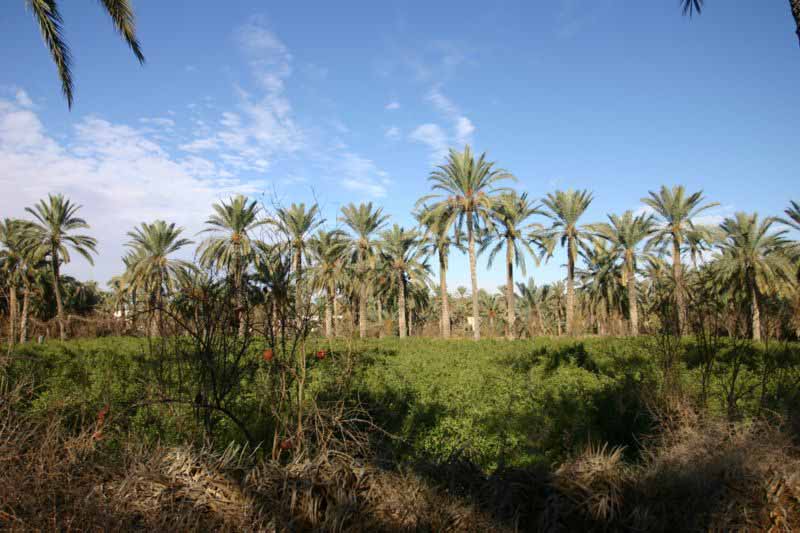
It is certain that Pliny spent some time in Africa Province, most likely as a procurator. Among other events or features that he saw are the provoking of rubetae, poisonous toads (Bufonidae), by the Psylli; the buildings made with molded earthen walls, "superior in solidity to any cement;" and the unusual, fertile seaside oasis of Gabes (then Tacape), Tunisia, currently a World Heritage Site. Syme assigns the African procuratorship to 70-72 AD.
The procuratorship of Hispania Tarraconensis is next. A statement by Pliny the Younger that his uncle was offered 400,000 sesterces for his manuscripts by Larcius Licinius while he (Pliny the Elder) was procurator of Hispania makes it the most certain of the three.
Pliny lists the peoples of "Hither Hispania", including population statistics and civic rights (modern Asturias and Gallaecia). He stops short of mentioning them all for fear of "wearying the reader". As this is the only geographic region for which he gives this information, Syme hypothesizes that Pliny contributed to the census of Hither Hispania conducted in 73/74 by Vibius Crispus, legate from the Emperor, thus dating Pliny's procuratorship there.
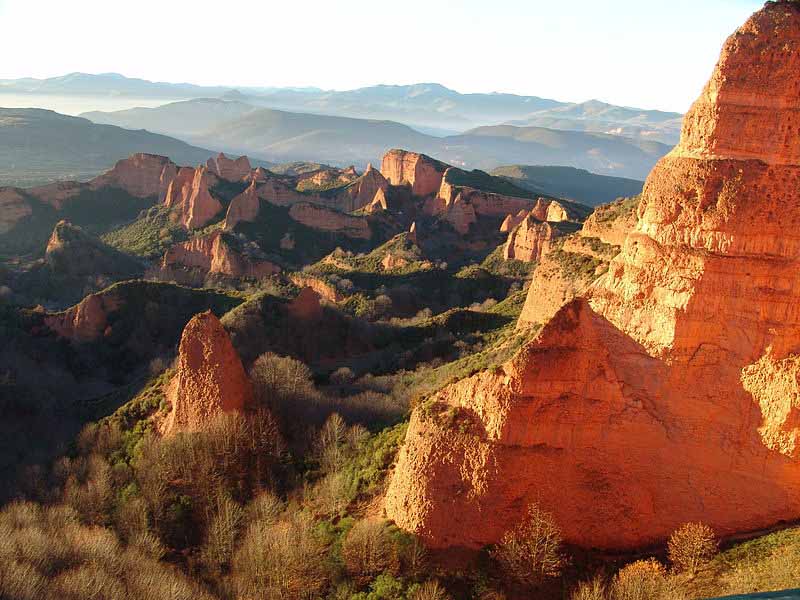
During his stay in Hispania he became familiar with the agriculture and especially the gold mines of the north and west of the country. His descriptions of the various methods of mining appear to be eye-witness judging by his discussion of gold mining methods in the Natural History. He might have visited the mine excavated at Las Medulas.
The last position of procurator, an uncertain one, was of Gallia Belgica, based on Pliny's familiarity with it. The capital of the province was Augusta Treverorum (Trier), named for the Treveri surrounding it. Pliny says that in "the year but one before this" a severe winter killed the first crops planted by the Treviri; they sowed again in March and had "a most abundant harvest."
The problem is to identify "this", the year in which the passage was written. Using 77 as the date of composition Syme arrives at 74-75 AD as the date of the procuratorship, when Pliny is presumed to have witnessed these events. The argument is based entirely on presumptions; nevertheless, this date is required to achieve Suetonius' continuity of procuratorships, if there was one in Gallia Belgica.
Pliny was allowed home (Rome) at some time in 75-76 AD. He was presumably at home for the first official release of Natural History in 77. Whether he was in Rome for the dedication of Vespasian's Temple of Peace in the Forum in 75 AD, which was in essence a museum for display of art works plundered by Nero and formerly adorning the Domus Aurea, is uncertain, as is his possible command of the vigiles (night-watchmen), a lesser post. The latter post is not consistent with what Pliny the Younger says of this period.
When that business was transacted, he turned to reading and making extracts, clearly in the process of working on the Natural History. No actual post is discernable in this regimen, which he could not have conducted as admiral at Misenum, unless his duties as admiral did not require his presence at Misenum. On the bare circumstances he was an official agent of the emperor in a quasi-private capacity. Perhaps he was between posts. In any case, his appointment as prefect of the fleet at Misenum took him to Misenum, where he was residing with his sister and nephew. Vespasian died of disease on June 23, 79. Pliny outlived him by two months.
During Nero's reign of terror, Pliny avoided working on any writing that would attract attention to himself. His works on oratory in the last years of Nero's reign (67, 68) focused on form rather than on content. He began working on content again probably after Vespasian's rule began in 69, when it was clear that the terror was over and was not going to be replaced. It was to some degree reinstituted (and later cancelled by his son Titus) when Vespasian suppressed the philosophers at Rome, but not for Pliny, who was not among them, representing, as he says, something new at Rome, an encyclopedist (certainly, a venerable tradition outside Italy).
In his next work, he "completed the history which Aufidius Bassus left unfinished, and ... added to it thirty books." Aufidius Bassus was a cause cŽl�bre according to Seneca the Younger, a man much admired at Rome. He had begun his history at some unknown contemporaneous time, ending with the reign of Tiberius. It was cut short when Bassus died slowly of a lingering disease, with such spirit and objectivity that Seneca remarked he seemed to treat it as someone else's dying.
Pliny's Bassus' History was one of the authorities followed by Suetonius and Plutarch. Tacitus also cites Pliny as a source. He is mentioned concerning the loyalty of Burrus, commander of the Praetorian Guard, whom Nero removed for disloyalty. Tacitus portrays parts of Pliny's view of the Pisonian conspiracy to kill Nero and make Piso emperor as "absurd and mentions that he could not decide whether Pliny's account or that of Messalla was more accurate concerning some of the details of the Year of the Four Emperors. Evidently Pliny's extension of Bassus extended at least from the reign of Nero to that of Vespasian. Pliny seems to have known it was going to be controversial, as he deliberately reserved it for publication after his death.
Pliny's last work, according to his nephew, was the Naturalis Historia, an encyclopedia into which he collected much of the knowledge of his time. Answers concerning the date of its publication, composition, or when he started or stopped work upon it, depend on the questions asked.
The encyclopedia utilizes some material from his memories of earlier times and from his prior works, such as the book on Germany. There is no evidence that he had planned to use this material in an encyclopedia later in his career. Most of the references in the encyclopedia must have come from his extracts, which he kept on an ongoing basis, hiring a reader and a secretary to keep them, and furnishing that secretary with gloves in winter so that his writing hand would not stiffen with cold.
The extracts collected for this purpose filled rather less than 160 volumes, which Larcius Licinus, the praetorian legate of Hispania Tarraconensis, vainly offered to purchase for 400,000 sesterces. That would have been in 73-74. At his death Pliny left the 160 volumes to his nephew. When composition began is unknown. Since he was preoccupied with his other works under Nero and then had to finish the history of his times, it is unlikely he began before 70. The procuratorships offered the ideal opportunity for an encyclopedic frame of mind. The date of an overall composition cannot be assigned to any one year. The dates of different parts must be determined, if they can, by philological analysis (the "post-mortem" of the scholars).
The closest known event to a single publication date; that is, when the manuscript was probably released to the public for borrowing and copying, and was probably sent to the Flavians, is the date of the Dedication in the first of the 37 books. It is to the "emperor" Titus. As Titus and Vespasian had the same name, Titus Flavius Vespasianus, earlier writers hypothesized a dedication to Vespasian. Pliny's mention of a brother (Domitian) and joint offices with a father, calling that father "great", points certainly to Titus. Since Titus is addressed as emperor ostensibly Vespasian had died, in which case the date would be 79.
However, Pliny says that Titus had been consul six times. The first six consulships of Titus are in 70, 72, 74, 75, 76 and 77, all conjointly with Vespasian, which brings the date of the Dedication to 77. In that year Vespasian was 68. He had been ruling conjointly with Titus for some years, which may be why he allowed Pliny to call Titus "emperor" and dedicate the work to him.
Aside from minor finishing touches, the work in 37 books was completed in AD 77. It would be unsubstantiated to presume that it was written entirely in 77 or that Pliny was finished with it then. Moreover, the dedication could have been written before publication, and it could have been published either privately or publicly earlier without dedication. The only certain fact is that Pliny did no further work on it after AD 79.
The Naturalis Historia is one of the largest single works to have survived from the Roman empire to the modern day and purports to cover the entire field of ancient knowledge, based on the best authorities available to Pliny. He claims to be the only Roman ever to have undertaken such a work. It encompasses the fields of botany, zoology, astronomy, geology and mineralogy as well as the exploitation of those resources. I
t remains a standard work for the Roman period and the advances in technology and understanding of natural phenomena at the time. Some technical advances he discusses are the only sources for those inventions, such as hushing in mining technology or the use of water mills for crushing or grinding corn. Much of what he wrote about has been confirmed by archaeology. It is virtually the only work which describes the work of artists of the time, and is a reference work for the history of art.
The work became a model for all later encyclopedias in terms of the breadth of subject matter examined, the need to reference original authors, and a comprehensive index list of the contents. Interspersed amongst the agricultural entries are several recipes and references to common methods of preparing food. Some of these have been collected in the book Roman Cookery. The work is dedicated to the Emperor Titus, son of Pliny's close friend, the emperor Vespasian, in the first year of Titus' reign. It is the only work by Pliny to have survived, and the last that he published, lacking a final revision at his sudden and unexpected death in the AD 79 eruption of Vesuvius.
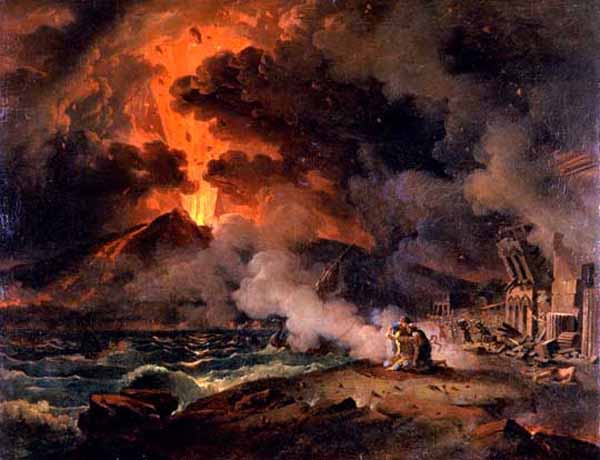
Pliny had received from the now deceased Vespasian the appointment of praefect of the Roman Navy. On August 24, 79 AD, he was stationed at Misenum, at the time of the great eruption of Mount Vesuvius, which overwhelmed Pompeii and Herculaneum. He was preparing to cross the Bay of Naples to observe the phenomenon directly when a message arrived from his friend Rectina asking for rescue. Launching the galleys under his command to the evacuation of the opposite shore he himself took "a fast-sailing cutter", a decision that may have cost him his life. His nephew, Pliny the Younger, provided an account of his death, obtained from the survivors. The nephew and his mother had decided not to go on the voyage across the bay.
As the light vessel approached the shore near Herculaneum, cinders and pumice began to fall on it. Pliny's helmsman advised turning back, to which Pliny replied "Fortune favors the brave, steer to where Pomponianus is (Stabiae, near the modern town of Castellammare di Stabia)." They landed and found Pomponianus "in the greatest consternation." Pliny hugged and comforted him. They loaded the cutter but the same winds that brought it to Stabiae prevented it from leaving.
Pliny reassured his party by feasting and sleeping while waiting for the wind to abate but finally they had to leave the buildings for fear of collapse and try their luck in the pumice fall. Pliny sat down and could not get up even with assistance and was left behind. His companions theorized that he collapsed and died through inhaling poisonous gases emitted from the volcano.
On their return three days later (26 August) after the plume had dispersed, his body was found under the pumice with no apparent external injuries. The problem with the toxicity theory is that his companions were unaffected by the supposedly toxic fumes, and they had no mobility problem where Pliny had to sit and could not rise. As he is described as a corpulent man, who also suffered from asthma, it is hypothesized that his friends left him because he was already dead.
The story of his last hours is told in a letter addressed twenty-seven years afterwards to Tacitus by the Elder Pliny's nephew and heir, Pliny the Younger, who also sent to another correspondent an account of his uncle's writings and his manner of life. The fragment from Suetonius (see under External links below) states a somewhat less flattering view, that Pliny approached the shore only from scientific interest and then asked a slave to kill him to avoid heat from the volcano. It is not as credible a source, as it is clear from the nephew's letter that the persons Pliny came to rescue escaped to tell the tale in detail; moreover, Suetonius hypothesizes a party witnessing events so agonizing as to destroy Pliny or cause him to order his own death and yet apparently were subject to none of these fatal events themselves.
Pliny is still remembered in volcanology where the term Plinian (or Plinean) refers to a very violent eruption of a volcano marked by columns of smoke and ash extending high into the stratosphere. The term ultra-Plinian is reserved for the most violent type of Plinian eruption such as the 1883 destruction of Krakatoa.
A carnelian inscribed with the letters C. PLIN. has been reproduced by Cades (v.211) from the original in the Vannutelli collection. It represents an ancient Roman with an almost completely bald forehead and a double chin; and is almost certainly a portrait, not of Pliny the Elder, but of Pompey the Great. Seated statues of both the Plinies, clad in the garb of scholars of the year 1500, may be seen in the niches on either side of the main entrance to Como Cathedral.
The elder Pliny's anecdotes of Greek artists supplied Vasari with the subjects of the frescoes which still adorn the interior of his former home at Arezzo.
ANCIENT AND LOST CIVILIZATIONS
ALPHABETICAL INDEX OF ALL FILES
