
Next-Generation Mars Rover Wheels Allow Mars Vehicles To Swim Across Dunes Daily Galaxy - May 20, 2026
A new Mars rover design promises to change planetary exploration, using wheels modeled on the sandfish lizard to 'swim' through soft sand rather than roll. Researchers have translated a biological locomotion strategy into cutting-edge robotics, offering a glimpse at the next generation of adaptive planetary rovers.
Life on Mars? Tiny cells just survived shock waves and toxic soil Science Daily - April 12, 2026
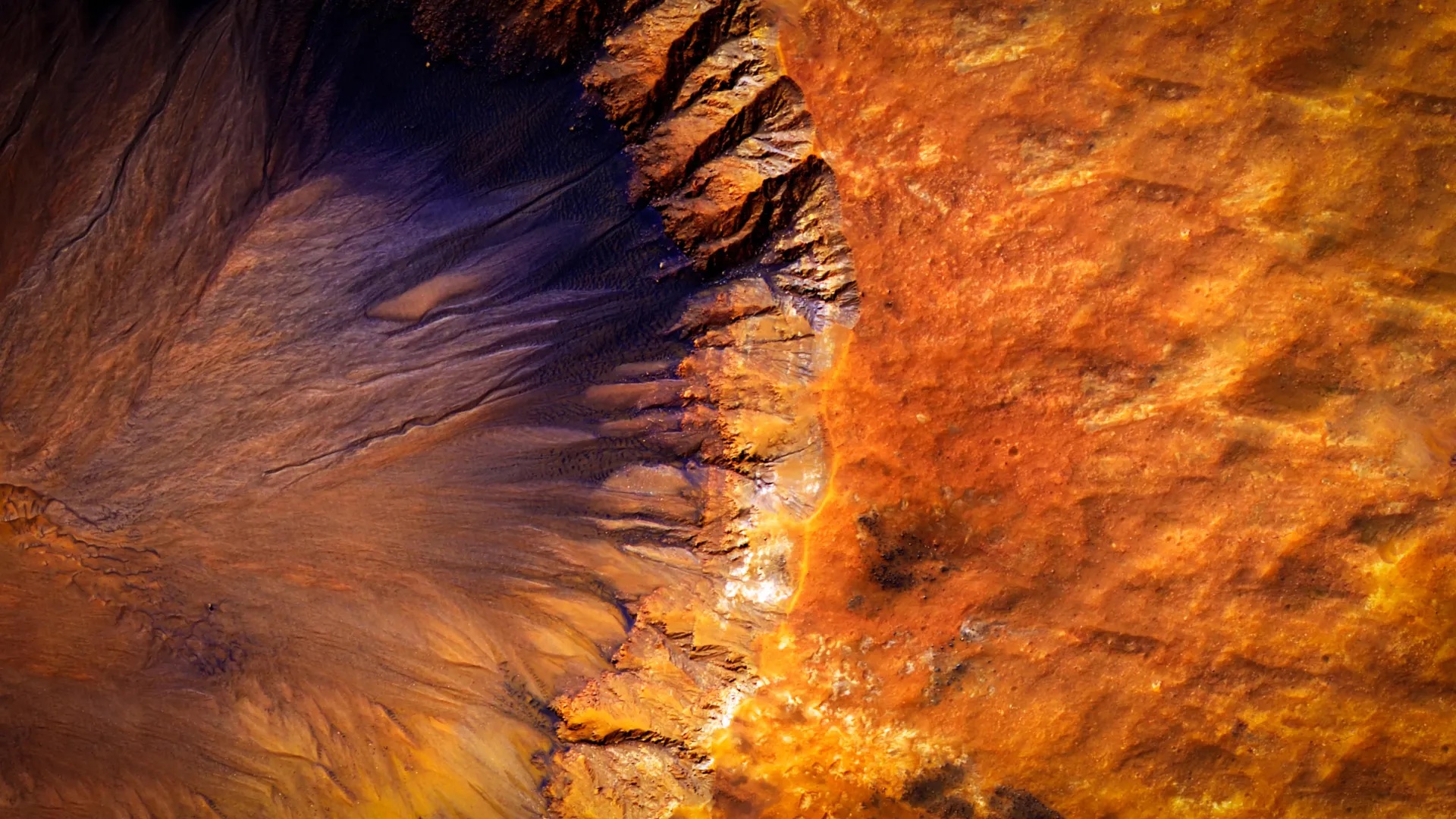
Mars may be hostile, but it might not be entirely unlivable. In lab experiments, yeast cells survived simulated Martian shock waves and toxic perchlorate salts - two major environmental threats on the Red Planet. Their secret weapon was forming protective molecular clusters that shield critical cellular functions under stress. Without these defenses, survival plummeted, pointing to a potential universal strategy life could use beyond Earth.
Hidden Ancient River System Found Deep Under The Surface of Mars Science Alert - March 18, 2026
Far away, alone in a crater on a planet inhabited only by robots, NASA's Perseverance rover explores a dry landscape that was once a river system billions of years ago. According to a new discovery, however, the Jezero Delta on Mars is not the sole remnant of abundant water that once flowed across the surface. Perseverance's RIMFAX instrument has now probed deeper than ever beneath the Jezero crater, revealing a vast delta system fed by flowing water that existed long before the one the rover now explores. In turn, this indicates that water flowed across the surface of Mars for much longer than the surface alone implies Ð a finding with important implications for the planet's past habitability.
Two Private Companies Are Building Lunar Harvesters to Extract a Rare Energy Resource from the Moon Daily Galaxy - March 8, 2026

Two companies, Interlune and Astrolab, are unveiling cutting-edge lunar harvesters that will extract Helium-3 from the Moon, advancing space exploration and energy production.
A Mysterious Mineral on Mars May Rewrite the Planet's Geologic History SciTech Daily - March 8, 2026

A potential new mineral on Mars forms when iron sulfates are heated above 100°C. Data from Valles Marineris regions suggest geothermal processes altered ancient sulfate deposits.
Mars' Missing Water Mystery Takes an Unexpected Turn SciTech Daily - February 23, 2026
Composite images of Mars taken by the Hubble Space Telescope in 2024. Thin clouds of water ice, visible in ultraviolet light, give the Red Planet an icy appearance. The frigid north polar ice cap was experiencing the beginning of Martian spring. New research shows that an intense regional dust storm transported unusually high amounts of water vapor into MarsÕ upper atmosphere, boosting hydrogen escape. The discovery reshapes understanding of how the planet gradually lost its water.
Scientists Have Detected Electric Sparks on Mars, and It Could Rewrite What We Know About Its Atmosphere SciTech Daily - December 23, 2025
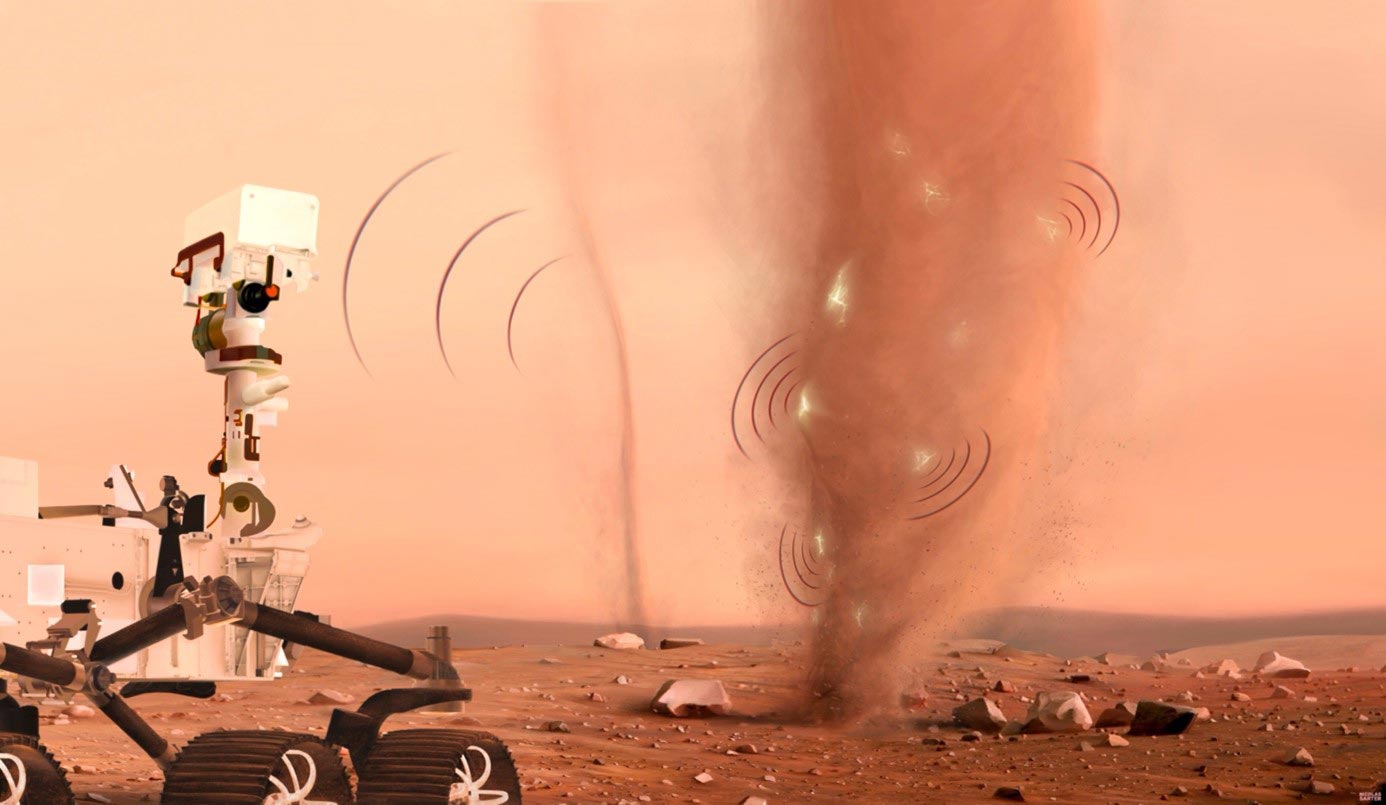
Electrical sparks inside Martian dust devils have been detected for the first time, reshaping how scientists understand the planetÕs atmosphere and climate.
Long ago, Mars had massive watersheds - now finally mapped PhysOrg - December 8, 2025

What can mapped drainage systems on Mars teach scientists about the red planet's watery past? This study has the potential to not only gain insight into ancient Mars and how much water existed there long ago, but also develop new methods for mapping ancient river basins on Mars and potentially other worlds.
NASA Recorded Lightning Crackling on Mars For The First Time Science Alert - November 26, 2025
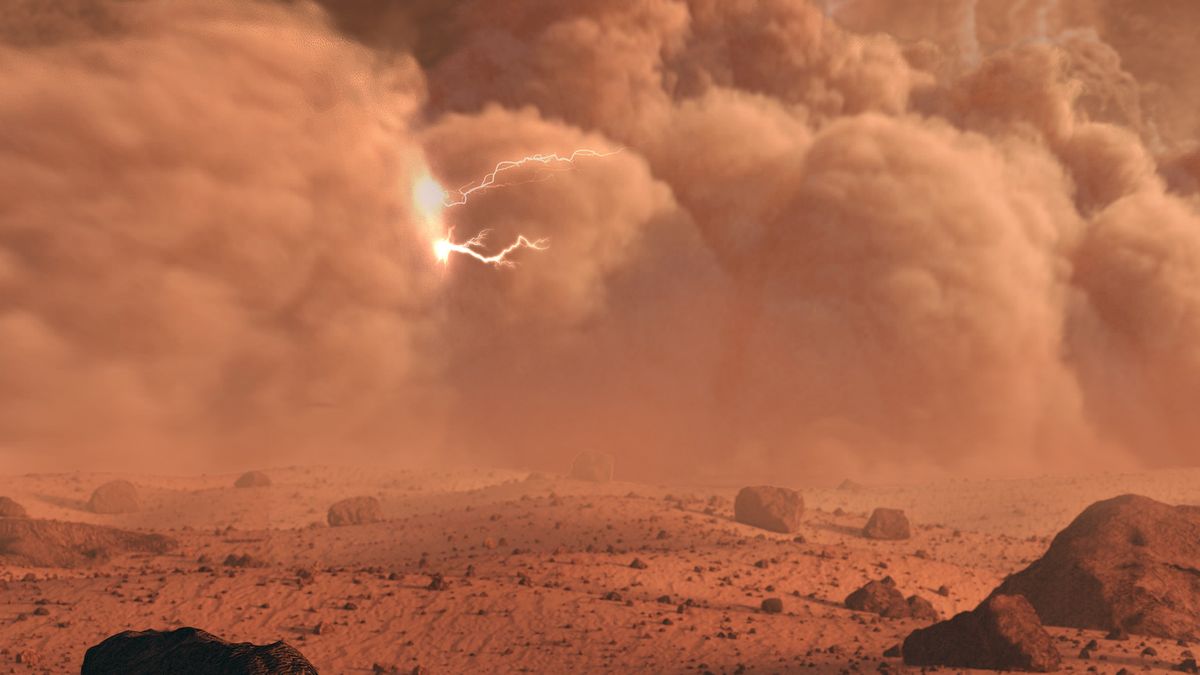
In recordings obtained by NASA's Perseverance rover, scientists have identified, for the first time, electrical discharges captured during Mars's wild dust events and whirling dust devils Ð not once, but 55 times over two Martian years of observation.
How a medieval Oxford friar used light and color to find out what stars and planets are made of Space.com - November 23, 2025

During the 1240s, Richard Fishacre, a Dominican friar at Oxford University, used his knowledge of light and color to show that the stars and planets are made of the same elements found here on Earth. In so doing he challenged the scientific orthodoxy of his day and pre-empted the methods and discoveries of the 21st-century James Webb space telescope.
A clue to ancient life? What scientists found inside Mars' frozen vortex Science Daily - October 21, 2025
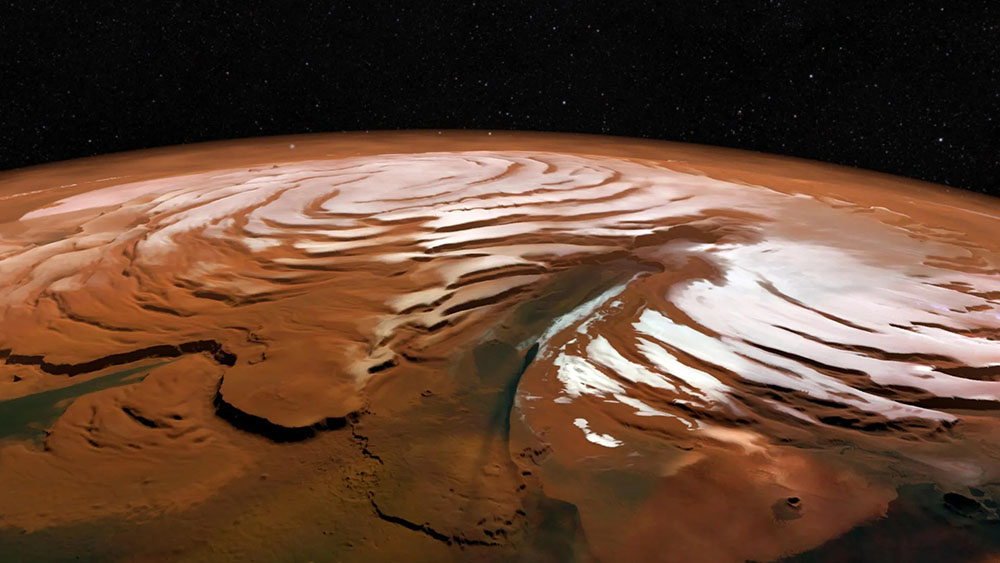
Scientists found that the lack of sunlight and moisture lets ozone build up unchecked. This discovery, made with data from ESAÕs and NASAÕs orbiters, could reveal clues about MarsÕ past atmospheric chemistry and potential for life.
Long-Standing Planetary Mystery Solved: Scientists Discover Mars Has an Earth-Like Core SciTech Daily - September 20, 2025

Seismic studies reveal Mars may have a solid inner core. The result deepens knowledge of its evolution and lost magnetic field.
'Potential biosignatures' found in ancient Mars lake PhysOrg - September 10, 2025
A new study suggests a habitable past and signs of ancient microbial processes on Mars. Led by NASA, the work has uncovered a range of minerals and organic matter in Martian rocks that point to an ancient history of habitable conditions and potential biological processes on the Red Planet.
NASA's Insight Lander Reveals a Surprise at The Very Core of Mars - InSight seismic data reveals a solid mass about 600 kilometers (373 miles) across Science Alert - September 4, 2025
This is not just in contrast to previous findings that the core is squishy all the way through Ð it doesn't fit with our current understanding of what the Martian core is made of.
To see the world in a grain of sand: Investigating megaripples at Kerrlaguna on Mars PhysOrg - August 23, 2025

On Mars, the past is written in stone - but the present is written in sand. Last week, Perseverance explored inactive megaripples to learn more about the wind-driven processes that are reshaping the Martian landscape every day.
Largest piece of Mars on Earth fetches meteoric $5.3 million at New York auction PhysOrg - July 16, 2025

The largest piece of Mars ever found on Earth was sold for just over $5 million at an auction of rare geological and archaeological objects in New York on Wednesday. But a rare young dinosaur skeleton stole the show when it fetched more than $30 million in a bidding frenzy. The 54-pound (25-kilogram) rock named NWA 16788 was discovered in the Sahara Desert in Niger by a meteorite hunter in November 2023, after having been blown off the surface of Mars by a massive asteroid strike and traveling 140 million miles (225 million kilometers) to Earth, according to Sotheby's. The estimated sale price before the auction was $2 million to $4 million. The identity of the buyer was not immediately disclosed. The final bid was $4.3 million. Adding various fees and costs, the official sale price was about $5.3 million, making it the most valuable meteorite ever sold at auction, Sotheby's said.
Why does NASA's Perseverance rover keep taking pictures of this maze on Mars? Live Science - June 10, 2025

This is a tiny, intricate maze etched into a small plate, photographed over and over again. It turns out the maze is a calibration target Ñ one of 10 for Perseverance's Scanning Habitable Environments with Raman & Luminescence for Organics and Chemicals instrument, otherwise known for its fun acronym, SHERLOC. This Sherlock HolmesÐinspired tool is designed to detect organic compounds and other minerals on Mars that could indicate signs of ancient microbial life. To do that accurately, the system must be carefully calibrated, and that's where the maze comes in.
The Martian Night Sky Was Seen Turning Green in a Stunning First Science Alert - May 15, 2025

An aurora gently glowing in wavelengths visible to the human eye has been captured on Mars for the first time Ð and a robot was the only one to see it live.
Mars: New Signals Hint at a Lost Ocean of Water Concealed Within Mars Science Alert - May 14, 2025

Evidence is mounting that a secret lies beneath the dusty red plains of Mars, one that could redefine our view of the Red Planet: a vast reservoir of liquid water, locked deep in the crust.
Extremely Weird Rock Found on Mars Looks Like Nothing Else Around It Science Alert - March 31, 2025

Once again, Mars has presented us with an example of something it seems to have in abundance: extremely peculiar and baffling rocks. As the Perseverance rover trundled about Broom Point, on the lower slopes of Witch Hazel Hill on the rim of Jezero Crater, it came across a rock that looks all bubbly and weird, like a deposition of frogspawn. It consists of hundreds of tiny dark gray spherules, each a millimeter or so across, all clumped together in a formation.
InSight reveals marsquakes travel through mantle, not crust Watchers - February 23, 2025
Researchers confirmed that a meteoroid impact in the Cerberus Fossae region generated seismic waves that traveled through MarsÕ mantle instead of being confined to the crust. The discovery, linked to seismic event S0794a, suggests that previously identified marsquakes may have originated from much farther distances than initially estimated, requiring a reassessment of epicenter locations and impact frequency estimates.
NASA Investigates Rock Unlike Any Seen On Mars Before Called Freya Castle IFL Science - September 24, 2024
The rock has also caught the attention of the Perseverance team, of course, who called it "unlike any seen on Mars before". Perseverance is currently heading to Dox Castle, a part of the Jezero Crater that could have been created when the asteroid impact that created the crater sent rocks flying.
Take a trip to the largest lake on Mars. Mars once hosted a lake larger than any on Earth PhysOrg - August 7, 2024
The broken-down and dried-up remnants of this ancient lakebed are shown here in amazing detail by ESA's Mars Express. The old lakebed is now filled with lots of raised mounds, thought to have formed as ancient martian winds swept dust across the planet; this dust was later covered and altered by water, before drying out again and breaking apart.
NASA's Perseverance Rover Spots Shimmering Rock Unlike Any Other Seen On Mars IFL Science - June 23, 2024
A strangely light-toned boulder on Mars is completely unlike any other rock weÕve seen on the Red Planet up to now. Spotted by NASAÕs Perseverance rover at a site called Mount Washburn - which sits within the wider study location of Jezero Crater - the unusual object may provide some intriguing clues into the ancient geological processes that helped to shape the Martian surface.

I go with choice 2. There are no crashed UFOs on Mars.
Mystery Of What Caused This Giant Hole On Mars - And What Lies Inside? Live Science - June 6, 2024

On Pavonis Mons - a large shield volcano in the Tharsis region of volcanic mountains - the camera saw a giant hole, appearing to lead into a large underground cavern. Further analysis showed that the hole's opening is around 35 meters (115 feet) in diameter, with the cavern beneath around 20 meters (66 feet) deep. Prior to the likely collapse and infilling, it was likely around 90 meters (295 feet) deep.
Nakhlite - A Lost Piece of Mars Found on Earth Reveals an Ancient Volcanic Secret Science Alert - May 31, 2024

An unexpected tool is giving us new insight into the fine structure of the outer layers of Mars. Using meteorites that were long ago chipped off the red planet around 11 million years ago and flung into space to eventually land on Earth, scientists have been able to study the way volcanism shaped the crust and mantle of Mars to infer the presence of silicate reservoirs that fed their formation.
There's a Hole on The Surface of Mars And Scientists Have No Idea What's Inside It Science Alert - May 30, 2024

Human visitors to Mars need somewhere to shelter from the radiation, temperature swings, and dust storms that plague the planet. If the planet is anything like Earth or the Moon, it may have large underground lava tubes that could house shelters. Collapsed sections of lava tubes, called skylights, could provide access to these subterranean refuges.
Hundreds of black 'spiders' spotted in mysterious 'Inca City' on Mars in new satellite photos Science Alert - April 26, 2024
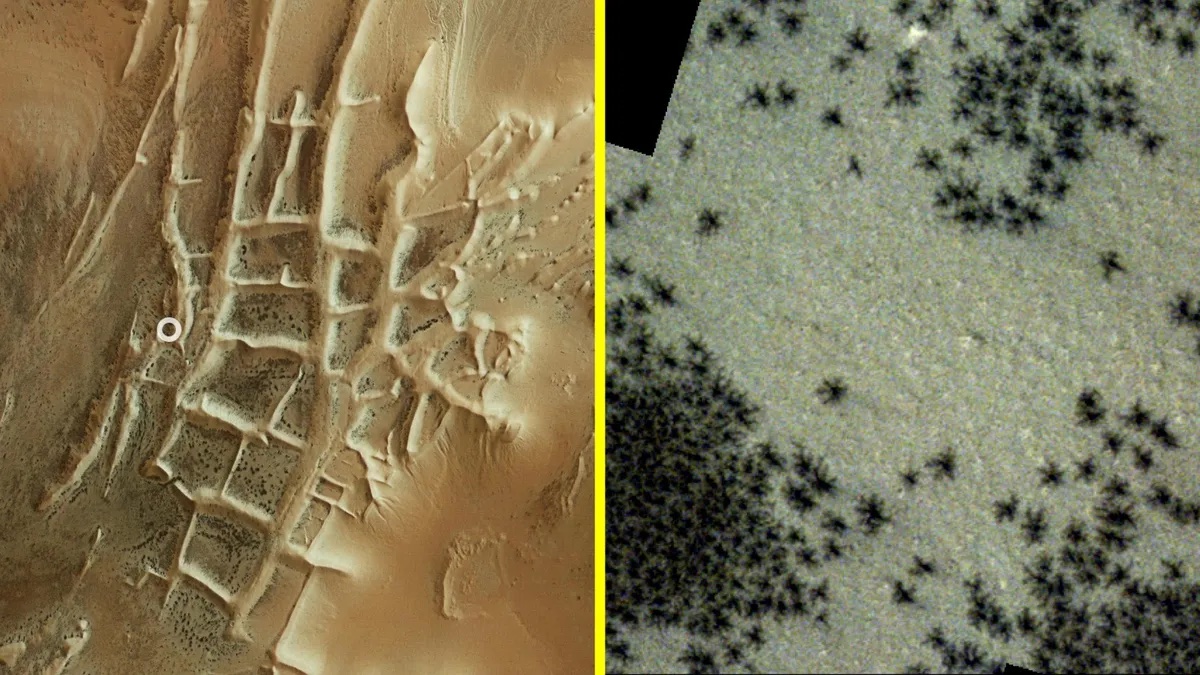
Eerie 'Spiders' Scattered Through Inca City on Mars Seen in Incredible Images Science Alert - April 26, 2024
Enormous Volcano on Mars Found Hidden Within Sprawling Labyrinth
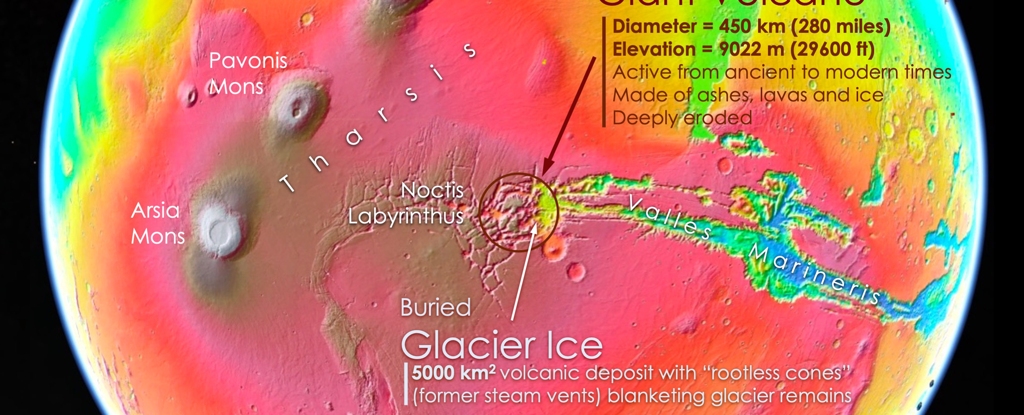
In a scarred and scored terrain on the face of Mars, a giant secret lurks. There, beneath the region known as Noctis Labyrinthus (Labyrinth of the Night), scientists have found evidence of an enormous, ancient volcano - and, possibly, a buried sheet of glacier ice. The discovery makes the equatorial site an attractive option in the search for signs of ancient life on the dry and dusty planet.
Giant volcano discovered on Mars PhysOrg - March 13, 2024
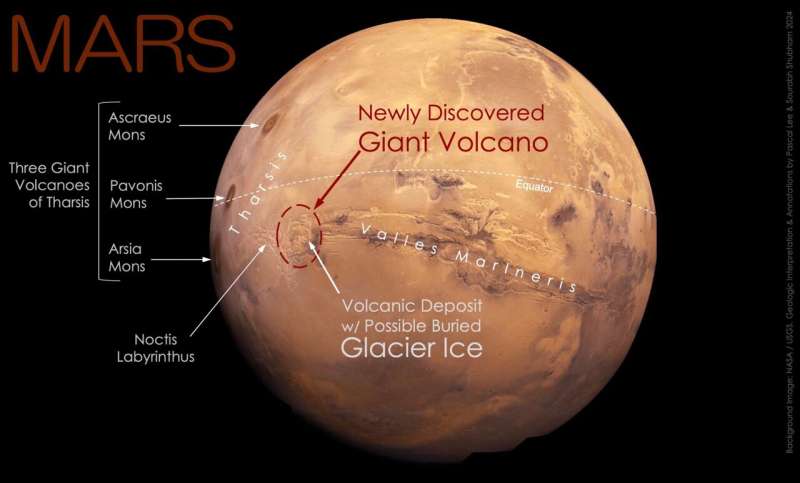
In a groundbreaking announcement scientists revealed the discovery of a giant volcano and possible sheet of buried glacier ice in the eastern part of Mars' Tharsis volcanic province near the planet's equator.
NASA's Perseverance rover has captured an image of the Ingenuity helicopter's final resting place, after it stopped functioning late last month. IFL Science - February 6, 2024
Ingenuity was an impressive little robot, becoming the first to make a powered, controlled flight on a planet other than Earth in April 2021. That's no easy feat, given the wildly different conditions on Mars.
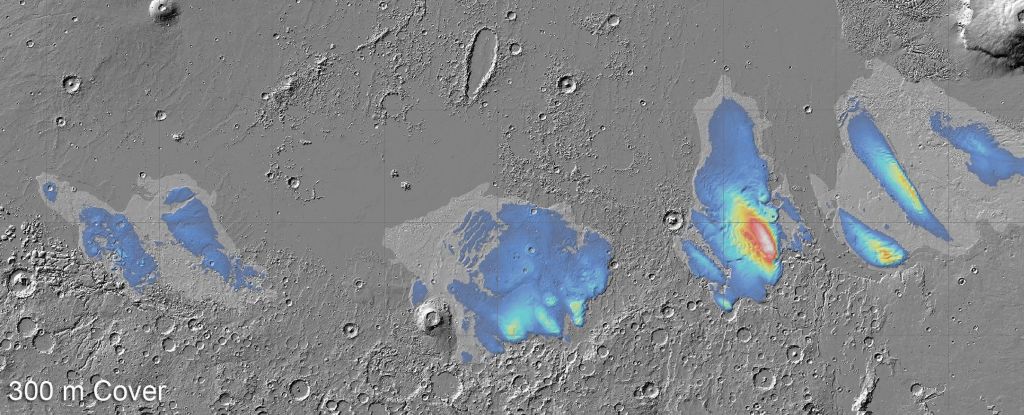
A Massive Amount of Water Ice Has Been Found on Mars, Lurking Beneath The Equator Science Alert - January 18, 2024
The surface of Mars may appear barren and lifeless, but it seems the red planet is keeping quite a few secrets hidden from prying human eyes. Luckily, we have technology Ð and a new radar survey of the Medusae Fossae Formation region on the Martian equator has revealed what appears to be giant layered slabs of buried water ice, several kilometers thick.
Rivers On Mars Flowed On And Off For Hundreds Of Millions Of Years IFL Science - January 18, 2024
Previous work estimated that it took at least tens of thousands of years for the valleys to form - that's the minimum amount of time for those rivers to have flowed. But what is the maximum time? Planetary Science Institute Research Scientist Alexander Morgan has estimated just that. He found that, at most, water was carving the rocks for 100 million years, but it was not a constant flow.
Astronauts Heading To Mars Will Experience The Effects Of Time Dilation IFL Science - January 18, 2024
When astronauts head to Mars, they will experience time dilation. That's to be expected. In fact, your feet and your head experience time dilation, with your head aging ever so slightly faster than your feet. But how much time dilation will they experience (relative to Earth observers)?
New analysis of data from the Curiosity rover reveals Mars was likely a planet of rivers PhysOrg - October 24, 2023
New analysis of data from the Curiosity rover reveals that much of the craters on Mars today could have once been habitable rivers. Prior studies of satellite data from Mars had identified erosional landforms called fluvial ridges as being possible candidates for ancient river deposits. Using data collected by the Curiosity rover at Gale crater, the team found signs of river deposits that are not associated with fluvial ridges, but rather bench-and-nose landforms that have never been linked to ancient river deposits.
In a 1st, NASA's Perseverance rover makes breathable oxygen on Mars Live Science - September 9, 2023
NASA's Perseverance rover has generated 4.3 ounces of breathable oxygen while on the Red Planet - enough to sustain an adult human for three hours.
Pareidolia: Perseverance rover spots a shark fin and crab claw on Mars Live Science - September 7, 2023
It looks like something fishy is happening on Mars. NASA's Perseverance Rover recently spotted a shark-fin-looking outcrop and an accompanying crab-claw-like boulder on the Red Planet. Since arriving on Mars on Feb. 18, 2021, the rolling robot has been exploring the Jezero Crater on Mars while hunting for signs of ancient life. But these strange rocks, captured on Aug. 18, 2023, came as surprise. Even though the now barren and arid landscape of Mars overflowed with water billions of years ago, there is no evidence that the planet was abundant with any sort of seafood, and these images certainly don't change that. Instead, what the rocks in the image evidence is the phenomenon of pareidolia.
Ancient cracked mud found on Mars PhysOrg - August 30, 2023
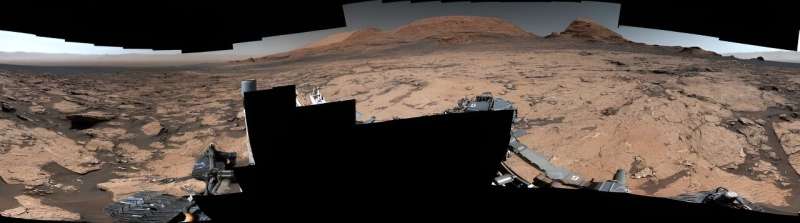

On Earth, mud cracks have traditionally been linked to cycles of wet and dry environments that assisted in developing the complex processes responsible for microbial life to take hold. This study was conducted by an international team of researchers and holds the potential to help scientists better understand the geological and chemical processes that might have existed in Mars' ancient past, up to billions of years ago.
'Building blocks of life' discovered on Mars in 10 different rock samples Live Science - July 17, 2023
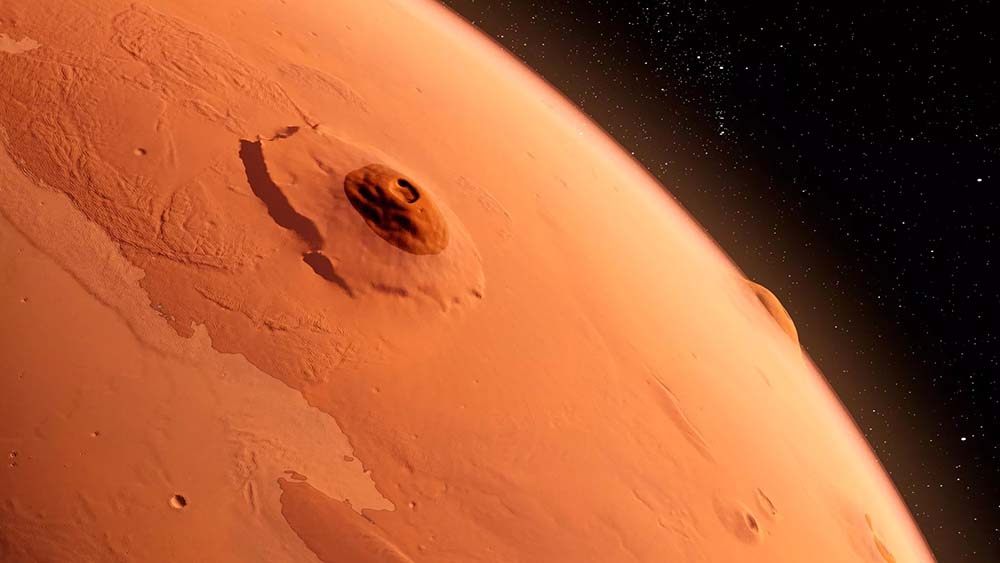
NASA's Perseverance rover has found a diverse menagerie of organic molecules in a Martian crater. Organic compounds are molecules composed of carbon, and often include other elements such as hydrogen, oxygen, nitrogen, phosphorus and sulfur
Perseverance Discovers More Evidence Of Building Blocks Of Life On Mars IFL Science - July 12, 2023
Scientists Detect Intriguing New Signals of Organic Molecules on Mars Science Alert - July 12, 2023
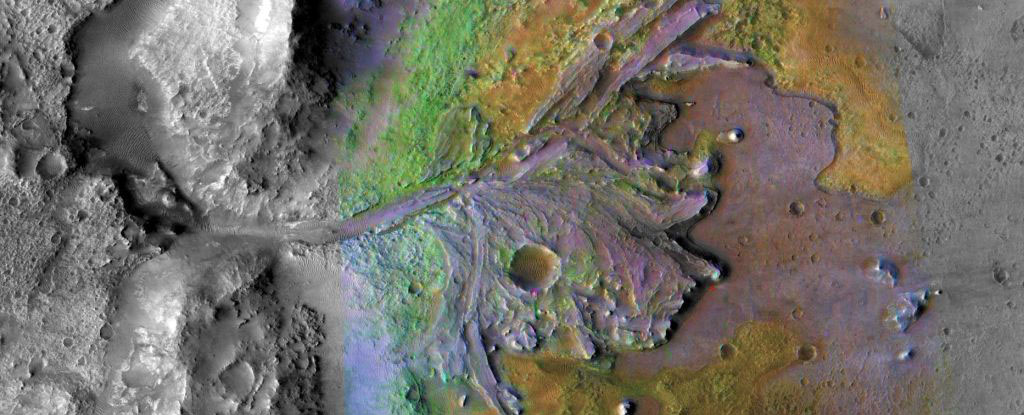
Materials found in the rocks of Mars' Jezero Crater suggest that organic matter may be widespread across the red planet. Spectroscopic analysis using instruments aboard the Perseverance rover has revealed evidence of hydrocarbon molecules in multiple rock formations. Moreover, the detections show different abundances and types of molecules in different rocks.
In an Incredible First, Scientists Have Discovered What's at The Core of Mars Science Alert - April 24, 2023
Mars' center is a liquid iron alloy, with surprisingly large amounts of sulfur and oxygen mixed in.
Clearest Images Ever Taken Of MarsÕs Moon Deimos At Just 100 Kilometers Away IFL Science - April 24, 2023
NASA Rover Encounters Spectacular Metal Meteorite on Mars Science Alert - February 6, 2023
A new study into the Tissint meteorite, which crash-landed in Morocco in 2011, revealed a wide array of organic compounds hidden in the rare space rock. Live Science - January 19, 2023
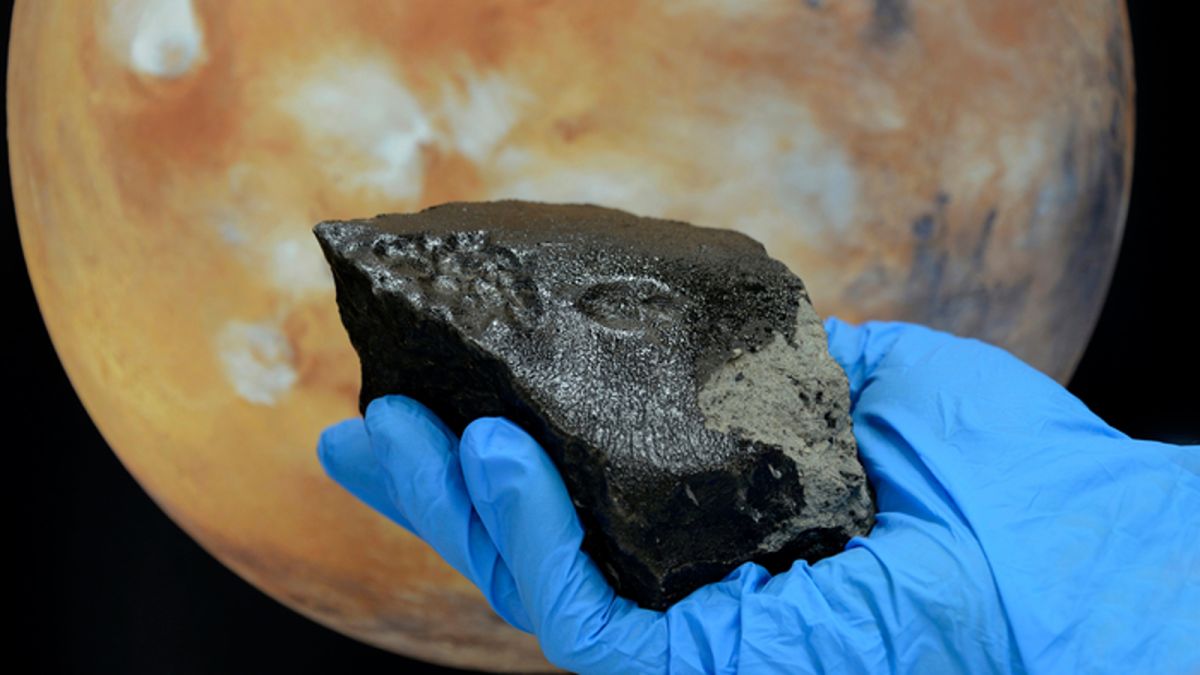
A Martian meteorite that crashed to Earth 12 years ago contains a "huge diversity" of organic compounds, including one that has never been seen on Mars before, a new study has found. The findings The Tissint meteorite broke apart in the sky above the city of Tissint in Morocco on July 18, 2011, showering fragments of the space rock across the surrounding desert. The meteorite, which formed on Mars hundreds of millions of years ago, was likely ejected from our cosmic next-door neighbor by a cataclysmic event before being caught in Earth's gravitational field. It is one of only five Martian meteorites witnessed by people as it crashed into our planet.could help scientists understand more about the Red PlanetÕs habitability and whether it potentially once harbored life.
Mars crater is 'chock-full' of opal gemstones, hinting at widespread water and possible microbial life Live Science - January 6, 2023
Mysterious "halos" of rock surrounding cracks in a Martian crater may be made of water-rich opal gemstones, a new study suggests. An ancient, dried-up lake bed on Mars may be teeming with opal gemstones, new data from NASA's Mars Curiosity rover suggests.
Glaciers flowed on ancient Mars, but slowly PhysOrg - September 7, 2022
A Lunchbox-Sized Device Called MOXIE Is Making Oxygen on Mars Smithsonian - September 6, 2022
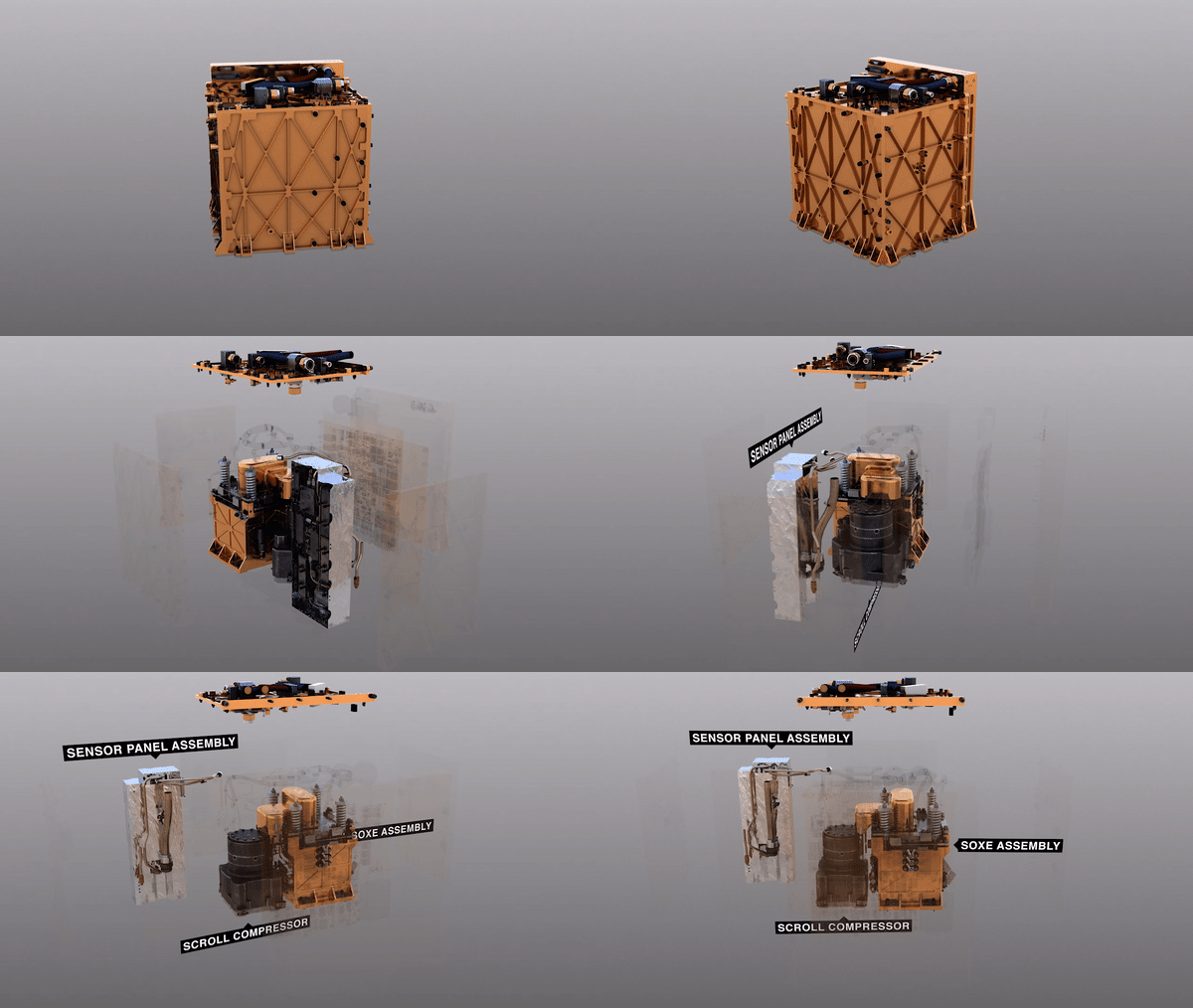
MOXIE experiment reliably produces oxygen on Mars PhysOrg - September 1, 2022
On the red and dusty surface of Mars, nearly 100 million miles from Earth, an instrument the size of a lunchbox is proving it can reliably do the work of a small tree.
A Briefcase-Sized Box Is Already Making Oxygen on Mars Science Alert - September 1, 2022
On Mars - that dusty, dry, alien world, a small instrument, a little bigger than a briefcase, has been reliably pumping out breathable oxygen from the Martian atmosphere. It's the first demonstration of the processing of in situ resources for human use on another planet - establishing a way that breathable air could be generated for a human mission to the red planet.
Strange Signal on Mars Reveals New Clues to The Red Planet's Hidden Past Science Alert - September 1, 2022
Perseverance rover is already sending some surprising data back to Earth. Radar detected that the rock layers beneath the crater are strangely inclined. These strange sections could have resulted from lava flows that slowly cooled or could be sedimentary deposits from an underground lake.
An Eerie New Kind of Martian Aurora Has Been Discovered by Scientists Science Alert - September 1, 2022
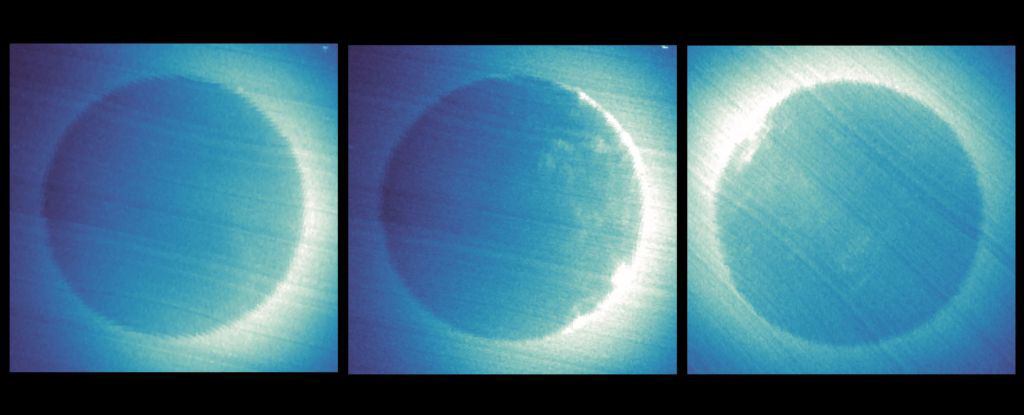
We have new insight into a wonderful Martian phenomenon, thanks to a collaboration between two orbiting space probes. NASA's Mars Atmosphere and Volatile Evolution (MAVEN) and the United Arab Emirates' Hope Probe have joined forces to study the ultraviolet proton auroras that dance and glow high up in Mars' atmosphere.
China's Mars orbiter has mapped the entire Red Planet, nailing key science goal (photos) Space.com - July 1, 2022
China's first successful interplanetary mission has completed mapping the Red Planet more than a year after its arrival. The Tianwen 1 orbiter used its medium-resolution camera to image the surface of Mars; the spacecraft also completed science objectives assigned to the six other scientific payloads on board. This milestone means that both the orbiter and the Zhurong rover, which accompanied Tianwen 1 on the trip to Mars, have now completed their planned scientific exploration tasks, according to the China National Space Administration (CNSA).
A "colorful" crater on Mars reflects varied chemical composition of planet's surface Space.com - June 10 , 2022
An usually colorful crater on the surface of Mars was captured by the European Mars Express probe.
Curiosity Has Found Some Truly Weird-Looking, Twisty Rock Towers on Mars Science Alert - June 7, 2022
Curiosity rover has found an outstanding rock formation piercing the alien landscape of Mars. Amongst the shallow sands and boulders of the Gale Crater rise several twisting towers of rock - the spikes of sediment look almost like frozen streams of water poured from an invisible jug in the sky.
Martian dust devils exhibit electrical characteristics

Mars Has Auroras Without a Global Magnetic Field, And We Finally Know How Science Alert - May 20, 2022
Earth's auroras are a glorious wonder, but our planet isn't the only place in the Solar System where these phenomena can be found. An atmospheric glow, albeit sometimes in invisible wavelengths, has been spotted at every planet except Mercury, and even some moons of Jupiter ... and even a comet. But Mars is where it gets interesting. The red planet is famous for its lost global magnetic field, an ingredient that plays a crucial role in the formation of aurora elsewhere. But that doesn't mean Mars is totally magnetism-free. Regions of localized magnetic fields sprout from some regions of the crust, particularly in the southern hemisphere. New analysis has confirmed that these small, local magnetic fields interact with the solar wind in interesting ways to produce Mars's discrete (or structured) ultraviolet auroras.
Spooky Discovery on Mars Looks Just Like an Alien Doorway Science Alert - May 12, 2022
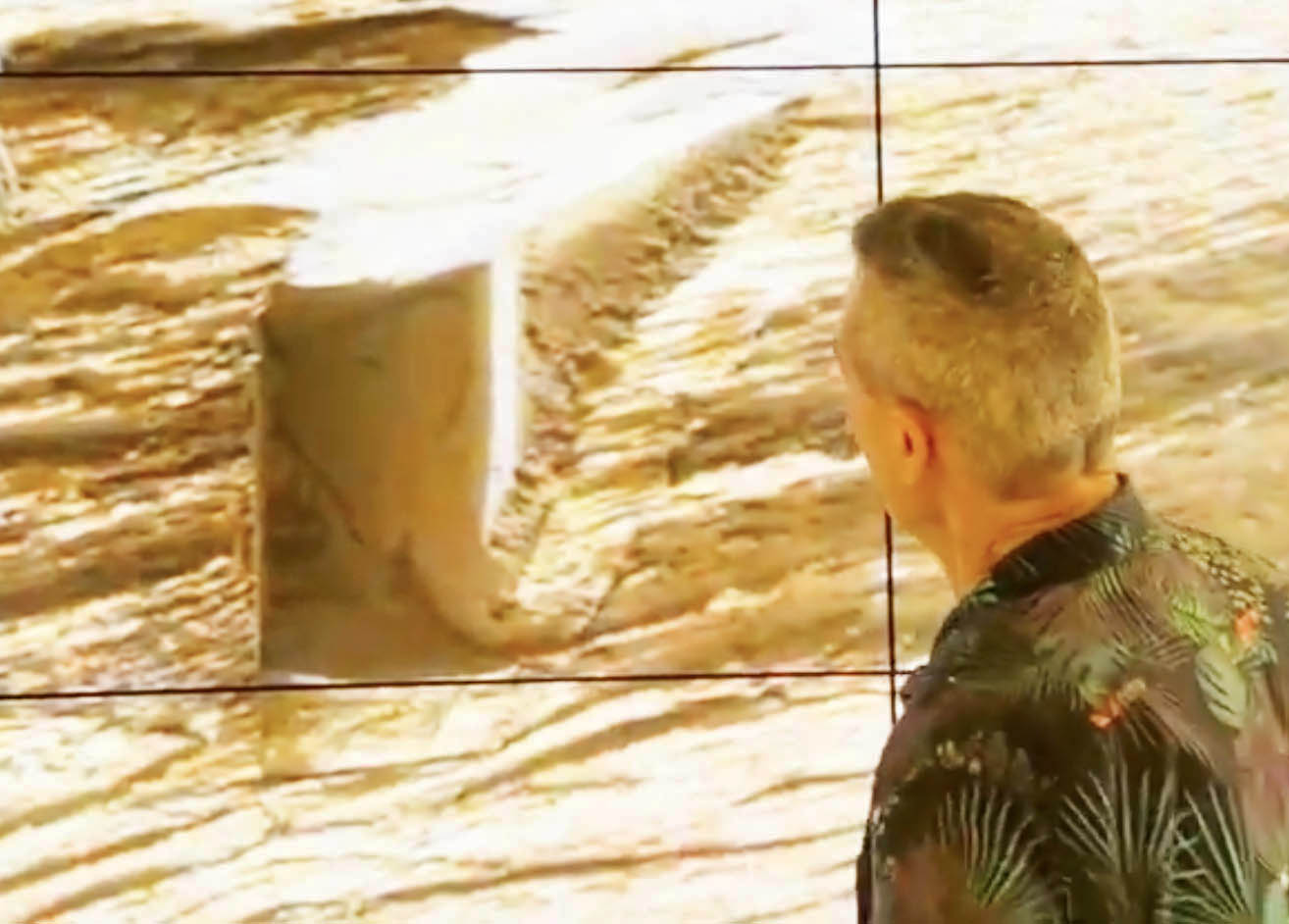
One of the most recent snaps beamed back from the Curiosity rover on Mars has revealed a rather interesting feature in the rocks: what looks to be a perfectly carved out doorway nestling in the Martian landscape. The doorway doppelganger is so eerily convincing we're almost tempted to start believing that it leads to a little hideaway for Martians, or perhaps a portal to another Universe entirely. We're also getting 'tunnel to the center of the planet' vibes from this. At the very least, the picture and the geological feature it's captured would seem to be enough to inspire a science-fiction movie or two.
Related Blog: "Doorway" on Mars - Science and Pseudoscience
'Monster' Quake on Mars Is The Biggest Ever Recorded on Another Planet, NASA Says Science Alert - May 11, 2022
In terms of seismic events on the red planet (or indeed any other planet besides Earth), this is the biggest one recorded so far: the NASA InSight lander has recorded a 'monster' of a marsquake, which is estimated to have hit magnitude 5 on the scale used on Earth.
NASA's InSight records monster quake on Mars PhysOrg - May 10, 2022
NASA's InSight Mars lander has detected the largest quake ever observed on another planet: an estimated magnitude 5 temblor that occurred on May 4, 2022, the 1,222nd Martian day, or sol, of the mission. This adds to the catalog of more than 1,313 quakes InSight has detected since landing on Mars in November 2018. The largest previously recorded quake was an estimated magnitude 4.2 detected Aug. 25, 2021.
New Images Show Giant 'Claw Marks' on The Surface of Mars Science Alert - May 11, 2022
While it still has plenty of mysteries for us to solve, Mars is becoming clearer to us every day, thanks to the dozen functioning robots we currently have either on the red planet's surface or in its orbit. Looking like giant scratches across the planet's surface, these grooves are part of a giant fault system on Mars known as Tantalus Fossae.
First audio recorded on Mars reveals two speeds of sound PhysOrg - April 1, 2022
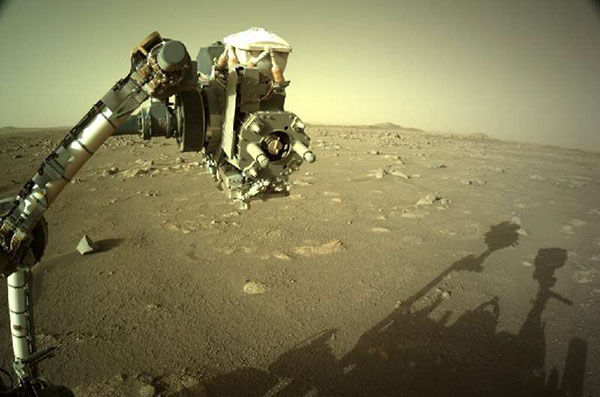
The first audio recordings on Mars reveal a quiet planet with occasional gusts of wind where two different speeds of sound would have a strange delayed effect on hearing
Curiosity Rover Snapped This Photo of a Tiny And Delicate Mineral 'Flower' on Mars called diagenetic crystal clusters Science Alert - February 27, 2022
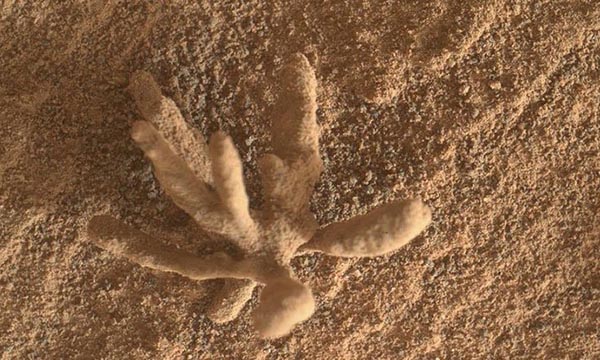
The Curiosity rover took a picture of something pretty enticing this week on the surface of Mars. While the object in question looks like a tiny little flower or maybe even some type of organic feature, the rover team confirmed this object is a mineral formation, with delicate structures that formed by minerals precipitating from water. Curiosity has actually seen these types of features before, which are called diagenetic crystal clusters. Diagenetic means the recombination or rearrangement of minerals, and these features consist of three-dimensional crystal clusters, likely made of a combination of minerals.
Curiosity rover finds 'tantalizing' signs of ancient Mars life Live Science - January 20, 2022
Some of the powdered rock samples that Curiosity has collected over the years contain organics rich in a type of carbon that here on Earth is associated with life, researchers report in a new study. But Mars is very different from our world, and many Martian processes remain mysterious. So it's too early to know what generated the intriguing chemicals, study team members stressed.
NASA's Curiosity Rover Drilled Holes Into Mars, And Found Something Very Strange - An unusual mix of the chemical element that could hypothetically point to the existence of alien life Science Alert - January 20, 2022
That's by no means certain, but it's a possibility. It's one of three different scenarios that experts think might have produced the carbon found in sediment in the Gale crater, collected across nine years from August 2012 to July 2021.
Organic Molecules Have Been Confirmed in The Jezero Crater on Mars Science Alert - December 17, 2021
It hasn't even been on Mars a full year, and NASA's Perseverance rover is making excellent surprise discoveries. Amid a number of findings announced this week at the American Geophysical Union Fall Meeting, scientists have revealed that the Jezero Crater formed from molten volcanic magma Ð and that organic molecules have been discovered in rocks and dust on the crater floor.
Video: 'Significant amounts of water' found in Mars' massive version of the Grand Canyon CNN - December 16, 2021
Mars has its own version of the Grand Canyon, and scientists have learned this dramatic feature is home to "significant amounts of water" after a discovery made by an orbiter circling the red planet. The ExoMars Trace Gas Orbiter, launched in 2016 as a joint mission between the European Space Agency and Roscosmos, detected the water in Valles Marineris on Mars. This canyon system is 10 times longer, five times deeper and 20 times wider than the Grand Canyon.
Perseverance rover makes 'completely unexpected' volcanic discovery on Mars CNN - December 16, 2021
Lava once flowed at the site of an ancient lake on Mars. The Perseverance rover landed on the planet just 10 months ago, but it has already made that surprising discovery.
Nasa's Mars rover Perseverance has identified what are probably the oldest rocks at its crater landing site. BBC - December 16, 2021
Nasa's Mars rover Perseverance has identified what are probably the oldest rocks at its crater landing site. They are volcanic in origin, perhaps the product of some ancient lava flow. It's an important milestone for the mission because it means that when samples of these rocks are returned to Earth next decade, they can be dated. This will tighten our understanding of the history of not only the touch-down location but of Mars generally and the wider Solar System beyond.
NASA's Ingenuity Mars Helicopter reaches a total of 30 minutes aloft PhysOrg - December 16, 2021
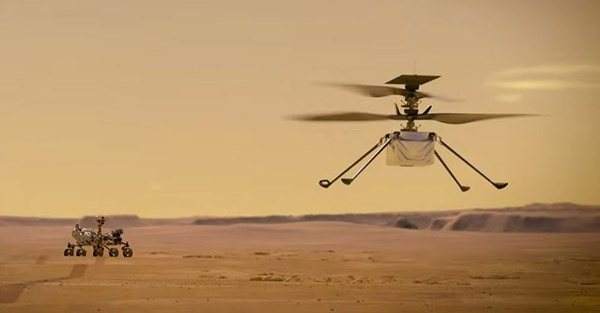
The 17th flight of NASA's Ingenuity Mars Helicopter on Dec. 5 pushed the total flight time past the 30-minute mark. The 117-second sortie brought history's first aircraft to operate from the surface of another world closer to its original airfield, "Wright Brothers Field," where it will await the arrival of the agency's Perseverance Mars rover, currently exploring "South Seitah" region of Mars's Jezero Crater.
Mars rover scrapes at rock to 'look at something no one's ever seen before on another planet CNN - November 12, 2021
One of the rover's key goals is to collect samples from rocks and dirt on Mars that will be returned to Earth by future missions. It has already collected two samples and has used help from the Ingenuity helicopter, acting as an aerial scout, to find its next sample-worthy targets.
Since October 25, Perseverance has been investigating some rock outcrops of the planet's South Seitah region, which are of interest to the rover's science team on Earth. The rover has an abrading tool on its robotic arm that can scrape away at rock layers to take a look inside these rocks. Layered rocks like this often form in water, and can hold clues about what their environment used to be like.
After chipping away at the rocks, the rover sent back images to show what was beneath the rusty-looking top layer: what appears to be a bevy of grainy minerals and sediments. The mineral content of rocks in Jezero Crater, which was once the site of a lake 3.7 billion years ago, act like an undisturbed ancient time capsule. They can tell scientists how the rocks formed and what the climate was like at the time. This could provide a big picture look at what the lake and its river delta were like when the planet was warmer and wetter - and potentially habitable.
NASA just found organic molecules on Mars for the first time Inverse - November 2, 2021
NASA just found organic molecules on #Mars for the first time. After spending 1,909 Martians sols on the red planet, NASAÕs Curiosity rover was suffering from a slight malfunction. The robotÕs drill stopped working while Curiosity was on MarsÕ Vera Rubin ridge at the base of Mount Sharp. The rover had collected a sample of Martian dirt, and the team behind the mission decided to go a different route. Instead of dropping the sample into one of the cups in the sample carousel, they dropped it into a cup pre-filled with a chemical mixture. The molecules released from the cup were then trapped and analyzed, revealing organic molecules on Mars that no space agency had previously detected.
New Orbiter Has Caught Glorious Images of Eerie Alien Auroras on Mars Science Alert - July 5, 2021
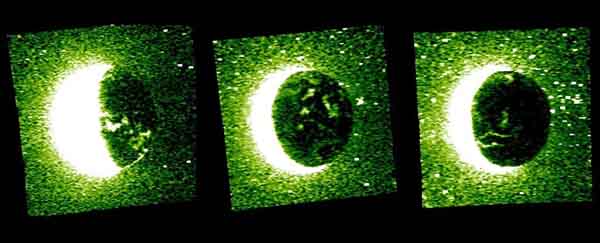
We just got our best views yet of the eerie alien aurora on Mars. The United Arab Emirates' Hope orbiter, which arrived at the red planet earlier this year, used its ultraviolet spectrometer to catch glowing structures of glowing atomic oxygen high up in the Martian night sky.
Early Mars climate was intermittently warm PhysOrg - March 10, 2021
A new study that characterizes the climate of Mars over the planet's lifetime reveals that in its earliest history it was periodically warmed due to the input of greenhouse gases derived from volcanism and meteorites, yet remained relatively cold in the intervening periods, thus providing opportunities and challenges for any microbial life form that may have been emerging on the Red Planet.
Martian dust storms may spark electric purple glow Live Science - February 25, 2021
From its new home on the Red Planet, NASA's Perseverance rover may soon have a front-row view of an otherworldly light show.
When the next seasonal dust storm passes through Jezero crater (where the rover landed on Feb. 18), the air around the rover could crackle and glow with purple light from the collision of statically charged dust particles, a new study suggests. These colorful sparks would almost certainly be too small and weak to pose a threat to Perseverance, or to any hypothetical humans who alight on Mars in the future, said lead study author Joshua MŽndez Harper, a geologist from the University of Oregon. However, the presence of electrostatic forces on Mars could have wide-ranging implications for how scientists understand the Red Planet's atmosphere and its potential to foster life
Scientists discover evidence of melting snow on the Red Planet flowing into gullies that could host aliens Daily Mail - February 25, 2021
Planetary scientists from Arizona State University analyzed images of features from the Martian surface taken by the NASA Mars Reconnaissance Orbiter. Within those images study authors Aditya Khuller and Philip Christensen found the lowest latitude evidence of dusty water ice on Mars that has formed into gullies. This is significant, said Khuller, as ice on Mars melts when it is dusty and at lower latitudes where it is warmer there could be stable liquid water 'within the ice'. While this doesn't necessarily mean there is life within that liquid water, it would be the best place to find surviving life on Mars today, the authors explained. False-color image of light-toned, dusty water ice (relatively white materials in this image) exposed within mid-latitude Martian gullies.
Perseverance Rover Wikipedia
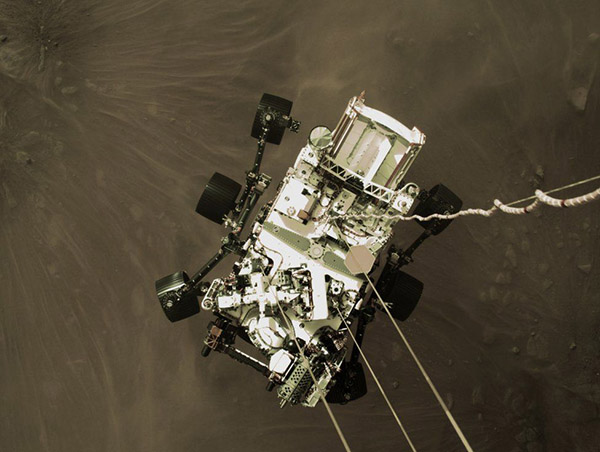
Nasa has released stunning videos of its Perseverance rover landing on Mars
NASAÕs Mars Perseverance Rover Provides Front-Row Seat to First Audio Recording of Red Planet
Touchdown! NASA's Perseverance rover lands on Mars to begin hunt for signs of ancient life
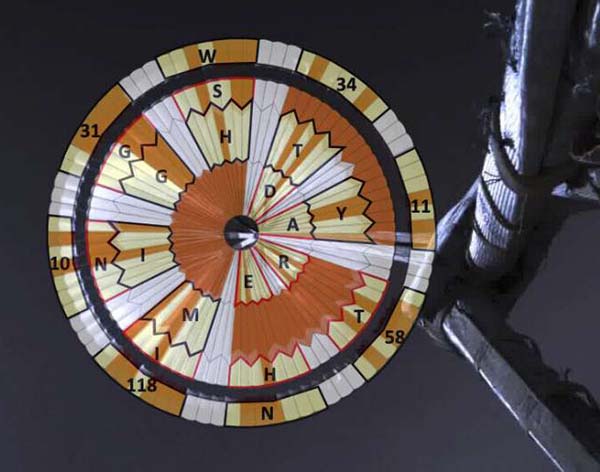
Mars rover's giant parachute carried secret message
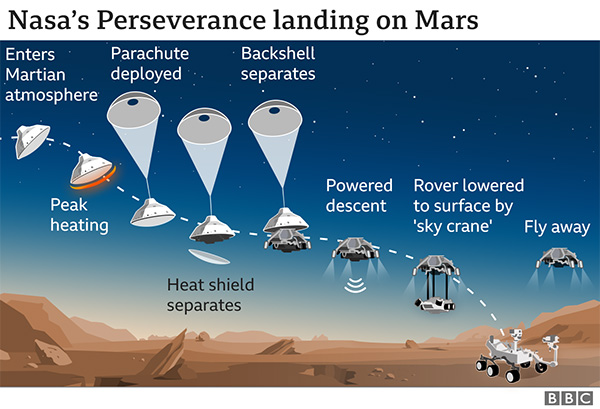
NYC's Empire State Building turns red to celebrate NASA's Perseverance rover

5 weird things NASA's Perseverance rover is bringing to Mars
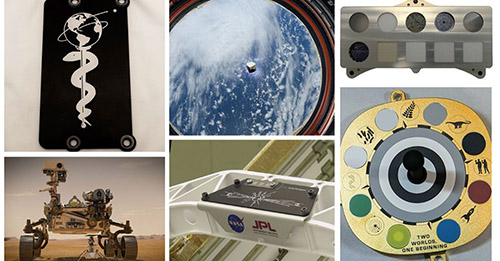
1. Mastcam-Z: "Are we alone?"
2. 10.9 million names
3. Covid-19 Tribute
4. SHERLOC
5. Mars Meteorite
Three new spacecraft are arrive at Mars this month, ending their seven-month journey through space. (See more below)
1. United Arab Emirates Mars Mission Hope Probe, was first to arrive last week. It will stay in orbit and study its atmosphere for one complete Martian year (687 Earth days).
2. China's Tianwen-1 mission entered orbit next and began scouting the potential landing site for its Mars rover, due to be deployed in May. If successful, China will become the second country to land a rover on Mars.
3. NASA's Perseverance Rover arrives February 18, 2021
They join six orbiting spacecraft actively studying the Red Planet from above:
- NASA's 2001 Mars Odyssey
- NASA's 2005 Mars Reconnaissance Orbiter (MRO)
- NASA's MAVEN Orbiter
- Europe's Mars Express
- India's Mars Orbiter Mission (MOM)
- European and Russian partnership ExoMars Trace Gas Orbiter
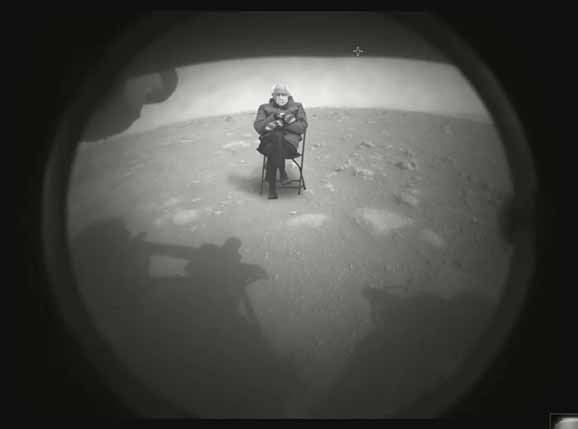
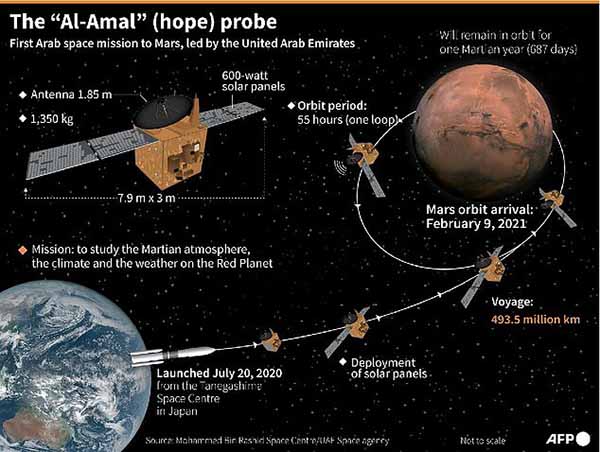
UAE's Hope probe safely enters Mars' orbit - beating both NASA and China to the Red Planet following a 500-million-km race from Earth Daily Mail - February 9, 2021
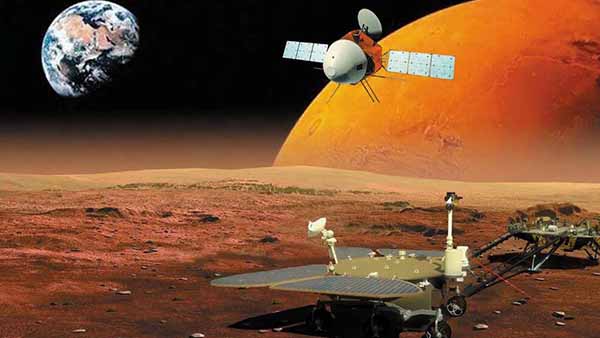
China's first Mars mission, Tianwen-1, successfully enters orbit around Red Planet joining Arab ship Hope Space.com - February 10, 2021
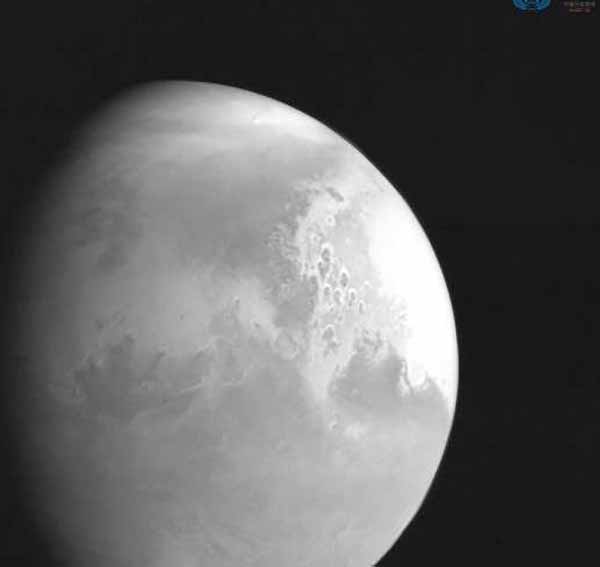
First Photo of Mars From China's Tianwen 1 Probe
Say cheese! Mars' 'Happy Face' crater has significantly grown over a decade due to ongoing thermal erosion that is removing polar frost from the surface Daily Mail - January 22, 2021
Researchers find Mars has a Chandler wobble PhysOrg - January 11, 2021
Approximately a century ago, astronomer Seth Carlo Chandler discovered that imperfectly round objects (such as planets) sometimes spin off their axis for periods of time. The phenomenon has come to be known as the Chandler wobble, and has been documented for planet Earth, which veers from its axis for distances up to 30 feet in a pattern that repeats approximately every 433 days.
A mysterious 'wobble' is moving Mars' poles around Live Science - January 8, 2021
The Red Planet is wiggling and wobbling as it spins, research in the journal Geophysical Research Letters confirms, and astronomers have no idea why.
A Network of Hidden Lakes Has Been Found Under The Surface of Mars, Scientists Say Science Alert - September 28, 2020
The surface of Mars is renowned for its aridity. The entire planet is a dusty, barren desert - a wasteland of rock and, in some regions, ice; but of liquid water, not a confirmed drop has been found. In 2018, scientists unveiled a bombshell discovery - they'd found evidence of a colossal underground reservoir of liquid water at the Martian south pole. Now, they've taken that discovery a crucial step forward. There's not one, but an entire network of multiple lakes under the southern polar ice cap. And that means that the first reservoir was not a one-off or a freak of Martian nature.
Billions of years ago Mars Had Planet-Wide Rainstorms So Intense They Breached Its Lakes Science Alert - August 24, 2020
New research on the Red Planet's now-empty lakes suggests a huge amount of liquid water must have spilled from the skies roughly 3.5 to 4 billion years ago, enough to sculpt river-like channels and breach several lake basins. This is extremely important because 3.5 to 4 billion years ago Mars was covered with water. It had lots of rain or snowmelt to fill those channels and lakes.
Lava tubes on Mars and the Moon are so wide they can host planetary bases PhysOrg - August 5, 2020
Researchers found that Martian and lunar tubes are respectively 100 and 1,000 times wider than those on Earth, which typically have a diameter of 10 to 30 meters. Lower gravity and its effect on volcanism explain these outstanding dimensions (with total volumes exceeding 1 billion of cubic meters on the Moon). Tubes as wide as these can be longer than 40 kilometers, making the Moon an extraordinary target for subsurface exploration and potential settlement in the wide protected and stable environments of lava tubes. The latter are so big they can contain Padua's entire city center
For the first time, scientists have observed that 'megaripples' on Mars - huge sand waves seen on the Martian surface - are moving structures, and not ancient relics stuck in place since the Red Planet's distant past Science Alert - July 29, 2020
Megaripples, which also occur in deserts on Earth, are generally larger than smaller sand ripples, and are composed of chunkier, coarser sand grains that sit at the top of their crests, resting on finer grains buried at the bottom. The heftiness of the crest grains - combined with the very thin and faint winds of Mars' light atmosphere today - had scientists thinking these sediment structures must be static and immovable formations. Not so, new research shows.
Mystery of lava-like flows on Mars solved by scientists PhysOrg - May 24, 2020
The mystery of some lava-like flows on Mars has been solved by scientists who say they are caused not by lava but by mud.
New water cycle on Mars discovered PhysOrg - May 11, 2019
Approximately every two Earth years, when it is summer on the southern hemisphere of Mars, a window opens: Only in this season can water vapor efficiently rise from the lower into the upper Martian atmosphere. There, winds carry the rare gas to the north pole. While part of the water vapor decays and escapes into space, the rest sinks back down near the poles.
Nasa's InSight lander 'detects first Marsquake' BBC - April 24, 2019
The American space agency's InSight lander appears to have detected its first seismic event on Mars. The faint rumble was picked up by the probe's sensors on 6 April - the 128th Martian day, or sol, of the mission.
Mysterious streaks in a Martian impact crater suggest the red planet still has an active groundwater system hundreds of meters beneath the surface Daily Mail - March 28, 2019
Though recent studies have detected the presence of deep lakes near MarsÕ south pole, features linked to water in areas closer to the equator have largely been attributed to flows at or near the surface.
New evidence of deep groundwater on Mars PhysOrg - March 28, 2019
A new investigation using data from Mars Express and the Mars Reconnaissance Orbiter now suggests groundwater is much more prevalent across the red planet than previously suspected. Scientists now say active groundwater likely exists far beyond the Martian poles, in some cases as deep as 750 meters, and gives rise to surface streams that leave snaking streaks along many crater walls.
Space Orbiter Spots 'Hairy Blue Spider' on Mars
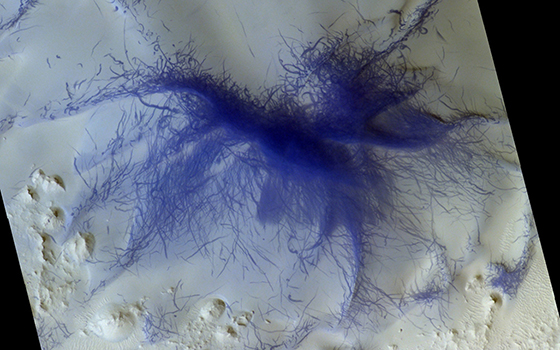
In reality, the so-called spider is a sprawling pattern left behind on a ridge by a frenzy of dust devils, when hundreds or even thousands of whirling tornadoes formed in the area.
First evidence of planet-wide groundwater system on Mars PhysOrg - March 1, 2019
Mars Express has revealed the first geological evidence of a system of ancient interconnected lakes that once lay deep beneath the Red Planet's surface, five of which may contain minerals crucial to life.
A selfie on Mars: NASA's InSight spacecraft sends stunning image back to Earth after surviving a supersonic plunge and landing safely on the red planet Daily Mail - November 27, 2018
NASA's latest interplanetary probe has sent its first selfie from the barren surface of Mars, after it successfully reached the planet following a seven month trip through space. The US space agency released a photograph taken by its Insight spacecraft shortly after it landed, showing part of the probe and the Martian surface in the distance. A Nasa satellite orbiting the red planet relayed images of the $1 billion (£0.78 billion) spacecraft from its landing site, known as Elysium Planitia, back to Earth at 8:30pm EST (1:30am GMT). The successful transfer confirms that InSight's solar panels, known as solar arrays, have now successfully opened, meaning it is able to collect sunlight and recharge its batteries each day.
InSight Lander Wikipedia
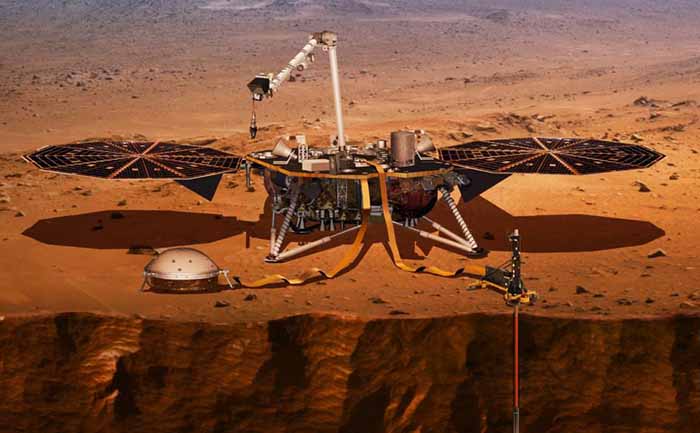
NASA's InSight lander has touched down on Mars CNN - November 26, 2018
After seven months of traveling through space, the NASA InSight mission has landed on Mars. A few minutes after landing, InSight sent the official "beep" to NASA to signal that it was alive and well, including a photo of the Martian surface where it landed. Mission Control at NASA's Jet Propulsion Laboratory exploded into celebratory applause and cheers after the touchdown was confirmed. The landing was watched around the world and even broadcast live on the Nasdaq Stock Market tower in New York City's Times Square. During a post-landing NASA press conference, the astronauts on the International Space Station called down to congratulate the mission team and said they "got some goosebumps" watching the coverage.
Why Is NASA Looking for 'Marsquakes'? Live Science - November 26, 2018
With a design inspired by the older Mars lander Phoenix, this next-generation machine will extend its robot arms and place a seismometer Ñ a device that measures quakes - onto the surface of Mars. If all goes well, for two Earth years (one Mars year), it will listen for vibrations that happen beneath the surface of the planet, to answer some fundamental questions about how rocky planets, including our own, formed. But what are marsquakes, and why are NASA scientists hunting for them?
Scientists capture the sound of sunrise on Mars PhysOrg - November 9, 2018
Scientists have created the soundtrack of the 5,000th Mars sunrise captured by the robotic exploration rover, Opportunity, using data sonification techniques to create a two-minute piece of music. Researchers created the piece of music by scanning a picture from left to right, pixel by pixel, and looking at brightness and color information and combining them with terrain elevation. They used algorithms to assign each element a specific pitch and melody. The quiet, slow harmonies are a consequence of the dark background and the brighter, higher pitched sounds towards the middle of the piece are created by the sonification of the bright sun disk.
Mars Express detects liquid water hidden under planetÕs south pole Science Daily - July 27, 2018
Evidence for the Red Planet's watery past is prevalent across its surface in the form of vast dried-out river valley networks and gigantic outflow channels clearly imaged by orbiting spacecraft. Orbiters, together with landers and rovers exploring the martian surface, also discovered minerals that can only form in the presence of liquid water. But the climate has changed significantly over the course of the planet's 4.6 billion year history and liquid water cannot exist on the surface today, so scientists are looking underground. Early results from the 15-year old Mars Express spacecraft already found that water-ice exists at the planet's poles and is also buried in layers interspersed with dust. The presence of liquid water at the base of the polar ice caps has long been suspected; after all, from studies on Earth, it is well known that the melting point of water decreases under the pressure of an overlying glacier. Moreover, the presence of salts on Mars could further reduce the melting point of water and keep the water liquid even at below-freezing temperatures.
Evidence detected of lake made of water beneath the surface of Mars CNN - July 25, 2018
A lake of liquid water has been detected by radar beneath the southern polar ice cap of Mars. Those pulses reflected 29 sets of radar samples that created a map of drastic change in signal almost a mile below the surface. It stretched about 12.5 miles across and looked very similar to lakes that are found beneath Greenland and Antarctic ice sheets on Earth. The radar reflected the feature's brightness, signaling that it's water.
Liquid water 'lake' revealed on Mars BBC - July 25, 2018
Researchers have found evidence of an existing body of liquid water on Mars. What they believe to be a lake sits under the planet's south polar ice cap, and is about 20km (12 miles) across. Previous research found possible signs of intermittent liquid water flowing on the martian surface, but this is the first sign of a persistent body of water on the planet in the present day. Lake beds like those explored by Nasa's Curiosity rover show water was present on the surface of Mars in the past. However, the planet's climate has since cooled due to its thin atmosphere, leaving most of its water locked up in ice. The result is exciting because scientists have long searched for signs of present-day liquid water on Mars, but these have come up empty or yielded ambiguous findings. It will also interest those studying the possibilities for life beyond Earth - though it does not yet raise the stakes in the search for biology.
NASA's Curiosity rover finds organic matter on Mars CNN - June 7, 2018
Organic matter has been found on Mars in soil samples taken from 3 billion-year-old mudstone in the Gale crater by the Curiosity rover, NASA announced today. The rover has also detected methane in the Martian atmosphere. The search for life outside Earth focuses on the building blocks of life as we know it, which includes organic compounds and molecules -- although these can exist without life. Organic matter can be one of several things: a record detailing ancient life, a food source for life or something that exists in the place of life.
Study explains why Mars growth stunted PhysOrg - May 7, 2018
A study offers a simple and more elegant solution for why Mars is small, barren and uninhabitable. The particular dynamics of the instability between the giant planets kept Mars from growing to an Earth-mass planet.
Nasa's InSight mission will target 'Marsquakes' BBC - May 5, 2018
The American space agency Nasa has launched its latest mission to Mars. InSight will be the first probe to focus its investigations predominantly on the interior of the Red Planet. The lander - due to touch down in November - will put seismometers on the surface to feel for "Marsquakes". These tremors should reveal how the underground rock is layered - data that can be compared with Earth to shed further light on the formation of the planets 4.6 billion years ago.
Huge reserves of water ice discovered on Mars could speed manned missions NBC - January 12, 2018
Huge ice sheets more than 300 feet deep have been discovered on Mars, making it possible that human astronauts could have access to almost limitless water. It has been known for some time that some locations on Mars have water ice just below the surface - but until now, there has been no accurate way to know just how much. The new data, collected in high-resolution three-dimensional images from two U.S. satellites, reveal at least eight locations where massive shelves of water ice are deposited from just below the Martian surface as far deep as 100 meters, or roughly 330 feet, according to the report
There is water on Mars: Scientists say rocks on the red planet absorbed it under the crust like a sponge killing all lifeforms and leaving the surface dry and desolate Daily Mail - December 20, 2017
The last water on Mars was sucked up into the planet's surface like a sponge when it came into contact with absorbent rocks, a new study claims. Experts found that basalt minerals on the red planet, formed by volcanic activity, can soak up 25 per cent more water than those on Earth. As a result they drew water from the Martian surface into its interior, leaving the surface barren and desolate. This would have been devastating to any simple forms of life that might have evolved on the planet's surface around 3.5 billion years ago, researchers say.
NASA's MAVEN mission finds Mars has a twisted magnetic tail Science Daily - October 19, 2017
NASA's Mars Atmosphere and Volatile Evolution Mission (MAVEN) spacecraft is in orbit around Mars gathering data on how the Red Planet lost much of its atmosphere and water, transforming from a world that could have supported life billions of years ago into a cold and inhospitable place today. The process that creates the twisted tail could also allow some of Mars' already thin atmosphere to escape to space, according to the research team.
Team discovers lull in Mars' giant impact history PhysOrg - April 25, 2017
The new results reveal that Mars' impact history closely parallels the bombardment histories we've inferred for the Moon, the asteroid belt, and the planet Mercury. We refer to the period for the later impacts as the 'Late Heavy Bombardment.' The new results add credence to this somewhat controversial theory. However, the lull itself is an important period in the evolution of Mars and other planets. We like to refer to this lull as the 'doldrums.' The early impact bombardment of Mars has been linked to the bombardment history of the inner solar system as a whole. Borealis, the largest and most ancient basin on Mars, is nearly 6,000 miles wide and covers most of the planet's northern hemisphere. New analysis found that the rim of Borealis was excavated by only one later impact crater, known as Isidis. This sets strong statistical limits on the number of large basins that could have formed on Mars after Borealis. Moreover, the preservation states of the four youngest large basins - Hellas, Isidis, Argyre, and the now-buried Utopia - are strikingly similar to that of the larger, older Borealis basin. The similar preservation states of Borealis and these younger craters indicate that any basins formed in-between should be similarly preserved. No other impact basins pass this test.
Astronomers find orbit of Mars hosts remains of ancient mini-planets PhysOrg - April 3, 2017
The planet Mars shares its orbit with a handful of small asteroids, the so-called Trojans. Now an international team of astronomers using the Very Large Telescope in Chile have found that most of these objects share a common composition; they are likely the remains of a mini-planet that was destroyed by a collision long ago.
Impact crater linked to Martian tsunamis BBC - March 26, 2017
Scientists have located an impact crater linked to powerful tsunamis that swept across part of ancient Mars. The team believe an asteroid triggered 150m-high waves when it plunged into an ocean thought to have existed on northern Mars three billion years ago. Lomonosov crater in the planet's northern plains fits the bill as the source of tsunami deposits identified on the surface.
Mars volcano, Earth's dinosaurs went extinct about the same time PhysOrg - March 20, 2017
Around the same time that the dinosaurs became extinct on Earth, a volcano on Mars went dormant, NASA researchers have learned. Arsia Mons is the southernmost volcano in a group of three massive Martian volcanoes known collectively as Tharsis Montes. Until now, the volcano's history has remained a mystery. But thanks to a new computer model, scientists were finally able to figure out when Arsia Mons stopped spewing out lava. According to the model, volcanic activity at Arsia Mons came to a halt about 50 million years ago. Around that same time, Earth experienced the Cretaceous-Paleogene extinction event, which wiped out three-quarters of its animal and plant species, including the dinosaurs.
Indicators show potatoes can grow on Mars PhysOrg - March 9, 2017
The Potatoes on Mars project was conceived by CIP to both understand how potatoes might grow in Mars conditions and also see how they survive in the extreme conditions similar to what parts of the world already suffering from climate change and weather shocks are already experiencing.
Alien Hunters Spot Trio Of Mile-High "Towers" On Mars Mysterious Universe - December 10, 2016
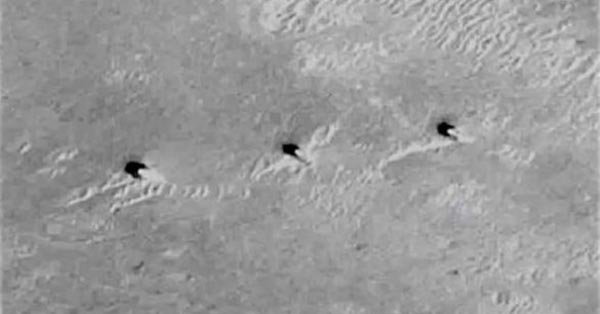
A 3D interpretation of what the 'towers' might look like on the Martian surface. Aside from Google Mars, the raw images which depict the alleged 'alien megatowers' are published by Malin Space Systems can be seen on their website. Clearly, if the photos can be considered accurate, there are indeed three very similarly-shaped structures found in this particular region of the Marian landscape; whether or not they are of alien origin, however, remains a mystery. The towers could simply be naturally-occurring geological formations. Satellite images are notoriously difficult to use as proof for claims that structures seen in them might be artificially-constructed. Belt of Orion Correlation?
NASA's MAVEN mission gives unprecedented ultraviolet view of Mars Science Daily - October 18, 2016
New global images of Mars from the MAVEN mission show the ultraviolet glow from the Martian atmosphere in unprecedented detail, revealing dynamic, previously invisible behavior. They include the first images of "nightglow" that can be used to show how winds circulate at high altitudes. Additionally, dayside ultraviolet imagery from the spacecraft shows how ozone amounts change over the seasons and how afternoon clouds form over giant Martian volcanoes. The images were taken by the Imaging UltraViolet Spectrograph (IUVS) on the Mars Atmosphere and Volatile Evolution mission (MAVEN).
A giant impact: Solving the mystery of how Mars' moons formed Science Daily - July 5, 2016
Where did the two natural satellites of Mars, Phobos and Deimos, come from? For a long time, their shape suggested that they were asteroids captured by Mars. However, the shape and course of their orbits contradict this hypothesis. Two independent and complementary studies provide an answer to this question. One of these studies rules out the capture of asteroids, and shows that the only scenario compatible with the surface properties of Phobos and Deimos is that of a giant collision. In the second study, researchers used cutting-edge digital simulations to show how these satellites were able to form from the debris of a gigantic collision between Mars and a protoplanet one-third its size.
The rise and fall of Martian lakes PhysOrg - May 13, 2016
There is a wealth of evidence, collected over the past few decades, that suggests liquid water was abundant in the early history of Mars Ð one of our nearest and most studied neighbors. However, the size, evolution and duration of standing bodies of water, such as lakes, on Mars' surface are still a matter of great debate. A recent study, using data from several spacecraft operating at Mars, paints a detailed picture of the rise and fall of standing bodies of water in a region of Mars which once hosted one of its largest lakes.
Speed of solar wind stripped away Martian atmosphere Science Daily - November 5, 2015
NASA's Mars Atmosphere and Volatile Evolution (MAVEN) mission has identified the process that appears to have played a key role in the transition of the Martian climate from an early, warm and wet environment that might have supported surface life to the cold, arid planet Mars is today.
'Streams and Lakes' in Gale Crater Tell Story of a Wet Mars NBC - October 9, 2015
The Red Planet's past may be more blue than we thought. A new study based on data collected by the Curiosity Mars rover suggests that Gale Crater, where the rover landed in 2012, may have once been an immense lake fed by moving water.
Liquid water flows on today's Mars: NASA confirms evidence Science Daily - September 28, 2015
New findings from NASA's Mars Reconnaissance Orbiter (MRO) provide the strongest evidence yet that liquid water flows intermittently on present-day Mars. Using an imaging spectrometer on MRO, researchers detected signatures of hydrated minerals on slopes where mysterious streaks are seen on the Red Planet. These darkish streaks appear to ebb and flow over time.
Stonehenge-style rocks spotted on Mars Daily Mail - September 24, 2015
Bizarre circular stone formation on the red planet resembles the iconic Pagan site. Alien hunters claim to have spotted a stone circle on the surface of Mars. They claim it resembles the famous Stonehenge formation in Wiltshire. However, experts have warned that stone circles can also form naturally. It is the latest in a long line of strange 'objects' spotted in images of Mars.
Mars crater wetter than thought, had water tracks in the last million years PhysOrg - June 24, 2015
Mars is thought to have had a watery past, but when exactly it transitioned to its dry and dusty present is up for debate. Now, though, a team of scientists studying the marks on a young Martian crater has found signs that waterlogged debris flowed down the Red Planet's slopes surprisingly recently - within the last million years.
Nasa rover captures blue sunset on Mars Times of India - May 11, 2015
Nasa's Mars rover Curiosity has captured stunning images of the Sun setting on the red planet, showing blue hues of the serene sundown over the Martian horizon. The Sun dips to the Martian horizon in a blue-tinged sky in images sent home to Earth last week from Curiosity. The sunset observations help researchers assess the vertical distribution of dust in the atmosphere.
Mars has belts of glaciers consisting of frozen water PhysOrg - April 7, 2015
Mars has distinct polar ice caps, but Mars also has belts of glaciers at its central latitudes in both the southern and northern hemispheres. A thick layer of dust covers the glaciers, so they appear as surface of the ground, but radar measurements show that underneath the dust there are glaciers composed of frozen water. New studies have now calculated the size of the glaciers and thus the amount of water in the glaciers. It is the equivalent of all of Mars being covered by more than one meter of ice.
Ancient Martian lake system records two water-related events PhysOrg - March 25, 2015
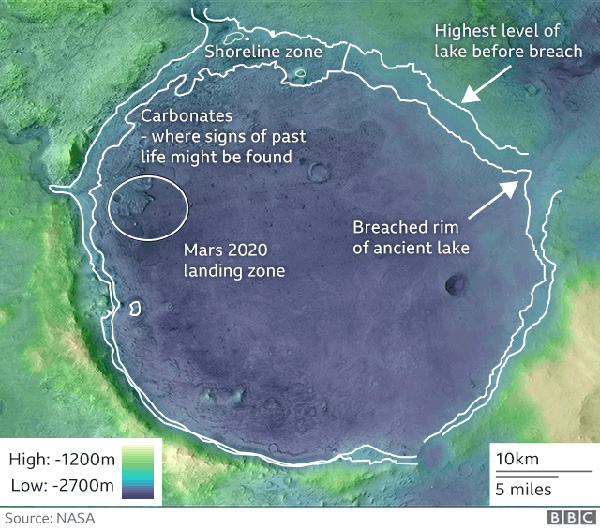
Researchers from Brown University have completed a new analysis of an ancient Martian lake system in Jezero Crater, near the planet's equator. The study finds that the onslaught of water that filled the crater was one of at least two separate periods of water activity in the region surrounding Jezero. The ancient lake at Jezero crater was first identified in 2005 by Caleb Fassett, a former Brown graduate student now a professor at Mount Holyoke College. Fassett identified two channels on the northern and western sides of the crater that appear to have supplied it with water. That water eventually overtopped the crater wall on the southern side and flowed out through a third large channel. It's not clear how long the system was active, but seems to have dried out around 3.5 to 3.8 billion years ago.
Why did NASA scientists name a geologic feature on Mars "Aztec"? PhysOrg - December 10, 2014
Last week, NASA mission controllers for the Mars rover Curiosity spied a piece of rock outcropping with tiny holes, veins and fractures in the rocks. It's common practice for the science team to assign names to these targets to make communication easier among team members. This particular outcropping's name? Aztec.
Curiosity Mars rover 'solves mountain riddle' BBC - December 9, 2014
Scientists working on Nasa's Curiosity rover think they can now explain why there is a huge mountain at the robot's landing site in Mars's Gale Crater. They believe it is the remains of sediments laid down in successive lakes that filled the deep bowl, probably over tens of millions of years. Only later did winds dig out an encircling plain to expose the 5km-high peak we see today. If true, this has major implications for past climates on the Red Planet.
Curiosity rover finds clues to how water helped shape Martian landscape PhysOrg - December 8, 2014
Observations by NASA's Curiosity Rover indicate Mars' Mount Sharp was built by sediments deposited in a large lake bed over tens of millions of years. This interpretation of Curiosity's finds in Gale Crater suggests ancient Mars maintained a climate that could have produced long-lasting lakes at many locations on the Red Planet.
Warmth, flowing water on early Mars were episodic Science Daily - November 18, 2014
There is ample evidence that water once flowed on the surface of ancient Mars. But that evidence is difficult to reconcile with the latest generation of climate models that suggest Mars should have been eternally icy. A new study suggest that warming and water flow on Mars were probably episodic and related to ancient volcanic eruptions.
Curiosity travels through ancient glaciers on Mars Science Daily - June 25, 2014
Some 3,500 million years ago, the Martian crater Gale -- through which the NASA rover Curiosity is currently traversing -- was covered with glaciers, mainly over its central mound. Very cold liquid water also flowed through its rivers and lakes on the lower-lying areas, forming landscapes similar to those which can be found in Iceland or Alaska.
Rock appears mysteriously in front of Mars Opportunity rover PhysOrg - January 20, 2014
The lead scientist for NASA's Mars rover exploration team (Steve Squyres) has announced that recent images beamed back by the Opportunity rover show a rock sitting in a place nearby where there wasn't one just twelve days prior. The image, he says, has caused quite a commotion with the rover team as possible explanations for the sudden appearance of the rock are bandied about.
Jelly Donut Shaped Rock Appears on Mars NASA - January 29, 2014
What if a rock that looked like a jelly donut suddenly appeared on Mars? That's just what happened in front of the robotic Opportunity rover currently exploring the red planet. The unexpectedly placed rock, pictured above, was imaged recently by Opportunity after not appearing in other images taken as recently as twelve Martian days (sols) before. Given the intriguing mystery, the leading explanation is somewhat tame - the rock was recently scattered by one of the rover's tires. Even so, the rock's unusual light tones surrounding a red interior created interest in its composition - as well as causing it to be nicknamed Jelly Donut. A subsequent chemical analysis showed the rock has twice the abundance of manganese than any other rock yet examined -- an unexpected clue that doesn't yet fit into humanity's understanding of the Martian geologic history. Opportunity, just passing its 10-year anniversary on Mars, continues to explore the Murray Ridge section of the rim of 22-kilometer wide Endeavor Crater.
Mars: Gusev Crater once held a lake after all, scientist says Science Daily - April 9, 2014
Evidence for an ancient 'Lake Gusev' on Mars has come and gone several times. That lake is looking pretty good today, thanks to new research. New research suggests floodwaters entered the crater through the huge valley that breaches Gusev's southern rim. These floods appear to have ponded long enough to alter the tephra, producing briny solutions. When the brines evaporated, they left behind residues of carbonate minerals. As the lake filled and dried, perhaps many times in succession, it loaded Comanche and its neighbor rocks with carbonates.
More Light Shed On Possibility of Life On Mars Science Daily - December 9, 2013
Scientists have found evidence of an ancient freshwater lake on Mars well suited to support microbial life. The lake, located inside Gale Crater where the rover landed in August 2012, likely covered an area 31 miles long and 3 miles wide, though its size varied over time. Analysis of sedimentary deposits gathered by NASA's Mars rover Curiosity shows the lake existed for at least tens of thousands of years and possibly longer. Humankind is by nature inquisitive, especially about the prospect of life on other planets and whether or not we are alone. The aptly named Curiosity, a NASA Mars rover, has been scouring that planet's surface as a potential habitat for life, either past or present.
New Evidence Supports Asteroid Origin Of Martian Moon Live Science - November 21, 2013
New research suggests that Mars' larger moon, Phobos, is likely an errant asteroid trapped by the planet's gravitational pull. Astronomers matched the chemical makeup of Phobos' surface to a meteorite that struck Canada, concluding that the Martian moon likely started out as a carbon-rich, "D-type" asteroid that drifted too close to the red planet. These new results are a step towards settling the mysterious origin of Mars' moons.
Secrets of Mars' Birth Revealed from Unique Meteorite Science Daily - November 21, 2013
The work of Munir Humayun -- a professor in FSU's Department of Earth, Ocean and Atmospheric Science and a researcher at the National High Magnetic Field Laboratory (MagLab) -- is based on an analysis of a 4.4 billion-year-old Martian meteorite that was unearthed by Bedouin tribesmen in the Sahara desert. The rock (NWA 7533) may be the first recognized sample of ancient Martian crust and holds a wealth of information about the origin and age of the Red Planet's crust.