Tuesday, March 1, 2005
I asked for a 'sign' as to whether or not I am on target with my work in so far as time travel and the loop fracture that occurred in the labs during WWII in Germany, which links with my book Sarah and Alexander.
Wednesday, I found the article below, which on some level validates my mission. Friends who read the article wonder why the US military spent so many year there. What were they searching for or working on?
Through the years I have met dozens of researchers and metaphysicians who have vivid memories, past life recall of the underground labs, time travel experiments, and parties at the Hitler retreat in Bavaria, one in particular that changed destiny and the outcome of the war. Their memories overlap with my own. We are all part of the same grid insert that is coming to zero point and linked to our mission in this time line.
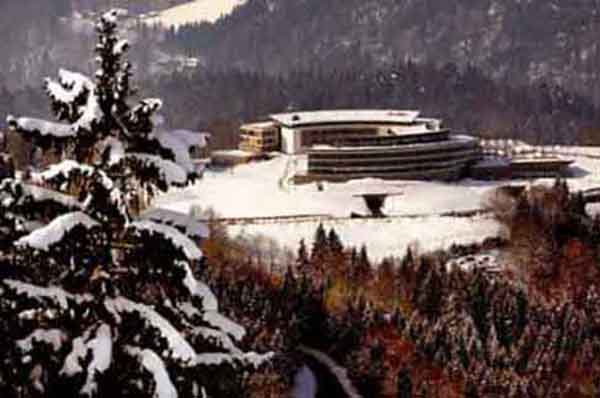
Snow covers a new four-star Inter Continental holiday resort in southern Bavarian town of Berchtesgaden. The 138-room resort opened on March 1, 2005 and is located near Adolf Hitler's former Alpine retreat, the Eagles Nest in Obersalzberg.
Bersalzberg, Germany, Reuters, March 2, 2005
When Adolf Hitler first encountered the breathtaking mountain scenery and lofty isolation of Obersalzberg in the Bavarian Alps, he fell instantly in love with the spot.
Later as German leader he sealed off the hamlet, creating an exclusive retreat where he and other top Nazis could wine and dine, savor the crisp Alpine air, and plan the most barbarous acts of the Third Reich.
Sixty years on, the owners of a new luxury hotel in Obersalzberg, which opens this week, are hoping the area's serene natural charm can attract a different kind of visitor and open a new chapter in the area's blighted history.
A glossy brochure presents "an oasis of well-being" where guests can indulge in spa treatments, have their ski boots warmed before use and play a round of golf.
The hotel, part of the Intercontinental chain, wants to avoid advertising the fact that it is just a stone's throw from where Hitler's Berghof villa once stood, for fear of attracting the wrong sort of visitors. But nor does it wish to evade Obersalzberg's infamy altogether.
Staff have been specially trained to answer questions on the area's history, and guests will find "Deadly Utopia" in their rooms, a disturbing account of how the seductive Obersalzberg landscape was woven into Nazi myths of German blood and soil and presented as a pilgrimage site to the Fuehrer.
"Obersalzberg is a loaded place ... it was a site linked to the perpetrators, which is a stigma that lingers and will continue to do so," said Bavarian Finance Minister Kurt Faltlhauser, who is behind the development of the resort.
"But Obersalzberg has another side. It was always also a place to recuperate in stunning landscape. The new hotel is part of this tradition."
Despite assurances from the Bavarian state government that it will not tolerate any misuse of the area or "Nazi tourism," Jewish groups have attacked the project as historically insensitive.
"Either people don't know the significance of the Obersalzberg, which is bad enough, or worse -- they know exactly what kind of a place it is, as Hitler's second seat of government, and they are doing this regardless," Jewish writer Ralph Giordano told German television.
In 1952 the American military cleared what remained of Hitler's Berghof, where the dictator received Benito Mussolini, relaxed with his lover Eva Braun and greeted children in lederhosen and dirndl dresses with his dog Blondie at his heels.
The archive footage is familiar the world over, and up to 100,000 tourists flock to the site every year.
"Hitler was shown here as a majestic visionary, as a successful statesman receiving dignitaries, but also as a man of the people -- a friend to nature and children," said Volker Dahm, who runs a documentation center on the Nazi period in Obersalzberg.
"We have to use the 'pull' this place exerts to inform people, and to present them with all aspects of the Nazi regime."
Until the center opened in 1999, neo-Nazi graffiti appeared regularly in Obersalzberg along with impromptu shrines to Hitler with candles and flowers.
But Dahm says now that the evils of Nazi rule are compellingly presented, far-right supporters have been deterred from further pilgrimages. Obersalzberg has been demystified.
Andreas Nachama, who runs a permanent exhibition on the site of the Gestapo headquarters in Berlin agrees.
"These people look for sites which haven't been interpreted by historians, where they can let their ideas run wild. The minute a museum appears they can no longer project their fantasies onto a place."
Obersalzberg was in the hands of the American military until 1996, when it returned it to the Bavarian state authorities, who planned the historical center in conjunction with a new hotel to boost tourism to the area.
The small town of Berchtesgaden in the valley below Obersalzberg has seen hotel occupancy rates plummet and high rates of migration in recent years.
Most locals are pragmatic about the past and have long sold picture-books of Hitler at the Berghof, alongside walking sticks, yodeling teddies and other Alpine gifts.
There is also some sense in Berchtesgaden that the new hotel and its guests will be as remote from the town as the Nazi elite. The sleek building with stone floors and enormous panoramic windows eschews Alpine decor in favor of feng shui and offers rooms from 189 euros ($250.6) a night.