
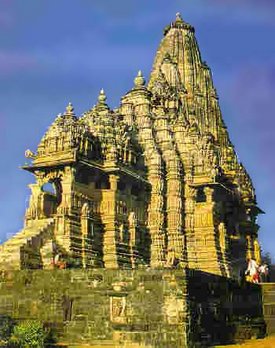
Hinduism is the world's third largest religion; its followers, known as Hindus, number about 1.15 billion, or 15-16% of the global population.Hindus form the majority of the population in India, Nepal and Mauritius. Significant Hindu communities are also found in other countries.
Hinduism is an Indian Dharma, or a way of life, widely practiced in South Asia. Hinduism has been called the oldest religion in the world, and some practitioners and scholars refer to it as Sanatana "the eternal tradition," or the "eternal way," beyond human history. Scholars regard Hinduism as a fusion or synthesis of various Indian cultures and traditions, with diverse roots and no founder. This "Hindu synthesis" started to develop between 500 BCE and 300 CE, following the Vedic period (1500 BCE to 500 BCE).
Although Hinduism contains a broad range of philosophies, it is linked by shared concepts, recogniZable rituals, cosmology, shared textual resources, and pilgrimage to sacred sites. Hindu texts are classified into Sruti ("heard") and Smrti ("remembered"). These texts discuss theology, philosophy, mythology, Vedic yajna, Yoga, agamic rituals, and temple building, among other topics. Major scriptures include the Vedas and Upanishads, the Bhagavad Gita, and the Agamas. Sources of authority and eternal truths in its texts play an important role, but there is also a strong Hindu tradition of the questioning of this authority, to deepen the understanding of these truths and to further develop the tradition.
Prominent themes in Hindu beliefs include the four Purusarthas the proper goals or aims of human life, namely Dharma (ethics/duties), Artha (prosperity/work), Kama (desires/passions) and Moksha (liberation/freedom/salvation); karma (action, intent and consequences), Samsara (cycle of rebirth), and the various Yogas (paths or practices to attain moksha).
Hindu practices include rituals such as puja (worship) and recitations, meditation, family-oriented rites of passage, annual festivals, and occasional pilgrimages. Some Hindus leave their social world and material possessions, then engage in lifelong Sannyasa (monastic practices) to achieve Moksha. Hinduism prescribes the eternal duties, such as honesty, refraining from injuring living beings (ahimsa), patience, forbearance, self-restraint, and compassion, among others. The four largest denominations of Hinduism are the Vaishnavism, Shaivism, Shaktism and Smartism.
According to Hindu doctrine, the ideal life consists of four stages:
1. The period of descipline and education
2. The life of the householder and active worker
3. The retreat for the loosening of the bonds
4. The life of the hermit, preparing for death and union with God.
In homes where Hinduism is practiced there is generally a room
or corner of a room for worship called puja where there are
pictures of a statue of a particular God.
Hinduism recognizes thousands of lessor Gods that all come under the umbrella of the one God Brahman. Hinduism also recognizes the divine avatars, God-realized beings living on Earth.
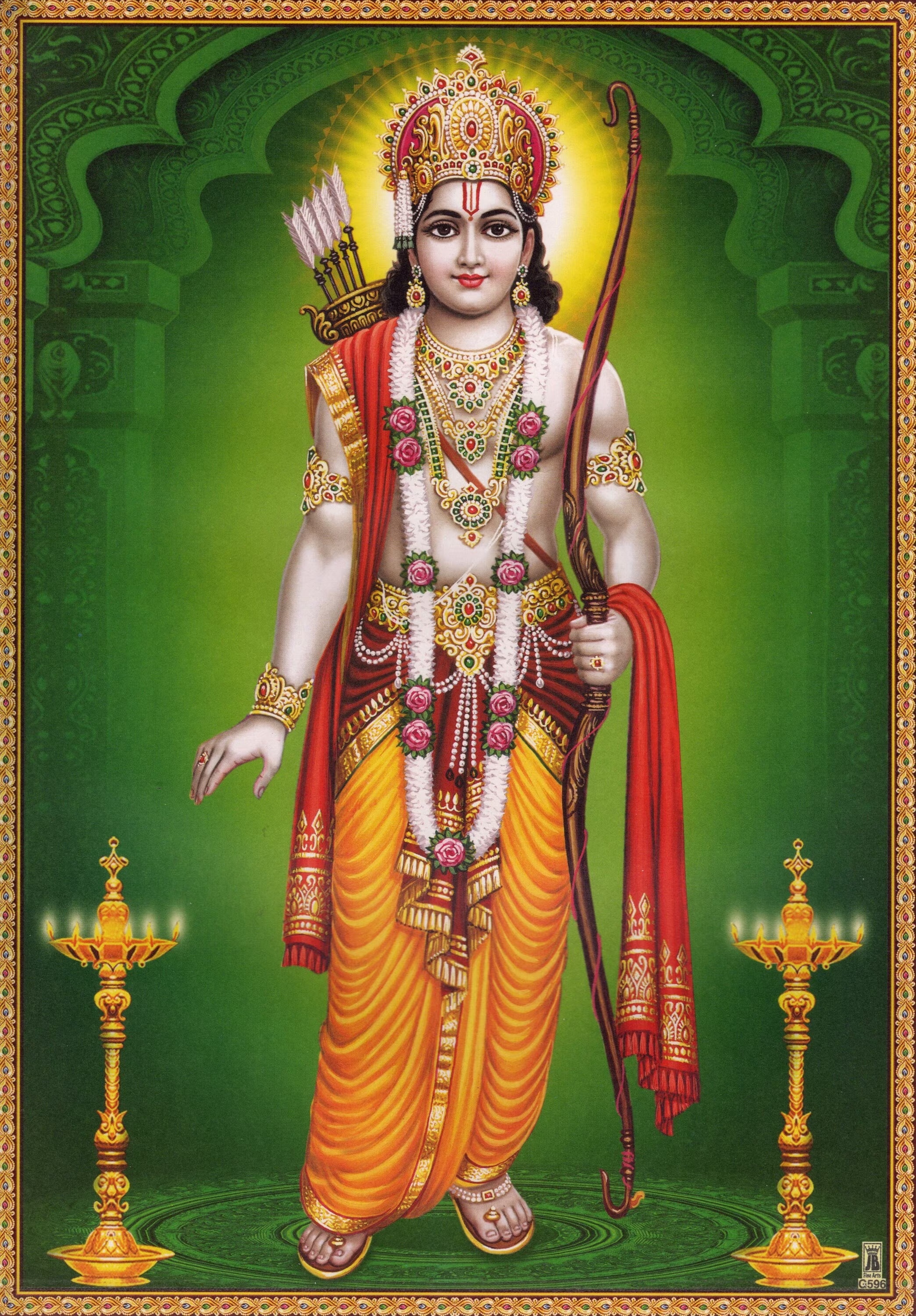
Rama - around 5000 BC who allegedly lived over 20,000 years ago.
'Rama' looks like the name Ra the Egyptian God.
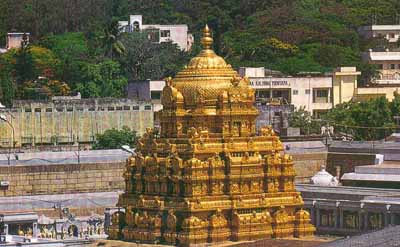
Thirumala - The richest and a important vaishnavite temple
Hinduism - the beliefs, practices, and socioreligious institutions of the Hindus (originally, the inhabitants of the land of the Indus River). Introduced in about 1830 by British writers, the term properly denotes the Indian civilization of approximately the last 2,000 years, which evolved from Vedism, the religion of the Indo-European peoples who settled in India in the last centuries of the 2nd millennium BC.
Because it integrates a variety of elements, Hinduism constitutes a complex but largely continuous whole and has religious, social, economic, literary, and artistic aspects. As a religion, Hinduism is a composite of diverse doctrines, cults, and ways of life.
The spectrum that ranges from the level of popular Hindu belief to that of elaborate ritual technique and philosophical speculation is very broad and is attended by many stages of transition and varieties of coexistence. Magic rites, animal worship, and belief in demons are often combined with the worship of more or less personal gods or with mysticism, asceticism, and abstract and profound theological systems or esoteric doctrines. The worship of local deities does not exclude the belief in pan-Indian higher gods or even in a single high God. Such local deities are also frequently looked upon as manifestations of a high God.
In principle, Hinduism incorporates all forms of belief and worship without necessitating the selection or elimination of any. It is axiomatic that no religious idea in India ever dies or is superseded--it is merely combined with the new ideas that arise in response to it. Hindus are inclined to revere the divine in every manifestation, whatever it may be, and are doctrinally tolerant, allowing others--including both Hindus and non-Hindus--whatever beliefs suit them best.
A Hindu may embrace a non-Hindu religion without ceasing to be a Hindu, and because Hindus are disposed to think synthetically and to regard other forms of worship, strange gods, and divergent doctrines as inadequate rather than wrong or objectionable, they tend to believe that the highest divine powers complement one another. Few religious ideas are considered to be irreconcilable. The core of religion does not depend on the existence or nonexistence of God or on whether there is one god or many. Because religious truth is said to transcend all verbal definition, it is not conceived in dogmatic terms. Moreover, the tendency of Hindus to distinguish themselves from others on the basis of practice (orthopraxy) rather than doctrine (orthodoxy) further de-emphasizes doctrinal differences.
Hinduism is both a civilization and a congregation of religions; it has neither a beginning or founder, nor a central authority, hierarchy, or organization. Every attempt at a specific definition of Hinduism has proved unsatisfactory in one way or another, the more so because the finest scholars of Hinduism, including Hindus themselves, have emphasized different aspects of the whole.
Nevertheless, it is possible to discern among the myriad forms of Hinduism several common characteristics of belief and practice.
Perhaps the defining characteristic of Hindu belief is the recognition of the Veda, the most ancient body of religious literature, as an absolute authority revealing fundamental and unassailable truth. At the same time, however, its content has long been practically unknown to most Hindus, and it is seldom drawn upon for literal information or advice. Still, it is venerated from a distance by every traditional Hindu, and those Indians who reject its authority (such as Buddhists and Jains) are regarded as unfaithful to their tradition. The Veda is also regarded as the basis of all the later Shastraic texts used in Hindu doctrine and practice. Parts of the Veda are still quoted in essential Hindu rituals, and it is the source of many enduring patterns of Hindu thought.
Also characteristic of Hinduism is the belief in the power of the Brahmans, a priestly class possessing spiritual supremacy by birth. As special manifestations of religious power and as bearers and teachers of the Veda, Brahmans are considered to represent the ideal of ritual purity and social prestige.
Hindus believe in an uncreated, eternal, infinite, transcendent, and all-embracing principle, which, "comprising in itself being and non-being," is the sole reality, the ultimate cause and foundation, source, and goal of all existence. This ultimate reality is called brahman. As the All, brahman causes the universe and all beings to emanate from itself, transforms itself into the universe, or assumes its appearance. Brahman is in all things and is the Self (atman) of all living beings. Brahman is the creator, preserver, or transformer and reabsorber of everything. Although it is Being in itself, without attributes and qualities and hence impersonal, it may also be conceived of as a personal high God, usually as Vishnu (Visnu) or Siva. This fundamental belief in and the essentially religious search for ultimate reality--i.e., the One that is the All--have continued almost unaltered for more than 30 centuries and have been the central focus of India's spiritual life.
A further characteristic of Hinduism is the ideal of ahimsa. Ahimsa, "non-injury" or the absence of the desire to harm, is regarded by Indian thinkers as one of the keystones of their ethics. Historically, ahimsa is unrelated to vegetarianism; in ancient India, killing people in war or in capital punishment and killing animals in Vedic sacrifices were acceptable to many people who for other reasons refrained from eating meat. However, the two movements, ahimsa and vegetarianism, reinforced one another through the common concept of the disinclination to kill and eat animals, and together they contributed to the growing importance of the protection and veneration of the cow, which gives food without having to be killed. Neither ahimsa nor vegetarianism ever found full acceptance. Even today, many Hindus eat beef, and nonviolence (as the ideal of ahimsa is often translated) has never been a notable characteristic of Hindu behaviour.
Hindus generally accept the doctrine of transmigration and rebirth and the complementary belief in karma, or previous acts as the factor that determines the condition into which a being, after a stay in heaven or hell, is reborn in one form or another. The whole process of rebirths is called samsara. Any earthly process is viewed as cyclic, and all worldly existence is subject to the cycle. Samsara has no beginning and, in most cases, no end; it is not a cycle of progress or a process of purification but a matter of perpetual attachment.
Karma, acting like a clockwork that, while running down, always winds itself up, binds the atmans (selves) of beings to the world and compels them to go through an endless series of births and deaths. This belief is indissolubly connected with the traditional Indian views of society and earthly life, and any social interaction (particularly those involving sex or food) results in the mutual exchange of good and bad karma. It has given rise to the belief that any misfortune is the effect of karma, or one's own deeds, and to the conviction that the course of world history is conditioned by collective karma.
Such doctrines encourage the view that mundane life is not true existence and that human endeavour should be directed toward a permanent interruption of the mechanism of karma and transmigration--that is, toward final emancipation (moksha), toward escaping forever from the impermanence that is an inescapable feature of mundane existence. In this view the only goal is the one permanent and eternal principle: the One, God, brahman, which is totally opposite to any phenomenal existence. Anyone who has not fully realized that his being is identical with brahman is thus seen as deluded. The only possible solution consists in the realization that the kernel of human personality (atman) really is brahman and that it is their attachment to worldly objects that prevents people from reaching salvation and eternal peace. (Hindus sometimes use the largely Buddhist term nirvana to describe this state.)
Although those Hindus who particularly worship either Vishnu or Siva generally consider one or the other as their "favourite god" (istadevata) and as the Lord (Isana) and Brahman in its personal aspect, Vishnu is often regarded as a special manifestation of the preservative aspect of the Supreme and Siva as that of the destructive function. Another deity, Brahma, the creator, remains in the background as a demiurge. These three great figures (Brahma, Vishnu, and Siva) constitute the so-called Hindu Trinity (Trimurti, "the One or Whole with Three Forms"). This conception attempts to synthesize and harmonize the conviction that the Supreme Power is singular with the plurality of gods in daily religious worship. Although the concept of the Trimurti assigns a position of special importance to some great gods, it never has become a living element in the religion of the people. Moreover, Brahma has had no major cult since ancient times, and many Hindus worship neither Siva nor Vishnu but one or more of the innumerable other Hindu gods.
In the West, the so-called life-negating aspects of Hinduism have often been overemphasized. The polarity of asceticism and sensuality, which assumed the form of a conflict between the aspiration to liberation and the heartfelt desire to have descendants and continue earthly life, manifested itself in Hindu social life as the tension between the different goals and stages of life.
The relative value of an active life and the performance of meritorious works (pravrtti) as opposed to the renunciation of all worldly interests and activity (nivrtti) was a much-debated issue. While one-sided religious and philosophical works, such as the Upanishads, placed emphasis on renunciation, the dharma texts argued that the householder who maintains his sacred fire, procreates children, and performs his ritual duties well also earns religious merit.
Nearly 2,000 years ago, these dharma texts elaborated the social doctrine of the four ashramas (stages of life). This concept is an attempt at harmonizing the conflicting tendencies of Hinduism into one system. It held that a member of the three higher classes should first become a chaste student (brahmachari); then become a married householder (grihastha), discharging his debts to his ancestors by begetting sons and to the gods by sacrificing; then retire (as a vanaprastha), with or without his wife, to the forest to devote himself to spiritual contemplation; and finally, but not mandatorily, become a homeless wandering ascetic (sannyasin). The situation of the forest dweller was always a delicate compromise that remained problematic on the mythological level and was often omitted or rejected in practical life.
Although the status of a householder was often extolled, and some authorities, regarding studentship as a mere preparation, went so far as to brand the other stages as inferior, there were always people who became wandering ascetics immediately after studentship. Theorists were inclined to reconcile the divergent views and practices by allowing the ascetic way of life to those who are, owing to the effects of restrained conduct in former lives, entirely free from worldly desire, even if they had not gone through the traditional prior stages.
Hindus disagree about the way (marga) to final emancipation (moksha). Three paths to salvation (variously valued but nonexclusive) are presented in an extremely influential religious text, the Bhagavadgita ("Song of the Lord"; c. 200 BC), according to which it is not acts themselves but the desire for their results that produces karma and thus attachment. These three ways to salvation are (1) the karma-marga ("the path of duties"), the disinterested discharge of ritual and social obligations; (2) the jnana-marga ("the path of knowledge"), the use of meditative concentration preceded by a long and systematic ethical and contemplative training, yoga, to gain a supra-intellectual insight into one's identity with brahman; and (3) the bhakti-marga ("the path of devotion"), the devotion to a personal God. These ways are regarded as suited to various types of people.
Although the search for moksha has never been the goal of more than a small minority of Hindus, liberation was a religious ideal that affected all lives. Moksha determined not only the hierarchical values of Indian social institutions and religious doctrines and practices but also the function of Indian philosophy, which is to discuss what one must do to find true fulfillment and what one has to realize, by direct experience, in order to escape from samsara (bondage) and obtain spiritual freedom. While those who have not been reached by formal Indian philosophy have only vague ideas about the doctrines of karma and moksha, in semipopular milieus these doctrines gave rise to much speculation.
For the ordinary Hindu, the main aim of worldly life lies in conforming to social and ritual duties, to the traditional rules of conduct for one's caste, family, and profession. Such requirements constitute an individual's dharma (law and duties), one's own part of the broader stability, law, order, and fundamental equilibrium in the cosmos, nature, and society. Sanatana (traditional) dharma--a term used by Hindus to denote their own religion--is a close approximation to "religious practices" in the West.
This traditional dharma applies theoretically to all Hindus, but it is superseded by the more particular dharmas that are appropriate to each of the four major varnas, or classes of society: Brahmans (priests), Ksatriyas (warrior kings), Vaisyas (the common people), and Sudras (servants). These four rather abstract categories are further superseded by the more practically applicable dharmas appropriate to each of the thousands of particular castes (jatis). Thus, religion for Hindus is mainly a tradition and a heritage, a way of life and a mode of thought. In practice, it is the right application of methods for securing both welfare in this life and a good condition in the hereafter.
The history of Hinduism began in India about 1500 BC. Although its literature can be traced only to before 1000 BC, evidence of Hinduism's earlier antecedents is derived from archaeology, comparative philology, and comparative religion.
The earliest literary source for the history of Hinduism is the Rigveda (Rgveda), the hymns of which were chiefly composed during the last two or three centuries of the 2nd millennium BC. The religious life reflected in this text is not that of Hinduism but of an earlier sacrificial religious system, generally known as Brahmanism or Vedism, which developed in India among Aryan invaders. This branch of a related group of nomadic and seminomadic tribal peoples originally inhabiting the steppe country of southern Russia and Central Asia brought with them the horse and chariot and the Sanskrit language. Other branches of these peoples penetrated into Europe, bringing with them Indo-European languages that developed into the chief language groups now spoken there.
Before they entered the Indian subcontinent (c. 1500 BC), the Aryans were in close contact with the ancestors of the Iranians, as evidenced by similarities between Sanskrit and the earliest surviving Iranian languages. Thus, the religion of the Rigveda contains elements from three evolutionary strata: an early element common to most of the Indo-European tribes; a later element held in common with the early Iranians; and an element acquired in the Indian subcontinent itself, after the main Aryan migrations. Hinduism arose from the continued accretion of further elements derived from the original non-Aryan inhabitants, from outside sources, and from the geniuses of individual reformers at all periods.
Hinduism has a few direct survivals from its Indo-European heritage. Some of the rituals of the Hindu wedding ceremony, notably the circumambulation of the sacred fire and the cult of the domestic fire itself, have their roots in the remote Indo-European past. The same is probably true of the custom of cremation and some aspects of the ancestor cult. The Rigveda contains many other Indo-European elements, such as the worship of male sky gods with sacrifices and the existence of the old sky god Dyaus, whose name is cognate with those of the classical Zeus of Greece and Jupiter of Rome ("Father Jove"). The Vedic heaven, the "world of the fathers," resembled the Germanic Valhalla and seems also to be an Indo-European inheritance.
The Indo-Iranian element in later Hinduism is chiefly found in the initiatory ceremony (upanayana) performed by boys of the three upper classes, a rite both in Hinduism and in Zoroastrianism that involves the tying of a sacred cord. The Vedic god Varuna, now an unimportant sea god, appears in the Rigveda as sharing many features of the Zoroastrian Ahura Mazda ("Wise Lord"); the hallucinogenic sacred drink soma corresponds to the sacred haoma of Zoroastrianism.
Indigenous Sources
Even in the earlier parts of the Rigveda the religion had already acquired numerous specifically Indian features. Some of the chief gods, for example, have no clear Indo-European or Indo-Iranian counterparts. Although some of the new features may have evolved entirely within the Aryan framework, it is generally presumed that many of them stem from the influence of the indigenous inhabitants. The Vedic Aryans may never have been in direct contact with the civilization of the Indus Valley in its prime, but the religion of the valley's culture undoubtedly influenced them.
Features of Hinduism that cannot be traced to the Rigveda are sometimes ascribed to the influence of the original inhabitants, who are often vaguely and incorrectly referred to as "Dravidians." The ruling classes of the Harappa culture (c. 2500-1700 BC), or the Indus civilization, may have spoken a Dravidian language, but as long as their script remains undeciphered this cannot be proved. Moreover, the presence of Dravidian speakers throughout the whole subcontinent at any time in history is not attested.
The Mediterranean racial type, to which most modern higher-caste Dravidian speakers belong, is widespread throughout India; but it cannot be proved that all people of this type originally spoke Dravidian languages or that all followed the same culture. Equally or more widely spread in South and Southeast Asia is the Proto-Australoid racial type, the purest members of which in India are the tribal peoples of the centre and the south, many of whom speak languages of the Austric family. Thus, although many aspects of Hinduism are traceable to non-Aryan influence, not all of these aspects are borrowed from "Dravidians." In the 20th century the term Dravidian generally refers to a family of languages and not to an ethnic group.
The Central Asian nomads who entered India in the two centuries before and after the beginning of the Christian Era might have influenced the growth of devotional Hinduism out of Vedic religion. The classical Western world directly affected Hindu religious art, and several features of Hinduism can be traced to Zoroastrianism. The influence of later Chinese Taoism on Tantric Hinduism (an esoteric system of rituals for spiritual power) has been suggested, though not proved. In more recent centuries, the influence of Islam and Christianity on Hinduism can be seen.
The development of Hinduism can be interpreted as a constant interaction between the religion of the upper social groups, represented by the Brahmans (priests and teachers), and the religion of other groups. From the time of the Aryan invasion (c. 1500 BC) the indigenous inhabitants of the subcontinent have tended to adapt their religious and social life to Brahmanic norms. This has developed from the desire of lower-class groups to rise on the social ladder by adopting the ways and beliefs of the higher castes.
This process, sometimes called "Sanskritization," began in Vedic times when non-Aryan chieftains accepted the ministrations of Brahmans and thus achieved social status for themselves and their subjects. It was probably the principal method by which Hinduism spread through the subcontinent and into Southeast Asia. Sanskritization still continues in the form of the conversion of tribal groups, and it is reflected by the persistent tendency of low-caste Hindus to try to raise their status by adopting high-caste customs, such as wearing the sacred cord and becoming vegetarians.
If Sanskritization has been the main means of spreading Hinduism throughout the subcontinent, its converse process, which has no convenient label, has been one of the means whereby Hinduism has changed and developed over the centuries. The Aryan conquerors lived side by side with the indigenous inhabitants of the subcontinent, and many features of Hinduism, as distinct from Vedic religion, may have been adapted from the religions of the non-Aryan peoples of India.
The phallic emblem of the god Siva arose from a combination of the phallic aspects of the Vedic god Indra and a non-Vedic icon of early popular fertility cults. Many features of Hindu mythology and several of the lesser gods--such as Ganesa, an elephant-headed god, and Hanuman, the monkey god--were incorporated into Hinduism and assimilated into the appropriate Vedic gods by this means. Similarly, the worship of many goddesses who are now regarded as the consorts of the great male Hindu gods, as well as the worship of the one great goddess herself, may have originally incorporated the worship of non-Aryan local goddesses. Unorthodox circles on the fringes of Brahmanic culture (probably in southern India) were one of the important sources of the system of ecstatic devotional religion known as bhakti.
Thus, the history of Hinduism can be interpreted as the imposition of orthodox custom upon wider and wider ranges of people and, complementarily, as the survival of features of non-Aryan religions that gained strength steadily until they were adapted by the Brahmans.
Indigenous Prehistoric Religion
The prehistoric culture of the Indus Valley arose in the latter centuries of the 3rd millennium BC from the metal-using village cultures of the region. There is considerable evidence of the religious life of the Indus people, but until their writing is deciphered its interpretation is speculative. Enough evidence exists, however, to show that several features of later Hinduism had prehistoric origins.
In most of the village cultures, small terra-cotta figurines of women, found in large quantities, have been interpreted as icons of a fertility deity whose cult was widespread in the Mediterranean area and in western Asia from Neolithic times onward. This hypothesis is strengthened by the fact that the goddess was apparently associated with the bull--a feature also found in the ancient religions farther west.
The Harappa culture (often called the Indus Valley civilization), located in modern Pakistan, has produced much evidence of the cult of the goddess and the bull. Figurines of both occur, with the goddess being more common than the bull. The bull, however, appears more frequently on the many steatite seals. A horned deity, possibly with three faces, occurs on a few seals, and on one seal he is surrounded by animals. A few male figurines in hieratic (sacerdotal) poses and one apparently in a dancing posture may represent deities.
No building has been discovered at any Harappan site that can be positively identified as a temple, but the Great Bath at Mohenjo-daro was almost certainly used for ritual purposes, as were the ghats (bathing steps on riverbanks) attached to later Hindu temples. The presence of bathrooms in most of the houses and the remarkable system of covered drains indicate a strong concern for cleanliness that may have been related to concepts of ritual purity as well as to ideas of hygiene.
Many seals show religious and legendary themes that cannot be interpreted with certainty. There is clear evidence, however, of the worship of sacred trees or of the divinities believed to reside in them. The bull is often depicted standing before a sort of altar, and the horned god has been interpreted, perhaps overconfidently, as a prototype of the Hindu god Siva. Small conical objects appear to be phallic emblems that are also connected with Siva in later Hinduism, although they may have been pieces used in board games.
Other interpretations of the remains of the Harappa culture are more speculative and, if accepted, would indicate that many features of later Hinduism were already in existence 4,000 years ago. The fact that Harappans buried their dead with grave deposits, a practice not followed by the later Hindus, suggests that they had some belief in an afterlife.
Some elements of the religious life of current and past folk religions--notably sacred animals, sacred trees, especially the pipal (Ficus religiosa), and the use of small figurines for cult purposes--are found in all parts of India and may have been borrowed from pre-Aryan civilizations. On the other hand, these figures are also commonly encountered outside of India, and therefore they may have originated independently in Hinduism as well.
The Aryans of the early Vedic period left few material remains, but they left a very important literary record called the Rigveda. Its 1,028 hymns are distributed throughout 10 books, of which the first and the last are the most recent. A hymn usually consists of three sections: it begins with an exhortation that is followed in the main part by praise of the deity, prayers, and imploration, with frequent references to the deity's mythology, and finishes with a specific request.
The Rigveda ("Wisdom of the Verses") is not a unitary work, and its composition may have taken several centuries. In its form at the time of its final edition it reflects a well-developed religious system. The date commonly given for the final recension of the Rigveda is 1000 BC. During the next two or three centuries the Rigveda was supplemented by three other Vedas and, still later, by Vedic texts called the Brahmanas and the Upanishads
The century from about 550 BC onward was a period of great change in the religious life of India. This century saw the rise of breakaway sects of ascetics who denied the authority of the Vedas and of the Brahmans and who followed founders claiming to have discovered the secret of obtaining release from transmigration.
By far the most important of these were Siddhartha Gautama, called the Buddha, and Vardhamana, called Mahavira ("Great Hero"), the great teacher of Jainism (see also Buddha; Jainism). There were many other heterodox teachers who organized bands of ascetic followers, and each group followed a specific code of conduct. They gained considerable support from ruling families and merchants. The latter were growing in wealth and influence, and many of them were searching for alternative forms of religious activity that would give them a more significant role than did orthodox Brahmanism or that would be less expensive to support.
The scriptures of the new religious movements throw some light on the popular religious life of the period. The god Prajapati was widely believed to be the highest god and the creator of the universe, with Indra, known chiefly as Sakra ("the Mighty One"), second to him in importance. The Brahmans were very influential, but opposition had developed to their large-scale animal sacrifices--on both philosophical and economic grounds--and their pretensions to superiority by virtue of their birth were questioned.
The doctrine of transmigration was by then generally accepted, although a group of outright materialists denied the survival of the soul after death. The ancestor cult, part of the Indo-European heritage, was retained almost universally, at least by the higher castes. Popular religious life largely centred around the worship of local fertility divinities (yaksha), snake-spirits (naga), and other minor spirits in sacred places and groves (caitya). Although these sacred places were the main centres of popular religious life, there is no evidence of any buildings or images associated with them, and it appears that neither temples nor large icons existed at the time.
Around 500 BC asceticism became widespread, and increasing numbers of intelligent young men "gave up the world" to search for release from transmigration by achieving a state of psychic security. The orthodox Brahmanical teachers reacted to these tendencies by devising the doctrine of the four ashramas (asramas, "abodes"), which divided the life of the twice-born after initiation into four stages: the brahmachari (celibate religious student); the grihastha (married householder); the vanaprastha (forest dweller); and the sannyasin (wandering ascetic).
This attempt to keep asceticism in check and confine it to men of late middle age was never followed universally, but thereafter Hindu social theory centred on the concept of varnashramadharma, or the duties of the four classes (varna) and the four stages of life (ashramas), which formed the ideal that Hindus were encouraged to follow.
The 3rd century BC was the period of the Mauryan empire, the first great empire of India. Its early rulers were heterodox, and Asoka (reigned c. 265-238 BC), the third and most famous of the Mauryan rulers, was a professed Buddhist. Although there is no doubt that Asoka's patronage of Buddhism did much to spread that religion, his inscriptions recognize the Brahmans as worthy of respect. Sentiments in favour of nonviolence (ahimsa) and vegetarianism, much encouraged by the heterodox sects, spread during the Mauryan period and were greatly encouraged by Asoka. A Brahmanic revival appears to have occurred with the fall of the Mauryas. The orthodox religion itself was undergoing change at this time, however, because of the development of theistic tendencies that centred around the gods Vishnu and Siva.
Inscriptions, iconographic evidence, and literary references point to the emergence of devotional theism in the 2nd century BC. Several brief votive inscriptions refer to the god Vasudeva, who by this time was widely worshiped in western India. At the end of the 2nd century, Heliodorus, a Greek ambassador from King Antialcidas of Taxila (in Pakistan), erected a large column in honour of Vasudeva at Besnagar in Madhya Pradesh and recorded that he was a Bhagavata, a term specifically used for the devotees of Vishnu. The identification of Vasudeva with the old Vedic god Vishnu and, later, with Vishnu's incarnation, Krishna (Krsna), was quickly accepted.
Near the end of the Mauryan period the first surviving stone images of Hinduism appear. Several large, simply carved figures survive, not representing any of the great gods but rather yakshas, or local chthonic divinities connected with water, fertility, and magic. The original locations of these images are uncertain, but they were probably erected in the open air in sacred enclosures. Temples are not clearly attested in this period by either archaeology or literature. A few fragmentary images thought to be those of Vasudeva and Siva, the latter in anthropomorphic form and in the form of a lingam, or phallic emblem, are found on coins of the 2nd and 1st centuries BC.
The centuries immediately preceding and following the dawn of the Common Era saw the recension of the two great Sanskrit epics, the Ramayana and the Mahabharata (the latter incorporating into it the Bhagavadgita). Although it was the worship of Vishnu, incarnate as Krishna in the Mahabharata and as Rama in the Ramayana, that developed significantly during this period (see below Epics and Puranas), the god Siva is active in the Mahabharata, and the cult of Siva developed alongside the cult of Vishnu.
The Vedic god Rudra gained in importance from the end of the Rigvedic period. In the Svetasvatara Upanishad, Rudra is for the first time called Siva and is described as the creator, preserver, and destroyer of the universe. His followers are called on to worship him with devotion (bhakti). The tendency for the laity to form themselves into religious guilds, or societies--evident in the case of the yaksha cults, Buddhism, and Jainism--promoted the growth of devotional Vaishnavism and Saivism. These local associations of worshipers appear to have been a principal factor in the spread of the new cults. Theistic ascetics are less in evidence at this time; but a community of Saivite monks, the Pasupatas, was also in existence by the 2nd or 3rd century AD.
The period between the fall of the Mauryan empire (c. 185 BC) and the rise of the Gupta (c. AD 320) was one of great change, with most of the area of Pakistan and parts of western India being conquered by a succession of invaders. India was opened to influence from the West as never before, not only by its invaders but by way of the sea through the flourishing trade with the Roman Empire. The effects of the new contacts were most obvious in art and architecture. The oldest freestanding stone temple in the subcontinent has been excavated at Taxila, near Rawalpindi, Pak. During the 1st century BC the Gandhara school of sculpture arose in the same region and made use of Hellenistic and Roman prototypes, mainly in the service of Buddhism. At that time Hindu temples probably were made of wood because no remains of them are extant; however, literary evidence shows that they must have existed.
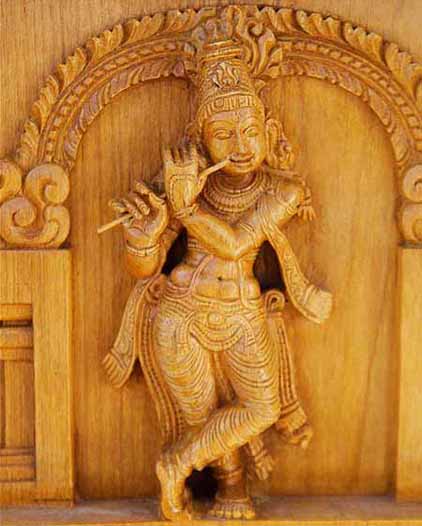
By the time of the early Gupta empire the new theism had been harmonized with the old Vedic religion, and two of the main branches of Hinduism were fully recognized. The Vaishnavas had the support of the Gupta emperors, who took the title paramabhagavata ("supreme devotee of Vishnu"). Vishnu temples were numerous and the doctrine of Vishnu's avatars (incarnations) was widely accepted. Of the 10 incarnations of later Vaishnavism, however, only two seem to have been much worshiped in the Gupta period. These were Krishna, the hero of the Mahabharata, who also begins to appear in his pastoral aspect as the cowherd and flute player, and the divine boar (Varaha), of whom several impressive images survive from the Gupta period.
The Saivites were also a growing force in the religious life of India. The sect of Pasupata ascetics, founded by Lakulisa (or Nahulisa), who lived in the 2nd century AD, is attested by inscriptions from the 5th century and is among the earliest of the sectarian religious orders of Hinduism. Representations of the son of Siva, Skanda (also called Karttikeya, the war god), appeared on Kushan coins as early as AD 100. Siva's other son, the elephant-headed Ganesa, patron deity of commercial and literary enterprises, did not appear until the 5th century. Very important in this period was Surya, the sun god, who had temples built in his honour, although in modern times he is little regarded by most Hindus. The solar cult had Vedic roots but later may have expanded under Iranian influence.
Several goddesses began to gain importance in this period. Although goddesses had always been worshiped in local and popular cults, they play comparatively minor roles in Vedic religion. Laksmi or Sri, goddess of fortune and consort of Vishnu, was worshiped before the beginning of the Christian era, and several lesser goddesses are attested from the Gupta period. But the cult of Durga, the consort of Siva, was only beginning to gain importance in the 4th century, and the large-scale development of Saktism (devotion to the active, creative principle personified as the Mother Goddess) did not take place until medieval times.
The Gupta period (4th-6th century) saw the rapid development of temple architecture. Earlier temples were made of wood, but freestanding stone and brick temples soon appeared in many parts of India. By the 7th century, stone temples, some of considerable dimensions, were found in the Aryanized parts of the country. Originally, the design of the Hindu temple may have borrowed from the Buddhist precedent, for in some of the oldest temples the image was placed in the centre of the shrine, which was surrounded by an ambulatory path resembling the path around the Buddhist stupa (a religious building containing a relic).
Nearly all surviving Gupta temples are comparatively small; they consist of a small cella (central chamber), constructed of thick and solid masonry, with a veranda either at the entrance or on all sides of the building. The earliest Gupta temples, such as the Buddhist temples at Sanchi, have flat roofs; however, the sikhara (spire), typical of the north Indian temple, was developed in this period and with time steadily was made taller. The massive and tall tower of the Buddhist temple of Buddh Gaya, which was in existence in the 7th century, represents the culmination of Gupta temple architecture.
The Buddhists and Jains had made use of artificial caves for religious purposes, and these were adapted by the Hindus. Hindu cave-temples, however, are comparatively rare, and none has been discovered from earlier than the Gupta period. In the Pallava site of Mahabalipuram, south of Madras, a number of small temples were carved in the 7th century from outcroppings of rock and represent some of the oldest religious buildings in the Tamil country.
Hinduism and Buddhism had an immense impact on the civilizations of Southeast Asia and contributed greatly to the development of a written tradition in that area. Around the beginning of the Christian era, Indian merchants in comparatively large numbers settled there, bringing Brahmans and Buddhist monks with them. These religious men were patronized by local chiefs, who converted to the new religion. The earliest material evidence of Hinduism in Southeast Asia comes from Borneo, where late 4th-century Sanskrit inscriptions testify to the performance of Vedic sacrifices by Brahmans at the behest of local chiefs. Chinese chronicles attest an Indianized kingdom in Vietnam two centuries earlier. The dominant form of Hinduism exported to Southeast Asia was Saivism, though some Vaishnavism was also known there. Later, from the 9th century onward, Tantrism, both Hindu and Buddhist, spread throughout the region.
The civilizations of Southeast Asia developed forms of Hinduism and Buddhism that had distinctive local features and were attuned to the local cultures, but the framework of their religious life was essentially Indian. Stories from the Ramayana and the Mahabharata became widely known in Southeast Asia and are still popular there in local versions. The people of Bali (in Indonesia) still follow a form of Hinduism adapted to their own genius. Versions of the Manu-smrti ("Laws of Manu") were taken to Southeast Asia and were translated and adapted to indigenous cultures until they lost most of their original content. Claims of early Hindu contacts farther east are more doubtful. There is little evidence of the influence of Hinduism on China and Japan, except through Buddhism.
Nearly as dubious as the question of Hindu influence on the religious life of the Far East is its influence on that of the ancient Mediterranean world. The Greek philosopher Pythagoras may have obtained his doctrine of metempsychosis (transmigration, or passage of the soul from one body to another) from India, mediated by Achaemenian (6th-4th century BC) Persia, but similar ideas were known in Egypt and were certainly present in Greece before the time of Pythagoras. The Pythagorean doctrine of a cyclic universe may also be derived from India, but the Indian theory of cosmic cycles is not attested in the 6th century BC.
Nevertheless, it is known that Hindu ascetics occasionally visited Greece. The most striking similarity of Greek and Indian thought is the resemblance between the system of mystical gnosis (esoteric knowledge) described in the Enneads of the Neoplatonic philosopher Plotinus (3rd century AD) and that of the Yoga-sutras attributed to Patanjali, an Indian religious teacher sometimes dated in the 2nd century AD. The Patanjali text is the older, and influence must be suspected, though the problem of mediation remains difficult because Plotinus gives no direct evidence of having known anything about Indian mysticism. Several Greek (e.g., Clement of Alexandria) and Latin writers show considerable knowledge of the externals of Indian religions, but none gives any intimation of understanding their more recondite aspects.
Certain Vaishnava legends, especially those referring to the infant Krishna, bearsome resemblance to those of Christianity, and claims have been made by both Hinduism and Christianity that the one influenced the other. There is, however, no definitive evidence for the priority of either one.
The medieval period saw the growth of new devotional religious movements centred on hymnodists who taught in the popular languages of the time. The new movements probably began with the appearance of hymns in Tamil associated with two groups of poets, the Nayanars, worshipers of Siva, and the Alvars, devoted to Vishnu. The oldest of these date from the early 7th century, although passages of devotional character can be found in earlier strata of Tamil literature.
The term bhakti, in the sense of devotion to a personal god, appears in the Bhagavadgita and the Svetasvatara Upanishad. In these early sources it represents a devotion still somewhat restrained and unemotional. The new form of bhakti, associated with singing in the languages of the common people, was highly charged with emotion, and the relation of worshiper and divinity was often described by the analogy of that of lover and beloved.
This devotional poetry is characterized by a mystical fervour not found in the Upanishads and the Bhagavadgita, in both of which, even when the object of meditation is conceived as a personal God, there is little expression of passion. The Tamil "saints," however, felt an intense love (Tamil: anbu) of a personal kind toward their god. They experienced overwhelming joy in his presence and deep sorrow when he did not reveal himself. Some of them felt a profound sense of guilt or inadequacy in the face of the divine. But the dominant emotion in these poems is one of joy, often expressing itself in song and dance. The poems have a strong ethical content and encourage the virtues of love, humility, and brotherhood. The ideas of these poets, spreading northward, probably were the origin of the growth of bhakti in northern India.
The devotional cults further weakened Buddhism, which had long been on the decline. From time to time Hindus, especially Saivites, took aggressive action against Buddhism. At least two Saivite kings--the Hephthalite invader Mihirakula (early 6th century) and the Bengal king Sasanka (early 7th century)--are reported to have been active persecutors, destroying monasteries and killing monks. The philosophers Kumarila and Sankara were also strongly opposed to Buddhism. In their journeys throughout India, their biographies claim, they vehemently debated with Buddhists and tried to persuade kings and other influential people to withdraw their support from Buddhist monasteries. Only in Bihar and Bengal, because of the patronage of the Pala dynasty and some lesser kings and chiefs, did Buddhist monasteries continue to flourish. Buddhism in eastern India, however, was well on the way to being reabsorbed into Hinduism when the Muslims invaded the Ganges (Ganga) Valley in the 12th century. The great Buddhist shrine of Buddh Gaya, the site of the Buddha's enlightenment, became a Hindu temple and remained as such until recent times.
At the end of its existence in India, Buddhism developed in a way that had some effect on Hinduism. Among the Buddhist Tantrists appeared a new school of preachers, often known as siddhas (those who have achieved), who sang their verses in the contemporary languages, early Maithili and Bengali. They taught that giving up the world was not necessary for release from transmigration and that by living a life of simplicity in one's own home one could achieve the highest state. This system, known as Sahajayana ("the Vehicle of the Natural," or "the Easy Vehicle"), influenced both Bengali devotional Vaishnavism, which produced sects called Sahajiya with similar doctrines, and the Natha yogis (mentioned below), whose teachings influenced Kabir and other later bhakti teachers.
The phase of Indian history marked by the domination of the Muslims in most of northern India saw great changes in Indian religion. The advent of Islam in the Ganges Basin at the end of the 12th century resulted in the withdrawal of royal patronage from Hinduism in much of the area. The attitude of the Muslim rulers toward Hinduism varied. Some, like Firuz Tughluq (ruled 1351-88) and Aurangzeb (ruled 1658-1707), were strongly anti-Hindu and enforced payment of jizya, a poll tax on unbelievers. Others, like the Bengali sultan Husayn Shah 'Ala' ad-Din (reigned 1493-1519) and the great Akbar (reigned 1556-1605), were well-disposed toward their Hindu subjects. Many temples, however, were destroyed by the more fanatical rulers. Conversion to Islam was more common in areas where Buddhism had once been strongest--modern Pakistan, Bangladesh, and Kashmir.
On the eve of the Muslim occupation, Hinduism was by no means sterile in northern India, but its vitality was centred in the southern, Dravidian-speaking areas. Throughout the centuries, the system of class and caste had become more rigid; in each region there was a complex hierarchy of castes strictly forbidden to intermarry and interdine, controlled and regulated by secular powers who acted on the advice of the court Brahmans. The large-scale Vedic sacrifices had practically vanished, but simple domestic Vedic sacrifices continued, and new forms of animal, and sometimes vegetarian, sacrifice had appeared, especially connected with the cult of the Mother Goddess.
By that time, the main divinities of later Hinduism were worshiped. Rama, the hero of the epic poem, had become the eighth avatar of Vishnu, and his cult was growing, although it was not yet as prominent as it later became. Similarly, Rama's monkey helper, Hanuman, now one of the most popular divinities of India and the most ready helper in time of need, was rising in importance. Krishna was worshiped with his adulterous consort, Radha. Strange syncretic gods had appeared, such as Harihara, a combination of Vishnu and Siva, and Ardhanarisvara, a synthesis of Siva and his shakti Parvati or Durga.
From the Gupta period onward Hindu temples tended to become larger and more prominent, and their architecture developed in distinctive regional styles. In northern India the best remaining Hindu temples are found in the Orissa region and in the town of Khajuraho in northern Madhya Pradesh. The best example of Orissan temple architecture is the Lingaraja temple of Bhubaneswar, built about 1000. The largest temple of the region, however, is the famous Black Pagoda, the Sun Temple (Surya Deula) of Konarak, built in the mid-13th century. Its tower has long since collapsed, and only the assembly hall remains. The most important Khajuraho temples were built during the 11th century. Individual architectural styles also arose in Gujarat and Rajasthan, but their surviving products are less impressive than those of Orissa and Khajuraho. By the end of the 1st millennium AD the South Indian style had reached its apogee in the great Rajarajesvara temple of Thanjavur (Tanjore).
In the temple the god was worshiped by the rites of puja (reverencing a sacred being or object) as though the worshipers were serving a great king. In the important temples a large staff of trained officiants waited on the god. He was awakened in the morning along with his goddess, washed, clothed and fed, placed in his shrine to give audience to his subjects, praised and entertained throughout the day, ceremoniously fed, undressed, and put to bed at night. Worshipers sang, burned lamps, waved lights before the divine image, and performed other acts of homage.
The god's dancing girls (devadasis) performed before him at regular intervals, watched by the officiants and lay worshipers, who were his courtiers. These women, either the daughters of devadasis or girls dedicated in childhood, may have also served as prostitutes. The association of dedicated prostitutes with certain Hindu shrines can be traced back to before the Christian era. It became more widespread in post-Gupta times, especially in South India, and aroused the reprobation of 19th-century Europeans. Through the efforts of Hindu reformers the office of the devadasis was discontinued. The role of devadasis is best understood in the context of the analogy between the temple and the royal court, for the Hindu king also had his dancing girls, who bestowed their favors on his courtiers.
Parallels between the temple and the royal palace also were in evidence in the rathayatras (shrine processions). As on festival days, when the king issued from his palace and paraded around his city, escorted by courtiers, troops, and musicians, so also the god paraded around his city in a splendid procession, together with the lesser gods of the minor shrines. The god rode on a tremendous and ornate moving shrine (ratha), which was often pulled by large bands of devotees. Rathayatras still take place in many cities of India. The best-known is the annual procession of Jagannatha ("Juggernaut"), a form of Vishnu, at Puri, Orissa.
The great temples were (and still are) wealthy institutions. They were supported by the transfer of the taxes levied by kings on specific areas of the nearby countryside, by donations of the pious, and by the fees of worshipers. Their immense wealth was one of the factors that encouraged the Ghaznavid and Ghurid Turks to invade India after the 11th century. They were controlled by self-perpetuating committees--whose membership was usually a hereditary privilege--and by a large staff of priests and temple servants under a high priest who wielded tremendous power and influence.
The great walled temple complexes of South India were (and still are) small cities, containing the central and numerous lesser shrines, bathing tanks, administrative offices, homes of the temple employees, workshops, bazaars, and public buildings of many kinds. Directly and indirectly they played an important part in the economy, as they were among the largest employers and greatest landowners in their areas. They also performed valuable social functions because they served as schools, dispensaries, poorhouses, banks, and concert halls.
The Muslim occupation brought India into close contact with a different, more aggressive, religion. In such circumstances, the absence of a central religious authority in Hinduism was a source of strength. The purohitas, or family priests who performed the domestic rituals and personal sacraments for the lay people, continued to function, as did the thousands of ascetics. In Muslim-occupied territory the temples suffered the most. In the sacred cities of Varanasi (Benares) and Mathura, no large temple remains from any period before the 17th century. The same is true of most of the main religious centres of northern India, but not of the regions where the Muslim hold was less firm, such as Orissa, Rajasthan, and South India.
Before the time the Muslims invaded the subcontinent, the new forms of South Indian bhakti were spreading beyond the bounds of the Dravidian south. Certain Vaishnava theologians of the Pancaratra and Bhagavata schools, including Ramanuja, a Tamil Brahman who was for a time chief priest of the Vaishnava temple of Srirangam, near Tiruchchirappalli (Trichinopoly), taught in the 11th century. They gave the growing Vaishnava bhakti cults a philosophical framework that also influenced some Saivite schools.
Two other Vaishnava teachers deserve mention. Nimbarka, a Telugu Brahman of the 12th or 13th century, spread the cult of the divine cowherd and his favorite gopi (cowherdess, especially associated with the legends of Krishna's youth), Radha. His sect survives near Mathura but has made little impact elsewhere. More important was Vallabha (Vallabhacarya; 1479-1531), who took the Vaishnava doctrine of grace and emphasized its erotic imagery.
His sect is noteworthy because it stresses absolute obedience to the guru (teacher). Early in its existence it was organized with a hierarchy of senior monks (gosvami), many of whom became very rich. The Vallabhacarya sect was once very influential in the western half of North India, but it declined in the 19th century, in part because of a number of lawsuits against the chief guru, the descendant of Vallabha.
The Saiva sects also developed from the 10th century onward. In South India there emerged the school of Saiva-siddhanta, still one of the most significant religious forces in that region, and one that, unlike the school of Sankara, does not admit the full identity of the soul and God. A completely monistic school of Saivism appeared in Kashmir in the early 9th century. Its doctrines differ from those of Sankara chiefly because it attributes personality to the absolute spirit, who is the god Siva and not the impersonal brahman.
An important and interesting sect, founded in the 12th century in the Kannada-speaking area of the Deccan, was that of the Lingayats, or Virasaivas ("Heroes of the Saiva Religion"). Its traditional founder, Basava, taught doctrines and practices of surprising unorthodoxy: he opposed all forms of image worship and accepted only the lingam of Siva as a sacred symbol. Virasaivism rejected the Vedas, the Brahman priesthood, and all caste distinction. Several Lingayat practices, now largely abandoned, such as the remarriage of widows and the burial of the dead, are deliberately antinomian.
An important development of Saivism in North India was brought about by Gorakhnath (Goraksanatha), who in the 13th century became leader of a sect of Saivite ascetics known as Natha ("Lord") from the title of their chief teachers. The Gorakhnathis were particularly important as propagators of the practices of hatha-yoga, a form of yoga that requires complex and difficult physical exercises and that has become popular in the West. These yogis, who are still numerous, influenced the teaching of several of the bhakti poets.
The poets and "saints" of medieval bhakti appeared throughout India. Although all have their individual genius, the bhakti lyricists share a number of common features whatever their language. The Sanskrit education needed for authors of Sanskrit texts limited them largely to the Brahman class and thus put a definite stamp on them. Because bhakti poets could use any language, they might come from any class. They brought to their poetry a familiarity with folk religion unknown or ignored in the Sanskrit texts.
The use of the spoken language, even though it was formalized, made possible the immediate expression of an unmediated vision that needed no further context; thus the lyrics are short, intensely personal, and precise. These works illustrate the localistic and reformist tendency evidenced throughout India in the vernacular literatures, especially in Tamil, Bengali, and Hindi.
The origin of the new forms of Hinduism has been attributed to the influence of Islam, but the proposition that the rise of popular emotional bhakti was a response to Islam is impossible, for the practice of singing ecstatic hymns in the current local language was well-known in South India even before Muhammad. All the features of this form of bhakti are found in the Bhagavata-Purana and in the commentaries of Ramanuja.
The earliest bhakti literature in a living Indo-Aryan language is from Maharashtra and was composed before Muslims occupied the area. Thus, passionate bhakti existed long before the Muslim conquest. However, the presence of rulers of alien faith and the withdrawal of royal patronage from the temples and Brahmanic colleges may have encouraged the spread of new, more popular forms of Hinduism. The psychological effect of the Muslim conquest may also have predisposed the people to accept the powerful teachings of the poets, but Islam was only a contributory factor in the spread of the new movements.
Much has been said about the synthesis of Hinduism and Islam in the period of Muslim dominance, but, as far as the Hindus were concerned, this was generally a matter of superficial observances. Thus, purdah (parda), the strict seclusion of women, became commonplace among the Hindu upper classes of northern India, numerous Muslim social customs were adopted, and Persian and Arabic words entered the vocabularies of Indian languages. The fundamental theology of Hinduism, however, was unaffected by Islam, even in the teachings of such men as Basava and Kabir, who may have been somewhat influenced by Muslim observances and social customs.
The origin of the new forms of Hinduism has been attributed to the influence of Islam, but the proposition that the rise of popular emotional bhakti was a response to Islam is impossible, for the practice of singing ecstatic hymns in the current local language was well-known in South India even before Muhammad. All the features of this form of bhakti are found in the Bhagavata-Purana and in the commentaries of Ramanuja.
The earliest bhakti literature in a living Indo-Aryan language is from Maharashtra and was composed before Muslims occupied the area. Thus, passionate bhakti existed long before the Muslim conquest. However, the presence of rulers of alien faith and the withdrawal of royal patronage from the temples and Brahmanic colleges may have encouraged the spread of new, more popular forms of Hinduism. The psychological effect of the Muslim conquest may also have predisposed the people to accept the powerful teachings of the poets, but Islam was only a contributory factor in the spread of the new movements.
Much has been said about the synthesis of Hinduism and Islam in the period of Muslim dominance, but, as far as the Hindus were concerned, this was generally a matter of superficial observances. Thus, purdah (parda), the strict seclusion of women, became commonplace among the Hindu upper classes of northern India, numerous Muslim social customs were adopted, and Persian and Arabic words entered the vocabularies of Indian languages. The fundamental theology of Hinduism, however, was unaffected by Islam, even in the teachings of such men as Basava and Kabir, who may have been somewhat influenced by Muslim observances and social customs.
What synthesis did take place came from the Muslims, most of whom were Indian by blood. In Hindi, Bengali, Gujarati, Punjabi, and Marathi there is much poetic literature, written by Muslims and commencing with the Islamic invocation of Allah, which nevertheless betrays strong Hindu influence. Thus, there are texts that proclaim Krishna as being in the line of the prophets of Islam and as the teacher of the unity of God. Much mystical poetry, though written by authors with Muslim names, uses Hindu imagery and Hindu terminology.
This literature originated in the accommodating character of early Indian Sufism, which, well before Kabir, proclaimed that Muslim, Christian, Jew, Zoroastrian, and Hindu were all striving toward the same goal and that the outward observances that kept them apart were false. Some of the Indian Sufis were greatly influenced by Hindu customs. For example, a school of Kashmir Sufis, whose members call themselves rishis, after the legendary Hindu sages (rsi), respect and repeat the verses of Lal Ded and are strict vegetarians.
Syncretic tendencies were encouraged by tolerant Muslim rulers, and these tendencies reached their zenith in the reign of Akbar (1556-1605), who took a great interest in the religion of his Hindu subjects, favoured vegetarianism, and tried to establish a single, all-embracing religion for his empire. Although the efforts of Akbar failed, they influenced India for more than 50 years after his death.
The orthodox Muslim theologians had long been complaining about the growth of heresy, however, and the emperor Aurangzeb (reigned 1658-1707) did all in his power to discourage it. Popular Muslim preachers throughout the 18th and 19th centuries worked to restore orthodoxy. Thus, syncretic tendencies virtually came to an end before the imposition of British power in the mid-18th century. Furthermore, British rule emphasized the distinctions between Hindu and Muslim and did not encourage efforts to harmonize the two religions.
From their small coastal settlements in southern India, the Portuguese promoted Roman Catholic missionary activity and made converts, most of whom were of low caste; the majority of caste Hindus were unaffected. Small Protestant missions operated from the Danish factories of Tranquebar in Tamil Nadu and Serampore in Bengal, but they were even less influential. The British East India Company, conscious of the disadvantages of unnecessarily antagonizing its Indian subjects, excluded all Christian missionary activity from its territories. Indeed, the company continued the patronage accorded by indigenous rulers to many Hindu temples and forbade its Indian troops to embrace Christianity. The growing evangelical conscience in England brought this policy to an end with the renewal of the company's charter in 1813. The company's policy then became one of strict impartiality in matters of religion, and missionaries were allowed to work throughout its territory. Thus, Christian ideas began to spread.
The pioneer of reform was Ram Mohun Roy. His intense belief in strict monotheism and in the evils of image worship began early and probably was derived from Islam, because at first he had no knowledge of Christianity. He later learned English and in 1814 settled in Calcutta, where he was prominent in the movement for encouraging education of a Western type. His final achievement was the foundation of the Brahmo Samaj ("Society of God") in 1828.
Roy outwardly remained a Hindu, wearing the sacred cord and keeping most of the customs of the orthodox Brahman; but his theology was surprisingly un-Indian. He was chiefly inspired by 18th-century Deism (rational belief in a transcendent creator god) and Unitarianism (belief in God's essential oneness), but some of his writing suggests that he was aware of the religious ideas of the Freemasons (a secret fraternity that espouses some Deistic concepts).
Several of his friends were members of a Masonic lodge in Calcutta. His ideas of the afterlife are obscure, and it is possible that he did not believe in the doctrine of transmigration. Roy was one of the first higher-class Hindus to visit Europe, where he was much admired by the intelligentsia of Britain and France.
After Ram Mohun Roy's death, Debendranath Tagore became leader of the Brahmo Samaj, and under his guidance a more mystical note was sounded by the society. The third great leader of the Brahmo Samaj, Keshab Chunder Sen, was a vigorous reformer who completely abolished caste in the samaj and admitted women. As his theology became more syncretistic and eclectic, a schism developed, and the more conservative faction remained under the leadership of Tagore.
Keshab's faction, the Brahmo Samaj of India, adopted as its scripture a selection of theistic texts gathered from all the main religions; at the same time, it became more Hindu in its worship, employing the samkirtana (hymn-singing session) and nagara-kirtana (street procession) of the Caitanya sect. In 1881 Keshab founded the Church of the New Dispensation (Naba Bidhan) for the purpose of establishing the truth of all the great religions in an institution that he believed would replace them all. When he died in 1884, the Brahmo Samaj began to decline, but it produced the greatest poet of modern India, Rabindranath Tagore (1861-1941), son of the second of its great leaders, Debendranath Tagore.
A reformer of different character was Dayanand Sarasvati, who was trained as a yogi but steadily lost faith in yoga and many other aspects of Hinduism. After traveling widely as an itinerant preacher, he founded the Arya Samaj in 1875, and it rapidly gained ground in the west of India. Dayanand rejected image worship, sacrifice, and polytheism and claimed to base his doctrines on the four Vedas as the eternal word of God. Later Hindu scriptures were judged critically, and many of them were believed to be completely evil. The Arya Samaj did much to encourage Hindu nationalism, but it did not disparage the knowledge of the West, and it established many schools and colleges. Among its members was the revolutionary Lala Lajpat Rai.
The most important developments in Hinduism, however, did not arise primarily from the new samajes. The mystic Ramakrishna, who was a devotee at a temple of Kali called Daksinesvar to the north of Calcutta, attracted a band of educated lay followers who spread his doctrines. As a result of his studies and visions, he came to the conclusion that "all religions are true" but that the religion of a person's own time and place was for him the best expression of the truth. Even idolatry met the needs of simple people and was not to be disparaged. Ramakrishna thus gave educated Hindus a basis on which they could justify the less rational aspects of their religion to a consciousness increasingly influenced by Western values.
Among the followers of Ramakrishna was Narendranath Datta, who became an ascetic after his master's death and assumed the religious name Vivekananda. In 1893 he attended the World's Parliament of Religions in Chicago, where his powerful personality and stirring oratory deeply impressed the gathering. After lecturing in the United States and England, he returned to India in 1897 with a small band of Western disciples. There he founded the Ramakrishna Mission, the most important modern organization of reformed Hinduism.
Vivekananda, more than any earlier Hindu reformer, encouraged social service and the uplift of the downtrodden. Influenced by progressive Western political ideas, he set himself firmly against all forms of caste distinction and fostered a spirit of self-reliance in his followers. The Ramakrishna Mission has done much to spread a knowledge of its version of Hinduism outside India and now has branches in many parts of the world.
Another movement influenced in part by Hinduism is the Theosophical Society, which at one time exerted considerable influence. Founded in New York City in 1875 by Helena Blavatsky of Russia, it had as its original inspiration Kabbala (Jewish esoteric mysticism), Gnosticism (esoteric salvatory knowledge), and other forms of Western occultism. When Blavatsky went to India in 1879, her doctrines quickly took on an Indian character, and from her headquarters at Adyar she and her followers established branches in many cities of India.
The society survived serious accusations of charlatanry leveled against its founder and certain other leaders, and it reached the peak of its influence under its next important leader, Annie Besant, a reform-minded Englishwoman. Under her guidance, many Theosophical lodges were founded in Europe and the United States, and these helped to acquaint the West with the principles of Hinduism, if in a rather idiosyncratic form.
Another modern teacher whose doctrines have had some influence outside India was Sri Aurobindo, who began his career as a revolutionary. He later withdrew from politics and settled in Pondicherry, then a French possession. There he established an ashram, or asrama (a retreat), and achieved a high reputation as a sage. His followers saw him as the first incarnate manifestation of the superbeings whose evolution he prophesied, and apparently he did not discourage this belief. After his death, the leadership of the Aurobindo Ashram was assumed by Mira Richard, a Frenchwoman who had been one of his disciples.
Numerous other teachers have affected the religious life of modern India. Among them was the great Bengali poet Rabindranath Tagore, who was influenced by many currents of earlier religious thought, both Indian and other. Tagore was particularly popular in Europe and America around the time of World War I, and he did much to disseminate Hindu religious thought in the West.
Less important outside India, but much respected in India itself, especially in the Dravidian south, was Ramana Maharshi, a Tamil mystic who maintained almost complete silence. His powerful personality attracted a large band of devotees.
Swami Sivananda, who had been a physician, established an ashram and an organization called the Divine Life Society near the sacred site of Rishikesh in the Himalayas. This organization has numerous branches in India and some elsewhere. His movement teaches more or less orthodox Vedanta, combined with both yoga and bhakti, but rejects caste and stresses social service.
The Hindu revival and reform movements of the 19th and early 20th centuries were closely linked with the growth of Indian nationalism and the struggle for independence. The Arya Samaj strongly encouraged nationalism, and even though Swami Vivekananda and the Ramakrishna Mission were always uncompromisingly nonpolitical, their effect in promoting the movement for self-government is quite evident.
Religion and politics were joined in the career of Bal Gangadhar Tilak, an orthodox Maharashtrian Brahman who believed that the people of India could be aroused only by appeals couched in religious terms. Tilak used the annual festival of the god Ganesa (Ganapati) for nationalist propaganda. His interpretation of the Bhagavadgita as a call to action was also a reflection of his nationalism, and through his mediation the Bhagavadgita became a stimulus to later leaders, including Mahatma Gandhi.
Hindu religious concepts also were enlisted in the nationalist cause in Bengal. In his historical novel Anandamath, the Bengali novelist Bankim Chandra Chatterjee described a band of martial ascetics at the time of the decline of the Mughal empire, who were pledged to free India from Muslim domination. These had as their anthem a stirring devotional song written in simple Sanskrit-- "Bande Mataram" ("I revere the Mother"). The Mother referred to is both the stern demon-destroying goddess Kali and a personification of India. This song was soon adopted by the more extreme nationalists. Vivekananda emphasized the need to turn the emotion of bhakti toward the suffering poor of India. During his short career as a young revolutionary leader, Sri Aurobindo made much use of "Bande Mataram," and he called on his countrymen to strive for the freedom of India in a spirit of devotion. The bhakti of the medieval poets was thus enlisted in the cause of modern independence.
Much influenced by the traditional bhakti of his native Gujarat and fortified by Christian and other religious literature that encouraged similar attitudes, Mahatma Gandhi, the most important leader for independence, appeared to his followers as the quintessence of the Hindu tradition. His austere celibate life was one that the Indian laity had learned to respect implicitly. Gandhi's message reached a wider public than that of any of the earlier reformers.
The Western element in Gandhi's ideology has often been exaggerated. His doctrine of nonviolence can be found in many Hindu sources, although his beliefs were much strengthened by Christian ethical literature and especially by the later writings of Leo Tolstoy. His political technique of passive resistance, satyagraha, also has Indian precedents, although in this he was influenced by Western writers such as the American Henry David Thoreau.
The chief innovations in Gandhi's philosophy were his belief in the dignity of manual labour and the equality of women. Precedents for both of these can be found in the writings of some 19th-century reformers, but they have little basis in earlier Indian thought. In many ways Gandhi was a traditionalist. His respect for the cow--which he and other educated Indians rationalized as the representative of Mother Earth--was a factor in the failure of his movement to attract large-scale Muslim support. His insistence on strict vegetarianism and celibacy among his disciples, in keeping with the traditions of Vaishnava ascetic ethics, also caused difficulty among some of his followers. Still, the success of Gandhi represented a political culmination of the movement of popular bhakti begun in South India early in the Christian era.
The mantle of Mahatma Gandhi fell on Vinoba Bhave, one of his most devoted Maharashtrian supporters. For some years after independence Vinoba led a campaign of social service that culminated in the bhudan (land-giving) movement, which persuaded many landowners and wealthy peasants to give fields to landless laborers. This movement had some small success in rural areas, but it gradually lost momentum. Although the memory of Gandhi continues to be revered by most Indians, his policies and principles carry little weight. The great bulk of social service is performed by government agencies rather than by voluntary bodies, whether Gandhian or other.
The increase of nationalism, after the division of India into India and Pakistan in 1947, led to a widening of the gulf between Hindus and Muslims. In the early 1970s it was fashionable in Indian circles to paint the relations of the two religions in earlier centuries as friendly, blaming alien rule for the division of India. In Pakistan the tendency has been to insist that Hindus and Muslims have always been "two nations," even though the Hindus were happy under their Muslim rulers. Neither position is entirely correct. In earlier times there was much mutual influence. But the conservative and rigid moralistic element in Indian Islam gained the upper hand long before British power was consolidated in India, and Islamic influence on Hinduism remained superficial.
Among the pioneers of nationalism, Tilak glorified the Maharashtrian hero Sivaji as the liberator of his country from the alien yoke of the Mughals; and Bankim Chandra Chatterjee's militant ascetics, who pledged to conquer and expel the Muslims, sang a battle hymn that no orthodox Muslim could repeat. British rulers of India did little or nothing to lessen Hindu-Muslim tension, and their policy of separate electorates for the two communities worsened the situation.
Many leaders of the Indian National Congress movement, such as Jawaharlal Nehru, carried their Hinduism lightly and favoured a secular approach to politics. The majority, however, followed the lead of Gandhi, whose insistence on Hindu values discouraged Muslims from joining his movement, despite the fact that at his prayer meetings he recited passages from the Qur'an as well as from Hindu and Christian scriptures. To the right of the Congress politically, the Hindu Mahasabha was equally nationalistic, but its explicitly Hindu nationalism was not opposed to nonviolence in its drive to establish a Hindu state in India.
The transfer of power in 1947 was accompanied by slaughter and pillage of huge proportions. Millions of Hindus left their homes in Pakistan for India, and millions of Muslims migrated in the opposite direction. The tension culminated in the assassination of Gandhi by a Hindu fanatic in January 1948.
The policy of the Indian government was to establish a secular state, and the successive Congress governments have broadly kept to this policy. The governments of the Indian states, however, have not been so restricted by constitutional niceties. Some state governments have introduced legislation of a specifically Hindu character.
On the other hand, the Congress government has passed legislation more offensive to Hindu traditional prejudices than anything that any British Indian government would have dared to enact. All forms of discrimination against "untouchables" (now usually referred to by euphemisms such as "harijans," or "people of God," instead of the British euphemism "scheduled castes") are forbidden, although it has been impossible to enforce the law in every case.
A great blow to conservatism was dealt by legislation in 1955 and 1956 that gave full rights of inheritance to widows and daughters, enforced monogamy, and permitted divorce on quite easy terms. The 1961 law forbidding dowries further undermined traditional Hinduism. Although the dowry has long been a tremendous burden to the parents of daughters, the strength of social custom is such that the law cannot be fully enforced.
The social structure of traditional Hinduism is slowly crumbling in the cities. Intercaste and interreligious marriages are becoming more frequent among the educated, although some aspects of the caste system show remarkable vitality, especially in the matter of appointments and elections. The bonds of the tightly knit Hindu joint family are also weakening, a process helped by legislation and the emancipation of women. The professional priests, who perform rituals for lay people in homes or at temples and sacred sites, complain of the lack of custom, and their numbers are diminishing.
Nevertheless, Hinduism is far from dying. Mythological films, once the most popular form of entertainment, are enjoying a renaissance. Organizations such as the Ramakrishna Mission flourish and expand their activities.
New teachers appear from time to time and attract considerable followings. Militant fundamentalist Hindu organizations such as the Society for the Self-Service of the Nation (Rashtriya Svayamsevak Sangh; RSS) are steadily growing. Such movements can be seen as the cause or the result, or both, of persistent outbreaks of communal religious violence involving Hindus and Sikhs in North India, Tamil Hindus and Sri Lankan Buddhists in Sri Lanka, Tamil extremists and moderates in Tamil Nadu, and, still everywhere, Hindus and Muslims.
The adaptability of Hinduism to changing conditions is illustrated by the appearance in the Hindu pantheon of a new divinity, of special utility in an acquisitive society. This is the goddess Santosi Mata, first worshiped widely by women in many cities of Uttar Pradesh and now worshiped throughout India, largely as the result of a popular mythological film about her birth and the origin of her worship.
The new goddess was unheard-of a few years ago and has no basis in any Puranic myth. Propitiated by comparatively simple and inexpensive rites performed in the home without the intervention of a priest, Santosi, it is believed, grants practical and obvious blessings, such as a promotion for a needy, overworked husband, a new radio, or even a refrigerator. News of Santosi's blessings is passed from housewife to housewife, and even moderately well-educated women have become her devotees.
On both the intellectual and the popular level, Hinduism is thus in the process of adapting itself to new values and new conditions that have been brought about by mass education and industrialization and is responding to 20th-century challenges.
Since World War II many Hindus have also settled in the United Kingdom. Most of these migrants, however, are comparatively uneducated, and their religion has made little impression on the people among whom they live. They also have made no serious attempts to gain converts. Yet, one of the most striking aspects of contemporary Western culture is its readiness to accept Eastern religious ideas in a way that is unprecedented since the days of the Roman Empire.
A recent manifestation of the spread of Indian religious attitudes in the Western world is the Hare Krishna cult, officially known as the International Society for Krishna Consciousness, with its principal office in Los Angeles. This is essentially a bhakti movement, broadly following the precedents of Caitanya.
Since its foundation by a Hindu sannyasi, A.C. Bhaktivedanta (Swami Prabhupada), in 1966, its growth has been surprising, and sankirtana (devotional singing and dancing) can be seen in the streets of New York City and London, performed by young men and women from Christian or Jewish homes wearing dhotis and saris. These manifestations are part of a process that began in 1784 with the first English translation of a Hindu religious text, Charles Wilkins' version of the Bhagavadgita.
Hinduism is not by nature a proselytizing religion, however, in part because of its inextricable roots in the social system and the land of India. In recent years, many new gurus, such as Bhagwan Shree Rajneesh and Satya Sai Baba, have been successful in making converts in Europe and the United States. The very success of these gurus, however, has produced material profits that many people regard as incompatible with the ascetic attitude appropriate to a Hindu spiritual leader; in some cases, the profits have led to notoriety and even legal prosecution.
In addition, the self-proclaimed conversion to questionable forms of "Hinduism" by popular singers and film stars has tended both to increase the glamour and to diminish the respectability of these new forms of Orientalism.
That Hinduism is flourishing in India is obvious; that it has made, and can continue to make, a genuine contribution to Western religious thought is undeniable; that the invasion of the gurus is a part of that contribution is highly debatable.

The Om (or Aum) sign is the principle symbol of Hinduism. Most of the world's religions indicate that creation began with sound ("In the beginning there was the word..."). For the Hindus (and Buddhists) Om is the primordial sound, the first breath of creation, the vibration that ensures existence. The Om sign thus signifies God, Creation, and the One-ness of all creation.
The underlying tenets of Hinduism cannot be easily defined. There is no unique philosophy that forms the basis of the faith of the majority of India's population. Hinduism is perhaps the only religious tradition that is so diversified in its theoretical premises and practical expressions as to be called a "museum of religions". This religion cannot be traced to a specific founder nor does it have a "holy book" as a basic scriptural guide. The Rig Veda, Upanishads and the Bhagwad Gita can all be described as the sacred text of the Hindus.
Unlike most other religions, Hinduism does not advocate the worship of one particular deity. One may worship Shiva or Vishnu or Rama or Krishna or some other gods and goddesses or one may believe in the 'Supreme Spirit' or the 'Indestructible Soul' within each individual and still be called a good Hindu. This gives an indication of the kind of contrasts this religion is marked by. At one end of the scale, it is an exploration of the 'Ultimate Reality'; at the other end there are cults that worship spirits, trees and animals.
Hinduism takes many forms from serene private prayer to cacophonous public festival. There are festivals and ceremonies associated not only with gods and goddesses but also with the sun, moon, planets, rivers, oceans, trees and animals. Some of the popular Hindu festivals are Deepawali, Holi, Dussehra, Ganesh Chaturthi, Pongal, Janamasthmi and Shiva Ratri. These innumerable festive occasions lend Hinduism its amazing popular appeal and make the Indian tradition rich and colorful. Hinduism Wikipedia
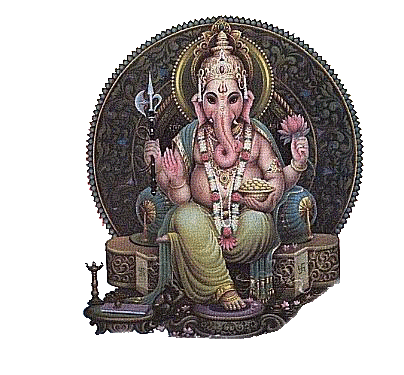
Ganesh
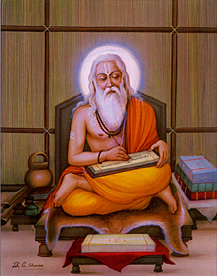
Vedas