
About 850 species of crab are freshwater, terrestrial or semi-terrestrial species; they are found throughout the world's tropical and semi-tropical regions. They were previously thought to be a monophyletic group, but are now believed to represent at least two distinct lineages, one in the Old World and one in the New World. The earliest unambiguous crab fossils date from the Jurassic, although Carboniferous Imocaris, known only from its carapace, may be a primitive crab. The radiation of crabs in the Cretaceous and afterward may be linked either to the break-up of Gondwana or to the concurrent radiation of bony fish, crabs' main predators. Read more ...
Ammonites are an extinct group of marine invertebrate animals in the subclass Ammonoidea of the class Cephalopoda. These molluscs are more closely related to living coleoids (i.e. octopuses, squid, and cuttlefish) than they are to shelled nautiloids such as the living Nautilus species. The earliest ammonites appear during the Devonian, and the last species died out during the CretaceousÐPaleogene extinction event. Ammonites are excellent index fossils, and it is often possible to link the rock layer in which a particular species or genus is found to specific geological time periods.
Their fossil shells usually take the form of planispirals, although there were some helically spiraled and nonspiraled forms (known as heteromorphs). The name "ammonite", from which the scientific term is derived, was inspired by the spiral shape of their fossilized shells, which somewhat resemble tightly coiled rams' horns. Pliny the Elder (d. 79 AD near Pompeii) called fossils of these animals ammonis cornua ("horns of Ammon") because the Egyptian god Ammon (Amun) was typically depicted wearing ram's horns. Read more ...
Ammonite diet revealed in X-rays BBC - January 6, 2011
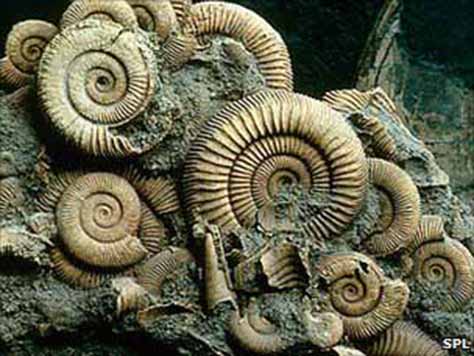
Ask someone to name their favorite fossils and the chances are they will point to the ammonites. These coiled remains of ancient squid-like creatures are in every child's rock collection. The animals were a big success, filling the oceans for 350 million years before going extinct with the dinosaurs. Now, exquisite X-ray images featured in Science magazine are providing new insights on how the ammonites lived and perhaps also on why they died out.
Fossil records 'crab' death march BBC - September 8, 2012
The behavior of an ancient horseshoe crab in its final moments before death has been captured in the fossil record. A 9.7m-long trackway was created around 150 million years ago when a horseshoe crab fell into a lagoon. The find is of interest because the fossil of the animal itself is present at the end of the trackway, where the animal died.
This fossil shows lobsters knew how to cuddle NBC - March 13, 2012
Fossils of tiny lobsters nestled together in a seashell suggest the fearsome-looking crustaceans were sociable far earlier in their evolution than known. Modern clawless lobsters often cluster together for shelter, and fossils of extinct clawed lobsters found in Canada suggested these crustaceans might be found together in burrows about 70 million years ago. Now a 180-million-year-old seashell found in a rock quarry in southern Germany holds a trio of fossilized lobsters, suggesting that as menacing as the animals might seem, they have long known the value of cuddling up.
Geologist analyzes earliest shell-covered fossil animals PhysOrg - October 22, 2009
The fossil remains of some of the first animals with shells, ocean-dwelling creatures that measure a few centimeters in length and date to about 520 million years ago, provide a window on evolution at this time, according to scientists. Their research indicates that these animals were larger than previously thought.
Ancient Anthropods Used Borrowed Homes Live Science - August 23, 2009
Hermit crabs, a lineage some 200 million years old, may not have been the first to salvage mollusk shells for self-protection. Primitive arthropods were among the earliest animals to venture onto land - 500 million years ago - and they too recycled shells, according to new research. James W. Hagadorn of Amherst College in Massachusetts and Adolf Seilacher of Yale University analyzed Cambrian-period fossil tracks left on a sand flat by ancient arthropods in what is now central Wisconsin. The small imprints are in remarkably good shape: a microbial mat permeating the beach probably saved them from obliteration by waves. The tracks resemble those of present-day hermit crabs, complete with intermittent, off-center impressions - hallmarks of a borrowed shell touching the ground with each step. But the marks suggest that compared with hermit crabs, the ancient trekkers wore their shells upside down. So whereas hermit crabs' rear ends curl under toward their bellies, the early arthropods' tails must have curled upward, like scorpions'.
Some Mollusks Thrived After Permian Extinction New York Times - August 27, 2009
The mass extinction that occurred at the end of the Permian period 252 million years ago was a body blow to marine organisms as the oceans became toxic (for reasons that are still cause for debate). Four out of five marine genera were wiped out, and recovery was slow. But not so slow, apparently, for one order of mollusks, the ammonoids. A study by French researchers in Science suggests that these shelled organisms (which look something like modern nautiluses but are related to squid and octopuses) diversified explosively in the first million years after the extinction. The general assumption has been that the mass extinction was so devastating that it took most genera at least five million years to recover.
Oldest Horseshoe Crab Fossil Discovered Live Science - January 28, 2008
Nearly a half a billion years ago, tiny horseshoe crabs crept along the shorelines much like today's larger versions do, new fossil evidence suggests. Two nearly complete fossil specimens discovered in Canada reveal a new genus of horseshoe crab, pushing their origins back at least 100 million years earlier than previously thought. Dubbed Lunataspis aurora, the ancient horseshoe crab is estimated to have been just 1.5 inches (4 centimeters) from head to tail-tip. That's much smaller than its modern-day relatives that can span nearly 20 inches (50 centimeters).
When Bivalves Ruled The World Science Daily - September 1, 2007
Before the worst mass extinction of life in Earth's history -- 252 million years ago -- ocean life was diverse and clam-like organisms called brachiopods dominated. After the calamity, when little else existed, a different kind of clam-like organism, called a bivalve, took over. A paleobiologist is now examining how elevated carbon dioxide affected ancient marine life. Her work supports a relatively new theory for the cause of the massive extinction that occurred as the Permian period ended and the Triassic period began: toxic oceans created by too much atmospheric carbon dioxide. The theory is important because it could help scientists predict what would happen in the oceans during a modern "C02 event."
ANCIENT AND LOST CIVILIZATIONS