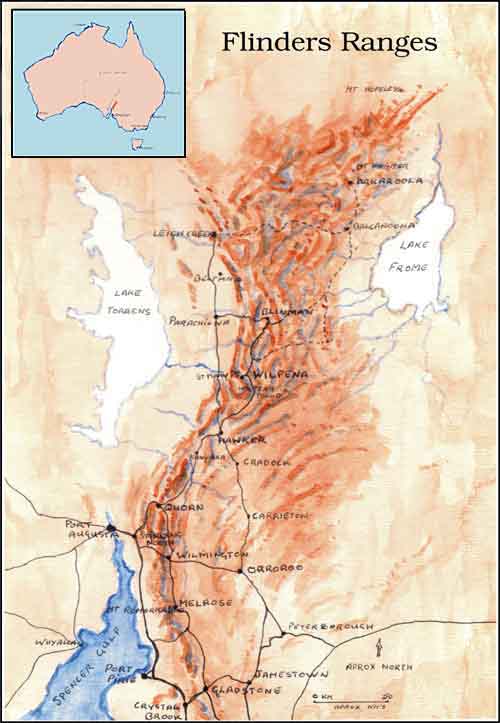
The Flinders Ranges is South Australia's largest mountain range which starts approximately 200 km north of Adelaide. The discontinuous ranges stretch for over 430 km from Port Pirie to Lake Callabonna. Its most characteristic landmark is Wilpena Pound, a large, sickle-shaped, natural amphitheatre covering nearly 80 square kilometres, containing the range's highest peak, St Mary Peak (1170m), and adjoining the Flinders Ranges National Park. The northern ranges host the Arkaroola wilderness sanctuary and the Vulkathunha-Gammon Ranges National Park. The southern part of the ranges are notable for the Pichi Richi scenic railway and Mount Remarkable National Park.
Several small areas in the Flinders Ranges are protected as National Parks. These include the Flinders Ranges National Park near Wilpena Pound and the Mount Remarkable National Park in the southern part of the ranges near Melrose. The Arkaroola Wilderness Sanctuary is a scenic protected area at the northern end of the ranges. In addition, the Dutchman's Stern Conservation Park, west of Quorn, and the Mount Brown Conservation Park, south of Quorn, are protected areas of the ranges. The Heysen Trail and Mawson Trail run for several hundred kilometres along the ranges providing scenic long distance routes for walkers, cyclists and horse-riders.

How algae conquered the world - and other epic stories hidden in the rocks of the Flinders Ranges PhysOrg - August 8, 2023
Earth was not always so hospitable. Evidence of how it came to be so beautiful and nurturing is locked in the rocks of South Australia's Flinders Ranges - a site now vying for World Heritage listing. New research seeks to better understand this near billion-year-old story. Researchers discovered immense planetary upheaval recorded in the ranges. In two related research projects, we've mapped how the continent that later became Australia responded to the most extreme climate change known in Earth's history. We then dated this event. The changes gave rise to algae. Their legacy is the oxygen we breathe and the evolution of the first animals more than 500 million years ago. The soft bodies of these animals have been exceptionally preserved at the new Nilpena-Ediacara National Park, which opened in April 2023.
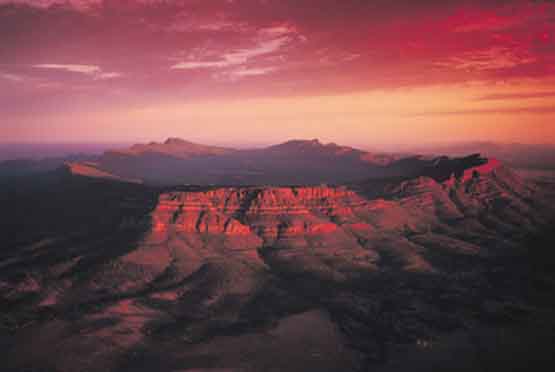
Wilpena Pound is a natural amphitheatre of mountains located 429 kilometres north of Adelaide, South Australia, in the heart of the Flinders Ranges National Park. The Pound is the most northern point with access via a sealed road in this part of the Flinders Ranges. The closest town to the north is Blinman and to the south, Hawker. Attempts at farming the pound failed during the early 20th century. Following this the tourism potential was recognized in 1945. The Flinders Range contains some of the most unusual geological formations in Australia. Indications of gigantic electric arcs are unmistakable.
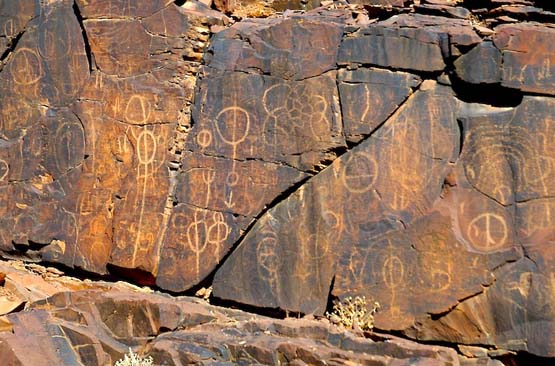
Carved in the mountainside are huge rock petroglyphs of eagle and Hawk-headed beings in canoes going down a river. These petroglyphs allegedly date 40,000 to 60,000 years. The Aborigines who live in the area say that this is the 'site of creation'. There are pictures that match some of the crop circle formations and some of the ancient Egyptian hieroglyphs. Interpretations of the petroglyphs is that they depict visitors from other worlds who came here in spaceships long ago, perhaps to seed the human race. May believe these visitors will return.
ANCIENT AND LOST CIVILIZATIONS