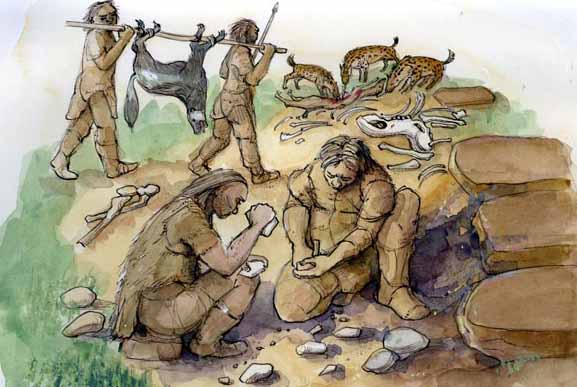



Neanderthals made advanced tools. The Molodova archaeological site in eastern Ukraine suggests some Neanderthals built dwellings using animal bones. A building was made of mammoth skulls, jaws, tusks and leg bones, and had 25 hearths inside.
Circumstantial evidence suggests Neanderthals may have been building some form of watercraft since the Middle Paleolithic.Scientists have speculated that these watercraft may have been similar to dugout canoes, which are among the oldest known boats in the archaeological record. Mousterian stone tools discovered on the southern Ionian Islands suggests that Neanderthals were sailing the Mediterranean Sea as early as 110,000 years BP. Quartz hand-axes, three-sided picks, and stone cleavers from Crete have also been recovered that date back about 170,000 years BP.
It was once thought that Neanderthals lacked the sophistication for hunting, perhaps scavenging meat from carcasses, but increasing evidence suggests they were apex predators, capable of bringing down a wide range of prey from red deer, reindeer, ibex and wild boar, to larger animals such as aurochs and even, on occasion, mammoth, straight-tusked elephant and rhinoceros. However, while largely carnivorous, new studies indicate Neanderthals also had cooked vegetables in their diet.
In 2010, an isotope analysis of Neanderthal teeth found traces of cooked vegetable matter, and more recently a 2014 study of Neanderthal coprolites (fossilized feces) found substantial amounts of plant matter, contradicting the earlier belief they were exclusively (or almost exclusively) carnivorous.
Did early humans ever really exist or is each iteration another insert in the simulation?
Traces of blue indigo on 34,000-year-old grinding tools suggest new Paleolithic plant use scenarios PhysOrg - September 3, 2025
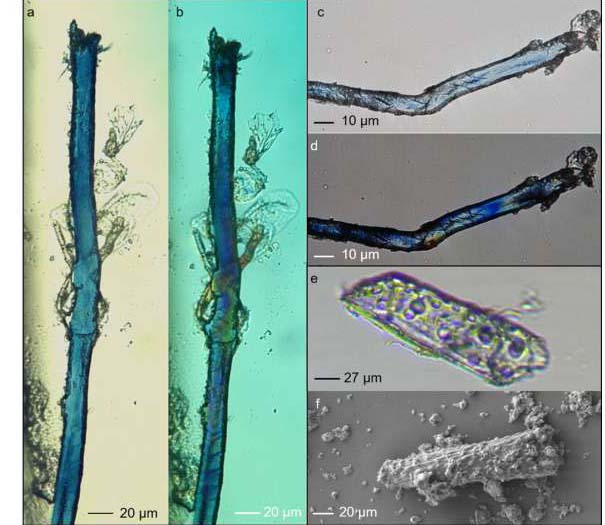
This is the first time indigotin - a blue secondary compound, also known as indigo - has been identified on such ancient artifacts. The molecule forms through a reaction between atmospheric oxygen and the natural glycoside precursors in Isatis tinctoria L. leaves, released from the cellular vacuoles. This proves that the plant, despite not being edible, was intentionally processed as early as 34,000 years ago.
1.5 million-year-old stone tools from mystery human relative discovered in Indonesia - they reached the region before our species even existed Live Science - August 7, 2025

Stone tools discovered on the Indonesian island of Sulawesi are rewriting what experts thought they knew about human evolution in this region. The tools date to about 1 million to 1.5 million years ago, which suggests that Sulawesi was occupied by an unknown human relative long before our species evolved. These are simple, sharp-edged flakes of stone that would have been useful as general-purpose cutting and scraping implements.
1.5 million-year-old bone tools crafted by human ancestors in Tanzania are oldest of their kind Live Science - April 8, 2025

The oldest human-crafted bone tools on record are 1.5 million years old, a finding that suggests our ancestors were much smarter than previously thought, a new study reports. The tools, made from hippo and elephant leg bones, were discovered at Olduvai Gorge in Tanzania and are a million years older than any previously found shaped bone tools.
Stone Age Artisans Chose Their Materials For A Reason. A New Study Is Figuring Out Why IFL Science - January 14, 2025

By directly experimenting on various raw materials from percussive tools from Melka Wakena, a 1.6-to-0.7-million-year-old archeological site in the Ethiopian Highlands, researchers were able to infer what made a material useful to our ancient ancestors Ð and when certain advantages outweighed others in their calculations.
Archaeologists just uncovered Oldest Evidence of Humans in Europe buried deep in the sediment of the Korolevo quarry in Ukraine are rewriting the history of human migration Science Alert - March 8, 2024

Stone tools found buried deep in the sediment of the Korolevo quarry in Ukraine are rewriting the history of human migration. The seemingly unassuming chunks of rock are tools once used by Homo erectus, a direct ancestor of ours, and new dating reveals they represent the earliest evidence of hominid habitation on the European continent.
Ancient stone tools found in Ukraine date to over 1 million years ago, and may be oldest in Europe PhysOrg - March 6, 2024
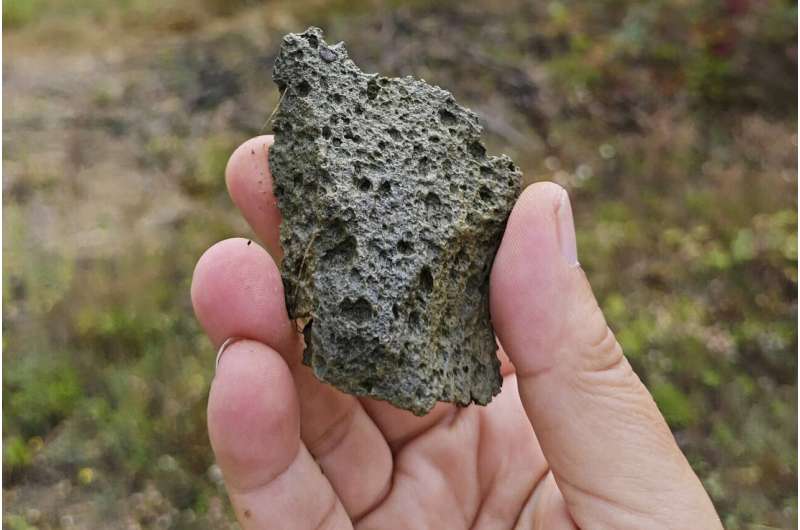
The chipped stones, deliberately fashioned from volcanic rock, were excavated from a quarry in Korolevo in the 1970s. Archaeologists used new methods to date the layers of sedimentary rock surrounding the tools to more than 1 million years old.
45,000-Year-Old Tools And Bones Reveal Earliest Evidence of Homo Sapiens in Eastern Asia Science Alert - January 18, 2024
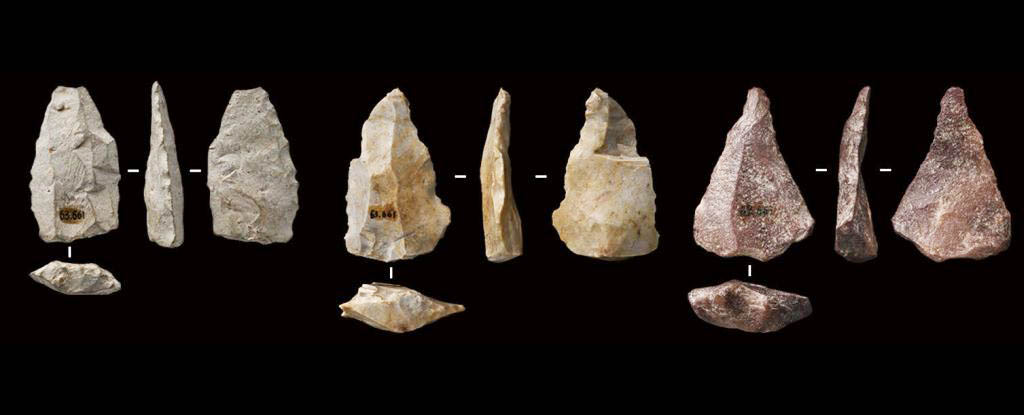
Fragments of ancient rock and bone in Eastern Asia are changing our understanding of the history of human migration. They're artifacts found in the Shiyu site of northeastern China, and new analysis has revealed that they were created by Homo sapiens some 45,000 years ago.
An unknown group of hominins crafted more than 500 obsidian hand axes more than 1.2 million years ago in what is now Ethiopia Live Science - February 7, 2023

More than 1.2 million years ago, an unknown group of human relatives may have created sharp hand axes from volcanic glass in a "stone-tool workshop" in what is now Ethiopia, a new study finds. This discovery suggests that ancient human relatives may have regularly manufactured stone artifacts in a methodical way more than a half-million years earlier than the previous record, which dates to about 500,000 years ago in France and England.
Because it requires skill and knowledge, stone tool use among early hominins, the group that includes humans and the extinct species more closely related to humans than any other animal, can offer a window into the evolution of the human mind. A key advance in stone tool creation was the emergence of so-called workshops. At these sites, archaeologists can see evidence of hominins methodically and repeatedly crafting stone artifacts.
Visual behavior during the manufacture of stone age tools is analyzed for the first time PhysOrg - November 27, 2022
The Paleoneurology Group at the Centro Nacional de Investigaci—n sobre la Evoluci—n Humana (CENIEH) has just published a new study in the Journal of Paleolithic Archaeology which, for the first time, analyzes visual behavior during the manufacture of Lower Paleolithic stone tools. The results show that the visual behavior depends on the tool being made.
Huge Find of 400,000-Year-Old Bone Tools Challenges Our Understanding of Early Humans Science Alert - September 1, 2021
As far as Lower Paleolithic archaeology goes, this is quite the haul: Experts have uncovered a record 98 elephant-bone tools at a site dating back some 400,000 years. This discovery could change our thinking on how some of the early humans - such as Neanderthals - fashioned implements like these.
Europe's earliest bone tools found in Britain BBC - August 13, 2020
The implements come from the renowned Boxgrove site in West Sussex, which was excavated in the 1980s and 90s. The bone tools came from a horse that humans butchered at the site for its meat. Flakes of stone in piles around the animal suggest at least eight individuals were making large flint knives for the job. Researchers also found evidence that other people were present nearby - perhaps younger or older members of a community - shedding light on the social structure of our ancient relatives.
Oldest flaked stone tools point to the repeated invention of stone tools PhysOrg - June 3, 2019
A new archaeological site discovered by an international and local team of scientists working in Ethiopia shows that the origins of stone tool production are older than 2.58 million years ago. Previously, the oldest evidence for systematic stone tool production and use was 2.58 to 2.55 million years ago.
Stone tools were 'invented' many times in different places before becoming essential to humanity, Ethiopian dig site suggests Daily Mail - June 3, 2019
Prehistoric 'Swiss Army knife' used to spear enemies, scrape rocks and dig holes reveals complex tools emerged in East Asia 170,000 years ago Daily Mail - November 19, 2018
A prehistoric 'Swiss Army knife' used to spear, slice, scrape or dig has been discovered in China. The 170,000-year-old tool, known as a 'Levallois stone', is a sign of advanced tool-making and is considered the 'multi-tool' of the prehistoric world. Levallois stones have previously been found in East Africa, and are thought to have first appeared around 300,000 years ago. Scientists had thought that this level of sophisticated tool making didn't emerge in East Asia until 40,000 years ago, but the new find pushes this figure back by 130,000 years.
Experts find stone tools connected communities PhysOrg - November 9, 2018
Stone tools from the Middle Stone Age in South Africa shows that different communities were connected over long time periods over vast geographical areas. Stone tools that were discovered and examined by a group of international experts showed for the first time that various communities that lived during the Middle Stone Age period were widely connected and shared ideas around tool design. The tools - mainly blades and backed knives from the Howiesons Poort - were found in various layers in the Klipdrift Shelter, in the southern Cape in South Africa. They were examined by a group of lithic experts, who found distinct similarities to tools from sites in South Africa's Western Cape, over 300km away, in particular with the Diepkloof Rock Shelter site.
Quantitative 3-D analysis of bone tools sheds light on ancient manufacture and use PhysOrg - November 7, 2018
Quantitative three-dimensional analysis of bone wear patterns can provide insight into the manufacture and use of early human tools. Humans have been using bone tools for at least 2 million years, and by approximately 100 thousand years ago, were manufacturing them with formal processes such as grinding and scraping. Ancient bone tools carry marks of their manufacture and use, which can provide information about the group of people that made the tools and the specific uses to which tools were put. Microscopy has been used to study these marks, but the study of use-wear on bone tools requires a comparative body of quantitative examples of wear over time and contact with different materials, to ensure that these studies are replicable. In the current study, the authors sought to determine the basics of use-wear formation over time by taking incremental molds of bone specimens subjected to a controlled, mechanical experiment.
Middle Stone Age ochre processing tools reveal cultural and behavioral complexity PhysOrg - November 2, 2016
Middle Stone Age humans in East Africa may have employed varied techniques to process ochre for functional and symbolic uses. Ochre fragments-which are rocks containing iron oxides, red or yellow in color-have often been found at Middle Stone Age sites and have played a role in shaping the cultures of early African Homo sapiens. Some researchers suggest that ochre was used for utilitarian purposes, for example in glue to adhere handles to tools, whilst others believe that the pigment was used for symbolic purposes, such as body painting or creating meaningful patterns. However, few ochre processing tools have been studied in detail to understand how this material was processed.
Archaeology team makes world-first tool discovery PhysOrg - August 8, 2016
How smart were human-like species of the Stone Age? New research by a team led by paleoanthropologist April Nowell of the University of Victoria reveals surprisingly sophisticated adaptations by early humans living 250,000 years ago in a former oasis near Azraq, Jordan.
Stone Age tools reveal how our ancestors prepared duck, rhino and horse meat up to 250,000 years ago Daily Mail - August 8, 2016
A haul of carefully shaped stone fragments uncovered in the baking deserts of Jordan has provided a glimpse at the eating habits of our Stone Age ancestors. Traces of animal protein have been found to have survived a quarter of a million years on the edges of flint blades, scrapers and other stone tools. They suggest the early humans who created them were skillfully butchering animals long before our own species - Homo sapiens - came on the scene.
New study finds that teaching is not essential for people to learn to make effective tools PhysOrg - November 27, 2015
A new study from the University of Exeter has found that teaching is not essential for people to learn to make effective tools. The results counter established views about how human tools and technologies come to improve from generation to generation and point to an explanation for the extraordinary success of humans as a species. The study reveals that although teaching is useful, it is not essential for cultural progress because people can use reasoning and reverse engineering of existing items to work out how to make tools.
Stone tools from Jordan point to dawn of division of labor PhysOrg - June 12, 2015
Thousands of stone tools from the early Upper Paleolithic, unearthed from a cave in Jordan, reveal clues about how humans may have started organizing into more complex social groups by planning tasks and specializing in different technical skills. The rich array of artifacts shows a mix of techniques for making points, blades, scrapers and cutting flakes. These toolmakers appear to have achieved a division of labor that may have been part of an emerging pattern of more organized social structures.
Oldest stone tools pre-date earliest humans BBC - May 20, 2015
The world's oldest stone tools have been discovered, scientists report. They were unearthed from the shores of Lake Turkana in Kenya, and date to 3.3 million years ago. They are 700,000 years older than any tools found before, even pre-dating the earliest humans in the Homo genus.
Complex cognition shaped the Stone Age hand axe Science Daily - April 16, 2015
The ability to make a Lower Paleolithic hand axe depends on complex cognitive control by the prefrontal cortex, including the 'central executive' function of working memory, a new study finds. The results knock another chip off theories that Stone Age hand axes are simple tools that don't involve higher-order executive function of the brain. For the first time, they've showed a relationship between the degree of prefrontal brain activity, the ability to make technological judgments, and success in actually making stone tools.
Ancient Stone Tool Brings New Ideas About Early Americans Huffington Post - March 9, 2015
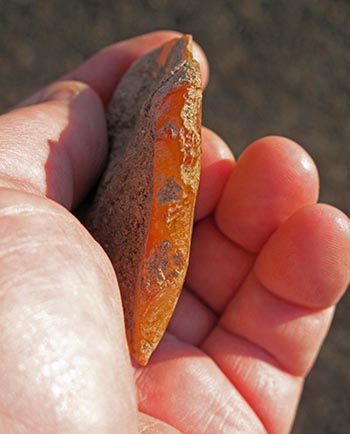
An ancient stone tool recently discovered in the high desert of southeast Oregon has archaeologists raising their eyebrows. The tool, a hand-held scraper chipped from a piece of agate, was unearthed from beneath a layer of volcanic ash near the Rimrock Draw Rockshelter outside Riley. Archaeologists have linked the ash to a major eruption from Mount St. Helens that occurred about 15,800 years ago.
Oldest Metal Object in Middle East Discovered in Woman's Grave Live Science - August 22, 2014
A copper awl is the oldest metal object unearthed to date in the Middle East. The discovery reveals that metals were exchanged across hundreds of miles in this region more than 6,000 years ago, centuries earlier than previously thought, researchers say. The artifact was unearthed in Tel Tsaf, an archaeological site in Israel located near the Jordan River and Israel's border with Jordan. The area was a village from about 5100 B.C. to 4600 B.C., and was first discovered in A.D. 1950, with digs taking place from the end of the 1970s up to the present day.
Photos: Ancient Burial and Metal Tool from Southern Levant Live Science - August 22, 2014
Between 2004 and 2007, archaeologists excavated a site in Tel Tsaf in the Jordan Valley of Israel, finding evidence for a Late Byzantine-Early Islamic occupation, including a settlement that dated to 5100 B.C. to 4600 B.C. A complex found at the site included courtyard buildings, with rectilinear, rounded rooms and silos, and cooking areas. They also uncovered four burials, two of which were discovered inside two silos, and a metal awl tool that may be the oldest metal object every found in the Middle East.
Earlier Stone Age artifacts found in Northern Cape of South Africa Science Daily - July 25, 2014
Excavations at an archaeological site at Kathu in the Northern Cape province of South Africa have produced tens of thousands of Earlier Stone Age artifacts, including hand axes and other tools. The archaeologists' research on the Kathu Townlands site, one of the richest early prehistoric archaeological sites in South Africa.
Language and Tool-Making Skills Evolved at the Same Time Live Science - September 3, 2013
Research by the University of Liverpool has found that the same brain activity is used for language production and making complex tools, supporting the theory that they evolved at the same time. Language and stone tool-making are considered to be unique features of humankind that evolved over millions of years.
Handaxe Design Reveals Distinct Neanderthal Cultures Science Daily - August 19, 2013
A study by a postgraduate researcher at the University of Southampton has found that Neanderthals were more culturally complex than previously acknowledged. Two cultural traditions existed among Neanderthals living in what is now northern Europe between 115,000 to 35,000 years ago. for the Archaeology of Human Origins (CAHO) and funded by the Arts and Humanities Research Council (AHRC) examined the design of 1,300 stone tools originating from 80 Neanderthal sites in five European countries; France, Germany, Belgium, Britain and the Netherlands. Dr Ruebens' investigations uncovered new evidence that two separate handaxe traditions or designs existed -- one in a region now spanning south-western France and Britain -- the other in Germany and further to the East. In addition, she found an area covering modern day Belgium and the Netherlands that demonstrates a transition between the two.
Earliest Archaeological Evidence of Human Ancestors Hunting and Scavenging Science Daily - May 13, 2013
A recent Baylor University research study has shed new light on the diet and food acquisition strategies of some the earliest human ancestors in Africa. Beginning around two million years ago, early stone tool-making humans, known scientifically as Oldowan hominin, started to exhibit a number of physiological and ecological adaptations that required greater daily energy expenditures, including an increase in brain and body size, heavier investment in their offspring and significant home-range expansion. Demonstrating how these early humans acquired
Did Rise of Ancient Human Ancestor Lead to New Stone Tools? Live Science - January 28, 2013
Scientists have unearthed and dated some of the oldest stone hand axes on Earth. The ancient tools, unearthed in Ethiopia in the last two decades, date to 1.75 million years ago. The tools roughly coincided with the emergence of an ancient human ancestor called Homo erectus, and fossilized H. erectus remains were also found at the same site, said study author Yonas Beyene, an archaeologist at the Association for Research and Conservation of Culture in Ethiopia. Collectively, the finding suggests an ancient tool-making technique may have arisen with the evolution of the new species.
Complex Tool Discovery Argues for Early Human Smarts Live Science - November 7, 2012
Rocks carved into ancient stone arrowheads or into lethal tools for hurling spears suggest humans innovated relatively advanced weapons much earlier than thought, researchers in South Africa say. The researchers' finds, partially exposed by a coastal storm, suggest ancient peoples were capable of complex forms of thinking, scientists added. Modern humans originated in Africa about 200,000 years ago, but when modern human ways of thinking emerged remains controversial. For instance, some researchers note that the first signs of complex thought such as art appeared relatively late in history, suggesting that genetic mutations linked with modern human behavior occurred as recently as 40,000 years ago. Other scientists argue that modern human thought originated much earlier but that the evidence was largely lost to the rigors of time.
'Earliest' evidence of modern human culture found BBC - August1, 2012
The earliest unambiguous evidence for modern human behavior has been discovered by an international team of researchers in a South African cave. The finds provide early evidence for the origin of modern human behavior 44,000 years ago, over 20,000 years before other findings. The artifacts are near identical to modern-day tools of the indigenous African San bush people.
Oldest Poison Pushes Back Ancient Civilization 20,000 Years Live Science - July 30, 2012
The late Stone Age may have had an earlier start in Africa than previously thought - by some 20,000 years. new analysis of artifacts from a cave in South Africa reveals that the residents were carving bone tools, using pigments, making beads and even using poison 44,000 years ago. These sorts of artifacts had previously been linked to the San culture, which was thought to have emerged around 20,000 years ago. "Our research proves that the Later Stone Age emerged in South Africa far earlier than has been believed and occurred at about the same time as the arrival of modern humans in Europe," study researcher Paola Villa, a curator at the University of Colorado Museum of Natural History, said in a statement.
Later Stone Age Got Earlier Start in South Africa Than Thought Science Daily - July 30, 2012
The Later Stone Age emerged in South Africa more than 20,000 years earlier than previously believed - about the same time humans were migrating from Africa to the European continent, says a new international study led by the University of Colorado Boulder. The study shows the onset of the Later Stone Age in South Africa likely began some 44,000 to 42,000 years ago, said Paola Villa, a curator at the University of Colorado Museum of Natural History and lead study author. The new dates are based on the use of precisely calibrated radiocarbon dates linked to organic artifacts found at Border Cave in the Lebombo Mountains on the border of South Africa and Swaziland containing evidence of hominid occupation going back 200,000 years.
Oregon stone tools enliven 'earliest Americans' debate BBC - July 13, 2012
Scientists studying how North America was first settled have found stone spearheads and darts in Oregon, US, that date back more than 13,000 years. The hunting implements, which are of the "Western Stemmed" tradition, are at least as old as the famous Clovis tools thought for a long time to belong to the continent's earliest inhabitants. Precise carbon dating of dried human feces discovered alongside the stone specimens tied down their antiquity.
Exciting stone tool find in Kenya BBC - September 1, 2011
The world's earliest sophisticated stone tools have been found near Lake Turkana in northwest Kenya. The teardrop-shaped hand-axes date to about 1.76 million years ago, and would have been used for a range of tasks from chopping wood to cutting up meat. They would have been so useful in fact that scientists describe them as the "Swiss army knife" of the Stone Age.
Ancient Toolmakers Plied Craft Near Niagara Falls Live Science - June 16, 2011
An ancient campsite where people were manufacturing tools has been discovered near the Niagara Falls. This find, combined with other archaeological discoveries in the area over the past few decades, suggests that such campsites lined the Niagara River as far back as 4,000 years ago. So far, the team has unearthed more than 20,000 artifacts, mostly bits of rock broken off when people were creating stone tools, on the southeastern tip of Grand Island New York, about 12 miles (20 km) upstream from Niagara Falls. The earliest artifacts at the site date back at least 4,000 years, opening a window on a time when people were living a nomadic lifestyle based on hunting, fishing and gathering plants. =
Stone tools 'demand new American story' BBC - March 25, 2011
The long-held theory of how humans first populated the Americas may have been well and truly broken. Archaeologists have unearthed thousands of stone tools that predate the technology widely assumed to have been carried by the first settlers. The discoveries in Texas are seen as compelling evidence that the so-called Clovis culture does not represent America's original immigrants. Details of the 15,500-year-old finds are reported in Science magazine.
Island tool finds show early settlers' diversity BBC - March 4, 2011
Caches of tools and animal remains from around 12,000 years ago, found on islands off the California coast, have given remarkable insight into the lives of the first Americans.
The finds show fine tool technology and a rich maritime economy existed there. The tools vary markedly from mainland cultures of the era such as the Clovis.
Cretan tools point to 130,000-year-old sea travel PhysOrg - January 3, 2011
Greece's culture ministry says archaeologists on the island of Crete have discovered what may be evidence of one of the world's earliest sea voyages by humans.A ministry statement says archaeologists from Greece and the U.S. have found rough axes and other tools thought to be between 130,000 and 700,000 years old in shelters on the island's south coast.
Tool-making and meat-eating began 3.5 million years ago BBC - August 11, 2010

Researchers have found evidence that hominins - early human ancestors - used stone tools to cleave meat from animal bones more than 3.2 million years ago. That pushes back the earliest known tool use and meat-eating in such hominins by more than 800,000 years.
Discovery Pushes Human Tool Use Back 800,000 Years Live Science - August 11, 2010
The timeline of early human evolution needs another revision with the discovery that human ancestors used tools 800,000 years earlier than previously realized. The finding in Ethiopia, a pair of mammalian fossil bones marred by tool marks, pushes tool use back into the age of Australopithecus afarensis, an early human ancestor that lived in east Africa 3 million to 4 million years ago. Archaeologists previously believed that early human ancestors, or hominins, started using tools 2.5 million years ago. That's when evidence shows one of the first Homo species, Homo habilis, began butchering meat with sharpened stones. (Our species, Homo sapiens, didn't show up until about 200,000 years ago.) But the new find is approximately 3.39 million years old, older than the famous Australopithecus fossil "Lucy," who lived near the find site 3.2 million years ago.
Ancient artifacts revealed as northern ice patches melt PhysOrg - April 26, 2010
High in the Mackenzie Mountains, scientists are finding a treasure trove of ancient hunting tools being revealed as warming temperatures melt patches of ice that have been in place for thousands of years.
Giant stone-age axes found in African lake basin PhysOrg - September 10, 2009
Four giant stone hand axes were recovered from the the dry basin of Lake Makgadikgadi in the Kalahari Desert.
Hand axes in Europe nearly a million years old: study PhysOrg - September 3, 2009
Early humans used two-sided stone axes in Europe up to 900,000 years ago, far earlier than previously thought, according to a study released Wednesday.
Prehistoric tools discovered at Isles of Shoals PhysOrg - August 27, 2009
Summer students in Cornell's new Archaeology Field School at Shoals Marine Laboratory, Cornell's marine field station, have discovered the first prehistoric archaeological site in the Isles of Shoals, six miles off the Maine and New Hampshire coast.
Early toolmakers were 'engineers' BBC - August 14, 2009
Early modern humans in South Africa were using "heat treatment" to improve their stone tools about 72,000 years ago, according to new research. This technique may bridge a gap between the use of fire to cook food 800,000 years ago and the production of ceramics 10,000 years ago. Evidence for this innovation was found at Pinnacle Point, a Middle Stone Age site on the South African coast.
Ancient Bone Tool Sheds Light On Prehistoric Midwest Science Daily - October 22, 2008
A prehistoric bone tool discovered by University of Indianapolis archeologists is the oldest such artifact ever documented in Indiana, the researchers say. Radiocarbon dating shows that the tool Ð an awl fashioned from the leg bone of a white tail deer, with one end ground to a point - is 10,400 years old. The find supports the growing notion that, in the wake of the most recent Ice Age, the first Hoosiers migrated northward earlier than previously thought. Sites from the Paleoindian and Early Archaic eras are more common in surrounding states such as Illinois and Ohio, which were not as heavily glaciated as Indiana.
Front garden yields ancient tools BBC - June 20, 2006
It comes in the form of giant flint handaxes that have been unearthed at a site at Cuxton in Kent. The Britons of 250,000 years ago were a good deal more sophisticated than they are sometimes given credit for, new archaeological evidence suggests. It comes in the form of giant flint handaxes that have been unearthed at a site at Cuxton in Kent. The tools display exquisite, almost flamboyant, workmanship not associated with this period until now. The axes - one of which measured 307mm (1ft) in length - were dug up from old sand deposits in a front garden.
Iron Age tool marks move to steel BBC - May 12, 2004
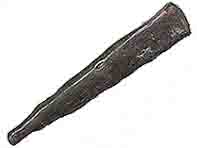
A tiny Iron Age tool found in Holland is one of the oldest objects unearthed in Europe made from the alloy steel. The 6cm-long punch has a carbon content (2%) rarely seen in iron-based objects from the region at the time. The 4th Century AD tool, which may have been used as a nail, was probably made using the process of furnace smelting. The discovery, which occurred at the site of Heeten, is reported in the Journal of Archaeological Science by Evelyne Godfrey and Matthijs van Nie.
9,000-year-old artifacts uncovered January 8, 2003 - BBC
Hunting tools believed to be 9,000 years old have been uncovered during a road development in County Antrim.
Blades and pottery unearthed during work on the new Toome Bypass reveal invaluable information about the lives of ancient peoples, according to archaeologists who have examined the artefacts. The finds are the most significant discovery in the province since a 4,000-year-old grave was discovered during an excavation in the ruins of Newtownstewart Castle in County Tyrone in 1999.
ANCIENT AND LOST CIVILIZATIONS