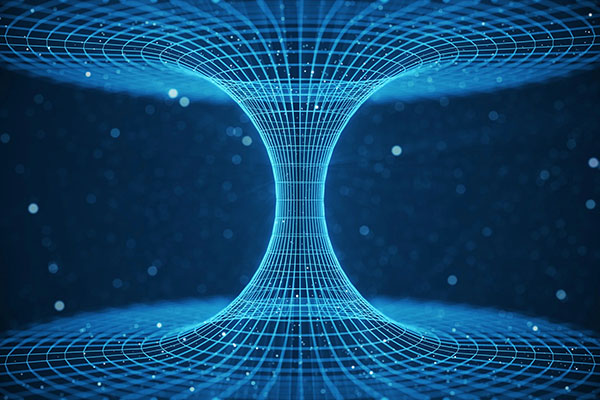
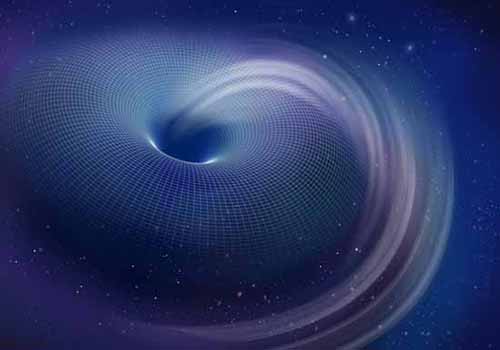
A wormhole or Einstein-Rosen Bridge is a hypothetical topological feature that would fundamentally be a shortcut connecting two separate points in spacetime. A wormhole, in theory, might be able to connect extremely far distances such as a billion light years or more, short distances such as a few feet, different universes, and different points in time. A wormhole is much like a tunnel with two ends, each at separate points in spacetime. For a simplified notion of a wormhole, space can be visualized as a two-dimensional (2D) surface. In this case, a wormhole would appear as a hole in that surface, lead into a 3D tube (the inside surface of a cylinder), then re-emerge at another location on the 2D surface with a hole similar to the entrance. An actual wormhole would be analogous to this, but with the spatial dimensions raised by one. For example, instead of circular holes on a 2D plane, the entry and exit points could be visualized as spheres in 3D space. Read more
Unusual Gravitational Wave May Be Sign of Wormhole Linking Universes Science Alert - September 23, 2025
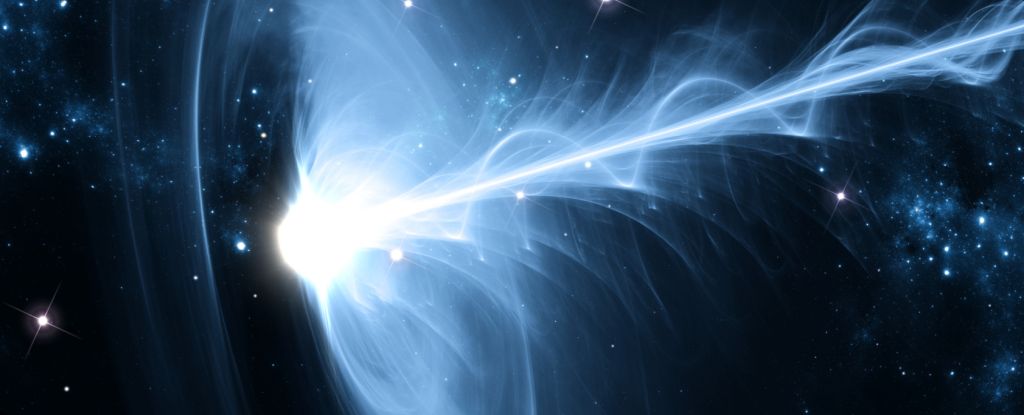
In 2019, LIGO and Virgo recorded something truly bizarre Ð a gravitational wave event less than a tenth of a second in duration. Compared to the drawn-out chirps of black hole binaries on decaying orbital spirals, it was a sharp crack. The best explanation of the event, named GW190521, was a chance encounter of two black holes snaring each other in passing. Now, a new paper has presented an alternative, far more exotic option: the echo of a black hole collision in another universe, reverberating through a collapsing wormhole that formed as a result of that merger.
A 'Wormhole' Built on a Quantum Computer Teleported Information as Predicted Science Alert - December 1, 2022
For the first time, scientists have created a quantum computing experiment for studying the dynamics of wormholes - that is, shortcuts through spacetime that could get around relativity's cosmic speed limits.
Physicists observe wormhole dynamics using a quantum computer Science Daily- December 1, 2022
Scientists have, for the first time, developed a quantum experiment that allows them to study the dynamics, or behavior, of a special kind of theoretical wormhole. The experiment has not created an actual wormhole (a rupture in space and time), rather it allows researchers to probe connections between theoretical wormholes and quantum physics, a prediction of so-called quantum gravity. Quantum gravity refers to a set of theories that seek to connect gravity with quantum physics, two fundamental and well-studied descriptions of nature that appear inherently incompatible with each other.
Physicists observe wormhole dynamics using a quantum computer PhysOrg - December 1, 2022
Scientists have, for the first time, developed a quantum experiment that allows them to study the dynamics, or behavior, of a special kind of theoretical wormhole. The experiment has not created an actual wormhole (a rupture in space and time), rather it allows researchers to probe connections between theoretical wormholes and quantum physics, a prediction of so-called quantum gravity. Quantum gravity refers to a set of theories that seek to connect gravity with quantum physics, two fundamental and well-studied descriptions of nature that appear inherently incompatible with each other.
Wormhole simulated in quantum computer could bolster theory that the universe is a hologram. Physicists have used a quantum computer to simulate the first-ever holographic wormhole and transport information through it Live Science - December 1 , 2022
Quantum experiment conducted on Google's Sycamore 2 computer transferred data across two simulated black holes, adding weight to the holographic principle of the universe. The "baby" wormhole, created on Google's Sycamore 2 quantum computer was not created with gravity, but through quantum entanglement - the linking of two particles such that measuring one instantaneously affects the other. By entangling qubits, or quantum bits, in minuscule superconducting circuits physicists were able to create a portal through which information was sent. The experiment has the potential to further the hypothesis that our universe is a hologram stitched together by quantum information.
Wormholes may be viable shortcuts through space-time after all, new study suggests Live Science - November 15, 2021
The new theory contradicts earlier predictions that these 'shortcuts' would instantly collapse. Wormholes, or portals between black holes, may be stable after all, a wild new theory suggests.
Traversable wormholes are possible under certain gravity conditions Live Science - August 23, 2021
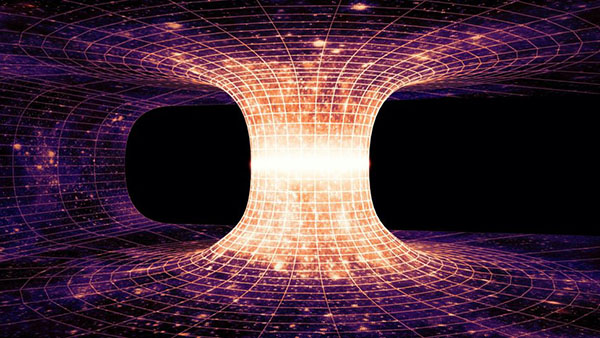
Interested in scooting through a wormhole, the ultimate cheat-code through space and time? Perhaps you'd like to hop from star system to star system across the universe without breaking a sweat? But first, you'd better make sure your wormhole is traversable.
Are some black holes wormholes in disguise? Gamma-ray blasts may shed clues Space.com -September 25, 2020
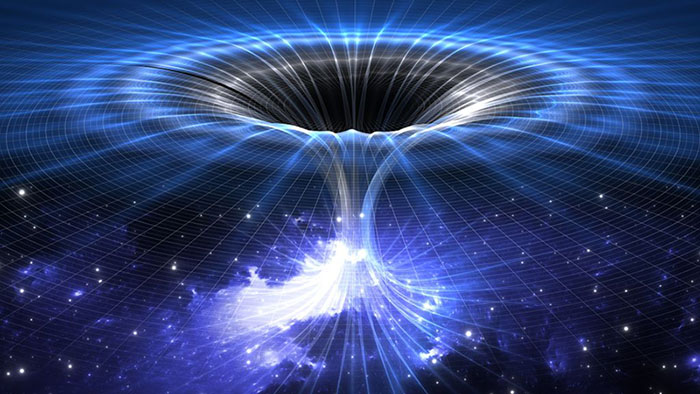
Unusual flashes of gamma rays could reveal that what appear to be giant black holes are actually huge wormholes, a new study finds. Wormholes are tunnels in space-time that can theoretically allow travel anywhere in space and time, or even into another universe. Einstein's theory of general relativity suggests wormholes are possible, although whether they really exist is another matter.
What happens if black holes fall into wormholes? A new way to find out. Space.com - August 11, 2020
Astronomers think they might be able to detect black holes falling into wormholes using ripples in spacetime known as gravitational waves, but only if wormholes actually exist and such a scenario ever happened, a new study finds. According to Einstein, who first predicted the existence of gravitational waves in 1916, gravity results from the way in which mass warps space and time. When two or more objects move within a gravitational field, they produce gravitational waves that travel at the speed of light, stretching and squeezing space-time along the way.
Physicists Just Released Step-by-Step Instructions for Building a Wormhole Live Science - August 27, 2019
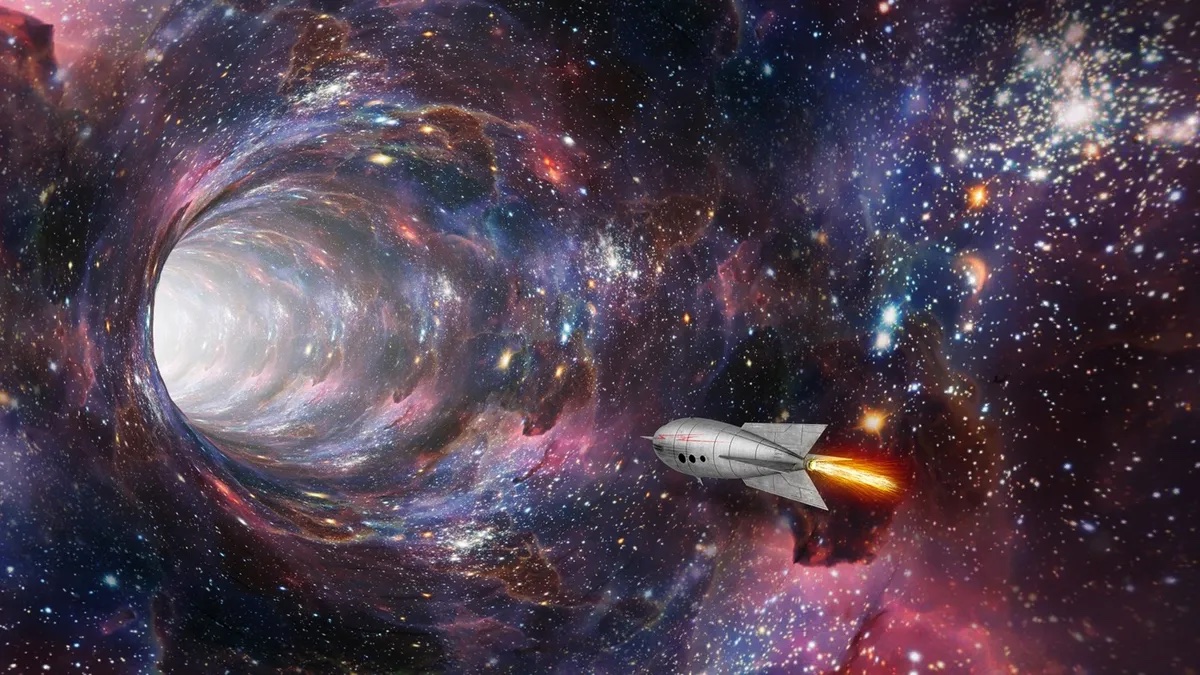
All you need are a couple of black holes and a few infinitely long cosmic strings.
Physicist describes the shape of a wormhole PhysOrg - October 17, 2018
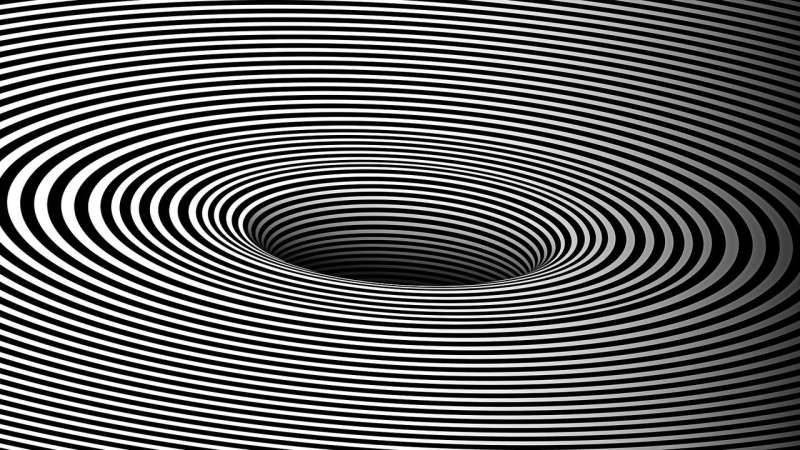
A RUDN physicist demonstrated how to describe the shape of any symmetrical wormhole - a black hole that theoretically can be a kind of a portal between any two points in space and time - based on its wave spectrum. The research would help understand the physics of wormholes and better identify their physical characteristics.
Physicists Simulate Sending Particles of Light Into the Past, Strengthening the Case that Time Travel Is Possible EMN - July 14, 2016
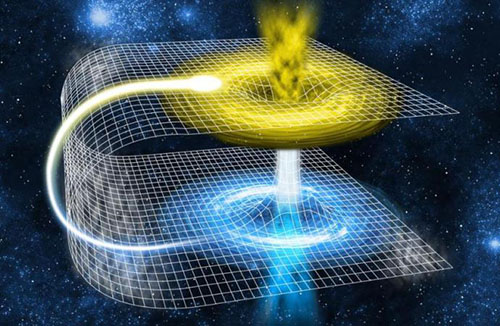
The study of closed time-like curves (CTCÕs) provides valuable insight into particles that can loop back on themselves, breaking free of linear time. Single particles of light (photons) to simulate quantum particles travelling through time were just used by scientists from the University of Queensland, Australia. They showed that one photon can pass through a wormhole and then interact with its older self.
Have physicist found the recipe for wormholes Daily Mail - April 26, 2016
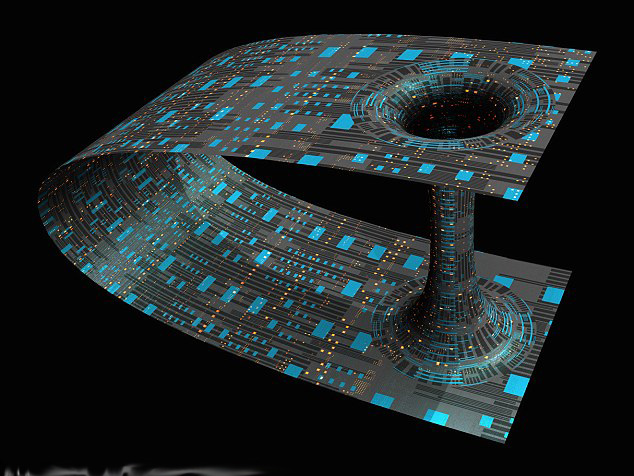
Is the universe littered with wormholes? Supermassive black holes laced with dark matter could produce 'tunnels' in space. Dark matter is one of the most elusive components of our universe, with scientists trying to find physical evidence of it to match our mathematical models of space. While we have been so far unable to see it or measure it directly, physicists believe the enigmatic material fills in the gaps in the universe, while matter makes up the 'stuff', like planets and stars. But a new paper has suggested that adding a sprinkling of dark matter to a supermassive black hole could result in one of the strangest objects in the universe - a wormhole.
Wormhole Created in Lab Makes Invisible Magnetic Field Live Science - August 20, 2015

Ripped from the pages of a sci-fi novel, physicists have crafted a wormhole that tunnels a magnetic field through space. This device can transmit the magnetic field from one point in space to another point, through a path that is magnetically invisible. From a magnetic point of view, this device acts like a wormhole, as if the magnetic field was transferred through an extra special dimension. The idea of a wormhole comes from Albert Einstein's theories. In 1935, Einstein and colleague Nathan Rosen realized that the general theory of relativity allowed for the existence of bridges that could link two different points in space-time. Theoretically these Einstein-Rosen bridges, or wormholes, could allow something to tunnel instantly between great distances (though the tunnels in this theory are extremely tiny, so ordinarily wouldn't fit a space traveler). So far, no one has found evidence that space-time wormholes actually exist.
Wormhole Is Best Bet for Time Machine, Astrophysicist Says Live Science - August 26, 2013
The concept of a time machine typically conjures up images of an implausible plot device used in a few too many science-fiction storylines. But according to Albert Einstein's general theory of relativity, which explains how gravity operates in the universe, real-life time travel isn't just a vague fantasy. The concept of a time machine typically conjures up images of an implausible plot device used in a few too many science-fiction storylines.
But according to Albert Einstein's general theory of relativity, which explains how gravity operates in the universe, real-life time travel isn't just a vague fantasy. Traveling forward in time is an uncontroversial possibility, according to Einstein's theory. In fact, physicists have been able to send tiny particles called muons, which are similar to electrons, forward in time by manipulating the gravity around them. That's not to say the technology for sending humans 100 years into the future will be available anytime soon, though. Time travel to the past, however, is even less understood. Still, astrophysicist Eric W. Davis argues that it's possible. All you need, he says, is a wormhole, which is a theoretical passageway through space-time that is predicted by relativity.
Our universe at home within a larger universe? So suggests wormhole research PhysOrg - April 7, 2010

In physics and fiction, a wormhole is a hypothetical topological feature of spacetime that would be, fundamentally, a "shortcut" through spacetime. Although they are very popular in science fiction, there is no actual evidence that they exist. For a simple visual explanation of a wormhole, consider spacetime visualized as a two-dimensional (2-D) surface (see illustration, right). If this surface is "folded" along a (non-existent) third dimension, it allows one to picture a wormhole "bridge". A wormhole is, in theory, much like a tunnel with two ends each in separate points in space-time.
There is no observational evidence for wormholes, and, although wormholes are valid solutions in general relativity, this is only true if exotic matter can be used to stabilize them. Even if the wormhole is stabilized, the slightest fluctuation in space would collapse it. If such exotic matter (that is, matter with negative mass) does not exist, all wormhole-containing solutions to Einstein's field equations are vacuum solutions, which require an impossible vacuum, free of all matter and energy. There is no evidence or experimental suggestion that wormholes do exist, except as predictions of certain (exotic) physical models. Wormholes allowed by current physical theories might arise spontaneously, but would vanish nearly instantaneously, and would likely be undetectable.