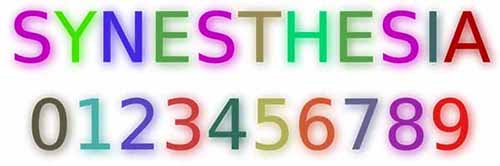
Synesthesia is a neurologically based phenomenon in which stimulation of one sensory or cognitive pathway leads to automatic, involuntary experiences in a second sensory or cognitive pathway. People who report such experiences are known as synesthetes.
In one common form of synesthesia, known as grapheme -> color synesthesia or color-graphemic synesthesia, letters or numbers are perceived as inherently colored, while in ordinal linguistic personification, numbers, days of the week and months of the year evoke personalities. In spatial-sequence, or number form synesthesia, numbers, months of the year, and/or days of the week elicit precise locations in space (for example, 1980 may be "farther away" than 1990), or may have a (three-dimensional) view of a year as a map (clockwise or counterclockwise).
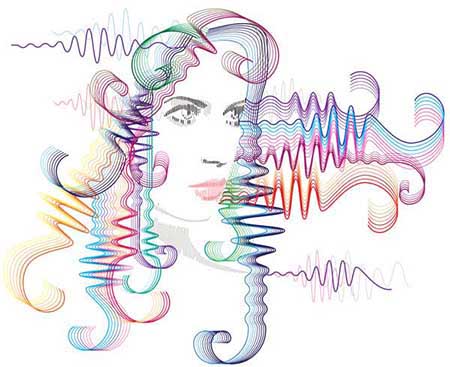
Yet another recently identified type, visual motion -> sound synesthesia, involves hearing sounds in response to visual motion and flicker. Over 60 types of synesthesia have been reported by people, but only a fraction has been evaluated by scientific research. Even within one type, synesthetic perceptions vary in intensity and people vary in awareness of their synesthetic perceptions.
While cross-sensory metaphors (e.g., "loud shirt," "bitter wind" or "prickly laugh") are sometimes described as "synesthetic," true neurological synesthesia is involuntary. It is estimated that synesthesia could possibly be as prevalent as 1 in 23 persons across its range of variants.
Synesthesia runs strongly in families, but the precise mode of inheritance has yet to be ascertained. Synesthesia is also sometimes reported by individuals under the influence of psychedelic drugs, after a stroke, during a temporal lobe epilepsy seizure, or as a consequence of blindness or deafness. Synesthesia that arises from such non-genetic events is referred to as "adventitious synesthesia" to distinguish it from the more common congenital forms of synesthesia. Adventitious synesthesia involving drugs or stroke (but not blindness or deafness) apparently only involves sensory linkings such as sound -> vision or touch -> hearing; there are few, if any, reported cases involving culture-based, learned sets such as graphemes, lexemes, days of the week, or months of the year.
Although synesthesia was the topic of intensive scientific investigation in the late 1800s and early 1900s, it was largely abandoned by scientific research in the mid-20th century, and has only recently been rediscovered by modern researchers.
Psychological research has demonstrated that synesthetic experiences can have measurable behavioral consequences, while functional neuroimaging studies have identified differences in patterns of brain activation.
Many people with synesthesia use their experiences to aid in their creative process, and many non-synesthetes have attempted to create works of art that may capture what it is like to experience synesthesia. Psychologists and neuroscientists study synesthesia not only for its inherent interest, but also for the insights it may give into cognitive and perceptual processes that occur in synesthetes and non-synesthetes alike. Read more ...
How my time-space synesthesia affects how I experience and 'feel' the new year Medical Express - January 2, 2026

I have a form of time-space synesthesia, so the new year arrives for me in a very physical way. I feel myself move around the year, almost like I'm traveling along a structure. December sits low and to my left; January lifts and slides forward. The transition has a weight to it, as though the calendar itself shifts in space. Synesthesia is a perceptual condition where one sense triggers an experience in another sense. For some people, sounds trigger colors and shapes, or words might have tastes.
Autism And Synesthesia May Have A Genetic Link, New Twin Study Reveals IFL Science - October 25, 2023
Being able to "see" sounds as colors is just one type of synesthetic experience.
A Genetic Link Between Synesthesia And Autism Has Just Been Revealed Science Alert - October 25, 2023
A new analysis of thousands of sets of twins suggests that synesthesia shares genetic roots with autism. In particular, synesthesia seems to be linked to what are known as non-social autism traits, or repetitive and restricted behaviors and interests (RRBIs) - which have also been linked to differences in perception compared to non-autistic individuals.
Psychologists discover enhanced language learning in synesthetes Medical Express - May 15, 2019

When I see equations, I see the letters in colors. I don't know why. I see vague pictures of Bessel functions with light-tan j's, slightly violet-bluish n's, and dark brown x's flying around. Feynman was describing his grapheme-color (GC) synesthesia - a condition in which individuals sense colors associated with letters and numbers. Synesthesia is a family of conditions where individuals perceive stimulation through more than one sense. GC synesthesia is just one form. In others, musical notes evoke colors; words have associated tastes; sequences of numbers are sensed as points in space; numbers suggest people, like an elderly man or a baby girl.
Tasting colors? Synesthesia induced with hypnosis Science Daily - December 13, 2017
Hypnosis can alter the way certain individuals information process information in their brain. A new phenomenon was identified by researchers who have successfully used hypnosis to induce a functional analogue of synesthesia. The discovery can open a window into the previously unexplored domains of cognitive neuroscience. Synesthesia is generally understood to be a rare phenomenon where, for example, seeing a certain letter or number is uniformly accompanied by an automatic association to or a visual perception of a color.
Associating Colors with Letters: Clues to Synesthesia Live Science - September 21, 2016
People with an unusual condition called synesthesia, which makes them experience a "mixing" of their senses, may automatically form stronger mental links between the sound of a word and the image that word conjures up in their mind, according to a small new study. About 1 to 4 percent of people have synesthesia. In one of its most common forms, people who are looking at colors might associate them with certain letters, or numbers, or sounds. For example, a person with synesthesia might always perceive the letter "Y" as blue or yellow, even when that individual sees it in black print.
Synesthesia Taught To Adults With Colored Letters And Memory Tests Medical Daily - November 19, 2014

Most synesthesia studies rely on a phenomenon in color psychology known as the Stroop Effect. It presents the test taker with a list of colors - Yellow, Green, Blue - each written in a typeface of a different color than what the word says. The word yellow may be written in red ink, for instance, and the word blue may actually appear yellow. The person taking the test has to say the color of the text, not read the word. Most of the time, it's difficult. But for synesthetes, the task isn't as hard because colors and words already have concrete associations in their brains. They have an easier time 'hooking' onto the desired color.
Hoping to mimic these effects, a team led by neuroscientist Daniel Bor recruited 14 people to undergo extensive training in the lab. For weeks, the participants read from specially designed colored e-books and spent half-hour chunks of time learning 13 letter-color associations. The goal was to engrain these cross-dimensional concepts as one codified unit, much like actual synesthetes taste words and see sound. By the five-week mark, many of the participants had begun seeing colored letters instead of black text in their lab tests.
People with Autism More Likely to Hear Colors, See Sounds Live Science - November 20, 2013

People with autism may be more likely than others to have synesthesia, a condition in which people experience a mixing of their senses, such as hearing tastes and shapes, and seeing numbers in colors, a new study from Europe suggests. Researchers tested 164 people with autism and 97 people without autism by giving them online questionnaires designed to evaluate whether they had synesthesia. They found synesthesia occurred in about 7 percent of people who didn't have autism, a figure within the range of previously reported rates. In contrast, 19 percent of people with autism appeared to have synesthesia.
Why It Pays to Taste Words and Hear Colors Live Science - November 22, 2011
While most of us see sights and hear sounds, some people also hear colors and taste words, a mysterious phenomenon called synesthesia, which occurs when stimulating one of the five senses triggers experiences in an unrelated sense. Now researchers suggest this unusual trait can provide numerous mental benefits, potentially explaining why evolution has kept it around
Brain study explores what makes colors and numbers collide PhysOrg - November 17, 2011
Someone with the condition known as grapheme-color synesthesia might experience the number 2 in turquoise or the letter S in magenta. Now, researchers reporting their findings online - have shown that those individuals also show heightened activity in a brain region responsible for vision. The findings provide a novel way of looking at synesthesia as the product of regional hyper-excitability in the brain, the researchers say. They also provide a window into our understanding of individual differences in perception. Not only do these grapheme-color synesthetes really see the colors they report, as measured in behavioral tests, but functional magnetic resonance imaging (fMRI) of their brains also shows activation in the color-selective regions of the cortex when they view black-and-white letters or numbers.