
The symbol of the 4-sided swastika is an archetype for the rotations of time and consciousness - moving clockwise and counterclockwise - in upward or downward spirals - allowing souls to experience many levels of reality simultaneously.
The word Swastika comes from the Sanskrit words su, meaning well, and asti, meaning 'to be'.
The swastika is an equilateral cross with its arms bent at right angles either clockwise or counterclockwise. It is traditionally oriented so that a main line is horizontal, though it is occasionally rotated at forty-five degrees, and the Hindu version often has a dot in each quadrant.
The swastika has not always been used as a symbol of Nazism and was in fact borrowed from Eastern cultures. It seems to have first been used by early inhabitants of Eurasia. It is an important symbol in Eastern religions, notably Hinduism and Buddhism, among others, and was also used in Native American faiths before World War II. By the early twentieth century it was regarded worldwide as a symbol of good luck and auspiciousness. Swastikas appeared on the spines of books by the Anglo-Indian writer Rudyard Kipling, and the symbol was used by Robert Baden-Powell's Boy Scout movement.
Since the rise of the National Socialist German Workers Party, the swastika has been associated with fascism, racism, World War II, and the Holocaust in much of the western world. Before this, it was particularly well-recognized in Europe from the archaeological work of Heinrich Schliemann, who discovered the symbol in the site of ancient Troy and who associated it with the ancient migrations of Indo-European (Aryan) peoples. Nazi use derived from earlier German volkisch nationalist movements, for which the swastika was a symbol of "Aryan" identity, a concept that came to be equated by theorists like Alfred Rosenberg with a Nordic master race originating in northern Europe. The swastika remains a core symbol of Neo-Nazi groups.
Since the end of World War II, the traditional uses of swastika in the western world were discouraged. Many innocent people or products were wrongly persecuted. There have been failed attempts by individuals and groups to educate Westerners to look past the swastika's recent association with the Nazis to its prehistoric origins.
Alternative historical English spellings of the Sanskrit word include suastika and svastica.
Alternative names for the shape are:
Crooked cross
Cross cramponned - in heraldry, as each arm resembles a crampon or angle-iron
Cross gammadion - tetragammadion or just gammadion, as each arm resembles the Greek letter (gamma)
Fylfot - meaning "four feet", chiefly in heraldry and architecture
Sun wheel - German Sonnenrad - a name also used as a synonym for the sun cross
Tetraskelion - Greek "four legged", especially when composed of four conjoined legs
Thor's hammer - from its supposed association with Thor, the Norse god of thunder, but this may be a misappropriation of a name that properly belongs to a Y-shaped or T-shaped symbol.
Hooked cross - (Dutch: hakenkruis, Icelandic Hakakross, German: Hakenkreuz, Finnish: hakaristi, Norwegian: Hakekors, Italian: croce uncinata and Swedish: Hakkors)
Black Spider - to various peoples in middle and western Europe
The swastika appears in art and design from pre-history symbolizing, in various contexts: luck, the sun, Brahma, or the Hindu concept of samsara. In antiquity, the swastika was used extensively by Hittites, Celts and Greeks, among others. It occurs in other Asian, European, African and Native American cultures - sometimes as a geometrical motif, sometimes as a religious symbol. Today, the swastika is a common symbol in Hinduism, Buddhism and Jainism, among others.
The ubiquity of the swastika has been explained by three main theories: independent development, cultural diffusion, and external event. The first theory is that the swastika's symmetry and simplicity led to its independent development everywhere, along the lines of Carl Jung's collective unconscious, or just as a very simple symbol.
Another explanation is suggested by Carl Sagan in his book Comet. Sagan reproduces an ancient Chinese manuscript that shows comet tail varieties: most are variations on simple comet tails, but the last shows the comet nucleus with four bent arms extending from it, recalling a swastika. Sagan suggests that in antiquity a comet could have approached so close to Earth that the jets of gas streaming from it, bent by the comet's rotation, became visible, leading to the adoption of the swastika as a symbol across the world.
Theories of single origin as a sacred prehistorical symbol point to the Proto-Indo-Europeans, noting that the swastika was not adopted by Sumer in Mesopotamia, which was established no later than 3500 BC, and the Old Kingdom of Egypt, beginning in 2630 BC, arguing that these were already well-established and codified at the time of the symbol's diffusion. As an argument ex silentio, this point has little value as a positive proof.
The swastika symbol is prominent in Hinduism, which is considered the parent religion of Buddhism and Jainism, both dating from about the sixth century BC, and both borrowing the swastika from their parent. Buddhism in particular enjoyed great success, spreading eastward and taking hold in southeast Asia, China, Korea and Japan by the end of the first millennium. The use of the swastika by the indigenous Bon faith of Tibet, as well as syncretic religions, such as Cao Dai of Vietnam and Falun Gong of China, is thought to be borrowed from Buddhism as well. Similarly, the existence of the swastika as a solar symbol among the Akan civilization of southwest Africa may have been the result of cultural transfer along the African slave routes around 1500 AD.
Regardless of origins, the swastika had generally positive connotations from early in human history, with the exceptions being most of Africa and South America.
The discovery of the Indo-European language group in the 1800s led to a great effort by archaeologists to link the pre-history of European peoples to the ancient Aryans. Following his discovery of objects bearing the swastika in the ruins of Troy, Heinrich Schliemann consulted two leading Sanskrit scholars of the day, Emile Burnouf and Max MŸller. Schliemann concluded that the swastika was a specifically Aryan symbol. This idea was taken up by many other writers, and the swastika quickly became popular in the West, appearing in many designs from the 1880s to the 1920s.
The positive meanings of the symbol were subverted in the early twentieth century when it was adopted as the emblem of the National Socialist German Workers Party. This association occurred because Nazism stated that the historical Aryans were the modern Germans and then proposed that, because of this, the subjugation of the world by Germany was desirable, and even predestined. The swastika was used as a convenient symbol to emphasize this mythical Aryan-German correspondence. Since World War II, most Westerners see the swastika as solely a Nazi symbol, leading to incorrect assumptions about its pre-Nazi use and confusion about its current use in other cultures.
A right-facing swastika may be described as "clockwise"...... or "counter-clockwise"A swastika composed of 17 squares in a 5x5 grid.
Geometrically, the swastika can be regarded as an irregular icosagon or 20-sided polygon. The arms are of varying width and are often rectilinear (but need not be). Only in modern use are the exact proportions considered important: for example, the proportions of the Nazi swastika were based on a 5x5 grid.
The swastika is chiral, with no reflectional symmetry, but both mirror-image forms have 90° rotational symmetry (that is, the symmetry of the cyclic group C4).


.. or "counter-clockwise"

A swastika composed of 17 squares in a 5x5 grid
The mirror-image forms are often described as:
"Left-facing" and "right-facing" are used mostly consistently. Looking at an upright swastika, the upper arm clearly faces towards the viewer's left (SM) or right (SP). The other two descriptions are ambiguous as it is unclear if they refer to the direction of the bend in each arm or to the implied rotation of the symbol. If the latter, the question as to whether the arms lead or trail remains. The terms are used inconsistently (sometimes even by the same writer) which is confusing and may obfuscate an important point, that the rotation of the swastika may have symbolic relevance.
The swastika is, after the simple equilateral cross (the "Greek cross"), the next most commonly found version of the cross.
Seen as a cross, the four lines emanating from the center point to the four cardinal directions. The most common association is with the Sun. Other proposed correspondences are to the visible rotation of the night sky in the Northern Hemisphere around Polaris.
The name sauwastika is sometimes given for the supposedly "evil", left-facing, form of the swastika (SM). However, the evidence for sauwastika seems sketchy and there seems to be very little other than conjecture to support the notion that the left-facing swastika is regarded as evil in Hindu tradition. Although the more common form is the right-facing swastika, Hindus all over India and Nepal still use the symbol in both orientations for the sake of balance. Buddhists almost always use the left-facing swastika.
Some contemporary writers - Servando Gonzalez, for example - confuse matters even further by asserting that the right-facing swastika, used by the Nazis is in fact the "evil" sauwastika. (Gonzalez "proves" that the left-facing swastika is the sunwise one with reference to a 1930s box of Standard fireworks from Sivakasi, India.) This inversion - whether intentional or not - might derive from a desire to prove that the Nazi's use of the right-handed swastika was expressive of their "evil" intent. But the notion that Adolf Hitler deliberately inverted the "good left-facing" swastika is wholly unsupported by any historical evidence.
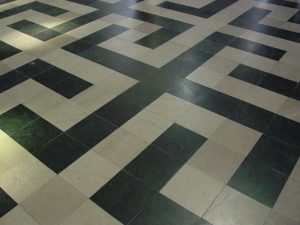
The swastika is common as a design motif in current Hindu architecture and Indian artwork as well as in ancient Western architecture, frequently appearing in mosaics, friezes, and other works across the ancient world. Ancient Greek architectural designs are replete with interlinking swastika motifs. Related symbols in classical Western architecture include the cross, the three-legged triskele or triskelion and the rounded lauburu. The swastika symbol is also known in these contexts by a number of names, especially gammadion. Pictish rock carvings, adorning ancient Greek pottery, and on Norse weapons and implements. It was scratched on cave walls in France seven thousand years ago.
In Chinese, Korean, and Japanese art, the swastika is often found as part of a repeating pattern. One common pattern, called sayagata in Japanese, comprises left and right facing swastikas joined by lines. As the negative space between the lines has a distinctive shape, the sayagata pattern is sometimes called the "key fret" motif in English.
The swastika symbol was found extensively in the ruins of the ancient city of Troy.
In Greco-Roman art and architecture, and in Romanesque and Gothic art in the West, isolated swastikas are relatively rare, and the swastika is more commonly found as a repeated element in a border or tesselation. A design of interlocking swastikas is one of several tesselations on the floor of the cathedral of Amiens, France. A border of linked swastikas was a common Roman architectural motif, and can be seen in more recent buildings as a neoclassical element. A swastika border is one form of meander, and the individual swastikas in such border are sometimes called 'Greek Keys'.
The Laguna Bridge in Yuma, Arizona was built in 1905 by the U.S. Reclamation Department and is decorated with a row of swastikas.
The Canadian artist ManWoman has attempted to rehabilitate the "gentle swastika.
The swastika is found all over Hindu temples, signs, altars, pictures and iconography in India and Nepal, where it remains very popular.
It is considered to be the second most sacred symbol in Hinduism, behind the Om symbol.In Hinduism, the two symbols represent the two forms of the creator god Brahma: clockwise it represents the evolution of the universe (Pravritti), anti-clockwise it represents the involution of the universe (Nivritti).
It is also seen as pointing in all four directions (North, East, South and West) and thus signifies stability and groundedness. Its use as a sun symbol can first be seen in its representation of Surya, the Hindu lord of the Sun.
The swastika is considered extremely holy and auspicious by all Hindus, and is regularly used to decorate all sorts of items to do with Hindu culture.
It is used in all Hindu yantras and religious designs. Throughout the subcontinent of India it can be seen on the sides of temples, written on religious scriptures, on gift items, and on letterhead.
The Hindu God Ganesh is closely associated with the symbol of the swastika.
Amongst the Hindus of Bengal, it is common to see the name "swastika" applied to a slightly different symbol, which has the same significance as the common swastika, and both symbols are used as auspicious signs. This symbol looks something like a stick figure of a human being.
"Swastika" is a common given name amongst Bengalis and a prominent literary magazine in Calcutta is called the Swastika.
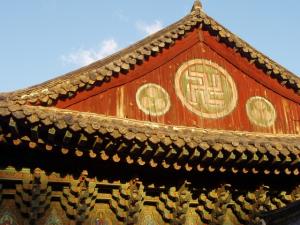
In Buddhism, the swastika is oriented horizontally.
These two symbols are included, at least since the Liao dynasty, as part of the Chinese language, the symbolic sign for the character meaning "all", and "eternality" (lit. myriad) and as SP which is seldom used.
A swastika marks the beginning of many Buddhist scriptures.
The swastikas (in either orientation) appear on the chest of some statues of Gautama Buddha and is often incised on the soles of the feet of the Buddha in statuary.
Because of the association with the right facing swastika with Nazism, Buddhist swastikas after the mid 20th century are almost universally left-facing.
This form of the swastika is often found on Chinese food packaging to signify that the product is vegetarian and can be consumed by strict Buddhists. It is often sewn into the collars of Chinese children's clothing to protect them from evil spirits.
Additionally, the left-facing swastika is found on Japanese maps to indicate a temple.
The swastika used in Buddhist art and scripture is known in Japanese as a manji, and represents Dharma, universal harmony, and the balance of opposites. When facing left, it is the omote (front) manji, representing love and mercy.
Facing right, it represents strength and intelligence, and is called the ura (rear) manji. Balanced manji are often found at the beginning and end of Buddhist scriptures.
Jainism
In Jainism, the swastika symbol is the only holy symbol. Jainism does not use the Hindu om symbol at all and thus gives even more prominence to the swastika than Hinduism. It is a symbol of the seventh Jina (Saint), the Tirthankara Suparsva. It is considered to be one of the 24 auspicious marks and the emblem of the seventh arhat of the present age. All Jain temples and holy books must contain the swastika and ceromonies typically begin and end with creating a swastika mark several times with rice around the altar.
The swastika was not widely utilized by followers of the Abrahamic religions. Where it does exist, it is not portrayed as an explicitly religious symbol and is often purely decorative or, at most, a symbol of good luck. The floor of the synagogue at Ein Gedi, built during the Roman occupation of Judea, was decorated with a swastika. Some Christian churches built in the Romanesque and Gothic eras are decorated with swastikas, carrying over earlier Roman designs. Swastikas are prominently displayed in a mosaic in the St. Sophia church of Kiev, Ukraine dating to the 12th century. They also appear as a repeating ornamental motif on a tomb in the Basilica of St. Ambrose in Milan. The Muslim "Friday" mosque of Isfahan, Iran and the Taynal Mosque in Tripoli, Lebanon both have swastika motifs.

Falun Gong Emblem
Some sources indicate that the Chinese Empress Wu (684-704) of the Tang Dynasty decreed that the swastika would be used as an alternative symbol of the sun.
The left-facing Buddhist swastika also appears on the emblem of Falun Gong. This has generated considerable controversy, particularly in Germany, where the police have reportedly confiscated several banners featuring the emblem. A court ruling subsequently allowed Falun Gong followers in Germany to continue the use of the emblem.
In Japan, the swastika is called manji (SM). On Japanese town plans, a swastika (left-facing and horizontal) is commonly used to mark the location of a Buddhist temple. The right-facing manji is often referred as the gyaku manji ("reverse manji"), and can also be called kagi jokji, literally "hook cross." A PokEmon playing card sold in Japan had a manji graphic. Because of its resemblance to the Nazi swastika (see below), the card was altered for Western translations, and eventually withdrawn in Japan following Western complaints. Similarly, a manji symbol was incorporated as a level design in both the Japanese and U.S. versions of the 1986 The Legend of Zelda video game.
The swastika was a widely used Native American symbol. It has been found in excavations of Mississippian-era sites in the Ohio valley. It was widely used by many southwestern tribes, most notably the Navajo. Among different tribes the swastika carried various meanings. To the Hopi it represented the wandering Hopi clans; to the Navajo it was one symbol for a whirling log (tsil no'oli'), a sacred image representing a legend that was used in healing rituals.
The center of the cross represents Tuwanasavi or the Center of the Universe which lay in what is now the Hopi country in the southwestern part of the US. Tuwanasavi was not the geographic center of North America, but the magnetic or spiritual center formed by the junction of the North-South and the East-West axws along which the Twins sent their vibratory messages and controlled the rotation of the planet.
Three directions (pasos) for most of the clans were the same: the ice locked back door to the north, the Pacific Ocean to the west and the Atlantic Ocean to the east.
Only 7 clans-the Bear, Eagle, Sun, Kachina, Parrot, Flute and Coyote clans-migrated to South America to the southern paso at it's tip. The rest of some 40 clans, having started from somewhere in southern Mexico or Central America, regarded this as their southern paso, their migration thus forming a balanced symbol.
Upon arriving at each paso all the leading clans turned right before retracing their routes.
The swastika, also known as the fylfot in northwestern Europe, appears on many pre-Christian artefacts, drawn both clockwise and counterclockwise, within a circle or in a swirling form. The Greek goddess Athena was sometimes portrayed as wearing robes covered with swastikas. The "Ogham stone" found in County Kerry, Ireland is inscribed with several swastikas dating to the fifth century AD, and is believed to have been an altar stone of the Druids. The pre-Christian Anglo-Saxon ship burial at Sutton Hoo, England, contains gold cups and shields bearing swastikas. Today it is used as a symbol for Asatru, the reconstructed religion of Northern Europe.
The British author Rudyard Kipling, who was strongly influenced by Indian culture, had a swastika on the dust jackets of all his books until the rise of Nazism made this inappropriate. One of Kipling's Just So Stories, "The Crab That Played With The Sea", had an elaborate full-page illustration by Kipling including a stone bearing what was called "a magic mark" (a swastika); some later editions of the stories blotted out the mark, but not its captioned reference, making the readers wonder what the "mark" was.
The Russian Provisional Government of 1917 printed a number of new bank notes with right-facing diagonally-rotated swastikars in their centres. Some have suggested that this may have been the inspiration behind the Nazis adoption of this symbol as Alfred Rosenberg was in Russia at this time.
It was also used as a symbol by the Boy Scouts in Britain, and worldwide. According to "Johnny" Walker, the earliest Scouting use was on the first Thanks Badge introduced in 1911.
Robert Baden-Powell's 1922 Medal of Merit design adds a swastika to the Scout fleur-de-lis as good luck to the person receiving the medal. Like Kipling, he would have come across this symbol in India.
During 1934 many Scouters requested a change of design because of the use of the swastika by the Nazis. A new British Medal of Merit was issued in 1935.
The Lotta Svard emblem was designed by Eric Wasstrom in 1921. It includes the swastika and heraldic roses.
During World War I, the swastika was used as the emblem of the British National War Savings Committee.
In Finland the swastika was used as the official national marking of the Finnish Air Force and Army between 1918 and 1944. The swastika was also used by the Lotta Svard organisation.
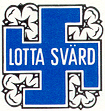
The blue swastika was the good luck symbol used by the Swedish Count Erich von Rosen, who donated the first plane to the Finnish White Army during the Civil War in Finland. It has no connection to the Nazi use of the swastika. It also still appears in many Finnish medals and decorations. In the very respected wartime medals of honor it was a visible element, first drafted by Axel Gallen-Kallela 1918-1919. Mannerheim cross with a swastika is the Finnish equivalent of Victoria Cross, Croix de Guerre and Congressional Medal of Honor. Due to Finland's alliance with Nazi Germany in World War II, the symbol was abandoned as a national marking, to be replaced by a roundel.
The Swedish company ASEA, now a part of Asea Brown Boveri, used the swastika in its logo from the 1800s to 1933, when it was removed from the logo.
In Latvia too, the swastika (known as Thunder Cross and Fire Cross) was used as the marking of the Latvian Air Force between 1918 and 1934, as well as in insignias of some military units. It was also used by the Latvian fascist movement Perkonkrusts (Thunder Cross in Latvian), as well as by other non-political organizations.
The Icelandic Steamship Company, Eimskip (founded in 1914) used a swastika in its logo until recently.
In
Dublin, Ireland, a laundry company known as the Swastika Laundry was in existence on the south side of the city. Featuring a black swastika on a white background, the business started up in the early 20th century and continued up until recent times.
The Theosophical Society, founded in New York in 1875, incorporated the Swastika into its seal because of the Buddhist associations of the symbol.
The swastika's use by the Navajo and other tribes made it a popular symbol for the American Southwest. Until the 1930s blankets, metalwork, and other Southwestern souvenirs were often made with swastikas.
One year in the first part of the 20th century, the Corn Palace in Mitchell, South Dakota featured a design that had a swastika on one of the towers.
Swastika is the name of a small community in northern Ontario, Canada, approximately 580 kilometres north of Toronto, and 5 kilometres west of Kirkland Lake, the town of which it is now part. The town of Swastika was founded in 1906. Gold was discovered nearby and the Swastika Mining Company was formed in 1908. The government of Ontario attempted to change the town's name during World War II, but the town resisted.
In Windsor, Nova Scotia, there was an ice hockey team from 1905-1916 named the Swastikas, and their uniforms featured swastika symbols. There were also hockey teams named the Swastikas in Edmonton, Alberta (circa 1916), and Fernie, British Columbia (circa 1922).
The 45th Infantry Division of the United States Army used a yellow swastika on a red background as a unit symbol until the 1930s, when it was switched to a thunderbird.
In 1925, Coca Cola made a lucky watch fob in the shape of a swastika with the slogan, "Drink Coca Cola five cents in bottles".
The Health, Physical Education and Recreation Building (HPER) at Indiana University contains decorative Native American-inspired reverse swastika tile work on the walls of the foyer and stairwells on the southeast side of the building. HPER was built as the university field house in the 1920's, before the Nazi party came to power in Germany. In recent years, the HPER swastika motif, along with the Thomas Hart Benton murals in nearby Woodburn Hall have been the cause of much controversy on campus.
The National Socialist German Workers Party (Nationalsozialistische Deutsche Arbeiterpartei or NSDAP) formally adopted the swastika or Hakenkreuz (hooked cross) in 1920. This was used on the party's flag (right), badge, and armband. (It had been used unofficially by the NSDAP and its predecessor, the German Workers Party, Deutsche Arbeiterpartei (DAP), however.)
In Mein Kampf, Adolf Hitler wrote:
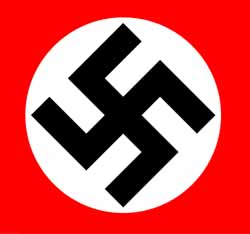
Red, white, and black were the colors of
the flag of the old German Empire.
The use of the swastika was associated by Nazi theorists with their conjecture of Aryan cultural descent of the German people. Following the Nordicist version of the Aryan invasion theory, the Nazis claimed that the early Aryans of India, from whose Vedic tradition the swastika sprang, were the prototypical white invaders. Thus, they saw fit to co-opt the sign as a symbol of the Aryan master race. The use of swastika as a symbol of the Aryan race dates back to writings of Emile Burnouf. Following many other writers, the German nationalist poet Guido von List believed it to be a uniquely Aryan symbol. Hitler referred to the swastika as the symbol of "the fight for the victory of Aryan man" - Mein Kampf.
The swastika was already in use as a symbol of German volkisch nationalist movements. In Deutschland Erwache - Ulric of England writes:
Jose Manuel Erbez wrote:
However, Liebenfels was drawing on an already-established use of the symbol.
NSDAP flags at the 1936 Nazi Party rally in NurembergOn 14 March 1933, shortly after Hitler's appointment as Chancellor of Germany, the NSDAP flag was hoisted alongside Germany's national colors. It was adopted as the sole national flag on 15 September 1935.
The swastika was used for badges and flags throughout Nazi Germany, particularly for government and military organizations, but also for "popular" organizations such as the Reichsbund Deutsche Jagerschaft.
Nazi Party rally in NurembergOn 14 March 1933, shortly after Hitler's appointment as Chancellor of Germany, the NSDAP flag was hoisted alongside Germany's national colors. It was adopted as the sole national flag on 15 September 1935.The swastika was used for badges and flags throughout Nazi Germany, particularly for government and military organizations, but also for "popular" organizations such as the Reichsbund Deutsche JŠgerschaft.
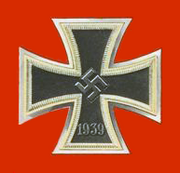
The Iron Cross featured a swastika during the Nazi period - while the DAP and the NSDAP had used both right-facing and left-facing swastikas, the right-facing swastika is used consistently from 1920 onwards. However, Ralf Stelter notes that the swastika flag used on land had a right-facing swastika on both sides, while the ensign (naval flag) had it printed through so that you would see a left-facing swastika when looking at the ensign with the flagpole to the right.
There were attempts to amalgamate Nazi and Hindu use of the swastika. Notably by Savitri Devi Mukherji who declared Hitler an avatar of Vishnu.
Because of its use by Hitler and the Nazis and, in modern times, by neo-Nazis and other hate groups, for many people in the West, the swastika is associated primarily with Nazism, fascism, and white supremacy in general. Hence, outside historical contexts, it has become taboo in Western countries. For example, the German postwar criminal code makes the public showing of the Hakenkreuz (the swastika) and other Nazi symbols illegal and punishable, except for scholarly reasons.
The powerful symbolism acquired by the swastika has often been used in graphic design and propaganda as a means of drawing Nazi comparisons; examples include the cover of Stuart Eizenstat's 2003 book Imperfect Justice, publicity materials for Costa-Gavras's 2002 film Amen, and a billboard that was erected opposite the U.S. Interests Section in Havana, Cuba, in 2004, which juxtaposed images of the Abu Ghraib prisoner abuse pictures with a swastika.
Founded in the 1970s, the Raelian Movement, a religious sect believing in the possibility of immortality by scientific progress, used a symbol that was the source of considerable controversy: an interlaced Star of David and swastika. In 1991, the symbol was changed to remove the swastika and deflect public criticism. The Society for Creative Anachronism, which aims to study and recreate Medieval and Renaissance history, imposes restrictions on its members' use of the swastika on their arms, although some arms dating to the early days of the group have the symbol.

The Ra‘lian symbol, before 1991 and afterIn recent years, controversy has erupted when consumer goods bearing the symbol have been exported (often unintentionally) to North America. In 2002, Christmas crackers containing plastic toy pandas sporting swastikas were pulled from shelves after complaints from consumers in Canada, although the China-based manufacturer claimed the symbol was presented in a traditional sense and not as a reference to the Nazis.
In 1995, the City of Glendale, California scrambled to cover up over 900 cast iron lampposts decorated with swastikas throughout the downtown portion of the city; the lampposts had been manufactured by an American company in the early 1920s, and had nothing to do with Nazism.
In 2004, Microsoft released a "critical update" to remove two swastikas and a Star of David from the font Bookshelf Symbol 7. The font had been bundled with Microsoft Office 2003.
Punk rockers like Siouxsie Sioux, Sid Vicious and John Lydon used, and were photographed using, the Nazi version of the swastika for its shock value, notwithstanding that Malcolm McLaren, the Sex Pistols' manager, was half-Jewish.
The previously successful career of the British band Kula Shaker virtually collapsed in the 1990s after the band's frontman, Crispian Mills, son of actress Hayley Mills, expressed his desire to use Swastikas as part of the imagery of their live show; because of this, and additional remarks he made, he was widely accused of holding Nazi sympathies.
However, the band was musically influenced by Indian styles, and Mills asserted that his attraction to the swastika was part of an attempt to reclaim the Indian usage of the symbol in the West.
In January 2005 there was much criticism when Prince Harry of Wales, third in line of succession to the British throne, was photographed wearing what appeared to be intended as an Afrika Korps uniform, plus a Nazi swastika armband, to a fancy dress party.
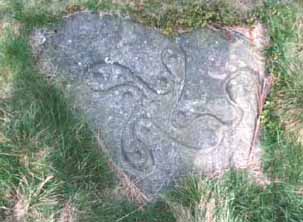
Iron Age Rock Carving
The stone is found in the moors near West Yorkshire.
The stone overlooks the valley of the River Wharfe, and is identical to some of the 'Camunnian Rose' designs in Val Camonica, Italy - nine cup-marks in a cross shape, surrounded by a curved swastika-shaped groove. The Ilkley carving also has an 'appendage' off the east arm - a cup surrounded by a curved hook-shaped groove. It is unique on the moor (which is covered in hundreds of cup-and-ring type carvings) although there is an unfinished swastika design (more angular, without cups) on the nearby Badger Stone.
One of the lines of cups on the Swastika Stone is less than a degree off magnetic north-south. One naturally looks north from the stone, as it is on a rocky outcrop on the north side of the moor. Was it associated with the Pole Star with which its cups align? Why then does its shape describe a clockwise motion, whereas the stars turn anti-clockwise around the pole?
Perhaps the design relates to the shamanic practice of ascent up the 'Pillar of the World' (to use the Lapp term). Numerous Siberian and northern European peoples documented by Mircea Eliade see the Pole Star as the summit of a pole holding up the sky (seen as a tent). Eliade notes similar beliefs about the Pole Star in Ancient Saxon, Scandinavian and Romanian myths. If, then, one imagines the Swastika design to be the base of a Pillar of the World, the implicit motion of the design makes sense. Something that appears to turn anti-clockwise when looking up from the bottom of a pole will, if it slides down the pole and is viewed from above, appear to turn clockwise.
The Swastika Stone may map the turning sky down onto the ground, forming the bond between 'levels' that is so central to shamanic cosmology.
Also, the 'appendage' cup, in relation to the central cup, would have only been a couple of degrees off the summer solstice sunrise during the period 2000BCE - 100CE (covering most of the likely times at which the glyph was carved. The 'hook' groove, if imagined to turn with the swastika, would 'haul' the cup-sun across the sky. This seems to strengthen the swastika-sky connection.
(I should note that I do not support the idea that cup-and-ring patterns are maps of stellar constellations. Perhaps some involved rudimentary attempts at this, but no one has found accurate correspondences in any existing patterns. They seem to me to be more generally concerned with access points to alternate realities).
With the Pole Star/Pillar of the World ideas in mind, one could see some cup-and-ring markings as being related. The 'tail' grooves could be the Pillar reaching up to the cup-pole, surrounded by rings of revolving stars. Some local cup-and-ring markings, like those on the Panorama Stone, have 'ladders' instead of 'tail' grooves. This image further supports the shamanic interpretation of the petroglyphs, as ladders are among the most frequently occurring representations of shamanic ascent to other worlds. Human figures atop ladders appear in !Kung San rock art related to trance-state ascension.
Cup-and-ring style petroglyphs in the British Isles are usually dated to the Bronze Age (because some are included in, or in the proximity of, Bronze Age burials) or the Neolithic (because of comparable carvings on Irish passage graves from that period - see also Richard Bradley's recent work 'Signing the Land' for arguments dating this style of prehistoric art to the Neolithic).
The Swastika Stone is arguably associated with this style of rock art, due to its use of cup-marks, but I have recently come to see it as most likely originating in the Iron Age, or even during Roman occupation. This is because of Verbeia, a Romano-Celtic goddess revered by the Roman troops stationed in Ilkley (then Olicana). Verbeia is often accepted as being a version of the Celtic spring/fire goddess Brigid, who is still associated with swastika-like symbols in Ireland. Also, the Roman cohort which set up her altar were recruited from the Lingones, a Gaulish Celtic tribe.
Apparently Romano-Celtic coins have been found in Gaul bearing swastika-like designs. It seems tempting to think that the Lingones cohort carved the Swastika Stone when they were here, but this would surely be unusual. Or perhaps the recruited Celtic/Roman troops were influenced in their choice of 'genuis loci', Verbeia, by the native Celts of West Yorkshire, the Brigantes (whose name derives from the goddess Brigantia, related to Brigid), who may have already carved the stone.
The Swastika may map the turning sky down onto the ground, forming the bond between 'levels' that is so central to shamanic cosmology.
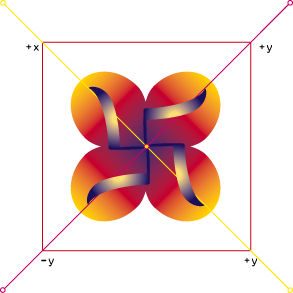
Legend has it that the Vedic civilization was highly advanced. The sages that oversaw its development, through their mystic insight and deep meditation, discovered the ancient symbols of spirituality - Aumkara and Swastika. They also discovered many scientific principles that they applied to develop a highly advanced technology. They gave the atom its sanskrit name "Anu".
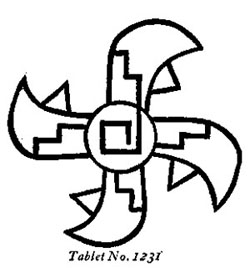
James Churchwood's Symbol of Lemuria

Ouroboros