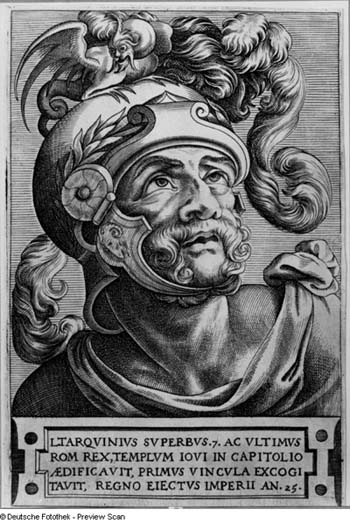
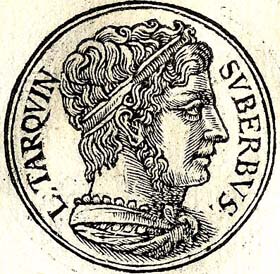
Lucius Tarquinius Superbus (535 - 496 BC) was the legendary seventh and final King of Rome, reigning from 535 BC until the popular uprising in 509 BC that led to the establishment of the Roman Republic. He is commonly known as Tarquin the Proud, from his cognomen Superbus, a Latin word meaning "proud, arrogant, lofty." The Tarquins were of Etruscan origin. According to Roman tradition, Tarquinius Superbus gained the kingship by ordering the assassination of his much-admired predecessor, Servius Tullius.
Tarquin's father, Lucius Tarquinius Priscus, was the fifth King of Rome, reigning 616-579 BC. His grandfather was said to be Demaratus the Corinthian, an immigrant from the Greek city of Corinth. Priscus himself originated in the Etruscan city of Tarquinia. Disgruntled with his opportunities there, Priscus migrated to Rome with his wife Tanaquil, at her suggestion. On their arrival, Tanaquil interpreted an omen as predicting Priscus' future as King of Rome. Superbus was not the immediate successor of his father Priscus, since Servius Tullius took the throne on Priscus' death.
Ancient accounts of the Regal period mingle history and legend. The reign of Tarquin is typically described as a tyranny that justified the abolition of the monarchy. His kingship ended in 509 BC, after his son Sextus Tarquinius raped Lucretia, a married noblewoman known as an exemplar of virtue. This outrage inspired an uprising led by the aristocrat Lucius Junius Brutus, which resulted in the expulsion of Tarquin and his family from Rome.
Tarquin's parents were the fifth king of Rome, Lucius Tarquinius Priscus, and his wife Tanaquil. Both Tarquin and his brother Aruns married daughters of Servius Tullius, the sixth king; both daughters were named Tullia, by Roman custom. Tarquin's mother, Queen Tanaquil, had aided in the selection of Servius Tullius as heir to the Roman throne when Lucius Tarquinius Priscus was assassinated by the sons of the previous king, Ancus Marcius, in 579 BC. Tarquin also had a sister, Tarquinia, the mother of Lucius Junius Brutus.
According to Livy, the younger of the two daughters of Servius Tullius was of fiercer temperament than her sister, yet she originally married Aruns, who had a milder disposition than his elder brother. The younger Tullia came to despise Aruns and developed a plot with Tarquin. Together, they arranged the murder of their respective siblings, in quick succession, and were thereafter married to each other. Tarquin had three sons: Titus, Aruns, and Sextus.
Tullia continued to encourage Tarquin to increase his own position. In time, she convinced him to attempt to usurp the throne. Tarquin began to solicit the support of the patrician senators, especially those families who had been given senatorial rank by his father. He bestowed presents upon them, and to them he criticized the king Servius Tullius.
In time, Tarquin felt ready to seize the throne. He went to the Senate-house with a group of armed men, sat himself on the throne, and summoned the senators to attend upon King Tarquin. He then spoke to the senators, criticising Servius: for being a slave born of a slave; for failing to be elected by the Senate and the people during an interregnum, as had been the tradition for the election of kings of Rome; for being gifted the throne by a woman; for favouring the lower classes of Rome over the wealthy and for taking the land of the upper classes for distribution to the poor; and for instituting the census so that the wealth of the upper classes might be exposed in order to excite popular envy.
Immediately afterward, Servius Tullius was murdered in the streets of Rome by a group of men sent by Tarquin, possibly on the advice of Tullia. Tullia then drove in her chariot to the senate house, where she hailed her husband as king. He ordered her to return home, away from the tumult. She drove along the Cyprian street, where the king had been murdered, and turned towards the Orbian Hill, in the direction of the Esquiline Hill. There she encountered her father's body and, on a street later to become known as wicked street because of her actions, she drove her chariot over her father's body. Livy also says that she took a part of her father's body, and his blood, and returned with it to her own and her husband's household gods, and that by the end of her journey she was, herself, covered in the blood.
Tarquin commenced his reign by refusing burial to his predecessor Servius, thereby earning for himself the name "Superbus" ('proud'), and then putting to death a number of the leading senators, whom he suspected of remaining loyal to Servius. By not replacing the slain senators, and not consulting the Senate on all matters of government, he diminished both the size and also the authority of the Senate. In another break with tradition, he also judged capital criminal cases without the advice of counsellors, thereby creating fear amongst those who might think to oppose him.
Early in his reign Tarquin called a meeting of the Latin leaders to discuss the bonds between Rome and the Latin towns. The meeting was held at a grove sacred to the goddess Ferentina. At the meeting Turnus inveighed against the arrogance of Tarquinius, and warned his countrymen against putting trust in him. Tarquinius then secretly bribed Turnus' servant to store a large number of swords in Turnus' lodging.
Tarquin called together the Latin leaders, and accused Turnus of plotting a coup. The Latin leaders accompanied Tarquin to Turnus' lodging and, the swords then being discovered, Turnus' guilt was then speedily inferred, and he was condemned and was thrown into a pool of water in the grove, and a wooden frame ("cratis") placed over his head, into which stones were thrown, thereby drowning him.
The meeting of the Latin chiefs then continued, and Tarquin persuaded them to renew their treaty with Rome and become her allies rather than her enemies, and it was agreed that the troops of the Latins would attend at the grove on an appointed day to form a united military force with the troops of Rome. This was done, and Tarquin formed combined units of Roman and Latin troops.
Tarquin next began a war against the Volsci. He took the wealthy town of Suessa Pometia, with the spoils of which he commenced the erection of the Temple of Jupiter Optimus Maximus which his father had vowed. He also celebrated a triumph for his victory. He was next engaged in a war with Gabii, one of the Latin cities, which had rejected the Latin treaty with Rome.
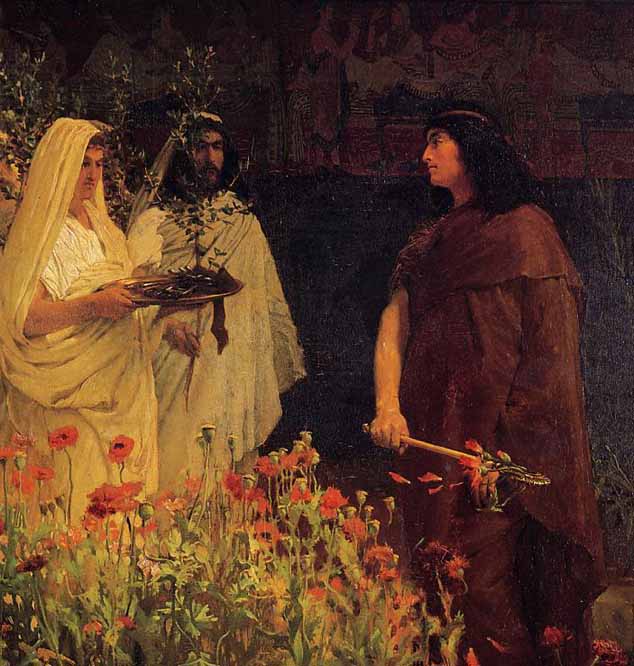
Unable to take the city by force of arms, Tarquin had recourse to a clever stratagem. His son, Sextus, pretending to be ill-treated by his father, and covered with the bloody marks of stripes, fled to Gabii. The infatuated inhabitants entrusted him with the command of their troops, and when he had obtained the unlimited confidence of the citizens, he sent a messenger to his father to inquire how he should deliver the city into his hands.
The king, who was walking in his garden when the messenger arrived, made no reply, but kept striking off the heads of the tallest poppies with his stick. Sextus took the hint. He put to death or banished, on false charges, all the leading men of the place, and then had no difficulty in compelling it to submit to his father.
Tarquin married his daughter to Octavius Mamilius, one of the leading men of Tusculum, and argued by some to be the most eminent of the Latin chiefs. This alliance secured Tarquin powerful assistance in the field.
Tarquin also agreed a peace with the Aequi, and renewed the treaty of peace between Rome and the Etruscans. According to the Fasti Triumphales, Tarquin also won a victory over the Sabines.
Tarquin completed the Temple of Jupiter Optimus Maximus on the Capitoline Hill which had been vowed and possibly begun by his father. This involved the leveling of the top of the Tarpeian Rock that overlooked the Forum and the removal of a number of its ancient Sabine shrines. He also ordered underground works carried out on the cloaca maxima, and the erection of benches at the circus maximus.
He established Roman colonies at the towns of Signia and Circeii.
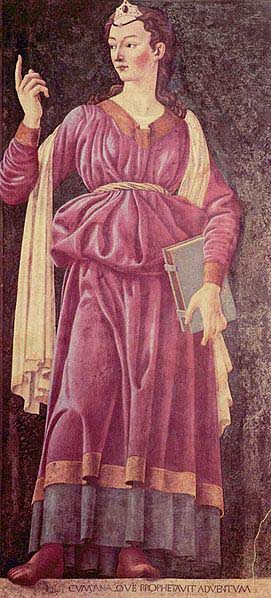
According to one story, when Tarquin was approached by the Cumaean Sibyl, she offered him nine books of prophecy at an exorbitant price.
The Cumaean Sibyl is one of the four sibyls painted by Raphael at Santa Maria della Pace (see gallery below.) She was also painted by Andrea del Castagno (Uffizi Gallery, illustration right), and in the Sistine Ceiling of Michelangelo her powerful presence overshadows every other sibyl, even her younger and more beautiful sisters, such as the Delphic Sibyl.
There are various names for the Cumaean Sibyl besides the "Herophile" of Pausanias and Lactantius[1] or the Aeneid's "Deiphobe, daughter of Glaucus": "Amaltheia", "Demophile" or "Taraxandra" are all offered in various references.
The story of the acquisition of the Sibylline Books by Lucius Tarquinius Superbus, the semi-legendary last king of the Roman Kingdom, or Tarquinius Priscus, is one of the famous mythic elements of Roman history.[2]
Centuries ago, concurrent with the 50th Olympiad not long before the expulsion of Rome's kings, an old woman "who was not a native of the country" (Dionysius) arrived incognita in Rome. She offered nine books of prophecies to King Tarquin; and as the king declined to purchase them, owing to the exorbitant price she demanded, she burned three and offered the remaining six to Tarquin at the same stiff price, which he again refused, whereupon she burned three more and repeated her offer. Tarquin then relented and purchased the last three at the full original price, whereupon she "disappeared from among men" (Dionysius).
The books were thereafter kept in the Temple of Jupiter on the Capitoline Hill, Rome, to be consulted only in emergencies. The temple burned down in the 80s BC, and the books with it, necessitating a re-collection of Sibylline prophecies from all parts of the empire (Tacitus 6.12). These were carefully sorted and those determined to be legitimate were saved in the rebuilt temple. The Emperor Augustus had them moved to the Temple of Apollo on the Palatine Hill, where they remained for most of the remaining Imperial Period.
The Books were burned in AD 405 by the General Flavius Stilicho, who was a Christian and regarded the books as Pagan and therefore evil. At the time of the Visigothic invasion five years later in AD 410, certain Pagan apologists bemoaned the loss of the books, claiming that the invasion of the city was evidence of the wrath of the Pagan gods over the destruction of the books.
The Cumaean Sibyl is featured in the works of, among others, Virgil (The Eclogues, The Aeneid), Ovid (Metamorphoses) and Petronius (The Satyricon).
Tarquin refused abruptly, and the Sibyl proceeded to burn three of the nine. She then offered him the remaining books, but at the same price. Tarquin hesitated, but refused again. The Sibyl then burned three more books and again offered Tarquin the three remaining Sibylline Books at the original price. At last Tarquin accepted. As the Sibylline Books were housed in the fortress temple of Jupiter, their legend has been associated with him.
Tarquinius next went to war with the Rutuli. According to Livy, the Rutuli were, at that time, a very wealthy nation and Tarquinius was keen to obtain the booty which would come with victory over the Rutuli in order, in part, to assuage the anger of his subjects. Tarquin unsuccessfully sought to take the Rutulian capital Ardea by storm, and subsequently began an extensive siege of the city.
Meanwhile, the king's son, Sextus Tarquinius snuck away from the camp to Collatia, and raped Lucretia, a beautiful noblewoman, who consequently committed suicide. Lucretia's kinsman Lucius Junius Brutus (himself a member of the Tarquin dynasty) and Lucretia's widowed husband, Lucius Tarquinius Collatinus (grand-nephew of Tarquinus Priscus and thus also a member of the dynasty) led the revolt, along with Publius Valerius Poplicola, and Lucretia's aging father, Spurius Lucretius Tricipitinus. That uprising resulted in the exile or Regifugium, after a reign of twenty-five years, of Tarquin and his family, and the establishment of the Roman Republic, with Brutus and Collatinus as the first consuls.
It is unclear what was the outcome of the siege of Ardea, or indeed the war against the Rutuli. Tarquin and his two eldest sons Titus and Aruns went into exile in Caere.
After his exile, Tarquin made a number of attempts to regain the throne. At first he sent ambassadors to the Senate to request the return of his family's personal effects which had been seized in the coup. In secret, while the Senate debated his request, the ambassadors met with and subverted a number of the leading men of Rome to the royal cause, in the Tarquinian conspiracy. The conspirators included two of Brutus' brothers-in-law, and his two sons Titus and Tiberius. The conspiracy was discovered, and the conspirators executed.
Although the Senate had initially agreed to Tarquin's request for a return of his family's effects, the decision was reconsidered and revoked after the discovery of the conspiracy, and the royal property was given over to be plundered by the Roman populace.
Tarquin next attempted to regain Rome by force of arms. He first gained the support of the cities of Veii and Tarquinii, recalling to the former their regular losses of war and land to the Roman state, and to the latter his family ties. The armies of the two cities were led by Tarquin against Rome in the Battle of Silva Arsia. The king commanded the Etruscan infantry. Although the result initially appeared uncertain, the Romans were victorious. Both Brutus (the consul) and Aruns (the king's son) were killed in battle.
Tarquin's final attempt relied on military support from Lars Porsenna, king of Clusium. The war led to the siege of Rome, and finally a peace treaty. However, Tarquin failed to achieve his aim of regaining the throne. Tarquinius and his family left Clusium, and instead sought refuge in Tusculum with his son-in-law Octavius Mamilius.
Tarquin died in exile at Cumae, Campania in 496 BC
According to Livy, Tarquin cut off the heads of the tallest poppies in his garden as an allegory to instruct his son Sextus to pacify a recently-conquered enemy city by executing its leading citizens. This is the one of many stories which leads to the modern expression of "Tall Poppy Syndrome" to describe the phenomenon of tearing down individuals who rise too far above the majority. A quotation concerning Tarquin and the poppy allegory appears in Kierkegaard's Fear and Trembling.
Patrick Henry refers to Tarquin in his famous speech ending, "Tarquin and Caesar each had his Brutus, Charles the First his Cromwell and George the Third ... may profit by their example." To yells of "treason", Henry added, "If this be treason then make the most of it!"
In George Lucas' Star Wars universe, the name and character of Grand Moff Tarkin, who controlled the first Death Star and arrogantly believed that it could not be destroyed, is thought to be based on his Etruscan namesake.
ALPHABETICAL INDEX OF ALL FILES
