(1494-1566)
(1494-1566)
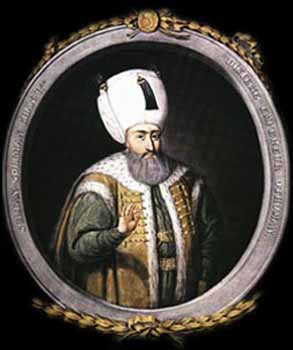
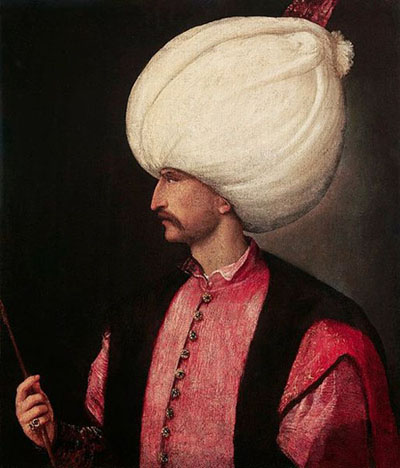
Suleiman ruled from 1520-1560. In his time was regarded as the most significant ruler in the world, by both Muslims and Europeans. His military empire expanded greatly both to the east and west, and he threatened to overrun the heart of Europe itself. In Constantinople, he embarked on vast cultural and architectural projects. Istanbul in the middle of the sixteenth century was architecturally the most energetic and innovative city in the world. While he was a brilliant military strategist and canny politician, he was also a cultivator of the arts. Suleiman's poetry is among the best poetry in Islam, and he sponsored an army of artists, religious thinkers, and philosophers that outshone the most educated courts of Europe.
Suleiman is remembered for his complete reconstruction of the Ottoman legal system. Suleiman became a prominent monarch of 16th century Europe, presiding over the apex of the Ottoman Empire's military, political and economic power. Suleiman personally led Ottoman armies to conquer the Christian strongholds of Belgrade, Rhodes, and most of Hungary before his conquests were checked at the Siege of Vienna in 1529. He annexed most of the Middle East in his conflict with the Safavids and large swathes of North Africa as far west as Algeria. Under his rule, the Ottoman fleet dominated the seas from the Mediterranean to the Red Sea and the Persian Gulf.
At the helm of an expanding empire, Suleiman personally instituted legislative changes relating to society, education, taxation, and criminal law. His canonical law (or the Kanuns) fixed the form of the empire for centuries after his death. Not only was Suleiman a distinguished poet and goldsmith in his own right; he also became a great patron of culture, overseeing the golden age of the Ottoman Empire's artistic, literary and architectural development. He spoke five languages: Ottoman Turkish, Arabic, Chagatai (a dialect of Turkic languages and related to Uyghur), Persian and Serbian.
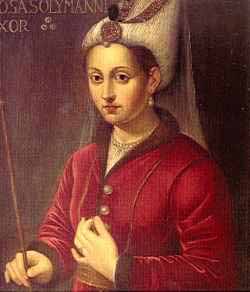
In a break with Ottoman tradition, Suleiman married a harem girl, Roxelana, who became Hurrem Sultan; her intrigues as queen in the court and power over the Sultan made her quite renowned. Their son, Selim II, succeeded Suleiman following his death in 1566 after 46 years of rule.
Suleiman allowed Hurrem Sultan to remain with him at court for the rest of her life, breaking another tradition - that when imperial heirs came of age, they would be sent along with the imperial concubine who bore them to govern remote provinces of the Empire, never to return unless their progeny succeeded to the throne.
In Islamic history, Suleiman is regarded as the perfect Islamic ruler in history. He is asserted as embodying all the necessary characteristics of an Islamic ruler, the most important of which is justice ('adale ).
The Qur'an itself points to King Solomon as embodying the perfect monarch because he so perfectly embodied 'adale ; Suleiman, named after Solomon, is regarded in Islamic history as the second Solomon. The reign of Suleiman in Ottoman and Islamic history is generally regarded as the period of greatest justice and harmony in any Islamic state.
The Europeans called him "The Magnificent," but the Ottomans called him Kanuni, or "The Lawgiver."
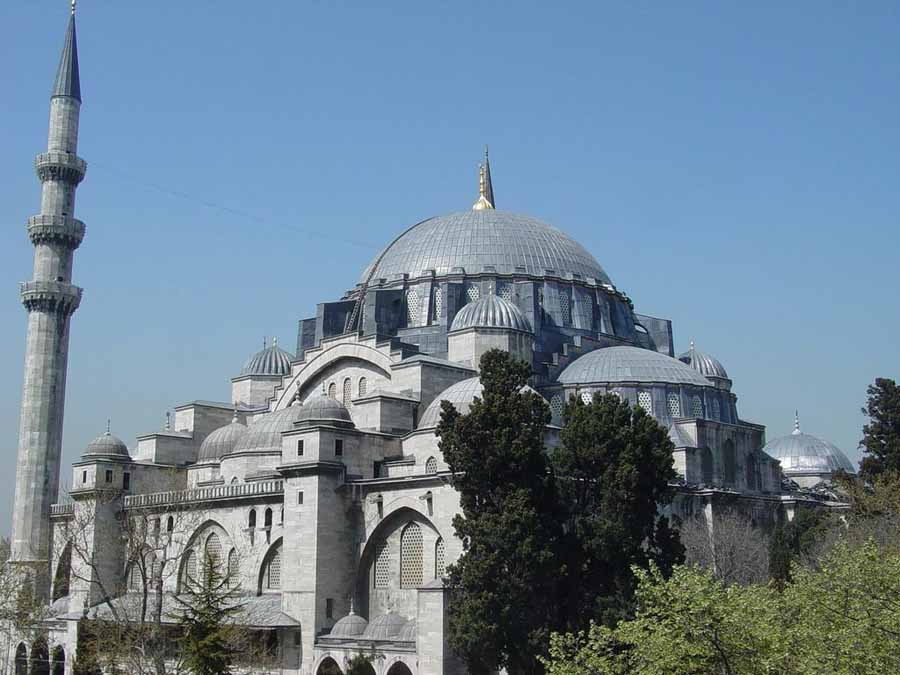
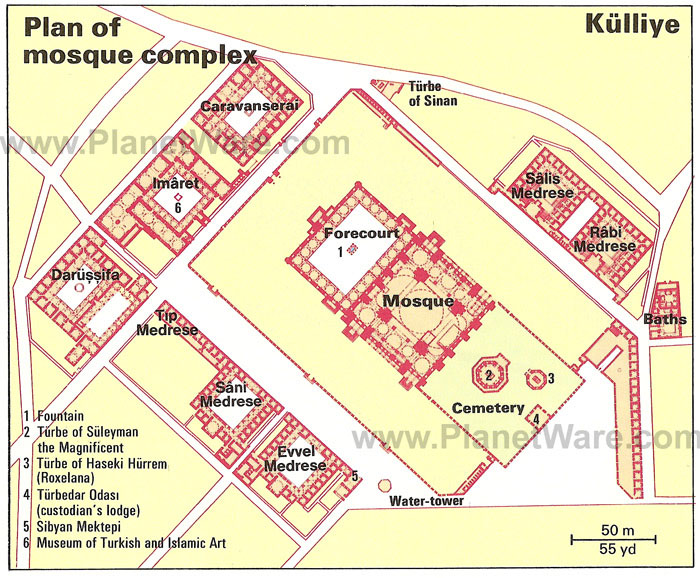
The Suleimanie Mosque, built for Suleiman, describes Suleiman in its inscription as Nashiru kawanin al-Sultaniyye , or "Propagator of the Sultanic Laws."
The primacy of Suleiman as a law-giver is at the foundation of his place in Islamic history and world view. It is perhaps important to step back a moment and closely examine this title to fully understand Suleiman's place in history.
The word used for law here, kanun, has a very specific reference. In Islamic tradition, the Shari'ah, or laws originally derived from the Qur'an , are meant to be universally applied across all Islamic states. No Islamic ruler has the power to overturn or replace these laws. So what laws was Suleiman "giving" to the Islamic world? What precisely does kanun refer to since it doesn't refer to the main body of Islamic law, the Shari'ah?
The kanun refer to situational decisions that are not covered by the Shari'ah . Even though the Shari'ah provides all necessary laws, it's recognized that some situations fall outside their parameters. In Islamic tradition, if a case fell outside the parameters of the Shari'ah , then a judgement or rule in the case could be arrived at through analogy with rules or cases that are covered by the Shari'ah . This method of juridical thinking was only accepted by the most liberal school of Shari'ah , Hanifism, so it is no surprise that Hanifism dominated Ottoman law.
The Ottomans, however, elevated kanun into an entire code of laws independent of the Shari'ah . The first two centuries of Ottoman rule, from 1350 to 1550, saw an explosion of kanun rulings and laws, so that by the beginning of the sixteenth century, the kanun were a complete and independent set of laws that by and large were more important than the Shari'ah . This unique situation was brought about in part because of the unique heritage of the Ottomans. In both Turkish and Mongol traditions, the imperial law, or law pronounced by the monarch, was considered sacred. They even had a special word for it: the Turks called it Ture and the Mongols called it Yasa . In the system of Ture and Yasa , imperial law was regarded as the essential and sacred foundation of the empire. When this tradition collided with the Islamic Shari'ah tradition, a compromised system combining both was formed.
The Sultanic laws were first collected together by Mehmed the Conqueror. Mehmed divided the kanun into two separate sets or laws. The first set dealt with the organization of government and the military, and the second set dealt with the taxation and treatment of the peasantry. The latter group was added to after the death of Mehmed and the Ottoman kanun pretty much crystallized into its final form in 1501. Suleiman, for his part, revised the law code, but on the whole the Suleiman code of laws is pretty identical to the 1501 system of laws. However, it was under Suleiman that the laws took their final form; no more revisions were made after his reign. From this point onwards, this code of laws was called, kanun-i 'Osmani , or the "Ottoman laws."
Western historians know Suleiman primarily as a conqueror, for he made Europe know fear like it had never known of any other Islamic state. Conquest, like every other aspect of the Ottoman state and culture, was a multicultural heritage, with origins as far back as Mesopotamia and Persia, and as far afield as the original Mongol and Turkish peoples in eastern and central Asia.
Suleiman had many titles; in inscriptions he calls himself:
Slave of God, powerful with the power of God, deputy of God on earth, obeying the commands of the Qur'an and enforcing them throughout the world, master of all lands, the shadow of God over all nations, Sultan of Sultans in all the lands of Persians and Arabs, the propagator of Sultanic laws (Nashiru kawanin al-Sultaniyye ), the tenth Sultan of the Ottoman Khans, Sultan, son of Sultan, Suleiman Khan.
Slave of God, master of the world, I am Suleiman and my name is read in all the prayers in all the cities of Islam. I am the Shah of Baghdad and Iraq, Caesar of all the lands of Rome, and the Sultan of Egypt. I seized the Hungarian crown and gave it to the least of my slaves.
He called himself the "Master of the Lands of Caesar and Alexander the Great," and later as simply, "Caesar." It's hard, of course, not to be slightly humbled by assertions of such greatness, and no ruler in the sixteenth century was more adept at diminishing the egos of all the other rulers surrounding him.
Suleiman believed, however, that the entire world was his possession as a gift of God. Even though he did not occupy Roman lands, he still claimed them as his own and almost launched an invasion of Rome (the city came within a few hairbreadths of Ottoman invasion in Suleiman's expedition against Corfu). In Europe, he conquered Rhodes, a large part of Greece, Hungary, and a major part of the Austrian Empire. His campaign against the Austrians took him right to the doorway of Vienna.
Besides invasions and campaigns, Suleiman was a major player in the politics of Europe. He pursued an aggressive policy of European destabilization; in particular, he wanted to destabilize both the Roman Catholic church and the Holy Roman Empire. When European Christianity split Europe into Catholic and Protestant states, Suleiman poured financial support into Protestant countries in order to guarantee that Europe remain religiously and politically destabilized and so ripe for an invasion. Several historians, in fact, have argued that Protestantism would never have succeeded except for the financial support of the Ottoman Empire.
Suleiman was responding to an aggressively expanding Europe. Like most other non-Europeans, Suleiman fully understood the consequences of European expansion and saw Europe as the principle threat to Islam. The Islamic world was beginning to shrink under this expansion. Portugal had invaded several Muslim cities in eastern Africa in order to dominate trade with India, and Russians, which the Ottomans regarded as European, were pushing central Asians south when the Russian expansion began in the sixteenth century. So in addition to invading and destabilizing Europe, Suleiman pursued a policy of helping any Muslim country threatened by European expansion. It was this role that gave Suleiman the right, in the eyes of the Ottomans, to declare himself as supreme Caliph of Islam. He was the only one successfully protecting Islam from the unbelievers and, as the protector of Islam, deserved to be the ruler of Islam.
While the expansion of European power helps explain Suleiman's conquest of European territories, it doesn't help us when it comes to the vast amount of Islamic territory that he invaded or simply annexed. How does conquering Islamic territory "protect" Islam? The Ottomans understood this as belonging to Suleiman's task as universal Caliph of Islam. This role demanded that Suleiman also see to the integrity of the faith itself and to root out heresy and heterodoxy. His annexation of Islamic territory, such as the annexation of Arabia, were justified by asserting that the ruling dynasties had abandoned orthodox belief or practice. Each of these invasions or annexations were preceded, however, by a religious judgement by Islamic scholars as to the orthodoxy of the ruling dynasty.
Suleiman undertook to make Istanbul the center of Islamic civilization. He began a series of building projects, including bridges, mosques, and palaces, that rivalled the greatest building projects of the world in that century. The greatest and most brilliant architect of human history was in his employ: Sinan. The mosques built by Sinan are considered the greatest architectural triumphs of Islam and possibly the world. They are more than just awe-inspiring; they represent a unique genius in dealing with nearly insurmountable engineering problems.
Suleiman was a great cultivator of the arts and is considered one of the great poets of Islam. Under Suleiman, Istanbul became the center of visual art, music, writing, and philosophy in the Islamic world. This cultural flowering during the reign of Suleiman represents the most creative period in Ottoman history; almost all the cultural forms that we associate with the Ottomans date from this time.
The reign of Suleiman, however, is generally regarded, by both Islamic and Western historians, as the high point of Ottoman culture and history. While Ottoman culture flourishes during the reign of Selim II, Suleiman's son, the power of the state, internally and externally, began to perceptibly decline. Islamic historians believe that the decline was due to two factors: the decreased vigilance of the Sultan over the functions of government and their consequent corruption, and the decreased interest of the government in popular opinion. Western historians are not sure how to explain the decline after the death of Suleiman.
A major factor seems to be a series of eccentric and sometimes insane Sultans all through the seventeenth century. When the Ottomans abandoned the practice of killing all rivals to the throne, they began to imprison them. The Sultanate, then, often fell to individuals who had been imprisoned for decades and, well, there was often no cream filling in those Twinkies. This led to the growth of the power of the bureaucracy and its consequent corruption (this does not fundamentally disagree with the Islamic version of Ottoman history).
in the Western tradition is also considerably determined by the ever-increasing expansion of the European powers. How much this played a direct part in the decline of the Ottomans in the seventeenth and eighteenth centuries is difficult to determine, but there is no question that the last century of the Ottomans (19th), the principle historical factor in Ottoman decline was the hyper-aggressive expansion of European colonial powers. Whatever the reason, the Ottoman Empire begins its slow transformation under Selim II, the son of Suleiman.
In 1536, Sultan Suleiman the Magnificent ordered extensive restorations on the Temple Mount and converted the church which had been built on Mount Zion during the Crusader conquest into a mosque. By building this mosque, Suleiman linked himself both to Solomon the son of David and the Davidic Messiah who, according to Christian belief, is Jesus.
It was Sultan Suleiman's messianic consciousness which led him to develop the link between himself and King Solomon. On the walls which be built around Jerusalem are stone decorations in the form of two interlocking triangles Ð Stars of David, known to Moslems as Khatam Suleiman and to Jews as Khatam Shlomo (King Solomon's Seal) Ð whose function was to protect the city.
The symbol of the hexagram, the star-like figure formed by two triangles, has many connotations, especially when it is enclosed by a circle; super-natural powers have been attributed to it in many parts of the world since ancient times. Beyond the Jewish national associations which have only become attached to it in the last few hundred years, the abstract element of the figure (which is connected to the celestial stars) and its geometrical completeness make it a universal symbol. Together with the five-pointed star (the pentagram, which is of much earlier origin) the hexagram represents the development of mathematics and geometry by the Greeks and their successors around the Mediterranean.
Through geometry, in which the Pythagoreans and their followers saw cosmic symbolism, the hexagram and the pentagram became an expression of heaven and its reflection on earth, the divine and its reflection in creation and of the connection between heaven and earth, between the macrocosm and the microcosm, and between spirit and matter.
Islamic civilization was a vibrant crossroads of culture through which the achievements of the ancient world flowed into modern-day Europe, through which information passed from east to west and back again, and in which various ethnic groups of different languages and religions lived side by side and contributed to cultural advancement.
King Solomon's Seal combines strength and beauty, symbolism and illustrative quality Ð and all within a geometric figure, the most important characteristic of Islamic art. The Moslem artist's love of geometry allows the true essence of King Solomon's Seal as a symbol of the connection between the two worlds to be expressed; in this context, it symbolizes the link between science, beauty and metaphysics, with elements of medicine and magic, astronomy and astrology, the art of irrigation and its influence on the garden, and the symbolic connection between pleasure gardens and the Garden of Eden, between the sky and architectural domes and on traditional cosmology and its connection to religion.
Today, the hexagram is known as the "Star of David" and is seen as the definitive symbol of Judaism Ð the term is even used in Islamic countries. There is a degree of confusion about its origins, name and associations. In Europe, the pentagram is usually known as King Solomon's Seal, while the hexagram is known as the Star of David; and it is often assumed that this was always the case. However, the evidence points to the gradual evolution of the hexagram from a Roman cosmological symbol to a religious and magical symbol which was not specifically connected to one religion or people.
Research suggests that both motifs were used by different religions and that the clearest meaning of the hexagram is associated with magical techniques to ward off evil forces. Professor Gershom Scholem, the noted scholar of the Kabbalah (Jewish mystic writings) studied the protective function of the hexagram and its entry into Judaism from Islamic traditions.
Takht-e Suleiman means the Throne of Solomon. It is one of the most interesting and enigmatic sacred sites in Iran. Its setting and landforms must certainly have inspired the mythic imagination of the archaic mind. Situated in a small valley, at the center of a flat stone hill rising twenty meters above the surrounding lands, is a small lake of mysterious beauty. Brilliantly clear but dark as night due to its depth, the lake's waters are fed by a hidden spring far below the surface. Places like this were known in legendary times as portals to the underworld, as abodes of the Earth spirits.
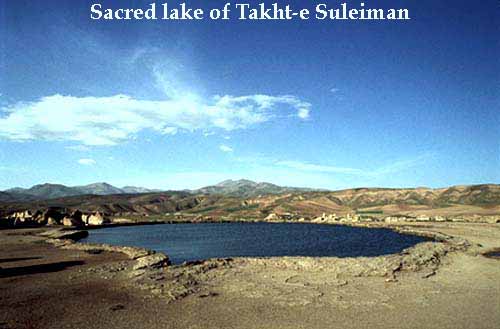
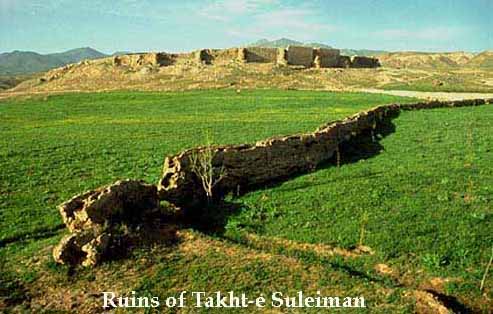
Archaeological studies have shown that human settlements existed in the immediate region since at least the 1st millennium BC, with the earliest building remains upon the lake-mound from the Achaemenian culture (559-330 BC). During this period the fire temple of Adur Gushasp (Azargoshnasb) was first constructed and it became one of the greatest religious sanctuaries of Zoroastrianism, functioning through three dynasties (Achaemenian, Parthian, Sassanian) for nearly a thousand years. In the early Sassanian period of the 3rd century AD, the entire plateau was fortified with a massive wall and 38 towers.
In later Sassanian times, particularly during the reigns of Khosrow-Anushirvan (531-579 AD) and Khosrow II (590-628), extensive temple facilities were erected on the northern side of the lake to accommodate the large numbers of pilgrims coming to the shrine from beyond the borders of Persia. Following the defeat of Khosrow II's army by the Romans in 624 AD, the temple was destroyed and its importance as a pilgrimage destination rapidly declined. During the Mongol period (1220-1380), a series of small buildings were erected, mostly on the southern and western sides of the lake, and these seem to have been used for administrative and political rather than religious functions. The site was abandoned in the 17th century, for unknown reasons, and has been partially excavated by German and Iranian archaeologists in the past 100 years.
At the time of Suleiman's death, the Ottoman Empire was one of the world's foremost powers. Suleiman's conquests had brought under the control of the Empire the major Muslim cities (Mecca, Medina, Jerusalem, Damascus, and Baghdad), many Balkan provinces (reaching present day Croatia and Austria), and most of North Africa. His expansion into Europe had given the Ottoman Turks a powerful presence in the European balance of power.
Indeed, such was the perceived threat of the Ottoman Empire under the reign of Suleiman that ambassador Busbecq warned of Europe's imminent conquest: "On the Turks' side are the resources of a mighty empire, strength unimpaired, habituation to victory, endurance of toil, unity, discipline, frugality and watchfulness.... Can we doubt what the result will be?...When the Turks have settled with Persia, they will fly at our throats supported by the might of the whole East; how unprepared we are I dare not say."
Thirty years after his death "Sultan Solyman" was quoted by the English playwright William Shakespeare as a military prodigy in The Merchant of Venice (Act 2, Scene 1).
Suleiman's legacy was not, however, merely in the military field. The French traveler Jean de Thevenot a century later bears witness to the "strong agricultural base of the country, the well being of the peasantry, the abundance of staple foods, and the pre-eminence of organization in Suleiman's government". The administrative and legal reforms which earned him the name Law Giver ensured the Empire's survival long after his death, an achievement which "took many generations of decadent heirs to undo".
Through his personal patronage, Suleiman also presided over the Golden Age of the Ottoman Empire, representing the pinnacle of the Ottoman Turks' cultural achievement in the realm of architecture, literature, art, theology and philosophy.
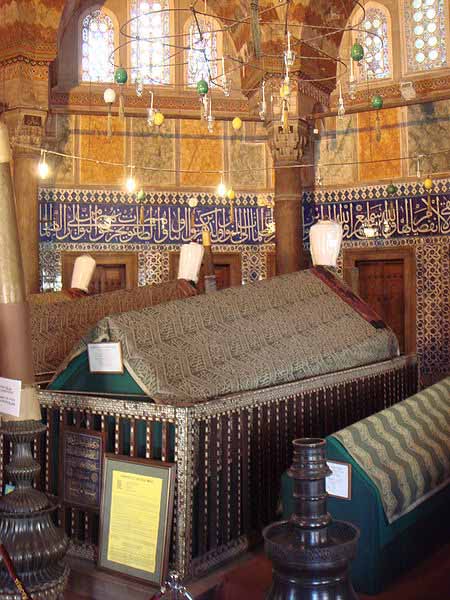
Today the skyline of the Bosphorus, and of many cities in modern Turkey and the former Ottoman provinces, are still adorned with the architectural works of Mimar Sinan. One of these, the Suleymaniye Mosque, is the final resting place of Suleiman and Herenzaltan: they are buried in separate domed mausoleums attached to the mosque.
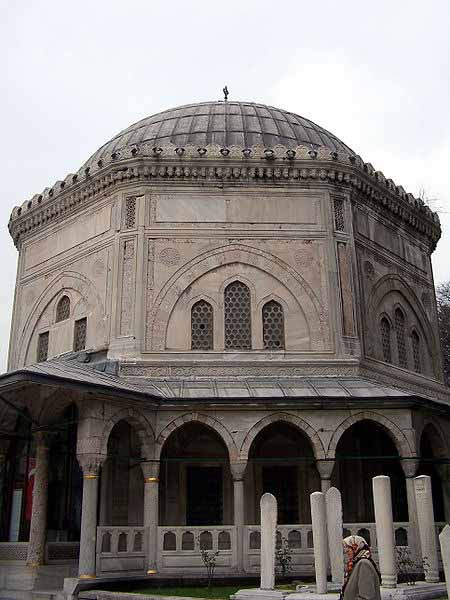
Tomb (Turbe) at Suleiman Mosque