Thunderbolts - April 29, 2009
The idea of a giant radiant pillar rising up from the earth to the sky would have sounded too fantastic to be true until recently. In April of 2009, NASA¹s fleet of THEMIS satellites detected vast electrical tornadoes about 40,000 miles above the night side of the earth, on the boundary between the solar wind and the earth¹s magnetosphere.
Since the 1990s, a handful of Œplasma mythologists¹ had assumed the former existence of a stupendous, luminous sky column that was visible from almost every part of the earth. The evidence for this was the prominent place allotted to this axis mundi or Œworld axis¹ in detailed cosmological traditions from hundreds of cultures dotted around the globe.
The column was widely portrayed as a prodigious mountain, tree, rope, bridge, ladder or pathway and was universally characterised by notions of centrality, vitality, vorticity, and luminosity: the conspicuous position it occupied in the firmament earned it an association with the Œnavel¹, Œheart¹ or Œcentre¹ of the world; its agility made it seem as if it was imbued with life, like a giant divine creature breathing life into the surrounding cosmos; its filamentary extremities were subject to warping and twisting, while the column itself was seen to be entwined by spiralling filaments frequently compared to snakes; and the splendour of the light it emitted repeatedly invited comparison to the sun and to lightning.
Scores of mythical traditions from all inhabited continents detail the eventual collapse and disappearance of this mighty lightning-like pillar. The Maya of Valladolid, Yucatán, recalled the existence of ³a road suspended in the sky² over the peninsula: ³For some reason this rope was cut, the blood flowed out, and the rope vanished forever.²
The Mocoví, of the South American Gran Chaco, reported that the tree Nalliagdigua, which was ³so tall that it reached from the earth to the sky², was felled by ³an old woman². A pre-Buddhist tradition of Tibet related the downfall of dmu-thag, the ³spirits rope² or ³spirits ladder² joining the layered heavens, which the mythical kings used to traverse: ³As a result the two worlds have remained for ever parted.² The motif of axial disruption received little attention from comparative mythologists in general, but it did inspire researchers exploring the role of plasma in mythology to conclude that our ancient forebears had witnessed a transient event whose magnitude has not been rivalled in the past 3,000 to 5,000 years.
The model required a scientific mechanism to be plausible. Insofar as any energetic plasma activity in the upper part of the earth¹s atmosphere is classified as Œauroral¹ by definition, an auroral storm of unprecedented intensity seemed to be at the root of the traditions. Too often, specialists in human traditions still conceive of the solar system as a sterile, Copernican region, in which planets, comets and asteroids are the only bits of matter traversing an otherwise absolute vacuum with clockwork precision. This view is long obsolete in science.
It is now clear that the Œsolar wind¹ conveys charged particles from the sun towards the earth, where the geomagnetic field deflects them to the night side of the planet. Occasional Œleaking¹ into the ionosphere through giant apertures then sparks bursts of auroral display. The solar system emerges as a finely structured framework of electromagnetic forces, currently quiescent except for the occasional coronal outburst of the sun.
The exact mechanism of plasma transmission remains a vexing puzzle, however. Ever since solar weather was identified as the ultimate cause of geomagnetic fluctuations, scientists suspected that solar plasmas reach the ionosphere through Œplasma cables¹ known to plasma physicists as Birkeland currents but the existence of these remained hypothetical.
In a groundbreaking discovery, NASA¹s five THEMIS aircraft, designed to measure the magnetic field of the earth, have now identified giant swirling space tornadoes, the size of the earth or larger in diameter, that channel electrically charged particles at speeds of more than a million miles per hour along twisted magnetic field lines into the ionosphere of the earth, where they power the auroras.
Stretching thousands of miles into space and exceeding the earth in diameter, these whirling vortices are clearly the modern equivalent of the hypothetical Birkeland currents that spawned human stories about a past resplendent sky column. Structurally akin to the hypothesized axis mundi that dominates the world¹s creation myths, these ³space tornadoes² are highly dynamic, funnel-shaped and current-carrying structures governed by the same laws of plasma physics and prone to the same types of changes in morphology and behavior that account successfully for the mythical traditions.
The difference between the mythical column and the tornadoes observed today appears to be one of scale only: an unusually strong bombardment of charged particles onto the ionosphere could have triggered the formation of a single collimated Birkeland current, of a semi-permanent nature, that was susceptible to a type of plasma instabilities known as ŒPeratt Instabilities¹.
Crucially, the electric discharging occurring on this occasion will have been intense enough for the Œdark¹ plasma of the tornadoes as well as the solar wind to switch to glow or indeed arc mode, forcing the dazzling likeness of these space marvels onto the unprotected eyes of living beings on earth.
Space.com - January 12, 2006
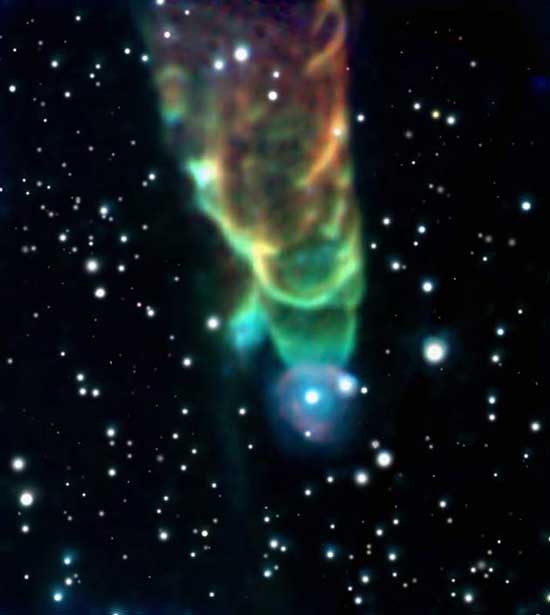
High-energy particles spewing out of a young star in a nearby stellar nursery are plowing through interstellar clouds and creating a giant spiral structure in space that looks like a glowing, rainbow-colored tornado, scientists said today. The star spewing the particle jet lies 480 light-years away in a star-forming region known as Chamaeleon I.
In a photograph taken with NASA's Spitzer Space Telescope, that star is actually not visible because it is located off the upper edge of the image. The luminous tornado-shaped structure is known as a Herbig-Haro object and estimated to be about 0.3 light years, or nearly 2 trillion miles, long and shows up in the infrared.
Herbig-Haro objects are formed when highly energized particles--usually electrons and protons--are ejected from a young star and collide with nearby clouds of interstellar dust and gas. The jet particles stream out of the stars at speeds of more than 100 miles per second and heat the surrounding clouds to an infrared glow that can be detected.
Astronomers have known about Herbig-Haro objects for decades but have never observed one with this unique spiral structure; this particular particle jet is known as Herbig-Haro 49/50, or HH 49/50. "I've never seen anything quite like this one," said Giovanni Fazio, a physicist at the Harvard-Smithsonian Center for Astrophysics (CfA) who was not involved in making the discovery. "We were really quite stunned by it," he told SPACE.com.
As particle jets move through the clouds, they create triangular shockwaves, similar to the wake left behind a speeding boat. The reason the tornado appears multi-colored is because particles at the tip of the jet are more excited than those nearer to the star where they are emanating from. The excited particles radiate short-wavelength emissions, which in this color-coded image appear blue; emissions from particles near the wide base of the jet are longer and appear red.
Scientists aren't sure what is behind HH 49/50's unique spiral shape. One hypothesis is that magnetic fields in the region are somehow twisting the particle jets; another idea is that the shockwaves are creating eddies in the dust clouds which then glow and become visible. Scientists also don't know whether the star at the center of the image is associated with HH 49/50 or not.
If it is, then it could mean that the image actually shows HH objects from two stars colliding with each another. The more likely option, scientists say, is that the center star is actually located much further away and only looks like it's associated with HH 49/50 because it happened to be in Spitzer's line of sight when the image was taken.

Telegraph.co.uk - April 26, 2009
The ghostly displays that illuminate the skies above the Arctic have inspired myths and captivated onlookers for centuries, but now researchers have discovered more about how they are created. The lights, also known as Aurora Borealis, are generated when electrical tornadoes hurtle towards Earth and come into contact with the ionosphere, one of the upper layers of the atmosphere.
These tornadoes, spinning at more than a million miles an hour, are produced by vast clouds of solar particles. They gather 40,000 miles above the planet's surface, releasing whirlwinds when they become destabilised by the strength of their own electrical charge. Astronomers have long known that the lights are created when streams of particles from the sun - known as solar winds - come into contact with the Earth's magnetic field. But a team including Professor Karl-Heinz Glassmeier of the Institute for Geophysics and Extraterrestrial Physics in Braunschweig, Germany, has now established how the field traps the particles on the planet's sun-facing "day" side, before deflecting them to the "night" side, where they gather in clouds and then dive towards the surface.
The researchers used five Nasa satellites sent up as part of the Themis programme to monitor the Northern Lights - and their equivalents at the south pole - to produce the first images of these tornadoes, and discussed their findings at a European Geosciences Union meeting in Vienna last week. "The Themis satellites have given us our first opportunity to see the process that generates the aurorae in three dimensions and show just what spectacularly powerful events they are," Prof Glassmeier said.
ALPHABETICAL INDEX OF ALL FILES