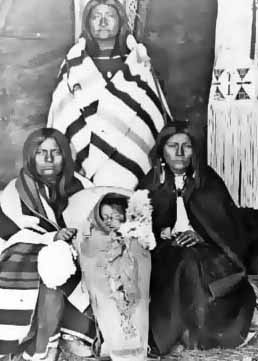
The Shoshone or Shoshoni are a Native American tribe in the United States with three large divisions: the Northern, the Western and the Eastern.
They traditionally spoke the Shoshoni language, a part of the Numic languages branch of the large Uto-Aztecan language family. The Shoshone were sometimes called the Snake Indians by early ethnic European trappers, travelers, and settlers.
The Northern Shoshone are concentrated in eastern Idaho, western Wyoming, and northeastern Utah. The Northern Shoshone would live in teepees, ride horses, and hunt buffalo.
The Eastern Shoshone tribes lived in Wyoming, northern Colorado and Montana. After 1750, warfare and pressure from the Blackfoot, Crow, Lakota, Cheyenne, and Arapaho pushed them south and westward. Some of them moved as far south as Texas, to become the Comanche.
The Western Shoshone tribes lived in Oregon and western Idaho, and ranged from central Idaho, northwestern Utah, central Nevada. Some are also located in California. The Idaho groups of Western Shoshone were called Tukuaduka (sheep eaters), while the Nevada/Utah bands were called the Gosiute or Toi Ticutta (cattail eaters). In California the Timbisha Shoshone (also known as the Death Valley or Panamint Shoshone) have lived for centuries in the Death Valley, Saline Valley, Panamint Valley and surrounding mountains. They have a federally recognized tribal reservation and government at Furnace Creek, California. Shoshone-Paiute have continued to live in the Owens Valley. The Western Shoshone would live in roofless grass huts, hunt birds,fish and rabbits.
The most historically well-known member of the Shoshone tribe may be Sacagawea, of the Lemhi Shoshone band of Northern Shoshone. She accompanied the Corps of Discovery (Lewis and Clark Expedition) with Meriwether Lewis and William Clark in their exploration of the Western United States. Jaime Luis Gomez, better known by his stage name Taboo, is an American singer, actor, and rapper best known as a member of the group The Black Eyed Peas.
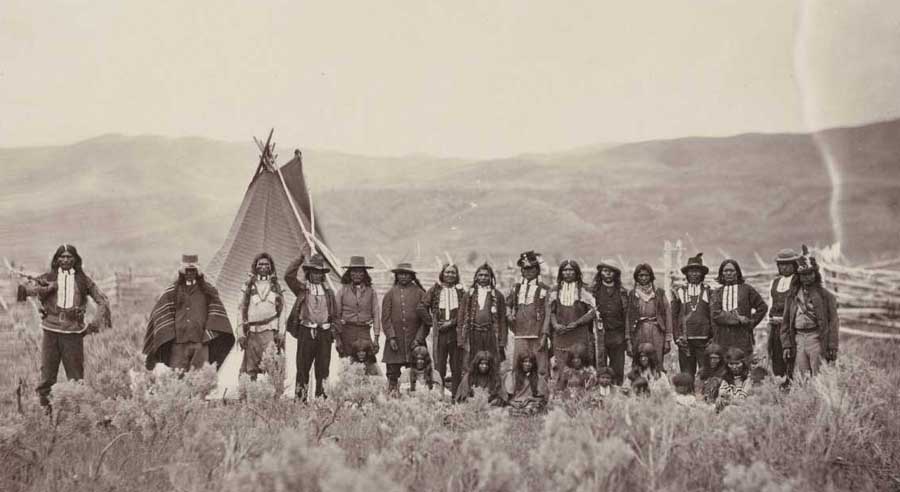
The Shoshone arose out of various cultures of indigenous peoples who had been in the territory for thousands of years. The Shoshone language is one of the Uto-Aztecan languages spoken by numerous peoples ranging from the Great Basin to coastal Southern California in present-day United States, and down through central, western and southern Mexico; into Central America and South America.
As more European-American settlers migrated west, tensions rose with the indigenous people. There were wars throughout the second half of the 19th century. The Northern Shoshone, led by Chief Pocatello, fought during the 1860s with settlers in Idaho (where a city was named for him). As more settlers encroached on Shoshone hunting territory, the natives raided farms and ranches for food, and attacked migrants.
The warfare resulted in the Bear River Massacre (1863), when US forces trapped and murdered an estimated 350-500 Northwestern Shoshone, including women and children, who were at their winter encampment. This was the highest number of deaths which the Shoshone suffered by the forces of the United States. Allied with the Bannock, to whom they were related, the Shoshone fought against the United States in the Snake War from 1864-1868. They fought US forces together in 1878 in the Bannock War. In 1876, by contrast, the Shoshone fought alongside the U.S. Army in the Battle of the Rosebud, as it was against their traditional enemies, the Lakota and Cheyenne.
In 1879 a band of approximately 300 Western Shoshones (known as "Sheepeaters") was involved in the Sheepeater Indian War. It was the last Indian war fought in the Pacific Northwest region of the present-day United States.
In 1911 a small group of Bannock under a leader named "Shoshone Mike" killed four ranchers in Washoe County, Nevada. The settlers formed a posse and went out after the Native Americans. They caught up with the band on February 26, 1911 and killed eight. They lost one man of the posse, Ed Hogle. The posse captured three children and a woman. The partial remains of three adult males, two adult females, two adolescent males, and three children, believed to be Shoshone Mike and his family, according to contemporary accounts, were donated by a rancher to the Smithsonian Institution for study. In 1994, the institution repatriated the remains to the Fort Hall Idaho Shoshone-Bannock Tribe.
In 2008, the Northwestern Shoshone acquired the site of the Bear River Massacre and some surrounding land. They wanted to protect the holy land and build a memorial to the massacre, the largest their nation had suffered. "In partnership with the American West Heritage Center and state leaders in Idaho and Utah, the tribe has developed public/private partnerships to advance tribal cultural preservation and economic development goals." They have become a leader in developing tribal renewable energy.
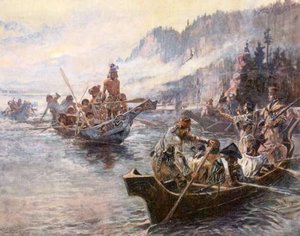
The Lewis and Clark expedition (1804-1806) was the first United States overland expedition to the Pacific coast and back.
The Louisiana Purchase in 1803 sparked interest in expansion to the west coast. A few weeks after the purchase, United States President Thomas Jefferson, an advocate of western expansion, had U.S. Congress appropriate $2500, "to send intelligent officers with ten or twelve men, to explore even to the western ocean". They were to study the Indian tribes, botany, geology, Western Terrain and wildlife in the region, as well as evaluate the potential interference of British and French-Canadian hunters and trappers who were already well established in the area. The expedition was not the first to cross North America, but was roughly a decade after the expedition of Alexander Mackenzie, the first European to cross North America by land north of Mexico, in 1793.
Jefferson selected Captain Meriwether Lewis to lead the expedition, afterwards known as the Corps of Discovery; Lewis selected William Clark as his partner. Due to bureaucratic delays in the US Army, Clark officially only held the rank of Second Lieutenant at the time, but Lewis concealed this from the men and shared the leadership of the expedition, always referring to Clark as "Captain".
The group, consisting of 33 members, departed from Camp Dubois and began their historic journey on May 14, 1804. They soon met-up with Lewis in Saint Charles, Missouri and the approximately forty men followed the Missouri River westward. Soon they passed Le Rochette, the last white settlement on the Missouri River. On August 20, 1804 The Corps of Discovery suffered its first and only death when Sergeant Charles Floyd died, apparently from acute appendicitis. In the winter of 1804-1805 they wintered at Fort Mandan.
The Shoshone/Hidatsa native woman Sacagawea and her husband, French Canadian Toussaint Charbonneau, joined the group from there and guided them westward. Sacagawea and her Shoshone tribe came from futher west. Not only did Lewis and Clark feel that she could aid them in translation, but they thought that when they got to that part of the country, she could take them to her native home.
The expedition followed the Missouri through what is now Kansas City, Missouri and Omaha, Nebraska, crossed the Rocky Mountains and descended by the Clearwater River, the Snake River, and the Columbia River, past Celilo Falls and through what is now Portland, Oregon until they reached the Pacific Ocean in the December of 1805. At this point in time, Lewis spotted Mt. Hood, a mountain known to be very close to the ocean.
By that time the expedition faced its second bitter winter during the trip, so the group decided to vote on whether to camp on the north or south side of the Columbia River. That was a "Real American Moment", for York, who was a slave, and Sacagawea, who was an Indian and a woman, voted along with the rest of the men of the party. The party agreed to camp on the south side of the river (modern Astoria, OR) , building Fort Clatsop as their winter quarters. While wintering at the fort, the men prepared for the trip home by boiling salt from the ocean, hunting elk and other wildlife. Mostly they just endured the persistent rain.
Lewis and Clark played a key role in the putting together of the United States. They had to act largely as diplomats for the President because when they met an Indian tribe, they had to tell them that the land now belonged to the United States. Without these calm meetings, the white settlers from the East would have stormed the Indian Country much too soon, and there would have been total chaos.
Historical documents from the Lewis and Clark expedition often refer to the Shoshone as the "Snake Indians"; the actual name "Shoshone" means "The Valley People". The name means inland, or in the valley.
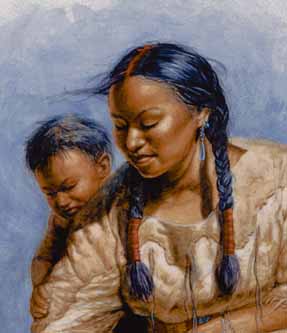
Sacagawea (Sakakawea, Sacajawea, Sacajewea) (1787- 1812) was a Native American woman who accompanied the Corps of Discovery with Meriwether Lewis and William Clark. Most of what is known of her life is from incomplete records and is therefore imbued with a great deal of legend and hearsay.
She was born to a tribe of Shoshone near what is now Three Forks, Montana, and betrothed at an early age to a much older man. However, in 1800, she was kidnapped by a group of Hidatsa, and taken to their village near the present Washburn, North Dakota. She therefore grew up culturally affiliated with this tribe; her name is taken from the Hidatsa phrase for "Bird Woman." She was named so because when she was born a flock of white birds flew overhead.
At the age of about sixteen she married a French trapper, Toussaint Charbonneau, who was also concurrently married to another Shoshone woman (he had purchased both from the Hidatsa as slaves). Sacagawea was pregnant with their first child when the Corps of Discovery arrived in the area to spend the winter of 1804/5. Needing someone to interpret the Hidatsa language, Lewis and Clark interviewed Charbonneau for the job. Although they were not overly impressed with him, the deal was sealed when they discovered that Sacagawea spoke Shoshone, an added bonus. She would become invaluable in her role as interpreter, as seen below.
Sacagawea gave birth to a son, Jean Baptiste Charbonneau, on February 11, 1805 while staying with the party at Fort Mandan. She would carry the infant throughout the entire trip to the Pacific Ocean and back. This had a very salubrious effect for the party - native tribes spotting the expedition knew that war parties didn't generally travel with a mother and child, and would therefore approach in a friendly manner. Undoubtedly this dispelled quite a bit of friction with the people they met throughout the excursion.
Contrary to a common romantic view, Sacagawea did not act as a "guide" per se on the main part of the trip; her knowledge of the land was limited to the areas in which she grew up. Once the party was past her former Shoshone settlement, her knowledge of the land was no greater than that of the rest of the group. She did however perform well as a "pilot" in the North Dakota/Montana area; for example, she was able to help the group get a bearing on the return trip by pointing out Bozeman Pass.
Her main duties were as a translator, and this worked in a very circuitous way. For example, with the Shoshone, she would translate into Hidatsa to her husband Charbonneau, who would then translate into French (he knew little English, but several others in the party knew French). The value of having Sacagawea as a Shoshone translator was proved when they reached her old village, and she was reunited with her brother, Cameahwait, who had by that time become a tribal leader. This smoothed the way in the negotiation to obtain much-needed horses from the Shoshone.
As recorded in the expedition's journals for May 14, 1805, Sacagawea proved crucial to the success of the project when her husband Charbonneau capsized a pirogue the group was using to make its way upriver. Unable to swim, Charbonneau flew into a panic and was unable to help right the situation; Sacagawea therefore calmly went about collecting items which had been lost into the river: instruments, trade items and - perhaps most important, at least to future generations - the water-sodden pages of the journals themselves.
After their return to Fort Mandan, the members of the expedition parted ways with Sacagawea in August of 1805 They extended an offer to take the Charbonneau family to St. Louis, offering to provide land for the family to farm and an education for Jean Baptiste. This offer was declined at the time, but by 1809 the family had moved to St. Louis. Toussaint Charbonneau abandoned farming after a few months, going with Sacagawea to Fort Manuel (near today's North Dakota/South Dakota border) and leaving Jean Baptiste in the care of William Clark.
Records of Fort Manuel show that Charbonneau then left Sacagawea there while he was off on further travels, and that she died in December 1812 of "putrid fever" (which was at the time a description for what is now called diphtheria). She would have been approximately 25 years old at the time. It is important to note that these records are disputed by many Native Americans, and there also is wide belief among the Shoshone people and historians that Sacagawea died from old age on April 9, 1884 at nearly 100 years old. For these reasons, she has 2 gravesites.
Reliable historical information about Sacagawea is extremely limited. For example, there was no contemporary portrait made of her. Regrettably, the lack of records has fostered a number of myths about Sacagawea. One of these is that she was romantically involved with Lewis or Clark; while the journals show that she was friendly with Clark and would often do favors for him, the idea of a liaison is almost certainly manufactured wholly by novelists who wrote about the expedition decades and centuries later.
Another legend surrounding Sacagawea involves a Shoshone woman who claimed to be her, and who died at the Wind River Band reservation in Wyoming on April 9, 1884. The Wyoming DAR in 1963 went so far as to erect a Sacagawea monument near Lander on the basis of this claim. There is, however, no proof of it being true, and it is not accepted by most serious historians.
The Shoshone were few in numbers, their total population being somewhere in the area of 8000.
The Shoshone lived in a wide area around the Great Basin and Great Plains areas in a number of bands headed by chiefs with shifting membership.
The Shoshone adopted a horse culture but had trouble competing with tribes to their east who had better access to European trade and weapons.
The tribe was party to the Fort Bridger Treaty Council of 1868.
Famous tribe members include Washakie, Sacagawea who guided the Lewis and Clark expedition, and Pocatello whose name was used by the city of Pocatello, Idaho.
There are three large divisions of the Shoshone - the Northern, the Western and the Eastern. The Northern concentrated in eastern Idaho, western Wyoming, and north-eastern Utah.
The Eastern lived in Wyoming, northern Colorado and Montana. Conflict with the Blackfoot, Crow, Sioux Cheyennes, and Arapahos pushed them south and westward after about 1750.
The Western ranged from central Idaho, northwestern Utah, central Nevada, and in California about Death Valley and Panamint Valley. This group is sometimes called the Panamint.
The Idaho groups of Western Shoshone were called Tukuaduka, or Sheep Eaters while the Nevada/Utah ones were called the Gosiute and the Toi Ticutta (cattail eaters).
The estimated population of Northern and Western Shoshoni was 4,500 in 1845. 3,650 Northern Shoshoni and 1,201 Western Shoshoni were counted in 1937 by the United States Office of Indian Affairs.The Northern Shoshone fought conflicts with settlers in Idaho in the 1860s which included the Bear River Massacre and again in 1878 in the Bannock War.
In 1875, resident Ulysses S. Grant established a 100 square mile executive order reservation for the Lemhi Valley Shoshone, establishing the Lemhi Valley Indian Reservation for use by the Shoshone, Bannock, and Sheepeater tribes.
They fought with the U.S. Army in the 1876 Battle of the Rosebud against their traditional enemies, the Lakota and Cheyenne.
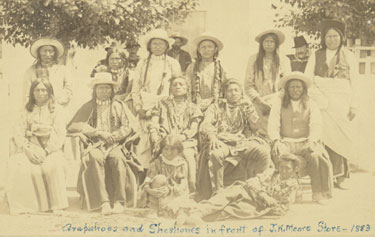
In 1905, nearly one hundred years after their first contact with the white man, the Lemhi Shoshone began their "Trail of Tears", being forcibly removed from their ancestral homelands to the Fort Hall Indian Reservation to their newly "appointed" home.
Today, the Shoshone are still waiting to become a Federally recognized tribe, along with over 200 other Native American tribes such as the California Chumash and the North-Eastern Abenakis. There has been much controversy surrounding the U.S. Government's plans to commemorate the bicentennial of the Lewis and Clark expedition. Read more Wikipedia