
Older brains work harder to stay upright, with nearly 50% longer delay Medical Express - June 3, 2026
Aging is known to degrade sensory systems, posing a major challenge to balance control and resulting in an increased risk of falls. Despite its importance, though, the role of the brain has only been explored indirectly, for example, by asking people to perform mental tasks while walking or standing.
A Signal of Cognitive Decline May Be Hidden in The Way You Write Science Alert - May 20, 2026
Simple, reliable tests to identify cognitive decline earlier in life and track it over time can make a real difference to treatment and support. New research shows the potential for handwriting exercises to form the basis of future tests. Writing down characters on a page may be a less practiced skill in the modern, digital age, but what makes it suitable for assessing cognitive decline is that it tests both physical motor skills and mental processing ability. It's a demanding workout for the brain.
Scientists Identify Molecular Switch That Lets Exercise Reverse Muscle Aging SciTech Daily - March 25, 2026

Researchers have identified a molecular mechanism that helps explain why exercise remains so effective in maintaining muscle health with age.
Strong friendships may literally slow aging at the cellular level. Science Daily - October 5, 2025

Social bonds, it seems, are as vital to longevity as diet or exercise. The cumulative effect of social advantages across a lifetime - from parental warmth in childhood to friendship, community engagement and religious support in adulthood - may slow the biological processes of aging. These social advantages appear to set back "epigenetic clocks" such that a person's biological age, as measured by analyzing DNA methylation patterns, is younger than their chronological age.
80-year-old SuperAger brain operates like that of a 50-year-old. Here's why CNN - August 7, 2025

The human brain shrinks as it ages, affecting the ability to remember - it's part of life. Yet there are a lucky few, called SuperAgers, who possess a brain that fights back. For these people, memories stay as sharp as they were 30 or more years in the past. To be a SuperAger in a program at Northwestern, a person must be over 80 and undergo extensive cognitive testing. Acceptance in the study only occurs if the person's episodic memory - the ability to recall everyday events and past personal history - is as good or better than cognitively normal people in their 50s and 60s.
The first 25 years of SuperAger research show cognitive decline is not an inevitable part of aging Medical Express - August 7, 2025

For 25 years, scientists at Northwestern Medicine have been studying individuals aged 80 and older - dubbed "SuperAgers" - to better understand what makes them tick. These unique individuals, who show outstanding memory performance at a level consistent with individuals who are at least three decades younger, challenge the long-held belief that cognitive decline is an inevitable part of aging. Over the quarter-century of research, the scientists have seen some notable lifestyle and personality differences between SuperAgers and those aging typically - such as being social and gregarious - but "it's really what we've found in their brains that's been so earth-shattering for us," said Dr. Sandra Weintraub, a professor of psychiatry and behavioral sciences and neurology at Northwestern University Feinberg School of Medicine.
Exceptional memory performance: SuperAgers score at least 9 out of 15 on a delayed word recall test - on par with individuals in their 50s and 60s. Youthful brain structure: Unlike typically aging brains, SuperAgers show no significant thinning of their cortex - the outer layer of the brain - and even have a thicker anterior cingulate cortex than younger adults. This crucial region of the brain plays a significant role in integrating information related to decision-making, emotion and motivation. Unique cellular traits: SuperAgers have more von economo neurons, which are specialized cells linked to social behavior, and larger entorhinal neurons, which are critical for memory, than their typically aging peers. Sociability as a common trait: Despite having diverse lifestyles and varying approaches to exercise, SuperAgers tend to be highly social and report strong interpersonal relationships.
Scientists Discover a Trait in Speech That Foreshadows Cognitive Decline - Difficulty Finding the Right Word Science Alert - March 11, 2025
Many of us will experience "lethologica", or difficulty finding words, in everyday life. And it usually becomes more prominent with age.
Extreme Heat Can Accelerate Aging, New Research Finds Science Alert - February 27, 2025

Sustained periods of heat do more than that - they age us faster. Cumulative heat stress changes our epigenetics - how our cells turn on or off gene switches in response to environmental pressure.
As more Americans work later in life, poll shows positive health impacts, especially for those over 65 Medical Express - February 11, 2025

Having a job - whether it's working for someone else or being their own boss - gives older Americans more than just a way to earn money or get health insurance, a new poll finds.
Older Americans see notable rise in disability-free living from 2008 to 2017: Study Medical Express - February 11, 2025

A sizable improvement was found in the prevalence of American adults aged 65 and older without disabilities - including memory, hearing, visual, and functional disabilities or limitations in activities of daily living.
According to research into the molecular changes associated with aging, humans experience two drastic lurches forward, one at the average age of 44 and the other at the average age of 60 Science Alert - November 20, 2024

Recent study suggests that it's the speed of speech, rather than the difficulty in finding words that is a more accurate indicator of brain health in older adults Science Alert - March 15, 2024

The researchers asked 125 healthy adults, aged 18 to 90, to describe a scene in detail. Recordings of these descriptions were subsequently analyzed by artificial intelligence (AI) software to extract features such as speed of talking, duration of pauses between words, and the variety of words used. Participants also completed a standard set of tests that measure concentration, thinking speed, and the ability to plan and carry out tasks. Age-related decline in these "executive" abilities was closely linked to the pace of a person's everyday speech, suggesting a broader decline than just difficulty in finding the right word. A novel aspect of this study was the use of a "picture-word interference task", a clever task designed to separate the two steps of naming an object: finding the right word and instructing the mouth on how to say it out loud.
Is Age Biological Or Psychological? Here's The Science IFL Science - November 4, 2023
We're often told that age is just a number. After all, when '40 is the new 30', but then life begins at 50, itÕs easy to think that none of it means anything at all. But there have to be some biological indicators of aging, donÕt there - some signs in our bodies that track the passage of time? Or is it really all in the mind?
Which leisure activities are linked to lower risk of dementia? Medical Express - August 11, 2022

Reading a book, doing yoga and spending time with family and friends may help lower the risk of dementia
Older women who regularly wash up, clean their house and cook meals have healthier hearts than those who avoid housework, research claims Daily Mail - February 22, 2022
Women who regularly wash dishes, clean the house and cook meals have healthier hearts than those who sit back and take it easy, a study suggests. Scientists at the University of California followed 5,500 women who were asked to wear movement-tracking gadgets for a week. Results showed women who did at least four hours of 'daily life movement' cut their risk of a death from a heart attack or stroke by almost two thirds.
Key mental abilities can actually improve during aging Medical Express - August 19, 2021
It's long been believed that advancing age leads to broad declines in our mental abilities. Now new research from Georgetown University Medical Center offers surprisingly good news by countering this view. The findings show that two key brain functions, which allow us to attend to new information and to focus on what's important in a given situation, can in fact improve in older individuals. These functions underlie critical aspects of cognition such as memory, decision making, and self-control, and even navigation, math, language, and reading. The findings not only change our view of how aging affects the mind, but may also lead to clinical improvements, including for patients with aging disorders such as Alzheimer's disease
More Than 4,000 Blood Tests Suggest Our Bodies Age in 3 Distinct Shifts - at 34 years, 60 years, and 78 years being the key thresholds Science Alert - April 6, 2021 Science Alert - April 6, 2021
In other words, there's evidence that aging isn't one long, continuous process that moves at the same speed throughout our lives. The findings might help us understand more about how our bodies start to break down as we get older, and how specific age-related diseases Š including Alzheimer's or cardiovascular disease - could be better tackled. The same study has also put forward a new way of reliably predicting people's ages using the protein levels (the proteome) in their blood.
Ecuador couple certified as oldest married pair, nearly 215 Medical Express - August 29, 2020
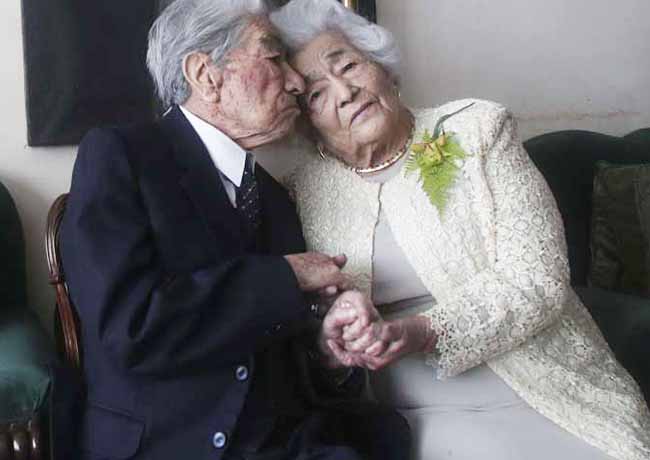
Julio Mora slipped away from his parents to secretly marry Waldramina Quinteros one February day. Both families disapproved. Seventy-nine years later, they're still together - he at 110 years of age, and she at 104, both lucid and both in good health, though relatives say they're a little depressed because they miss their big family get-togethers due to the pandemic.
Why Do Old People Have Sex? Their motives overlap those of youths, including to feel attractive and desired Psychology Today - September 30, 2019
1. Maintain Overall Functioning. This is a 'use it or lose it' motive, to keep themselves in shape, energetic, and vital: Just like you want to be able to walk, and you want to be able to hike, and you want to be able to climb, and you want to feel strong - sex takes a certain amount of energy and you certainly want to be able to continue to do it.
New type of dementia identified BBC - April 30, 2019
Millions of elderly people have a form of dementia that has been misdiagnosed as Alzheimer's disease, according to researchers. One expert called it the most important dementia finding in years. The condition, limbic-predominant age-related TDP-43 encephalopathy, or Late, shares similar symptoms to Alzheimer's, but it is a distinct disease, the journal Brain reports. It may partly explain why finding a dementia cure has failed so far.
Link between what we see and how we remember 'breaks' as we get older Medical Express - October 27, 2018
Forgetfulness and age-related memory lapses are a common complaint for many older adults, but what is still not understood is what causes these changes.
Older people slowdown in the winter: Cognitive skills of over 70s gets worse during the darker months, study finds Daily Mail - September 5, 2018
For people of a certain age, the cryptic crossword may be just about to get easier. Over-70s can expect to be at the top of their game for remembering things when the autumn equinox comes at the end of the month. The effect is like being almost five years younger, a study has found, and appears to last from late September to early October. Scientists made the discovery after finding that memory and problem-solving skills change throughout the year. The study involved more than 3,300 older people taking extensive memory tests. It found performance peaked in late summer and early autumn before slowly declining and hitting rock bottom in late winter and early spring.
Older adults grow just as many new brain cells as young people Science Daily - April 6, 2018
Researchers show for the first time that healthy older men and women can generate just as many new brain cells as younger people. There has been controversy over whether adult humans grow new neurons, and some research has previously suggested that the adult brain was hard-wired and that adults did not grow new neurons. This study counters that notion. The findings may suggest that many senior citizens remain more cognitively and emotionally intact than commonly believed.
Learning and staying in shape key to longer lifespan, study finds Science Daily - October 13, 2017
People who are overweight cut their life expectancy by two months for every extra kilogram of weight they carry, research suggests. A major study has also found that education leads to a longer life, with almost a year added for each year spent studying beyond school.
New measures of aging may show 70 is the new 60 Science Daily - June 22, 2017
A new study uses new measures of aging to scientifically illustrate that one's actual age is not necessarily the best measure of human aging itself, particularly in relation to population aging. The study combines the new measures of aging with probabilistic projections from the United Nations and predicts an end to population aging in the U.S. and other countries before the end of the century. Population aging -- when the median age rises in a country because of increasing life expectancy and lower fertility rates -- is a concern for countries because of the perception that population aging leads to declining numbers of working age people and additional social burdens.
Youthful DNA in old age Science Daily - September 22, 2016
The DNA of young people is regulated to express the right genes at the right time. With the passing of years, the regulation of the DNA gradually gets disrupted, which is an important cause of aging. A study of over 3,000 people shows that this is not true for everyone: there are people whose DNA appears youthful despite their advanced years.
Study finds that aging warps our perception of time Medical Express - December 15, 2015
Much like trying to watch a video with the audio out of synch, older adults may have difficulty combining the stimuli they see and hear, and it could have implications for rapid decision-making tasks such as driving, according to new research. When researchers presented them with both a light and sound at the same or different times, they found that young and older adults could determine whether they occurred simultaneously with similar accuracy. But when asked to determine which appeared first, the light or the sound, older adults performed much worse.
The Science of Meditation's Effects on Aging Huffington Post - December 8, 2015

A growing body of research supports the immediate benefits of meditation, such as reduced stress and anxiety levels, lower blood pressure, and enhanced happiness. Studies on mindfulness interventions show these effects are common in as few as eight weeks. While these initial perks may be reason enough for us to practice, meditation's positive impact appears to be even more far-reaching, potentially adding years to our lives and improving cognitive function well into old age.