
Doctor's kit found on Mount Vesuvius victim in Pompeii Live Science - May 18, 2026
A man who died during the eruption of mount Vesuvius in AD 79 had a medical kit with him when he perished. The medical kid indicates that he was probably a physician.
8 ancient Roman shoes of 'exceptional size' discovered at Roman fort near Hadrian's Wall Live Science - July 4, 2025

Ancient Roman Bigfoot? 'Unusually Large' Shoes Puzzle Archaeologists Science Alert - July 4, 2025
A stash of "unusually large" 2,000-year-old shoes dug up at a Roman site in northern England has left archaeologists searching for an explanation
2,000-year-old RSVP: A birthday invitation from the Roman frontier that has the earliest known Latin written by a woman Live Science - February 28, 2025

This wooden tablet is the earliest known example of Latin writing by a woman, Claudia Severa, who invited her good friend Sulpicia Lepidina to her birthday party. The invitation was found at the Roman fort of Vindolanda, where oxygen-free soil helped preserve numerous organic artifacts, including shoes and camping equipment, that normally would have disintegrated over time.
The Vesuvius challenge is using AI to virtually unroll Pompeii's ancient scrolls PhysOrg - August 30, 2024

The Vesuvius Challenge is an unparalleled competition in the field of classical studies, with the potential to pave the way for something akin to a second Renaissance. Its objective is to use artificial intelligence (AI) to virtually unroll hundreds of closed papyrus scrolls, containing ancient literature that has not been seen for 2,000 years.
Shepherd's Graffiti Suggests An Ancient Temple Once Existed Where The Parthenon Now Stands IFL Science - June 20, 2024
Archaeologists have found a rock engraving 20 kilometers (12 miles) from Athens depicting what appears to be an unknown temple that stood where the famous Parthenon is now found. The graffito is at least 50 years older than the Parthenon and uses a term that had confused archaeologists for a while: Hekatompedon.
Ancient Roman Site Found Frozen in Time in The Wreckage of Pompeii Science Alert - April 7, 2024
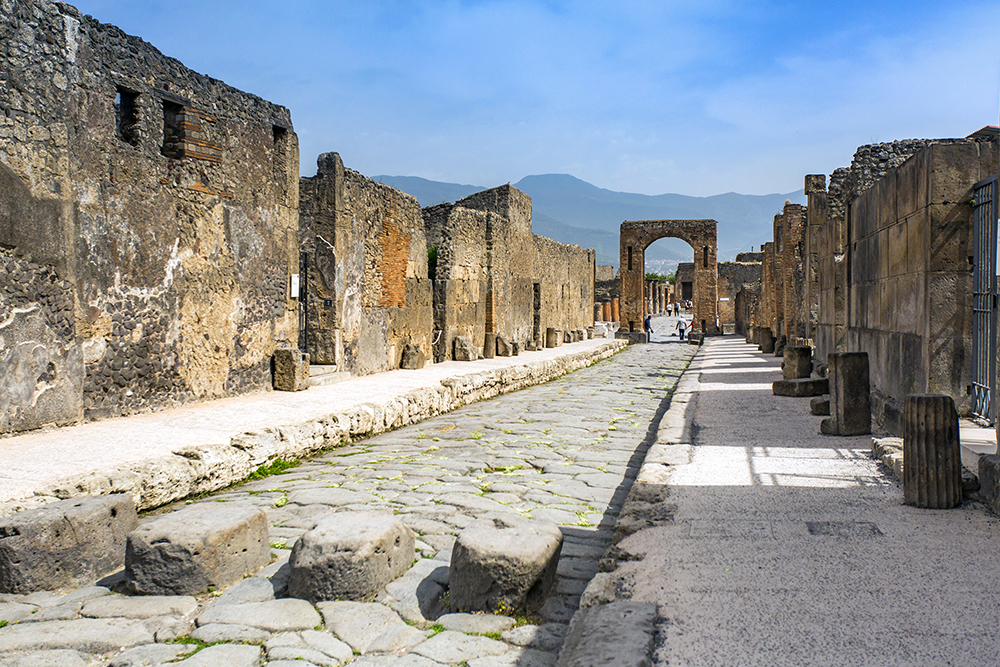
Archaeologists have found an unusual treasure that has been buried for nearly 2,000 years under the ash and debris that rained down from the catastrophic eruption of Vesuvius, in 79 CE. In the rooms of an ancient home, or domus, excavations have revealed a construction site, in perfect condition. That includes tools, unused tiles, bricks hewn from volcanic material called tuff, and the piece de resistance - piles of lime to mix Ancient Roman concrete. Home renovation may seem somewhat mundane, but the discovery gives us a pristine snapshot of how the Ancient Romans constructed the buildings in which they lived. And it also reveals some new information about the construction techniques that produced buildings that are still standing, thousands of years later.
Spicy wine: New study reveals ancient Romans may have had peculiar tastes PhysOrg - January 24, 2024
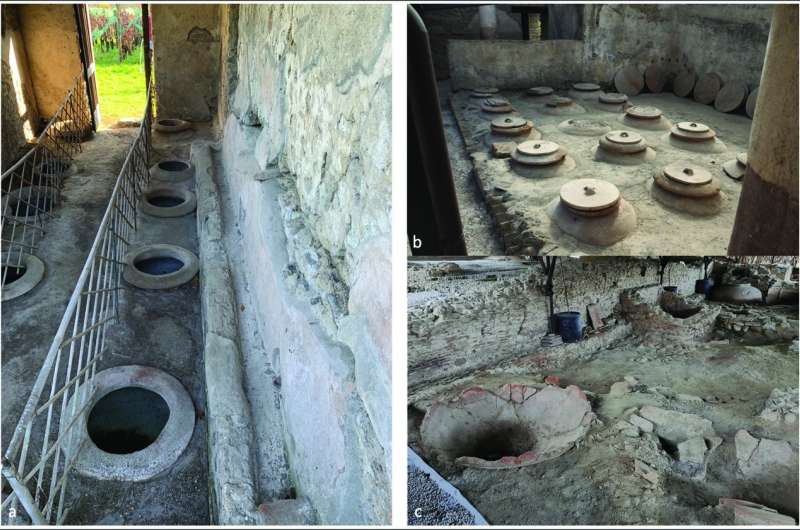
It's no secret that the ancient Romans were lovers of wine. So gripped by the grape were they, that they even worshiped a god Bacchus - devoted to wine and merriment. But, little is known about what their wine actually tasted like. Was it bitter or sweet? Fruity or earthy? According to a pioneering new study, it was rather spicy and smelled like toast. As a result of their winemaking process - and the addition of natural yeasts - the wine would have taken on a "slightly spicy" taste and given off the aroma of "toasted bread, apples, roasted walnuts and curry," researchers said.
Roman-era wine shop, possibly destroyed in an earthquake, discovered in Greece Live Science - January 24, 2024
Archaeologists in Greece have discovered a 1,600-year-old wine shop that was destroyed and abandoned after a "sudden event," possibly an earthquake or building collapse, left broken vessels and 60 coins scattered on the floor, according to new research. The shop operated at a time when the Roman Empire controlled the region. It was found in the ancient city of Sikyon (also spelled Sicyon), which is located on the northern coast of the Peloponnese in southern Greece. Within the wine shop, archaeologists found the scattered coins, as well as the remains of marble tabletops and vessels made of bronze, glass and ceramic.
Roman dodecahedron - a mysterious class of objects that has baffled experts for centuries - uncovered by amateur archaeologists in the UK Live Science - January 19, 2024
More than 100 dodecahedrons have now been found in northwestern Europe, but archaeologists still don't know what they were used for.
A penis carved carefully in stone was recently found near Hadrian's Wall in the United Kingdom Science Alert - June 11, 2022
Charms, amulets, and necklaces decorated with a penis motif were commonly worn by people in the Roman civilization to improve fertility and ward away evil spirits and bad luck. Even children at this time were running around sporting little gold rings bearing male genitalia.
Metal detectorist in UK finds ancient Roman penis pendant Live Science - June 9, 2022
A metal detectorist recently discovered a silver, penis-shaped pendant in Kent, England that was likely worn around the neck to protect a person from misfortune around 1,800 years ago. Ancient Roman writers such as Marcus Terentius Varro (lived 116 B.C. to 27 B.C.) and Pliny the Elder (A.D. 23 to 79) mention how the phallus and representations of it are thought to have had the power to protect a person from evil. Many depictions of the phallus have been found throughout the Roman Empire and scholars often believe that they were created to avoid bad luck. The pendant (also called an amulet) is about 1.2 inches (3.1 centimeters) long, with a tiny ring at the top for a string (necklace) to go through. It dates back to a time when the Romans controlled England, between A.D. 42 and 410.
2,000-year-old ruins of a Roman military chief's luxury villa with 14 rooms, marble floors and ornate mosaics are unearthed by subway construction workers in Rome Daily Mail - March 8, 2018
Sprawling ruins of the 2,000-year-old luxury villa of a Roman military commander have been unearthed during work to expand the Italian capital's subway system. Archaeologists working on Rome's Metro C line uncovered the second century AD residence, or domus, adjoining a military barracks excavated in 2016. The richly decorated dwelling is complete with a well-preserved geometric design mosaic, marble floors and frescoed walls.
Lead found in ink used to write scrolls buried by eruption of Mount Vesuvius PhysOrg - March 22, 2016
For several hundred years, before the dangers of lead were known, lead and other metals were added to ink to aid in color improvement, binding and consistency. But until now, it was believed this practice didn't start until approximately the fourth or fifth centuries AD - prior to then, inks were primarily carbon based. In this new effort, the researchers were studying scrolls that were charred and then covered when Mount Vesuvius erupted in 79 AD, burying the town, and of course nearby Pompeii as well.
Ancient scrolls give up their secrets BBC - March 21, 2016
Metallic ink was used to inscribe scrolls regarded as an archaeological wonder, according to scientists. The discovery pushes back the date for the first use of metallic ink by several centuries. The Herculaneum scrolls were buried by the eruption of Mount Vesuvius in AD79 and are charred and fragile. Previous efforts to read them, over many centuries, has damaged or destroyed some of the scrolls. The task of reading the surviving scrolls has fallen to scientists using technology such as the European synchrotron, which produces X-rays 100 billion times brighter than the X-rays used in hospitals. Last year, physicists used the 3D X-ray imaging technique to decipher writing in the scrolls. The scrolls are the only library known to have survived from classical times