Animals and Prophecy

In many prophecies, the birth of rare animals represents a rebirth for humanity,
the sacred animals being harbingers of peace, as foretold by the ancients.


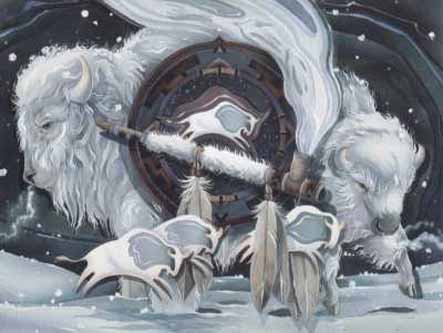
White Buffalo - White Buffalo Calf Woman

North Dakota: White buffalo may herald hope and peace Grand Forks Herald - June 8, 2008


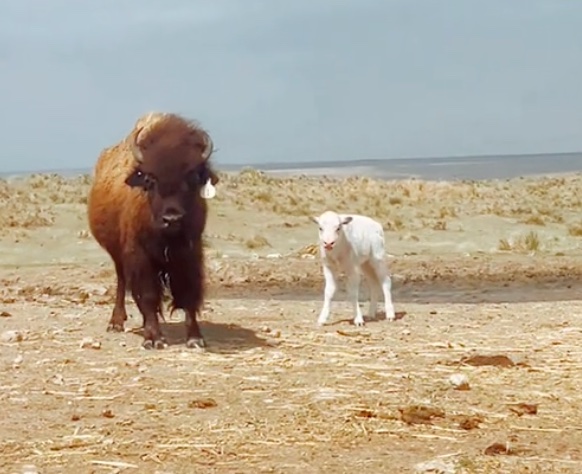
White Buffalo Born in 2006

Third rare white buffalo born on Wis. farm - Reuters - September 14, 2006

Baby buffalo believed to be good luck charm - NBC - May 10, 2006


August 2006


June 8, 2005 - Kentucky: A second rare white buffalo born in 2005
White calf named Cante Pejuta, or Medicine Heart
Her mother, formerly 'cow No. 9,' is now Spirit Mother.


Rare white bison born in B.C. - CBC News - May 25, 2005


White bison born near Flagstaff - May 24, 2004 - AZ Republic

Spirit Mountain Ranch in Flagstaff, Arizona has successfully bred two generations of white buffalo starting from a single white female, all with brown fathers.


White Buffalos in History

In 1833, a white bison was killed by the Cheyenne. The skin of this bison is hanging on the wall of Bent's Old Fort in Colorado. The Cheyenne killed this white bison during the Leonid Meteor Shower (The Night the Stars Fell) and scribed a peace and trade treaty on its skin. This event was documented by historian Josiah Gregg and other travelers on the Santa Fe Trail.

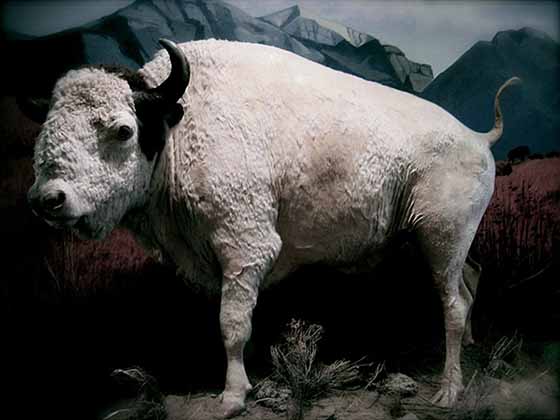
A bison named Big Medicine (1933-1959) was born in the wild on the National Bison Range on Montana's Flathead Indian Reservation, and is now displayed at the Montana Historical Society.

A female named Miracle (not Miracle Moon), was born at the family farm of Dave, Valerie, and Corey Heider near Janesville, Wisconsin on August 20, 1994. Her fur fully transitioned to brown as she matured, and she gave birth to four calves of her own before dying of natural causes on September 19, 2004. Sioux tribal members had continually visited their farm since the birth of Miracle. Additionally, a calf born at the Heider farm died aged 4 days in 1997. A third white calf was born in September 2006.


Miracle, The Sacred White Buffalo
Born August 20, 1994
Died September 19, 2004
Heider Farm - Janesville, Wisconsin


White Buffalo
Wikipedia


White Buffalo Mythology

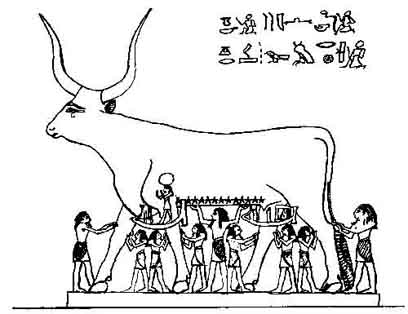
Egyptian Book of the Dead - Chapter 84

And when she promised to return again, she made some prophesies at that time. One of those prophesies was that the birth of a white buffalo calf would be a sign that it would be near the time when she would return again to purify the world.

This means the SHE will bring back harmony again and balance, spiritually. White Buffalo links with the return of White Buffalo Calf women or the return of the feminine energies, rebirth and creation, Hathor (cow goddess), solar discs, and horns and cones.

A white buffalo called Ma-hi-ya-sqa was born in 1996 on a farm in North Dakota, not far from to where I traveled to attend the first Star Knowledge Conference and Sun Dance festivals in South Dakota in June 1996. White symbolizes moving into higher frequency of light and consciousness.


Legend of White Buffalo Calf Woman

To the Native Americans the birth of a white buffalo is a symbol of rebirth and world harmony

One summer, long ago, the seven sacred council fires of the Lakota Oyate, the nation, came together and camped. Every day they sent scouts to look for game, but the scouts found nothing, and the people were starving.

Among the bands assembled were the Itazipcho, the Without-Bows, who had their own camp circle under their chief, Standing Hollow Horn. Early one morning the chief sent two of his young men to hunt for game. They searched everywhere but could find nothing. Seeing a high hill, they decided to climb it in order to look over the whole country. Halfway up, they saw something coming toward them from far off, but the figure was floating instead of walking. From this they knew that the person was wakan, holy.

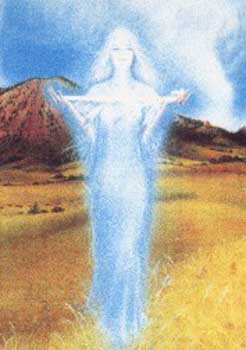
At first they could make out only a small moving speck and had to squint to see that it was a human form. But as it came nearer, they realized that it was a beautiful young woman, more beautiful than any they had ever seen. She wore a wonderful white buckskin outfit, tanned until it shone a long way in the sun. It was embroidered with sacred and marvelous designs of porcupine quill, in radiant colors no ordinary woman could have made. This wakan stranger was Ptesan-Wi, White Buffalo Calf Woman. In her hands she carried a large bundle and a fan of sage leaves. She wore her hair loose except for a strand at the left side, which was tied up with buffalo fur. Her eyes shone dark and sparkling, with great power in them.

The two young men looked at her open-mouthed. One was overawed, but the other desired her and stretched his hand out to touch her. This woman was Lila wakan, very sacred, and could not be treated with disrespect. Lightning instantly struck the brash young man and burned him up, so that only a small heap of blackened bones was left.

To the other scout who had behaved rightly, the White Buffalo Calf Woman said: "Good things I am bringing, something holy to your nation. A message I carry for your people from the buffalo nation. Go back to the camp and tell the people to prepare for my arrival. Tell your chief to put up a medicine lodge with twenty-four poles. Let it be made holy for my coming."

This young hunter returned to the camp. He told the chief, and the people, what the sacred woman had commanded. So the people put up the big medicine tipi and waited. After four days they saw the White Buffalo Calf Woman approaching, carrying her bundle before her. Her wonderful white buckskin dress shone from afar. The chief, Standing Hollow Horn, invited her to enter the medicine lodge. She went in and circled the interior sunrise. The chief addressed her respectfully, saying: "Sister, we are glad you have come to instruct us."

She told him what she wanted done. In the center of the tipi they were to put up an owanka wakan, a sacred altar, made of red earth, with a buffalo skull and a three-stick rack for a holy thing she was bringing. They did what she directed, and she traced a design with her finger on the smoothed earth of the altar. She showed them how to do all this, then circled the lodge again sunwise. Halting before the chief, she now opened the bundle. The holy thing it contained was the chanunpa, the sacred pipe. She held it out to the people and let them look at it. She was grasping the stem with her right hand and the bowl with her left, and thus the pipe has been held ever since.

Again the chief spoke, saying: "Sister, we are glad. We have had no meat for some time. All we can give you is water." They dipped some wacanga, sweet grass, into a skin bag of water and gave it to her, and to this day the people dip sweet grass or an eagle wing in water and sprinkle it on a person to be purified.

The White Buffalo Calf Woman showed the people how to use the pipe. She filled it with chan-shasha, red willow-bark tobacco. She walked around the lodge four times after the manner of Anpetu-Wi, the great sun. This represented the circle without end, the sacred hoop, the road of life. The woman placed a dry buffalo chip on the fire and lit the pipe with it. This was peta-owihankeshni, the fire without end, the flame to be passed on from generation to generation.

She told them that the smoke rising from the bowl was Tunkashila's breath, the living breath of the great Grandfather Mystery.

The White Buffalo Calf Woman showed the people the right way to pray, the right words and the right gestures. She taught them how to sing the pipe-filling song and how to lift the pipe up to the sky, toward Grandfather, and down toward Grandmother Earth, to Unci, and then to the four directions of the universe.

"With this holy pipe," she said, "you will walk like a living prayer. With your feet resting upon the earth and the pipe stem reaching into the sky, your body forms a living bridge between the Sacred Beneath and the Sacred Above. Wakan Tanka smiles upon us, because now we are as one: earth, sky, all living things, the two-legged, the four-legged, the winged ones, the trees, the grasses.

Together with the people, they are all related, one family. The pipe holds them all together.

"Look at this bowl," said the White Buffalo Calf Woman. "Its stone represents the buffalo, but also the flesh and blood of the red man. The buffalo represents the universe and the four directions, because he stands on four legs, for the four ages of creation. The buffalo was put in the west by Wakan Tanka at the making of the world, to hold back the waters.

Every year he loses one hair, and in every one of the four ages he loses a leg. The sacred hoop will end when all the hair and legs of the great buffalo are gone, and the water comes back to cover Mother Earth.

The wooden stem of this chanunpa stands for all that grows on the Earth. Twelve feathers hanging from where the stem - the backbone - joins the bowl - the skull - are from Wanblee Galeshka, the spotted eagle, the very sacred bird who is the Great Spirit's messenger and the wisest of all flying ones.

You are joined to all things of the universe, for they all cry out to Tunkashila. Look at the bowl: engraved in it are seven circles of various sizes. They stand for the seven sacred ceremonies you will practice with this pipe, and for the Oceti Shakowin, the seven sacred campfires of our Lakota nation."

The White Buffalo Calf Woman then spoke to the women, telling them that it was the work of their hands and the fruit of their bodies which kept the people alive. "You are from Mother Earth," she told them. "What you are doing is as great as what the warriors do."

And therefore the sacred pipe is also something that binds men and women together in a circle of love. It is the one holy object in the making of which both men and women have a hand.

The men carve the bowl and make the stem; the women decorate it with bands of colored porcupine quills. When a man takes a wife, they both hold the pipe at the same time and red trade cloth is wound around their hands, thus tying them together for life.

The White Buffalo Calf Woman also talked to the children, because they have an understanding beyond their years. She told them that what their fathers and mothers did was for them, that their parents could remember being little once, and that they, the children, would grow up to have little ones of their own.

She told them: "You are the coming generation, that's why you are the most important and precious ones. Some day you will hold this pipe and smoke it. Some day you will pray with it."

She spoke once more to all the people: "The pipe is alive; it is a red being showing you a red life and a red road. And this is the first ceremony for which you will use the pipe. You will use it to keep the soul of a dead person, because through it you can talk to Wakan Tanka, the Great Mysterious. The day a human dies is always a sacred day. The day when the soul is released to the Great Spirit is another."

She spoke one last time to Standing Hollow Horn, the chief, saying, "Remember: this pipe is very sacred. Respect it and it will take you to the end of the road. The four ages of creation are in me. I will come to see you in every generation cycle. I shall come back to you."

The sacred woman then took leave of the people, saying: "Toksha ake wacinyanktin ktelo -- I shall see you again."

The people saw her walking off in the same direction from which she had come, outlined against the red ball of the setting sun. As she went, she stopped and rolled over four times. The first time, she turned into a black buffalo; the second into a brown one; the third into a red one; and finally, the fourth time she rolled over, she turned into a white buffalo calf. A white buffalo is the most sacred living thing you could ever encounter.

The White Buffalo Calf Woman disappeared over the horizon. As soon as she had vanished, buffalo in great herds appeared, allowing themselves to be killed so that the people might survive. And from that day on, our relations, the buffalo, furnished the people with everything they need -- meat for their food, skins for their clothes and tipi1s, and bones for their many tools.


Red Heifer in Judiasm

In Judaism, the red heifer (Hebrew parah adumah) is a heifer that is sacrificed and whose ashes are used for the ritual purification of people who came into contact with a corpse. A heifer is a young cow before she has had her first calf.

In the Bible: According to Numbers 19:2: Speak unto the Children of Israel that they bring thee a red heifer without spot, wherein is no blemish, and upon which never came yoke. The animals will not have hairs of any other color, it must be in perfect health, and it must never have been used to perform work. The cow is then brought to an altar built to the east of the Temple Mount, where it is slaughtered and burned. Cedar wood, hyssop, and scarlet are added to the fire, and the remaining ash is placed in a vessel containing pure water. In order to purify a person who has become ritually contaminated by contact with a corpse, water from the vessel is sprinkled on him, using a bunch of hyssop, on the third and seventh day after the contamination took place (Numbers 19:19). The priests who have performed the ritual then become impure themselves. Continued Wikipedia

Red Heifer Born in Israel


Other White Animals

Rare white killer whale spotted in Alaska MSNBC - March 7, 2008


Albino Mountain Goat Spotted in Mila, Italy


Norway: White moose sparks debate Aftenposten - October 6, 2006

Discovery of a rare white Tree Hedgehog BBC - January 25, 2006

Rare White Giraffe Photographed in Tanzia, Africa National Geographic - September 9, 2005


Albino Persian Fallow Deer - Google


Albino elephants Google


ANIMAL INDEX

PROPHECIES

PHYSICAL SCIENCE


ALPHABETICAL INDEX OF ALL FILES

CRYSTALINKS MAIN PAGE

CRYSTALINKS MAILING LIST, NEWSLETTER, UPDATES

PSYCHIC READING WITH ELLIE


Google