Phoenician was a language originally spoken in the coastal (Mediterranean) region then called "Canaan" in Phoenician, Arabic, Hebrew, and Aramaic, "Phoenicia" in Greek and Latin, and "Put" in Ancient Egyptian. Phoenician is a Semitic language of the Canaanite subgroup; its closest living relative is Hebrew, to which it is very similar; then Aramaic, then Arabic. The area where Phoenician was spoken includes modern-day Lebanon, coastal Syria, Palestine, northern Israel (as well as parts of Cyprus - along with Greek - and, at least as a prestige language, in some adjacent areas of Anatolia). It was also spoken in the area of Phoenician colonization along the coasts of the South-Western Mediterranean, including, notably, those of modern Tunisia, Morocco and Algeria, as well as Malta, the west of Sicily, Sardinia, Corsica and southernmost Spain.
Phoenician is currently known only from brief and unvaried inscriptions of official and religious character and occasional glosses in books written in other languages; Roman authors such as Sallust allude to some books written in Punic, but none have survived except occasionally in translation (e.g., Mago's treatise) or in snippets (e.g., in Plautus' plays). The Cippi of Melqart, discovered in Malta in 1694, were inscribed in two languages, Ancient Greek and Carthaginian. This made it possible for French scholar Abbe Barthelemy to decipher and reconstruct the Carthaginian alphabet. Further, since a trade agreement was found in 1964 written between the Etruscans and a group of Phoenicians, more Etruscan has been deciphered.
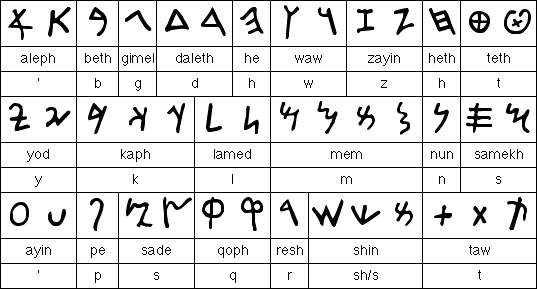
Notable Features - The Phoenician alphabet consists of 22 letters, many of which have a number of different forms, and does not indicate vowel sounds.
The names of the letters are the same as those used in Hebrew.
Phoenician was written with the Phoenician script, an abjad (consonantary) originating from the Proto-Canaanite script that also became the basis for the Greek and hence the Latin alphabets. The Western Mediterranean (Punic) area form of the script gradually developed somewhat different and more cursive letter shapes; in the 3rd century AD, it also began to exhibit a tendency to mark the presence of vowels, especially final vowels, with an aleph or sometimes an ayin. Furthermore, around the time of the Second Punic War, an even more cursive form began to develop and it gave rise to a variety referred to as Neo-Punic, which existed alongside the more conservative form and became predominant some time after the destruction of Carthage (146 BC).
Neo-Punic in turn tended to designate vowels with matres lectionis more frequently than the previous systems had and also began to systematically use different letters for different vowels, in the way explained in more detail below. Finally, a number of late inscriptions from El-Hofra (Constantine), in the 1st century BC, make use of the Greek alphabet to write Punic, and many inscriptions from Tripolitania, in the third and fourth centuries AD, use the Latin alphabet for that purpose.
In Phoenician writing, unlike that of most later abjads such as those of Aramaic, Biblical Hebrew and Arabic, even long vowels remained generally unexpressed, and that regardless of their origin. Eventually Punic writers did begin to implement systems of marking of vowels by means of consonantal letters (matres lectionis): first, beginning in the third century BC, there appeared the practice of using final to mark the presence of any final vowel and, occasionally, of y to mark a final long.
Later, mostly after the destruction of Carthage, in the so-called "Neo-Punic" inscriptions, this was supplemented by a system in which w denoted [u], y denoted [i], denoted [e] and [o], denoted [a] and h and h could also be used to signify [a].
This latter system was used first with foreign words and was then extended to many native words as well. A third practice reported in the literature is the use of the consonantal letters for vowels in the same way as that had occurred in the original adaptation of the Phoenician alphabet to Greek and Latin, which was apparently still transparent to Punic writers: i.e. h for [e] and for [a]. Later, Punic inscriptions began to be written in the Latin alphabet, which also indicated the vowels. These later inscriptions, in addition with some inscriptions in Greek letters and transcriptions of Phoenician names into other languages, represent the main source for Phoenician vowels.
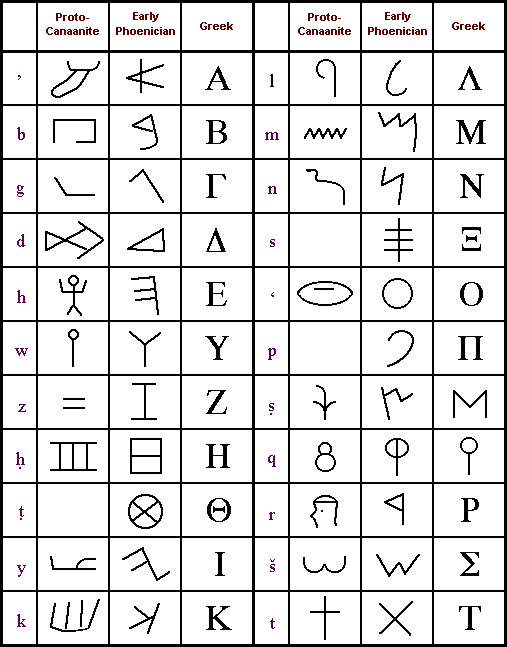
Proto-Canaanite, also known as Proto-Sinaitic, was the first consonant alphabet. Even a quick and cursory glance at its inventory of signs makes very apparent this script' Egyptian origin. It is thought that at round 1700 BC, Sinai was conquered by Egypt (for its turquoise mines and trade routes). Egyptian influence must have poured into the local West-Semitic speaking population, who, among other things, adopted a small number of hieroglyphic signs (probably no more than 22) to write down their language.
The process of adoption, though, is quite interesting. Egyptian hieroglyphs already have phonetic signs (in addition to logograms), but the Sinaitic people did not adopt these phonetic signs. Instead, they randomly chose pictorial Egyptian glyphs (like ox-head, house, etc), where each sign stood for a consonant. How did they decide which sign gets which consonant? A sign is a picture of an object, and the first consonant of the word for this object becomes the sound the sign represents. In short, this is called the acrophonic principle.
For example, the word for an ox is /'aleph/, which is the first sign on the left Proto-Canaanite column. It stood for the sound /'/, which is the glottal stop.
Phoenician was the immediate descendent of Proto-Canaanite. Its major change is the more linear (less curved) shapes of its signs. Other than this cosmetic change, everything else remained pretty much the same. South Arabian was also an early offshoot of Proto-Canaanite, as its letters are very different in shape and order from Phoenician.
There were many branches that sprang up from Phoenician, like Hebrew, Greek, and Aramaic. Phoenician itself remained in use, in the form of Punic (more cursive), until about 200 AD. Phoenician Language
This chart shows a comparison between the Proto-Canaanite, Phoenician, and Greek alphabets.