Publius Ovidius Naso (20 March 43 BC - AD 17/18), known as Ovid in the English-speaking world, was a Roman poet who is best known as the author of the three major collections of poetry: Heroides, Amores, and Ars Amatoria, and of the Metamorphoses, a mythological hexameter poem.
He is also well known for the Fasti, about the Roman calendar; and the Tristia and Epistulae ex Ponto, two collections of poems written in exile on the Black Sea. Ovid was also the author of several smaller pieces, the Remedia Amoris, the Medicamina Faciei Femineae, and the long curse-poem Ibis.
He also authored a lost tragedy, Medea. He is considered a master of the elegiac couplet, and is traditionally ranked alongside Virgil and Horace as one of the three canonic poets of Latin literature. The scholar Quintilian considered him the last of the canonical Latin love elegists. His poetry, much imitated during Late Antiquity and the Middle Ages, decisively influenced European art and literature and remains as one of the most important sources of classical mythology.
Ovid wrote in elegiac couplets, with two exceptions: his lost Medea, whose two fragments are in iambic trimeter and anapests, respectively, and his great Metamorphoses, which he wrote in dactylic hexameter, the meter of Virgil's Aeneid and Homer's epics. Ovid offers an epic unlike those of his predecessors, a chronological account of the cosmos from creation to his own day, incorporating many myths and legends about supernatural transformations from the Greek and Roman traditions.
Ovid was born in Sulmo (Sulmona), in an Apennine valley east of Rome, to an important equestrian family, on March 20, 43 BC. That was a significant year in Roman politics. He was educated in Rome in rhetoric under the teachers Arellius Fuscus and Porcius Latro with his brother who excelled at oratory.
His father wished him to study rhetoric toward the practice of law. According to Seneca the Elder, Ovid tended to the emotional, not the argumentative pole of rhetoric. After the death of his brother at 20 years of age, Ovid renounced law and began travelling to Athens, Asia Minor, and Sicily.
He held minor public posts, as one of the tresviri capitales and as one of the decemviri stlitibus iudicandis, but resigned to pursue poetry probably around 29 - 25 BC, a decision of which his father apparently disapproved. His first recitation has been dated to around 25 BC, when Ovid was eighteen.
He was part of the circle centered upon the patron Marcus Valerius Messalla Corvinus, but seems to have been friends with poets in the circle of Maecenas. In Trist. 4.10.41 - 54, Ovid mentions friendships with Macer, Propertius, Horace, and Bassus (he only barely met Virgil and Tibullus, a fellow member of Messalla's circle whose elegies he admired greatly). Ovid was very popular at the time of his early works, but was later exiled by Augustus in AD 8.
He married three times and divorced twice by the time he was thirty years old. However, he only had one daughter who eventually bore him grandchildren. His last wife was connected in some way to the influential gens Fabia and would help him during his exile in Tomis.
The first 25 years of Ovid's literary career were spent primarily writing poetry in elegiac meter with erotic themes. The chronology of these early works is not secure; tentative dates, however, have been established by scholars. His earliest extant work is thought to be the Heroides, letters of mythological heroines to their absent lovers, which may have been published in 19 BC, although the date is uncertain as it depends on a notice in Am.2.18.19 - 26, which seems to describe the collection as an early published work.
The authenticity of various of these poems has been challenged but this first edition probably contained the first 14 poems of the collection. The first five-book collection of the Amores, a series of erotic poems addressed to a lover, Corinna, is thought to have been published in 16 - 15 BC; the surviving, extant version, redacted to three books according to an epigram prefixed to the first book, is thought to have been published c. 8 - 3 BC.
Between the publications of the two editions of the Amores can be dated the premiere of his tragedy Medea which was admired in antiquity but is now no longer extant. Ovid's next poem, the Medicamina Faciei, a fragmentary work on women's beauty treatments preceded the Ars Amatoria, the Art of Love, a parody of didactic poetry and a three-book manual about seduction and intrigue, which has been dated to 2 AD.
Ovid may identify this work in his exile poetry as the carmen, or song, which was one cause of his banishment. The Ars Amatoria was followed by the Remedia Amoris in the same year. This corpus of elegiac, erotic poetry earned Ovid a place among the chief Roman elegists Gallus, Tibullus, and Propertius, of which he saw himself as the fourth member.
By 8 AD, he had completed his most ambitious work, the Metamorphoses, a hexameter epic poem in 15 books which encyclopedically catalogues transformations in Greek and Roman mythology from the emergence of the cosmos to the deification of Julius Caesar. The stories follow each other in the telling of human beings transformed to new bodies - trees, rocks, animals, flowers, constellations et cetera. At the same time, he was working on the Fasti, a six-book poem in elegiac couplets which took the Roman festivals calendar and astronomy as its theme. The composition of this poem was interrupted by Ovid's exile, and it is thought that Ovid abandoned work on the piece in Tomis. It is likely in this period, if they are indeed by Ovid, that the double letters (16-21) in the Heroides were composed.
The Metamorphoses, Ovid's most ambitious and popular work, consists of a 15-book catalogue written in dactylic hexameter about the transformations in Greek and Roman mythology set within a loose mytho-historical framework. Each myth is set outdoors where the mortals are often vulnerable to external influences.
Almost 250 different myths are mentioned. The poem stands in the tradition of mythological and aetiological catalogue poetry such as Hesiod's Catalogue of Women, Callimachus' Aetia, Nicander's Heteroeumena, and Parthenius' Metamorphoses.
The first book describes the formation of the world, the ages of man, the flood, the story of Daphne's rape by Apollo and Io's by Jupiter.
The second book opens with Phaethon and continues describing the love of Jupiter with Callisto and Europa.
The third book focuses on the mythology of Thebes with the stories of Cadmus, Actaeon, and Pentheus.
The fourth book focuses on three lovers: Pyramus and Thisbe, Salmacis and Hermaphroditus, and Perseus and Andromeda.
The fifth book focuses on the song of the Muses, which describes the rape of Proserpina.
The sixth book is a collection of stories about the rivalry between gods and mortals, beginning with Arachne and ending with Philomela.
The seventh book focuses on Medea, as well as Cephalus and Procris.
The eighth book focuses on Daedalus' flight, the Calydonian boar hunt, and the contrast between pious Baucis and Philemon and the wicked Erysichthon.
The ninth book focuses on Heracles and the incestuous Byblis.
The tenth book focuses on stories of doomed love, such as Orpheus, who sings about Hyacinthus, as well as Pygmalion, Myrrha, and Adonis.
The eleventh book compares the marriage of Peleus and Thetis with the love of Ceyx and Alcyone.
The twelfth book moves from myth to history describing the exploits of Achilles, the battle of the centaurs, and Iphigeneia.
The thirteenth book discusses the contest over Achilles' arms, and Polyphemus.
The fourteenth moves to Italy, describing the journey of Aeneas, Pomona and Vertumnus, and Romulus.
The final book opens with a philosophical lecture by Pythagoras and the deification of Caesar. The end of the poem praises Augustus and expresses Ovid's belief that his poem has earned him immortality.
In analyzing the Metamorphoses, scholars have focused on Ovid's organization of his vast body of material. The ways that stories are linked by geography, themes, or contrasts creates interesting effects and constantly forces the reader to evaluate the connections. Ovid also varies his tone and material from different literary genres; G. B. Conte has called the poem a "a sort of gallery of these various literary genres."
In this spirit, Ovid engages creatively with his predecessors, alluding creatively to the full spectrum of classical poetry. Ovid's use of Alexandrian epic, or elegiac couplets, shows his fusion of erotic and psychological style with traditional forms of epic.
In 8 AD, Ovid was banished to Tomis, on the Black Sea, by the exclusive intervention of the Emperor Augustus, without any participation of the Senate or of any Roman judge, an event which would shape all of his following poetry. Ovid wrote that the reason for his exile was carmen et error - "a poem and a mistake", claiming that his crime was worse than murder,more harmful than poetry.
The Emperor's grandchildren, Agrippa Postumus and Julia the Younger, were banished around the time of his banishment; Julia's husband, Lucius Aemilius Paullus, was put to death for conspiracy against Augustus, a conspiracy about which Ovid might have known.
The Julian Marriage Laws of 18 BC, which promoted monogamous marriage to increase the population's birth rate, were fresh in the Roman mind. Ovid's writing in the Ars Amatoria concerned the serious crime of adultery, and he may have been banished for these works which appeared subversive to the emperor's moral legislation. However, because of the long distance of time between the publication of this work (1 BC) and the exile (8 AD), some authors suggest that Augustus used the poem as a mere justification for something more personal.
It was during this period of exile - more properly known as a relegation - that Ovid wrote two more collections of poems, called Tristia and Epistulae ex Ponto, which illustrate his sadness and desolation away from Rome. Even though he was friendly with the natives of Tomis, he still pined for Rome and his beloved third wife. Many of the poems are addressed to her, but also to Augustus, whom he calls Caesar and sometimes God, to himself, and even sometimes to the poems themselves, which expresses his heart-felt solitude. The famous first two lines of the Tristia demonstrate the poet's misery from the start.
Ovid died at Tomis in AD 17. It is thought that the Fasti, which he spent time revising, were published posthumously. He was allegedly buried a few kilometers away in a nearby town. In 1930 that town was renamed Ovidiu in his honor. As Ovid spent the last years of his life and literary work in what is now Romania, Romanian nationalists have adopted him as "The First Romanian Poet" and placed him in the pantheon of Romanian national heroes. Ovidiu is a common male first name in Romania. Also, a statue commemorates him in the Romanian city of Tomis.
Ovid's works have been interpreted in various ways over the centuries with attitudes that depended on the social, religious and literary contexts of different times. It is known that since his own lifetime, he was already famous and criticized.
In the Remedia Amoris, Ovid reports criticism from people who considered his books insolent. Ovid responded to this criticism by writing the following: "Gluttonous Envy, burst: my nameÕs well known already:/it will be more so, if only my feet travel the road theyÕve started. But youÕre in too much of a hurry: if I live youÕll be more than sorry:/many poems, in fact, are forming in my mind."
After such criticism subsided, Ovid became one of the best known and most loved Roman poets during the Middle Ages and the Renaissance. The authors of the Middle Ages used his work as a way to read and write about sex and violence without orthodox "scrutiny routinely given to commentaries on the Bible". In the Middle Ages the voluminous Ovide Moralise, a French work that moralizes 15 books of the Metamorphoses was composed. This work then influenced Chaucer. Ovid's poetry provided inspiration for the Renaissance idea of humanism, and more specifically, for many Renaissance painters and writers. Montaigne, for example, alluded to Ovid several times in his Essais, specifically in his comments on Education of Children.
In the 16th century, some Jesuit schools of Portugal cut several passages from Ovid's Metamorphoses. While the Jesuits saw his poems as elegant compositions worthy of being presented to students for educational purposes, they also felt his works as a whole might corrupt students.
Jesuits took much of their knowledge of Ovid to the Portuguese colonies. According to Serafim Leite (1949), the ratio studiorum was in effect in Colonial Brazil during the early 17th century, and in this period Brazilian students read works like the Epistulae ex Ponto to learn Latin grammar.
In Spain Ovid is both praised and criticized by Cervantes in his Don Quixote where he warns against satires that can exile poets as it happened to Ovid.
In the 16th century, Ovid's works were criticized in England. The Archbishop of Canterbury and the Bishop of London ordered that a contemporary translation of Ovid's love poems be publicly burned in 1599. The Puritans of the following century viewed Ovid as pagan, thus as an immoral influence.
John Dryden composed a famous translation of the Metamorphoses into stopped rhyming couples during the 18th century, when Ovid was "refashioned in its own image, one kind of Augustanism making over another."
The Romantic movement of the 19th century, in contrast, considered Ovid and his poems "stuffy, dull, over-formalized and lacking in genuine passion."
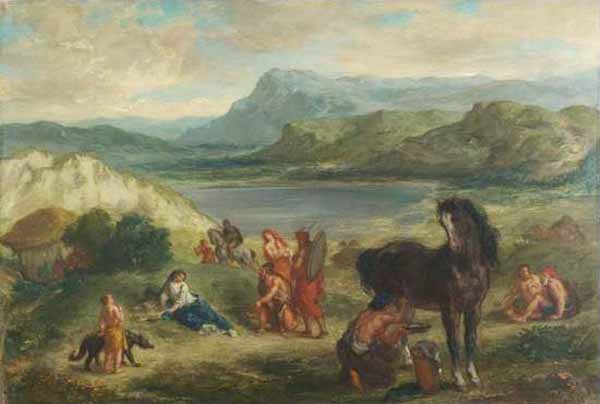
Romantics might have preferred his poetry of exile The picture Ovid among the Scythians, painted by Delacroix, portrays the last years of the poet in exile in Scythia, and was seen by Baudelaire, Gautier and Edgar Degas.
Baudelaire took the opportunity to write a long essay about the life of an exiled poet like Ovid. These informations show that the exile of Ovid had some influence in 19th century Romanticism since it makes connections with its key concepts such as the wildness and the misunderstood genius.
ANCIENT AND LOST CIVILIZATIONS