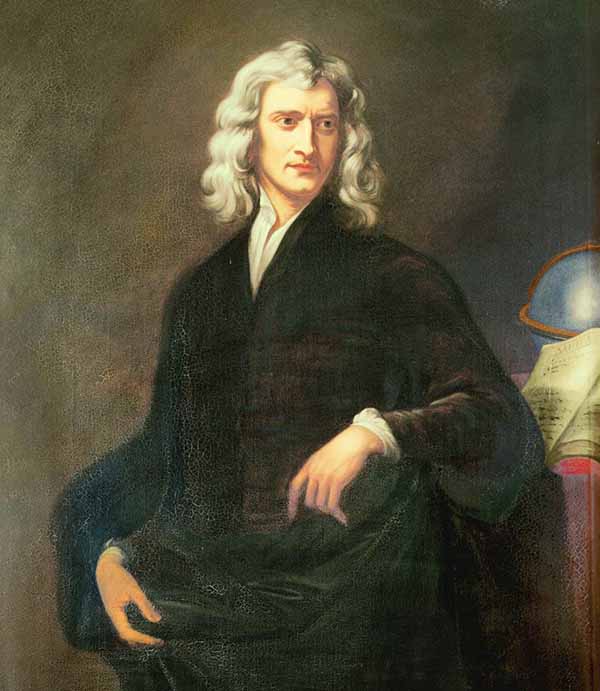
Sir Isaac Newton (January 4, 1643 - March 31, 1727) was an English mathematician, physicist, astronomer, alchemist, and natural philosopher who is generally regarded as one of the greatest scientists and mathematicians in history. Newton wrote the Philosophiae Naturalis Principia Mathematica, in which he described universal gravitation and the three laws of motion, laying the groundwork for classical mechanics. By deriving Kepler's laws of planetary motion from this system, he was the first to show that the motion of objects on Earth and of celestial bodies are governed by the same set of natural laws. The unifying and deterministic power of his laws was integral to the scientific revolution and the advancement of heliocentrism.
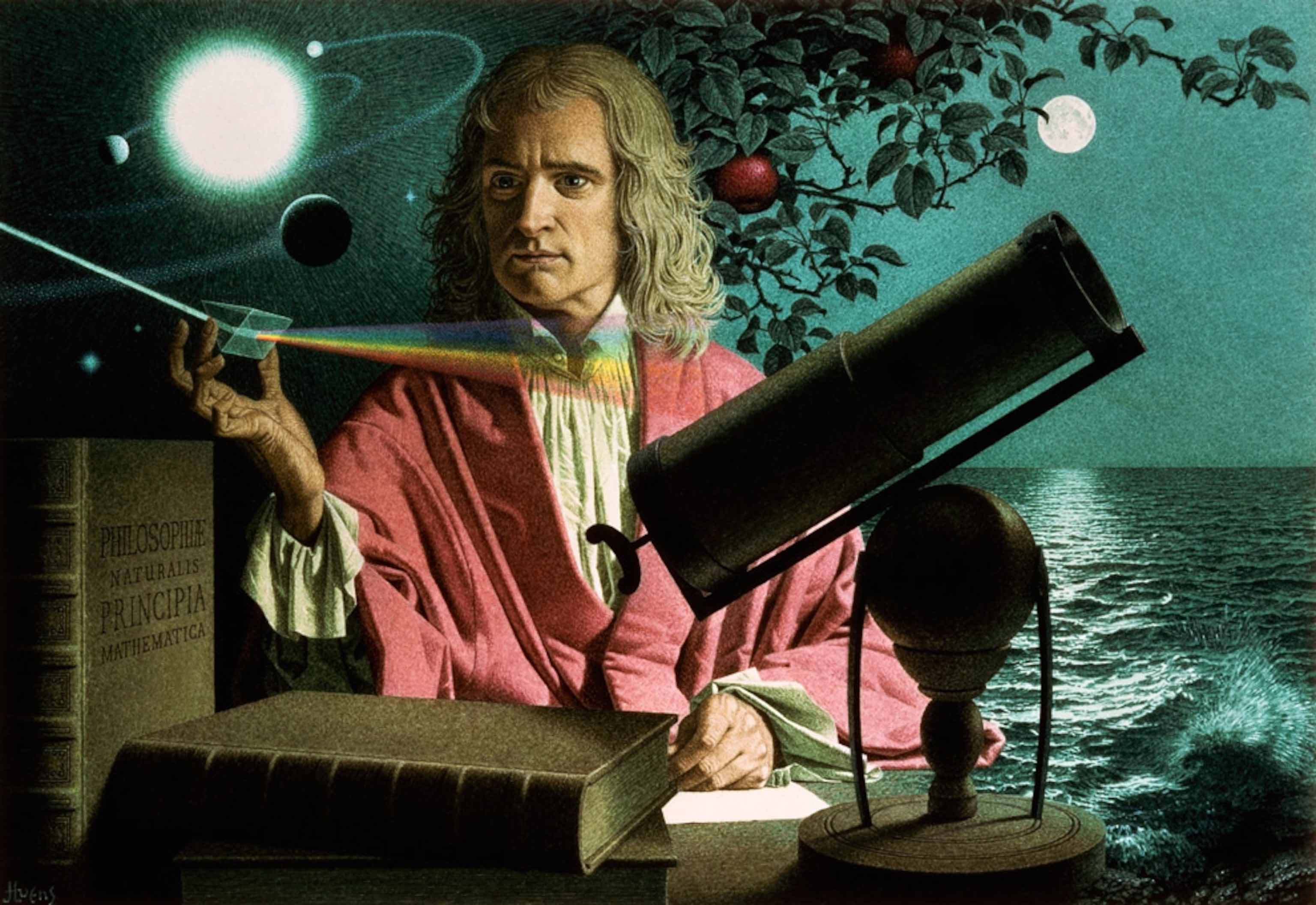
Among other scientific discoveries, Newton realized that the spectrum of colors observed when white light passes through a prism is inherent in the white light and not added by the prism (as Roger Bacon had claimed in the thirteenth century), and notably argued that light is composed of particles.
He also developed a law of cooling, describing the rate of cooling of objects when exposed to air.
He enunciated the principles of conservation of momentum and angular momentum.
Finally, he studied the speed of sound in air, and voiced a theory of the origin of stars.
Despite this renown in mainstream science, Newton actually spent more time working on alchemy than physics, writing considerably more papers on the former than the latter.
Newton played a major role in the development of calculus, sharing credit with Gottfried Leibniz. He also made contributions to other areas of mathematics, for example the generalized binomial theorem. The mathematician and mathematical physicist Joseph Louis Lagrange (1736-1813), said that "Newton was the greatest genius that ever existed and the most fortunate, for we cannot find more than once a system of the world to establish."
Born in the hamlet of Woolsthorpe, Newton was the only son of a local yeoman, also Isaac Newton, who had died three months before, and of Hannah Ayscough. That same year, at Arcetri near Florence, Galileo Galilei had died; Newton would eventually pick up his idea of a mathematical science of motion and bring his work to full fruition. A tiny and weak baby, Newton was not expected to survive his first day of life, much less 84 years.
From the age of about twelve until he was seventeen, Newton was educated at The King's School in Grantham (where his signature can still be seen upon a library window sill). He was removed from school and by Oct 1659 he was to be found at Woolsthorpe, where his mother attempted to make a farmer of him. He was, by later reports of his contemporaries, thoroughly unhappy with the work. It appears to be Henry Stokes, master at the King's School, who persuaded his mother to send him back to school so that he might complete his education.
In June 1661 he matriculated to Trinity College, Cambridge. At that time, the college's teachings were based on those of Aristotle, but Newton preferred to read the more advanced ideas of modern philosophers such as Descartes and astronomers such as Galileo, Copernicus and Kepler.
When Newton arrived in Cambridge in 1661, the movement now known as the scientific revolution was well advanced, and many of the works basic to modern science had appeared. Astronomers from Copernicus to Kepler had elaborated the heliocentric system of the universe. Galileo had proposed the foundations of a new mechanics built on the principle of inertia. Led by Descartes, philosophers had begun to formulate a new conception of nature as an intricate, impersonal, and inert machine. Yet as far as the universities of Europe, including Cambridge, were concerned, all this might well have never happened. They continued to be the strongholds of outmoded Aristotelianism, which rested on a geocentric view of the universe and dealt with nature in qualitative rather than quantitative terms.
Like thousands of other undergraduates, Newton began his higher education by immersing himself in Aristotle's work. Even though the new philosophy was not in the curriculum, it was in the air. Some time during his undergraduate career, Newton discovered the works of the French natural philosopher Rene Descartes and the other mechanical philosophers, who, in contrast to Aristotle, viewed physical reality as composed entirely of particles of matter in motion and who held that all the phenomena of nature result from their mechanical interaction.
A new set of notes, which he entitled Quaestiones Quaedam Philosophicae (Certain Philosophical Questions), begun sometime in 1664, usurped the unused pages of a notebook intended for traditional scholastic exercises; under the title he entered the slogan "Amicus Plato amicus Aristoteles magis amica veritas" ("Plato is my friend, Aristotle is my friend, but my best friend is truth").
Newton's scientific career had begun.
The "Quaestiones" reveal that Newton had discovered the new conception of nature that provided the framework of the scientific revolution. He had thoroughly mastered the works of Descartes and had also discovered that the French philosopher Pierre Gassendi had revived atomism, an alternative mechanical system to explain nature. The "Quaestiones" also reveal that Newton already was inclined to find the latter a more attractive philosophy than Cartesian natural philosophy, which rejected the existence of ultimate indivisible particles.
The works of the 17th-century chemist Robert Boyle provided the foundation for Newton's considerable work in chemistry. Significantly, he had read Henry More, the Cambridge Platonist, and was thereby introduced to another intellectual world, the magical Hermetic tradition, which sought to explain natural phenomena in terms of alchemical and magical concepts. The two traditions of natural philosophy, the mechanical and the Hermetic, antithetical though they appear, continued to influence his thought and in their tension supplied the fundamental theme of his scientific career.
Although he did not record it in the "Quaestiones," Newton had also begun his mathematical studies. He again started with Descartes, from whose La Geometrie he branched out into the other literature of modern analysis with its application of algebraic techniques to problems of geometry. He then reached back for the support of classical geometry. Within little more than a year, he had mastered the literature; and, pursuing his own line of analysis, he began to move into new territory. He discovered the binomial theorem, and he developed the calculus, a more powerful form of analysis that employs infinitesimal considerations in finding the slopes of curves and areas under curves.
When Newton received the bachelor's degree in April 1665, the most remarkable undergraduate career in the history of university education had passed unrecognized. On his own, without formal guidance, he had sought out the new philosophy and the new mathematics and made them his own, but he had confined the progress of his studies to his notebooks.
Then, in 1665, the plague closed the university, and for most of the following two years he was forced to stay at his home, contemplating at leisure what he had learned. During the plague years Newton laid the foundations of the Calculus and extended an earlier insight into an essay, "Of Colors," which contains most of the ideas elaborated in his Opticks.
It was during this time that he examined the elements of circular motion and, applying his analysis to the Moon and the planets, derived the inverse square relation that the radially directed force acting on a planet decreases with the square of its distance from the Sun--which was later crucial to the law of universal gravitation. The world heard nothing of these discoveries. He chose not to share concepts he had discovered unless he was asked.
Newton became a fellow of Trinity College in 1669. In the same year he circulated his findings in De Analysi per Aequationes Numeri Terminorum Infinitas (On Analysis by Infinite Series), and later in De methodis serierum et fluxionum (On the Methods of Series and Fluxions), whose title gave rise to the "method of fluxions". Despite the fact that only a handful of savants were even aware of Newton's existence, he had arrived at the point where he had become the leading mathematician in Europe.
Newton and Gottfried Leibniz developed the calculus independently, using different notations. Although Newton had worked out his method years before Leibniz, he published almost nothing about it until 1693, and did not give a full account until 1704. Meanwhile, Leibniz began publishing a full account of his methods in 1684. Moreover, Leibniz's notation and "differential Method" were universally adopted on the Continent, and after 1820 or so, in the British Empire.
Newton claimed that he had been reluctant to publish his calculus because he feared being mocked for it. Starting in 1699, other members of the Royal Society accused Leibniz of plagiarism, and the dispute broke out in full force in 1711. Thus began the bitter calculus priority dispute with Leibniz, which marred the lives of both Newton and Leibniz until the latter's death in 1716. This dispute created a divide between British and Continental mathematicians that may have retarded the progress of British mathematics by at least a century.
Newton is generally credited with the generalized binomial theorem, valid for any exponent. He discovered Newton's identities, Newton's method, classified cubic plane curves (polynomials of degree three in two variables), made substantial contributions to the theory of finite differences, and was the first to use fractional indices and to employ coordinate geometry to derive solutions to Diophantine equations.
He approximated partial sums of the harmonic series by logarithms (a precursor to Euler's summation formula), and was the first to use power series with confidence and to revert power series. He also discovered a new formula for pi.He was elected Lucasian professor of mathematics in 1669.
In that day, any fellow of Cambridge or Oxford had to be an ordained Anglican priest. However, the terms of the Lucasian professorship required that the holder not be active in the church (presumably so as to have more time for science). Newton argued that this should exempt him from the ordination requirement, and Charles II, whose permission was needed, accepted this argument. Thus a conflict between Newton's religious views and Anglican orthodoxy was averted.
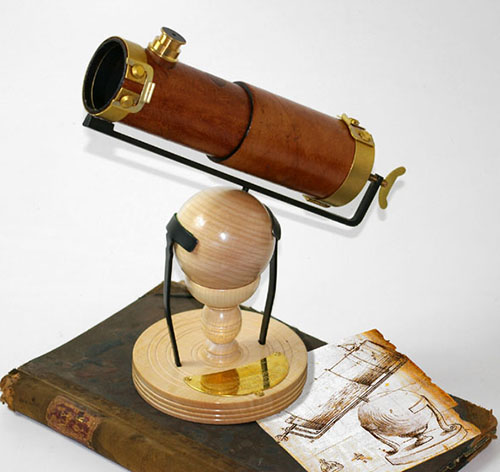
Replica of Newton's 6-inch reflecting telescope of 1672 for the Royal Society
From 1670 to 1672 he lectured on optics. During this period he investigated the refraction of light, demonstrating that a prism could decompose white light into a spectrum of colours, and that a lens and a second prism could recompose the multicoloured spectrum into white light. He also showed that the coloured light does not change its properties, by separating out a coloured beam and shining it on various objects.
Newton noted that regardless of whether it was reflected or scattered or transmitted, it stayed the same color. Thus the colors we observe are the result of how objects interact with the incident already-colored light, not the result of objects generating the color. Many of his findings in this field were criticized by later theorists, the most well-known being Johann Wolfgang von Goethe, who postulated his own color theories.
From this work he concluded that any refracting telescope would suffer from the dispersion of light into colours, and invented a reflecting telescope (today known as a Newtonian telescope) to bypass that problem.
By grinding his own mirrors, using Newton's rings to judge the quality of the optics for his telescopes, he was able to produce a superior instrument to the refracting telescope, due primarily to the wider diameter of the mirror. (Only later, as glasses with a variety of refractive properties became available, did achromatic lenses for refractors become feasible.)
In 1671 the Royal Society asked for a demonstration of his reflecting telescope. Their interest encouraged him to publish his notes On Color, which he later expanded into his Opticks.
When Robert Hooke criticized some of Newton's ideas, Newton was so offended that he withdrew from public debate. The two men remained enemies until Hooke's death.
In one experiment, to prove that color perception is caused by pressure on the eye, Newton slid a darning needle around the side of his eye until he could poke at its rear side, dispassionately noting "white, darke & colored circles" so long as he kept stirring with "ye bodkin."
Newton argued that light is composed of particles, but he had to associate them with waves to explain the diffraction of light (Opticks Bk. II, Props. XII-XX).
Later physicists instead favored a purely wavelike explanation of light to account for diffraction.
Today's quantum mechanics restores the idea of "wave-particle duality", although photons bear very little resemblance to Newton's corpuscles (e.g., corpuscles refracted by accelerating toward the denser medium).
Newton is believed to have been the first to explain precisely the formation of the rainbow from water droplets dispersed in the atmosphere in a rain shower.
In his Hypothesis of Light of 1675, Newton posited the existence of the ether to transmit forces between particles. Newton was in contact with Henry More, the Cambridge Platonist who was born in Grantham, on alchemy, and now his interest in the subject revived.
During a period of isolation, Newton was greatly influenced by the Hermetic tradition with which he had been familiar since his undergraduate days.
Newton, always somewhat interested in alchemy, now immersed himself in it, copying by hand treatise after treatise and collating them to interpret their arcane imagery. Under the influence of the Hermetic tradition, his conception of nature underwent a decisive change.
Until that time, Newton had been a mechanical philosopher in the standard 17th-century style, explaining natural phenomena by the motions of particles of matter. Thus, he held that the physical reality of light is a stream of tiny corpuscles diverted from its course by the presence of denser or rarer media. He felt that the apparent attraction of tiny bits of paper to a piece of glass that has been rubbed with cloth results from an ethereal effluvium that streams out of the glass and carries the bits of paper back with it.
This mechanical philosophy denied the possibility of action at a distance; as with static electricity, it explained apparent attractions away by means of invisible ethereal mechanisms.
Newton's Hypothesis of Light of 1675, with its universal ether, was a standard mechanical system of nature. Some phenomena, such as the capacity of chemicals to react only with certain others, puzzled him, however, and he spoke of a "secret principle" by which substances are "sociable" or "unsociable" with others.
About 1679, Newton abandoned the ether and its invisible mechanisms and began to ascribe the puzzling phenomena - chemical affinities, the generation of heat in chemical reactions, surface tension in fluids, capillary action, the cohesion of bodies, and the like, to attractions and repulsions between particles of matter.
More than 35 years later, in the second English edition of the Opticks, Newton accepted an ether again, although it was an ether that embodied the concept of action at a distance by positing a repulsion between its particles. The attractions and repulsions of Newton's speculations were direct transpositions of the occult sympathies and antipathies of Hermetic philosophy--as mechanical philosophers never ceased to protest.
Newton, however, regarded them as a modification of the mechanical philosophy that rendered it subject to exact mathematical treatment. As he conceived of them, attractions were quantitatively defined, and they offered a bridge to unite the two basic themes of 17th-century science--the mechanical tradition, which had dealt primarily with verbal mechanical imagery, and the Pythagorean tradition, which insisted on the mathematical nature of reality. Newton's reconciliation through the concept of force was his ultimate contribution to science.
John Maynard Keynes, who acquired many of Newton's writings on alchemy, stated that "Newton was not the first of the age of reason: he was the last of the magicians."
Newton's interest in alchemy cannot be isolated from his contributions to science. He lived at a time when there was no clear distinction between alchemy and science. Had he not relied on the occult idea of action at a distance, across a vacuum, he might not have developed his 'theory of gravity.'
In 1704 Newton wrote Opticks, in which he expounded his corpuscular theory of light. He considered light to be made up of extremely subtle corpuscles, that ordinary matter was made of grosser corpuscles and speculated that through a kind of alchemical transmutation "Are not gross Bodies and Light convertible into one another,...and may not Bodies receive much of their Activity from the Particles of Light which enter their Composition?" Newton also constructed a primitive form of a frictional electrostatic generator, using a glass globe (Optics, 8th Query). Controversy
Among the most important dissenters to Newton's paper was Robert Hooke, one of the leaders of the Royal Society who considered himself the master in optics and hence he wrote a condescending critique of the unknown parvenu. One can understand how the critique would have annoyed a normal man. The flaming rage it provoked, with the desire publicly to humiliate Hooke, however, bespoke the abnormal. Newton was unable rationally to confront criticism. Less than a year after submitting the paper, he was so unsettled by the give and take of honest discussion that he began to cut his ties, and he withdrew into virtual isolation.
In 1675, during a visit to London, Newton thought he heard Hooke accept his theory of colors. He was emboldened to bring forth a second paper, an examination of the colour phenomena in thin films, which was identical to most of Book Two as it later appeared in the Opticks.
The purpose of the paper was to explain the colors of solid bodies by showing how light can be analyzed into its components by reflection as well as refraction. His explanation of the colors of bodies has not survived, but the paper was significant in demonstrating for the first time the existence of periodic optical phenomena.
He discovered the concentric coloured rings in the thin film of air between a lens and a flat sheet of glass; the distance between these concentric rings (Newton's rings) depends on the increasing thickness of the film of air. In 1704 Newton combined a revision of his optical lectures with the paper of 1675 and a small amount of additional material in his Opticks.
A second piece which Newton had sent with the paper of 1675 provoked new controversy. Entitled "An Hypothesis Explaining the Properties of Light," it was in fact a general system of nature. Hooke apparently claimed that Newton had stolen its content from him, and Newton boiled over again. The issue was quickly controlled, however, by an exchange of formal, excessively polite letters that fail to conceal the complete lack of warmth between the men.
Newton was also engaged in another exchange on his theory of colors with a circle of English Jesuits in Lige, perhaps the most revealing exchange of all. Although their objections were shallow, their contention that his experiments were mistaken lashed him into a fury. The correspondence dragged on until 1678, when a final shriek of rage from Newton, apparently accompanied by a complete nervous breakdown, was followed by silence. The death of his mother the following year completed his isolation. For six years he withdrew from intellectual commerce except when others initiated a correspondence, which he always broke off as quickly as possible.
In 1679, Newton returned to his work on mechanics, i.e., gravitation and its effect on the orbits of planets, with reference to Kepler's laws of motion, and consulting with Hooke and Flamsteed on the subject. He published his results in De Motu Corporum (1684). This contained the beginnings of the laws of motion that would inform the Principia.
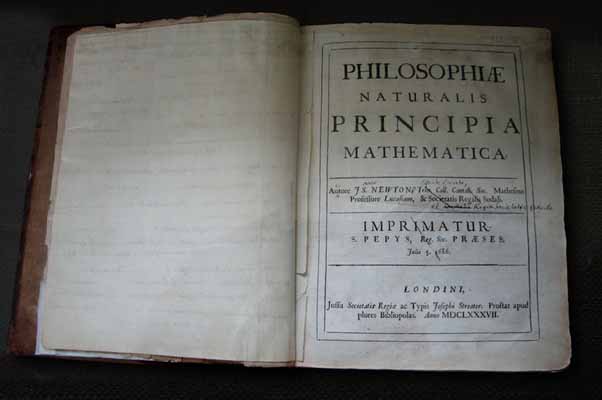
The Philosophiae Naturalis Principia Mathematica (now known as the Principia) was published on 5 July 16871 with encouragement and financial help from Edmond Halley.
In this work Newton stated the three universal laws of motion that were not to be improved upon for more than two hundred years. He used the Latin word gravitas (weight) for the force that would become known as gravity, and defined the law of universal gravitation. In the same work he presented the first analytical determination, based on Boyle's law, of the speed of sound in air.
With the Principia, Newton became internationally recognised. He acquired a circle of admirers, including the Swiss-born mathematician Nicolas Fatio de Duillier, with whom he formed an intense relationship that lasted until 1693. The end of this friendship led Newton to a nervous breakdown.
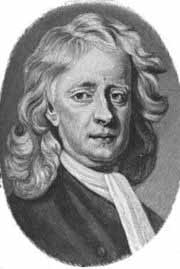
In the 1690s Newton wrote a number of religious tracts dealing with the literal interpretation of the Bible. Henry More's belief in the infinity of the universe and rejection of Cartesian dualism may have influenced Newton's religious ideas. A manuscript he sent to John Locke in which he disputed the existence of the Trinity was never published.
Later works - The Chronology of Ancient Kingdoms Amended (1728) and Observations Upon the Prophecies of Daniel and the Apocalypse of St. John (1733) - were published after his death.
He also devoted a great deal of time to alchemy.
Newton was also a member of the Parliament of England from 1689 to 1690 and in 1701, but his only recorded comments were to complain about a cold draft in the chamber and request that the window be closed.
Newton moved to London to take up the post of warden of the Royal Mint in 1696, a position that he had obtained through the patronage of Charles Montagu, 1st Earl of Halifax, then Chancellor of the Exchequer. He took charge of England's great recoining, somewhat treading on the toes of Master Lucas (and finagling Edmond Halley into the job of deputy comptroller of the temporary Chester branch). Newton became perhaps the best-known Master of the Mint upon Lucas' death in 1699, a position Newton held until his death. These appointments were intended as sinecures, but Newton took them seriously, retiring from his Cambridge duties in 1701, and exercising his power to reform the currency and punish clippers and counterfeiters.
As Master of the Mint Newton unofficially moved the Pound Sterling to the gold standard from silver in 1717; great reforms at the time and adding considerably to the wealth and stability of England. It was his work at the Mint, rather than his earlier contributions to science, that earned him a knighthood from Queen Anne in 1705.
Newton was made President of the Royal Society in 1703 and an associate of the French Academie des Sciences. In his position at the Royal Society, Newton made an enemy of John Flamsteed, the Astronomer Royal, by prematurely publishing Flamsteed's star catalogue.
Newton died in London on March 20th, 1727, and was buried in Westminster Abbey. His half-niece, Catherine Barton Conduitt, served as his hostess in social affairs at his house on Jermyn Street in London; he was her "very loving Uncle", according to his letter to her when she was recovering from smallpox. Newton died intestate and his considerable estate was divided between his half-nieces and half-nephews.
After his death, Newton's body was discovered to have had massive amounts of mercury in it, probably resulting from his alchemical pursuits. Mercury poisoning could explain Newton's eccentricity in late life.
The law of gravity became Newton's best-known discovery. He warned against using it to view the universe as a mere machine, like a great clock. He said, "Gravity explains the motions of the planets, but it cannot explain who set the planets in motion. God governs all things and knows all that is or can be done."
His scientific fame notwithstanding, Newton's study of the Bible and of the early Church Fathers were among his greatest passions. He devoted more time to the study of the Scriptures, the Fathers, and to Alchemy than to science, and said, "I have a fundamental belief in the Bible as the Word of God, written by those who were inspired. I study the Bible daily."
Newton himself wrote works on textual criticism, most notably An Historical Account of Two Notable Corruptions of Scripture.
Newton also placed the crucifixion of Jesus Christ at 3 April, AD 33, which is now the accepted traditional date. He also attempted, unsuccessfully, to find hidden messages within the Bible.
Despite his focus on theology and alchemy, Newton tested and investigated these ideas with the scientific method, observing, hypothesizing, and testing his theories. To Newton, his scientific and religious experiments were one and the same, observing and understanding how the world functioned.
Newton rejected the church's doctrine of the trinity, and was probably a follower of arianism. In a minority view, T.C. Pfizenmaier argues that he more likely held the Eastern Orthodox view of the Trinity rather than the Western one held by Roman Catholics, Anglicans, and most Protestants.
In his own day, he was also accused of being a Rosicrucian (as were many in the Royal Society and in the court of Charles II).
In his own lifetime, Newton wrote more on religion than he did on natural science. He believed in a rationally immanent world, but he rejected the hylozoism implicit in Leibniz and Baruch Spinoza. Thus, the ordered and dynamically informed universe could be understood, and must be understood, by an active reason, but this universe, to be perfect and ordained, had to be regular.
Newton and Robert Boyle's mechanical philosophy was promoted by rationalist pamphleteers as a viable alternative to the pantheists and enthusiasts, and was accepted hesitantly by orthodox preachers as well as dissident preachers like the latitudinarians.
Thus, the clarity and simplicity of science was seen as a way to combat the emotional and metaphysical superlatives of both superstitious enthusiasm and the threat of atheism, and, at the same time, the second wave of English deists used Newton's discoveries to demonstrate the possibility of a "Natural Religion."
The attacks made against pre-Enlightenment "magical thinking," and the mystical elements of Christianity, were given their foundation with Boyle's mechanical conception of the universe. Newton gave Boyle's ideas their completion through mathematical proofs, and more importantly was very successful in popularizing them.
The perceived ability of Newtonians to explain the world, both physical and social, through logical calculations alone is the crucial idea in the disenchantment of Christianity.
Newton saw God as the master creator whose existence could not be denied in the face of the grandeur of all creation.
But the unforeseen theological consequence of his conception of God, as Leibniz pointed out, was that God was now entirely removed from the world's affairs, since the need for intervention would only evidence some imperfection in God's creation, something impossible for a perfect and omnipotent creator.
Leibniz's theodicy cleared God from the responsibility for "l'origine du mal" by making God removed from participation in his creation. The understanding of the world was now brought down to the level of simple human reason, and humans, as Odo Marquard argued, became responsible for the correction and elimination of evil.
On the other hand, latitudinarian and Newtonian ideas taken too far resulted in the millenarians, a religious faction dedicated to the concept of a mechanical universe, but finding in it the same enthusiasm and mysticism that the Enlightenment had fought so hard to extinguish.
As warden of the royal mint, Newton estimated that 20% of the coins taken in during The Great Recoinage were counterfeit. Counterfeiting was treason, punishable by death by drawing and quartering. Despite this, convictions of the most flagrant criminals could be extremely difficult to achieve; however, Newton proved to be equal to the task.
He gathered much of that evidence himself, disguised, while he hung out at bars and taverns. For all the barriers placed to prosecution, and separating the branches of government, English law still had ancient and formidable customs of authority.
Newton was made a justice of the peace and between June 1698 and Christmas 1699 conducted some 200 cross-examinations of witnesses, informers and suspects. Newton later ordered all records of his interrogations to be destroyed. Newton won his convictions and in February 1699, he had ten prisoners waiting to be executed.
Newton's greatest triumph as the king's attorney was against William Chaloner. One of Chaloner's schemes was to set up phony conspiracies of Catholics and then turn in the hapless conspirators whom he entrapped. Chaloner made himself rich enough to posture as a gentleman.
Petitioning Parliament, Chaloner accused the Mint of providing tools to counterfeiters (a charge also made by others). He proposed that he be allowed to inspect the Mint's processes in order to improve them. He petitioned Parliament to adopt his plans for a coinage that could not be counterfeited, while at the same time striking false coins. After being exposed by Newton, Chaloner was hanged, drawn and quartered on March 23, 1699.
Enlightenment philosophers chose a short history of scientific predecessors - Galileo, Boyle, and Newton principally - as the guides and guarantors of their applications of the singular concept of Nature and Natural Law to every physical and social field of the day. In this respect, the lessons of history and the social structures built upon it could be discarded.
It was Newton's conception of the universe based upon Natural and rationally understandable laws that became the seed for Enlightenment ideology. Locke and Voltaire applied concepts of Natural Law to political systems advocating intrinsic rights; the physiocrats and Adam Smith applied Natural conceptions of psychology and self-interest to economic systems and the sociologists criticized the current social order for trying to fit history into Natural models of progress. Monboddo and Samuel Clarke resisted elements of Newton's work, but eventually rationalized it to conform with their strong religious views of nature.
Newton's laws of motion and gravity provided a basis for predicting a wide variety of different scientific or engineering situations, especially the motion of celestial bodies. His calculus proved vitally important to the development of further scientific theories.
Finally, he unified many of the isolated physics facts that had been discovered earlier into a satisfying system of laws. Newton's conceptions of gravity and mechanics, though not as accurate as Einstein's Theory of Relativity or quantum mechanics, still represent an enormous step in the evolution of human understanding of the universe. For this reason, he is generally considered one of history's greatest scientists.
In 1717, the Kingdom of Great Britain went on to an unofficial gold standard when Newton, then Master of the Mint, established a fixed price of 44 guineas per standard (22 carat) troy pound. Under the gold standard the value of the pound (measured in gold weight) remained largely constant until the beginning of the 20th century.
Newton is reputed to have invented the cat flap. This was said to be done so that he would not have to disrupt his optical experiments, conducted in a darkened room, to let his cat in or out.
Newtonmas is a holiday celebrated by some scientists as an alternative to Christmas, taking advantage of the fact that Newton's birthday fell on 25 December in the Julian calendar in use at the time of his birth.
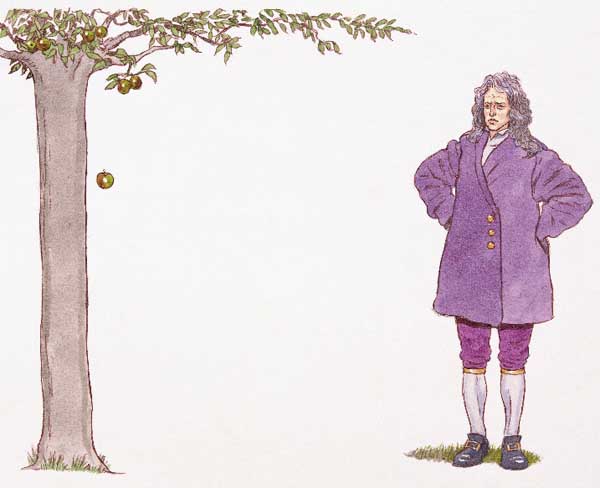
To this day, Newton's achievements have been immortalized in popular culture. Almost all schoolchildren are familiar with the apocryphal story of Newton's apple and his subsequent discovery of gravity; even the likeness of Newton holding an apple under a tree is a well-known image of science. English poet Alexander Pope was sufficiently moved by Newton's accomplishments to write the famous epitaph:
Newton has also featured in conspiracy theories and fiction.
Newton has been identified as a "Grand Master of the Priory of Sion" from 1691-1727 in documents that have been dismissed as a hoax concocted by Pierre Plantard.
This information was incorporated into the 1982 book The Holy Blood and the Holy Grail, which was later one of the primary source books for the bestselling 2003 Dan Brown novel The Da Vinci Code.
The famous three laws of Newton are:
Newton's First Law (also known as the Law of Inertia) states that an object at rest tends to stay at rest and that an object in uniform motion tends to stay in uniform motion unless acted upon by a net external force.
Newton's Second Law states that an applied force equals the rate of change of momentum. For constant mass: F=ma, or force equals mass times acceleration. In other words, the acceleration produced by a net force on an object is directly proportional to the magnitude of the net force and inversely proportional to the mass. In the MKS system of measurement, mass is given in kilograms, acceleration in metres per second squared, and force in newtons (named in his honor).
Newton's Third Law states that for every action there is an equal and opposite reaction.
The question was not whether gravity existed, but whether it extended so far from Earth that it could also be the force holding the moon to its orbit. Newton showed that if the force decreased as the inverse square of the distance, one could indeed calculate the Moon's orbital period, and get good agreement. He guessed the same force was responsible for other orbital motions, and hence named it "universal gravitation".
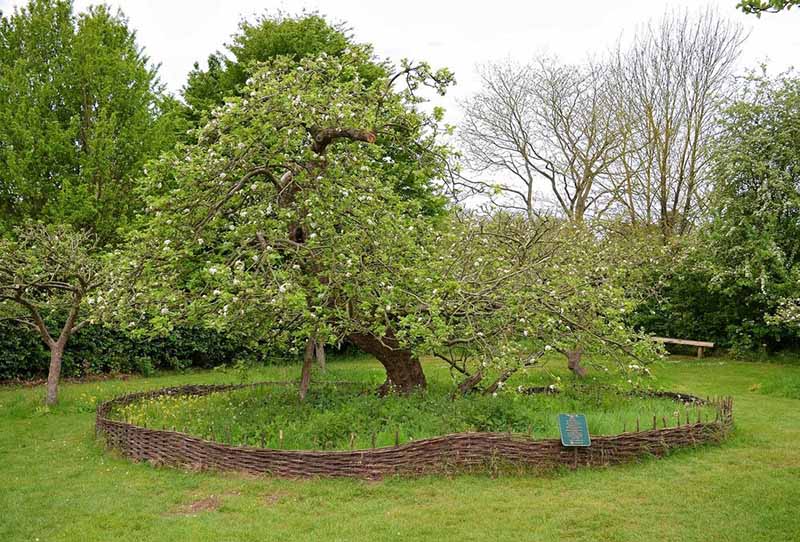
A contemporary writer, William Stukeley, recorded in his Memoirs of Sir Isaac Newton's Life a conversation with Newton in Kensington on April 15, 1726, in which Newton recalled "when formerly, the notion of gravitation came into his mind. It was occasioned by the fall of an apple, as he sat in contemplative mood. Why should that apple always descend perpendicularly to the ground, thought he to himself. Why should it not go sideways or upwards, but constantly to the earth's centre." In similar terms, Voltaire wrote in his Essay on Epic Poetry (1727), "Sir Isaac Newton walking in his gardens, had the first thought of his system of gravitation, upon seeing an apple falling from a tree." These accounts are probably exaggerations of Newton's own tale about sitting by a window in his home (Woolsthorpe Manor) and watching an apple fall from a tree.
Various trees are claimed to be "the" apple tree which Newton describes, the King's School, Grantham, claims that the tree was purchased by the school, uprooted and transported to the headmaster's garden some years later, the staff of the [now] National Trust-owned Woolsthrope Manor dispute this, and claim that a tree present in their gardens is the one described by Newton. It is also claimed that the tree was replanted in front of the council buildings in Grantham, which is unlikely, considering that they were built over 300 years after Newton's death. A clone of the original tree can be seen growing outside the main gate of Trinity College, Cambridge, below the room Newton lived in when he studied there.
Unpublished Papers Reveal Lesser-known, but Significant Research of Sir Issac Newton PhysOrg - September 11, 2006
Known primarily for his foundational work in math and physics, Sir Issac Newton actually spent more time on research in alchemy, as well as its interrelationships with science, history and religion, and its implications for economics.
Alchemy, as Newton practiced it in the 17th and 18th centuries, was research into the nature of chemical substances and processes - primarily the transmutation of materials from one type of matter to another. Newton and others conducted experiments, but also incorporated philosophical thought in their attempts to uncover the mysteries of the physical universe.
"NewtonŐs extensive work on universal history (which presents human history as a coherent unit governed by certain immutable principles) provides an essential setting for linking his work on alchemy and his work heading EnglandŐs mint in the 1690s," said Georgia Institute of Technology Professor Kenneth Knoespel, who chairs the School of Literature, Communication and Culture. "It is not at all farfetched to think of history as a kind of alchemical process that looks to the creation of value and wealth."
Knoespel presented a talk titled NewtonŐs Alchemical work and the creation of economic value at the American Chemical SocietyŐs 232nd national meeting in San Francisco. The talk was part of a session dedicated to scholarship based on the unpublished manuscripts of Newton, most of which are housed at the University of Cambridge and in the Edelstein Center at Hebrew University in Jerusalem. For the past 15 years, Knoespel has studied both collections -- some portions of which weren't available to scholars until the 1970s.
By integrating the study of these manuscripts, Knoespel determined that NewtonŐs alchemical practice functions as a translation code for a new language of economics in which an investigation of material-spiritual value becomes transformed into a systematic structure of social value understood through economics.
Newton began to translate his notions of value in alchemy to an economic setting when he was appointed to head EnglandŐs mint Đ several years after the 1687 publication of "The Principia," in which Newton described universal gravitation and the three laws of motion, laying the groundwork for classical mechanics.
"Newton moves from an academic research position to a position of considerable visibility within the state," Knoespel noted. "He became the symbol of the stability of the British economy at this time. It is hardly an exaggeration to think of such a move as involving a shift from private research to the broad application of policy formed by decades of private research."
Newton took the new job very seriously, undertaking new research on the history of money and combining it with his work in mathematics, alchemy and metallurgy. He improved the edging of coins, much like U.S. coins are formed today, to prevent people from clipping the edges. Newton also assayed the coins of Europe to determine the amount of gold and silver they contained to help establish EnglandŐs economic basis.
As the economic system of capitalism began to be institutionalized in Europe in the decades following Newton, many thought that capital, or value, within capitalism was being mystified in the same way that gold is within its alchemical transformation. Newton thought by improving the English economic system, he was going to contribute to the ongoing transformation of England into GodŐs kingdom on Earth. A Newtonian approach to matter carries with it a Messianic force that finally grounds itself in natural philosophy that includes an interpretation of human and natural history.
Newton never makes economic value the sole force that determines history. Instead, the practice of economics is at least twofold, involving both the practice of a monetary system and a conceptual framework that sees within an economic system, the workings of God in time.
Connecting the published work of Newton the mathematician and the physicist with the unpublished work of Newton the alchemist, historian and religious philosopher provides broader insight into his legacy. The history of science has often separated Newton the complex mathematician from the Newton of the Newtonians. The purists say: 'Newton is a mathematician and a physicist. DonŐt mix him up with religion or alchemy because youŐll turn him into Harry Potter.' But it is this purist belief that for 200 years suppressed NewtonŐs unpublished work in alchemy until the mid-20th century. Newton was profoundly interested in the relationship between physics and religion, but that doesnŐt turn him into a magician."