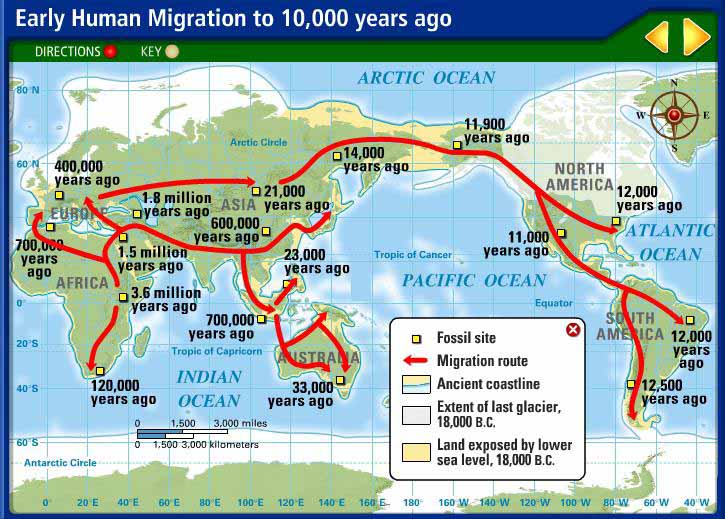
Human migration is physical movement by humans from one area to another, sometimes over long distances or in large groups. Historically this movement was nomadic, often causing significant conflict with the indigenous population and their displacement or cultural assimilation. Only a few nomadic people have retained this form of lifestyle in modern times. Migration has continued under the form of both voluntary migration within one's region, country, or beyond and involuntary migration (which includes the slave trade, trafficking in human beings and ethnic cleansing).
People who migrate into a territory are called immigrants, while at the departure point they are called emigrants. Small populations migrating to develop a territory considered void of settlement depending on historical setting, circumstances and perspective are referred to as settlers or colonists, while populations displaced by immigration and colonization are called refugees. The rest of this article will cover sense of a "change of residence", rather than the temporary migrations of travel, tourism, pilgrimages, or the commute. Read more
Ancient DNA Shatters the Simple Story of Europe's Origins

Ancient genomes from northwest Europe show that farming, foraging, migration, and marriage shaped prehistory in ways far more complex than earlier models suggested. Europe was settled in just three massive migrations from the east. The first arrivals were hunter-gatherers, who reached Europe more than 40,000 years ago. Later, after 9,000 years ago, farming populations from Anatolia spread across the continent during the Neolithic age.
Humans returned to Britain 500 years earlier than scientists thought after the last ice age Science Daily - May 13, 2026

People moved back into the British Isles around 15,200 years ago after the last major ice sheet began retreating, according to new research. That timeline is nearly 500 years earlier than earlier estimates suggested. The return of humans appears to have happened alongside a sharp increase in summer temperatures in southern Britain. At the time, Britain was still connected to mainland Europe, allowing people and animals to move across the landscape more easily.
I have always "seen" a connection between the darkest portals-regions on the planet from - parts of Africa to Haiti, to New Orleans, and to Papua New Guinea.
Who are the Papua New Guineans? New DNA study reveals stunning origins. They share a common ancestry from the same 'Out of Africa' event that also gave rise to other non-African groups Science Daily - September 15, 2025

On remote islands of Papua New Guinea, people carry a story that ties us all back to our deepest roots. Although their striking appearance once puzzled scientists, new genetic evidence shows they share a common ancestry with other Asians, shaped by isolation, adaptation, and even interbreeding with mysterious Denisovans. Yet, their unique history - marked by survival bottlenecks and separation from farming-driven booms - leaves open questions about the earliest migrations out of Africa and whether their lineage holds traces of a forgotten branch of humanity.
Once submerged migration routes redraw map of how humans settled beyond Africa PhysOrg - July 24, 2025

An improved simulation of ancient sea levels can reveal how melting glaciers - continuing long after the Last Glacial Maximum - may have transformed migration pathways and shaped the rise of civilizations in Africa.
'Ultimate adventure story': Submerged stone circles reveal perilous migration of prehistoric people to far northern Scotland 11,000 years ago nbsp Live Science - May 13, 2025
'Hugely Significant' Stone Circles in Scotland Suggest Early Human Arrival Science Alert - May 13, 2025
Discovery of ancient culture on remote Scottish isle rewrites the range of early settlers PhysOrg - May 13, 2025
Homo sapiens regularly crossed the Pyrenees during the Ice Age carry with them a leather rucksack containing objects of value containing pieces of their homeland PhysOrg - May 10, 2025

A fine mist accompanies the clan as the sun rises and they begin their journey. There are 12 people in total, some of them adults, some children, and others so small that they have to travel on the backs of the women.
150,000-year-old rock-shelter in Tajikistan found on 'key route for human expansion' used by Homo sapiens, Neanderthals and Denisovans Live Science - November 11, 2024

Along a stream in Tajikistan, archaeologists have discovered a rock-shelter that may have been a migration site for Neanderthals, Denisovans and modern humans over a span of 130,000 years. Archaeologists have long known that modern humans and our close relatives trekked through the so-called Inner Asian Mountain Corridor (IAMC) of Central Asia during the Stone Age. Over the years, researchers have investigated the remains of Neanderthals and evidence of Denisovans and modern humans in this region, "making the IAMC a location where the three human metapopulations could have met and interacted," researchers wrote in a new study, published Nov. 4 in the journal Antiquity.
New evidence from West Papua offers fresh clues about how and when humans first moved into the Pacific PhysOrg - August 14, 2024

n the deep human past, highly skilled seafarers made daring crossings from Asia to the Pacific Islands. It was a migration of global importance that shaped the distribution of our species - Homo sapiens - across the planet. These mariners became the ancestors of people who live in the region today, from West Papua to Aotearoa New Zealand.
The list should include proximity to the Great Pyramid though the details of the rise of the human experiment are more complex than any geographic location
Our human ancestors arose in Africa due to many factors, including climate. Live Science - May 27, 2024
Humans have left clues of our existence throughout time, leaving behind burials, artifacts and written records that hint at our evolution, beliefs, practices and cultures. Studying the archaeological record shows us that the oldest known bones belonging to Homo sapiens are 300,000 years old, or that the worldÕs oldest civilizations arose at least 6,000 years ago.
Researchers find that early human migrants followed lush corridor-route out of Africa PhysOrg - October 5, 2023
An international team of scientists has found early human migrants left Africa for Eurasia, across the Sinai peninsula and on through Jordan, over 80,000 years ago. Modern humans evolved in Africa between 300,000 and 200,000 years ago and dispersed out of the continent in several stages. It's thought that over tens of thousands of years they went on to populate Asia and then Europe.
Ancient DNA reveals the earliest evidence of the last massive human migration to Western Europe PhysOrg - July 22, 2023
In Europe, there have been two major migrations in the past 10,000 years. First, there was an expansion of early farming groups from Anatolia around 9,000 years ago. This was associated with the introduction of farming practices and animal husbandry, a more sedentary lifestyle (permanent housing) and the wide use of pottery and new types of polished stone tools. Second was the expansion of steppe herders from the Eurasian Pontic Steppes around 5,000 years ago. This is associated with the spread of pastoralism and dairying technologies, a different type of ancestry and possibly some of the Indo-European languages.
Modern Humans Reached Europe In 3 Waves Starting 10,000 Years Before Previous Estimates IFL Science - May 3, 2023
A new model of Homo sapiens' movement into Europe proposes two periods of coexistence with Neanderthals, before a subsequent replacement associated with technological development. Until last year it was thought H. sapiens didn't reach Western Europe until 43,000 years ago, and all cultural artifacts from before that time must be the work of Neanderthals. The discovery of a child's tooth at the cave in the Rhone Valley, France, disproved that idea. However, the same dig revealed teeth from six different Neanderthals in the cave, some in more recent layers than 54,000 year-old deposit where the human tooth was found.
A Surprise Cave Finding Has Once Again Upended Our Story of Humans Leaving Africa Science Alert - April 8, 2022
Last year, a genetic analysis of bone fragments representing our earliest known presence in Europe raised a few questions over the steps modern humans took to conquer every corner of the modern world.
Dating of boulders suggests Ice-Free Corridor from Beringia to Great Plains existed 13,800 years ago PhysOrg - March 22, 2022
Over the past several decades, scientists have been trying to pinpoint the time and place that humans first came to inhabit North America, as well as the manner of their arrival. Most in the community agree that the first humans to inhabit North America came from Eurasia, but when and how this happened is still debated. One theory suggests that people came down from near what is now the Bering Strait by walking along the IFC, a corridor formed by spaces between ice sheets.
Ancient DNA study reveals large-scale migrations into Bronze Age Britain PhysOrg - December 29, 2021
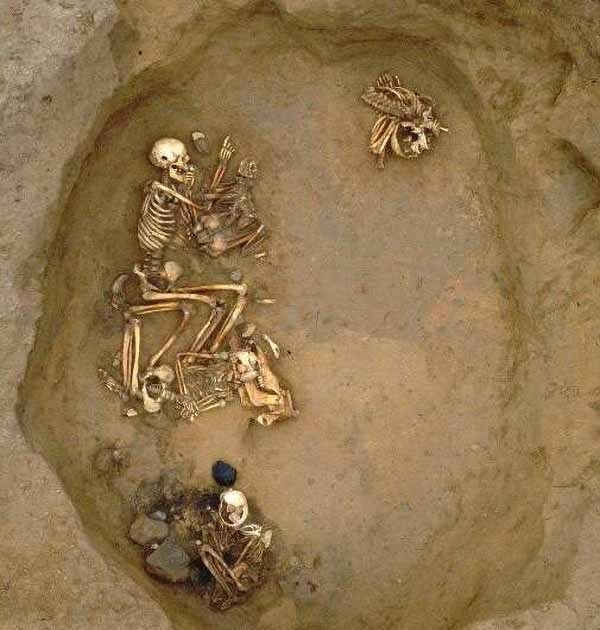
A major new study of ancient DNA has traced the movement of people into southern Britain during the Bronze Age. The new study,= shows that people moving into southern Britain around 1300-800 BC were responsible for around half the genetic ancestry of subsequent populations.
Mapping the 'superhighways' travelled by the first Australians PhysOrg - April 29, 2021

'Superhighways' used by a population of up to 6.5 million Indigenous Australians to navigate the continent tens of thousands of years ago have been revealed by new research using sophisticated modelling of past people and landscapes.
Was North America populated by 'stepping stone' migration across Bering Sea? PhysOrg - April 29, 2021

For thousands of years during the last ice age, generations of maritime migrants paddled skin boats eastward across shallow ocean waters from Asia to present-day Alaska. They voyaged from island to island and ultimately to shore, surviving on bountiful seaweeds, fish, shellfish, birds and game harvested from coastal and nearshore biomes. Their island-rich route was possible due to a shifting archipelago that stretched almost 900 miles from one continent to the other.
Modern humans reached westernmost Europe 5,000 years earlier than previously known PhysOrg - September 28, 2020

Modern humans arrived in the westernmost part of Europe 41,000 - 38,000 years ago, about 5,000 years earlier than previously known. Tools, discovered in a cave named Lapa do Picareiro, located near the Atlantic coast of central Portugal, link the site with similar finds from across Eurasia to the Russian plain. The discovery supports a rapid westward dispersal of modern humans across Eurasia within a few thousand years of their first appearance in southeastern Europe. The tools document the presence of modern humans in westernmost Europe at a time when Neanderthals previously were thought to be present in the region. The finding has important ramifications for understanding the possible interaction between the two human groups and the ultimate disappearance of the Neanderthals.
Polynesians, Native Americans made contact before European arrival, genetic study finds PhysOrg - July 8, 2020
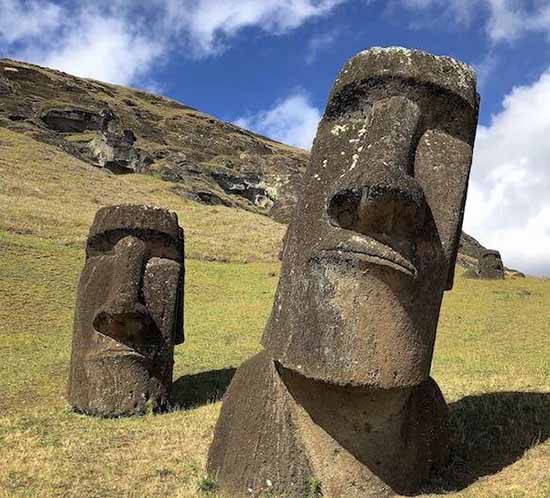
Through deep genetic analyses, Stanford Medicine scientists and their collaborators have found conclusive scientific evidence of contact between ancient Polynesians and Native Americans from the region that is now Colombia - something that's been hotly contested in the historic and archaeological world for decades.
Skulls from ancient North Americans hint at multiple migration waves Live Science - January 30, 2020
he earliest humans in North America were far more diverse than previously realized, according to a new study of human remains found within one of the world's most extensive underwater cave systems. The remains, discovered in the caverns of the Mexican state of Quintana Roo, represent just four of the earliest North Americans, all of whom lived between 9,000 and 13,000 years ago. They're important because North American remains from the first millennia of human habitation in the Americas are rare.
Ancient DNA sheds light on Arctic hunter-gatherer migration to North America 5,000 years ago PhysOrg - June 5, 2019
The first humans in North America arrived from Asia some time before 14,500 years ago. The next major stream of gene flow came about 5000 years ago, and is known to archaeologists as Paleo-Eskimos. About 800 years ago, the ancestors of the present-day Inuit and Yup'ik people replaced this population across the Arctic. By about 700 years ago, the archaeological evidence for the Paleo-Eskimo culture disappeared. Their genetic legacy in living populations has been contentious, with several genetic studies arguing that they made little contribution to later North Americans.
Early human migration was easier than we thought: Movement out of Africa was part of a 'range expansion' 500,000 years ago and not because of the evolution of modern-day man Daily Mail - October 29, 2018
Scientists have found that the first movement of early humans out of Africa was not as hard as previously thought. The initial expansion out of the continent and into the Arabian peninsula has been found to be a result of a 'range expansion' of early hominids. Previous research has claimed it was driven by the adaptations of early humans who had evolved to become better suited to the unexplored region. These latest findings reveal that the hominids were in fact not driven by their adaptations but by a need to expand and occupy new territory.
Did humans leave Africa earlier than previously thought? Science Daily - July 11, 2018
Ancient tools and bones discovered in China by archaeologists suggest early humans left Africa and arrived in Asia earlier than previously thought.The artifacts show that our earliest human ancestors colonized East Asia over two million years ago. The tools were discovered at a locality called Shangchen in the southern Chinese Loess Plateau. The oldest are ca. 2.12 million years old, and are c. 270,000 years older than the 1.85 million year old skeletal remains and stone tools from Dmanisi, Georgia, which were previously the earliest evidence of humanity outside Africa.
Rewriting the story of humanity's origins: Fossil records suggest our ancestors evolved right across Africa and not just in one region Daily Mail - July 11, 2018
For years, scientists believed that humans evolved in a single spot in Africa and this large band of people spread around the world. It is as though there was a ÔGarden of Eden', where humanity first began, before going forth and multiplying. But a new study says the fossil record does not support humans being fully formed when they spread across the world. Instead early humans had a huge variation in the sizes and shapes of their heads, undergoing a series of genetic and cultural shifts that led to modern humanity.
Two ancient populations that diverged later reconverged in the Americas Science Daily - May 31, 2018
A new genetic study of ancient individuals in the Americas and their contemporary descendants finds that two populations that diverged from one another 18,000 to 15,000 years ago remained apart for millennia before mixing again. This historic reconvergence occurred before or during their expansion to the southern continent.
In ancient boulders, new clues about the story of human migration to the Americas Science Daily - May 30, 2018
A geological study provides compelling evidence to support the hypothesis that ancient humans migrated into the Americas via a coastal route. By analyzing boulders and bedrock, a team shows that part of a coastal migration route became accessible to humans 17,000 years ago. During this period, ancient glaciers receded, exposing islands of southern Alaska's Alexander Archipelago to air and sun -- and, possibly, to human migration.
Alaskan infant's DNA tells story of 'first Americans' BBC - January 4, 2018
The 11,500-year-old remains of an infant girl from Alaska have shed new light on the peopling of the Americas. Genetic analysis of the child, allied to other data, indicates she belonged to a previously unknown, ancient group. Scientists say what they have learnt from her DNA strongly supports the idea that a single wave of migrants moved into the continent from Siberia just over 20,000 years ago.
Lower sea-levels back then would have created dry land in the Bering Strait. It would have submerged again only as northern ice sheets melted
The genes that rewrite American pre-history: Ancient DNA reveals how the first humans arrived on the continent in ONE wave more than 25,000 years ago and then split into three ancestral Native American groups Daily Mail - January 3, 2018
The DNA of a six-week-old Native American infant who died 11,500 years ago has rewritten the history of the Americas.
The young girl's genes reveal the first humans arrived on the continent 25,000 years ago - much earlier than some studies claim - before splitting into three Native American groups. This is the first time that direct genetic traces of the earliest Native Americans have been identified. The girl belonged to a previously unknown population of ancient people in North America known as the 'Ancient Beringians.'
This small Native American group resided in Alaska and died out around 6,000 years ago, researchers claim.
Newfoundland populated multiple times by distinct groups, DNA evidence shows PhysOrg - October 12, 2017
Indigenous people have been on the far northeastern edge of Canada for most of the last 10,000 years, moving in shortly after the ice retreated from the Last Glacial Maximum. Archaeological evidence suggests that people with distinct cultural traditions inhabited the region at least three different times with a possible hiatus for a period between 2,000 and 3,000 years ago.
Paleogenomic analysis sheds light on Easter Island mysteries Science Daily - October 12, 2017
Easter Island is a place of mystery that has captured the public imagination. Famous for ancient carved statues and a location so remote it boggles the mind, the island presents a captivating puzzle for researchers eager to understand how and when it became inhabited, and by whom. New paleogenomic research conducted by an international team led by UC Santa Cruz sheds light on those questions by ruling out the likelihood that inhabitants of Easter Island intermixed with South Americans prior to the arrival of Europeans on the island in 1722.
Native American tribes did not help to populate Easter Island until European explorers arrived in 1722 AD, genetic study finds Daily Mail - October 12, 2017
The mystery of how Easter Island came to be inhabited looks set to remain unsolved, after DNA analysis revealed Native Americans did not help to populate the island. Archaeologists have suggested that sea travel between Polynesia and the Americas was plausible, leading to the intermingling of these cultures in its early history. The latest study suggests that European explorers who arrived at the island, known indigenously as Rapa Nui, in the 18th century brought South Americans with them.
Study of ancient skulls suggest there may have been multiple migrations into the Americas PhysOrg - February 26, 2017
For many years, it was believed that a single wave of ancient immigrants made their way from Asia to North America and eventually to South America - the first people to exist in the New World. But that view has been challenged in more recent years. In this new effort, the researchers describe evidence they have found that suggests the first settlers of the New World may have come from more than one place.
Study reveals Asian ancestry of Pacific Islanders PhysOrg - October 4, 2016

Ancient DNA has revealed the first inhabitants of Vanuatu and Tonga came from Asia, not other Oceanic populations as has long been assumed, a study published Tuesday found. The study sheds light on the last great human migration into unpopulated lands, when a people called the Lapita fanned out into the South Pacific about 3,000 years ago. Little is known of the mysterious culture beyond their distinctive dotted pottery and the human remains they left behind. Scientists had speculated that they were an offshoot of Australo-Papuan populations of Australia, New Guinea and the Solomon Islands, who arrived in the region 40,000-50,000 years ago.
Mysterious Branch of Humanity Possibly Discovered Live Science - September 23, 2016

A group of humans migrating out of Africa some 40,000 to 70,000 years ago mingled with an as-yet unknown branch of humanity, researchers say. Modern humans originated about 150,000 to 200,000 years ago in Africa. However, scientists have long debated when and how the modern human lineage spread out of Africa to nearly every corner of the globe. Nearly everyone outside Africa descended from an exodus that occurred between 40,000 and 70,000 years ago, but recent archaeological findings and climate models suggest that migrations of modern humans from Africa began at least 100,000 years ago. One way to find out whether, in the past, modern humans dispersed from Africa in one wave or many - and to see if they intermingled with any other human lineages along the way - is to examine the genomes of present-day modern humans.
Scientists reveal sub-Saharan Africa's legacy of past migrations over last 4,000 years Science Daily - June 22, 2016
Researchers have revealed that the genetic ancestries of many of sub-Saharan Africa's populations are the result of historical DNA mixing events, known as admixture, within the last 4,000 years. Their study, to be published in the journal eLife, uncovers signatures of these admixture events through a large analysis of DNA from populations across the continent. The discovery provides a foundation for the recent genetic history of the continent, which could aid future studies of non-communicable and infectious diseases, such as malaria. While admixture has been demonstrated in other regions of the world, the new analysis has allowed the team to characterise sub-Saharan Africa's mixing events in an unprecedented level of detail.
Betrayals of trust helped the rapid spread of human species around the world PhysOrg - November 27, 2015

New research by an archaeologist suggests that betrayals of trust were the missing link in understanding the rapid spread of our own species around the world. The speed and character of human dispersals changed significantly around 100,000 years ago. Before then, movement of archaic humans were slow and largely governed by environmental events due to population increases or ecological changes. Afterwards populations spread with remarkable speed and across major environmental barriers.
Fossil teeth place humans in Asia '20,000 years early' BBC - October 14, 2015

Fossil finds from China have shaken up the traditional narrative of humankind's dispersal from Africa. Scientists working in Daoxian, south China, have discovered teeth belonging to modern humans that date to at least 80,000 years ago. This is 20,000 years earlier than the widely accepted "Out of Africa" migration that led to the successful peopling of the globe by our species.
Humans Exited Africa, and Trekked to China, Fossils Reveal Live Science - October 14, 2015
Teeth from a cave in China suggest that modern humans lived in Asia much earlier than previously thought, and tens of thousands of years before they reached Europe, researchers say. This discovery yields new information about the dispersal of modern humans from Africa to the rest of the world, and could shed light on how modern humans and Neanderthals interacted, the scientists added.Modern humans first originated about 200,000 years ago in Africa. When and how the modern human lineage dispersed from Africa has long been controversial.
Ancient DNA reveals 'into Africa' migration BBC - October 9, 2015
Researchers extracted DNA from a 4,500-year-old skull that was discovered in the highlands of Ethiopia. A comparison with genetic material from today's Africans reveals how our ancient ancestors mixed and moved around the continents. This has left a genetic legacy, and the scientists believe up to 25% of the DNA of modern Africans can be traced back to this event.
DNA uncovers mystery migration to the Americas BBC - July 22, 2015


Two separate genetic analyses have found evidence for a surprising genetic link between the native populations of the Americas and Oceania. The DNA of some native Amazonians shows significant similarity to indigenous inhabitants of Australia and Melanesia.
eople in Australasia, suggesting a previously unknown wave of migration to the Americas thousands of years ago, a new study has found.
Genome analysis pins down arrival and spread of first Americans PhysOrg - July 21, 2015
The original Americans came from Siberia in a single wave no more than 23,000 years ago, at the height of the last Ice Age, and apparently hung out in the north - perhaps for thousands of years - before spreading in two distinct populations throughout North and South America, according to a new genomic analysis.
Humans migrated north, rather than south, in the main successful migration from Cradle of Humankind PhysOrg - May 29, 2015

New research suggests that European and Asian (Eurasian) peoples originated when early Africans moved north - through the region that is now Egypt - to expand into the rest of the world. The findings answer a long-standing question as to whether early humans emerged from Africa by a route via Egypt, or via Ethiopia.
Humans Trekked Out of Africa Via Egypt, Study Suggests Live Science - May 29, 2015
The major gateway for modern humans out of Africa may have been Egypt, a new genetic analysis suggests. This finding may helps scientists reconstruct how humans evolved as they wandered across the globe, the researchers added. Modern humans first arose about 200,000 years ago in Africa south of the Sahara. When and how the modern human lineage crossed the Sahara and dispersed from Africa has long been controversial. Previous research suggested the exodus from Africa started between 70,000 and 40,000 years ago. However, a recent study hinted that modern humans might have begun their march across the globe as early as 130,000 years ago, and continued their expansion out of Africa in multiple waves.
Two ancient human fossils from Laos reveal early human diversity Science Daily - April 8, 2015
An ancient human skull and a jawbone found a few meters away in a cave in northern Laos add to the evidence that early modern humans were physically quite diverse. The skull, found in 2009 in a cave known as Tam Pa Ling in the Annamite Mountains of present-day Lao is the oldest modern human fossil found in Southeast Asia. Its discovery pushed back the date of modern human migration through the region by as much as 20,000 years. It revealed that early humans who migrated to the islands and coasts of Southeast Asia after migrating out of Africa also traveled inland much earlier than previously thought, some 46,000 to 63,000 years ago. The jaw was discovered in late 2010 and is roughly the same age as the skull. Unlike the skull, it has both modern and archaic human trait.
Genomes document ancient mass migration to Europe BBC - March 2, 2015

DNA analysis has revealed evidence for a massive migration into the heartland of Europe 4,500 years ago. Data from the genomes of 69 ancient individuals suggest that herders moved en masse from the continent's eastern periphery into Central Europe. These migrants may be responsible for the expansion of Indo-European languages, which make up the majority of spoken tongues in Europe today. Analysis show that 7,000-8,000 years ago, a closely related group of early farmers moved into Europe from the Near East, confirming the findings of previous studies. The farmers were distinct from the indigenous hunter-gatherers they encountered as they spread around the continent. Eventually, the two groups mixed, so that by 5,000-6,000 years ago, the farmers' genetic signature had become melded with that of the indigenous Europeans. But previous studies show that a two-way amalgam of farmers and hunters is not sufficient to capture the genetic complexity of modern Europeans. A third ancestral group must have been added to the melting pot more recently.
Skull clue to exodus from Africa BBC - January 28, 2015
An ancient skull discovered in Israel could shed light on the migration of modern humans out of Africa some 60,000 years ago. This migration led to the colonization of the entire planet by our species, as well as the extinction of other human groups such as the Neanderthals. The skull from Manot Cave dates to 55,000 years ago and may be the closest we've got to finding one of the earliest migrants from Africa.
First Eurasians left Africa up to 130,000 years ago Science Daily - April 22, 2014
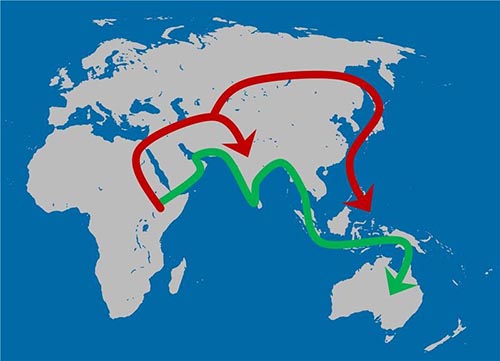
Scientists have shown that anatomically modern humans spread from Africa to Asia and Europe in several migratory movements. The first ancestors of today's non-African peoples probably took a southern route through the Arabian Peninsula as early as 130,000 years ago, the researchers found.
Humans May Have Dispersed Out of Africa Earlier Than Thought Live Science - April 21, 2014
Modern humans may have dispersed in more than one wave of migration out of Africa, and they may have done so earlier than scientists had long thought, researchers now say. Modern humans first arose between 100,000 and 200,000 years ago in Africa. But when and how the modern human lineage then dispersed out of Africa has long been controversial.
Scientists have suggested the exodus from Africa started between 40,000 and 70,000 years ago. However, stone artifacts dating to at least 100,000 years ago that were recently uncovered in the Arabian Desert suggested that modern humans might have begun their march across the globe earlier than once suspected.
Chicken bones tell true story of Pacific migration PhysOrg - March 17, 2014
Did the Polynesians beat Columbus to South America? Not according to the tale of migration uncovered by analysis of ancient DNA from chicken bones recovered in archaeological digs across the Pacific. The ancient DNA has been used to study the origins and dispersal of ancestral Polynesian chickens, reconstructing the early migrations of people and the animals they carried with them.
Language 'evolution' may shed light on human migration out-of-Beringia: Relationship between Siberian, North American languages Science Daily - March 13, 2014
Evolutionary analysis applied to the relationship between North American and Central Siberian languages may indicate that people moved out from the Bering Land Bridge, with some migrating back to central Asia and others into North America.
Hitchhiking Virus Confirms Saga of Ancient Human Migration Science Daily - October 23, 2013
A study of the full genetic code of a common human virus offers a dramatic confirmation of the "out-of-Africa" pattern of human migration, which had previously been documented by anthropologists and studies of the human genome. The virus under study, herpes simplex virus type 1 (HSV-1), usually causes nothing more severe than cold sores around the mouth, says Curtis Brandt, a professor of medical microbiology and ophthalmology at UW-Madison. Brandt is senior author of the study, now online in the journal PLOS ONE.
New theory on African exit PhysOrg - January 30, 2013
Modern humans left Africa twice as early as previously thought, spreading in a number of climate-driven waves, new research suggests. The paper, published in Quaternary International, pours fresh doubt on the previously-held consensus that humans spread from Africa in a single cohort. The consensus view has been that modern humans left Africa around 60,000 years ago by a coastal route, skirting around some very arid places, and spread to Australia very quickly. Previous attempts to put a date on the exit of modern humans from Africa have relied heavily on evidence from genetics and archaeology.
Ancient migration: Genes link Australia with India BBC - January 15, 2013
Australia experienced a wave of migration from India about 4,000 years ago, a genetic study suggests. It was thought the continent had been largely isolated after the first humans arrived about 40,000 years ago until the Europeans moved in in the 1800s.
Gene flow from India to Australia about 4,000 years ago PhysOrg - January 14, 2013
Long before Europeans settled in Australia humans had migrated from the Indian subcontinent to Australia and mixed with Australian aborigines.
Secret of Dingo's Down-Under Origin Revealed Live Science - January 14, 2013
Indians migrating to Australia more than 4,000 years ago may have introduced dingoes to the island continent, along with novel stone tools and new ways to remove toxins from edible plants, researchers say. Australia was thought to have remained largely isolated from the rest of the world between its initial colonization about 40,000 years ago by the ancestors of aboriginal Australians and the arrival of Europeans in the late 1800s.
Americas 'settled in three waves' BBC - July 13, 2012
The biggest survey of Native American DNA has concluded that the New World was settled in three major waves. But the majority of today's indigenous Americans descend from a single group of migrants that crossed from Asia to Alaska 15,000 years ago or more. Previous genetic data have lent support to the idea that America was colonized by a single migrant wave. An international team of researchers have published their findings in the journal Nature.
Native American populations descend from three key migrations PhysOrg - July 12, 2012
Scientists have found that Native American populations - from Canada to the southern tip of Chile - arose from at least three migrations, with the majority descended entirely from a single group of First American migrants that crossed over through Beringia, a land bridge between Asia and America that existed during the ice ages, more than 15,000 years ago.
Asia Was Settled in Multiple Waves of Migration, DNA Study Suggests Science Daily - September 26, 2011
An international team of researchers studying DNA patterns from modern and archaic humans has uncovered new clues about the movement and intermixing of populations more than 40,000 years ago in Asia.
Skulls show New World was settled twice: study PhysOrg - June 14, 2010
Paleoanthropologists compared the skulls of several dozen Paleoamericans, dating back to the early days of migration 11,000 years ago, with the more recent remains of more than 300 Amerindians.
DNA testing on 2,000-year-old bones in Italy reveal East Asian ancestry PhysOrg - February 2, 2010
Researchers excavating an ancient Roman cemetery made a surprising discovery when they extracted ancient mitochondrial DNA (mtDNA) from one of the skeletons buried at the site: the 2,000-year-old bones revealed a maternal East Asian ancestry.
Greening of Sahara Desert Triggered Early Human Migrations out of Africa Science Daily - November 11, 2009
A team of scientists has determined that a major change in the climate of the Sahara and Sahel region of North Africa facilitated early human migrations from the African continent. Among the key findings are that the Sahara desert and the Sahel were considerably wetter around 9,000, 50,000 and 120,000 years ago than at present, allowing for the growth of trees instead of grasses.
ANCIENT AND LOST CIVILIZATIONS