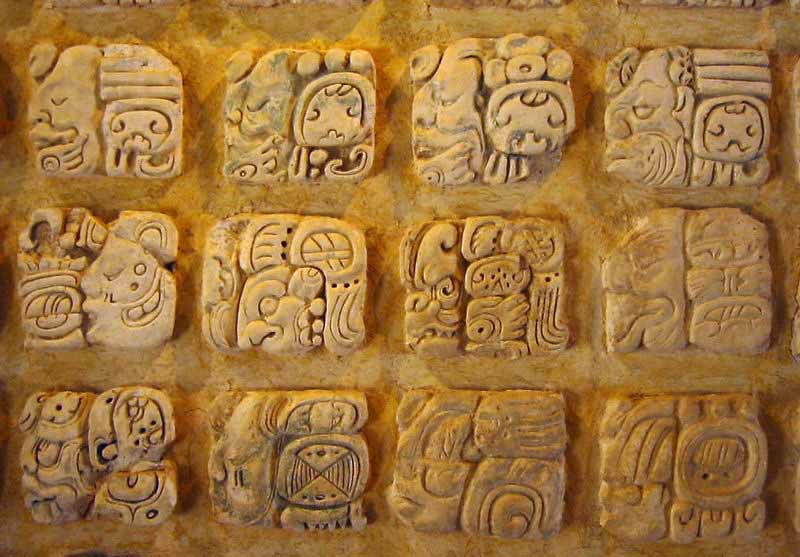
The Maya script, also known as Maya glyphs or Maya hieroglyphs, is the writing system of the Maya civilization of Mesoamerica, presently the only Mesoamerican writing system that has been substantially deciphered. The earliest inscriptions found which are identifiably Maya date to the 3rd century BCE in San Bartolo, Guatemala. Writing was in continuous use until shortly after the arrival of the conquistadors in the 16th century CE (and even later in isolated areas such as Tayasal).
Maya writing used logograms complemented by a set of syllabic glyphs, somewhat similar in function to modern Japanese writing. Maya writing was called "hieroglyphics" or hieroglyphs by early European explorers of the 18th and 19th centuries who did not understand it but found its general appearance reminiscent of Egyptian hieroglyphs, to which the Maya writing system is not at all related.
Although most Mayan languages utilize the Latin alphabet, Maya writing has received official support and promotion by the Mexican government and is taught in universities and public schools in some Mayan speaking areas.
It is now thought that the codices and other Classic texts were written by scribes, usually members of the Maya priesthood, in a literary form of the Ch'olti' language. It is possible that the Maya elite spoke this language as a lingua franca over the entire Maya-speaking area, but also that texts were written in other Mayan languages of the Peten and Yucatan, especially Yucatec. There is also some evidence that the script may have been occasionally used to write Mayan languages of the Guatemalan Highlands. However, if other languages were written, they may have been written by Ch'olti scribes, and therefore have Ch'olti elements.
Maya writing consisted of relatively elaborate set of glyphs, which were laboriously painted on ceramics, walls or bark-paper codices, carved in wood or stone, or molded in stucco. Carved and molded glyphs were painted, but the paint has rarely survived. About 90% of Maya writing can now be read with varying degrees of certainty, enough to give a comprehensive idea of its structure.
The Maya script was a logosyllabic system. Individual symbols ("glyphs") could represent either a word (actually a morpheme) or a syllable; indeed, the same glyph could often be used for both. For example, the calendaric glyph MANIK' was also used to represent the syllable chi. (It's customary to write logographic readings in all capitals and phonetic readings in italics.) It is possible, but not certain, that these conflicting readings arose as the script was adapted to new languages, as also happened with Japanese kanji and with Assyro-Babylonian and Hittite cuneiform. There was ambiguity in the other direction as well: Different glyphs could be read the same way. For example, half a dozen apparently unrelated glyphs were used to write the very common third person pronoun.
Within each block, glyphs were arranged top-to-bottom and left-to-right, superficially rather like Korean Hangul syllabic blocks. However, in the case of Maya, each block tended to correspond to a noun or verb phrase such as his green headband. Also, glyphs were sometimes conflated, where an element of one glyph would replace part of a second. Conflation occurs in other scripts: For example, in medieval Spanish manuscripts the word de 'of' was sometimes written - (a D with the arm of an E). Another example is the ampersand (&) which is a conflation of the Latin "et". In place of the standard block configuration Maya was also sometimes written in a single row or column, 'L', or 'T' shapes. These variations most often appeared when they would better fit the surface being inscribed.
Maya glyphs were fundamentally logographic. Generally the glyphs used as phonetic elements were originally logograms that stood for words that were themselves single syllables, syllables that either ended in a vowel or in a weak consonant such as y, w, h, or glottal stop. For example, the logogram for 'fish fin' (Maya [kah] - found in two forms, as a fish fin and as a fish with prominent fins), came to represent the syllable ka. These syllabic glyphs performed two primary functions: They were used as phonetic complements to disambiguate logograms which had more than one reading, as also occurred in Egyptian, and they were used to write grammatical elements such as verbal inflections which did not have dedicated logograms, as in modern Japanese. For example, bahlam 'jaguar' could be written as a single logogram, BALAM, complemented phonetically as ba-BALAM, or BALAM-ma, or ba-BALAM-ma, or written completely phonetically as ba-la-ma.
An "emblem glyph" is a kind of royal title. It consists of a word ajaw a Classic Maya term for "lord" of yet unclear etymology but well-attested in Colonial sources and a place name that precedes the word ajaw and functions as an adjective. An expression "Boston lord" would be a perfect English analogy. Sometimes, the title is introduced by an adjective kÕuhul ("holy, divine" or "sacred"), just as if someone wanted to say "holy Boston lord". Of course, an "emblem glyph" is not a "glyph" at all: it can be spelled with any number of syllabic or logographic signs and several alternative spellings are attested for the words kÕuhul and ajaw, which form the stable core of the title. The term "emblem glyph" simply reflects the times when mayanists could not read Classic Maya inscriptions and had to come up with some nicknames isolating certain recurrent structural components of the written narratives.
This title was identified in 1958 by Heinrich Berlin, who coined the term "emblem glyph". Berlin noticed that the "emblem glyphs" consisted of a larger "main sign" and two smaller signs now read as kÕuhul ajaw. Berlin also noticed that while the smaller elements remained relatively constant, the main sign changed from site to site. Berlin proposed that the main signs identified individual cities, their ruling dynasties, or the territories they controlled.
Subsequently, Marcus argued that the "emblem glyphs" referred to archaeological sites, broken down in a 5-tiered hierarchy of asymmetrical distribution. Marcus' research assumed that the emblem glyphs were distributed in a pattern of relative site importance depending on broadness of distribution, roughly broken down as follows: Primary regional centers (capitals) (Tikal, Calakmul, and other "superpowers") were generally first in the region to acquire a unique emblem glyph(s). Texts referring to other primary regional centers occur in the texts of these "capitals", and dependencies exist which utilize the primary center's glyph.
Secondary centers (Altun Ha, Luubantuun, Xunantunich, and other mid-sized cities had their own glyphs but are only rarely mentioned in texts found in the primary regional center, while repeatedly mentioning the regional center in their own texts. Tertiary centers (towns) had no glyphs of their own, but have texts mentioning the primary regional centers and perhaps secondary regional centers on occasion.
These were followed by the villages with no emblem glyphs and no texts mentioning the larger centers, and hamlets with little evidence of texts at all. This model was largely unchallenged for over a decade until Mathews and Justeson, as well as Houston argued once again that the "emblem glyphs" were the titles of Maya rulers with some geographical association.
The debate on the nature of "emblem glyphs" received a new spin with the monograph by Stuart and Houston. The authors convincingly demonstrated that there were lots of place names-proper, some real, some mythological, mentioned in the hieroglyphic inscriptions. Some of these place names also appeared in the "emblem glyphs", some were attested in the "titles of origin" (various expressions like "a person from Boston"), but some were not incorporated in personal titles at all.
Moreover, the authors also highlighted the cases when the "titles of origin" and the "emblem glyphs" did not overlap, building upon an earlier research by Houston. Houston noticed that the establishment and spread of the Tikal-originated dynasty in the Petexbatun region was accompanied by the proliferation of rulers using the Tikal "emblem glyph" placing political and dynastic ascendancy above the current seats of rulership.
It was until recently thought that the Maya may have adopted writing from the Olmec or Epi-Olmec. However, recent discoveries have pushed back the origin of Maya writing by several centuries, and it now seems possible that the Maya were the ones who invented writing in Mesoamerica.
Knowledge of the Maya writing system continued into the early colonial era and reportedly a few of the early Spanish priests who went to Yucat‡n learned it. However, as part of his campaign to eradicate pagan rites, Bishop Diego de Landa ordered the collection and destruction of written Maya works, and a sizable number of Maya codices were destroyed.
Later, seeking to use their native language to convert the Maya to Christianity, he derived what he believed to be a Maya "alphabet" (the so-called de Landa alphabet). Although the Maya did not actually write alphabetically, nevertheless he recorded a glossary of Maya sounds and related symbols, which was long dismissed as nonsense but eventually became a key resource in deciphering the Maya script, though it has itself not been completely deciphered.
The difficulty was that there was no simple correspondence between the two systems, and the names of the letters of the Spanish alphabet meant nothing to Landa's Maya scribe, so Landa ended up asking the equivalent of write H: a-i-tee-cee-aitch "aitch", and glossed a part of the result as "H".
Landa was also involved in creating a Latin orthography for the Yukatek Maya language, meaning that he created a system for writing Yukatek in the Latin alphabet. This was the first Latin orthography for any of the Mayan languages,[citation needed] which number around thirty.
Only four Maya codices are known to have survived the conquistadors. Most surviving texts are found on pottery recovered from Maya tombs, or from monuments and stelae erected in sites which were abandoned or buried before the arrival of the Spanish.
Knowledge of the writing system was lost, probably by the end of the 16th century. Renewed interest in it was sparked by published accounts of ruined Maya sites in the 19th century.
The decipherment of the writing was a long and laborious process. 19th century and early 20th century investigators managed to decode the Maya numbers and portions of the texts related to astronomy and the Maya calendar, but understanding of most of the rest long eluded scholars.
In the 1930s, Benjamin Whorf wrote a number of published and unpublished essays, proposing to identify phonetic elements within the writing system. Although some specifics of his decipherment claims were later shown to be incorrect, the central argument of his work, that Maya hieroglyphs were phonetic (or more specifically, syllabic), was later supported by the work of Yuri Knorozov, who played a major role in deciphering Maya writing.
In 1952, Knorozov published the paper "Ancient Writing of Central America" arguing that the so-called "de Landa alphabet" contained in Bishop Diego de Landa's manuscript Relacion de las Cosas de Yucatan was actually made of syllabic, rather than alphabetic symbols. He further improved his decipherment technique in his 1963 monograph "The Writing of the Maya Indians" and published translations of Maya manuscripts in his 1975 work "Maya Hieroglyphic Manuscripts".
In the 1960s, progress revealed the dynastic records of Maya rulers. Since the early 1980s it has been demonstrated that most of the previously unknown symbols form a syllabary, and progress in reading the Maya writing has advanced rapidly since.
The Maya may have inherited some elements, and perhaps the entire basis, of their ancient writing system from the Olmecs, which was significantly modified and expanded by the Maya of the Pre-Classic era. Pre-Classic texts are less numerous and less well understood by archaeologists than the later Classic and Post-Classic texts. (However, the Isthmian (or Epi-Olmec) script once thought of as a possible direct ancestor of the Maya script is now known to be several centuries too recent, and may instead be a descendant.)
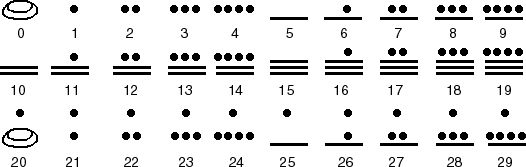
Other related and nearby Mesoamerican cultures of the period were also heirs to the Olmec writing system, and developed parallel systems which shared key attributes (such as the base-twenty numerical system written with a system of bars and dots). However, it is generally believed that the Maya developed the only complete writing system in Mesoamerica, meaning that they were the only civilization that could write everything they could say.
As Knorozov's early essays contained several older readings already published in the late 19th century by Cyrus Thomas, and the Soviet editors added propagandistic claims to the effect that Knorozov was using a peculiarly "Marxist-Leninist" approach to decipherment, many Western Mayanists simply dismissed Knorozov's work.
However, in the 1960s more came to see the syllabic approach as potentially fruitful, and possible phonetic readings for symbols whose general meaning was understood from context began to be developed. Prominent older epigrapher J. Eric S. Thompson was one of the last major opponents of Knorozov and the syllabic approach. Thompson's disagreements are sometimes said to have held back advances in decipherment. For example, Coe (1992) says "the major reason was that almost the entire Mayanist field was in willing thrall to one very dominant scholar, Eric Thompson".
In 1959, examining what she called "a peculiar pattern of dates" on stone monument inscriptions at the Classic Maya site of Piedras Negras, Russian-American scholar Tatiana Proskouriakoff determined that these represented events in the lifespan of an individual, rather than relating to religion, astronomy, or prophecy, as held by the "old school" exemplified by Thompson. This proved to be true of many Maya inscriptions, and revealed the Maya epigraphic record to be one relating actual histories of ruling individuals: dynastic histories similar in nature to those recorded in literate human cultures throughout the world. Suddenly, the Maya entered written history.
Although it was now clear what was on many Maya inscriptions, they still could not literally be read. However, further progress was made during the 1960s and 1970s, using a multitude of approaches including pattern analysis, de Landa's "alphabet", Knorozov's breakthroughs, and others. In the story of Maya decipherment, the work of archaeologists, art historians, epigraphers, linguists, and anthropologists cannot be separated. All contributed to a process that was truly and essentially multidisciplinary. Key figures included David Kelley, Ian Graham, Gilette Griffin, and Michael Coe.
Dramatic breakthroughs occurred in the 1970s, in particular at the first Mesa Redonda de Palenque, a scholarly conference organized by Merle Greene Robertson at the Classic Maya site of Palenque held in December, 1973. A working group was led by Linda Schele, an art historian and epigrapher at the University of Texas at Austin, which included Floyd Lounsbury, a linguist from Yale, and Peter Mathews, then an undergraduate student of David Kelley's at the University of Calgary (whom Kelley sent because he could not attend).
In one afternoon they managed to decipher the first dynastic list of Maya kings, the ancient kings of the city of Palenque. By identifying a sign as an important royal title (now read as the recurring name K'inich), the group was able to identify and "read" the life histories (from birth, to accession to the throne, to death) of six kings of Palenque.
From that point, progress proceeded at an exponential pace, not only in the decipherment of the Maya glyphs, but also towards the construction of a new, historically based understanding of Maya civilization. Scholars such as J. Kathryn Josserand, Nick Hopkins and others published findings that helped to construct a Mayan vocabulary.
In 1988, Wolfgang Gockel published a translation of the Palenque inscriptions based on a morphemic rather than syllabic interpretation of the glyphs. The "old school" continued to resist the results of the new scholarship for some time.
A decisive event which helped to turn the tide in favor of the new approach occurred in 1986, at an exhibition entitled "The Blood of Kings: A New Interpretation of Maya Art". It was organized by InterCultura and the Kimbell Art Museum and curated by Schele and Yale art historian Mary Miller. This exhibition and attendant catalogue and international publicity revealed to a wide audience the new world which had latterly been opened up by progress in decipherment of Maya hieroglyphics.
Not only could a real history of ancient America now be read and understood, but the light it shed on the material remains of the Maya showed them to be real, recognizable individuals. They stood revealed as a people with a history like that of all other human societies: full of wars, dynastic struggles, shifting political alliances, complex religious and artistic systems, expressions of personal property and ownership and the like.
Moreover, the new interpretation, as the exhibition demonstrated, made sense out of many works of art whose meaning had been unclear and showed how the material culture of the Maya represented a fully integrated cultural system and world view. Gone was the old Thompson view of the Maya as peaceable astronomers without conflict or other attributes characteristic of most human societies.
However, three years later in 1989, a final counter-assault was launched by supporters who were still resisting the modern decipherment interpretation. This occurred at a conference at Dumbarton Oaks. It did not directly attack the methodology or results of decipherment, but instead contended that the ancient Maya texts had indeed been read but were "epiphenomenal". This argument was extended from a populist perspective to say that the deciphered texts tell us only about the concerns and beliefs of the society's elite, and not about the ordinary Maya. Michael Coe in opposition to this idea described "epiphenomenal" as:
a ten penny word meaning that Maya writing is only of marginal application since it is secondary to those more primary institutions economics and society so well studied by the dirt archaeologists.
Linda Schele noted following the conference that this is like saying that the inscriptions of ancient Egypt or the writings of Greek philosophers or historians do not reveal anything important about their cultures. Most written documents in most cultures tell us about the elite, because in most cultures in the past, they were the ones who could write (or could have things written down by scribes or inscribed on monuments).
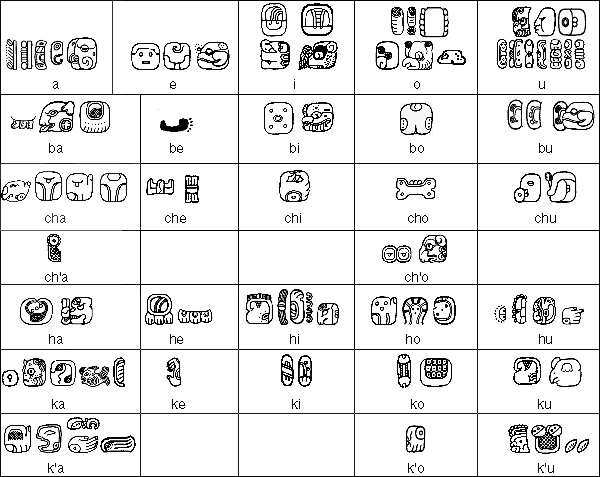
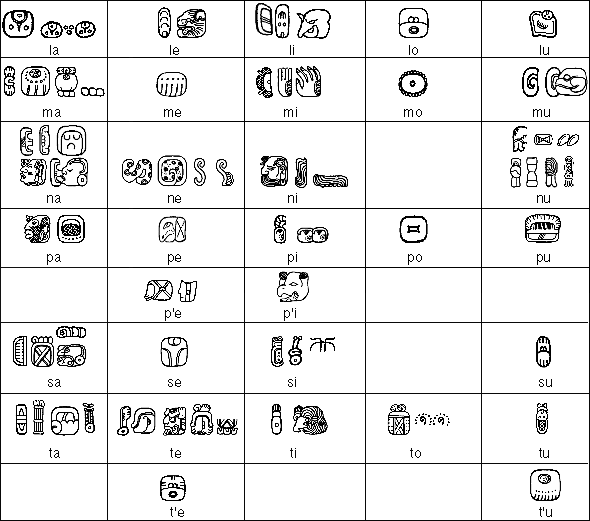
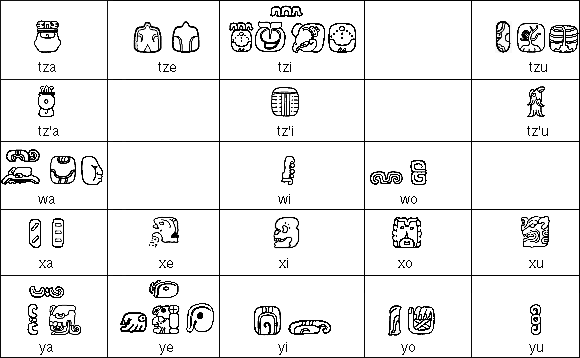
Progress in decipherment continues at a rapid pace today, and it is generally agreed by scholars that over 90 percent of the Maya texts can now be read with reasonable accuracy. As of 2008, at least one phonetic glyph was known for each of the syllables marked in this chart. Based on verbal inflection patterns, it would seem that a syllabogram for [wu] did not exist rather than simply being unattested.
- The Mayan script is logosyllabic combining about 550 logograms (which represent whole words) and 150 syllabograms (which represent syllables). There were also about 100 glyphs representing place names and the names of gods. About 300 glyphs were commonly used.
- Examples of the script have been found carved in stone and written on bark, wood, jade, ceramics, and a few manuscripts in Mexico, Guatemala and northern Belize.
- Many syllables can be represented by more than one glyph
- The script was usually written in paired vertical columns reading from left to right and top to bottom in a zigzag pattern.
Numerals
Maya Script Wikipedia