
Maya civilization collapse mystery deepens as scientists find no drought at key site Science Daily - April 28, 2026
The mysterious collapse of the Maya civilization may not have been driven solely by drought after all. New evidence from lake sediments in Guatemala reveals that one key city, Itzan, enjoyed a stable climate even as its population abruptly vanished. Instead of environmental collapse, the findings point to something more complex: a tightly interconnected network of cities unraveling under pressure. As drought struck neighboring regions, wars, migration, and economic breakdown likely rippled outward, dragging even stable communities into decline.
2000-Year-Old Mystery: Researchers May Have Decoded the Lost Script of Teotihuacan SciTech Daily - March 29, 2026

Researchers decoded Teotihuacan symbols as an early Uto-Aztecan writing system, possibly linked to Nahuatl speakers and reshaping theories about the cityÕs people. After studying symbols found in TeotihuacanÕs murals and artifacts, the researchers concluded that these markings form a true writing system. They suggest it represents an early Uto-Aztecan language, which later evolved into Cora, Huichol, and Nahuatl, the language associated with the Aztecs. Founded around 100 BC, Teotihuacan remained a dominant cultural center until about 600 AD. Hansen and Helmke compare its importance to that of Rome in the Roman Empire, highlighting its central role in ancient Mesoamerica.
Hidden Clues Challenge the Long-Held Theory Behind the Maya Civilization's Collapse SciTech Daily - March 12, 2026

New sediment evidence from a Maya site in Guatemala challenges the idea that drought alone caused the civilizationÕs collapse.
Scientists trace mineral sources for sacred Maya Blue in Late Classic pottery from Buenavista, Belize PhysOrg - July 30, 2025
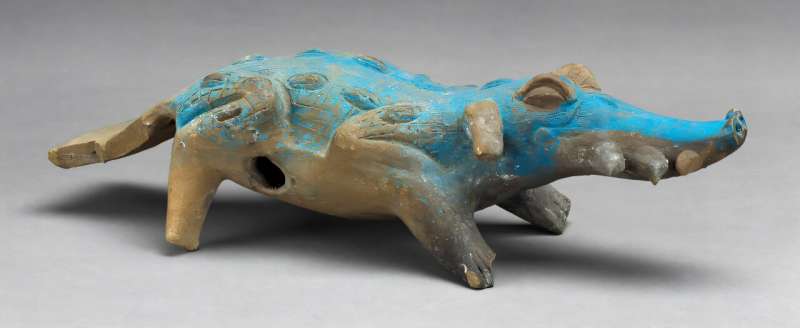
Maya Blue was a unique pigment made by combining organic indigo with inorganic palygorskite. Unlike pure indigo, it exhibits much better stability when exposed to sunlight and acids. This has allowed the color to persist for centuries, even in the tropical lowland climates of Mesoamerica.
Archaeologists uncover tomb of Te K'ab Chaak, first ruler of ancient Maya city Caracol PhysOrg - July 11, 2025
Archaeologists from the University of Houston working at Caracol in Belize, Central America have uncovered the tomb of Te K'ab Chaak, the first ruler of this ancient Maya city and the founder of its royal dynasty. Now in ruins, this metropolis was a major political player in Maya history, dominating the southern part of the Yucatan Peninsula from 560 through 680 AD before its abandonment by 900 AD. The discovery is the first identifiable ruler's tomb found in over four decades of work in Caracol, the largest Maya archaeological site in Belize and in the Maya lowlands.
Maya Ruler's Tomb Is Unearthed in Belize, With Clues to His Ancient World
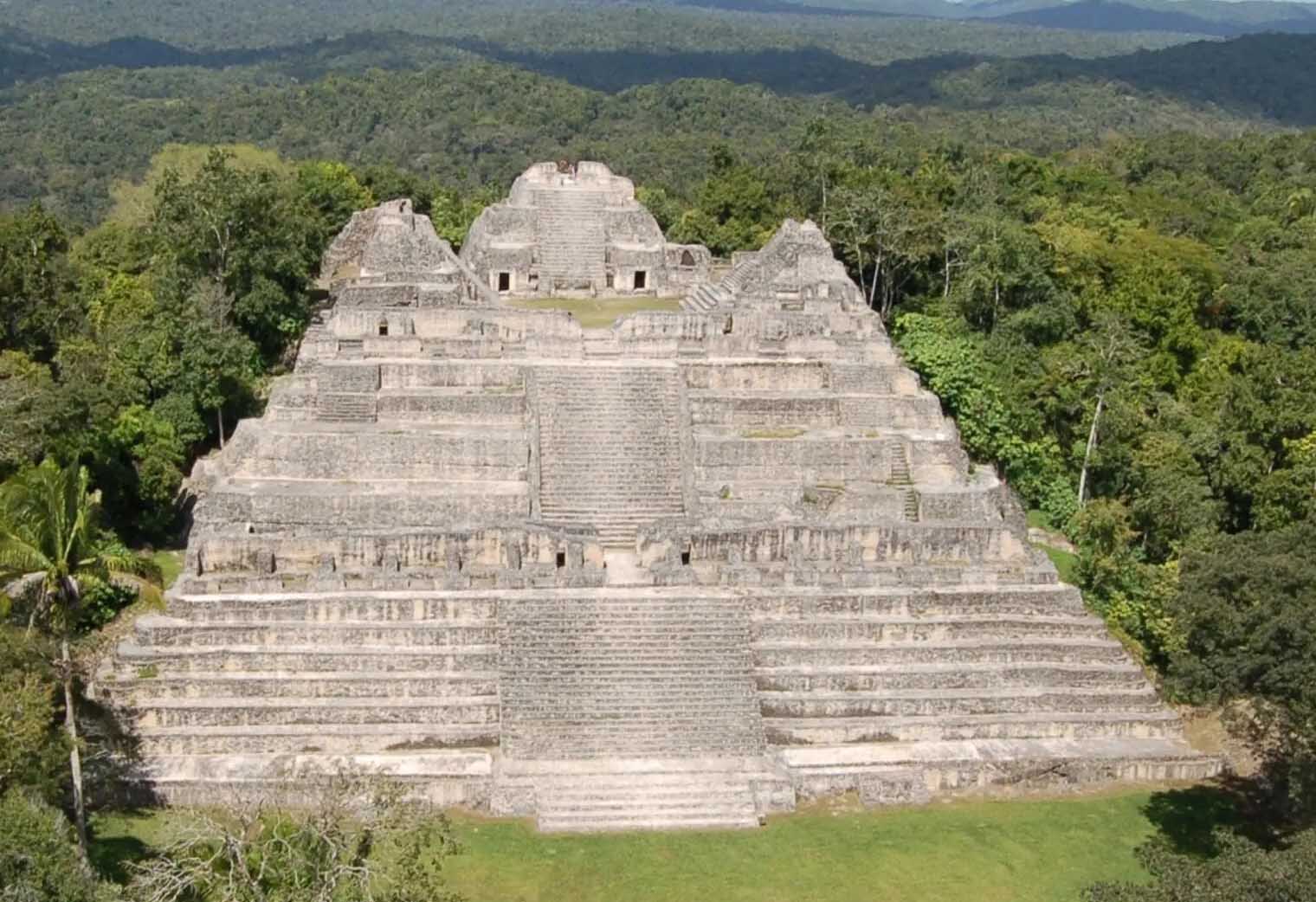
The archaeologists worked in the shadow of towering Maya ruins, piercing the floor of a structure they had searched years before. Below, they found an even more ancient chamber, still holding a body and the treasures it was buried with: a rare mosaic death mask and jadeite jewelry, shells from the Pacific and elaborate designs on pottery and bone.
/Users/elliecrystal/Desktop/index.html
Lasers reveal Maya city, including thousands of structures, hidden in Mexico Live Science - October 29, 2024
The new city, dubbed Valeriana, was a dense urban settlement with temple pyramids and a ball court
Maya warrior statue with serpent helmet discovered at Chichen Itza Live Science - November 12, 2023
The statue depicts a warrior wearing a helmet shaped like a serpent with its jaws open, as well as a feathered headdress, Mexico's National Institute of Anthropology and History (INAH) said in a translated statement. The statue is 13 inches (33 centimeters) tall and 11 inches (28 cm) wide, and aside from a crack, it's in good shape, according to the statement. The head may have once been part of a larger sculptural design.
Circular temple dedicated to Maya serpent deity Kukulcan discovered in Mexico's Yucatan peninsula dates between A.D. 1000 and 1200. Live Science - November 4, 2023
The roughly 1,000-year-old temple was found in El Tigre, an archaeological site in the Yucatan Peninsula, and served as one of the ancient Maya's last settlements before the civilization collapsed, according to a translated National Institute of Anthropology and History (INAH) statement. Excavations revealed that the circular structure contained two levels and at one time would've been capped off with a flat roof.
Lasers reveal massive, 650-square-mile Maya site hidden beneath Guatemalan rainforest Live Science - January 12, 2023
While conducting an aerial survey of northern Guatemala, researchers detected a sprawling Maya site. Geologists in northern Guatemala have discovered a massive Maya site that stretches approximately 650 square miles (1,700 square kilometers) and dates to the Middle and Late Preclassic period (roughly 1000 B.C. to 250 B.C.). The findings were the result of an aerial survey that researchers conducted via airplane using lidar (light detection and ranging), in which lasers are beamed out and the reflected light is used to create aerial imagery of a landscape.
The technology is particularly beneficial in areas such as the rainforests of Guatemala's Mirador-Calakmul Karst Basin, where lasers can penetrate the thick tree canopy. Using data from the scans, the team identified more than 1,000 settlements dotting the region, which were interconnected by 100 miles (160 kilometers) of causeways that the Maya likely traversed on foot. They also detected the remains of several large platforms and pyramids, along with canals and reservoirs used for water collection, according to the study, which was published Dec. 5 in the journal Ancient Mesoamerica (opens in new tab).
Ancient Mesoamerican structures aligned for use as a 260-day calendar PhysOrg - January 11, 2023
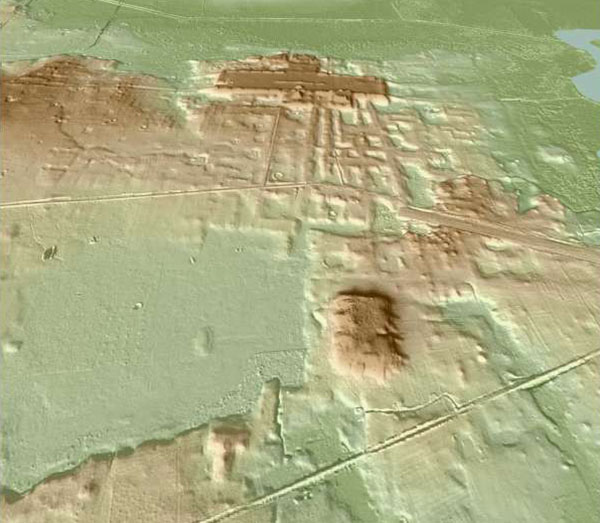
Researchers have found examples of Mesoamerican structures aligned for use as a 260-day calendar, built thousands of years ago along Mexico's gulf coast. Aircraft-based LIDAR equipment allowed them to see the alignment of the ancient structures. The work involved pointing LIDAR equipment at the ground from an airplane flying above Mexico's gulf coast. The researchers observed the remains of 415 ceremonial complexes built by Olmec or Mayan people. Analysis of the structures showed that they were aligned in ways that noted the rising and setting of celestial bodies on certain days represented in a 260-day calendar. They noted that most of the angles of the complexes were aligned east to west, which would have corresponded to the rising and setting of celestial objects such as the sun. The structures have been dated to between 1100 B.C. and 250 A.D.
The Last Maya City Reveals a Trove of Buried Secrets And Spanish Bullets Science Alert - October 31, 2022
The new excavation project began last June in an effort to understand more about the Tayasal outpost where Maya inhabitants first settled in 900 BCE during their Preclassic period. Tayasal was the last Maya city to yield to the Spanish conquest in 1697, a century after Europeans entered the western highlands of what is now Guatemala.
Startling Discovery Reveals Mysterious Citadel Hidden in Ancient Maya City Science Alert - September 30, 2021
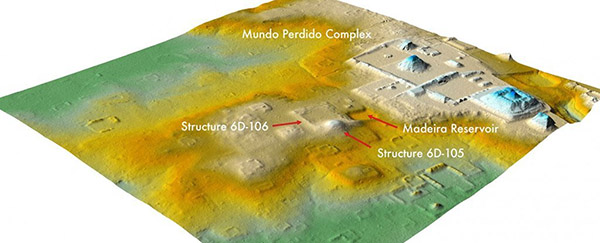
The city in question is Tikal, now in Guatemala. Thought to have been one of the most dominant settlements in the ancient Maya empire, particularly between 200-900 CE, at its peak it could have had as many as 90,000 people living there. Using LIDAR scanning equipment, researchers found evidence of development under what was thought to be a natural area. What's more, the hidden ruins look to match the style of buildings in Teotihuacan Ð a sprawling metropolis established centuries before the rise of the Aztecs, built by a largely unknown culture.
The Ilopango volcanic eruption that shocked the Maya's civilization 1590 years ago PhysOrg - September 29, 2020
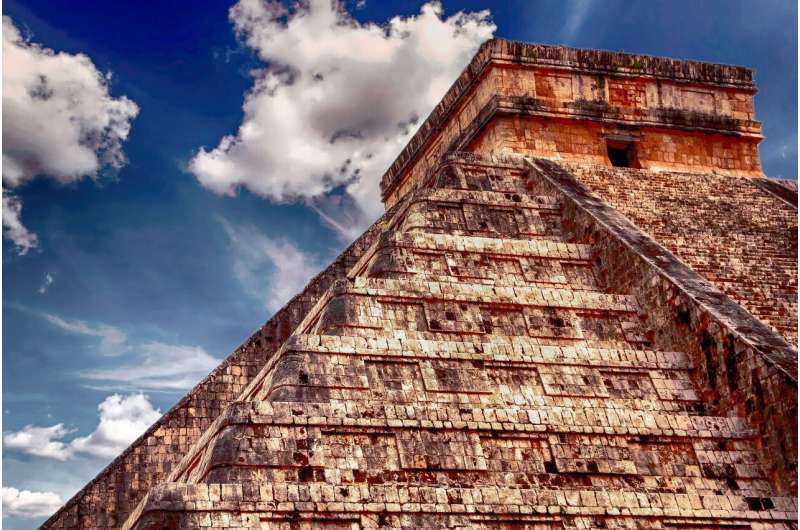
In 431 CE, 1590 years ago, the Maya civilization was laid waste as the Ilopango volcano erupted, killing every living thing within 40 km around the volcano.
Archaeologists discover 1,000-year-old 'untouched' Maya ritual site containing hundreds of ceramic vessels, burnt offerings, and fragments of bone in Mexican cave Daily Mail - March 5, 2019
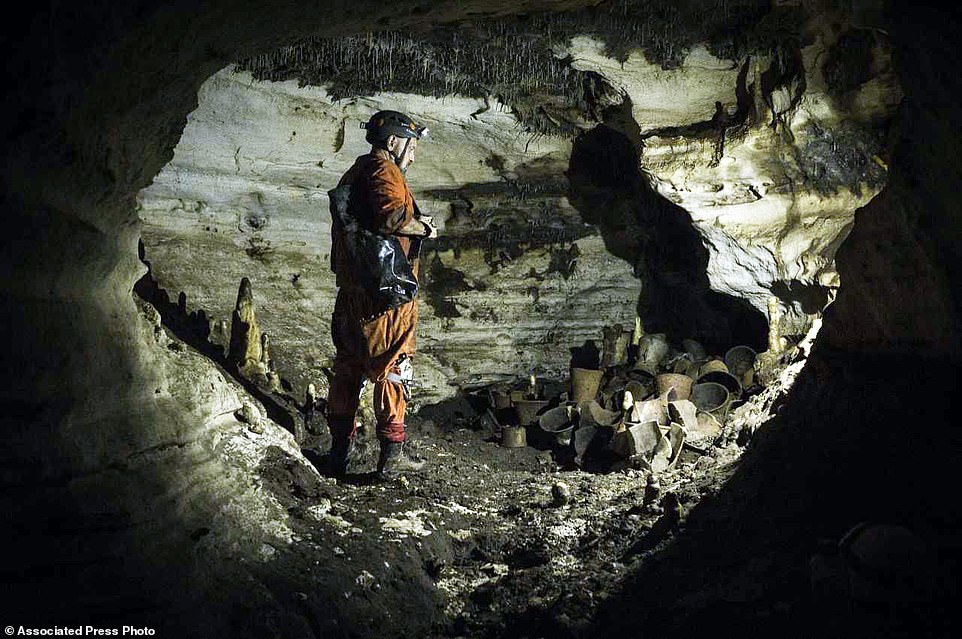
Lost Cave of 'Jaguar God' Rediscovered Below Mayan Ruins - and It's Full of Treasure Live Science - March 5, 2019
Shimmying through a maze of dark tunnels below the Mayan ruins of Chichen Itza on Mexico's Yucatan Peninsula, archaeologists have rediscovered a long-sealed cave brimming with lost treasure. According to an statement from Mexico's National Institute of Anthropology and History (INAH), the cave is stockpiled with more than 150 artifacts, including incense burners, vases, and decorative plates adorned with the faces of ancient gods and other religious icons. The trove is believed to be just one of seven sacred chambers in a network of tunnels known as Balamku - "Jaguar God" - that sits below Chichen Itza, a city that accommodated millions of people at its peak during the 13th century. The artifacts have likely been untouched by human hands for more than 1,000 years, according to the INAH.
Though the treasures were probably deliberately sealed off, the ritual cave, rediscovered in 2018 by archaeologists hunting for a sacred well below the city, has had at least one human visitor in the past millennium, National Geographic reported. The cave was initially discovered in 1966 by archaeologist V’ctor Segovia Pinto, who wrote a report about the find, but never excavated before directing local farmers to seal the cavern's entrance for reasons that are still unknown. Segovia's records of the discovery went missing, leaving behind a mystery that would take five decades to solve.
1,500-Year-Old Maya Altar Reveals Amazing Secrets of the 'Snake Kings' Live Science - September 23, 2018
Archaeologists have discovered a nearly 1,500-year-old carved stone altar in the ancient Maya city of La Corona, deep in the jungles of northern Guatemala. The finding, announced Sept. 12 at the National Museum of Archaeology and Ethnology in Guatemala City, is the oldest monument on record at the La Corona site from the Classic Maya period, which lasted from A.D. 250 to 900, the archaeologists said.
An analysis of the carvings on the altar revealed how the powerful Kaanul dynasty started its 200-year rule over much of the Maya lowland
The face of Pacal the Great: Archaeologists unearth rare 7th century mask showing Mayan ruler in his old age Daily Mail - August 27, 2018
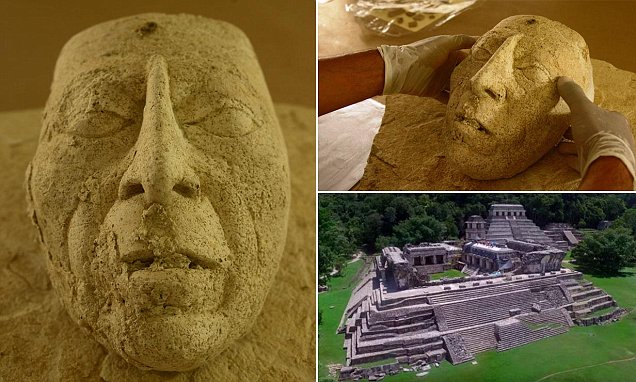
Archaeologists have discovered an ancient stucco mask thought to depict the face of the Mayan ruler ÔPacal the Great.Õ The remarkable 7th century artifact is unlike most such treasures as it represents the king in his old age, with visible wrinkle lines. Pacal ruled from the time he was just 12 years old, until his death at the age of 80. Researchers unearthed the mask during excavations at the Palenque archaeological site in the Mexican jungle.
Scientists find first evidence DOGS were traded among the Mayan civilization 2500 years ago - and the pups were prestigious gifts that people liked to 'show off' Daily Mail - March 19, 2018
Researchers have found the first evidence of live dogs being traded in the Americas - and they were exchanged over distances of more than 100 miles (160km). The Maya were trading live dogs in 400BC from Ceibal in Guatemala, which is one of the earliest ceremonial sites from the Mesoamerican civilization, researchers found. The bones were largely found in the ceremonial centre meaning the animals were probably owned by someone important or could have even been a prestigious gift. These traded dogs - which were probably slightly bigger than chihuahuas - were older than dogs for eating and were thought to be treated better too.
Team reports first evidence of live-traded dogs for Maya ceremonies PhysOrg - March 19, 2018
Maya 'megalopolis' featuring thousands of ancient pyramids, palaces and causeways is found hidden under thick jungle foliage in Guatemala Daily Mail - February 3, 2018
More than 60,000 previously unknown Mayan structures - including pyramids, palaces and causeways - have been revealed under jungle foliage in Guatemala in what has been hailed as a 'major breakthrough'. Researchers used laser technology to look beneath the forest canopy in northern Peten - an area close to already-known Mayan cities. The lasers revealed the 'breathtaking' remains of a sprawling pre-Columbian 'megalopolis' that was far more complex than most specialists had ever believed. The discovery suggests that Central America supported a civilization that was, at its peak 1,500 years ago, more advanced than ancient Greek and Chinese cultures. The landscape may have been home to up to 15 million individuals and the abundance of defensive walls, ramparts and fortresses suggests that warfare was rife throughout their existence and not just at the end.
Maya Underworld: Peek Inside the World's Longest Flooded Cave Live Science - January 18, 2018
Divers enter the flooded underworld that lies beneath the Yucatan Peninsula. Cave explorers with the Great Maya Aquifer Project announced this week that two cave systems near the city of Tulum are actually one, making the system the longest flooded series of caves in the world.
Ancient palace complex discovered in Mexican Valley of Oaxaca PhysOrg - March 28, 2017
The Oaxaca Valley near the southern tip of Mexico has been offering up clues of past civilizations for several decades - a team has been working at the El Palenque site in particular since 1993. In this new effort, the researchers focused on a dig on the north end of the plaza - the site of what the researchers believe was the home and business center for the ruler of an ancient empire. The palace has been dated to approximately 2,100 to 2,300 years ago, a time before the Aztecs. Most in the field believe that the civilization that existed in Oaxaca was among the earliest states to come into existence in Mesoamerica. Redmond and Spencer suggest that their findings at the palace site back up that theory.
This ancient text reveals a Maya astronomer calculated the movements of Venus over a millennium ago Science Alert - August 18, 2016
A new analysis of the ancient Mayan text, the Dresden Codex - the oldest book written in the Americas known to historians - suggests an early Maya scientist may have made a major discovery in astronomy more than a thousand years ago. According to a new study, astronomical data written in part of the text called the Venus Table weren't just based on numerology as had been thought, but were a pioneering form of scientific record-keeping that had huge significance for Maya society. A "mathematical subtlety", which scholars have long known about but considered a numerological oddity, serves as a correction for Venus's irregular cycle, which lasts 583.92 days, just like our own Gregorian calendar incorporates leap years.
Painted Human Jawbones Used as Ancient Jewelry Live Science - May 18, 2016
Painted human mandibles that may have been worn like necklace pendants have been discovered at a ceremonial site in Mexico that dates back around 1,300 years. In the same ceremonial area, numerous whistles and figurines were also discovered. Made out of ceramic, these objects had been smashed into thousands of fragments, not a single example found intact. The whistles may have made owl-like sounds, archaeologists said. Some of the figurines were sculpted images of Xipe Totec, a Mesoamerican god associated with human sacrifice and agricultural activity. The god was often shown with human bones draped around his neck.
Archaeological Finds in El Salvador Tell a Whole Different Tale about Maya Society Scientific American - December 23, 2015
Artifacts uncovered by the Ceren dig suggest Maya citizens enjoyed certain freedoms when trading and making societal decisions. For decades scientists thought that, in order to maintain a prosperous and powerful empire along the territories which make up what today is El Salvador, Honduras, Guatemala, Belize and the southwest of Mexico, the Mayan elite must have exerted strict control over the nation's people, customs and economy.
Six Ways Ancient Maya Still Alter the Environment Epoch Times - September 7, 2015
Activities of the Maya 2,000 years ago in Central America contributed to the decline of their environment. New research finds evidence of their influence on today's environmental conditions, as well. It's the first study to show the full extent of the "Mayacene" as a microcosm of the early Anthropocene - a period when human activity began greatly affecting environmental conditions. The researchers identified six stratigraphic markers - or "golden spikes" - that indicate a time of large-scale change, including:
"Maya clay" rocks;
unique soil sequences;
carbon isotope ratios;
widespread chemical enrichment;
building remains and landscape modifications;
signs of Maya-induced climate change.
'Sacred sinkhole' discovered under 1,000-year-old Mayan temple... and it may eventually destroy the pyramid Daily Mail - August 17, 2015
It is a towering testament to a long dead civilization and has fascinated archaeologists for more than 150 years, but one of the most famous Mayan pyramids has been hiding a secret beneath its mighty steps. Researchers have discovered an enormous sinkhole beneath the 1,000-year-old Temple of Kukulkan, also known as El Castillo, which dominates the Mayan city of Chichen Itza in the northern Yucatan Peninusula of Mexico. And they fear the underground cavern, or cenote, which has a river running through it, may eventually cause the entire pyramid to collapse if its roof gives way. Pyramids of Mesoamerica
Ancient Mayan Tablet with Hieroglyphics Honors Lowly King Live Science - August 5, 2015
A 1,600-year-old Mayan stone tablet describing the rule of an ancient king has been unearthed in the ruins of a temple in Guatemala. The broken tablet, or stela, depicts the king's head, adorned with a feathered headdress, along with some of his neck and shoulders. On the other side, an inscription written in hieroglyphics commemorates the monarch's 40-year reign. The stone tablet, found in the jungle temple, may shed light on a mysterious period when one empire in the region was collapsing and another was on the rise.
Stone Tablet Tells Tale of Early Maya King Epoch Times - July 24, 2015
Archaeologists have discovered a well-preserved Maya stela - a stone tablet - from the site of El Achiotal that dates to the 5th century CE. This stela portrays an early king during one of the more poorly understood periods of ancient Maya history. Researchers discovered the second known reference to the so-called 'end date' of the Maya calendar in 2012.
Early Urban Planning: Ancient Mayan City Built on Grid Live Science - April 29, 2015
An ancient Mayan city followed a unique grid pattern, providing evidence of a powerful ruler, archaeologists working at Nixtun-Ch'ich' in Peten, Guatemala, have found. The city, which contains flat-topped pyramids, was in use between roughly 600 B.C. and 300 B.C., a time when the first cities were being constructed in the area. No other city from the Maya world was planned using this grid design, researchers say. This city was "organized in a way we haven't seen in other places.
Archaeologists discover Maya 'melting pot' PhysOrg - March 23, 2015
Archaeologists working in Guatemala have unearthed new information about the Maya civilization's transition from a mobile, hunter-gatherer lifestyle to a sedentary way of life. The team's excavations of the ancient Maya lowlands site of Ceibal suggest that as the society transitioned from a heavy reliance on foraging to farming, mobile communities and settled groups co-existed and may have come together to collaborate on construction projects and participate in public ceremonies. A public plaza uncovered at Ceibal dates to about 950 B.C., with surrounding ceremonial buildings growing to monumental sizes by about 800 B.C. Yet, evidence of permanent residential dwellings in the area during that time is scarce. Most people were still living a traditional hunter-gatherer-like lifestyle, moving from place to place throughout the rainforest, as they would continue to do for five or six more centuries. The area's few permanent residents could not have built the plaza alone.
Maya Mural Reveals Ancient 'Photobomb' Live Science - February 20, 2015
An ancient Maya mural found in the Guatemalan rainforest may depict a group portrait of advisers to the Maya royalty, a new study finds. Most Maya murals depict life within the royal sphere, but the newfound mural, uncovered in the Guatemalan rainforest in 2010, shows a vibrant scene of intellectuals consulting with the royal governor, who is dressed as the Maya wind god. Behind him, an attendant, almost hidden behind the king's massive headdress, adds a unique photobomb to the mural, said Bill Saturno, the study's lead researcher and an assistant professor of archaeology at Boston University.
Belize's Famous 'Blue Hole' Reveals Clues to the Maya's Demise Live Science - December 24, 2014
The ancient Mayan civilization collapsed due to a century-long drought, new research suggests. Minerals taken from Belize's famous underwater cave, known as the Blue Hole, as well as lagoons nearby, show that an extreme drought occurred between A.D. 800 and A.D. 900, right when the Mayan civilization disintegrated. After the rains returned, the Mayans moved north - but they disappeared again a few centuries later, and that disappearance occurred at the same time as another dry spell, the sediments reveal. Although the findings aren't the first to tie a drought to the Mayan culture's demise, the new results strengthen the case that dry periods were indeed the culprit. That's because the data come from several spots in a region central to the Mayan heartland.
Ancient People of Teotihuacan Drank Milky Alcohol, Pottery Suggests Live Science - September 15, 2014
Ancient pottery confirms people made and drank a milky alcoholic concoction at one of the largest cities in prehistory, Teotihuacan in Mexico, researchers say. This liquor may have helped provide the people of this ancient metropolis with essential nutrients during frequent shortfalls in staple foods, scientists added. The ancient city of Teotihuacan, whose name means "the city of the gods" in the Nahuatl language of the Aztecs, was the largest city in the Americas before the arrival of Christopher Columbus. At its zenith, Teotihuacan encompassed about 8 square miles (20 square kilometers) and supported an estimated population of 100,000 people, who raised giant monuments such as the Temple of Quetzalcoatl and the Pyramids of the Sun and the Moon.
Volcanic Evidence Opens New Maya Mystery Live Science - May 30, 2014
Tough and tiny zircon crystals have helped researchers rule out an enormous volcanic blast as the source of ash used to make Maya pottery, deepening this long-running archaeological mystery. However, the results did a reveal a tantalizing new pottery puzzle for scientists to solve - whether the Maya's ash came from one volcano or many spewing cones. otters at Maya cities on the Caribbean side of Central America fused volcanic ash with local limestone to form household and ceremonial pottery, because the ash made their ceramics easier to fire. The distinctive recipe was a hallmark of the Late Classic Period from A.D. 600 to 900, Ford said. With thousands of people living in cities such as El Pilar and Tikal, the Mayan potters burned through several tons of volcanic ash every year, Ford has estimated. But no one can figure out where the ash came from. The mystery begins with the fact that there just aren't any volcanoes in eastern Central America. Nor have archaeologists found evidence the Maya mined ash locally.
How Many Mayans Were There? Live Science - June 27, 2013
The traces of ancient corn farms could reveal how many people lived in a legendary Maya city, a new study suggests. The pyramid-filled Maya site of Tikal in Guatemala is one of the largest archaeological complexes in Central America. The vast city-state had a long run, flourishing from roughly 600 B.C. until A.D. 900 when the Maya civilization mysteriously collapsed. A group of scientists recently revisited the site, not to hunt for lost treasures or artifacts, but to look for clues in the soil chemistry that might reveal the population of Tikal in its prime. "Dirt analysis may not be as sexy as digging up a jade mask from a former Maya king, but now we can answer more questions about the regular people that made up this ancient civilization," study researcher Chris Balzotti, a graduate studentat Brigham Young University (BYU), said in a statement.
2,300-year-old Mayan pyramid bulldozed MSNBC - May 14, 2013
A construction company has essentially destroyed one of Belize's largest Mayan pyramids with backhoes and bulldozers to extract rock for a road-building project. The head of the Belize Institute of Archaeology says the destruction was detected late last week. Only a small portion of center of the pyramid mound was left standing.
Mayan pyramid bulldozed by Belize construction crew BBC - May 14, 2013
Officials in Belize say a construction company has destroyed one of the country's largest Mayan pyramids. Head of the Belizean Institute of Archaeology Jaime Awe said the Noh Mul temple was leveled by a road-building company seeking gravel for road filler. The Mayan temple dates back to pre-Columbian times and is estimated to be 2,300 year old. Only a small core of the pyramid was left standing. Police said they were investigating the incident. Archaeologists said this was not the first incident of its kind.
Robot Finds Mysterious Spheres in Ancient Temple Discovery - April 30, 2013
Hundreds of mysterious spheres lie beneath the Temple of the Feathered Serpent, an ancient six-level step pyramid just 30 miles from Mexico City. The enigmatic spheres were found during an archaeological dig using a camera-equipped robot at one of the most important buildings in the pre-Hispanic city of Teotihuacan.
Archeologists Unearth New Information On Origins of Maya Civilization Science Daily - April 25, 2013
The Maya civilization is well-known for its elaborate temples, sophisticated writing system, and mathematical and astronomical developments, yet the civilization's origins remain something of a mystery. Anthropologists typically fall into one of two competing camps with regard to the origins of Maya civilization. The first camp believes that it developed almost entirely on its own in the jungles of what is now Guatemala and southern Mexico. The second believes that the Maya civilization developed as the result of direct influences from the older Olmec civilization and its center of La Venta.
Where did Maya culture come from? Archaeologists dig into tangled roots MSNBC - April 25, 2013
Archaeologists say that ceremonial structures unearthed in Guatemala are centuries older than they expected - and that the findings point to new theories for the rise of Maya culture. "The origin of Maya civilization was more complex than previously thought," the University of Arizona's Takeshi Inomata, lead researcher for a study appearing in this week's issue of the journal Science, told reporters on Thursday. Even though all this happened 3,000 years ago, the findings could provide fresh insights about social change in general, he said. The Maya had their heyday in Mexico and Central America between the year 250 and 900, but the roots of their culture go much farther back. There are several schools of thought about how their distinctive culture arose: Some archaeologists say the central features of Maya cultural life, including grand ceremonies centered on broad plazas and pyramids, were borrowed from Mexico's older Olmec civilization. Others say those features arose internally, without much outside influence.
Robot Discovers Burial Chambers in Ancient Temple Live Science - April 23, 2013
Like many other workers, it looks like Indiana Jones has been replaced by a robot. A remote-controlled, mobile robot the size of a lawn mower has discovered three burial chambers deep within the shadowy recesses of the Temple of the Feathered Serpent, an ancient pyramid in Mexico. The temple is part of the archaeological site of Teotihuacan, a vast complex of temples and pyramids about 31 miles (50 kilometers) northeast of Mexico City. Constructed almost 2,000 years ago, the city of Teotihuacan - with more than 125,000 residents, one of the largest cities in the world at its peak - was abandoned several centuries later for reasons that have yet to be discovered.
Ancient Mexico's Dead Got Makeovers Live Science - January 9, 2013
Death didn't mean the end of beauty for pre-Hispanic civilizations in what is now Mexico. A new study finds that ancient Teotihuacans likely exhumed the dead and painted them with cosmetics during periodic remembrance rituals. The ancient city of Teotihuacan is northeast of modern-day Mexico city. It was a major cultural area in its day, marked by huge monuments, temples and pyramids. Among the archaeological finds at the site are pots of cosmetic pigments. It was these pots that researchers from Mexico and Spain analyzed to reveal the death practices.
Maya Predicted 1991 Solar Eclipse Live Science - January 8, 2013
>
The Maya, best known these days for the doomsday they never foretold, may have accurately predicted astronomical phenomena centuries ahead of time, scientists find. A new book, "Astronomy in the Maya Codices" (American Philosophical Society, 2011), which was awarded the Osterbrock Book Prize for historical astronomy here at the American Astronomical Society conference Monday (Jan. 7), details a series of impressive observations made by Mayan astronomers pre-16th century.
Maya Predicted 1991 Solar Eclipse Live Science - January 8, 2013
The Maya, best known these days for the doomsday they never foretold, may have accurately predicted astronomical phenomena centuries ahead of time, scientists find. A new book, "Astronomy in the Maya Codices" (American Philosophical Society, 2011), which was awarded the Osterbrock Book Prize for historical astronomy here at the American Astronomical Society conference Monday (Jan. 7), details a series of impressive observations made by Mayan astronomers pre-16th century.
'Oldest Mayan tomb' found in Guatemala's Retalhuleu BBC - October 26, 2012
One of the oldest Mayan tombs ever found has been uncovered in western Guatemala, say archaeologists. Located at a temple site in Retalhuleu province, the grave is thought to be that of an ancient ruler or religious leader who lived some 2,000 years ago. Carbon-dating indicated the tomb had been built between 700 and 400 BC, said government archaeologist Miguel Orrego.
Maya Holy Snake Queen's Tomb Unearthed in Guatemala Smithsonian - October 4, 2012
Within a burial chamber, the scientists came across a small, carved alabaster jar depicting the head and arm of a mature woman, a strand of hair in front of her ear. Four glyphs carved into the jar indicated that it belonged to Lady K'abel, a seventh-century Maya Holy Snake Lord, who is considered one of the great queens of Classic Maya civilization.
Tomb of Maya Queen K'abel Discovered in Guatemala Science Daily - October 4, 2012
Archaeologists in Guatemala have discovered the tomb of Lady K'abel, a seventh-century Maya Holy Snake Lord considered one of the great queens of Classic Maya civilization.
Sustainable Tech Saw Ancient Maya Through Drought Live Science - July 16, 2012
For four months out of every year in the ancient Mayan city of Tikal, the skies dried up and no rain fell. Nevertheless, this metropolis in what is now Guatemala became a bustling hub of as many as 80,000 residents by A.D. 700. Now, researchers have found that the residents of Tikal hung on to their civilization for more than 1,000 years thanks to a surprisingly sustainable system of water delivery. The water needs of Tikal were met by a series of paved reservoirs that held rainwater during the 8-month-long wet season for use during dry periods, archeologists report Monday (July 16) in the journal Proceedings of the National Academy of Sciences. This early plumbing system was surprisingly resilient, seeing the city through times of both plenty and drought.
Maya archaeologists unearth new 2012 monument PhysOrg - June 28, 2012
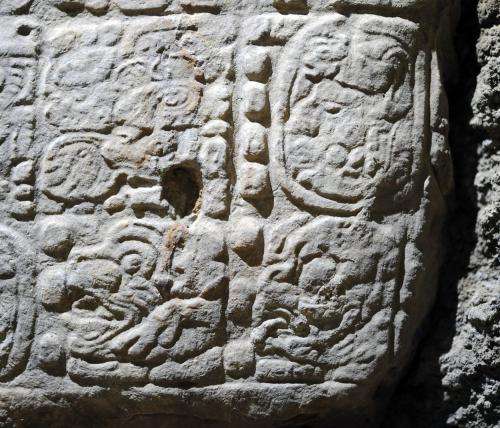
Archaeologists working at the site of La Corona in Guatemala have discovered a 1,300 year-old year-old Maya text that provides only the second known reference to the so-called 'end date' for the Maya calendar on December 21, 2012. The discovery, one of the most significant hieroglyphic find in decades, was announced today at the National Palace in Guatemala