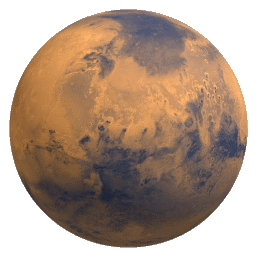
Mars is the fourth planet from the Sun in the solar system. It is named after Mars, the god of war in Roman mythology (the counterpart to Ares, the god of war in Greek mythology) because of its red color as viewed in the night sky. This feature also earned it the name of "the Red Planet." Mars has two moons (Phobos and Deimos) which are both small and oddly-shaped, possibly being captured asteroids. The prefix areo- refers to Mars.
Mars has certainly been seen by skygazers since prehistoric times. It was known by the Egyptians as "Her Deschel" or "the Red One." Among the Babylonians Mars was known as "Nirgal" or "the Star of Death". The Romans were the ones to give Mars its modern name, after the God of War. Mythology and Metaphysics
Physical characteristics
Mars has always fascinated people. Its red, fiery appearance is caused by iron oxide (rust) on its surface. Mars has only a quarter the surface area of the Earth and only one-tenth the mass (though its surface area is approximately equal to that of the Earth's dry land because Mars lacks oceans). The solar day (or "sol") on Mars is almost the same length as it is on Earth: 24 hours, 39 minutes, and 35.244 seconds.
Mars' atmosphere is thin: the air pressure on the surface is only 750 pascals, about 0.75 percent of the average on Earth. However, the scale height of the atmosphere is about 11 km, somewhat higher than Earth's 6 km. The atmosphere on Mars is 95 percent carbon dioxide, 3 percent nitrogen, 1.6 percent argon, and traces of oxygen and water. In 2003, methane was also discovered in the atmosphere by Earth-based telescopes, and possibly confirmed in March 2004 by the Mars Express Orbiter, present measurements state an average methane concentration of about 11±4 ppb by volume. The thin atmosphere cannot hold heat and is the cause of the lower temperatures on Mars (20 degrees Celsius or 68 degrees Fahrenheit is about as hot as it gets).
The presence of methane on Mars is very intriguing, since as an unstable gas it indicates that there must be (or have been within the last few hundred years) a source of the gas on the planet. Volcanic activity, comet impacts and the existence of life in the form of microorganisms such as methanogens are among possible but as yet unproven sources. The methane appears in patches, which suggests that it is being rapidly broken down (and so is presumably also continually being released to the atmosphere) before it has time to become uniformly distributed in the atmosphere. Plans are now being made to look for other 'companion' gases that may suggest which sources are most likely; in the Earth's oceans biological methane production tends to be accompanied by ethane, while volcanic methane is accompanied by sulfur dioxide.
Apart from methane release and breakdown, other aspects of the atmosphere are also dynamic, with water vapor moving from one pole to the other with the change between summer and winter, giving rise to Earth-like frost and large cirrus clouds of water-ice that were photographed by the Opportunity rover in 2004.
Geology
Observations of the magnetic fields on Mars by the Mars Global Surveyor spacecraft have revealed that parts of the planet's crust has been magnetized in alternating bands, typically measuring 100 miles wide by 600 miles long (160 km by 1000 km), in a similar pattern to those found on the ocean floors of Earth. One interesting theory, published in 1999 is that these bands could be evidence of the past operation of plate tectonics on Mars, although this has yet to be proven. If true, the processes involved may have helped to sustain an Earth-like atmosphere by transporting carbon rich rocks to the surface, while the presence of a magnetic field would have helped to protect the planet from cosmic radiation. Other explanations have also been proposed.
Amongst the findings from the Opportunity rover is the presence of hematite on Mars in the form of small spheres on the Meridiani Planum. The spheres are only a few millimeters in diameter and are believed to have formed as rock deposits under watery conditions billions of years ago. Other minerals have also been found containing forms of sulfur, iron or bromine such as jarosite. This and other evidence led a group of 50 scientists to conclude in the December 9, 2004 edition of the journal Science that "Liquid water was once intermittently present at the Martian surface at Meridiani, and at times it saturated the subsurface. Because liquid water is a key prerequisite for life, we infer conditions at Meridiani may have been habitable for some period of time in Martian history". On the opposite side of the planet the mineral goethite, which (unlike hematite) forms only in the presence of water, along with other evidence of water, has also been found by the Spirit rover in the "Columbia Hills".
In 1996, researchers studying a meteorite (ALH84001) believed to have originated from Mars reported features which they attributed to microfossils left by life on Mars. As of 2005, this interpretation remains controversial with no consensus having emerged.
Topography
The dichotomy of Martian topography is striking: northern plains flattened by lava flows contrast with the southern highlands, pitted and cratered by ancient impacts. The surface of Mars as seen from Earth is consequently divided into two kinds of areas, with differing albedo. The paler plains covered with dust and sand rich in reddish iron oxides were once thought of as Martian 'continents' and given names like Arabia Terra (land of Arabia) or Amazonis Planitia (Amazonian plain). The dark features were thought to be seas, hence their names Mare Erythraeum, Mare Sirenum and Aurorae Sinus. The largest dark feature seen from Earth is Syrtis Major.
Mars has polar ice caps that contain frozen water and carbon dioxide that change with the Martian seasons - the carbon dioxide ice sublimates in summer, uncovering a surface of layered rocks, and forms again in winter. An extinct shield volcano, Olympus Mons (Mount Olympus), is at 27 km the highest mountain in the solar system. It is in a vast upland region called Tharsis, containing several large volcanos. See list of mountains on Mars. Mars also has the solar system's largest canyon system, Valles Marineris or the Mariner Valley, which is 4000 km long and 7 km deep. Mars is also scarred by a number of impact craters. The largest of these is the Hellas impact basin, covered with light red sand. See list of craters on Mars.
The difference between Mars' highest and lowest points is nearly 31 km (from the top of Olympus Mons at an altitude of 27 km to the bottom of the Hellas impact basin at an altitude of 4 km below the datum). In comparison, the difference between Earth's highest and lowest points (Mount Everest and the Mariana Trench) is only 19.7 km. Combined with the planets' different radii, this means Mars is nearly three times "rougher" than Earth.
The International Astronomical Union's Working Group for Planetary System Nomenclature is responsible for naming Martian surface features.
Zero elevation: Since Mars has no oceans and hence no 'sea level', a zero-elevation surface or mean gravity surface must be selected. The datum for Mars is defined by the fourth-degree and fourth-order spherical harmonic gravity field, with the zero altitude defined by the 610.5 Pa (6.105 mbar) atmospheric pressure surface (approximately 0.6% of Earth's) at a temperature of 273.16 K. This pressure and temperature correspond to the triple point of water.
Zero meridian: Mars' equator is defined by its rotation, but the location of its Prime Meridian was specified, as was Earth's, by choice of an arbitrary point which was accepted by later observers. The German astronomers Wilhelm Beer and Johann Heinrich Mädler selected a small circular feature as a reference point when they produced the first systematic chart of Mars features in 1830-32. In 1877, their choice was adopted as the prime meridian by the Italian astronomer Giovanni Schiaparelli when he began work on his notable maps of Mars. After the spacecraft Mariner 9 provided extensive imagery of Mars in 1972, a small crater (later called Airy-0), located in the Sinus Meridiani ('Middle Bay' or 'Meridian Bay') along the line of Beer and Mädler, was chosen by Merton Davies of the RAND Corporation to provide a more precise definition of 0.0° longitude when he established a planetographic control point network.
Canals
Mars has an important place in human imagination due to the belief by some that life existed on Mars, due mainly to observations by many in the 19th century popularized by Percival Lowell and Giovanni Schiaparelli. Schiaparelli called these observed features 'canali', meaning channels in Italian. This was popularly mistranslated as 'canals', and the myth of the Martian canals began. They were apparently artificial linear features on the surface that were asserted to be canals, and due to seasonal changes in the brightness of some areas that were thought to be caused by vegetation growth. This gave rise to many stories concerning Martians. The linear features are now known to be mostly non-existent or, in some cases, dry ancient watercourses. The color changes have been ascribed to dust storms.
Mars' Moons
Both Phobos and Deimos are tidally locked with Mars, always pointing the same face towards it. Since Phobos orbits around Mars faster than the planet itself rotates, tidal forces are slowly but steadily decreasing its orbital radius. At some point in the future Phobos will be broken up by gravitational forces (see Roche limit). Deimos, on the other hand, is far enough away that its orbit is being slowly boosted instead.
Both satellites were discovered in 1877 by Asaph Hall, and are named after the characters Phobos (panic/fear) and Deimos (terror/dread) who, in Greek mythology, accompanied their father the Greek god Ares into battle. Ares was known to the Romans as Mars, the god of war.
As seen from Mars, Phobos has an angular diameter of about 12', while Deimos has an angular diameter of about 2'. The Sun's angular diameter, by contrast, is about 21'.
The Exploration of Mars
Dozens of spacecraft, including orbiters, landers, and rovers, have been sent to Mars by the Soviet Union, the United States, Europe, and Japan to study the planet's surface, climate, and geography. Roughly two-thirds of all spacecraft destined for Mars have failed in one manner or another before completing or even beginning their missions. Part of this high failure rate can be ascribed to technical problems, but enough have either failed or lost communications for no apparent reason that some researchers half-jokingly speak of an Earth-Mars "Bermuda Triangle" or of a Great Galactic Ghoul which subsists on a diet of Mars probes, or of a Mars Curse.
Among the most successful missions are the Mars probe program, the Mariner and Viking programs, Mars Global Surveyor, Mars Pathfinder, and Mars Odyssey. Global Surveyor has taken pictures of gullies and debris flow features that suggest there may be current sources of liquid water, similar to an aquifer, at or near the surface of the planet. Mars Odyssey determined that there are vast deposits of water ice in the upper three meters of Mars' soil within 60° latitude of the south pole.
In 2003, the ESA launched the Mars Express craft consisting of the Mars Express Orbiter and the lander Beagle 2. Mars Express Orbiter confirmed the presence of water ice and carbon dioxide ice at the planet's south pole. NASA had previously confirmed their presence at the north pole of Mars. Attempts to contact the Beagle 2 failed and it was declared lost in early February 2004.
Also in 2003, NASA launched the twin Mars Exploration Rovers named Spirit (MER-A) and Opportunity (MER-B). Both missions landed successfully in January 2004 and have met or exceeded all their targets; while a 90-day nominal mission was planned, as of February 2005, their missions have been extended twice and they continue to return science, although some mechanical faults have occurred. Among the most significant science return has been evidence of liquid water some time in the past at both landing sites. In addition, for the first time, dust devils imaged from ground-level have been detected moving across the surface of Mars by Spirit (MER-A).
Observation of Mars
Earth passes Mars every 780 days (or two years plus seven weeks) at a distance of about 80,000,000 km. However, this varies because the orbits are elliptical. To a naked-eye observer, Mars usually shows a distinct yellow, orange or reddish colour, and varies in brightness more than any other planet as seen from Earth over the course of its orbit, due to the fact that when furthest away from the Earth it is more than seven times as far from the latter as when it is closest (and can be lost in the Sun's glare for months at a time when least favourably positioned). At its most favourable times - which occur twice every 32 years, alternately at 15 and 17-year intervals, and always between late July and late September - Mars shows a wealth of surface detail to a telescope. Especially noticeable, even at low magnification, are the polar ice caps.
On August 27, 2003, at 9:51:13 UT, Mars made its closest approach to Earth in nearly 60,000 years: 55,758,006 km (approximately 35 million miles) without Light-time correction. This close approach came about because Mars was one day from opposition and about three days from its perihelion, making Mars particularly easy to see from Earth. The last time it came so close is estimated to have been on September 12, 57,617 BC. Detailed analysis of the solar system's gravitational landscape forecasts an even closer approach in 2287. However, to keep this in perspective, this record approach was only an imperceptibly tiny fraction less than other recent close approaches that occur four times every 284 years. For instance, the minimum distance on August 22, 1924 was 0.37284 AU, compared to 0.37271 AU on August 27, 2003, and the minimum distance on August 24, 2208 will be 0.37278 AU.
A transit of the Earth as seen from Mars will occur on November 10, 2084. At that time the Sun, the Earth and Mars will be exactly in a line. There are also transits of Mercury and transits of Venus, and the moon Deimos is of sufficiently small angular diameter that its partial "eclipses" of the Sun are best considered transits (see Transit of Deimos from Mars).
Martian meteorites
A Martian meteorite is a meteorite that has landed on Earth but is believed to have originated from Mars. This could have been the result of an impact of a celestial body on Mars, sending material from Mars into space. Note that this does not refer to meteorites actually found on Mars, such as Heat Shield Rock.
Mars meteorites include three rare groups of achondritic (stony) meteorites (16 objects total) with isotope ratios that are said to be consistent with each other and inconsistent with the Earth. It should be pointed out, however, that the isotope ratios do not actually match Mars ratios especially well, to the extent that Mars ratios are known, although they do differ substantially from Earth isotope ratios and from what is known of Lunar ratios.
All the meteorites are igneous rocks. Lherzolitic shergottites (one from Antarctica, 2 from California) are identified by their Deuterium/Hydrogen ratios. The crystals appear to be 154-187 million years old and they appear, from cosmic ray analysis, to have spent 2.5 to 3.6 million years in space. There are also basaltic shergottites, some of which appear (from the presence of hydrated carbonates and sulfates) to have been exposed to liquid water prior to injection into space. One of the shergottites, known as ALH84001, is much older than the others - about 4.5 billion years. In this respect, it resembles a typical meteorite rather than the other shergottites.
The other two types of Martian meteorites are Chassignites and Nakhlites. All appear to have been on earth no more than 35,000 years. Together, these objects are called SNC meteorites.Although common wisdom is that the SNC meteorites are from Mars, the Mars origin theory does have some problems. The isotope ratios are not an especially good match.
A widely published graph showing a near-perfect match is alleged to be constructed from examples selected to "prove" the hypothesis and to be a poor representation of the real data. For example, the Ar40/Ar36 ratio for one meteorite (1650) is almost exactly half-way between Earth (300) and Mars (3000). Carbon dioxide, the predominant gas in the current Mars atmosphere, is unaccountably rare in the trapped gases in the SNC meteorites.
The SNC meteorites do not show shock artifacts that would be expected in small objects ejected with enough velocity to escape Mars. The majority of SNC meteorites are quite young by geologic standards and seem to imply that volcanic activity was present on Mars only a few hundred million years ago. Cosmic ray traces in the meteorites indicate relatively short stays (3 to 3.5 million years) in space. It is asserted that there are no large young craters on Mars that are candidates as sources for the SNC meteorites.
Possible evidence of life has been hypothesized in three meteorites.
In August 2002, a NASA team led by Thomas-Keptra published a study indicating that 25% of the magnetite in ALH84001 occurs as small, uniform-sized crystals in a crystal form that, on Earth, is associated only with biologic activity. The remainder of the material appears to be normal inorganic magnetite. The extraction technique did not permit determination as to whether the possibly biologic magnetic was organized into chains as would be expected.
On April 14, 2004, NASA revealed that a rock known as "Bounce", studied by the Mars Exploration Rover Opportunity, was similar in composition to the meteorite EETA79001-B, discovered in Antarctica in 1979. The rock may have been ejected from the same crater as the meteorite, or from another crater in the same area of the Martian surface.
Visible Ice Lake Discovered
On the 29th July 2005, the BBC reported that a visible ice lake had been discovered on Mars. Photographs of the lake were taken by the High Resolution Stereo Camera on board Mars Express, the European Space Agency probe which had been exploring the planet.
The ice disc is located on Vastitas Borealis, a broad plain that covers much of Mars' far northern latitudes.The highly visible ice is sitting in a crater which is 35 km (23 miles) wide, with a maximum depth of about two km (1.2 miles).It was also reported that researchers studying the images are sure it is not frozen carbon dioxide (CO2), because CO2 ice had already disappeared from the north polar cap at the time the image was taken.
The BBC claims that this discovery 'raises the prospect that past or present life will one day be detected', and that 'It also boosts the chances that manned missions can eventually be sent to the Red Planet'.
Ice lake found on the Red Planet BBC - July 30, 2005
Life on Mars
Evidence exists that the planet once was significantly more habitable than today, but the question whether living organisms ever actually existed there is an open one. Some researchers think that a certain rock which is believed to have originated on Mars - specifically, meteorite ALH84001 - does contain evidence of past biologic activity, but no consensus about these claims has been achieved so far and recent research indicates that the rock, since its creation several billion years ago, has never been exposed to temperatures for extended periods of time that would allow for liquid water.
The Viking probes carried experiments designed to detect microorganisms in Martian soil at their respective landing sites, and had some positive results, later denied by many scientists, resulting in ongoing controversey. Also, present biologic activity is one of the explanations that have been suggested for the presence of traces of methane within the Martian atmosphere, but other explanations not involving life are generally considered more likely.
If colonization is going to happen, Mars seems a likely choice due to its rather hospitable conditions (compared with other planets, it is most like Earth).
ALPHABETICAL INDEX OF ALL FILES