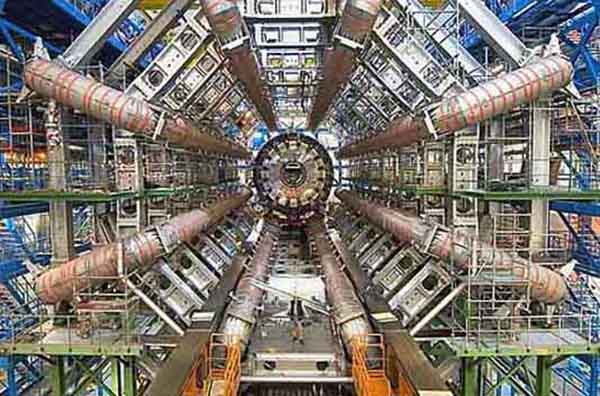
The Large Hadron Collider (LHC) is the world's largest and most powerful particle collider, built by the European Organization for Nuclear Research (CERN) from 1998 to 2008. Its aim is to allow physicists to test the predictions of different theories of particle physics and high-energy physics, and particularly prove or disprove the existence of the theorized Higgs particle and of the large family of new particles predicted by supersymmetric theories. The LHC is expected to address some of the unsolved questions of physics, advancing human understanding of physical laws. It contains seven detectors, each designed for certain kinds of research.
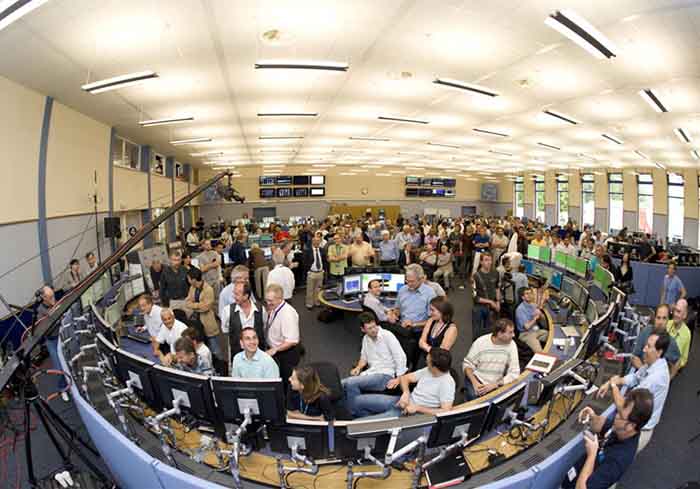
The LHC was built in collaboration with over 10,000 scientists and engineers from over 100 countries,
as well as hundreds of universities and laboratories.
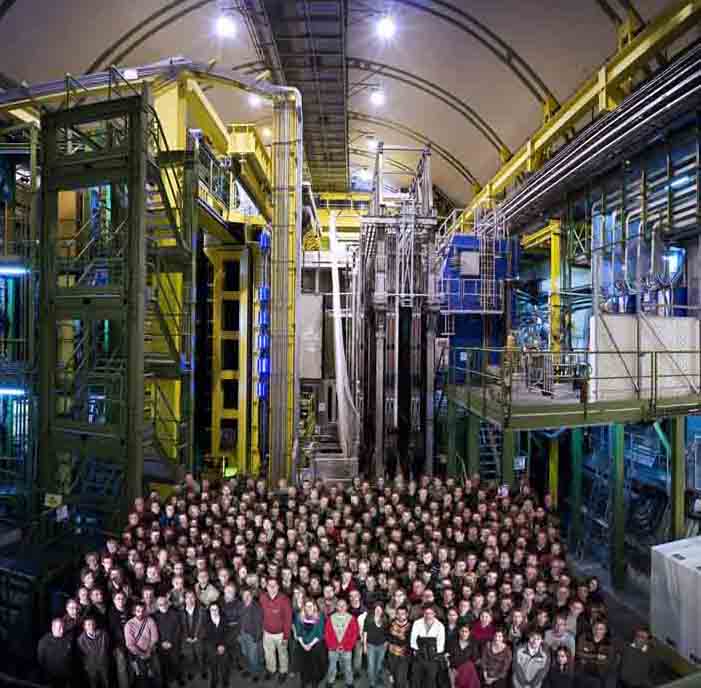

The LHC lies in a tunnel 27 kilometres (17 mi) in circumference, as deep as 175 metres (574 ft) beneath the Franco-Swiss border near Geneva, Switzerland. As of 2014, the LHC remains one of the largest and most complex experimental facilities ever built. Read more ...
The Higgs boson just revealed a new secret at the Large Hadron Collider Science Daily - August 25, 2025
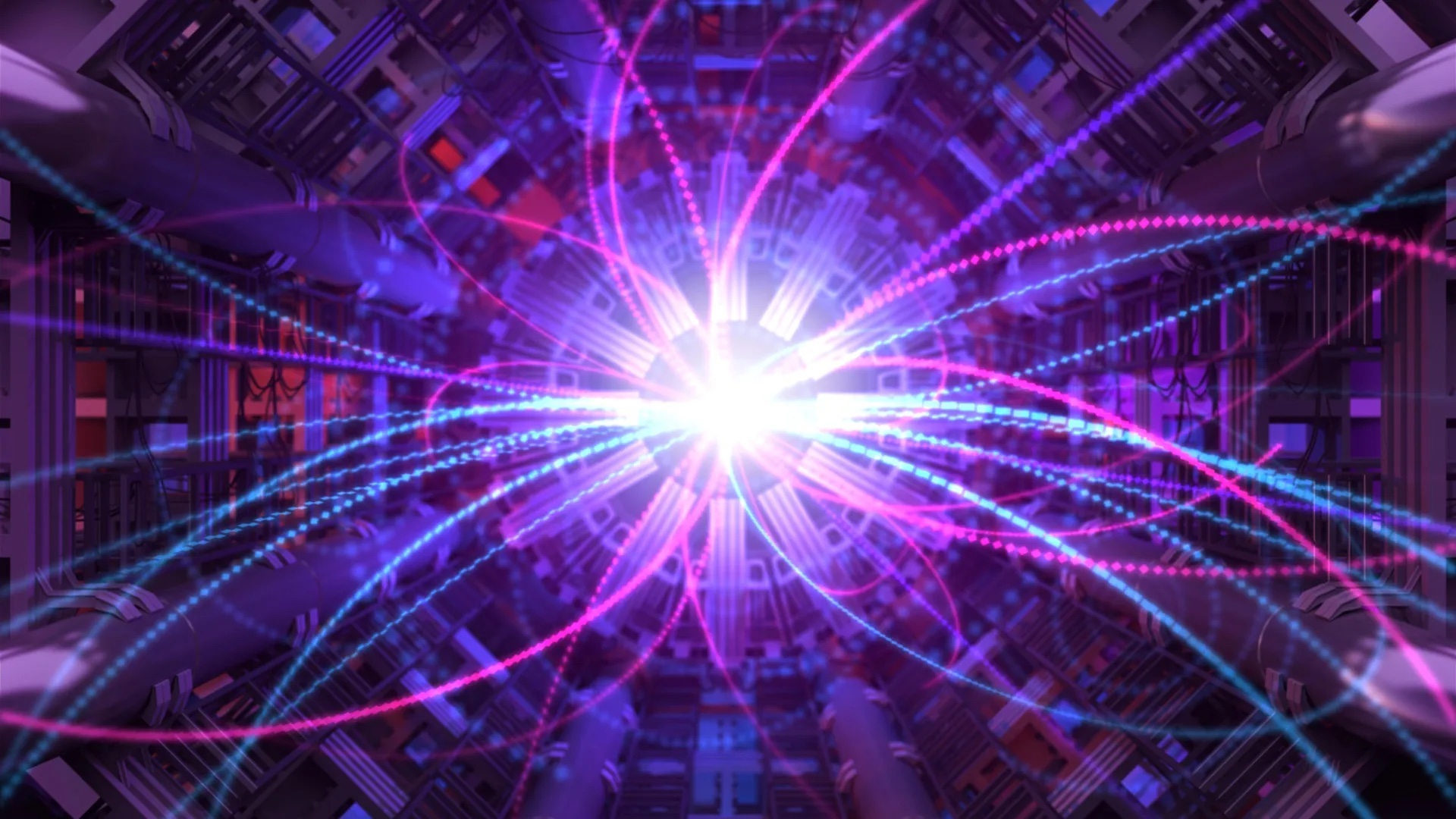
ATLAS researchers have found evidence of the Higgs boson transforming into muons and refined their search for other rare decays, pushing the limits of what we know about this mysterious particle. The ATLAS Collaboration finds evidence of Higgs-boson decays to muons and improves sensitivity to Higgs-boson decays to a Z boson and a photon. Since the discovery of the Higgs boson in 2012, physicists have made major strides in exploring its properties. Does that mean the subject is done and dusted? Far from it! In new results presented at the 2025 European Physical Society Conference on High Energy Physics (EPS-HEP), the ATLAS Collaboration narrowed in on two exceptionally rare Higgs-boson decays using data collected in Run 3 of the Large Hadron Collider (LHC). These studies offer deep insights into how closely the Higgs boson's behavior aligns with the Standard Model.
First-ever collisions of oxygen at the Large Hadron Collider PhysOrg - July 1, 2025
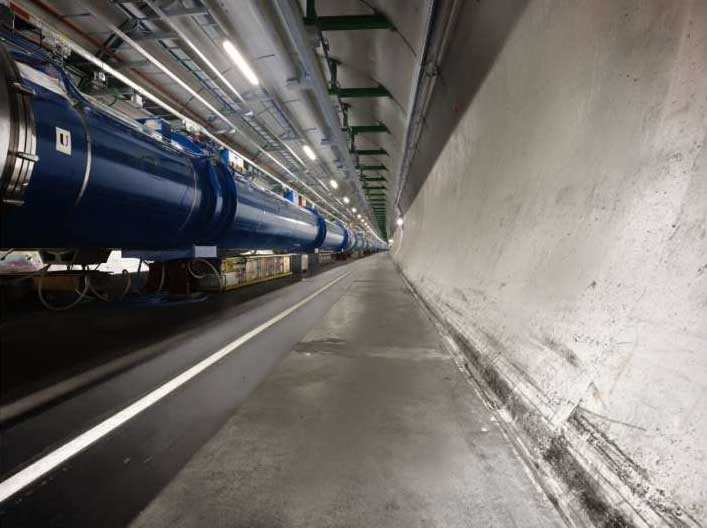
The Large Hadron Collider (LHC) gets a breath of fresh air as it collides beams of protons and oxygen ions for the very first time.
AI enhances the Higgs boson's 'charm' PhysOrg - May 20, 2025
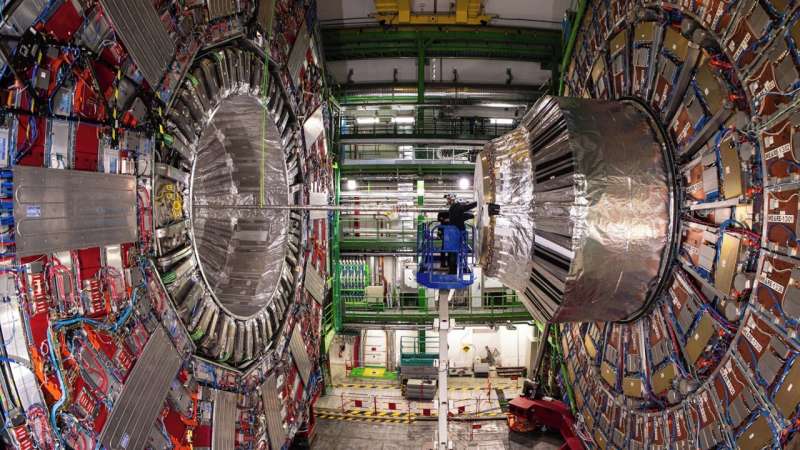
The Higgs boson, discovered at the Large Hadron Collider (LHC) in 2012, plays a central role in the Standard Model of particle physics, endowing elementary particles such as quarks with mass through its interactions. The Higgs boson's interaction with the heaviest "third-generation" quarks has been observed and found to be in line with the Standard Model.
Matter vs. Antimatter: LHC Discovery Could Explain How Universe Avoided Obliteration Science Alert - April 3, 2025

Experiments at the Large Hadron Collider (LHC) may have uncovered new clues as to how we avoided this apocalypse, hinting at a surprising difference in the decays of particles called baryons and their antimatter twin.
Physicists at the world's largest particle accelerator - have made a first-of-its-kind discovery about antimatter that could help solve one of the universe's biggest mysteries. Live Science - March 31, 2025
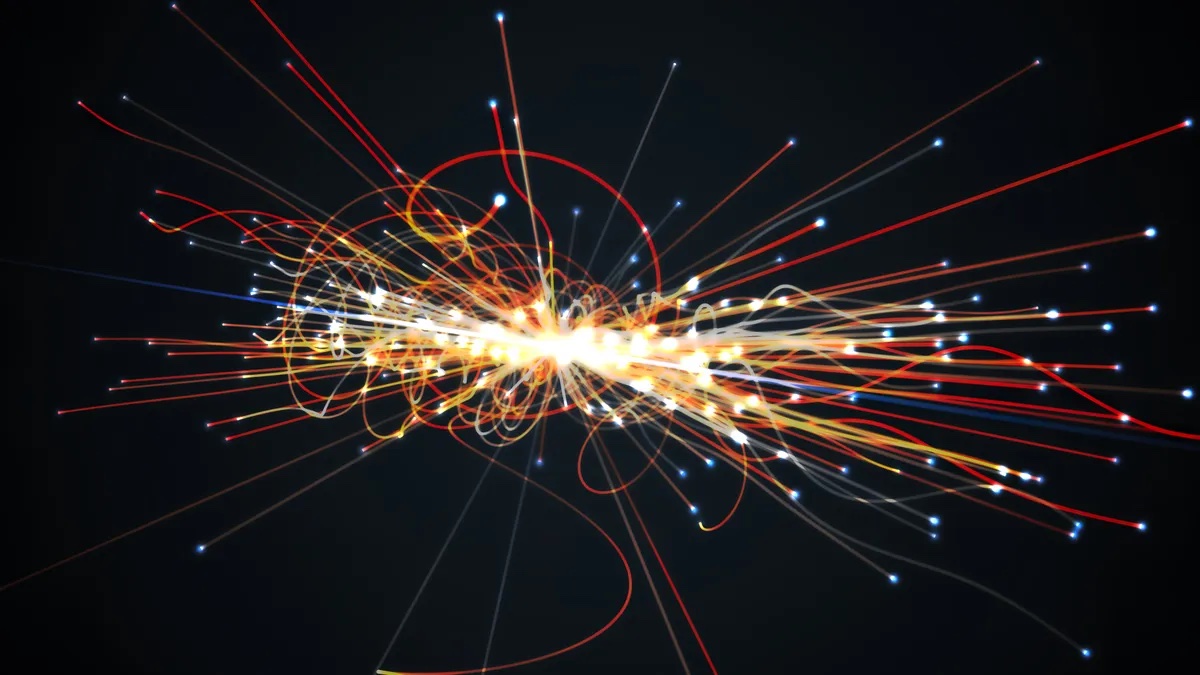
Why matter dominates over antimatter in our universe has long been a major cosmic mystery to physicists. A new finding by the world's largest particle collider has revealed a clue.
The next-generation triggers for CERN detectors PhysOrg - April 12, 2024
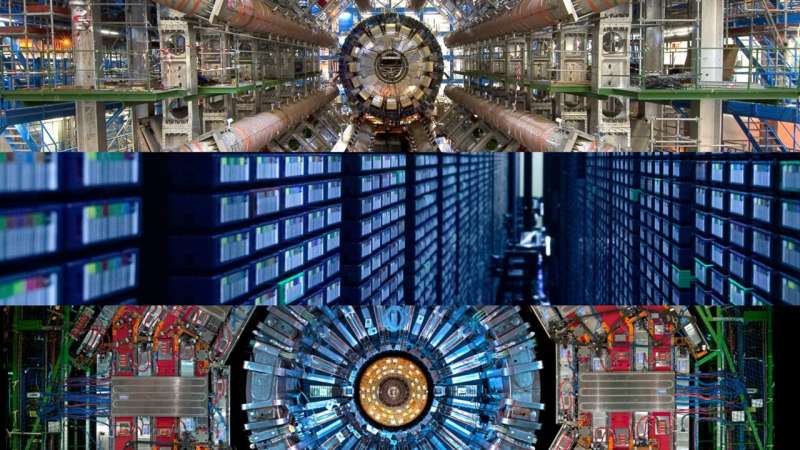
Peter Higgs transformed what we know about the building blocks of the universe PhysOrg - April 12, 2024
Peter Higgs Has Died At 94. What Is The Higgs Boson "God Particle" He Predicted? IFL Science - April 11, 2024
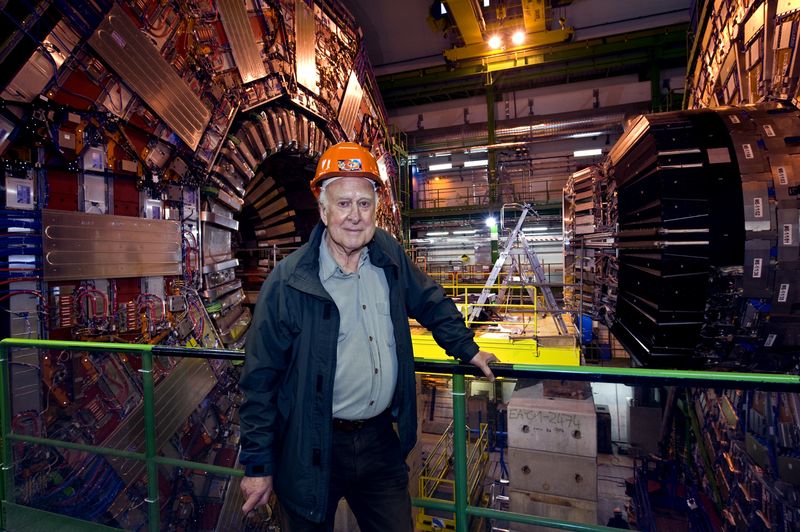
'God Particle' Nobel Laureate Peter Higgs Passes Away Age 94 Science Alert - April 10, 2024

ATLAS provides first measurement of the W-boson width at the LHC PhysOrg - April 10, 2024
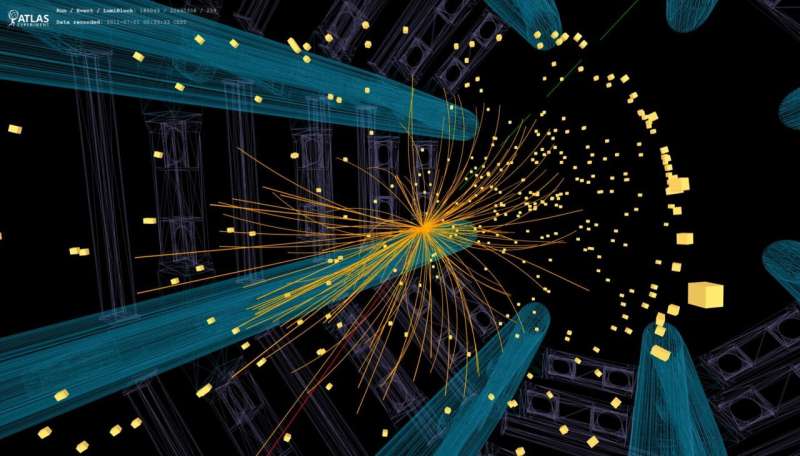
Evidence of a new subatomic particle observed PhysOrg - April 12, 2024
Physicists Capture Elusive 4D 'Ghost' in CERN Particle Accelerator Science Alert - March 25, 2024
In the Super Proton Synchrotron, physicists have finally measured and quantified an invisible structure that can divert the course of the particles therein, and create problems for particle research.
Cern: Scientists search for mysterious ghost particles BBC - March 25, 2024
Some physicists have long suspected that mysterious 'ghost' particles in the world around us could greatly advance our understanding of the true nature of the Universe. Now scientists think they've found a way to prove whether or not they exist. Europe's centre for particle research, Cern, has approved an experiment designed to find evidence for themThe new instrument will be a thousand times more sensitive to such particles than previous devices. It will smash particles into a hard surface to detect them instead of against each other like Cern's main device the Large Hadron Collider (LHC).
World's smallest particle accelerator is 54 million times smaller than the Large Hadron Collider, and it works Live Science - October 26, 2023
Scientists recently fired up the world's smallest particle accelerator for the first time. The tiny technological triumph, which is around the size of a small coin, could open the door to a wide range of applications, including using the teensy particle accelerators inside human patients. The new machine, known as a nanophotonic electron accelerator (NEA), consists of a small microchip that houses an even smaller vacuum tube made up of thousands of individual "pillars." Researchers can accelerate electrons by firing mini laser beams at these pillars.
Rare 'Hypernuclei' Have Been Detected at The Large Hadron Collider Science Alert - August 30, 2023
A rare type of particle has emerged from proton collisions in the Large Hadron Collider. Between 2016 and 2018, physicists recorded more than 100 rare, unstable hypernuclei - atomic cores that contain an unusual flavor of quark in one of their nuclear particles. It's a discovery that could help us understand the source of mysterious antihelium tentatively detected out in the great wide beyond of the cosmos. The Large Hadron Collider is what it sounds like: a giant machine for smashing particles together in high-speed collisions, so that physicists can pore over the remains and look for things like unstable, short-lived particles that we can't detect any other way.
First Detection Of Particle Accelerator-Produced Neutrinos At The Large Hadron Collider IFL Science - August 30, 2023
For the first time, neutrinos produced from nuclear reactions triggered by the Large Hadron Collider have been detected. Although physicists have been sure that the reactions occurring when particles are accelerated to close to the speed of light and crashed together produce neutrinos, capturing the evidence has been a different matter. The achievement could help particle physicists resolve some of the great unknowns of subatomic particle behavior.
LHC, the world's most powerful particle accelerator - upgraded version - "High Luminosity LHC" - will be available in 2028 Big Think - April 23, 2023
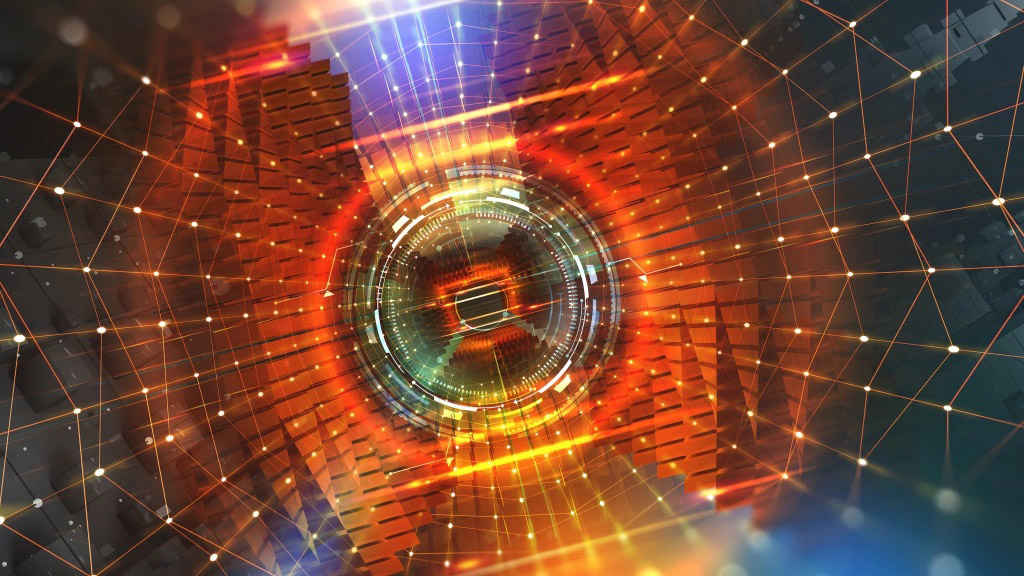
The LHC is a true technological marvel, with a magnetic field 160,000 times greater than that of Earth and particle collisions that are 100,000 times hotter than the center of the Sun.
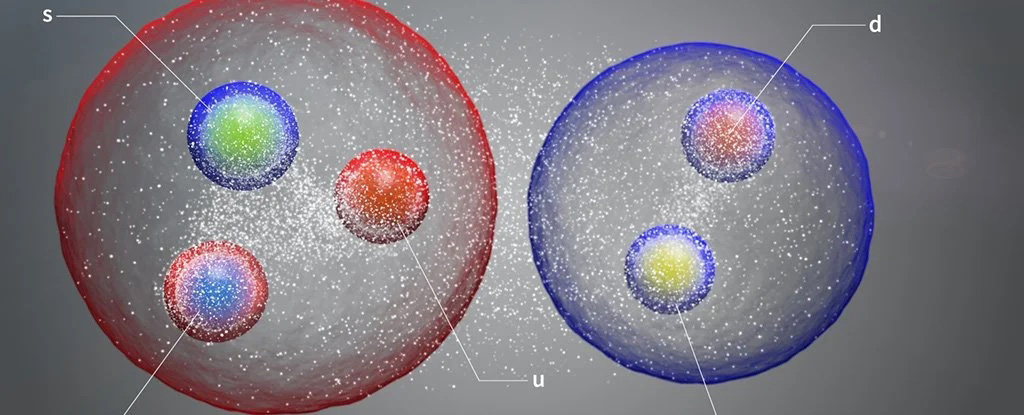
Physicists say they've found evidence in data from Europe's Large Hadron Collider for three never-before-seen combinations of quarks, just as the world's largest particle-smasher is beginning a new round of high-energy experiments Science Alert - July 6, 2022
CERN's Large Hadron Collider fires up for third time to unlock more secrets of the universe CNN - July 5, 2022
A decade ago, the Large Hadron Collider, Earth's most powerful particle accelerator, proved the existence of an subatomic particle called the Higgs boson - thought to be a fundamental building block of the universe dating back to the big bang billions of years ago.
Now, physicists at the European Organization for Nuclear Research (CERN) on the Swiss-French border are restarting the collider with the aim of understanding more about the Higgs boson, other subatomic particles and the mysteries of dark matter - an invisible and elusive substance that can't be seen because it doesn't absorb, reflect or emit any light.
The Large Hadron Collider's crowning glory was the discovery of the Higgs boson, but there's one thing that could usurp it: the discovery of dark matter Space.com - July 5, 2022
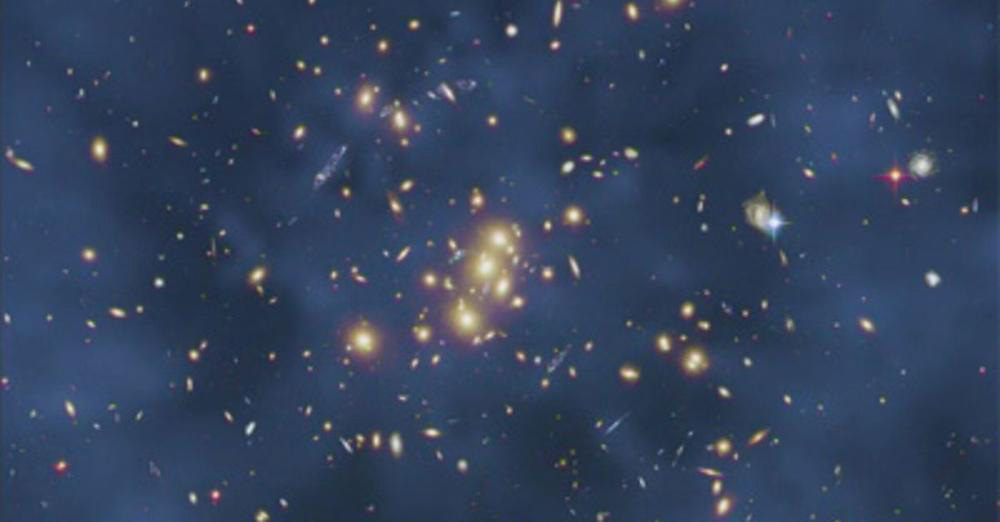
10 Years After the Higgs Boson, What's the Next Big Thing for Physics? Gizmodo - July 2, 2022
On July 4, 2012, scientists at CERN confirmed the observation of the Higgs boson, an elementary particle first proposed in the 1960s. The bosonŐs discovery was a momentous occasion, as it meant physicists were a step closer to probing the field associated with the boson, which gives particles mass.
The Vertex Locator (VELO) was installed at the LHCb experiment in May 2022, just in time for the start of the third LHC run, on 5 July, marking the end of 15 years of development and construction. PhysOrg - July 6, 2022
The pixel detector, with its millions of microscopic pixels, each measuring 55 x 55 micrometers, can recreate particles' trajectories at an unprecedented speed of 40 million times per second and is located only 3 millimeters from the LHCb collision point. This frenetic rate will make it possible to obtain a complete picture of the collisions in the LHC.
What comes after the Higgs boson PhysOrg - July 6, 2022
10 years after the discovery of the Higgs boson, physicists still can't get enough of the 'God particle' Space.com - July 5, 2022
The Higgs boson, ten years after its discovery PhysOrg - July 5, 2022
ATLAS and CMS release results of most comprehensive studies yet of Higgs boson's properties PhysOrg - July 4, 2022
Large Hadron Collider Breaks Proton Record Only Days After 3-Year Shutdown Science Alert - April 26, 2022
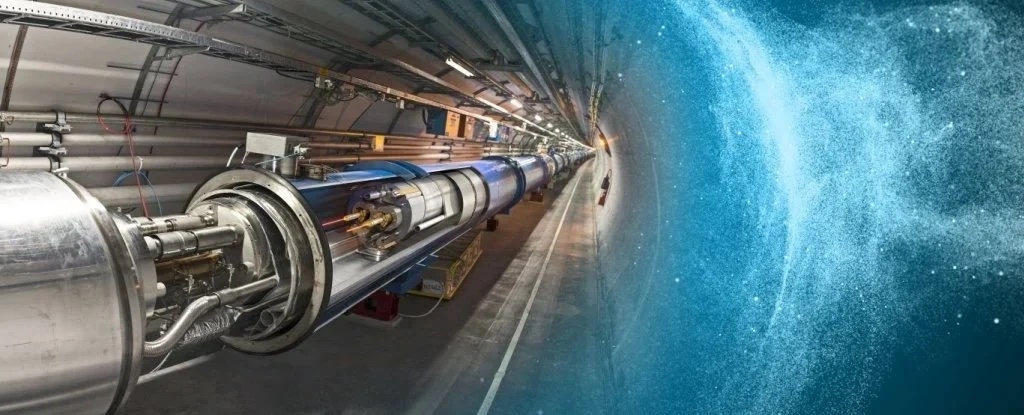
'X particle' from the dawn of time detected inside the Large Hadron Collider Live Science - January 25, 2022
These X particles, which likely existed in the tiniest fractions of a second after the Big Bang, were detected inside a roiling broth of elementary particles called a quark-gluon plasma, formed in the LHC by smashing together lead ions. By studying the primordial X particles in more detail, scientists hope to build the most accurate picture yet of the origins of the universe.These X particles, which likely existed in the tiniest fractions of a second after the Big Bang, were detected inside a roiling broth of elementary particles called a quark-gluon plasma, formed in the LHC by smashing together lead ions. By studying the primordial X particles in more detail, scientists hope to build the most accurate picture yet of the origins of the universe.
Physicists Detect Mysterious X Particles in 'Primordial Soup' For The First Time Science Alert - January 25, 2022
A mysterious particle thought to have existed briefly just after the Big Bang has now been detected for the first time in the 'primordial soup'. Specifically, in a medium called the quark-gluon plasma, generated in the Large Hadron Collider by colliding lead ions. There, amid the trillions of particles produced by these collisions, physicists managed to tease out 100 of the exotic motes known as X particles.
Scientists have recreated the first matter that appeared after the Big Bang in the Large Hadron Collider Live Science - June 2, 2021
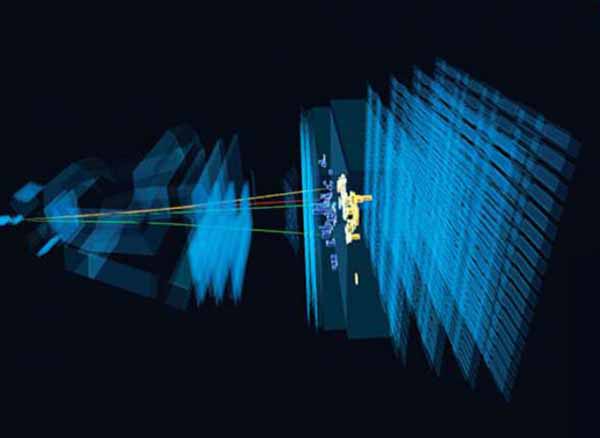
New result from the LHCb experiment challenges leading theory in physics PhysOrg - March 24, 2021
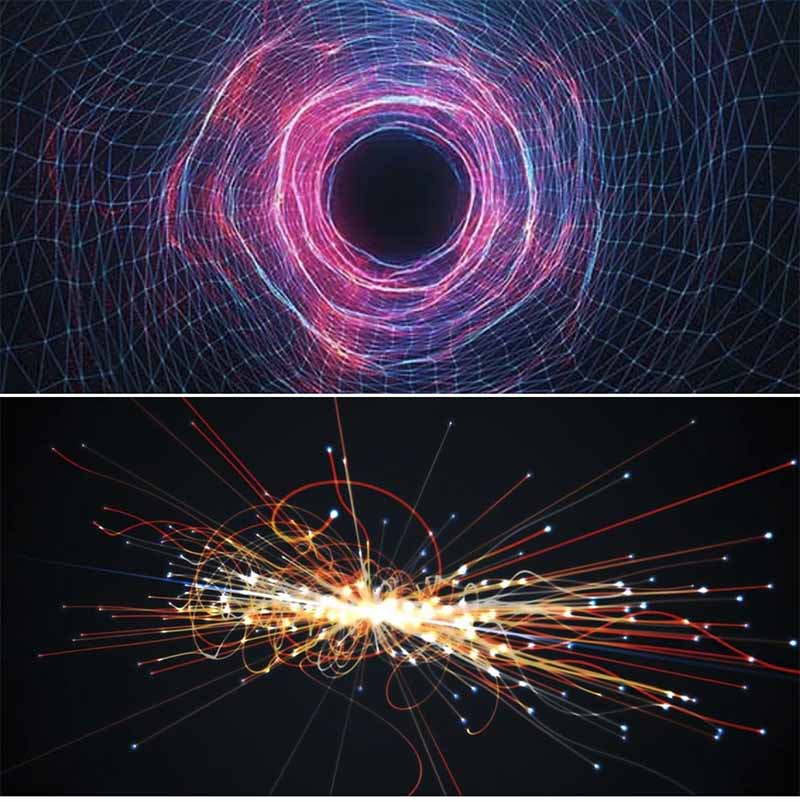
Strange pattern found inside world's largest atom smasher has physicists excited Live Science - March 24, 2021
After 50 Years, Physicists Confirm The Existence of an Elusive Quasiparticle Science Alert - March 24, 2021
The Large Hadron Collider's official tally: 59 new hadrons and counting PhysOrg - March 3, 2021
How many new particles has the LHC discovered? The most widely known discovery is of course that of the Higgs boson. Less well known is the fact that, over the past 10 years, the LHC experiments have also found more than 50 new particles called hadrons. Coincidentally, the number 50 appears in the context of hadrons twice, as 2021 marks the 50th anniversary of hadron colliders: on 27 January 1971, two beams of protons collided for the first time in CERN's Intersecting Storage Rings accelerator, making it the first accelerator in history to produce collisions between two counter-rotating beams of hadrons.
LHC creates matter from light PhysOrg - September 4, 2020
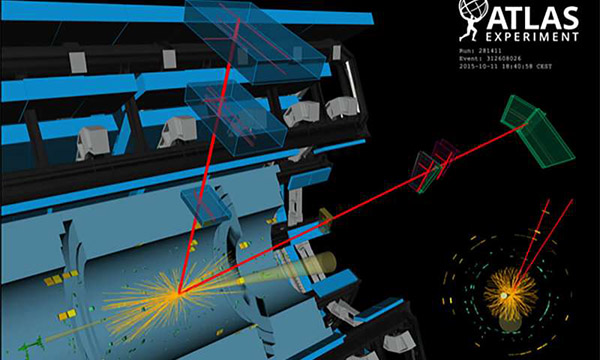
The Large Hadron Collider plays with Albert Einstein's famous equation, E = mc2, to transform matter into energy and then back into different forms of matter. But on rare occasions, it can skip the first step and collide pure energy - in the form of electromagnetic waves. Last year, the ATLAS experiment at the LHC observed two photons, particles of light, ricocheting off one another and producing two new photons. This year, they've taken that research a step further and discovered photons merging and transforming into something even more interesting: W bosons, particles that carry the weak force, which governs nuclear decay. This research doesn't just illustrate the central concept governing processes inside the LHC: that energy and matter are two sides of the same coin. It also confirms that at high enough energies, forces that seem separate in our everyday lives - electromagnetism and the weak force - are united.
Long-sought decay of Higgs boson observed PhysOrg - August 28, 2018
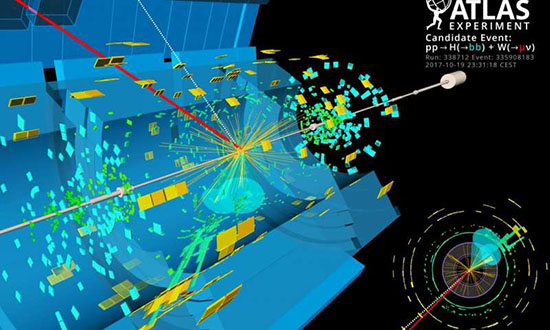
Six years after its discovery, the Higgs boson has at last been observed decaying to fundamental particles known as bottom quarks. The finding, presented today at CERN1 by the ATLAS and CMS collaborations at the Large Hadron Collider (LHC), is consistent with the hypothesis that the all-pervading quantum field behind the Higgs boson also gives mass to the bottom quark. Both teams have submitted their results for publication today.
First-Ever Evidence of Higgs Boson Decay Opens New Doors for Particle Physics Live Science - August 28, 2018

If you've been a science fan for the last few years, you're aware of the exciting results to emerge from the Large Hadron Collider (LHC), which in 2012 found the Higgs boson, the subatomic particle responsible for giving mass to fundamental subatomic particles. Today, physicists have another exciting announcement to add to the Higgs saga: They have made the first unambiguous observation of Higgs bosons decaying into a matter-antimatter pair of bottom quarks. Surprisingly, the Higgs bosons decay most often in this way. The new announcement shows a strong agreement between the theoretical predictions and the experimental data, which could in turn set strict constraints on ideas of more fundamental physics that strive to explain why the Higgs boson even exists.
Flit, zip, jitter, boom. Quarks, the tiny particles that make up everything tangible in the universe, remain deeply mysterious to physicists even 53 years after scientists first began to suspect these particles exist. They bop around at the edge of scientific instruments' sensitivities, are squirreled away inside larger particles, and decay from their higher forms into their simplest in half the time it takes a beam of light to cross a grain of salt. The little buggers don't give up their secrets easily. That's why it took more than five decades for physicists to confirm the existence of an exotic particle they've been hunting since the beginning of quark science: the massive (at least in subatomic particle terms), elusive tetraquark.
LHC double heavy particle to shine light on strong force BBC - July 6, 2017
The discovery will help researchers learn more about the so-called "strong force" which holds the centers of atoms together. The existence of the new particle was theoretically predicted but this is the first time it has been identified.
LHCb experiment announces observation of a new particle with two heavy quarks PhysOrg - July 6, 2017
Large Hadron Collider finds five new subatomic particles 'hiding in plain sight' that could shed new light on how the universe began Daily Mail - March 20, 2017
They were discovered by scientists in charge of the LHCb experiment, also known as 'beauty', which is exploring what happened just after the Big Bang that gave birth to the universe. By measuring their properties, physicists hope to gain greater insight into the strong nuclear force that binds the building blocks of atoms together.
Ghost in the Machine: Atom Smasher's 'New Particle' Was Illusion Live Science - August 11, 2016
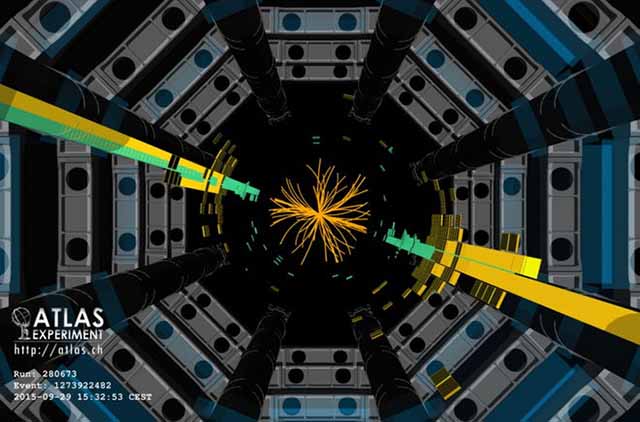
When you're searching high and low for your lost keys, sometimes the places where you don't see them can help you narrow down where they might be. In science, the search for new physics often takes a similar path. In December 2015, scientists at the Large Hadron Collider (LHC) - the world's largest particle accelerator - thought they may have seen a hint of a brand-new particle, and with it, a window into physics beyond what scientists know now. But the findings turned out to be ghosts, a statistical fluke. Yet despite the negative result, the fact that there is nothing there shows that reigning theories of particle physics are working remarkably well, experts said. But that result only deepens the mysteries physicists are trying to solve, and pushes them to find out just where new particles or forces could be hiding.
An awe-inspiring new video is a reminder of just how enormous the Large Hadron Collider really is - and it looks even bigger when you get to see all of it. The video (above), which BBC News released last week, offers an unprecedented 360-degree view of the particle collider. At any time during the video, viewers can click on the screen and drag the mouse to reorient their point of view within the massive machine. It's something very few people have seen, narrator Spencer Kelly says in the video. The LHC is the largest machine in the world and sits a little more than 325 feet beneath the Swiss-French border.
Large Hadron Collider discovers new pentaquark particle BBC - July 14, 2015
It was first predicted to exist in the 1960s but, much like the Higgs boson particle before it, the pentaquark eluded science for decades until its detection at the LHC. The discovery, which amounts to a new form of matter, was made by the Hadron Collider's LHCb experiment.
First images of LHC collisions at 13 TeV PhysOrg - May 21, 2015
A key part of the process was the set-up of the collimators. These devices which absorb stray particles were adjusted in colliding-beam conditions. This set-up will give the accelerator team the data they need to ensure that the LHC magnets and detectors are fully protected. Today the tests continue. Colliding beams will stay in the LHC for several hours. The LHC Operations team will continue to monitor beam quality and optimization of the set-up.
Giant Atom Smasher Revs up: Physicists Reveal What They're Looking For Live Science - April 14, 2015
The first run of the LHC had a single overarching goal: finding the Higgs boson, the particle that explains how other particles get their mass. With that task accomplished in 2012, scientists are now on the hunt for completely new physics.
1.The fifth dimension
2. New Higgs particles
3. Evidence for supersymmetry
4. Particle to Dark Matter
5. Sub-subatomic particles
6. Particles that can validate, or disprove, existing theories ... something completely out of left field
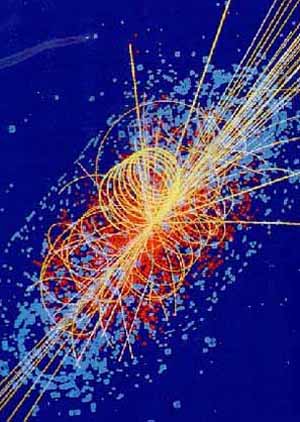
The Higgs Boson was discovered on July 4, 2012. The discovery has been called "monumental" because it appears to confirm the existence of the Higgs field, which is pivotal to the Standard Model and other theories within particle physics. It would explain why some fundamental particles have mass when the symmetries controlling their interactions should require them to be massless, and why the weak force has a much shorter range than the electromagnetic force.
The discovery of a Higgs boson should allow physicists to finally validate the last untested area of the Standard Model's approach to fundamental particles and forces, guide other theories and discoveries in particle physics, and potentially lead to developments in "new" physics. By August 2014, the LHC had discovered a massive 125 GeV boson (which subsequent results confirmed to be the long-sought Higgs boson) and several composite particles.
Higgs boson could also explain the earliest expansion of the Universe PhysOrg - August 16, 2014
The Higgs boson, which was recently confirmed to be the origin of mass, may also be responsible for the mode of inflation and shape of the Universe shortly after the Big Bang.
Higgs Music: What the World's Largest Atom Smasher Sounds Like
Live Science - October 3, 2014
Physicists simulate sounds of the Higgs boson PhysOrg - June 23, 2010