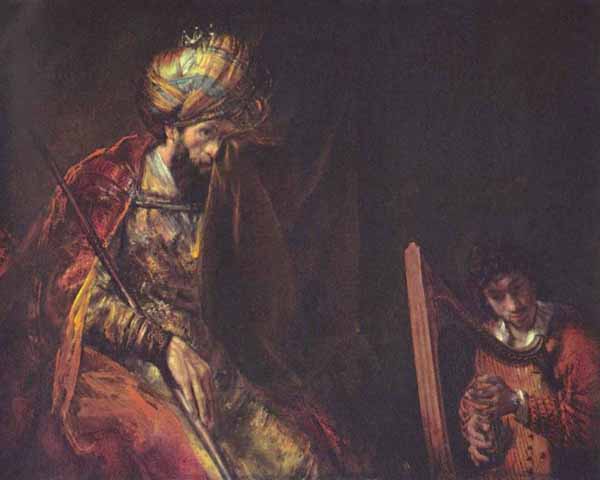
King Saul
King Saul
Saul (reigned 1047 - 1007 BC?) was the first king of the united Kingdom of Israel according to the Hebrew bible. He was anointed by the prophet Samuel and reigned from Gibeah. He committed suicide during a battle with the Philistines at Mount Gilboa, during which several of his sons were also killed. The succession to his throne was contested by his surviving son Ish-bosheth and the famous David, who eventually prevailed. The main account of Saul's life and reign is found in the Book of Samuel.
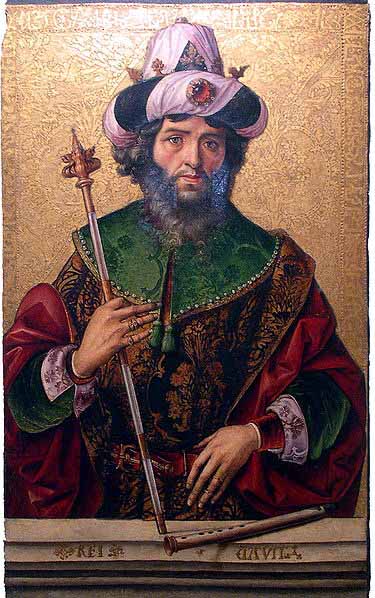
King David
King David reigned from 1008 BC - 970 BC. He was the second king of the united Kingdom of Israel according to the bible. He is depicted as a righteous king, although not without fault, as well as an acclaimed warrior, musician and poet (he is traditionally credited with the authorship of many of the Psalms). The narrative depicts him throughout his life as conflicted between his ruthless ambition and lusts, and his desire to serve God. The biblical chronology sets his life c.1037 970 BC, his reign over Judah c.1007 1000 BC, and his reign over the united Kingdom of Israel c.1000 970 BC.
The Books of Samuel is the primary source of information on his life and reign; there is little archaeological evidence to confirm the Bible's picture of David (although the Tel Dan stele records the existence in the mid-9th century of a Judean royal dynasty called the "House of David"), but his story has been of immense importance to subsequent Jewish and Christian culture.
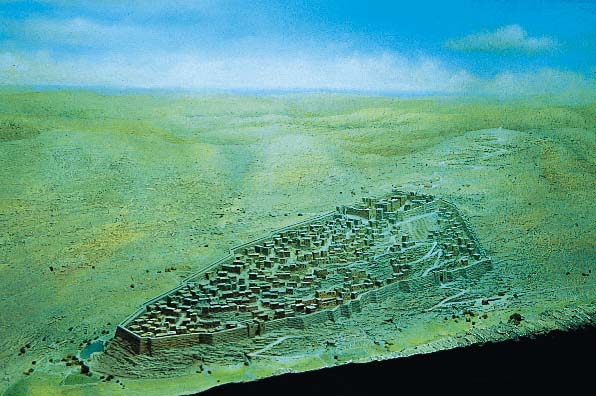
The biblical City of David was situated on the southern slope of Mount Moriah, outside today's Old City wall. Under King Solomon the city was extended northward and included Mount Moriah. David chose Jerusalem as his capital primarily for geopolitical reasons. The bringing of the Ark of the Covenant to the city made it the Israelites' exclusive national, religious, and administrative center. Solomon had the lateral valley separating the city from Mount Moriah filled in. This "miloh" (infill) area, as it was known, became the site of many new palaces, while the Temple was built on the summit of Mount Moriah. The city's major point of vulnerability the fact that its water sources lay outside was removed on the eve of the Assyrian siege of 701 BCE by the digging of Hezekiah's Tunnel.
Jerusalem of the First Temple period reached the zenith of its development under King Hezekiah, expanding westward to the slopes of Mount Zion. In 586 BCE Jerusalem was captured and put to the torch by the Babylonians under King Nebuchadnezzar. The flames literally baked about 50 royal seals ("bullae"), which thus survived intact to our own time. It was in the small area of the City of David that the prophets uttered their resounding perorations during the period of the First Temple, articulating spiritual and ethical values which became the pillars of human civilization. Taking solace from the consolation offered by the prophet Jeremiah, who told them that they would return, the people of Jerusalem were led into a Babylonian exile which would last for 50 years.
A mark of power! Tiny 2,700-year-old royal seal of Judah's 'greatest king' Hezekiah found in ancient rubbish dump in Jerusalem Daily Mail - November 23, 2015
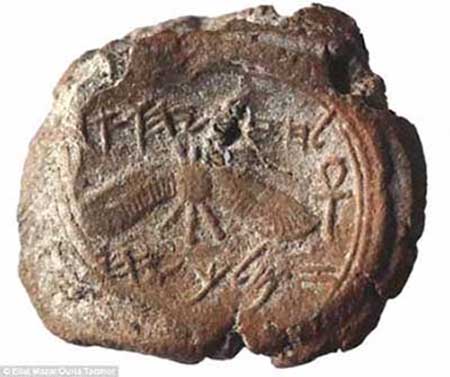
The oval piece of clay bears the symbol of a winged sun and hieroglyphs
Archaeologists said it was the private seal of the biblical King Hezekiah
During his rule, the Kingdom of Judah saw its power rise dramatically
The seal has provided new clues about Hezekiah's life and politics
Biblical King's seal discovered in dump site CNN - December 3, 2015
The oval bulla pictured above - which is 0.5 inches wide -- is estimated to be 2,700 years old. It is believed to be the first-ever seal - also referred to as a "bulla" - from an Israeli or Judean King to be discovered by archaeologists.
Goliath Gates: Entrance to Famous Biblical Metropolis Uncovered Live Science - August 4, 2015
A massive gate unearthed in Israel may have marked the entrance to a biblical city that, at its heyday, was the biggest metropolis in the region. The town, called Gath, was occupied until the ninth century B.C. In biblical accounts, the Philistines the mortal enemies of the Israelites ruled the city. The Old Testament also describes Gath as the home of Goliath, the giant warrior whom the Israelite King David felled with a slingshot. The new findings reveal just how impressive the ancient Philistine city once was, said lead archaeologist of the current excavation.
A mark of power! Tiny 2,700-year-old royal seal of Judah's 'greatest king' Hezekiah found in ancient rubbish dump in Jerusalem Daily Mail - November 23, 2015
The oval piece of clay bears the symbol of a winged sun and hieroglyphs
Archaeologists said it was the private seal of the biblical King Hezekiah
During his rule, the Kingdom of Judah saw its power rise dramatically
The seal has provided new clues about Hezekiah's life and politics
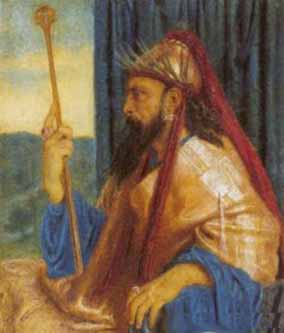
King Solomon
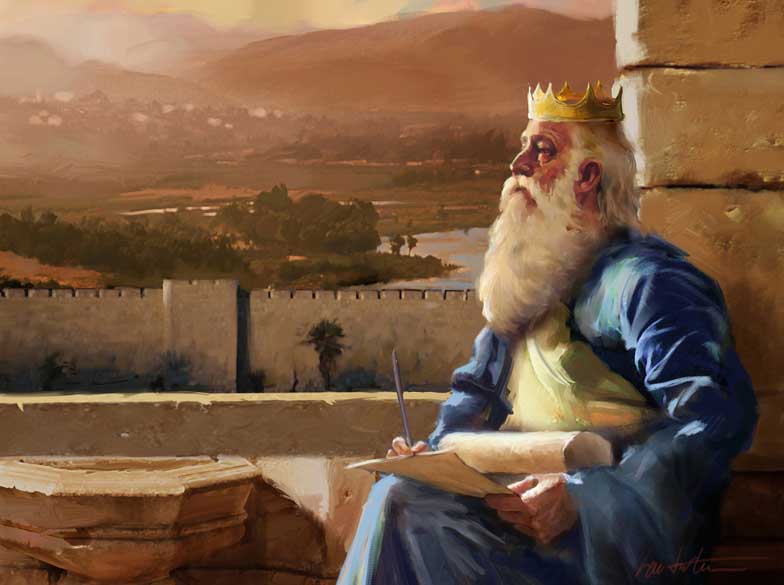
King Solomon reigned from 970 BC - 931 BC. Solomon or Shlomo in the Hebrew Bible (Old Testament), also called Jedidiah, was the third king of the united ancient Kingdom of Israel (there was no Kingdom of Judah in his time). Solomon was the builder of the first Temple in Jerusalem, also known as Solomon's Temple in Jerusalem. He was renowned for his great wisdom, wealth, and power, but also blamed for his later pacifism toward his converted wives in their worship of other gods. He is the subject of many later legends. He is also in a line of the greatest Kabbalah masters, legendary kabbalists.
The name Solomon (Shlomo) means "peaceful," or "complete", from the Hebrew Shelomoh (Arabic Sulaiman). The name given by God to Solomon in the Bible is Jedidiah, meaning "loved by God", (2 Samuel 12:25), and some scholars have conjectured that Solomon is a "king name" taken either when he assumed the throne or upon his death.Solomon's case is one of the few in the Bible where the name given by God does not stay with the character. Solomon's birth is considered a grace from God, after the death of the previous child between David and Bathsheba.
Solomon is David's second son by Bathsheba. In the Hebrew Bible, the prophet Nathan informs David that God has willed that his firstborn son must die, as punishment for David's method of execution of Uriah the Hittite, and his relationship with Bathsheba, Uriah's wife, which was fornication (although whether or not it was adulterous is disputed. After praying and fasting for a week, David heard the news that his son had died, and comforted the grieving Bathsheba, who became pregnant with Solomon.
Solomon's history is recorded in 1 Kings 1-11 and 2 Chronicles 1-9. He succeeded his father (reigned circa 1011/1010 BC to 971/970 BC BC) on the throne in about 971 or 970 BC, not 1037 BC (1 Kings 6:1), following E. R. Thiele. His father chose him as his successor, passing over the claims of his elder sons, by women other than Bathsheba. His elevation to the throne took place before his father's death, and is hastened on mainly by Nathan and Bathsheba, in consequence of the rebellion of Adonijah.During his long reign of 40 years the Hebrew monarchy gained its highest splendor. This period has well been called the "Augustan Age" of the Jewish annals. In a single year he collected tribute amounting to 666 talents of gold, according to 1 Kings 10:13.
The first half of his reign was, however, by far the brighter and more prosperous; the latter half was clouded by the idolatries into which he fell, mainly, according to the scribes, from his intermarriages. According to 1 Kings 11:3, he had 700 wives and 300 concubines. As soon as he had settled himself in his kingdom, and arranged the affairs of his extensive empire, he entered into an alliance with Egypt by a marriage with the daughter of the Pharaoh.
In 1 Kings 3:5-14 there is written an account of an encounter between the newly crowned Solomon and the God of the Kingdom of Israel in which he offers Solomon anything he pleases. Solomon asks for "an understanding heart to judge thy people, that I may discern between good and bad: for who is able to judge this thy so great a people?" Pleased with his non-materialistic wish God tells him that not only will he receive a foundation in epistemology greater than any other man, but also great wealth, power and prosperity.
The idea that Solomon's Wisdom is God-given is very important to various Judeo-Christian beliefs. The biblical Book of Proverbs, written by Solomon, is a dogmatic guideline for morality and manners in many Jewish and Christian denominations. Some believe that Solomon also wrote the biblical book of Ecclesiastes in which there is an established sense of absurdity of man's feeble accomplishments. Here Solomon attacks the vanity of human actions and the importance of a relationship with God that many religions embrace.
He surrounded himself with all the luxuries and the external grandeur of an Eastern monarch, and his government prospered. He entered into an alliance with Hiram I, king of Tyre, who in many ways greatly assisted him in his numerous undertakings. For some years before his death David was engaged in the active work of collecting materials for building a temple in Jerusalem as a permanent abode for the Ark of the Covenant.
After the completion of the temple, Solomon erected many other buildings of importance in Jerusalem and in other parts of his kingdom. For the long space of thirteen years he was engaged in the erection of a royal palace on Ophel. Solomon also constructed great works for the purpose of securing a plentiful supply of water for the city, Millo (Septuagint, Acra) for the defense of the city, and Tadmor in the wilderness as a commercial depot as well as a military outpost.
During his reign Israel enjoyed great commercial prosperity. Extensive traffic was carried on by land with Tyre and Egypt and Arabia, and by sea with Tarshish (Spain), Ophir and South India and the coasts of Africa. The royal magnificence and splendor of Solomon's court are unrivaled. Solomon was known for his wisdom and proverbs. People came from far and near "to hear the wisdom of Solomon", including queen Makedah or Bilqis of Sheba. Their son Menelik I, according to Ethiopian tradition, would become the first emperor of Ethiopia. His thoughts are enshrined in storytelling, though probably, not all the clever thinking in the stories originates with the one man.
Blamed for his decline and fall from his high estate were his polygamy and his great wealth, causing him to become decadent and involved in various forms of idol worship which are contrary to the religious law. Because of this idol worship, a prophet visits Solomon and tells him that after his death his kingdom would be split in two Israel and Judah and that his son, Rehoboam, would suffer because of his sin. He died, after a reign of forty years, and was buried in Jerusalem.
In 1 Kings3:15-28 an account of Solomon's wisdom can be viewed as symbolic of the split in the Kingdom of Israel following the death of Solomon. In the story there are two new mothers, one of which who had smothered her baby during sleep and claimed the other woman's baby as her own. The problem is presented to King Solomon who proposes the baby be split in half, each woman receiving one half of the baby. The woman who was lying went along with the plan while the real mother immediately feels sympathy for her offspring and would rather see the other woman raise it than see it die. Solomon instantly grants the real mother the baby realizing that a true mother would compromise to see her offspring survive. This act, though not truly biblically significant it is a metaphor for what was about to happen to the Israelites and their nation.
Solomon also appears in the Qur'an, where he is called Sulayman. The Qur'an refers to Solomon as the son of David, as a prophet and as a great ruler imparted by God with tremendous wisdom, favor, and mystical powers. Solomon was said to have under his rule not only people, but also hosts of invisible beings (i.e., jinn). And like his father David, Solomon is said to have been able to understand the language of the birds, and to see some of the hidden glory in the world that was not accessible to common human beings.
Surah 27:15 "And, indeed, We granted true knowledge unto David and Solomon as well; and both were wont to say: 'All praise is due to God, who has thus favored us above many of His believing servants!' And in this insight Solomon was truly David's heir; and he would say: 'O you people! We have been taught the speech of the birds, and have been given in abundance of all good things: this, behold, is indeed a manifest favor from God.'"
Surah 34:12 "And unto Solomon we made subservient the wind: its morning course covered the distance of a month's journey, and its evening course, a month's journey. And we caused a mountain of molten copper to flow at his behest; and even among the invisible beings there were some that had been constrained to labor for him by his Sustainer's leave - and whichever of them deviated from Our command, him would We let taste suffering through a blazing flame -: they made for him whatever he wished of sanctuaries, and statues, and basins as large as great watering-troughs, and cauldrons firmly anchored."
To Solomon are attributed by rabbinical tradition but not internally, the Biblical books of Book of Proverbs, Ecclesiastes and the Song of Solomon. Then comes the Wisdom of Solomon, probably written in the 2nd century BC where Solomon is portrayed as an astronomer. Other books of wisdom poetry attributed to Solomon are the "Odes of Solomon" and the "Psalms of Solomon".
The Jewish historian Eupolemus, who wrote about 157 BC, included copies of apocryphal letters exchanged between Solomon and the kings of Egypt and Tyre.
The Gnostic Apocalypse of Adam, which may date to the 1st or 2nd century, refers to a legend in which Solomon sends out an army of demons to seek a virgin who had fled from him, perhaps the earliest surviving mention of the later common tale that Solomon controlled demons and made them his slaves. This tradition of Solomon's control over demons appears fully elaborated in the early Christian work called the "Testament of Solomon" with its elaborate and grotesque demonology.
Solomon's mastery of demons is a common element in later Jewish and Arab legends, and is often attributed to possession of a magic ring called the "Seal of Solomon".
The ancient Imperial legend of Ethiopia, as told in the Kebra Nagast maintains that the Queen of Sheba returned to her realm from her Biblical visit to Solomon, pregnant with his child, and giving birth to a son by the Mai Bella stream in the province of Hamasien, Eritrea. This child would eventually inherit her throne with the new rank and title of Menelik I, Emperor of Abyssinia. The dynasty he would establish would reign in Abyssinia with few interruptions until the overthrow of Emperor Haile Selassie in 1974.

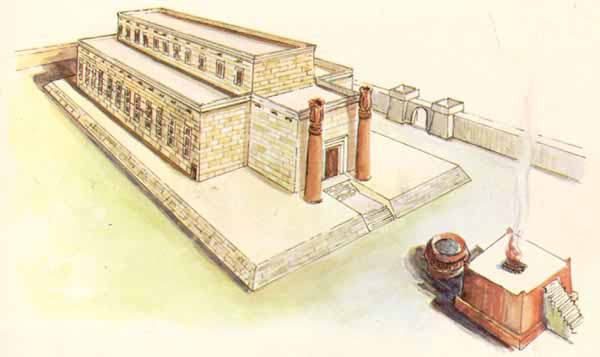
Solomon's Temple (also known as the First Temple) was, according to the Torah and the Bible, the first Jewish temple in Jerusalem. It functioned as a religious focal point for worship and the sacrifices known as the korbanot in ancient Judaism. The temple was destroyed by the Babylonians in 586 BCE.
Before his death, King David had provided materials in great abundance for the building of the temple on the summit of Mount Moriah (1 Chronicles 22:14; 29:4; 2 Chronicles 3:1), where he had purchased a threshing floor from Araunah the Jebusite (2 Sam. 24:21 et seq.), on which he offered sacrifice.
The Bible states that in the beginning of his reign, King Solomon of the united Kingdom of Israel, set about giving effect to the ideas of his father, and prepared additional materials for the building. From subterranean quarries at Jerusalem he obtained huge blocks of stone for the foundations and walls of the temple. These stones were prepared for their places in the building under the eye of Tyrian master-builders.According to this account, Solomon also entered into a compact with Hiram I, king of Tyre, for the supply of whatever else was needed for the work, particularly timber from the forests of Lebanon, which was brought in great rafts by the sea to Joppa, whence it was dragged to Jerusalem (1 Kings 5).
According to tradition, Solomon also provided for a sufficient water supply for the temple by hewing in the rocky hill vast cisterns, into which water was conveyed by channels from the "pools" near Bethlehem. One of these cisterns, the "great sea," was capable of containing three million gallons. The overflow was led off by a conduit to the Kidron.
These accounts in the Bible are also the basis for much of the legend and lore of Freemasonry, which uses the construction of the Temple as a backdrop and metaphor for moral instruction.
According to tradition, in all these preparatory undertakings a space of about three years was occupied; and now the process of the erection of the great building began, under the direction of skilled Phoenician builders and workmen, in the fourth year of Solomon's reign. The building followed the Phoenician model, which makes the Bible's description an important source for historians regarding the lay-out of Phoenician temples, and vice versa. David provided Solomon with a large amount of gold and silver with which to build the temple. The Biblical account reports that this amounted to 100,000 talents (3,000 tons) of gold (an amount exceeding the current annual global production and 1,000,000 talents (30,000 tons) of silver.
According to biblical tradition, many thousands of labourers and skilled artisans were employed in the work. Stones prepared in the quarries underneath the city (1 Kings 5:17, 18) of huge dimension were gradually placed on the massive walls, and closely fitted together without any mortar between, till the whole structure was completed. The building was 60 cubits (27 m) long, 20 cubits (9 m) wide, and 25 (in the Greek text) or 30 (in the Hebrew) cubits (14 m) high.
At length, in the Autumn of the eleventh year of his reign, seven and a half years after it had been begun, the temple was completed. For thirteen years there it stood, on the summit of Moriah, silent and unused. The reasons for this strange delay in its consecration are unknown. At the close of these thirteen years preparations for the dedication of the temple were made. The Temple remained empty for only eleven months, until the month of Tishri in the year following its completion. Thus the Temple was dedicated at the autumnal new-year festival.
According to biblical tradition, the Ark of the Covenant was solemnly brought from the tent in which David had deposited it to the place prepared for it in the temple. Then Solomon ascended a platform which had been erected for him, in the sight of all the people, and lifting up his hands to heaven poured out his heart to God in prayer (1 Kings 8; 2 Chr. 6, 7). The feast of dedication, which lasted seven days, followed by the feast of tabernacles, marked a new era in the history of Israel. On the eighth day of the feast of tabernacles, Solomon dismissed the vast assemblage of the people.
Due to the extensive rebuilding of the Second Temple in later centuries, no remains of the First Temple are extant (however, certain remains from the First Temple have recently been discovered in the refuse from an extensive construction project performed on the Temple Mount by the Islamic Wakf in November of 1999); the detailed descriptions provided in the Tanakh and educated guesses based on the remains of other temples in the region are the sources for reconstruction of its appearance. Technical details are lacking, since the scribes who wrote down the books were not architects or engineers. Reconstructions differ; the following enumeration is largely based on Easton's Bible Dictionary and the Jewish Encyclopedia:
2. The Hekal: the holy place, 1 Kings 8:8-10, called also the "greater house" (2 Chr. 3:5) and the "temple" (1 Kings 6:17); the word also means "palace". It was of the same width and height as the Holy of Holies, but 40 cubits in length. Its walls were lined with cedar, on which were carved figures of cherubim, palm-trees, and open flowers, which were overlaid with gold. Chains of gold further marked it off from the Holy of Holies. The floor of the Temple was of fir-wood overlaid with gold. The door-posts, of olive-wood, supported folding-doors of fir. The doors of the Holy of Holies were of olive-wood. On both sets of doors were carved cherubim, palm-trees, and flowers, all being overlaid with gold (1 Kings 6:15 et seq.)
3. The Ulam: the porch or entrance before the temple on the east (1 Kings 6:3; 2 Chr. 3:4; 9:7). This was 20 cubits long (corresponding to the width of the Temple) and 10 cubits deep (1 Kings 6:3). 2 Chr. 3:4 adds the curious statement (probably corrupted from the statement of the depth of the porch) that this porch was 120 cubits high, which would make it a regular tower. The description does not specify whether a wall separated it from the next chamber. In the porch stood the two pillars Jachin and Boaz (1 Kings 7:21; 2 Kings 11:14; 23:3), which were 18 cubits in height and surmounted by capitals of carved lilies, 5 cubits high.
4. The chambers, which were built about the temple on the southern, western, and northern sides (1 Kings 6:5-10). These formed a part of the building and were used for storage. They were probably one story high at first; two more may have been added late.
According to biblical tradition, round about the building were:
2. The great court, which surrounded the whole temple (2 Chr. 4:9). Here the people assembled to worship God (Jeremiah 19:14; 26:2).
The inner court of the priests contained the altar of burnt-offering (2 Chr. 15:8), the brazen sea (4:2-5, 10), and ten lavers (1 Kings 7:38, 39).
From 2 Kings 16:14 it is learned that a brazen altar stood before the Temple; 2 Chr. 4:1 gives its dimensions as 20 cubits square and 10 cubits high.
The brazen sea, 5 cubits wide and 10 deep, rested on the backs of twelve oxen (1 Kings 7:23-26). The Book of Kings gives its capacity as "two thousand baths"; the Chronicler inflates this to three thousand (2 Chr. 4:5-6) and states that its purpose was to afford opportunity for the ablutions of the priests.
The lavers, each of which held "forty baths" (1 Kings 7:38), rested on portable holders made of bronze, provided with wheels, and ornamented with figures of lions, cherubim, and palm-trees. These vessels especially excited the admiration of the Jews. The author of the books of the Kings describes their minute details with great interest (1 Kings 7:27-37).
Josephus reported that the vessels in the temple were composed of Orichalcum in the Antiquities of the Jews.
According to 1 Kings 7:48 there stood before the Holy of Holies a golden altar of incense and a table for showbread. This table was of gold, as were also the five candlesticks on each side of it. The implements for the care of the candles - tongs, basins, snuffers, and fire-pans - were of gold; and so were the hinges of the doors.
The Temple was probably situated upon the more easterly of the two hills which form the site of the present-day Noble Sanctuary, in the center of which area is the Dome of the Rock. Under the Jebusites the site was used as a threshing floor. 2 Sam. 24 describes its consecration during David's reign.
Two slightly different sites for the Temple have been proposed: one places the bronze altar on the rock which is now beneath the gilded dome, with the rest of the temple to the west; the Well of Souls was, in this theory, a pit for the remnants of the korbanot. The slope of the terrain in this area would require massive supporting structures for the Temple, what Easton's Bible Dictionary describes as "a huge wall of solid masonry of great height, in some places more than 200 ft (60 m) high. . .raised across the south of the hill, and a similar wall on the eastern side, and in the spaces between. . .many arches and pillars. . . ." The other places the Holy of Holies atop this rock, thus explaining its elevation. The traditions of this rock were sacred; probably the site was the same as that of the temple which Hadrian erected to Jupiter, which in turn was on the site of Herod's temple, which would naturally be on that of Solomon'sÑan example of the persistency of sacred sites in the East.
The Temple has recognizable similarities to other temples of its time and region. Syro-Phoenician, Egyptian, and Mesopotamian influences are visible. A plaza or courtyard surrounding the sacred residence of the god, marked with stones, is a feature common throughout ancient Semitic religions. Earlier evidence of this practice among the Hebrews survives in the twelve stones that Joshua placed at Gilgal (Joshua 4:20) and the marking of Mount Sinai by Moses (Ex. 19:12), and in the forbidden zone surrounding the tent which was the predecessor of the Temple. Even today the Muslims designate certain areas, especially that surrounding Mecca, as inviolate haram.
The Biblical text makes it clear that Solomon received aid from Hiram, King of Tyre, in the construction of his buildings. As the Hebrews were an agricultural people, this aid probably involved not only material (cedar-wood, etc.), but architectural direction and skilled craftsmen. Its tripartite division is similar to that found in 13th century BCE temples at Alalakh in Syria and Hazor in the upper Galilee; a 9th century BCE temple at Tell Tayinat also follows this plan. Phoenician temples varied somewhat in form, but were similarly surrounded by courts.
Among the details which were probably copied from Tyre were the two pillars Jachin and Boaz. Herodotus (ii. 44) says that the temple at Tyre contained two such, one of emerald and the other of fine gold. In the same way the ornamentation of palm trees and cherubim were probably derived from Tyre, for Ezekiel (28:13, 14) represents the King of Tyre, who was high priest also, as being in the "garden of God." Probably both at Tyre and at Jerusalem the cherubim and palm-tree ornaments were survivals of an earlier conception - that the abode of God was a "garden of Eden." The Tyrians, therefore, in their temple imitated to some extent the primitive garden, and Solomon borrowed these features.
Similarly, the bronze altar was a Phoenician innovation; and probably the same is true of the bronze implements which were ornamented with palm-trees and cherubim. The Orthodox Israelitish altar was of earth or unhewn stone. The Decalogue of Ex. 20 (Elohist) prohibited the making of graven images, while that of Ex. 34 (Jahwist) prohibited the making of molten gods; and the Deuteronomic expansions prohibited the making of any likeness whatever. All these are, to be sure, later than Solomon's time; but there is no reason to believe that before that time the Hebrews had either the skill or the wealth necessary to produce ornamentation of this kind.
Several temples in Mesopotamia, many in Egypt, and some of the Phoenicians are now known. In Babylonia the characteristic feature was a ziggurat, or terraced tower, evidently intended to imitate the mountains on which the gods resided. The chamber for the divine dwelling was at its top. The early Egyptian temples consisted of buildings containing two or three rooms, the innermost of which was the abode of the deiA good example is the granite temple near the sphinx at Giza. The Middle Kingdom (12th dynasty) added obelisks and pylons, and the New Kingdom (18th dynasty) hypostyle halls. Solomon's Temple was not a copy of any of these, nor of the Phoenician buildings, but embodied features derived from all of them. It was on the summit of a hill, like the altar of Ba'al on Mount Carmel and the sanctuaries of Mount Hermon, and like the Babylonian idea of the divine abode. It was surrounded by courts, like the Phoenician temples and the splendid temple of Der al-Bakri at Thebes. Its general form reminds one of Egyptian sanctuaries and closely matches that of other temples in the region, as described above.
The two pillars Jachin and Boaz had their parallel not only at Tyre but at Byblos, Paphos, and Telloh. In Egypt the obelisks expressed the same idea. The Jewish Encyclopedia stated that "All these were phallic emblems, being survivals of the primitive Hamito-Semitic 'mazzebah'", Jachin and Boaz were really isolated columns, as Schick has shown, and not, as some have supposed, a part of the ornamentation of the building. Their tops were crowned with ornamentation as if they were lamps; and W. R. Smith supposed (l.c. p. 488) that they may have been used as fire-altars. This assumes that they contained cressets for burning the fat.
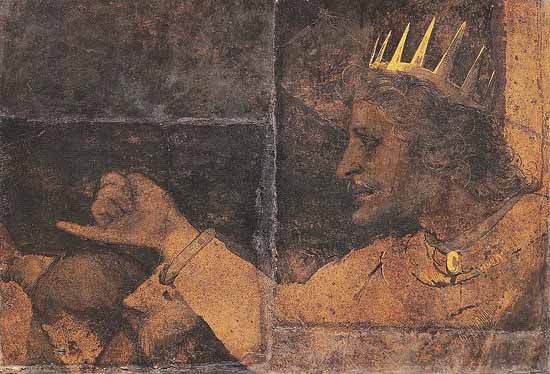
King Rehoboam
King Rehoboam reigned from 31 BC - 930 BC. According to the Hebrew Bible, Rehoboam was a king of ancient Israel and later king of the Kingdom of Judah after the ten northern tribes of Israel rebelled in 932-931 BC to form the independent Kingdom of Israel. He was a son of Solomon and a grandson of David. His mother was Naamah the Ammonite. His name means he who enlarges the people.