Jupiter's Rings Are Shaped By Interplay Of Sunlight And Shadow Science Daily - May 1, 2008
Soap bubbles recreate Jupiter's turbulent storms - the Great Red Spot New Scientist - April 10, 2008
Volcanic Moon Creates Glowing Aurora Spots on Jupiter National Geographic - March 20, 2008
Mystery Of Jupiter's Jets Uncovered Science Daily - January 25, 2008
Mystery of Io's Atmosphere Solved Live Science - October 15, 2007
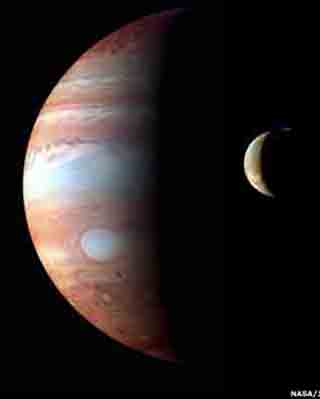
Pluto-bound probe's Jupiter vista BBC - October 10, 2007
Lightning Strikes, Changing Climate Revealed on Jupiter National Geographic - October 9, 2007
"Missing" Moons, "Dirty" Ice Among Jupiter Flyby Finds National Geographic - October 9, 2007
Have Jupiter's smallest moons been obliterated? New Scientist - October 9, 2007
First Proof of Wet "Hot Jupiter" Outside Solar System National Geographic - July 11, 2007
Hubble Watches As Jupiter Changes Stripes Space.com - June 29, 2007
Giant Volcanic Plume Bursts From Jupiter Moon National Geographic - May 2, 2007
Spacecraft returns Jupiter images - Volcanic Plumes BBC - May 2, 2007
Big Auroras on Jupiter NASA - April 4, 2007
Probe spies Jupiter's moon Io, volcanic plume as it erupts BBC - March 1, 2007
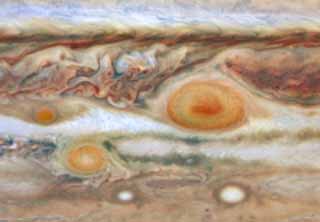
By Jupiter, scientists find 'Red Spot Jr.' CNN - July 31, 2006

Red Spot Jr. is about as wide as Earth's diameter and formed from the merger of three white spots very recently, sometime between 1998 and 2000, and only turned red in December 2005, the astronomers said in a statement. The Great Red Spot is nearly twice its smaller companion's size and has been circling Jupiter for at least 342 years. But the two are located in the same area and appear to be racing each other around the planet. The two spots are about the same color when seen in visible light, but Red Spot Jr. was much darker when viewed at infrared wavelengths, the scientists said. That difference could mean the smaller storm's cloud tops are lower than the big storm's.
New Storm on Jupiter Hints at Climate Change Space.com - May 5, 2006

Jupiter is growing a new red spot and the Hubble
Space Telescope is photographing the scene.

Jupiter growing another red spot BBC - March 7, 2006
Jupiter's New Red Spot NASA - March 3, 2006
Icy Jupiter Moon Throws A Curve Ball At Formation Theories Science Daily - June 2, 2005
Jovian Lights Astrobiology Magazine - March 2005

Scientists have obtained new insight into the unique
power source for many of Jupiter's auroras
Remnants of 1994 Comet Impact Leave Puzzle at Jupiter Space.com - August 2004
Scientists discover Jupiter's largest moon Ganymede has a lumpy interior Science Daily - August 2004
Hottest Body Outside The Sun: Researchers Show Jupiter's Science Daily - June 2004
Moon Io Vaporizing Rock Gases Into Atmosphere - It is Volcanic
Jupiter spots disappear amid major climate change Space.com - April 2004
Jupiter is undergoing major climate change and could lose
many of its large spots over the next seven years, only to
make way for the creation of fresh spots in a decades-long
cycle, according to a new explanation of old mysteries.
Europa Diary - Life on Ice Space.com - May 2003
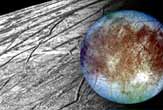
The ice shell of Europa, a moon of Jupiter, is probably about
25 kilometres (15 miles) thick, according to scientists.
Dark Spot on Jupiter Bigger than Famed Great Red Spot Space.com - March 2003
Seven new moons discovered orbiting Jupiter BBC - March 2003
Jupiter moon 'full of holes' BBC - December 2002
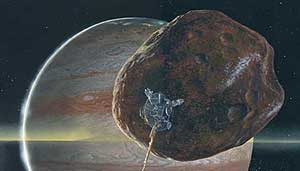
Io blows its top BBC - November 2002

The most powerful eruption ever detected on any planet in our
Solar System has been seen on Io, one of Jupiter's moons.
Jupiter moon's 'elevator of life' BBC - November 2002
Europa's icy crust may cover a life-filled ocean
Another Jupiter Twin Found in Flood of Planet Discoveries Space.com - June 2002
Astronomers Discover 11 More Small Moons Of Jupiter May 2002 - Science Daily
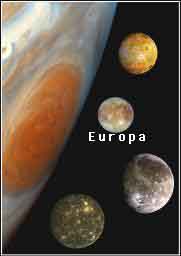
We have found 39 moons -
nine more than the previous record of Saturn.
The moons are also called satellites.

January 10, 2001 - Spaceflight Now
An unprecedented surge in planetary moon discoveries continues as astronomers announced Friday the discovery of 10 more moons orbiting Jupiter.
The ten natural satellites, provisionally designated S/2000 J2 through S/2000 J11, were first spotted in late November and early December by a group of astronomers at the University of Hawaii. The astronomers, led by graduate student Sam S. Sheppard and professor David Jewitt, used a wide-field camera mounted on the university's 2.2-meter telescope on Mauna Kea to find the moons.
All ten moons are believed to be very small: based on their magnitudes and estimates for their albedo, or reflectivity, they are thought to be no more than five kilometers in diameter. All ten are in moderately elliptical orbits inclined by 15 to 30 degrees. Nine of the ten are in retrograde orbits -- orbiting in the opposite direction than the planet's other moons -- at an average distance from Jupiter of 21 to 24 million kilometers. The tenth moon is in a prograde orbit about 13 million kilometers from the planet.
The discoveries bring to 28 the total number of moons orbiting the giant planet, with 12 of the moons discovered in just over a year. In addition to the ten spotted in November and December, the same University of Hawaii group spotted another moon in late November, designated S/2000 J1. Later calculations showed this was the same moon first seen in 1975 but lost shortly thereafter. A twelfth moon, S/1999 J1, was discovered in late 1999 with the Spacewatch telescope in Arizona but originally thought to be a slow-moving asteroid; only later analysis, confirmed by observations in the middle of last year, determined the small body was a moon.
Although Jupiter is the largest planet in the solar system, even these latest discoveries do not make it the planet with the most moons. That honor goes to Saturn and its 30 moons, 12 of which were discovered since late October by another group of astronomers from France, Canada, and the United States. Like the Jovian discoveries, Saturn's newly-discovered moons are also small and in distant, elliptical orbits, suggesting in both cases that the moons are captured bodies from either the asteroid belt or the Centaurs, a family of small icy bodies orbiting between Saturn and Uranus.
The latest finds are the latest in a surge of planetary moon discoveries unparalleled in the history of astronomy. In addition to the moons found orbiting Jupiter and Saturn, astronomers have also found six more moons orbiting Uranus since 1997: five from telescopic searches similar to the ones that netted Jupiter and Saturn's moons, and one from a reanalysis of Voyager 2 images taken when the spacecraft flew by the planet 15 years ago. As recently as October Uranus held the crown for the planet with the most moons with 21; it is now a distant third.
Astronomers credit this new surge in discoveries to dedicated searches using large telescopes and improved instruments that allow them to scan large areas around planets to look for the faint signatures of these moons. They also caution, however, that more work needs to be done to follow up these discoveries, making additional observations of the moons in order to refine their orbits.
Fractured crust: What is driving these surface features?
December 17, 2000 - BBC
The researchers said magnetic readings taken by the Galileo space probe suggested the presence of a vast body of water in liquid form beneath the moon's frozen surface.
On Earth, wherever there is water, there is usually life. The same is certainly not true in space, but this discovery will heighten expectations that one day extraterrestrial life may be found.
The University of California scientists stressed they could not be certain they had discovered water on Ganymede, which is larger than Mercury or Pluto.
Persuasive results
Margaret Kivelson of the University of California-Los Angeles said that readings taken in May this year were "highly suggestive" that a salty, liquid ocean existed there.
Ganymede: Larger than Mercury or Pluto
"It would need to be something more electrically conductive than solid ice," she said, explaining that a melted layer of water several kilometres thick about 200 km beneath the surface would fit the data if it were about as salty as Earth's oceans.
Other scientists have identified what appear to be salty minerals on the moon's crust, indicating that salt water was once found on the surface.
"They are similar to the hydrated salt minerals we see on Europa, possibly the result of brine making its way to the surface by eruptions or through cracks," said Thomas McCord, a geophysicist at the University of Hawaii, Honolulu.
The hypothesis of water on Ganymede has been bolstered by new, high-resolution images of Ganymede sent back by Galileo.
The images hint that water or slushy ice may have surfaced through the fractured crust to create smooth areas in between separated areas of crust.
December 18, 2000 - BBC
Ripples in magnetic fields wafting through interplanetary space have been detected by a space probe and converted into sound.
The "noises" were picked up the Cassini spacecraft which is en route to Saturn in 2004 via Jupiter.
The probe is detecting waves in the thin gas of charged particles that fills the space between the Sun and its planets.
The waves are in low radio frequencies and can be converted to sound wave frequencies to make the patterns audible.
Listening to the "sounds" of near-Jupiter space has been done before by the Pioneer and Voyager probes of the 1970's, but this is the first time that Cassini's data have been used in this way.
Oscillations
The waves were detected by Cassini's radio wave and plasma science instrument on 8 December, at a distance of about 23 million kilometres (14 million miles) from Jupiter.
Scientists believe that they arise from interactions between Jupiter's magnetic field and the solar wind of particles streaming away from the Sun.
Researchers point out that valuable information can be gleaned from this data. There are oscillations discernible that are produced by so-called ion-acoustic waves, the result of electrons pushed around by the energy in Jupiter's bow shock region.
The bow shock is similar to a sonic boom from a supersonic jet flying through Earth's atmosphere. Near Jupiter, the bow shock is caused by the superfast solar wind being diverted around Jupiter's magnetic field. The solar wind is heated, slowed and deflected.
Cassini has not yet reached Jupiter's bow-shock - this should occur in a few weeks from now. But the shock is probably the source of energy driving the waves that are reaching the spacecraft.
The Cassini spacecraft snaps Jupiter's Great Red Spot
October 25, 2000 - BBC
For the first time, astronomers have seen two giant storms on Jupiter collide and merge to form an even bigger storm.
The two swirling wind systems are each about half the size of the Earth.
Researchers speculate that a similar merger of storms produced Jupiter's famous Great Red Spot, a hurricane that has persisted in the planet's atmosphere for more than 300 years.
The collision between the storms will help scientists understand more about the dynamics of Jupiter's turbulent atmosphere.
"Usually when we've seen two (storms) approaching each other, they bounce back away from each other," said Dr Glenn Orton of Nasa's Jet Propulsion Laboratory in California.
Swirling vortex
The current giant storm began forming about 60 years ago as three "white oval" storms in a band of Jupiter's atmosphere south of the Great Red Spot.
In the following decades until 1998, the storms sometimes approached each other but never collided.
But in early 1998, astronomers witnessed two of the ovals moving towards each other as Jupiter went out of sight from Earth, behind the Sun. When the planet came back into view, the two had become one.
"We weren't able to see how they came together that time," said Dr Orton.
Last year, however, the newly formed storm approached the third remaining oval. Winds within it were swirling counter-clockwise at about 470 km (290 miles) per hour. One was about 9,000 km (5,600 miles) across, the other slightly smaller.
A third, darker oval, this time swirling clockwise, formed temporarily between the two white ovals.
Joining forces
That type of intervening system would usually keep white ovals from colliding, the team proposed. But the middle storm appears to have been pushed even further south and torn apart, as all three passed near the Great Red Spot last December.
The disappearance of the opposite-swirling storm from between them cleared the way for the two white ovals to meet.
Their collision began in March and lasted about three weeks. The storms circled around each other counter-clockwise then merged into a single oval.
This single storm was about one-third wider than either of the ovals had been beforehand.
A giant storm is formed from three 'white oval' storms
The ovals' approach and merger was observed by several telescopes including one at the Pic-du-Midi Observatory in France, Nasa's Infrared Telescope Facility in Hawaii, and the Hubble Space Telescope.
Meanwhile, the Cassini spacecraft, approaching Jupiter for a fly-by in December, has taken a new image of the Great Red Spot.
As it passes by, Cassini will make a series of measurements of the planet in several wavelengths of light as well as sampling energetic particles and magnetic fields.
A dark lava lake at the summit of a volcano
May 19, 2000 - Journal Science
Astronomers have obtained their best view yet of the most volcanically active world in our Solar System: Jupiter's moon, Io.
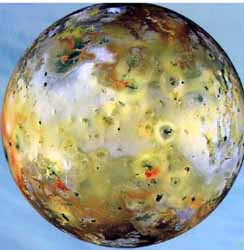
Io, roughly the size of our own Moon, has a yellow and ochre surface covered in sulphur chemicals deposited by giant volcanic plumes that reach hundreds of kilometres in height.
A ribbon of light marks the edge of a lava lake
Its volcanism is driven by the extreme tidal energy it gets from Jupiter.
The satellite was first studied in detail in 1979 by the Voyager fly-by mission. Now, new images, taken from the Galileo spacecraft show Io's surface to be marked by volcanic calderas, plains, and fissures.
It is awash with fluid lava thrown up by fountains and pooled in lakes.
Ribbon of light
A lava lake was seen in the central caldera of Pele, a volcano 1200 km (746 miles) across that sends a gaseous plume 400 km (250 miles) into space. Viewed at night-time, the lava lake is seen as a glowing ribbon of light.
Prometheus: A wandering volcano
The most powerful volcano in the Solar System is located on Io and is called Loki Patera. Galileo's images show it to have a huge, dark lava lake cooling in its summit depression.
The images also reveal evidence of lava flows that may have streamed across the surface at hundreds of metres a second.
Analysing the spectra of the lava allows scientists to deduce its composition. Changes between the images show how the eruptions change over time, and how they help to create mountains and other landforms.
Scientists believe that Io's surface is very young, being continuously covered by sulphur deposits. The fact that no impact crater was seen in the images anywhere on Io means that the world must be completely resurfaced every million years or so.
One volcano even appears to have moved.
Galileo and the 1979 Voyager spacecraft observations show that one large volcanic plume called Prometheus may have been caught in the act of migrating across Io's surface.
Unlike any volcano on Earth, Prometheus appears to have wandered as much as 95 km (59 miles) over a volcanic plain in just a few decades.
Scientists think that the two vents are connected by a dark lava flow running over a so-called snowfield of sulphur dioxide. The pressure and heat of the lava flow from Prometheus melts the sulphur snowfield that makes it way to the surface through a wandering pipe.
Europa's icy crust may conceal an ocean
March 8, 2000 - BBC
This mosaic provides the best view ever obtained of the side of Jupiter's moon Europa that faces the giant planet.

The 12 images of the ice-encrusted surface were taken by the Galileo spacecraft last November during its 25th orbit of Jupiter. Details as small as one kilometre (0.6 miles) can be seen.

A -- The gravity of Jupiter and its large moons play tug-o'-war with Io. As a result, the moon bulges on two sides like an American football. Right: B -- Jupiter and three Galilean satellites pull on the same side of Io, creating tidal bulges in Io's crust about 100 m high. [more information]
Astronomers believe that beneath the ice-crust lies a liquid water ocean which some think may be a good place to look for alien life.
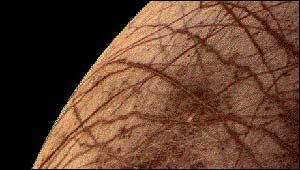
Linear features visible in the centre of the mosaic and toward the poles may have formed in response to tides strong enough to fracture the moon's icy surface.
Some of these features extend for over 1,500 km (900 miles). Darker regions near the equator on the eastern (right) and western (left) limb may be vast areas of chaotic, broken terrain. Bright white spots near the western limb are the ejecta blankets of young impact craters.
Io is the most volcanic world in the Solar System
High-resolution images of Jupiter's volcanic moon Io have also just been released by Galileo mission scientists. They show the relationships between the different surface materials and the underlying geologic structures on Io.
The red material, seen around the margin of an erupting volcano called Monan Patera, is thought to be a compound of sulphur. A broad circle of bright, white material seen in the image is thought to be sulphur-dioxide being deposited from the plume called Amirani.
Sulphurous chemicals spill on to the surface
The lengths of the shadows cast by the mountains make it possible to estimate the mountains' heights - between 4,000 and 8,000 metres (13,000 to 26,000ft) high.
Another Io image shows the Zal Patera region. The edge of this volcanic crater is marked by black flows, coinciding with the edge of a plateau. In this image, the red material follows the base of a mountain, which may indicate that sulphurous gases are escaping along a fault associated with the formation of the mountain.
Io is the most volcanic world in the Solar System.
Passing close to volcanic Io although Galileo has a damaged antenna
February 23, 2000 - BBC
The Galileo spacecraft, in orbit around Jupiter, has made its third and closest flyby of Jupiter's dramatic moon Io, the most volcanic body in the Solar System.
Observations from Earth-based telescopes by the International Jupiter Watch suggest that a volcanic outburst was underway on Io as Galileo passed by.
Galileo flew only 200 km (124 miles) above Io's surface at 15:32 GMT on Tuesday. During its previous close flybys of Io Galileo has gathered a wealth of data as well as stunning pictures.
Io, the most volcanically active world in the Solar System, has volcanic vents that spew sulphur plumes over 100 km (60 miles) above the surface. The sulphur falls back and covers Io, turning it into a dramatic red, yellow and black landscape.
"Io's volcanoes are so active that the moon's surface is always changing, and with each flyby we get new and different observations," said Dr. Torrence Johnson, Galileo project scientist at Nasa's Jet Propulsion Laboratory.
"This time we expect to be able to observe the effects of the eruptions we saw in the October and November Io flybys."
Risky mission
Io orbits so close to Jupiter that it is bombarded by radiation from the giant planet's radiation belts. The radiation can disrupt Galileo's systems or even disable its instruments, but mission planners believe potential gains in scientific knowledge outweigh the risk.
Nonetheless, the encounters were planned near the end of Galileo's mission when the spacecraft has already returned volumes of pictures and information from Jupiter and its moons.
Galileo has been in orbit around Jupiter since December 1995. It was originally intended to spend two years studying Jupiter, its moons and its magnetic environment. When that original mission ended in December 1997, it was followed by a two-year extended mission, which ended in January 2000. This Io flyby is part of an additional extension, called the Galileo Millennium Mission.
End of mission
Galileo has two close flybys of the frozen Jupiter moon Ganymede planned for later this year. After that it may be commanded to crash into one of Jupiter's moons or even into the atmosphere of Jupiter itself. According to scientists such a dramatic end may yield more scientific returns than just letting it run out of fuel in orbit.
Thunderstorm on Jupiter with white water clouds
February 9, 2000 - BBC
Astronomers studying the latest images from the Galileo mission believe that the motions of Jupiter's atmosphere are driven by similar processes to those which drive the weather on Earth.
The atmosphere of Jupiter is thick, multi-coloured and layered. Its swirling blanket of gases include hydrogen, helium, nitrogen, methane, ammonia and water vapour.
Jupiter's Red Spot
At the cloud tops are ice crystals of ammonia. Between the jet streams, cyclones and anti-cyclones, there are redder and warmer depths visible.
Swirling clouds of light, the equivalent of the Earth's aurorae, ripple above the clouds while lightning streaks between the cloud layers. Water clouds lurk 50 kilometres below the visible surface but below that it gets too hot for them to survive.
The images on this page come from the Galileo mission, which has been in orbit around Jupiter since 1995. The images are analysed in a report in the journal Nature.
Red Spot
Some aspects of Jupiter's weather system are remarkably stable. The Red Spot, a huge oval storm the size of the Earth, has persisted for at least three centuries. What is more, its atmosphere is divided into stable bands.
Scientists, at Cornell University in the US, looked in detail at two large storms close to the Red Spot, which were accompanied by lightning strikes through the cloud layer.
They suggest that a possible driving force behind these storms is moist convection: the rising of water-rich gases, accompanied by condensation and cloud formation.
Convection is the power behind tropical thunderstorms on Earth. But whereas moist convection on Earth is ultimately powered by the heat of the Sun, on Jupiter there is another power source.
The sunlight falling on Jupiter is only about 4% as strong as it is on Earth. However, Jupiter generates about twice as much heat as it absorbs from the Sun. The energy comes from the giant planet's slow contraction, as well as from the separation of gases within the planet. It is this, scientists believe, which could be powering Jupiter's weather systems.
ALPHABETICAL INDEX OF ALL FILES