Unification
The Oda regime
In the 1550-60 period the Sengoku daimyo, who had survived the wars of the previous 100 years, moved into an even fiercer stage of mutual conflict. These powerful daimyo were harassed not only by each other but also by the rise of common people within their domains. The daimyo sought to resolve their dilemma by acquiring land and people to widen their domains and, finally, by trying to seize control of the whole country. That, of course, required the control of Kyoto, the political centre of Japan since ancient times. Out of these bloody struggles emerged one Sengoku daimyo, Oda Nobunaga of Owari province (in modern Aichi prefecture), who succeeded in occupying the capital as the first feudal unifier.
The emergence of Nobunaga's regime reversed the feudal disintegration of the previous century and moved the country toward unification. Oda was a military genius, who was the first to successfully adapt firearms to Japanese warfare. His bold wars of suppression, waged against both other daimyo and recalcitrant religious communities, led to a great redrawing of the political map of Japan, previously split up among daimyo throughout the country.
In the Kinai district, where Nobunaga's conquered territory was centred, however, he established control by dividing his new domain among his commanders. Rather than completely abrogating the long-established privileges of the temples, shrines, and local landlords (kokujin), he at first recognized them, regarding them as an important adjunct to the strengthening of his military power and using them as followers in his battles for unification.
Cadastral surveys aimed at strengthening feudal landownership were at this stage carried out not so much to gain control over the complicated landholding and taxation system of the farmers as to define the size of fiefs (chigyo) of Nobunaga's retainers in order to confirm the extent of their military services and obligations to him.
Nobunaga's unification policy was predicated on a separation of warriors from the farmers, but unification was hampered because of resistance from old political forces, especially several major Buddhist temples. Unification proceeded further during the era of Nobunaga's successor, Toyotomi Hideyoshi.
Nobunaga's father was a minor Owari daimyo, whereas Hideyoshi was the son of a peasant from the same province. After entering Nobunaga's service, Hideyoshi impressed all with his brilliant talents, and he soon rose to become one of Nobunaga's most powerful commanders. After Nobunaga's death--his vassal Akechi Mitsuhide assassinated him--Hideyoshi eliminated many rivals by relying on his superb political judgment and shrewd actions, firmly establishing himself as successor.
Following in Nobunaga's footsteps, Hideyoshi proceeded to unify the whole country at a rapid pace, and by 1590 all Japan--from Kyushu in the southwest to Tohoku in the northeast--had come under his control. As an example of Hideyoshi's shrewd judgment, he gave the Kanto domain, formerly controlled by the Hojo family, to Tokugawa Ieyasu, nominally as a reward for distinguished service. The "reward" forced Ieyasu to move to Edo (modern Tokyo); this was, in fact, a stratagem to remove the Tokugawa family from the Chubu region around modern-day Nagoya, which had been its power base.
At the core of Hideyoshi's unification policy was its firm establishment in the principle of the separation between warriors and peasants. Hideyoshi adopted several major policies to accomplish this end: a comprehensive land survey (kenchi), the disarmament of the peasantry, and the separation of the classes. The so-called Taiko land survey played a crucial role in this process. Taiko was a traditional title for the former office of kampaku (chancellor) which Hideyoshi assumed in 1591.
Like Nobunaga, Hideyoshi felt constrained by lineage not to make himself shogun and thus sought other titles to legitimize his rule. The Taiko land survey was carried out throughout the country from 1583 to 1598, being completed just before Hideyoshi's death.
As a result of this survey, the complicated relationships of rights to landownership that had developed since the Kamakura period were now clarified. The former shoen system of complex landholding had been obliterated by Sengoku daimyo. Landowning relations were now based on kokudaka--i.e., on the actual product of the land.
Moreover, this kokudaka now came within the landlord's grasp in every village, and land taxes were levied on the village as a unit. In addition to this definition of the rights held by the farming population, the kokudaka system also applied to the landholdings of the daimyo for distribution among their retainers. In place of previous land taxes (nengu) assessed in money as so many hundred or ten thousand kan of silver, an assessment of kokudaka was made as so many hundred or ten thousand koku of rice.
A koku represented the amount of rice consumed by one person in one year (about five bushels); the amount also was used as a standard on which military services were levied in proportion.
As part of the process, a register was drawn up in every village. Peasants had their rights as cultivators recognized to the extent that their land was duly registered; in return, they were bound to pay land taxes in rice and were forbidden to neglect the cultivation of their fields or to move elsewhere. In return for a certain security of tenure, peasants were thus tied more closely to the land, allowing for easier exploitation. The promulgation of an order of social-status control in 1591 prohibited warriors from taking up farming and forbade other daimyo from employing a samurai who left his master.
The ordinance required that peasants remain in villages and not flee to cities; it also forbade artisans and merchants from residing in villages, thus extending Nobunaga's attempt to separate warriors and farmers into a social-class system of warriors, farmers, artisans, and merchants. Hideyoshi's so-called "sword hunt" (katana-gari) of 1588, which attempted to disarm the peasantry and melt the confiscated arms into an enormous statue of the Buddha, was an important prerequisite for this policy. With the establishment of the kokudaka system, the Taiko land survey delivered the final blow to the shoen system of manorial holdings, which had already virtually disappeared under the onslaught of the Sengoku daimyo.
The feudal chigyo system, based on the kokudaka assessment, was established throughout the country. The provincial daimyo all submitted to Hideyoshi's regime, and the more egalitarian, alliance-like relationship between Nobunaga and the former Sengoku daimyo was replaced by a clear lord-vassal relationship.
The political structure of the Hideyoshi regime was not yet fully sufficient, however, to be the unified governing authority for the whole country. For example, the kurairechi (lands under its direct control), which were the immediate financial base of the regime, amounted to more than 2.2 million koku by the time of Hideyoshi's death, nearly one-eighth of Japan's cultivated land. But aside from those in the metropolitan and surrounding provinces, these lands were in many cases divided among the distant, independent tozama ("outside") daimyo, and the management of these lands was entrusted to them.
Such lands were thus not firmly in the grasp of the regime. By contrast, the lands that later came under the direct control of the Tokugawa shogunate amounted to more than four million koku, or nearly double those of the Hideyoshi regime; four-fifths of these were managed by officials known as gundai and daikan, who were direct retainers of the shogunate, with only a fifth entrusted to daimyo. This limitation of Hideyoshi's regime gave rise to internal power struggles and finally drove Hideyoshi to such reckless actions as the invasions of Korea in 1592 and 1597.
These two ill-advised adventures were designed to bring China under Hideyoshi's sway and to provide an outlet for tens of thousands of warlike samurai only recently--and loosely--brought under Hideyoshi's vassalage. Hideyoshi's regime collapsed on the failure of the second Korean expedition and as the direct result of Hideyoshi's subsequent death. Hideyoshi failed to bequeath his power to his heir, Hideyori, and Tokugawa Ieyasu emerged as the strongest candidate to succeed him.
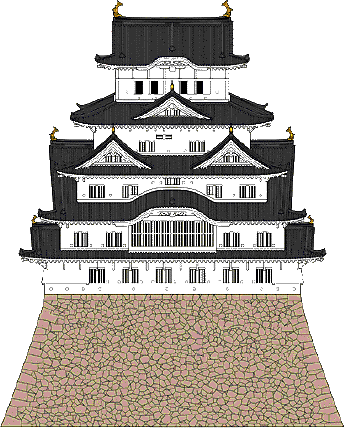
Cultural historians often refer to the last few decades of this era as the Azuchi-Momoyama period, taking the name from Oda Nobunaga's massive fortress at Azuchi, overlooking Lake Biwa at Hikone, and Hideyoshi's magnificent edifice in the Momoyama district, southeast of Kyoto. Often abbreviated as, simply, the Momoyama period, it is characterized by gaudy splendour celebrating the ego of the two great rulers. The defining feature of the age is the castles --magnificent structures of stone, surrounded by wide moats and topped by graceful ramparts and donjons--that dotted the landscape between the 1580s and 1630s. Many of the associated castle towns were the forerunners of Japan's present provincial capitals (e.g., Okayama, Kanazawa, Hiroshima, Osaka, and Matsuyama).
The castles were often filled with items reflecting the personalities of the rulers. In particular, Momoyama culture is noted for the magnificent standing screens, fusuma (sliding doors), and wall paintings of a monumental nature that decorated the castles. Artists of the Kano school, drawing on the old Yamato-e style, produced colourful pictures of animals and landscapes.
Characterized by rich pigments on reflective, gold-leaf backgrounds, these paintings are thought to have enhanced the poor illumination in the massive rooms of these castles. Whatever the reason for the strikingly rich colours and great reliance on gold, Momoyama paintings provide a vivid contrast to the somber tones of the monochrome paintings of the Muromachi era.
A specific genre within this tradition is often referred to as namban ("southern barbarian") pictures, since they represent both the European priests and traders--referred to as "southern barbarians" since they had entered Japan from the South Seas--of the day and their magnificent ships. Nobunaga and Hideyoshi spent great amounts of time and money indulging their cultural proclivities, especially the tea ceremony (chanoyu).
Both men collected valuable tea bowls, caddies, and other implements associated with the rituals of the ceremony, and Hideyoshi favoured enormous social events, such as the massive tea party scheduled to last for several days in Kyoto in 1587. Not always devoted to ostentation, Hideyoshi extended his patronage to the tea master Sen no Rikyu, the figure from whom all current tea masters trace their lineage. Rikyu brought the tea ceremony to new heights before he was forced to commit suicide by the impetuous Hideyoshi in 1591.
The establishment of the system
The ancestors of Tokugawa Ieyasu, the founder of the Edo bakufu, were the Matsudaira, a Sengoku daimyo family from the mountainous region of Mikawa province (in present Aichi prefecture) who had built up their base as daimyo by advancing into the plains of Mikawa. But when they were attacked and defeated by the powerful Oda family from the west, Ieyasu's father, Hirotada, was killed. Ieyasu had earlier been sent to the Imagawa family as a hostage to cement an alliance but had been captured en route by the Oda family.
After his father's death Ieyasu was sent to the Imagawa family and spent 12 years there under detention. When, in 1560, Oda Nobunaga destroyed the Imagawa family in the Battle of Okehazama, launching him on his course of unification, Ieyasu was finally released. Ieyasu returned to Okazaki in Mikawa and brought this province under his control. As Oda's ally, he guarded the rear for the advance on Kyoto, and he thereafter fought his own military campaigns, advancing steadily eastward. By 1582 he was a powerful daimyo, possessing, in addition to his home province of Mikawa, the four provinces of Suruga and Totomi (modern Shizuoka prefecture), Kai (Yamanashi prefecture), and southern Shinano (Nagano prefecture).
When Hideyoshi seized power, Ieyasu at first opposed him. But he then submitted, and, rising to be the most powerful daimyo among Hideyoshi's vassals, he became chief of the five tairo (senior ministers), the highest officers of the Hideyoshi regime. After Hideyoshi's death the daimyo split between those supporting Hideyori and those siding with Ieyasu. Matters came to a head at the Battle of Sekigahara in 1600, where Ieyasu won a decisive victory and established his national supremacy. Ieyasu had seen the failure of both Nobunaga and Hideyoshi to consolidate a lasting regime, and in 1603 he set up the Edo bakufu (more commonly known as the Tokugawa shogunate [1603-1867]) to legalize this position. Assuming the title shogun, he exercised firm control over the remaining daimyo at this time.
On the pretext of allotting rewards after Sekigahara, he dispossessed, reduced, or transferred a large number of daimyo who opposed him. Their confiscated lands he either gave to relatives and Tokugawa family retainers to establish them as daimyo and to increase their holdings, or he reserved them as Tokugawa house domains. Furthermore, Hideyoshi's son and heir Hideyori was reduced to the position of a daimyo of the Kinki (Osaka area) district.
Two years after the establishment of the bakufu, Ieyasu relinquished the post of shogun to his son Hidetada, retiring to Sumpu (modern city of Shizuoka) to devote himself to strengthening the foundations of the bakufu. In 1615 Ieyasu stormed and captured Osaka Castle, destroying Hideyori and the Toyotomi family. Immediately afterward, the Laws for the Military Houses (Buke Shohatto) and the Laws for the Imperial and Court Officials (Kinchu Narabi ni Kuge Shohatto) were promulgated as the legal basis for bakufu control of the daimyo and the imperial court. In 1616 Ieyasu died, the succession already having been established.
Under the second and third shoguns, Hidetada and his successor, Iemitsu, the bakufu control policy advanced further until the bakuhan system--the government system of the Tokugawa shogunate; literally a combination of bakufu and han (the domain of a daimyo)--reached its completion. By reorganizations in 1633-42 the executive of the bakafu government was almost completed, as represented by the offices of senior councillors (roju), junior councillors (wakadoshiyori), and three commissioners (bugyo) for the temples and shrines of the country, the shogun's capital, and the treasury of the bakufu.
Confiscations and reductions of domains continued, and wide-scale transfers of daimyo also took place, distributing the strategic districts of Kanto, Kinki, and Tokaido among the daimyo who were relatives and retainers of the bakufu, thus keeping the "outside" (tozama) lords in check. Along with the rearrangement of the daimyo, the lands under the direct control of the bakufu also were increased at key points throughout the country. The most important cities--Kyoto, Osaka, and Nagasaki--and mines (notably, the island of Sado) also were placed under direct bakufu administration and used to control commerce, industry, and trade.
The bakufu also revised the Laws for the Military Houses and established a system called sankin kotai (alternative attendance), by which the daimyo were required to pay ceremonial visits to Edo every other year, while their wives and children resided permanently in Edo as hostages. The system also forced the daimyo--especially the potentially dangerous tozama who lived farthest away--to spend large sums of money to support two separate administrative structures and trips to and from Edo. In addition, the daimyo were forced to assist in such public works as the construction of castles in the bakufu domains, thus being kept in financial difficulties.
Tokugawa bakufu domains now amounted to more than seven million koku--about one-fourth of the whole country. Of these lands, more than four million koku were under its direct control, and three million koku were distributed among the hatamoto and gokenin, the liege vassals to the bakufu. In addition, because the bakufu declared a monopoly over foreign trade and alone had the right to issue currency, it had considerably greater financial resources than did the daimyo. In military strength as well, it was also far more powerful than any individual daimyo.
In step with the structural organization of the bakufu as the supreme power, the domain administration (hansei) of the daimyo also progressively took shape. The relationship between the shogun and the daimyo was that of lord and vassal, based on the feudal chigyo system. In theory, the land belonged to the shogun, who divided this among the lords as a special favour, or go-on. In order to rank as a daimyo, a warrior had to control lands producing at least 10,000 koku.
In return, the daimyo incurred the obligation to provide military and other services to the shogun. Precisely the same connection existed between the domain lords and their retainers; and for the daimyo to concentrate and strengthen their rule, it was necessary for them to tighten this connection. In order to restrict the traditional right of their vassals to chigyo, or subdomains, daimyo rewarded them instead with rice stipends (kuramai), thus increasing their dependence on the daimyo.
At the same time, this policy increased the lands under the direct control of the daimyo, strengthening the economic base of the domain. Thus, the daimyo employed the same methods toward their own vassals as the bakufu used to control them. In this way, a hierarchical, "feudal" regime was established by means of the kokudaka system, which extended from the shogun through the daimyo to their retainers.
Control over the agricultural populace was now further strengthened. The Taiko land survey had recognized the rights of the peasants as actual cultivators of the land and made them responsible for taxes. Similar in intent, the land surveys of the bakufu and the daimyo were much more detailed and precise, concerned, as they were, with extracting the greatest possible tax yield. Tokugawa villages thus differed from those of the preceding ages, which had been controlled by local landlords, or myoshu.
The Tokugawa villages were composed of a main core of small farmers, generally called hyakusho. Since villages were now administrative units of the new regime, a three-tiered system of village officers was established--nanushi (or shoya), kumigashira, and hyakushodai--to carry out its functions. The inhabitants of towns and villages throughout the country were required to form gonin-gumi ("five-household groups"), or neighbourhood associations, to foster joint responsibility for tax payment, to prevent offenses against the laws of their overlords, to provide one another with mutual assistance, and to keep a general watch on one another. Economic controls over peasants were further strengthened.
They were strictly prohibited from buying, selling, or abandoning their land or from changing their occupation; minute restrictions were also placed on their attire, food, and housing. The Keian no Ofuregaki ("Proclamations of the Keian era"), promulgated by the bakufu in 1649, was a compendium of bakufu policies designed to control rural administration.
The 1630s also marked an important dividing line in foreign relations with the issuance of a series of directives enforcing a policy of national seclusion, later called sakoku (literally, "closed country"). The seeds of this policy had been sown in trade control and in measures against Christianity by the Nobunaga and Hideyoshi regimes. Hideyoshi, although strongly attracted to trade as a source of national wealth and military strength, had issued an order for the exclusion of the missionaries.
Leyasu, even more strongly attracted by profits, made efforts to trade not only with the Portuguese Roman Catholics but also with Protestant Holland and England, protecting trade with the southern regions by granting special licenses, or shuin-jo ("red-seal license"), to oceangoing merchant ships. But Ieyasu's encouragement of trade was aimed at establishing a bakufu trade monopoly.
In 1604, for example, a special system for the purchase of silk was established: Chinese silk imported to Japan by Portuguese ships was sold at fixed prices to the powerful merchants of Kyoto, Sakai, and Nagasaki, who formed a guild and then distributed this silk to the domestic retail merchants. Ieyasu, however, enjoyed a preferential purchase of a part of the imported silk (the goyo ito, or "official silk") prior to the guild's allotment and reaped a huge profit on releasing this to the domestic markets.
Eager for trade, Ieyasu was initially tolerant of Christian proselytization, but later he came to fear that the Christians would join Hideyoshi's heir Hideyori to resist the bakufu, and he took steps to prohibit Christianity before his destruction of the Toyotomi family. Decrees prohibiting Christianity were promulgated in 1612 and 1614, and the persecution of its adherents began immediately thereafter.
Persecution became much more severe under Hidetada and Iemitsu, until, at length, it became official policy to stamp out Christianity even at the sacrifice of trade. This policy became manifest with the seclusion orders of the 1630s. Thus, in 1635 Japanese were forbidden to make overseas voyages or to return to Japan from overseas, which was a severe blow to Japan's traders.
In 1637, in resistance to heavy taxes and the prohibition of Christianity, Amakusa Shiro, a Christian masterless samurai (ronin), led an uprising of peasants and Christians in the Shimabara Peninsula of Kyushu. For five months they put up a fierce fight before their defeat by the bakufu army. The bakufu having been hard-pressed to quell the rebellion, thereafter stepped up its strict controls on Christians and attempted to root them out by such means as fumi-e, in which one was made to trample on an image of Christ or the Virgin Mary.
The system of registration at Buddhist temples was instituted: all Japanese were required to register as parishioners to a parent Buddhist temple, called a danna-dera ("family temple"), which every year had to guarantee that the parishioner was not a Christian. When in 1639 Portuguese ships were forbidden to visit Japan, the sakoku orders were completed. The Dutch and the Chinese were allowed to trade as before, although this trade was restricted and confined to the island of Dejima at Nagasaki. Iemitsu also allowed a certain amount of trade with Korea and the Ryukyu Islands.
Scholars continue to debate the effects of national seclusion, but its impact on Japan was profound. The vigorous desire of the Japanese of the Sengoku era to expand overseas was thenceforth transformed into an attitude hostile to foreign trade, if not to foreigners themselves.
On the one hand, the seclusion policy was instrumental in enabling the Tokugawa bakufu to establish a prolonged peace of nearly 300 years; yet on the other, it has been argued that this simply prolonged a rigid feudal system to an extent unknown elsewhere in the world. Pax Tokugawa may have helped foster commerce and given rise to a unique popular culture, but it also was a narrowly chauvinistic culture with no international dimension. Certainly, one viewpoint is that it produced in the Japanese a unique sense of insularity.
Thus, the bakuhan system was firmly solidified by the second half of the 17th century. The establishment of a strict class structure of warriors, farmers, artisans, and merchants (shi-no-ko-sho) represents the final consummation of the system. Distinctions between the statuses of warriors, farmers, artisans, and merchants were strictly enforced, but the distinction between the samurai and the other three classes was especially strict.
Forming barely 7 percent of Japan's total population, warriors levied taxes on the farmers, who formed more than four-fifths of the population and who thus provided the economic foundation of the system. Symbolizing their dominance of society by force of arms, samurai wore two swords; by law, the other classes were forbidden to wear them, thus carrying the policies of Nobunaga and Hideyoshi to their logical conclusion. Concern for strict status differentiation was evident even in family relationships, as absolute obedience was demanded from members of the family toward the house head (kacho). Among the family members, the status of women was especially low, and the idea of danson-johi ("respect for the male, contempt for the female") was prevalent.
The establishment of the Tokugawa regime created a need for legitimation, a new worldview, and a system of ethics to support it. Neither the Shinto nor the Buddhist ideologies of the earlier medieval society was adequate. But the ideas of Neo-Confucianism, especially of the Sung dynasty Chu Hsi school (Shushigaku)--which had been well-known to political and ethical thinkers since the 13th century--provided an intellectual rationalization for the status-oriented social structure of the bakuhan system. Shushigaku appealed especially to the feudal rulers because, among the various schools of Confucianism, it was the most systematic doctrine.
Fujiwara Seika is regarded as the father of Tokugawa Neo-Confucianism, lecturing even to Ieyasu himself. Seika's student, the Chu Hsi scholar Hayashi Razan, served as advisor to the first three shoguns. He established what was to become the official Confucian school, which provided philosophical guidance to the shogunal house and high bakufu officials throughout the period. Razan is said to have had a hand in the drafting of all bakufu official documents and in the formulation of bakufu laws. His political ideas--as seen in such works as Honcho hennen-roku ("Chronological History of Japan") and Honcho tsugan ("Survey History of Japan"), completed by his son Gaho--provided a historical justification for the establishment of the Tokugawa shogunate, based upon the concept of tendo ("way of heaven").
Tendo essentially took on the connotation of the Chinese term t'ien-ming ("mandate of heaven"; Japanese: tenmei), and Razan and other Confucian thinkers provided an explanation and justification for changes in rulers through the process of gekokujo (overthrow of superiors by inferiors) of the Sengoku period.
But the role of Chu Hsi political-ethical thought in Tokugawa times was to repudiate the revolutionary idea of gekokujo by stressing the legitimacy of Ieyasu's new regime, emphasizing instead the idea of kenshin ("devotion," or "loyalty"), linking this to Confucian moral concepts. Razan stressed the Chinese idea that, just as there is order between heaven and earth, there needed to be order between rulers and subjects.
Thus he argued that the separation of the four classes of society was in accord with the teachings of Confucius. The two central moral ideals of Confucianism were chu, or "loyalty," and ko, or "filial piety." But in contrast to China, Tokugawa thinkers like Razan placed more emphasis on chu as a support for feudal lord-vassal relations than on ko, which was a family ethic. Chu Hsi studies opposed the new worldview and logic introduced by Christianity, which gave more importance to God than to the ruler-subject relationship, and also bitterly criticized the other-worldly aspects of Buddhism, which had been the ideology of the medieval era. Orthodox Chu Hsi thought was a perfect conservative philosophy of statecraft that valued loyalty and order above all else.
Japanese thinkers of the 17th century could hardly have been expected to fully ingest a foreign political philosophy already several hundred years old, and challenges to orthodox Chu Hsi thought were many. Some argued for a return to the original teaching of Confucius himself, emulating a reform movement already under way in China.
The philosophy of yet another Sung thinker, Wang Yang-ming, also held a special place in Confucian circles in the early Edo period. Wang Yang-ming studies (Oyomeigaku in Japanese) were characterized by a strong subjective idealism but, at the same time, were quite practical since they emphasized the unity of thought and deed. Virtue had to be not only cultivated in the abstract but practiced as well.
Nakae Toju, often regarded as the father of Japanese Wang Yang-ming studies, was so earnest in performing virtuous acts that he was called the sage of Omi. One of his followers, Kumazawa Banzan, who criticized the growing autocracy in the politics of his day, transformed Wang Yang-ming studies from a means for individual spiritual training into a method for political reformation.
ALPHABETICAL INDEX OF ALL FILES
CRYSTALINKS MAILING LIST, NEWSLETTER, UPDATES