After the withdrawal of Go-Daigo to Yoshino, Ashikaga Takauji set up a bakufu at Nijo Takakura in Kyoto. But in 1378 Takauji's grandson, the shogun Yoshimitsu, moved the bakufu to the Muromachi district in Kyoto, where it remained and took final shape. Yoshimitsu, assisted by the successive shogunal deputies (kanrei) Hosokawa Yoriyuki and Shiba Yoshimasa, gradually overcame the power of the great military governors (shugo) who had been so important in the founding of the new regime.
He destroyed the Yamana family in 1391, and, in uniting the Northern and Southern courts, attacked and destroyed the great shugo Ouchi Yoshihiro, thus gaining control of the Inland Sea. Yoshimitsu was now raised to the highest office of prime minister, or dajo-daijin. He constructed the famed Golden Pavilion (Kinkaku-ji; see below The establishment of warrior culture) northeast of the capital in Kitayama, taking great pride in its luxurious display, and also reestablished trade and diplomacy with Ming dynasty China under the title "King of Japan."
The Muromachi bakufu inherited almost unchanged the structure of its Kamakura predecessor (see above The establishment of warrior government), setting up a Mandokoro, Monchujo, and Samurai-dokoro. But after the appointment of Hosokawa Yoriyuki as kanrei, this post became the most important in the bakufu government. The official business of the Mandokoro was to control the finances of the bakufu; and later the Ise family, who were hereditary retainers of the Ashikaga, came to inherit this office.
The Samurai-dokoro, besides handling legal judgments, was entrusted with the control of the capital. Leading officials called shoshi who held the additional post of shugo of Yamashiro province (now in Kyoto urban prefecture) were next in importance to the kanrei. New offices were established to streamline judicial decisions and handle financial matters, and the Ashikaga maintained their own private guard, the hokoshu. In local administration, a special administrator was set up in Kamakura to control the 10 provinces of the Kanto area. This office came to be held by heads of the Ashikaga Motouji family. The 11 provinces of Kyushu were placed under control of an office known as the Kyushu tandai.
The crucial difference between the two bakufu, however, was the difference in the role of the shugo. Appointed first by Takauji in the chaos of the war between the courts, many rose to positions of great power in one or several provinces under their purview. By Yoshimitsu's time, their number had been reduced and their powers somewhat curtailed. But the structure of the bakufu was essentially a delicate balance between the Ashikaga shogunal house and about a dozen major shugo houses, almost evenly divided between collateral Ashikaga houses and nonrelated warrior families. Yoshimitsu made them all establish primary residence in Kyoto, where they ruled in council with the shogun. This retarded their abilities to develop stronger vassalage ties with local warriors in their provinces, and they often sent out deputies to manage their provincial areas in their absence. Consequently, in later years many powerful shugo from the early and middle parts of the Muromachi period were overthrown by their own deputies.
The finances of the Muromachi bakufu could not be met simply from its receipts from the lands under its direct control, as Kamakura had managed to do. So, according to bakufu needs, the shugo and jito of each province were ordered to levy monetary taxes on either every unit of land or every household; this, however, also was not fully effective in meeting financial needs. As a result, the bakufu extracted taxes from such dealers as pawnbrokers and sake brewers, who were among the wealthiest merchants of the time. Financial deficiencies also were supplemented by trading with China. Despite this more diversified tax structure, the Muromachi regime maintained only a shaky hold on the nation. The foundations of the bakufu began to be shaken by the increasing power of the shugo and by the frequent uprisings of local samurai and farmers.
In the Kamakura period the authority of the shugo was essentially limited to security matters--suppressing rebellion, apprehending murderers, and mustering out vassals for service in Kyoto. In the latter half of the Northern and Southern courts period, their executive power over the areas under their control was increased. As the number of disturbances grew, they gained wide powers of military command. Sometimes estates were made depots for military supplies on the pretext of protecting them from the depredations of local warriors, and half their yearly taxes were given to the shugo. This was called the equal tax division, or hanzei. Many shugo succeeded to their domains by inheritance, and in cases such as that of the Yamana family a single shugo sometimes held a number of provinces. If the primary agent of the Kamakura bakufu had been the jito, the shugo was the defining office of the Muromachi regime. From the outset, the controlling power of the Ashikaga bakufu was relatively weak, and, especially after the death of Yoshimitsu, the tendency for powerful shugo to defect became marked. Hence, as time passed the office of shogun became increasingly impotent.
In the villages around Kyoto, the status of farmers rose markedly as agriculture became more highly developed, and commerce and small-scale manufacturing prospered. Also, confederations of the middle and small landlords, or myoshu, proceeded apace and often led to uprisings against absentee control. Such confederations appeared where farming by the larger myoshu had dissolved and middle and small myoshu had established themselves on a wide scale. These smaller landlords endeavoured to defend themselves against the ravages of local warfare, forming unions to manage the forests in common and to maintain irrigation works. In such confederations, a leader called the elder (otona) would be selected to head village government. Assemblies were held regularly among its members at the village shrine or temple, and regulations were drawn up for the maintenance of community life.
As self-government became strong in the communities, the resistance of farmers became fierce. After the unification of the Northern and Southern courts, armed uprisings broke out among the farming villages, the peasants demanding reductions in yearly taxes from the old proprietors and a moratorium on debts owed to the moneylenders. A large-scale uprising of this kind took place in 1428 in the last years of Yoshimitsu's rule. In 1429 an uprising broke out in Harima province (now part of modern Hyogo prefecture) aimed at the expulsion of the warriors from the province. In 1441 farmers living around Kyoto attacked the pawnbrokers and demanded that the bakufu declare a moratorium on debts. Thereafter, uprisings occurred on a greater or lesser scale almost yearly--testimony to the fading power of both the shoen system and the bakufu.
Trade with Ming dynasty China began after the bakufu agreed to suppress Japanese piracy. Ashikaga Takauji had sent ships of the Tenryu Temple to trade with the Yüan (Mongol) dynasty. But trade then ceased because of the internal disturbances, and pirates from the maritime districts of western Japan raided both China and the Korean peninsula. When Korea came under the control of the Choson (Yi) dynasty and in China the Ming dynasty emerged, they both requested that the bakufu open formal trade relations, hoping to suppress piracy. Yoshimitsu, both in response to the desires of the merchants and in order to supplement bakufu finances, began formal trade relations with Ming China and Korea, repatriating a large number of Chinese who had been taken captive by the pirates. In response, the Ming also began to trade with Japan, under the form of tribute from Yoshimitsu, "King of Japan," to the emperor of China. In order to distinguish between pirate ships and trading ships, seals received from the Ming called kangofu were used, hence the use of the term kango, or tally, trade.
Profits from the China trade were important to the bakufu, but control of this trade later came into the hands of the western shugo families of the Hosokawa and Ouchi, under whose protection trading merchants became active in the ports of Hakata, Hyogo, and Sakai. After the Onin War (see below The Onin War [1467-77]), the Ouchi controlled the trade--albeit in competition and often conflict with the Hosokawa--but with the destruction of the Ouchi the kango trade ceased and piracy again became rife. Trade with Choson dynasty Korea was carried on through the agency of the So family of Tsushima, and various shugo and the merchants of Hakata were actively involved in it, importing cotton and other goods. Japanese traders even established settlements in southeastern Korea, including Pusan. Also included in the trade with China and Korea were goods imported by Japanese merchants from the Ryukyu Islands, lying between Japan and Taiwan, and dye materials, pepper, and other special products from the South Seas.
During the rule of the shogun Ashikaga Yoshimasa a general civil war broke out in the area around Kyoto, caused by economic distress and precipitated by a dispute over the shogunal succession. Indeed, severe famines engendered rebellion nearly every autumn, and it is said that during his term as shogun Yoshimasa issued 13 edicts for the cancellation of debts known as tokuseirei, or "acts of grace." Lacking children of his own, Yoshimasa at first proposed that his younger brother should succeed him. But when he later fathered a child a serious dispute arose over control of the Ashikaga family.
The two chief administrators, Shiba and Hatakeyama, and most of the remaining shugo also took sides in the power dispute, with Hosokawa Katsumoto and Yamana Sozen (Yamana Mochitoyo) at the head. In 1467, the first year of the Onin era, fighting broke out between the "eastern" army of the Hosokawa party and the "western" army of the Yamana faction. The eastern army had the advantage of the support of both the emperor and the shogun, but the western army, assisted by the Ouchi family, recovered its power, and fighting raged mainly in and around Kyoto.
Destruction around Kyoto was severe, many large temples and residences were burned, and large numbers of citizens fled the city. After 11 years the war itself ended, but the fighting spread to the provinces. As a result, farming villages held conferences and frequently mounted armed uprisings in self-defense. The leaders of these uprisings were local samurai with village roots. Such men frequently established themselves as domain lords (daimyo) during the disturbances. They formed associations and often mounted uprisings that extended over an entire province and challenged the great shugo. In the autumn of 1485, for example, 36 representatives of the local warriors of southern Yamashiro province met in the Byodo Temple at Uji and successfully demanded the withdrawal of the two Hatakeyama armies. As a result, southern Yamashiro became self-governing for more than eight years.
During this constant warfare, the civil aristocracy and temple complexes lost much of their income from shoen, which, in any event, had been declining. Many of them left the capital, moving to Sakai or Nara or even taking up residence in the castle towns under the protection of local daimyo. This migration of aristocrats and priests functioned to diffuse the higher culture of the capital to the provinces. Old traditions were destroyed, but from the ashes a new culture was born.
The shogun Ashikaga Yoshimasa, for example, ultimately turned his back on a troubled world and built a detached residence--the Silver Pavilion (Ginkaku-ji)--in the Higashiyama section of Kyoto, where he lived in elegance and refinement, paying little attention to matters of government. The political power of the bakufu thus became virtually nonexistent, and real power came into the hands of the chief administrators of the Hosokawa family (1490-1558). In the 16th century actual power devolved into the hands of their retainers, the Miyoshi family (1558-65), until it was finally usurped by their own retainers, the Matsunaga family (1565-68).
The emergence of new forces.
After the Onin War, the power of independent local leaders increased markedly, and in many instances deputies of great shugo houses usurped the domains of their superiors, retainers overthrew their overlords, and branch families seized power from main families. Because of this tendency for "inferiors to overcome superiors" (gekokujo), the previous shugo almost completely disappeared from Kyoto and the surrounding provinces; a new type of domain lord, the daimyo, took their place. Since this time was marked by constant warfare among many such lords, it is called the Sengoku ("Warring States") period, named for a somewhat similar period in ancient Chinese history.
Until the first half of the 16th century, daimyo in the various localities were thus building up strong military bases. During this period, the provinces held by the daimyo were almost completely free of bakufu control. The daimyo turned local leaders into their retainers, taking away their independence by enforcing land surveys and directly controlling the farming villages. Daimyo such as the Imagawa, Date, and Ouchi issued their own laws, called bunkoku-ho, to administer their own territories.
These provincial laws, while drawing on the precedent of warrior codes of the Joei Formulary, also included regulations for farmers and applied strict controls over retainers. In principle, for example, inheritance by retainers was restricted to the main heir alone, and the lord's permission was necessary for his vassals to inherit property or to marry. In farming villages the daimyo, in addition to carrying out detailed land surveys, also built irrigation dikes and opened new rice fields in order to stimulate production. To concentrate their power they also readjusted the disposition of local fortified strongholds, gathered their retainers into castles, and reorganized roads and post stations to centre on their castle towns (jokamachi).
Commerce and towns made marked development at this time in Japan's history. Periodic markets also sprang up throughout the country. Despite the obstructions of customs barriers (erected by both bakufu and private interests), products from all parts of the country were available in these markets. In large cities such as Kyoto, commodity exchange markets were set up to handle huge quantities of rice, salt, fish, and other goods; wholesalers, or toiya, specialized in dealings with distant areas. The circulation of coined money also became vigorous, but in addition to the various kinds of copper coin imported from China of the Sung, Yüan, and Ming dynasties, privately minted coins also circulated within the country, giving rise to confusion of exchange rates. The bakufu and daimyo issued laws to prohibit people from hoarding good coins but with little success. Muromachi guilds showed a strong monopolistic tendency in trying to protect themselves against new-style merchants who emerged, while new guilds were set up in the castle towns under the direct control of the daimyo.
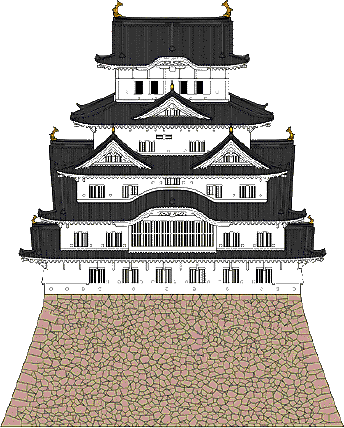
Among the cities of the time, next to Kyoto and Nara, Uji-Yamada, Sakamoto, and other towns sprang up outside the gates of major temples and shrines. Besides these, towns naturally grew up around the castles of the daimyo, such as Naoetsu of the Uesugi family, Yamaguchi of the Ouchi family, Ichijodani of the Asakura family, and Odawara of the later Hojo. As the castles shifted from serving as defensive mountain fortresses to administrative strongholds in the plains, markets were opened outside the castle walls, and merchants and artisans gathered there to live.
Harbour towns (minato machi) such as Sakai, Hyogo, and Onomichi on the Inland Sea, Suruga and Obama on the Sea of Japan, and Kuwana and Ominato on Ise Bay also flourished as exchange centres. Sake brewers, brokers, and wholesale merchants were leading townsmen (machishu), and town elders (otona) were chosen to carry on local government through assemblies. In the trading port of Sakai, for example, an assembly of 36 men drawn from the wholesale guilds administered the city. They maintained soldiers and constructed moats and other defenses, and while profiting from the confrontation between daimyo, they resisted their domination. The Jesuit missionaries (see below) compared Sakai to the free cities of Europe in the Middle Ages and described its flourishing condition in their reports.
As the warring daimyo carved out their territories, neither emperor nor shogun was able to govern the domestic scene, let alone control overseas trade. Further, Japanese marauders in association with Chinese pirates again became active. It was at this point in Japanese history that the Spanish and Portuguese made their appearance in the archipelago.
In 1543 several Portuguese were shipwrecked on the island of Tanega, off southern Kyushu. These were the first Europeans to arrive in Japan, and the art of musket construction they passed on at this time immediately spread to Sakai and other places. This new technology, eagerly sought by the daimyo, revolutionized warfare in Japan.
In 1549 the Jesuit missionary Francis Xavier arrived in Kagoshima. After missionary work for more than two years, he left Japan; but thereafter Jesuit missionaries arrived continuously. The missionaries utilized trade in goods from the Portuguese ships to propagate Christianity, and there were cases in which merchant ships would not enter the ports of daimyo who did not show good will toward missionary activity. Thus, the daimyo of the Sengoku era, seeking profits of foreign trade and the acquisition of military equipment and supplies, protected Christianity. Some daimyo became Christian converts. Three Kyushu Christian lords--Otomo Sorin, Arima Harunobu, and Omura Sumitada--even sent an embassy to Rome. Farmers also increasingly became converts, in part because of the influence of the social relief work and medical aid that accompanied missionary activity.
While absorbing the traditional culture of the civil aristocracy, the warrior houses that established themselves in Kyoto during Muromachi times also introduced the continental culture of the Sung, Yüan, and Ming dynasties, especially the culture associated with Zen Buddhism, thus fashioning a new warrior culture. This process began with the golden age of Ashikaga Yoshimitsu at the end of the 14th century, when scholarship and the arts flourished in the five Zen monasteries of Kyoto under shogunal patronage.
Renga (linked verse) and no drama flourished. The essence of this culture found concrete expression in Yoshimitsu's Golden Pavilion at Kitayama ("Northern Mountain"). Destroyed by an arsonist in 1950 and rebuilt in 1955, it is now officially called the Rokuon Temple and is located in northwestern Kyoto. Facing a garden of refined elegance, the Golden Pavilion is built in the Japanese shinden style (a style of mansion construction developed in the Heian period) in its first and second stories, while its upper story is in the kara ("Chinese") style of the Zen school. Thus Kitayama culture, while absorbing new Zen influences from China, retained much of the earlier native aristocratic culture.
The era of the shogun Yoshimasa, following the destruction caused by the Onin War, was one of an even deeper Zen flavour and showed a refined appreciation of simplicity and quiet profundity. Yoshimasa's Silver Pavilion and its garden in eastern Kyoto (now part of the Jisho Temple) truly reflect Higashiyama ("Eastern Mountain") culture. This somber temple (never covered, as planned, with silver) and its serene surroundings--in marked contrast to the ostentation of the Golden Pavilion--represent the essence of this polished cultural style. While adopted by the daimyo, Higashiyama culture also spurred the development of a new culture centred on the townspeople of Kyoto and Sakai and was as well the forerunner of the Azuchi-Momoyama and Edo cultures.
In Buddhism, the great ancient temples like the Enryaku Temple became mere shadows of their former greatness with the gradual diminution of their shoen. Since the Kamakura period, the new Rinzai Zen sect had been especially favoured by high-ranking warrior houses. The Muromachi shogunal family (the Ashikaga) gave special protection to followers of the priest Muso Soseki of this sect, which flourished in the Gozan monasteries (the five most important Zen monasteries) in Kyoto. Gozan monks advised the bakufu in matters of government, diplomacy, and culture; they studied the Neo-Confucian philosophy of Chu Hsi that came from China along with Zen, published books, and wrote poetry and prose in the Chinese style. But the Gozan monasteries became somewhat vulgarized because of their excessive links with the political world, and consequently they ceased to prosper as the bakufu declined. In contrast, the Myoshin and Daitoku temples--also of the Rinzai sect but outside the Gozan system--rose to prominence, the latter perhaps best known for the work of the monk Ikkyu, who propagated his own special form of teaching.
It was during this period that Rennyo (1415-99) of the Shin (True) sect of Pure Land Buddhism rose to prominence, teaching his principles in simple phrases. His base, the Hongan Temple in Kyoto, was attacked and burned, however, by the still-powerful Enryaku Temple. Rennyo was forced to flee north to the coast of the Sea of Japan, where he established a school at Yoshizaki. He then returned to the capital area, where the Hongan Temple was reestablished and achieved its golden age. While also persecuted by long-established temples, the Hokke (Lotus) sect continued to gain adherents among warriors and merchants. Moreover, it was during this time that the custom of pilgrimages to the holy places of the Buddhist deity Kannon, to the Shinto shrines at Ise, and to the summit of Mount Fuji also became popular. Accompanying this trend was the development of a worldly Shinto belief. In the 15th century the scholar Yoshida Kanetomo attempted to free Shinto shrines from Buddhist control; he believed that only a deep religious faith in Shinto could cure the people of their despondency.
In the arts the no drama developed in the Kamakura period out of the older tradition of agricultural festival dances, and guilds (za) were formed to serve at the ceremonies of temples and shrines and at funeral services. Four such actor guilds were attached to the Kofuku Temple and the Kasuga Shrine of Yamato province (present Nara prefecture), from which came the father and son Kan'ami and Zeami Motokiyo; under the patronage of Ashikaga Yoshimitsu, they laid the foundations for a flourishing no drama, establishing the guidelines for performance and bequeathing many texts. Kyogen (dialogue plays with dance), which developed from the comic elements of an older form of entertainment called sarugaku, were performed in the intervals of no drama. Based on themes from the everyday life of the common people, kyogen were widely appreciated by them, especially because they satirized the upper class. Traditional Japanese waka verse was still composed, but renga (linked verse) became ever more popular and was enjoyed by the warriors and the common people alike. After a time, however, even renga became overly formal, as the waka had, and lost its freshness; hence, the free-style verse called haikai was born.
As Zen prospered, the shoin architectural style closely connected with this school was widely adopted by both warriors and civil aristocrats in the construction of their residences, becoming the foundation of present-day Japanese domestic architecture. Originally a room in which monks read the Buddhist scriptures, the shoin had several distinctive features: an entrance called a genkan, straw mats called tatami laid out over the entire floor of the room, paper-covered sliding partitions (shoji) between rooms, and an alcove (tokonoma) and shelves at different levels (chigaidana) for displaying works of art. The custom of hanging a monochrome painting in the tokonoma and placing flowers or an incense bowl before it also became popular at this time. In the construction of gardens, delight was taken in adding the Zen mood of retreat from the world to the old shinden style, making symbolic use of streams, flowers, and bushes. Later, even more symbolic gardens were constructed using arrangements only of stones, raked sand, and gravel.
The carving of images of the Buddha and the Buddhist paintings that had flourished in the Kamakura period declined in later Muromachi times; so, too, did the ancient sects themselves, and new ones arose. Yamato-e painting also declined, and the picture-scrolls lost their freshness. In their place, the increased interest in Zen led to the introduction of monochrome painting in the Sung and Yüan style by the Gozan monks. By the time of Yoshimasa, however, the great painter Sesshu broke away from imitation of Chinese models and opened new frontiers in monochrome paintings. The father and son Kano Masanobu and Kano Motonobu introduced the gentle forms of Yamato-e to monochrome painting and became the founders of the new Kano school.
Tea drinking, introduced from Sung China by the Zen priest Eisai in the Kamakura period, spread among warriors and even common people from the mid-14th century. In the time of the shogun Yoshimasa, Murata Shuko, a man of merchant background from Nara, began the wabi-cha form of tea ceremony by bringing together the chanoyu of the civil aristocracy and the cha-yoriai of the common people. This new form spread among the warriors and great merchants and was further stylized by the Sakai merchant Takeno Joo.
The development of the tea ceremony stimulated new forms in tearoom architecture, flower arrangement, pottery, and even the Japanese cakes served with tea. The Higashiyama cultural tradition was further diffused among the common people, and as the levels of wealth and education of urban merchants and artisans rose, they, too, came to enjoy no and kyogen dramas, the tea ceremony, and renga.
Fairy tales were also widely enjoyed, being easy to read, and included stories that had been related among the people since ancient times. These became popular not only among the children of the nobility and warriors but also among those of the townspeople who were educated in temples and shrines. Muromachi fiction celebrated the life of the burgeoning artisan and merchant classes. Local daimyo also promoted culture within their domains, eager to enhance their dignity as lords by building temples and shrines in their castle towns and by employing artists and scholars who helped spread the culture of Kyoto.
Thus, while warfare was rife in the Muromachi period, it gave Japan some of its most distinctive cultural institutions.
ALPHABETICAL INDEX OF ALL FILES
CRYSTALINKS MAILING LIST, NEWSLETTER, UPDATES