Ancient Greece Articles in the News
A storehouse of ancient treasures, including precious jewels and gold beads, has been uncovered by archaeologists on an island near Crete devoted to making a precious purple dye from sea snails thousands of years ago Live Science - December 11, 2019
A storehouse of ancient treasures, including precious jewels and gold beads, has been uncovered by archaeologists on an island near Crete devoted to making a precious purple dye from sea snails thousands of years ago. The finds on Chrysi - a now uninhabited island - show the high value placed on the rare purple dye and the flourishing economy of the settlement between 3,800 and 3,500 years ago, during the Protopalatial and Neopalatial periods of the Minoan civilization on Crete.
Archaeologists find remains of lost city of Tenea first settled by prisoners who survived the Trojan war Daily Mail - November 13, 2018
Greece's culture ministry said that archaeologists have located the first tangible remains of a lost city that the ancient Greeks believed was first settled by Trojan captives of war after the sack of Troy. A ministry statement said excavations from September to early October in the southern Greek region of the Peleponnese turned up 'proof of the existence of the ancient city' of Tenea, until now known mostly from ancient texts. Finds included walls and clay, marble or stone floors of buildings, as well as household pottery, a bone gaming die and more than 200 coins dating from the 4th century B.C. to late Roman times.
Knossos: Palace of the Minoans Live Science - November 7, 2017
The Palace of Knossos is located just south of modern-day Heraklion near the north coast of Crete. Built by a civilization that we call the Minoans, it covers about 150,000 square feet (14,000 square meters), the size of more than two football fields, and was surrounded by a town in antiquity. The site came to prominence in the early 20th century when it was excavated and restored by a team led by British archaeologist Arthur Evans. When the palace was first constructed "it must have been a remarkable sight, quite unlike anything seen on Crete before
Masterpiece of Greek Art Found in the Griffin Warrior Tomb Smithsonian - November 7, 2017
In 2015, archaeologists discovered an intact tomb of a Mycenean warrior or priest later dubbed the ÒGriffin WarriorÓ in an olive grove near Pylos, Greece, dating to around 1450 B.C. It was an incredible find, with the researchers recovering gold and silver cups, weapons and armor, and 50 gold and gemstone seals engraved with intricate images. Now, reports Nicholas Wade at The New York Times, researchers have fully analyzed one of those agate seals and have found that it is on par with the greatest artworks of the ancient world. But unlike ancient Greek sculpture or Roman mosaics, the seal might be hard to see without a magnifying glass. The engraved image is less than an inch and a half long, but includes an incredibly detailed scene of a warrior slaying two enemies. The seal has been named the Pylos Combat Agate. The stunning combat scene on the seal stone, one of the greatest masterpieces of Aegean art, bears comparison with some of the drawings in the Michelangelo show now at the Metropolitan Museum of Art.
Archaeologists unearth 'masterpiece' sealstone in Greek tomb Science Daily - November 7, 2017
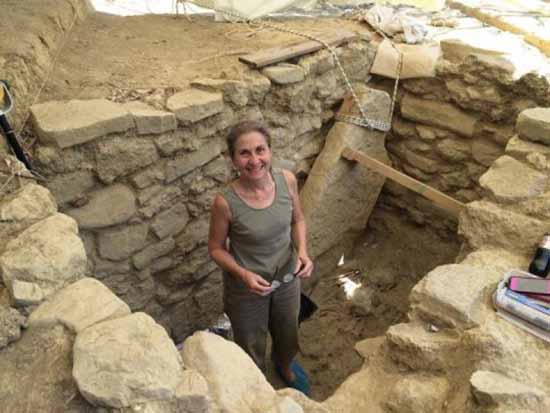
Discovery of a rare Minoan sealstone in the treasure-laden tomb of a Bronze Age Greek warrior promises to rewrite the history of ancient Greek art. Archaeologists are documenting artifacts contained within their amazing 2015 find, the tomb of the Griffin Warrior in Greece. But the 3,500-year-old treasures include their most stunning historical offering yet: an intricately carved gem, or sealstone, that represents one of the finest works of prehistoric Greek art ever found.
Some people saw this as a laptop, but it wasn't.
Video: Is this ancient Greek statue proof someone took a laptop back in time (or is it just a Tablet?) Daily Mail - February 5, 2015
Astronomical Find: One of the Earliest Greek Depictions of Constellations Live Science - October 27, 2014
A 2,600-year-old two-handled wine cup currently on display at the Lamia Archaeological Museum in Greece has long been thought to depict a random assortment of animals. But the piece of ancient pottery, called a skyphos,may actually contain one of the earliest Greek depictions of the constellations, a new analysis shows. The study researchers suggested that other ancient artistic representations of animals may also portray constellations, and hold clues to what the early Greeks knew about astronomy, said study researcher John Barnes, a classical archaeology doctoral candidate at the University of Missouri.
Greece: Video Archeologists uncovered a large floor mosaic near the recently-discovered tomb of Macedonian king, Philip the Second CNN - October 13, 2014
Philip is the father of Alexander the Great.
Greece archaeologists uncover Amphipolis floor mosaic BBC - October 13, 2014
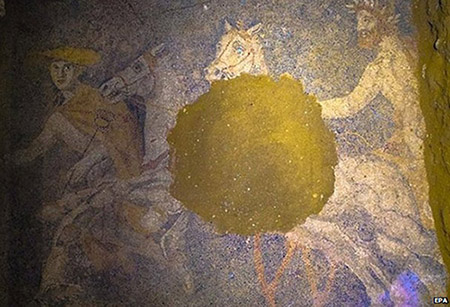
The mosaic - 3m (10ft) wide and 4.5m (15ft) long - depicts a man with a laurel wreath driving a chariot drawn by horses and led by the god Hermes. The burial site is said to be the largest ever found in Greece. It dates from the late 4th Century BC, spurring speculation that it is linked to Alexander the Great of Macedon. Archaeologists started digging in August and think the magnificence of the tomb means it was built for someone very important. Some observers say the tomb could belong to a member of Alexander's immediate family - maybe his mother, Olympias, or his wife, Roxana - or another Macedonian noble. Others believe it could be a cenotaph, a monument built in honor of a person whose remains are elsewhere.
Did an Earthquake Destroy Ancient Greece? Live Science - April 23, 2013
The grand Mycenaens, the first Greeks, inspired the legends of the Trojan Wars, "The Iliad" and "The Odyssey." Their culture abruptly declined around 1200 B.C., marking the start of a Dark Ages in Greece. The disappearance of the Mycenaens is a Mediterranean mystery. Leading explanations include warfare with invaders or uprising by lower classes. Some scientists also think one of the country's frequent earthquakes could have contributed to the culture's collapse. At the ruins of Tiryns, a fortified palace, geologists hope to find evidence to confirm whether an earthquake was a likely culprit. Tiryns was one of the great Mycenaean cities. Atop a limestone hill, the city-state's king built a palace with walls so thick they were called Cyclopean, because only the one-eyed monster could have carried the massive limestone blocks. The walls were about 30 feet (10 meters) high and 26 feet (8 m) wide, with blocks weighing 13 tons, said Klaus-G. Hinzen, a seismologist at the University of Cologne in Germany and project leader. He presented his team's preliminary results April 19 at the Seismological Society of America's annual meeting in Salt Lake City.
Athenian 'Snake Goddess' Gets New Identity Live Science - January 8, 2013
A mysterious "snake goddess" painted on terracotta and discovered in Athens may actually be Demeter, the Greek goddess of the harvest. Once linked to the worship of the dead, the goddess is flanked by two snakes on a slab of terracotta about the size of a piece of notebook paper. She has her hands up above her head, which has given her the nickname "the touchdown goddess" thanks to the resemblance of the pose to a referee's signal. The goddess is painted in red, yellow and blue-green on a tile, with only her head molded outward in three dimensions. This unusual piece of art was found amid a jumble of gravel and other terracotta fragments in 1932 in what was once the Athenian agora, or public square.
Over 300 Clay Figures Found at Ancient Site Live Science - January 9, 2013
Archaeologists at a Neolithic settlement in Greece have discovered over 300 clay figurines - some that look like people, others that look like human-animal hybrids, all of which date back more than 7,000 years. The little statuettes were scattered all over Koutroulou Magoula, a site about 160 miles (257 kilometers) from Athens that was occupied during the Middle Neolithic period (c. 5800 - 5300 B.C.). Researchers say Koutroulou Magoula was once home a few hundred people who made houses from stone and mud-bricks and subsisted by farming and keeping domestic animals. The archaeologists are still investigating what the artifacts say about the ancient settlement's culture.
Athenian 'Snake Goddess' Gets New Identity Live Science - January 8, 2013
A mysterious "snake goddess" painted on terracotta and discovered in Athens may actually be Demeter, the Greek goddess of the harvest. Once linked to the worship of the dead, the goddess is flanked by two snakes on a slab of terracotta about the size of a piece of notebook paper. She has her hands up above her head, which has given her the nickname "the touchdown goddess" thanks to the resemblance of the pose to a referee's signal. The goddess is painted in red, yellow and blue-green on a tile, with only her head molded outward in three dimensions. This unusual piece of art was found amid a jumble of gravel and other terracotta fragments in 1932 in what was once the Athenian agora, or public square.
In Vino Veritas: Wine Cups Tell History of Athenian Life Live Science - January 12, 2011
Over centuries, the ancient Athenian cocktail parties went full circle, from a practice reserved for the elite to one open to everyone and then, by the fourth century B.C., back to a luxurious display of consumption most could not afford.
Pavlopetri -- the world's oldest known submerged town PhysOrg - October 21, 2009
The world's oldest known submerged town has been revealed through the discovery of late Neolithic pottery.
The finds were made during an archaeological survey of Pavlopetri, off the southern Laconia coast ...
Pavlopetri Wikipedia
Mount Lykaion: Mythic Birthplace of Zeus Said Found Live Science - February 10, 2009
The Chariot of Zeus image is from the 1879 "Stories from the Greek Tragedians" by Alfred Church. The Greek god of thunder and lightning had Earthly beginnings, and scientists think they finally know where. Ancient Greeks first worshipped the omnipotent Zeus at a remote altar on Mount Lykaion, a team of Greek and American archaeologists now think. During a recent dig at the site, the researchers found ceremonial goods commonly used in cult activity and dated at over three millennia old, making them the earliest known "appearance" of Zeus in Greece. The discovery challenges the idea that Zeus worship began on the Greek island of Crete, which at least one classical historian names as the god's mythic birthplace. The latest finds on Mount Lykaion, in the mainland province of Arcadia, are as old as the idea of Zeus himself, said the project's senior research scientist David Romano, of the University of Pennsylvan
Why Ancient Greek Statues are Always Nude Live Science - February 2, 2007
>
Male nudes are the norm in Greek art, even though historians have stated that ancient Greeks kept their clothes on for the most part. New research suggests that art might have been imitating life more closely than previously thought. Nudity was a costume used by artists to depict various roles of men, ranging from heroicism and status to defeat.
Ancient Coffin Depicts Scenes from Homer's Odyssey, Iliad Live Science - March 21, 2006
A 2,500-year-old sarcophagus with vivid color illustrations from Homer's epics has been discovered in western Cyprus, archaeologists said Monday. Construction workers found the limestone sarcophagus last week in a tomb near the village of Kouklia, in the coastal Paphos area. The tomb, which probably belonged to an ancient warrior, had been looted during antiquity.
Greek tomb find excites experts BBC - February 12, 2006
Archaeologists in Greece say they are examining the largest underground tomb ever found in the country. A farmer had stumbled across the tomb carved into the rock near the ancient city of Pella, the birthplace of Alexander the Great. Archaeologists believe it dates to the period after Alexander's death, which was marked by mass power struggles. The tomb was probably used by a noble family about 2,300 years ago - some of whose names are still visible. Archaeologists said that the eight-chambered tomb was significant in style. It is accessible through a 16-metre entrance.
Greeks 'borrowed Egyptian numbers' BBC - September 2003
The astronomers, physicists and mathematicians of ancient Greece were true innovators. But one thing it seems the ancient Greeks did not invent was the counting system on which many of their greatest thinkers based their pioneering calculations. New research suggests the Greeks borrowed their system known as alphabetic numerals from the Egyptians, and did not develop it themselves as was long believed. Greek alphabetic numerals were favored by the mathematician and physicist Archimedes, the scientific philosopher Aristotle and the mathematician Euclid, amongst others.
ANCIENT GREECE INDEX
ANCIENT CIVILIZATIONS INDEX
ALPHABETICAL INDEX
CRYSTALINKS HOME PAGE
PSYCHIC READING WITH ELLIE
BOOK: THE ALCHEMY OF TIME
DONATION TO CRYSTALINKS
ADVERTISE ON CRYSTALINKS