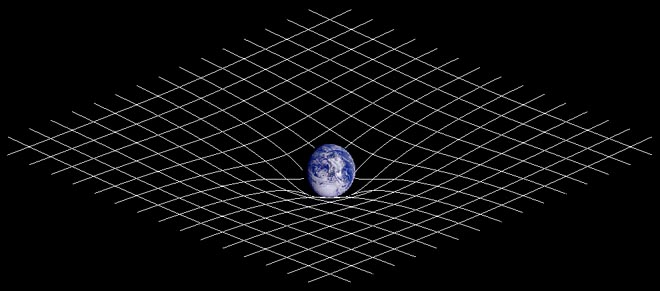
In physics, gravitational waves are ripples in the curvature of spacetime which propagate as waves, traveling outward from the source. Predicted in 1916 by Albert Einstein on the basis of his theory of general relativity, gravitational waves theoretically transport energy as gravitational radiation. The existence of gravitational waves is a possible consequence of the Lorentz invariance of general relativity since it brings the concept of a limiting speed of propagation of the physical interactions with it. By contrast, gravitational waves cannot exist in the Newtonian theory of gravitation, in which physical interactions propagate at infinite speed.
Although gravitational radiation has not been directly detected, there is indirect evidence for its existence. For example, measurements of the Hulse-Taylor binary system suggest that gravitational waves are more than a theoretical concept. Other potential sources of detectable gravitational waves include binary star systems composed of white dwarfs, neutron stars, and black holes. As of 2016, various gravitational-wave detectors are under construction or in operation, such as Advanced LIGO which began observations in September 2015. Read More
'Lost World' of Gravitational Waves Reveals The Origins of Black Holes Science Alert - May 28, 2026

Over the last decade, gravitational-wave observatories have revealed them in bewildering variety: giant black holes far chunkier than we thought possible, black holes rotating at dizzying speeds, and pairs so mismatched that scientists struggled to explain them. Now, with the latest release of gravitational-wave data from the LIGO-Virgo-KAGRA collaboration, astronomers finally have enough detections to move beyond individual curiosities and begin taking a true census of the black hole population. And the emerging picture suggests that the Universe has a surprisingly versatile range of black hole construction methods.
Record-breaking gravitational wave puts Einstein's relativity to its toughest test yet and proves him right again Live Science - February 13, 2026

A record-breaking gravitational wave signal let scientists "listen" to a distant black hole merger and put Einstein's gravity to its toughest test yet.
Unusual Gravitational Wave May Be Sign of Wormhole Linking Universes Science Alert - September 23, 2025
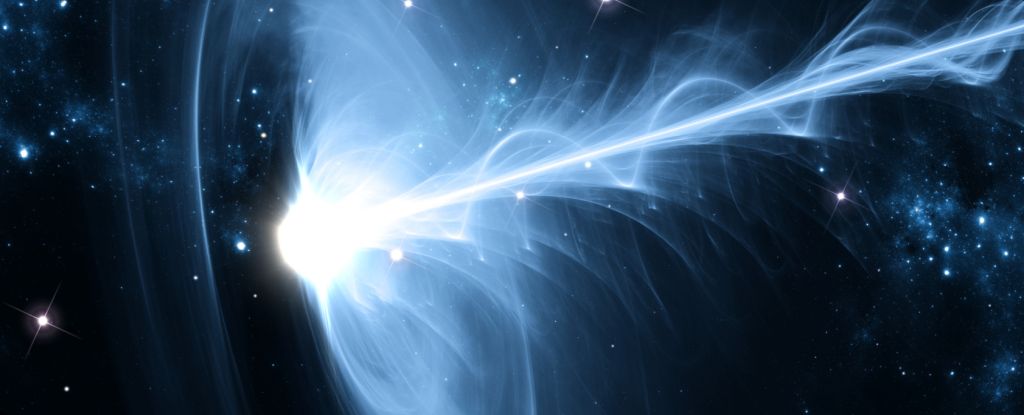
In 2019, LIGO and Virgo recorded something truly bizarre Š a gravitational wave event less than a tenth of a second in duration. Compared to the drawn-out chirps of black hole binaries on decaying orbital spirals, it was a sharp crack. The best explanation of the event, named GW190521, was a chance encounter of two black holes snaring each other in passing. Now, a new paper has presented an alternative, far more exotic option: the echo of a black hole collision in another universe, reverberating through a collapsing wormhole that formed as a result of that merger.
Einstein's theory of general relativity suggests that the "memory" of ancient events, such as black hole mergers, may be etched into the fabric of space-time by gravitational waves Live Science - March 6, 2025
New research shows how this theory of gravitational memory could finally be proven. The researchers suggest that the cosmic microwave background - a faint glow left over from the Big Bang - might carry the signatures of powerful gravitational waves from distant black hole mergers. Studying these signals could not only confirm Einstein's prediction but also shed light on some of the most energetic events in the universe's history.
The Bizarre Behind-The-Scenes Story Of The First-Ever Detection Of Gravitational Waves IFL Science - February 28, 2024
This is not a hypothetical, but what actually happened during the weeks following the momentous first observation of gravitational waves. LetÕs go back to September 14, 2015. On that day, the two LIGOs (Laser Interferometer Gravitational-Wave Observatory), one in Hanford, Washington, and the other in Livingston, Louisiana, detected for the first time vibrations in space-time.
Physicists Have Detected The Background Hum of The Universe. Science Alert - June 29, 2023
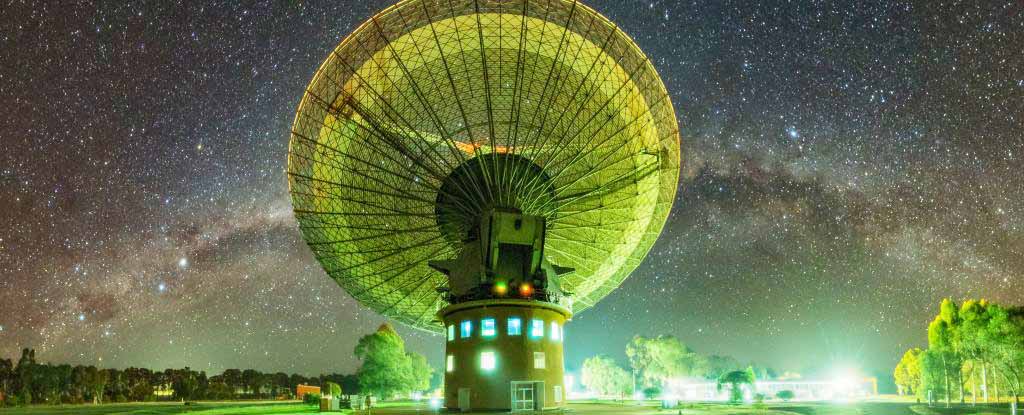
There's something out there shaking the stars in a way that can no longer be ascribed to chance. Several teams around the world have independently found a signal in the timing of flashing stars called pulsars that points to giant, long-wavelength gravitational waves rolling through the galaxy. It's not quite a detection of those gravitational waves yet - but there is more than a 99 percent chance that what we're looking at is something significant.
Gravitational waves innovation could help unlock cosmic secrets PhysOrg - June 8, 2023
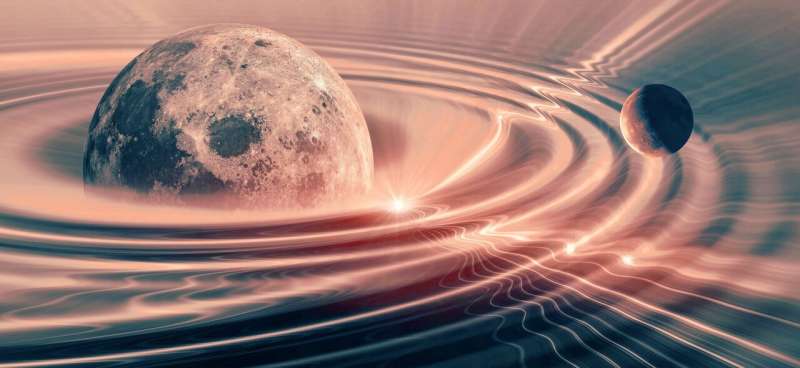
Gravitational waves, first predicted by Albert Einstein's theory of general relativity, are ripples in the fabric of spacetime caused by the most energetic events in the cosmos, such as black hole mergers and neutron star collisions. Detecting and studying these waves provides invaluable insights into the fundamental nature of the universe.
Cocoons Of Dying Stars May Also Emit Detectable Gravitational Waves IFL Science - June 8, 2023
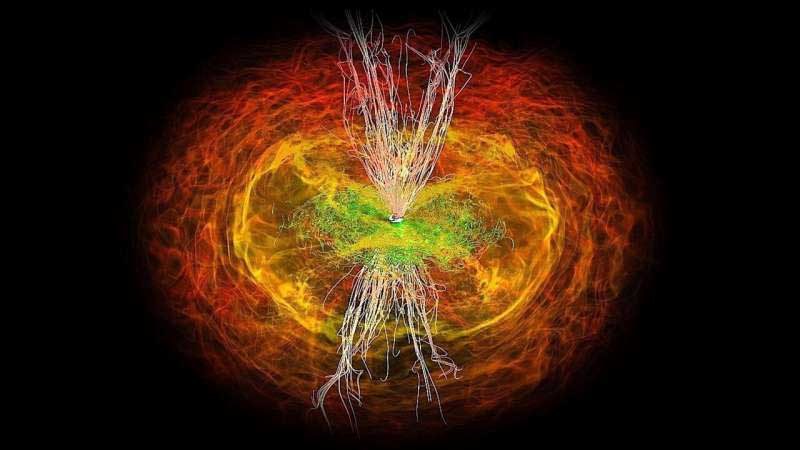
New simulations show that dying stars release enormous "cocoons" of gas that may rattle with space-time ripples called gravitational waves. Since the first direct detection of the space-time ripples known as gravitational waves was announced in 2016, astronomers regularly listen for the ringing of black holes across the universe. Projects like the Laser Interferometer Gravitational-Wave Observatory (better known as LIGO) have detected almost 100 collisions between black holes (and sometimes neutron stars), which shake up the fabric of the cosmos and send invisible waves rippling through space.
But new research shows that LIGO might soon hear another kind of shake-up in space: cocoons of roiling gas spewed from dying stars. Researchers at Northwestern University used cutting-edge computer simulations of massive stars to show how these cocoons may produce "impossible to ignore" gravitational waves. Studying these ripples in real life could provide valuable insight into the violent deaths of giant stars.
Radical Idea Could Make Future Space Mission 100 Times More Powerful. It has to do with gravitational waves Science Alert - May 9, 2023
The first-time detection of gravitational waves (GW) by researchers at the Laser Interferometer Gravitational-wave Observatory (LIGO) in 2015 triggered a revolution in astronomy. This phenomenon consists of ripples in spacetime caused by the merger of massive objects and was predicted a century prior by Einstein's theory of general relativity.
Gravitational Waves Might Let Us See When Time Actually Started IFLScience - January 23, 2023
The first light free to move through the universe is what we now call the cosmic microwave background, emitted 380,000 years after the Big Bang. Before then, photons - the particles of light - were constantly interacting with matter, so we canÕt use light to see what happened back then. But gravitational waves were already moving freely, and physicists have long supposed that one day we might use them to study this mysterious time period. And now a team has got the mathematical tools to use gravitational waves for exactly that endeavor.
Ripples in fabric of universe may reveal start of time PhysOrg - January 20, 2023
Scientists have advanced in discovering how to use ripples in space-time known as gravitational waves to peer back to the beginning of everything we know. The researchers say they can better understand the state of the cosmos shortly after the Big Bang by learning how these ripples in the fabric of the universe flow through planets and the gas between the galaxies.
New telescope to detect gravitational wave events PhysOrg - July 5, 2022
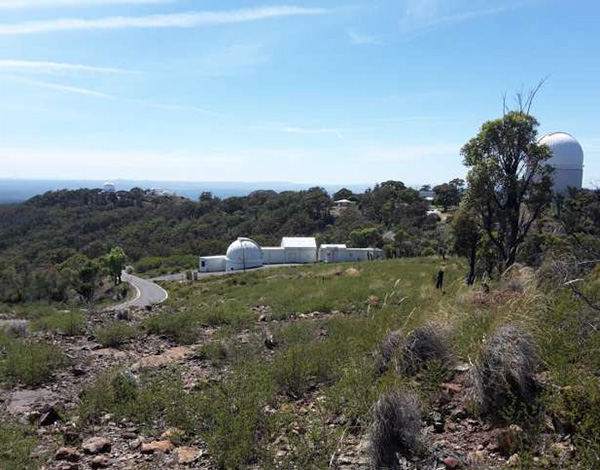
The Gravitational-wave Optical Transient Observer (GOTO), led by the University of Warwick, signals a new era of gravitational wave science. Deployed across two antipodal locations to fully cover the sky, GOTO will scour the skies for optical clues about the violent cosmic events that create ripples in the fabric of space itself.
Long hypothesized as a by-product of the collision and merger of cosmic behemoths such as neutron stars and black holes, gravitational waves were finally detected directly by the Advanced LIGO (Laser Interferometry Gravitational-Wave Observatory) in 2015. Since 2015, there have been many subsequent detections but, since observatories like LIGO can only measure the effects of the gravitational wave as it passes through our local patch of space time, it can be difficult to track down the source's point of origin. GOTO is designed to fill this observational gap by searching for optical signals in the electromagnetic spectrum that might indicate the source of the GW - quickly locating the source and using that information to direct a fleet of telescopes, satellites and instruments at it.
LIGO resumes work in 2023 and will catch gravitational wave signals fainter than ever Space.com - July 5, 2022
Following two years of upgrades, the Laser Interferometer Gravitational-Wave Observatory (LIGO) is almost ready for its next operating run, which is set to begin in March 2023. The gravitational wave detector will be able to spot neutron star mergers as distant as 620 million light-years away.
Gravitational waves point scientists to elusive missing-link black hole Space.com - September 2, 2020
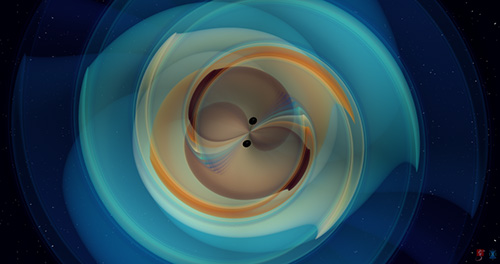
Since 2015, astrophysicists have been using gravitational-wave detectors to "hear" chirp-like signals and decode massive collisions that send subtle ripples across spacetime. Now, scientists have heard a new kind of sound, a fast, deep "bang" that could unlock even more cosmic secrets, according to new research from the Laser Interferometer Gravitational-wave Observatory (LIGO) and its European counterpart, Virgo.
Physicists make rapid progress in bounding the speed of gravity PhysOrg - November 1, 2017
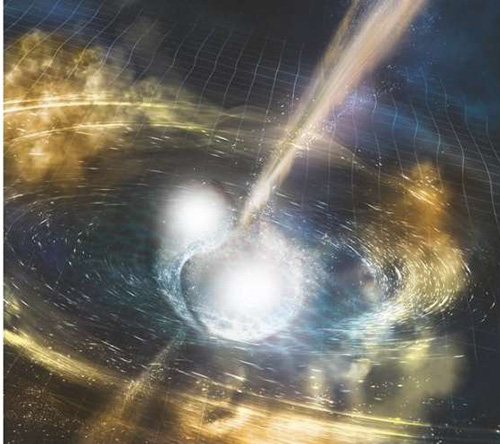
Recent gravitational wave detections have allowed physicists to confirm with greater and greater precision what Einstein predicted over 100 years ago in the theory of general relativity: that gravity does not act instantaneously as Newton thought, but instead propagates at the speed of light. Over the past few months, physicists have made very rapid progress in bounding the speed of gravity using gravitational wave observations.
Einstein's waves detected in star smash BBC - October 17, 2017
Scientists have detected the warping of space generated by the collision of two dead stars, or neutron stars. They have confirmed that such mergers lead to the production of the gold and platinum that exists in the Universe. The measurement of the gravitational waves given off by this cataclysmic event was made on 17 August by the LIGO-VIRGO Collaboration. The discovery enabled telescopes all over the world to capture details of the merger as it unfolded. David Reitze, executive director of the LIGO Laboratory at Caltech in Pasadena, California, said: "This is the one we've all been waiting for."
Einstein's waves win physics Nobel
Gravitational waves quest to go into space
Getting your head around Einstein's waves
Gravitational waves: A triumph for big science
Gravitational waves: So many new toys to unwrap BBC - October 17, 2017
Whenever there's a big science discovery, it's always nice to get a historical perspective. And so here goes with the remarkable observation of gravitational waves emanating from the merger of two dead stars, or neutron stars, some 130 million light-years from Earth. It's 50 years since the existence of these stellar remnants was confirmed (July 1967) by the mighty Northern Irish astronomer Jocelyn Bell Burnell. It's more than 40 years since we realized neutron stars might occur in pairs, or binaries, as we call them.
'New chapter in astrophysics' as scientists detect gravitational waves created by a titanic gold-producing neutron star collision 130 million light years away Daily Mail - October 16, 2017
Scientists yesterday discovered a vast supply of gold on the far side of the universe. The extraordinary hoard is the result of a huge collision between two ultra-dense neutron stars. The resulting gravitational waves and radiation flash were picked up by powerful detectors and telescopes on Earth and in orbit. The explosion happened 130 million years ago in the Hydra constellation, which is so far away that the light and the ripples in space and time have only just reached us.
The gold created by the blast is estimated to weigh more than the whole of the Earth's mass. Huge quantities of platinum, uranium and other heavy elements such as lead were also created. Scientists not only 'heard' the phenomenon by measuring vibrations in space-time, they also used satellite and ground-based telescopes to see light and radiation pouring out of the stellar fireball, dubbed a 'kilonova'. Excited astronomers talked of opening a 'new chapter in astrophysics' and unlocking a 'treasure trove' of new science. The discovery will help scientists better understand the inner workings and emissions of neutron stars, as well as more fundamental physics such as general relativity and the expansion of our universe. One scientists suggests the event 'will be remembered as one of the most studied astrophysical events in history.'
First gravitational waves form after 10 million years PhysOrg - September 5, 2016
If two galaxies collide, the merging of their central black holes triggers gravitational waves, which ripple throughout space. An international research team has now calculated that this occurs around 10 million years after the two galaxies merge - much faster than previously assumed. In his General Theory of Relativity, Albert Einstein predicted gravitational waves over a century ago; this year, they were detected directly for the first time: The American Gravitational Wave Observatory LIGO recorded such curvatures in space from Earth, which were caused by the merging of two massive black holes. The research on gravitational waves - and thus the origin of the universe - continues: From 2034 three satellites are to be launched into space in a project headed by the European Space Agency (ESA) to measure gravitational waves at even lower frequency ranges from space using the Evolved Laser Interferometer Space Antenna.
Gravitational waves open 'a window on the universe,' scientists say CNN - February 11, 2016
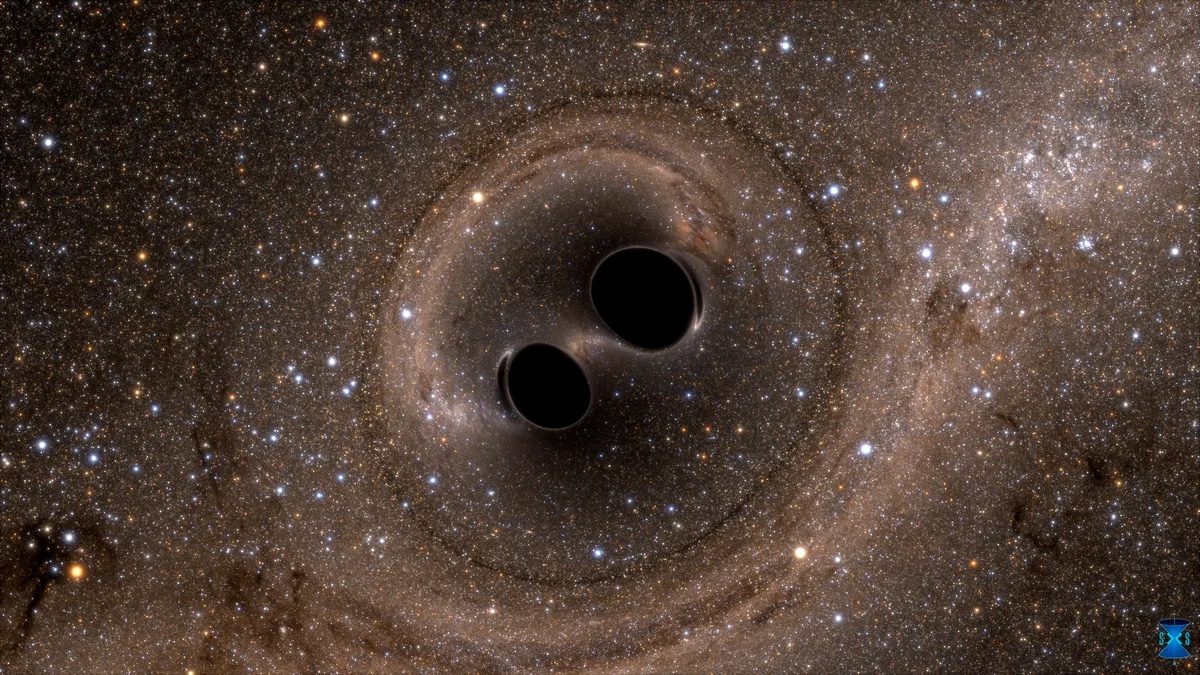
Just over 100 years after he published his general theory of relativity, scientists have found what Albert Einstein predicted as part of the theory: gravitational waves. he gravitational waves -- ripples in space-time -- were created by the merging of two black holes, Reitze said. One black hole had the mass of 29 suns; the other was the equivalent of 36 suns. Each was perhaps 50 kilometers (30 miles) in diameter. More than a billion years ago -- LIGO estimates about 1.3 billion -- the two collided at half the speed of light. Gravitational waves pass through everything, so the result traveled through the universe for that time before reaching Earth.
We Just Heard the Spacetime 'Chirp' of Black Hole Rebirth Discovery - February 11, 2016
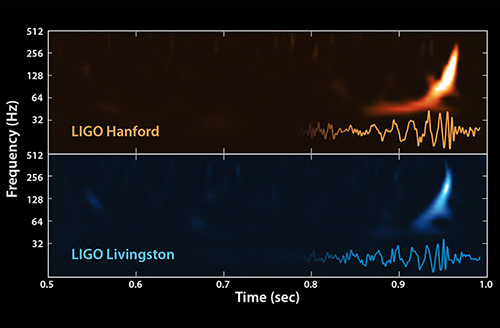
Today will go down in the history books as the day we directly detected gravitational waves. The discovery, made by scientists of the LIGO Science Collaboration, is a Nobel Prize-worthy event that equals, and maybe even surpasses, the discovery of the Higgs boson in 2012 and the realization by Edwin Hubble in 1929 that the universe is expanding.
Demonstration: Einstein's gravitational waves 'seen' from black holes BBC - February 11, 2016
Scientists are claiming a stunning discovery in their quest to fully understand gravity. They have observed the warping of space-time generated by the collision of two black holes more than a billion light-years from Earth. The international team says the first detection of these gravitational waves will usher in a new era for astronomy. It is the culmination of decades of searching and could ultimately offer a window on the Big Bang.
Gravitational waves detected 100 years after Einstein's prediction Science Daily - February 11, 2016
For the first time, scientists have observed ripples in the fabric of spacetime called gravitational waves, arriving at Earth from a cataclysmic event in the distant universe. This confirms a major prediction of Albert Einstein's 1915 general theory of relativity and opens an unprecedented new window onto the cosmos.
Video: Major scientific announcement could validate Einstein CNN - February 11, 2016
On Thursday, scientists are expected to declare they have detected gravitational waves. Not only will such a discovery support a prediction that's essential to Albert Einstein's general theory of relativity, but it will also add to our understanding of the universe. In physics, gravitational waves are ripples in the curvature of spacetime which propagate as waves, traveling outward from the source. Predicted in 1916 by Albert Einstein on the basis of his theory of general relativity, gravitational waves theoretically transport energy as gravitational radiation. Read more ...
Audio: The music of gravitational waves BBC - September 18, 2015
The Advanced Ligo experiment, which aims finally to detect ripples in the fabric of space-time, is up and running.
Gravitational waves are a prediction of Einstein's Theory of General Relativity, and should be generated by violent events, such as the merger of black holes and neutron stars. The frequency of many waves is expected to be around 100 Hz, which means that scientists can describe these cosmic phenomena in terms of sound because that frequency is in the human auditory band. Ligo scientist Vern Sandberg explained this concept to our correspondent Aleem Maqbool.