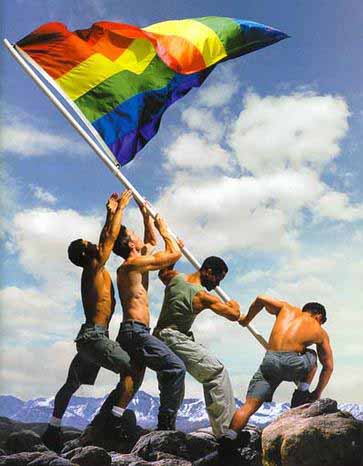
Homosexuality is romantic attraction, sexual attraction or sexual behavior between members of the same sex or gender. As a sexual orientation, homosexuality is "an enduring pattern of emotional, romantic, and/or sexual attractions" to people of the same sex. It "also refers to a person's sense of identity based on those attractions, related behaviors, and membership in a community of others who share those attractions."
Along with bisexuality and heterosexuality, homosexuality is one of the three main categories of sexual orientation within the heterosexualÐhomosexual continuum.
Scientists do not know what determines an individual's sexual orientation, but they theorize that it is caused by a complex interplay of genetic, hormonal, and environmental influences, and do not view it as a choice. They favor biologically-based theories, which point to genetic factors, the early uterine environment, both, or the inclusion of genetic and social factors.
Hypotheses for the impact of the post-natal social environment on sexual orientation, however, are weak, especially for males. There is no substantive evidence which suggests parenting or early childhood experiences play a role with regard to sexual orientation.While some people believe that homosexual activity is unnatural, scientific research has shown that homosexuality is a normal and natural variation in human sexuality and is not in and of itself a source of negative psychological effects. There is insufficient evidence to support the use of psychological interventions to change sexual orientation.
The most common terms for homosexual people are lesbian for females and gay for males, but gay also commonly refers to both homosexual females and males. The percentage of people who are gay or lesbian and the proportion of people who are in same-sex romantic relationships or have had same-sex sexual experiences are difficult for researchers to estimate reliably for a variety of reasons, including many gay and lesbian people not openly identifying as such due to prejudice or discrimination such as homophobia and heterosexism. Homosexual behavior has also been documented in many non-human animal species.
Many gay and lesbian people are in committed same-sex relationships, though only in the 2010s have census forms and political conditions facilitated their visibility and enumeration. These relationships are equivalent to heterosexual relationships in essential psychological respects.Homosexual relationships and acts have been admired, as well as condemned, throughout recorded history, depending on the form they took and the culture in which they occurred.
Since the end of the 19th century, there has been a global movement towards freedom and equality for gay people, including the introduction of anti-bullying legislation to protect gay children at school, legislation ensuring non-discrimination, equal ability to serve in the military, equal access to health care, equal ability to adopt and parent, and the establishment of marriage equality. Read more...
LGBT is an initialism that stands for "lesbian, gay, bisexual, and transgender". In use since the late 1980s, the initialism, as well as some of its common variants, functions as an umbrella term for marginalized sexualities and gender identities.
LGBT is an adaptation of LGB, which in the mid-to-late 1980s began to replace the term gay (or gay and lesbian) in reference to the broader LGBT community. When not inclusive of transgender people, the shorter LGB is still used.
It may refer to anyone who is non-heterosexual or non-cisgender, instead of exclusively to people who are lesbian, gay, bisexual, or transgender. A popular variant, LGBTQ, adds the letter Q for those who identify as queer or are questioning their sexual or gender identity.
Another popular variation, LGBTQ+, adds a plus sign in order to represent other identities not perceived to be included in LGBTQ. Many further variations of the acronym exist, such as LGBT+ (simplified to encompass the Q concept within the plus sign), LGBTQIA+ (adding intersex, and asexual/aromantic), and 2SLGBTQ+ (adding two-spirit for a term specific to Indigenous North Americans). The LGBT label is not universally agreed to by everyone that it is generally intended to include. Read more...