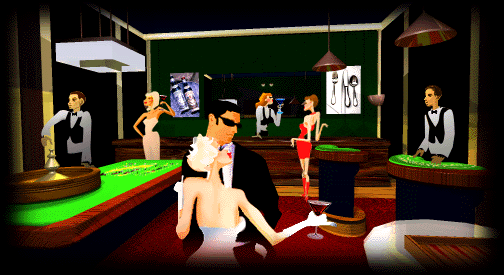
Life is a gamble and most people like to play in one form or another. We gamble on love, money, or wager on just about anything. It's fun and tests our intuition and luck.
Gambling is the wagering of money or something of material value (referred to as "the stakes") on an event with an uncertain outcome with the primary intent of winning additional money and/or material goods. Typically, the outcome of the wager is evident within a short period.
The term gaming in this context typically refers to instances in which the activity has been specifically permitted by law. The two words are not mutually exclusive; i.e., a gaming company offers (legal) gambling activities to the public and may be regulated by one of many gaming control boards, for example, the Nevada Gaming Control Board. However, this distinction is not universally observed in the English-speaking world. For instance, in the UK, the regulator of gambling activities is called the Gambling Commission (not the Gaming Commission).
Gambling is also a major international commercial activity, with the legal gambling market totaling an estimated $335 billion in 2009. In other forms, gambling can be conducted with materials which have a value, but are not real money. For example, players of marbles games might wager marbles, and likewise games of Pogs or Magic: The Gathering can be played with the collectible game pieces (respectively, small discs and trading cards) as stakes, resulting in a meta-game regarding the value of a player's collection of pieces.
One can also bet with another person that a statement is true or false, or that a specified event will happen (a "back bet") or will not happen (a "lay bet") within a specified time. This occurs in particular when two people have opposing but strongly held views on truth or events. Not only do the parties hope to gain from the bet, they place the bet also to demonstrate their certainty about the issue. Some means of determining the issue at stake must exist. Sometimes the amount bet remains nominal, demonstrating the outcome as one of principle rather than of financial importance.
In 2014 millions of people are attracted to online gambling - especially with the ongoing recession and high unemployment rate. They visit online sites like Pokersites.com in hopes of making fast money. Sites like Casino.org offers the best US Online Casino for US Players.
With the rise in the use of the internet, legislators have been faced with a new form of gambling and as such have had to re-write their gambling legislations to include the online variants.
Religious perspectives on gambling have been mixed. Ancient Hindu poems like the Gambler's Lament and the Mahabharata testify to the popularity of gambling among ancient Indians. However, the text Arthashastra (c. 4th century BCE) recommends taxation and control of gambling. Both the Catholic and Jewish traditions have even set aside days for gambling, (for Jews Hanukkah), although religious authorities generally disapprove of gambling. Ancient Jewish authorities frowned on gambling, even disqualifying professional gamblers from testifying in court.
The Catholic Church holds the position that there is no moral impediment to gambling, so long as it is fair, all bettors have a reasonable chance of winning, there is no fraud involved, and the parties involved do not have actual knowledge of the outcome of the bet (unless they have disclosed this knowledge) . Gambling has often been seen as having social consequences. For these social and religious reasons, most legal jurisdictions limit gambling. Some Islamic nations prohibit gambling; most other countries regulate it.
Many popular games played in modern casinos originate from Europe and China. Games such as craps, baccarat, roulette, and blackjack originate from different areas of Europe. A version of keno, an ancient Chinese lottery game, is played in casinos around the world. In addition, pai gow poker, a hybrid between pai gow and poker is also played. Read more ...
Reality is a game, and we are all players here to experience and then go home. Since the beginning of time, gambling has always been part of the equation - legal and illegal. Life is a crap shoot - emotionally, physically, and physically. As reality is based on a dualistic principal - you win some, you lose some. Simulation Hypothesis - Holographic Universe Theory