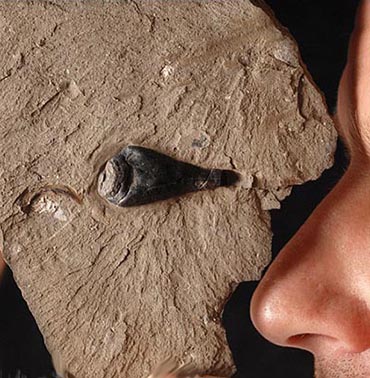
Visual perception is the ability to interpret the surrounding environment by processing information that is contained in visible light. The resulting perception is also known as eyesight, sight, or vision (adjectival form: visual, optical, or ocular). The various physiological components involved in vision are referred to collectively as the visual system, and are the focus of much research in psychology, cognitive science, neuroscience, and molecular biology, collectively referred to as vision science. Read more ...
17,000 Year Old Remains Could Be Oldest Evidence of Blue Eyes Science Alert - December 24, 2024

Vision is so vital that most animals today have photoreceptors of some kind. Notable exceptions include creatures that live in total darkness, such as in caves or the deep ocean. Yet the fossil record of eyes is very poor. The rock record generally preserves hard parts such as bones and shells. Eyes and other soft tissues, such as nerves, veins and intestines, are preserved only under exceptional circumstances.
54 million year-old fossil flies yield new insight into the evolution of sight PhysOrg - August 15, 2019
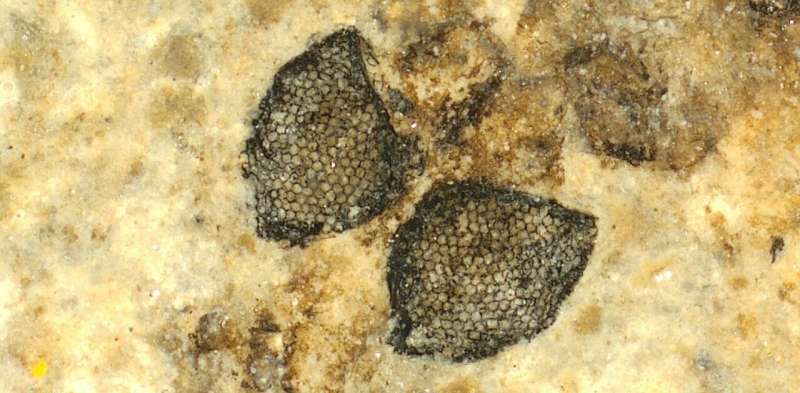
Fossilized flies that lived 54 million years ago have revealed a surprising twist to the tale of how insects' eyes evolved. These craneflies, unveiled in Nature today, show that insect eyes trap light the same way as human eyes, using the pigment melanin - yet another example of evolution finding similar solutions to similar problems.
530-million-year-old fossil has look of world's oldest eye, study suggests PhysOrg - December 7, 2017

The remains of an extinct sea creature include an early form of the eye seen in many of today's animals, including crabs, bees and dragonflies, researchers say. Scientists made the finding while examining the well-preserved fossil of a hard-shelled species - called a trilobite. These ancestors of spiders and crabs lived in coastal waters during the Palaeozoic era, between 541-251 million years ago. They found the ancient creature had a primitive form of compound eye - an optical organ that consists of arrays of tiny visual cells, called ommatidia, similar to those of present-day bees. The team, which included a researcher from the University of Edinburgh, say their findings suggest that compound eyes have changed little over 500 million years. The right eye of the fossil - which was unearthed in Estonia - was partly worn away, giving researchers a clear view inside the organ. This revealed details of the eye's structure and function, and how it differs from modern compound eyes. The species had poor vision compared with many animals today, but it could identify predators and obstacles in its path, researchers say.
New Fossils Demonstrate That Powerful Eyes Evolved in a Twinkling Science Daily - June 30, 2011

Paleontologists have uncovered half-a-billion-year-old fossils demonstrating that primitive animals had excellent vision. An international team led by scientists from the South Australian Museum and the University of Adelaide found the exquisite fossils, which look like squashed eyes from a recently swatted fly.
Fossil Eyes Reveal Predator's Sharp Vision Live Science - June 30, 2011

Ancient animals saw the world through multi-faceted compound eyes, a new fossil discovery reveals. The ancient eyes, which date back half a billion years, probably belonged to a predator, likely a giant shrimp-like creature. Like a modern fly, the ancient creature relied on compound eyes consisting of thousands of separate lenses to see the world. Each lens provides a pixel of vision. The more lenses, the better the creature could see. The mysterious ancient shrimp saw better than any other animal yet discovered from its era: Its eyes contained 3,000 lenses. <
Scientists Discover 600 Million-Year-Old Origins of Vision Science Daily - March 12, 2010

By studying the hydra, a member of an ancient group of sea creatures that is still flourishing, scientists at UC Santa Barbara have made a discovery in understanding the origins of human vision. The finding is published in the Proceedings of the Royal Society B, a British journal of biology. Hydra are simple animals that, along with jellyfish, belong to the phylum cnidaria. Cnidarians first emerged 600 million years ago. "We determined which genetic 'gateway,' or ion channel, in the hydra is involved in light sensitivity," said senior author Todd H. Oakley, assistant professor in UCSB's Department of Ecology, Evolution and Marine Biology. "This is the same gateway that is used in human vision." Oakley explained that there are many genes involved in vision, and that there is an ion channel gene responsible for starting the neural impulse of vision. This gene controls the entrance and exit of ions; i.e., it acts as a gateway.
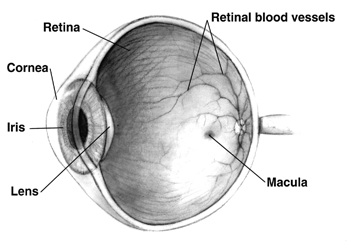
Eyes - Vision
ANCIENT AND LOST CIVILIZATIONS