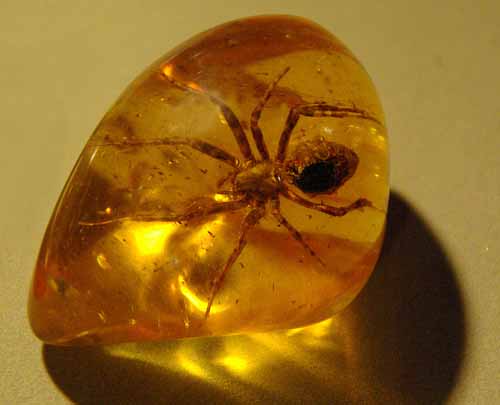
Although the fossil record of spiders is considered poor, almost 1000 species have been described from fossils. Because spiders' bodies are quite soft, the vast majority of fossil spiders have been found preserved in amber. The oldest known amber that contains fossil arthropods dates from 130 million years ago in the Early Cretaceous period. In addition to preserving spiders' anatomy in very fine detail, pieces of amber show spiders mating, killing prey, producing silk and possibly caring for their young. In a few cases amber has preserved spiders' egg sacs and webs, occasionally with prey attached; the oldest fossil web found so far is 100 million years old. Earlier spider fossils come from a few lagerstatten, places where conditions were exceptionally suited to preserving fairly soft tissues. Read more ...
The evolution of spiders has been going on for at least 400 million years, since the first true spiders (thin-waisted arachnids) evolved from crab-like chelicerate ancestors. Today, there are 42,473 described spider species within the diverse phylum of arthropods. Read more ...
Move Over Daddy Longlegs, Meet The 48-Million-Year-Old Iridescent "Grandpa Longlegs" IFL Science - June 4, 2024
Bright and shiny animals are all over the place, from deep sea worm species to electric blue tarantulas and even bright jellyfish. Now, several ancient harvestmen have been discovered in Germany, and the iridescence has even been preserved within the fossil.
Astonishing 15-Million-Year-Old Spider Fossil Is The Second Largest Ever Found IFL Science - September 22, 2023
A spider bonanza kicked off in Australia during the Miocene at a time when a change in the climate dried up the landscape. This gave a group of spiders called mygalomorph spiders an opportunity to diversify, which would be really cool to see if we had many spider fossils to work from. The record is regrettably sparse, but scientists recently discovered a world-first fossil that comes from a new genus and species of arachnids
Fossil site discovery tells of Australia's 'origin story' CNN - January 8, 2022
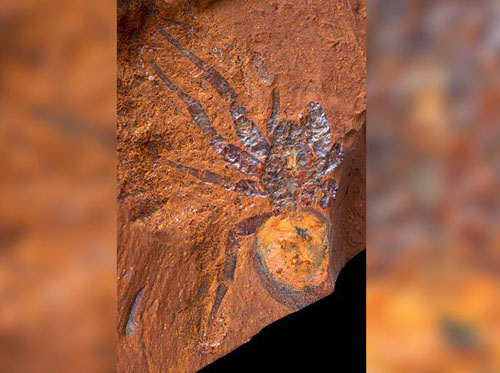
This is a fossilized mygalomorph spider found at McGraths Flat, a newly discovered fossil site in New South Wales, Australia. The arid deserts and shrub lands in Australia weren't always that way, according to a newly discovered and extraordinarily well-preserved fossil site in New South Wales. The fossilized spiders, cicadas, wasps, plants and fish, which date back to between 11 million and 16 million years ago during the Miocene Epoch, are painting a vivid picture of Australia's once abundant rainforest ecosystems. It is an extremely important fossil site with exceptionally well-preserved fossils from a time that we don't know a lot about.
Mind-Blowing New Fossil Site Found in The 'Dead' Heart of Australia Science Alert - January 7, 2022
A new fossil site that can most aptly be described as "exceptional" has turned up fossils of spiders, insects, fish, plants and even a bird feather, dating to the Miocene 11 to 16 million years ago.
Fossil is the oldest-known scorpion PhysOrg - January 16, 2020
Scientists studying fossils collected 35 years ago have identified them as the oldest-known scorpion species, a prehistoric animal from about 437 million years ago. The researchers found that the animal likely had the capacity to breathe in both ancient oceans and on land. The discovery provides new information about how animals transitioned from living in the sea to living entirely on land: The scorpion's respiratory and circulatory systems are almost identical to those of our modern-day scorpionsÑwhich spend their lives exclusively on landÑand operate similarly to those of a horseshoe crab, which lives mostly in the water, but which is capable of forays onto land for short periods of time.
Half a billion-year-old brains of terrifying sea monsters related to today's spiders and insects are found perfectly preserved in Greenland Daily Mail - March 16, 2018
The half a billion-year-old brains and nervous systems of 15 ancestors of modern-day spiders and insects have been found in the frozen shale of Greenland. The brains and nervous tissue belong to a type of marine predator known as Kerygmachela kierkegaardi which existed around 521 and 514 million years ago. These sea monsters are believed to have had two long appendages on their head, 11 swimming flaps and a skinny tail to help them hunt their prey. Unlike the human brain, which has three segments, the fossilized brains of these predators only had a single segment.
Ancient fossil was 'nearly a spider' BBC - March 30, 2016
Scientists say a 305 million-year-old fossil is the closest relative to "true spiders" ever discovered - but is not itself a spider. Easily pre-dating the dinosaurs, the 1.5cm creature lived alongside the oldest known ancestors of modern spiders but its lineage is now extinct. The specimen was dug up decades ago in France but never identified, because its front half was encased in rock.
First microwhip scorpion from Mesozoic period found in Burmese amber PhysOrg - March 9, 2016
It's smaller than a grain of rice, yellowish, trapped in amber and lived 100 million years ago alongside dinosaurs. Meet Electrokoenenia yaksha, a newly described type of microwhip scorpion, or palpigrade, from Myanmar, whose minute fossilized remains have been found, trapped in Burmese amber.
Fossil of ancient spider attack only one of its type ever discovered PhysOrg - October 8, 2012
This is the only fossil ever discovered that shows a spider attacking prey in its web. Researchers have found what they say is the only fossil ever discovered of a spider attack on prey caught in its web - a 100 million-year-old snapshot of an engagement frozen in time. The extraordinarily rare fossils are in a piece of amber that preserved this event in remarkable detail, an action that took place in the Hukawng Valley of Myanmar in the Early Cretaceous between 97-110 million years ago, almost certainly with dinosaurs wandering nearby. Aside from showing the first and only fossil evidence of a spider attacking prey in its web, the piece of amber also contains the body of a male spider in the same web. This provides the oldest evidence of social behavior in spiders, which still exists in some species but is fairly rare. Most spiders have solitary, often cannibalistic lives, and males will not hesitate to attack immature species in the same web.
It's a 49-million-year-old spider face - in 3-D MSNBC - May 20, 2011
A very old spider has shown its face to the world for the first time in 49 million years, as scientists used high-tech X-ray methods to peer through the shroud of amber encasing the fossilized arachnid. These arachnids, also known as Huntsman spiders, live in the tropics and in Southern Europe today. From leg to leg, they can grow to a size of almost a foot. Huntsman spiders are non-aggressive and non-toxic to humans, but they can deliver a painful bite.
Largest Fossil Spider Found in Volcanic Ash Live Science - April 20, 2011
The largest fossil spider uncovered to date once ensnared prey back in the age of dinosaurs, scientists find. The spider, named Nephila jurassica, was discovered buried in ancient volcanic ash in Inner Mongolia, China. Tufts of hairlike fibers seen on its legs showed this 165-million-year-old arachnid to be the oldest known species of the largest web-weaving spiders alive today - the golden orb-weavers, or Nephila, which are big enough to catch birds and bats, and use silk that shines like gold in the sunlight.
Oldest known spider's web found in amber PhysOrg - November 2, 2009
Pieces of amber containing parts of a spider's web have been found in East Sussex and dated back to the Cretaceous period 140 million years ago, which makes it the oldest spider's web known. The pieces of amber (fossilized tree resin) were found last December by amateur fossil-hunting brothers Jamie and Jonathan Hiscocks on a beach near Bexhill-on-Sea in the South of England. Jamie Hiscocks told the BBC at the time that the pieces of amber were just lying on the beach for anyone to find and pick up. The beach is well-known for its fossilized dinosaur tracks. The rare finding, believed to be the most significant amber deposit found in Britain, was analyzed by researchers at the University of Oxford. They discovered the amber contained spider web threads about a millimeter long and joined together in the roughly circular pattern of a web. The amber also contained insect droppings, plant matter, charred bark, burnt sap, and microbes. The samples also provide the earliest evidence of actinobacteria, which form soil by breaking down plant materials, a finding that will shed some light on how soil evolved. The threads were identified as having been woven by an ancestor of today's common garden orb-weaving spider.
Ancient spiders yield 3D secrets BBC - August 5, 2009
Ancient fossilized, spider-like species have been imaged in 3D using thousands of X-ray scans and imaging software. The two species, Cryptomartus hindi and Eophrynus prestvicii, lived 300 million years ago but are closely related to modern spiders. The 3D images show that C. hindi grasped at prey with its front legs and E. prestivicii had defensive spikes on its back. The results are published in the journal Biology Letters. The 3D images were obtained by using a computed tomography scanner - a device that can take X-ray images from many angles. Some 3,000 images of each fossil were obtained, and a custom software package developed at Imperial College London was used to assemble the images into a single, detailed, 3D virtual model of the creatures.
Ancient web spins evolution story BBC - June 22, 2006
The oldest-known spider web with prey still entrapped has been found preserved in a chunk of amber in Spain. The mesh of silk strands - snaring the remains of a fly, beetle, mite and wasp - dates back 110 million years to the time of the dinosaurs. The fossil web appears to have been designed along the same lines as the round nets woven by modern spiders. The find sheds light on the early evolution of spiders and the insects they fed on.
Early web-spinner found in amber BBC - June 14, 2006
Spiral orb webs, which to many people typify spiders, were catching insects in their sticky silk while the dinosaurs still walked the Earth. True orb weaving spiders found trapped in amber from 121-115 million years ago are the oldest of their type yet found. The spiral webs have proven an extremely successful strategy for catching prey - evidenced by the great diversity of orb weavers present today.
Spider blood found in 20 million year old fossil PhysOrg - September 30, 2005
>
Two droplets of blood, technically known as haemolymph, have been preserved in the amber which also contains the spider - Filistatidae - a family commonly found in South America and the Caribbean. The droplets are the first identified examples of spider blood ever found in an amber fossil. It is possible the blood could be used to extract DNA. The fossil, which is 4cm long and 2cm wide, was discovered in the Dominican Republic and dates back to the Miocene period.
Oldest spider silk preserved in amber BBC - August 7, 2003
A dinosaur-era spider web is found preserved in amber. The oldest known strand of spider silk has been found, preserved in Lebanese amber. It dates from the Early Cretaceous Period, more than 120 million years ago. This means it comes from about 80-90 million years further back in time than the previous oldest reported spider thread, found in Baltic amber.
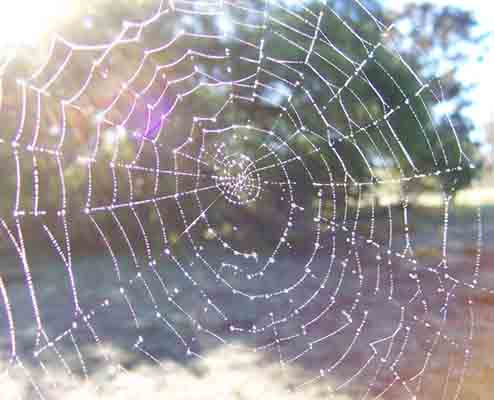
Spiderweb Effect
ANCIENT AND LOST CIVILIZATIONS