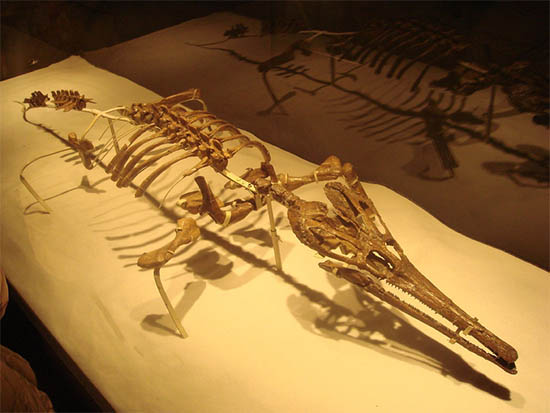
Tchoiria is a genus of simoedosaurid choristodere, a type of crocodile-like aquatic reptile. Fossils of this genus have been found in Early Cretaceous-age rocks in Mongolia. Four species have been named, but two have been given their own genera. The type species is T. namsari, based on PIN 3386/1, a partial skull and skeleton discovered in the Aptian-age Lower Cretaceous HŸhteeg Formation at HŸren Dukh, central Mongolia. Two other species were named from this locality, with both later being reassigned: T. egloni, now Irenosaurus egloni; and T. magnus, now Ikechosaurus magnus. A fourth species, T. klauseni, was named from a partial skull and skeleton found in rocks of roughly the same age farther west in Mongolia.
Tzaganosuchus is an extinct genus of fossil crocodile from the Gobi Desert of southern/southeastern Mongolia. The type and only known species for this genus, Tzaganosuchus infansis was discovered during a joint paleontological expedition conducted by the Soviet Union and Mongolia. Read more ...
Dzungarisuchus is an extinct genus of crocodile. Fossils have been found from Xinjiang, China of late Eocene age. The only remains that have been found have been isolated postcranial and jaw fragments. As a result, the genus is poorly known. All material yet found has been referable to the type species, D. manacensis.
Giant crocodile fossils have been discovered in Kenya dating from the Mesozoic Era, over 200 million years ago. The fossils were found in JulyÐAugust 2004, during an excavation conducted by a team from the University of Utah and the National Museums of Kenya at Lokitaung Gorge, near Lake Turkana.
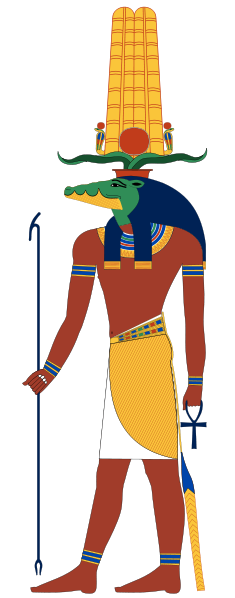
Crocodiles have appeared in various forms in religions across the world. Ancient Egypt had Sobek, the crocodile-headed god, with his cult-city Crocodilopolis, as well as Taweret, the goddess of childbirth and fertility, with the back and tail of a crocodile.The South Temple at Karanis in Graeco-Roman Egypt was dedicated to local crocodile gods in the 1st century BC.
The Jukun shrine in the Wukari Federation, Nigeria is dedicated to crocodiles in thanks for their aid during migration. Crocodiles appear in different forms in Hinduism. Varuna, a Vedic and Hindu god, rides a part-crocodile makara; his consort Varuni rides a crocodile. Similarly the goddess personifications of the Ganga and Yamuna rivers are often depicted as riding crocodiles. In India crocodile worship is practiced, including the annual Mannge Thapnee ceremony. In Latin America, Cipactli was the giant earth crocodile of the Aztec and other Nahua peoples.
34-Million-Year-Old Snake Found in Wyoming Rewrites Our Understanding of Evolution
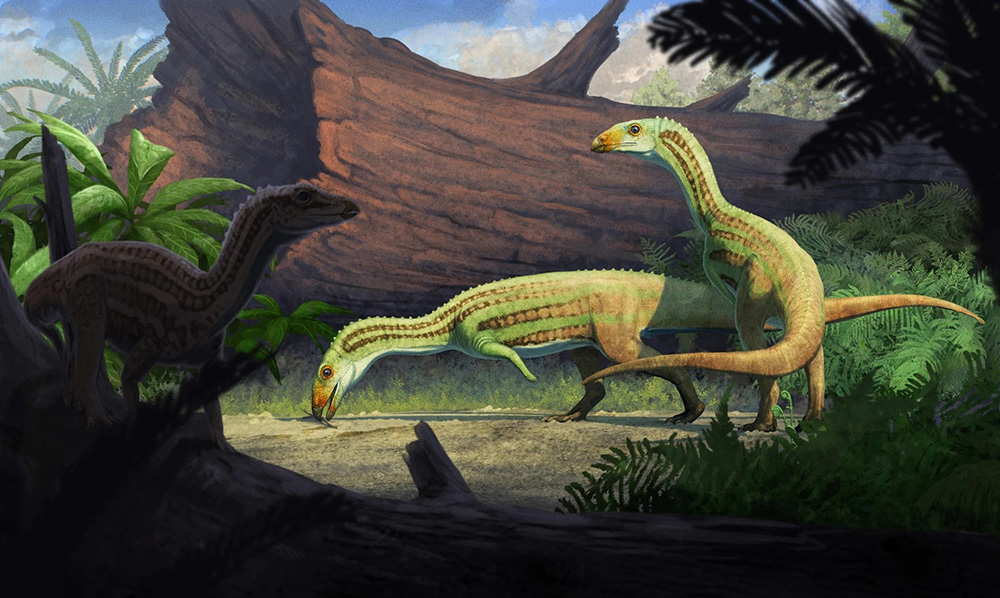
Scientists Discover Unusual Long-Legged Ancient Crocodile From 200 Million Years Ago SciTech Daily - February 25, 2026

A new Triassic crocodylomorph from Gloucester sheds light on early crocodile evolution and pre-extinction ecosystems.
Tiny 95-Million-Year-Old Croc Relative Baffles Scientists With Its Strange Teeth SciTech Daily - November 14, 2025

Ancient crocodile found in Peru sheds new light on their origin PhysOrg - May 24, 2022
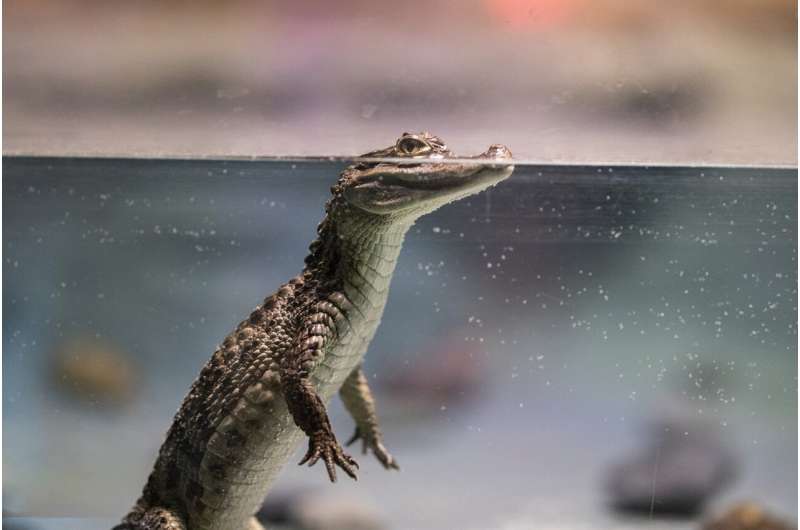
Testing has shown that the fossil is from approximately 7 million years ago. They have named it Sacacosuchus cordovai and have concluded that when alive, it would have been approximately four meters long.
Monstrous crocodile fossil points to early rise of ancient reptiles PhysOrg - October 3, 2017
A newly identified prehistoric marine predator has shed light on the origins of the distant relatives of modern crocodiles. The discovery reveals that an extinct group of aquatic reptiles evolved millions of years earlier than was previously thought, researchers say.
The new species was a 10-foot-long animal that lived in the warm, shallow seas that covered much of what is now Europe. Powerful jaws and big, serrated teeth allowed it to feed on large prey, such as prehistoric squid.
Researchers identify new species of prehistoric crocodile PhysOrg - September 13, 2017
Around 95 million years ago, a giant relative of modern crocodiles ruled the coastlines and waterways of what would one day become north central Texas. The team found the bones in a place one normally doesn't think to look for ancient fossils - in the heart of the Dallas-Fort Worth Metroplex.
Discovery of 13-million-year-old croc suggests parallel evolution of 'telescoping' eyes PhysOrg - April 20, 2016
Fossils of a 13-million-year-old extinct crocodilian from the Peruvian Amazon suggest that South American and Indian species evolved separately to acquire protruding, "telescoped" eyes that helped the animals conceal their bodies underwater while scanning the river's edge. The new study provides a long-sought insight about the extremely long and slender-snouted gavialoids - one of the three major types of crocodilians, along with alligators and crocodiles - that are represented today by just one living species, the Indian gharial.
Fossils of Largest Marine Croc Found on Tatooine Live Science - January 15, 2016
A monster of a reptile, a 30-foot-long crocodile ancestor, once navigated the lagoons of the Tataouine region of southern Tunisia 130 million years ago. Found on the fringes of the Sahara - in the area that served as Star Wars' Tatooine - fossils suggest Machimosaurus rex was the largest marine crocodile ever found and represents a new species of teleosaurid a type of extinct crocodylomorph, or a group that includes crocodiles and their ancestors. In December 2014, a multinational paleontological team was two days away from the end of an expedition when they came upon what appeared to be a jumble of crushed, isolated bones. Further excavation revealed something much greater.
Crocodile ancestor was top predator before dinosaurs roamed North America Science Daily - March 20, 2015
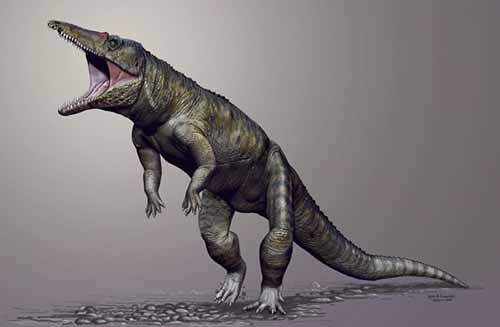
A newly discovered crocodilian ancestor may have filled one of North America's top predator roles before dinosaurs arrived on the continent. Carnufex carolinensis, or the 'Carolina Butcher,' was a nine-foot long, land-dwelling crocodylomorph that walked on its hind legs and likely preyed upon smaller inhabitants of North Carolina ecosystems such as armored reptiles and early mammal relatives. Typical predators roaming Pangea included large-bodied rauisuchids and poposauroids, fearsome cousins of ancient crocodiles that went extinct in the Triassic Period. In the Southern Hemisphere, "these animals hunted alongside the earliest theropod dinosaurs, creating a predator pile-up," says Zanno. However, the discovery of Carnufex indicates that in the north, large-bodied crocodylomorphs, not dinosaurs, were adding to the diversity of top predator niches. "We knew that there were too many top performers on the proverbial stage in the Late Triassic
Crocodiles rocked pre-Amazonian Peru: Seven crocodile species found in single 13-million-year-old bone bed Science Daily - February 26, 2015
Thirteen million years ago, as many as seven different species of crocodiles hunted in the swampy waters of what is now northeastern Peru, new research shows. This hyperdiverse assemblage, revealed through more than a decade of work in Amazon bone beds, contains the largest number of crocodile species co-existing in one place at any time in Earth's history, likely due to a food source that forms a small part of modern crocodile diets: mollusks.
Ancient Knife-Toothed Reptile Is Crocodile Cousin Live Science - January 22, 2015
The fossil of a prehistoric 9-foot-long (2.7 meters) carnivorous reptile that had sharp, serrated teeth is helping researchers fill out the early branches of the reptile family tree, according to a new study.
It's unclear where the reptile, Nundasuchus songeaensis, falls on the evolutionary tree. But the new findings show that Òit is either the closest relative of the common ancestor of birds and crocodylians, or it is more closely related to crocodylians than to birds, most appropriately called a crocodylian cousin.
Biologists map crocodilian genomes Science Daily - December 11, 2014
Understanding the crocodilian genome can help scientists better understand birds. The DNA in alligators, crocodiles and gharials is about 93 percent identical across the genome. By comparison, a human shares about 93 percent of his or her DNA with a macaque.
Prehistoric crocodiles' evolution mirrored in living species PhysOrg - October 15, 2014
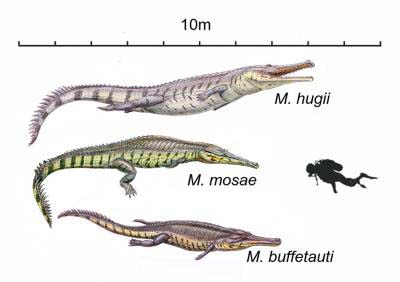
Crocodiles which roamed the world's seas millions of years ago developed in similar ways to their modern-day relatives, a study has shown. Fresh research into a group of prehistoric marine crocs known as Machimosaurus reveals key details of how and where they lived. Each species adapted features that enabled them to live and hunt in a range of habitats, just like modern-day crocodiles. They varied in body length, body skeleton, skull and lower jaw shape, and in their teeth. The ancient croc group included a nine-metre long saltwater species, which was adapted for living in open seas, and fed on marine turtles. Its closest relatives, by contrast, lived in coastal, choppy environments. The prehistoric crocs' development mirrors those of today's crocodiles, whose saltwater varieties are far bigger and suited to larger territories compared with their smaller cousins that live closer to shore or in freshwater.
The largest known true crocodile identified PhysOrg - May 5, 2012
A crocodile large enough to swallow humans once lived in East Africa, according to a University of Iowa researcher. The new species lived between 2 and 4 million years ago in Kenya. It resembled its living cousin, the Nile crocodile, but was more massive.
Bizarre fossil crocodile dispels notion that these reptiles are static and unchanging PhysOrg - December 8, 2010
We all know that crocodiles are reptiles with long snouts, conical teeth, strong jaws and long tails. But according to researchers at Stony Brook University in New York, we don't know what we thought we knew. Rather, some crocodiles possessed a dazzling array of adaptations that resulted in unique and sometimes bizarre anatomy, including blunt, pug-nosed snouts, pudgy bodies and short tails.
Ancient 'cat-like' crocodile had bite like a mammal BBC - August 4, 2010
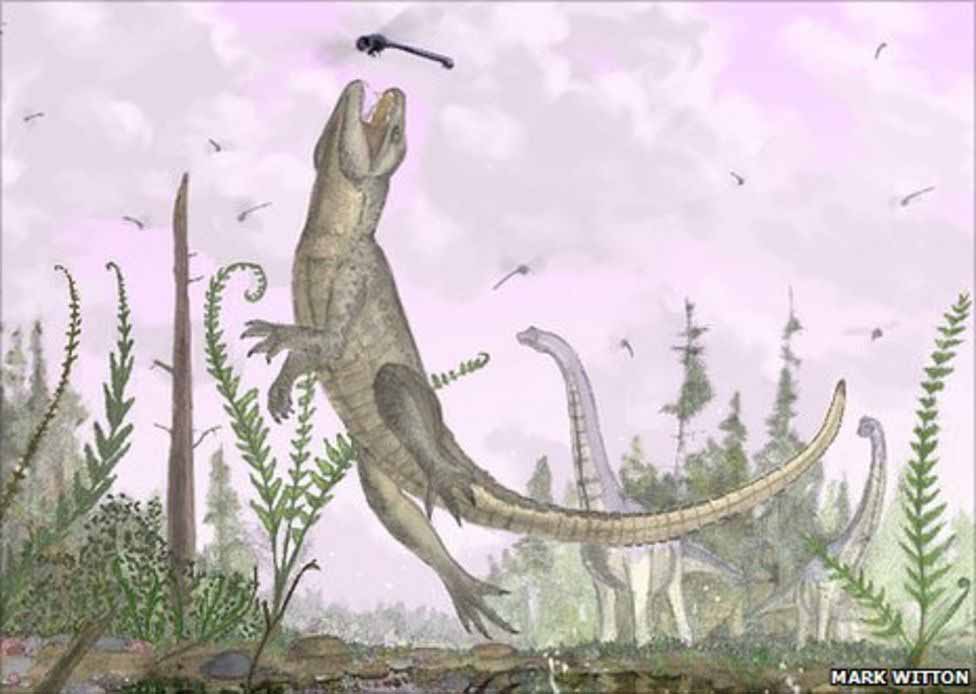
Paleontologists working in Tanzania have unearthed fossils of a tiny crocodile-like creature with teeth resembling those of mammals.
The animal, Pakasuchus kapilimai, lived between 144 and 65 million years ago - during the Cretaceous - in what is now sub-Saharan Africa. Scientists say the find shows that crocs were once more diverse than they are today. Paka means "cat" in Kiswahili, Tanzania's official language, and refers to the reptile's short, low skull with slicing, molar-like teeth.
Ancient Human Ancestors Faced Fearsome Horned Crocodile Live Science - February 24, 2010
A newfound horned crocodile may have been the largest predator encountered by our ancestors in Africa, researchers now suggest.
Scientists have even found bones from members of the human lineage bearing tooth marks from this reptile, whose scientific name, Crocodylus anthropophagus, means "man-eating crocodile." This predator, which lived some 1.84 million years ago, possessed a deep snout that would have made it look more robust than moderncrocodiles. It also had prominent triangular horns.
Strange Ancient Crocodiles Swam the Sahara Live Science - November 19, 2009
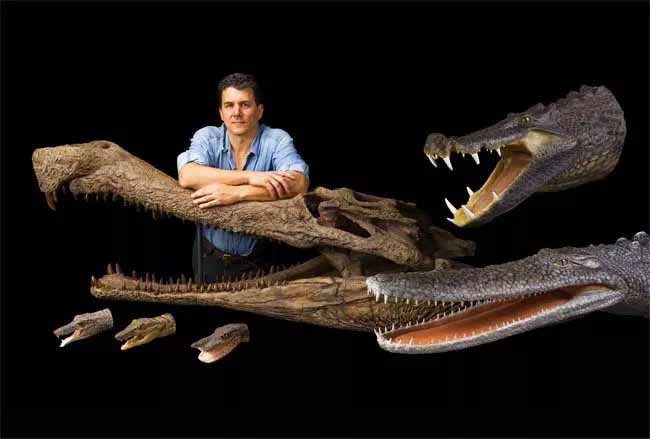
From a crocodile sporting a boar-like snout to a peculiar pal with buckteeth for digging up grub, an odd-looking bunch of such reptiles dashed and swam across what is now the Sahara Desert some 100 million years ago when dinosaurs ruled. That's the picture created by remains of three newly identified species of ancient crocs plus fossils from two species previously named. A team led by Paul Sereno of the University of Chicago unearthed remains of the bizarre crocodiles during a series of expeditions beginning in 2000 in the Sahara.
Skull Of Crocodile 100 Million Years Old Unearthed Science Daily - July 16, 2009
Paleontologists have made the most important discovery to date at the Arlington Archosaur Site, a prolific fossil site in Texas. The disassembled skull of a crocodile with two-and-a-half-inch-long teeth that lived nearly 100 million years ago has been unearthed.
ANCIENT AND LOST CIVILIZATIONS