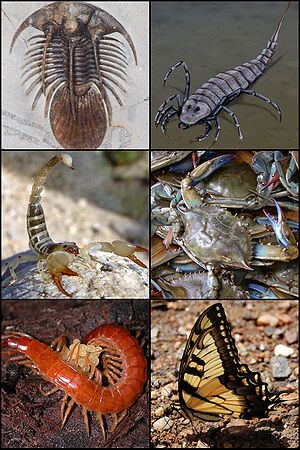
An arthropod is an invertebrate animal having an exoskeleton (external skeleton), a segmented body, and jointed appendages. Arthropods form the phylum Arthropoda, and include the insects, arachnids, myriapods, and crustaceans. It has been proposed that the Ediacaran animals Parvancorina and Spriggina, from around 555 Mya, were arthropods. Read more ...
Ancient Blueprint For Human Bodies Discovered in Sea Anemones Science Alert - June 28, 2025

Sea anemones may look alien, but scientists just found out they're hiding an ancient body 'blueprint' – one that most animals, including humans, still follow. The discovery could shake up the timeline of evolution.
A segmented little beastie that swam Earth's seas nearly half a billion years ago has now been identified as the grandparent of spiders, scorpions, and horseshoe crabs Science Alert - May 26, 2024
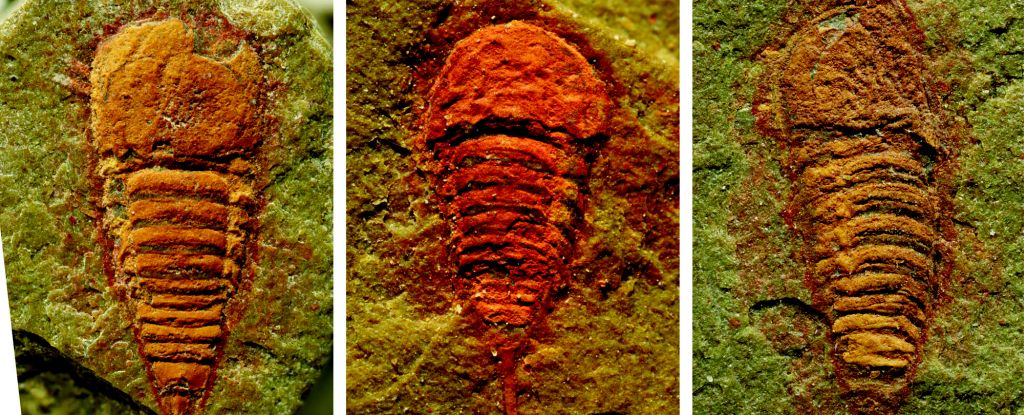
It's called Setapedites abundantis, a teeny tiny creature around 5 millimeters long, and it thrived in an ocean that once covered what is now Morocco, 478 million years ago.
A newly discovered brain in a 525-million-year-old arthropod fossil looks to be the oldest found so far - and may have settled an ongoing debate about how brains first evolved in these invertebrate animals Science Alert - November 28, 2022
Spotted in a tiny, armored lobopodian known as Cardiodictyon catenulum, the surprise is that the brain survived at all and that it was made up of three components distinct from the nervous system. That's important because it suggests that the brain evolved separately from the head and the nervous system. It had previously been thought that the brains of these creatures were split into repeating segments of neural structures called ganglia, just like the nervous system in the trunk.
Scientists find fossil of largest arthropod to ever live, a car-size millipede Live Science - December 22, 2021
They were likely one of the biggest animals living on Earth at the time. Researchers have found the fossilized exoskeleton of the largest arthropod to have ever lived. These giant millipede-like creatures were the length of a car and likely roamed Earth during the Carboniferous Period, between 359 million and 299 million years ago. The monstrous millipede ancestors, known as Arthropleura, were already known to scientists, but the discovery of the new fossilized exoskeleton fragment confirms that these ancient invertebrates could grow to be much larger than previously expected. Researchers discovered the new Arthropleura fossil, which is around 326 million years old, inside a fragmented block of sandstone on a beach in Northumberland in northeast England in 2018. The exoskeleton fragment is 2.5 feet (75 centimeters) long and 1.8 feet (55 cm) wide. This means the individual that molted it would have been around 8.5 feet (2.6 meters) long and weighed around 110 pounds (50 kilograms), according to the researchers.
Ancient Sea Monster Was One of Largest Arthropods Live Science - March 11, 2015
A remarkably well-preserved fossil of a 480-million-year-old seamonster is helping researchers understand the evolution of arthropods. The creature, an anomalocaridid, has not one but two sets of legs on each of its body segments, showing that it's an ancestor of modern-day arthropods, which include arachnids, insects and crustaceans. Despite its size, A. benmoulae was a gentle giant.
Bacterial traces from 3.5 billion years ago are oldest fossils, experts say Washington Post - December 31, 2012
Scientists analyzing Australian rocks have discovered traces of bacteria that lived a record-breaking 3.49 billion years ago, a mere billion years after Earth formed. If the find withstands the scrutiny that inevitably faces claims of fossils this old, it could move scientists one step closer to understanding the first chapters of life on Earth. The discovery could also spur the search for ancient life on other planets. These traces of bacteria are the oldest fossils ever described. Those are our oldest ancestors. Unlike dinosaur bones, the newly identified fossils are not petrified body parts. They're textures on the surfaces of sandstone thought to be sculpted by once-living organisms. Today, similar patterns decorate parts of Tunisia's coast, created by thick mats of bacteria that trap and glue together sand particles. Sand that is stuck to the land beneath the mats and thus protected from erosion can over time turn into rock that can long outlast the living organisms above it.
Ancient Anthropods Used Borrowed Homes Live Science - August 23, 2009
Hermit crabs, a lineage some 200 million years old, may not have been the first to salvage mollusk shells for self-protection. Primitive arthropods were among the earliest animals to venture onto land - 500 million years ago - and they too recycled shells, according to new research. Researchers analyzed Cambrian-period fossil tracks left on a sand flat by ancient arthropods in what is now central Wisconsin. The small imprints are in remarkably good shape: a microbial mat permeating the beach probably saved them from obliteration by waves. The tracks resemble those of present-day hermit crabs, complete with intermittent, off-center impressions - hallmarks of a borrowed shell touching the ground with each step. But the marks suggest that compared with hermit crabs, the ancient trekkers wore their shells upside down. So whereas hermit crabs' rear ends curl under toward their bellies, the early arthropods' tails must have curled upward, like scorpions'.
ANCIENT AND LOST CIVILIZATIONS