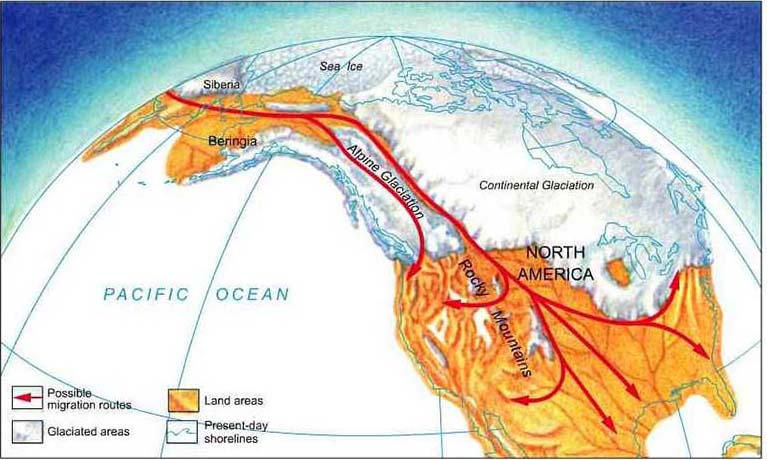
Early American Migration
Early American Migration
Confirmed: New Mexico Footprints Rewrite Timeline of Humans in America Science Alert - June 24, 2025
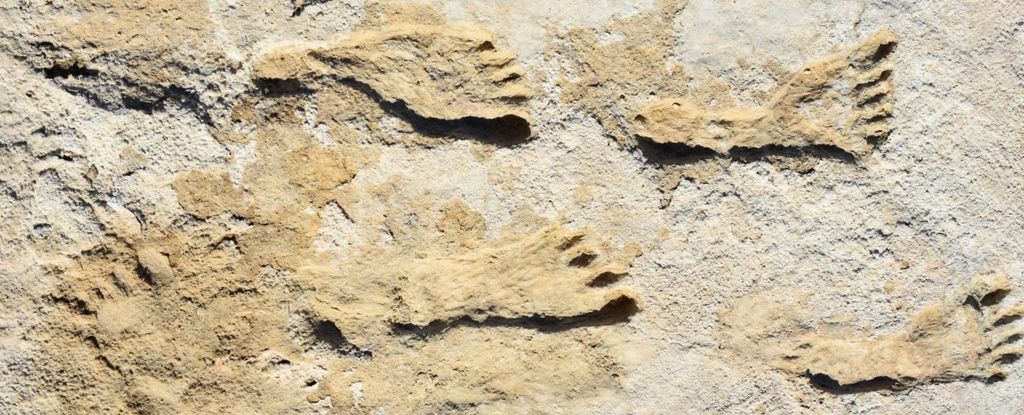
Ancient seas left an expanse of rolling gypsum dunes known as White Sands in New Mexico, and within this surreal landscape lies evidence that humans have roamed the Americas for at least 20,000 years. While most of White Sands is protected as a national park, the US army controls part of it as a missile range. It was within this section that researchers found clay footprints, preserved below the gypsum, that have rewritten the timeline of human presence in the Americas. Previously, we thought humans arrived in North America around 13,200 to 15,500 years ago. A new study combines evidence from mud, Ruppia seeds and pollen found in layers above and below the trace fossils, to date the footprints as being between 20,700 and 22,400 years old.
11,000-year-old settlement in Canada could rewrite history of Indigenous civilizations in North America Live Science - February 8, 2025

An 11,000-year-old settlement in Canada is challenging the idea that early Indigenous people were nomadic. The newly uncovered village site of Asowananihk, which means "a place to cross" in the Cree language, is one of the oldest archaeological sites found on the continent and suggests that an organized society existed in central Canada far earlier than experts previously thought.
Archaeologists Found 23,000-Year-Old Footprints That Rewrite the Story of Humans in America Science Alert - May 16, 2024

Studying preserved footprints in New Mexico continues to provide insight into the first human movements in North America. A research team believes the footprints are more than 23,000 years old, confirming an earlier study that dates the prints to 10,000 years older than previously believed. Tracking the footsteps provides modern scientists a view into ancient life.
What's the earliest evidence of humans in the Americas? Live Science - August 13, 2023
The arrival and establishment of humans in the Americas was a key step in humanity's trek across the planet, but exactly when this milestone was achieved remains hotly contested. According to the evidence we have now, when did the first humans arrive in North America? Based on stone artifacts dating to about 13,000 years ago, archaeologists for most of the 20th century suggested that the prehistoric Clovis culture was the first to migrate to the Americas. However, the site of Monte Verde in southern Chile, first discovered in 1975, was found to be about 14,200 years old. If people made it that far down in South America by that point - either after their ancestors crossed over the Bering Land Bridge that once connected Asia and North America, or traveling in watercraft along Pacific coasts - then earlier sites must exist in North America
A Strange Fossil in South China Reveals an Intriguing Link With The First Americans Science Alert - July 15, 2022
Researchers from the Chinese Academy of Sciences evaluated nuclear and mitochondrial sequences extracted from a 14,000-year-old skull, discovering the woman it once belonged to - dubbed Mengzi Ren was closely related to populations who would eventually be the first to set foot in the Americas.
Footprints in New Mexico are oldest evidence of humans in the Americas BBC - September 23, 2021
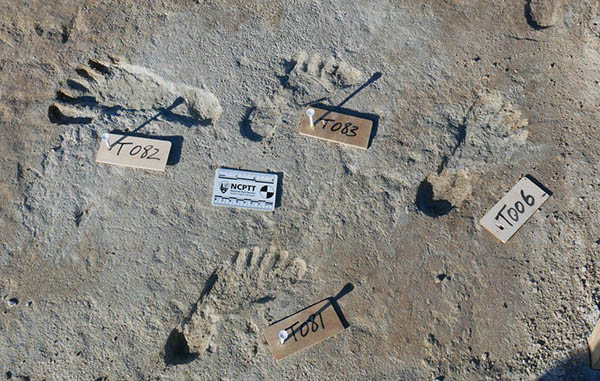
Humans reached the Americas at least 7,000 years earlier than previously thought, according to new findings. The topic of when the continent was first settled from Asia has been controversial for decades. Many researchers are sceptical of evidence for humans in the North American interior much earlier than 16,000 years ago. Now, a team working in New Mexico has found scores of human footprints dated to between 23,000 and 21,000 years old. The discovery could transform views about when the continent was settled. It suggests there could have been great migrations that we know nothing about. And it raises the possibility that these earlier populations could have gone extinct. The footprints were formed in soft mud on the margins of a shallow lake which now forms part of Alkali Flat in White Sands.
Earliest evidence of human activity found in the Americas at White Sands National Park in New Mexico PhysOrg - September 23, 2021
The footprints were formed in soft mud on the margins of a shallow lake that now forms part of Alkali Flat, a large playa at White Sands. Researchers from the U.S. Geological Survey dated these tracks using radiocarbon dating of seed layers above and below the footprint horizons. The dates range in age and confirm human presence over at least two millennia with the oldest tracks dating from around 23,000 years ago, which corresponds to the height of the last glacial cycle - making them the oldest known human footprints in the Americas.
1st Americans had Indigenous Australian genes Live Science - April 3, 2021
During the last ice age, when hunters and gatherers crossed the ancient Bering Land Bridge that connected Asia with North America, they carried something special with them in their genetic code: pieces of ancestral Australian DNA, a new study finds. Over the generations, these people and their descendants trekked southward, making their way to South America. Even now, more than 15,000 years after these people crossed the Bering Land Bridge, their descendants - who still carry ancestral Australian genetic signatures - can be found in parts of the South American Pacific coast and in the Amazon, the researchers found.
Skulls from ancient North Americans hint at multiple migration waves Live Science - January 30, 2020
The earliest humans in North America were far more diverse than previously realized, according to a new study of human remains found within one of the world's most extensive underwater cave systems. The remains, discovered in the caverns of the Mexican state of Quintana Roo, represent just four of the earliest North Americans, all of whom lived between 9,000 and 13,000 years ago. They're important because North American remains from the first millennia of human habitation in the Americas are rare.
Ancient DNA analysis yields unexpected insights about peoples of Central, South America PhysOrg - November 8, 2018
An international team of researchers has revealed unexpected details about the peopling of Central and South America by studying the first high-quality ancient DNA data from those regions. The findings include two previously unknown genetic exchanges between North and South America, one of which represents a continent-wide population turnover. The results suggest that the people who spread the Clovis culture, the first widespread archaeological culture of North America, had a major demographic impact further south than previously appreciated. The authors analyzed genome-wide data from 49 individuals from Central and South America, some as old as 11,000 years. Previously, the only genomes that had been reported from this region and that provided sufficient quality data to analyze were less than 1,000 years old. By comparing ancient and modern genomes from the Americas and other parts of the globe, the researchers were able to obtain qualitatively new insights into the early history of Central and South America.
History of early settlement and survival in Andean highlands revealed by ancient genomes PhysOrg - November 8, 2018
A multi-center study of the genetic remains of people who settled thousands of years ago in the Andes Mountains of South America reveals a complex picture of human adaptation from early settlement, to a split about 9,000 years ago between high and lowland populations, to the devastating exposure to European disease in the 16th-century colonial period.
DNA of world's oldest natural mummy unlocks secrets of Ice Age tribes in the Americas Science Daily - November 8, 2018

A legal battle over a 10,600 year old ancient skeleton - called the 'Spirit Cave Mummy' - has ended after advanced DNA sequencing found it was related to a Native American tribe.
Who Were the 1st Americans? 11,000-Year-Old DNA Reveals Clues Live Science - November 8, 2018
People genetically linked to the Clovis culture, one of the earliest continent-wide cultures in North America, made it down to South America as far back as 11,000 years ago. Then they mysteriously vanished around 9,000 years ago, new research reveals. Where did they go? It appears that another ancient group of people replaced them, but it's unclear how or why this happened, the researchers said.
Gault site research pushes back date of earliest North Americans Science Daily - July 23, 2018

Archaeological evidence has increasingly called into question the idea of 'Clovis First.' Now, a study has dated a significant assemblage of stone artifacts to 16-20,000 years of age, pushing back the timeline of the first human inhabitants of North America before Clovis by at least 2,500 years.
How 250 Siberians Became the First Native Americans Live Science - May 10, 2018
The Americas are a big place, but the Native American group that first settled it was small - just about 250 people, according to a new genetic study. These people, known as a founding group because they "founded" the first population, migrated from Siberia to the Americas by about 15,000 years ago. Figuring out the size of founding groups is key, because it determines the amount of genetic diversity that gets passed on to the group's descendants.
Spear point study offers new explanation of how early humans settled North America Science Daily - April 3, 2018
Careful examination of numerous fluted spear points found in Alaska and western Canada prove that the Ice Age peopling of the Americas was much more complex than previously believed. Using new digital methods of analyses utilized for the first time in such a study of these artifacts, the researchers found that early settlers in the emerging ice-free corridor of interior western Canada "were travelling north to Alaska, not south from Alaska, as previously interpreted," says Goebel.
Alaskan infant's DNA tells story of 'first Americans' BBC - January 4, 2018
The 11,500-year-old remains of an infant girl from Alaska have shed new light on the peopling of the Americas. Genetic analysis of the child, allied to other data, indicates she belonged to a previously unknown, ancient group. Scientists say what they have learnt from her DNA strongly supports the idea that a single wave of migrants moved into the continent from Siberia just over 20,000 years ago. Lower sea-levels back then would have created dry land in the Bering Strait. It would have submerged again only as northern ice sheets melted
The genes that rewrite American pre-history: Ancient DNA reveals how the first humans arrived on the continent in ONE wave more than 25,000 years ago and then split into three ancestral Native American groups Daily Mail - January 3, 2018
The DNA of a six-week-old Native American infant who died 11,500 years ago has rewritten the history of the Americas. The young girl's genes reveal the first humans arrived on the continent 25,000 years ago - much earlier than some studies claim - before splitting into three Native American groups. This is the first time that direct genetic traces of the earliest Native Americans have been identified. The girl belonged to a previously unknown population of ancient people in North America known as the 'Ancient Beringians.' This small Native American group resided in Alaska and died out around 6,000 years ago, researchers claim.
Human settlement in the Americas may have occurred in the late Pleistocene PhysOrg - August 30, 2017
Analysis of a skeleton found in the Chan Hol cave near Tulum, Mexico suggests human settlement in the Americas occurred in the late Pleistocene era. Scientists have long debated about when humans first settled in the Americas. While osteological evidence of early settlers is fragmentary, researchers have previously discovered and dated well-preserved prehistoric human skeletons in caves in Tulum in Southern Mexico.
Humans were in America 115,000 years earlier than thought: Dramatic discovery that mastodon bones were butchered with Stone Age tools has forced scientists to stunning new conclusion Daily Mail - April 26, 2017
A controversial find could rewrite the history of humans in North America. Archaeologists claim to have found evidence an unknown species of human was living on the continent as early as 130,000 years ago - 115,000 years earlier than previously thought. Researchers discovered the butchered remains of an enormous mastodon in San Diego, with evidence of chips and fractures made by early humans - but they admit they don't know if they were Homo sapiens, Homo erectus, Neanderthals, or something else.
Mastodon discovery shakes up understanding of early humans in the New World Science Daily - April 26, 2017
Broken bones and rocks yield evidence that pushes back the record of early humans in North America by more than 100,000 years
Pre-Clovis civilization in Florida; settlement 1,500 years earlier than previously believed Science Daily - May 13, 2016
The discovery of stone tools alongside mastodon bones in a Florida river shows that humans settled the southeastern United States as much as 1,500 years earlier than scientists previously believed, according to a new research. This site on the Aucilla River - about 45 minutes from Tallahassee - is now the oldest known site of human life in the southeastern United States. It dates back 14,550 years.
In Photos: Human Skeleton Sheds Light on First Americans Live Science - May 15, 2014
A near-complete human skeleton has been discovered, buried alongside saber-toothed cats, pumas and bobcats, at the bottom of Hoyo Negro, deep beneath the jungles of the eastern Yucatan Peninsula. Here, divers Nava and Susan Bird transport the Hoyo Negro skull to an underwater turntable so that it can be photographed in order to create a 3D model.
Sunken body clue to American origins BBC - May 15, 2014
The ancient remains of a teenage girl discovered deep underground in Mexico are providing additional insights on how the Americas came to be populated. Divers found the juvenile's bones by chance in a vast, flooded limestone chamber on the Yucatan Peninsula. Aged 15 or 16 at death, the girl lived at least 12,000 years ago. Researchers have told Science Magazine her DNA backs the idea that the first Americans and modern Native American Indians share a common ancestry. This theory argues that people from Siberia settled on the land bridge dubbed Beringia that linked Asia and the Americas some 20,000 years ago before sea levels rose.
Prehistoric Boy May Be Native American 'Missing Link' Live Science - February 13, 2014
A prehistoric boy's DNA now suggests that ancient toolmakers long thought of as the first Americans may serve as a kind of "missing link" between Native Americans and the rest of the world, researchers say. The findings reveal these prehistoric toolmakers are the direct ancestors of many contemporary Native Americans, and are closely related to all Native Americans. Scientists investigated a prehistoric culture known as the Clovis, named after sites discovered near Clovis, N.M. Centuries of cold, nicknamed the "Big Freeze," helped wipe out the Clovis, as well as most of the large mammals in North America. The artifacts of the Clovis are found south of the giant ice sheets that once covered Canada, in most of North America, though not in South America.

Ancient American's genome mapped BBC - February 13, 2014
Present-day Native Americans are descended from some of the continent's earliest settlers, a genetic study suggests. Scientists sequenced the genome of a one-year-old boy who died in what is now Montana about 12,500 years ago. Some researchers have raised questions about the origins of early Americans, with one theory even proposing a link to Ice Age Europeans. But the Nature study places the origins of these ancient people in Asia. The infant was a member of the Clovis people, a widespread, sophisticated Ice Age culture in North America. They appeared in America about 13,000 years ago and hunted mammoth, mastodon and bison. The boy's remains, uncovered at the Anzick Site in Montana in 1968, were associated with distinctive Clovis stone tools. In fact, it is the only known skeleton directly linked to artifacts from this culture.
But the origins of the Clovis people, and who they are related to today, has been the subject of intense discussion.
Ancient giant sloth bones suggest humans were in Americas far earlier than thought PhysOrg - November 20, 2013
A team of Uruguayan researchers working in Uruguay has found evidence in ancient sloth bones that suggests humans were in the area as far back as 30,000 years ago. Most scientists today believe that humans populated the Americas approximately 16,000 years ago, and did so by walking across the Bering Strait, which would have been frozen over during that time period. More recent evidence has begun to suggest that humans were living in South America far earlier than that - just last month a team of excavators in Brazil discovered cave paintings and ceramics that have been dated to 30,000 years ago and now, in this new effort, the research team has found more evidence of people living in Uruguay around the same time.
Paleo CSI: Early Hunters Left Mastodon Murder Weapon Behind Live Science - October 21, 2011
A new look at a very old mastodon skeleton has turned up evidence of the first known hunting weapon in North America, a tool made of bone that predates previously known hunting technology by 800 years. The sharp bit of bone, found embedded in a mastodon rib unearthed in the 1970s, has long been controversial. Archaeologists have argued about both the date assigned to the bone - around 14,000 years old - and about whether the alleged weapon was really shaped by human hands. But now, researchers say it's likely that 13,800 years ago, hunters slaughtered elephant-like mastodons using bony projectile points not much bigger around than pencils, sharpened to needle-like tips.
Old American theory is 'speared' BBC - October 21, 2011
An ancient bone with a projectile point lodged within it appears to up-end - once and for all - a long-held idea of how the Americas were first populated. The rib, from a tusked beast known as a mastodon, has been dated precisely to 13,800 years ago. This places it before the so-called Clovis hunters, who many academics had argued were the North American continent's original inhabitants.
Stone tools 'demand new American story' BBC - March 25, 2011
The long-held theory of how humans first populated the Americas may have been well and truly broken. Archaeologists have unearthed thousands of stone tools that predate the technology widely assumed to have been carried by the first settlers. The discoveries in Texas are seen as compelling evidence that the so-called Clovis culture does not represent America's original immigrants. Details of the 15,500-year-old finds are reported in Science magazine.
Ancient woman suggests diverse migration PhysOrg - July 23, 2010
This undated photo taken at the France-based Atelier Daynes in Paris, released on Friday, July 23, 2010, by Mexico's National Institute of Anthropology and History, shows a scientific reconstruction of an ancient woman known as La Mujer de las Palmas, based on the skeletal remains of a female who lived between 10,000 and 12,000 years ago in Tulum, Mexico. Experts reconstructed what the woman may have looked like based on the remains found in 2002 in a sinkhole cave near the Caribbean resort of Tulum, Mexico. Anthropologist Alejandro Terrazas says the reconstruction resembles people from southeastern Asia areas like Indonesia, even though experts had long believed the first people to migrate to the Americas where from northeast Asia. A scientific reconstruction of one of the oldest sets of human remains found in the Americas appears to support theories that the first people who came to the hemisphere migrated from a broader area than once thought, researchers say.
Fossilized feces found in Oregon's Paisley Caves may help solve the riddle of when and how humans came to the Americas. BBC - April 3, 2008
Fossilized feces found in a US cave may help solve the riddle of when and how humans came to the Americas. The samples date back just over 14,000 years, before the time of the Clovis culture. Clovis people dominated North and Central America around 13,000 years ago, and whether any groups came before them has been controversial. In the journal Science, the researchers describe how their conclusion hinged on modern genetic analysis. The 14 fecal fragments were discovered in caves near a lake in the north-western US state of Oregon, among other signs of ancient human occupation.
First Americans May Have Been European Live Science - February 20, 2006
The first humans to spread across North America may have been seal hunters from France and Spain. This runs counter to the long-held belief that the first human entry into the Americas was a crossing of a land-ice bridge that spanned the Bering Strait about 13,500 years ago.
Ancient People Followed 'Kelp Highway' to America Live Science - February 20, 2006
Ancient humans from Asia may have entered the Americas following an ocean highway made of dense kelp. The new finding lends strength to the "coastal migration theory," whereby early maritime populations boated from one island to another, hunting the bountiful amounts of sea creatures that live in kelp forests.
Footprints of 'first Americans' BBC - July 5, 2005
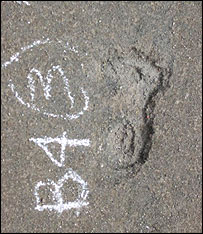
Human settlers made it to the Americas 30,000 years earlier than previously thought, according to new evidence. A team of scientists came to this controversial conclusion by dating human footprints preserved by volcanic ash in an abandoned quarry in Mexico. They say the first Americans may have arrived by sea, rather than by foot. The traditional view is that the continent's early settlers arrived around 11,000 years ago, by crossing a land bridge between Siberia and Alaska.
New Evidence Puts Man In North America 50,000 Years Ago Science Daily - November 18, 2004
Radiocarbon tests of carbonized plant remains where artifacts were unearthed last May along the Savannah River in Allendale County South Carolina archaeologist Dr. Albert Goodyear indicate that the sediments containing these artifacts are at least 50,000 years old, meaning that humans inhabited North American long before the last ice age. The findings are significant because they suggest that humans inhabited North America well before the last ice age more than 20,000 years ago, a potentially explosive revelation in American archaeology. Goodyear, who has garnered international attention for his discoveries of tools that pre-date what is believed to be humans' arrival in North America.
Seafaring clue to first Americans 8,000 years ago BBC - February 26, 2004
People in North America were voyaging by sea some 8,000 years ago, boosting a theory that some of the continent's first settlers arrived there by boat. That is the claim of archaeologists who have found evidence of ancient seafaring along the Californian coast. The traditional view holds that the first Americans were trekkers from Siberia who crossed a land bridge into Alaska during the last Ice Age.
Humans reached America at least 30,000 years ago BBC - July 22, 2003
A new genetic study deals a blow to claims that humans reached America at least 30,000 years ago - around the same time that people were colonizing Europe. The subject of when humans first arrived in America is hotly contested by academics. On one side of the argument are researchers who claim America was first populated around 13,000 years ago, toward the end of the last Ice Age. On the other are those who propose a much earlier date for colonization of the continent - possibly around 30,000-40,000 years ago.
ANCIENT AND LOST CIVILIZATIONS