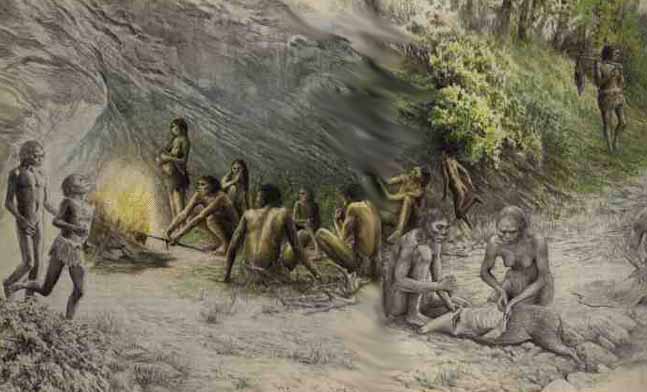
The control of fire by early humans was a turning point in the cultural aspect of human evolution that allowed humans to cook food and obtain warmth and protection. Making fire also allowed the expansion of human activity into the dark and colder hours of the night, and provided protection from predators and insects. Evidence of widespread control of fire dates to approximately 125,000 years ago and later. Evidence for the controlled use of fire by Homo erectus beginning some 400,000 years ago has wide scholarly support, with claims regarding earlier evidence finding increasing scientific support. Claims for the earliest definitive evidence of control of fire by a member of Homo range from 0.2 to 1.7 million years ago (Mya). Read more ...
Archaeologists Discover Earliest Evidence of Humans Using Tools to Make Fire Live Science - December 10, 2025
Archaeologists uncover evidence that Neanderthals made fire 400,000 years ago in England Live Science - December 10, 2025
Ancient Humans in Europe Started Controlling Fire Far, Far Earlier Than We Thought Science Alert - May 20, 2023
Human history is intimately entwined with the use and control of fire. However, working out when our relationship with fire began and how it subsequently evolved has been notoriously difficult. This is partly due to the incomplete nature of archaeological records, and also because fire use was fleeting, making burnt remains difficult to detect. A team has found evidence of the controlled use of fire by direct human ancestors - or hominins - at a site in Spain dating to 250,000 years ago.
The Oldest Evidence of Ancient Humans Cooking With Fire Was Just Found Science Alert - November 15, 2022
What sets humans apart from other animals? It's a burning question that some scientists say boils down to the fine control of one earthly force: fire.
Oldest evidence of the controlled use of fire to cook food, researchers report Science Daily - November 15, 2022
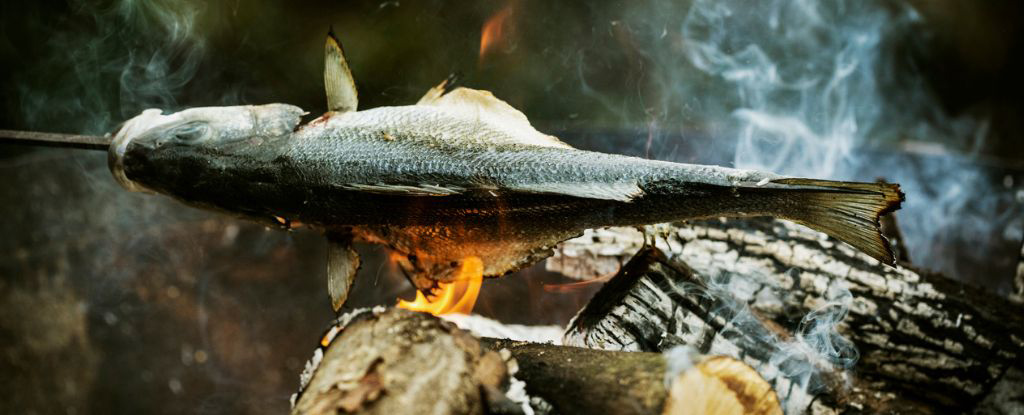
A close analysis of the remains of a carp-like fish found at the Gesher Benot Ya'aqov (GBY) archaeological site in Israel shows that the fish were cooked roughly 780,000 years ago. Cooking is defined as the ability to process food by controlling the temperature at which it is heated and includes a wide range of methods. Until now, the earliest evidence of cooking dates to approximately 170,000 years ago. The question of when early man began using fire to cook food has been the subject of much scientific discussion for over a century.
The pyrophilic primate Science Daily - April 12, 2016
Fire, a tool broadly used for cooking, constructing, hunting and even communicating, was arguably one of the earliest discoveries in human history. But when, how and why it came to be used is hotly debated among scientists. A new scenario crafted by anthropologists proposes that human ancestors became dependent on fire as a result of Africa's increasingly fire-prone environment 2-3 million years ago. A new scenario crafted by University of Utah anthropologists proposes that human ancestors became dependent on fire as a result of Africa's increasingly fire-prone environment 2-3 million years ago. As the environment became drier and natural fires occurred more frequently, ancestral humans took advantage of these fires to more efficiently search for and handle food. With increased resources and energy, these ancestors were able to travel farther distances and expand to other continents.
300,000-Year-Old Caveman 'Campfire' Found Live Science - January 27, 2014
A newly discovered hearth full of ash and charred bone in a cave in modern-day Israel hints that early humans sat around fires as early as 300,000 years ago - before Homo sapiens arose in Africa. In and around the hearth, archaeologists say they also found bits of stone tools that were likely used for butchering and cutting animals. The finds could shed light on a turning point in the development of culture "in which humans first began to regularly use fire both for cooking meat and as a focal point - a sort of campfire - for social gatherings.
Archaeologists claim objects are earliest 'matches' BBC - August 8, 2012
Researchers from Israel say that mysterious clay and stone artifacts from Neolithic times could be the earliest known "matches". Although the cylindrical objects have been known about for some time, they had previously been interpreted as "cultic" phallic symbols. The researchers' new interpretation means these could be the earliest evidence of how fires were ignited.
4,000-year study supports use of prescribed burns in Southern Appalachians PhysOrg - April 6, 2010
A new study reconstructing thousands of years of fire history in the southern Appalachians supports the use of prescribed fire, or controlled burns, as a tool to reduce the risk of wildfires, restore and maintain forest health and protect rare ecological communities in the region's forests. Duke University researchers used radiocarbon analysis of 82 soil charcoal samples dating from 1977 to more than 4,000 years ago to reconstruct the fire history of a 25-acre site in the Nantahala National Forest in western North Carolina. These are the first hard data showing that fires have occurred relatively frequently over much of the last 4,000 years and have played an important role in the health, composition and structure of southern Appalachian forest ecosystems
Fossils reveal oldest wildfire BBC - April 27, 2004
Scientists have discovered evidence for the earliest known wildfire in Earth's history, the journal Geology reports. It comes in the form of small plant fossils preserved as charcoal, which were unearthed by researchers near the town of Ludlow on the Welsh borders. The plant remains date to the Silurian Period, about 443 to 417 million years ago, say a Cardiff University team. Previously, charcoal was known only from the later Devonian Period, which saw an explosion in plant diversity. But in the Silurian, plants were generally quite small, which would have restricted the fuel source for wildfires.
Bones hint at first use of fire BBC - March 22, 2004
Human-like species living in Africa up to 1.5 million years ago may have known how to control fire, scientists say. US and South African experts analyzed burnt bones from Swartkrans, just north of Johannesburg, using the technique of electron spin resonance. It showed the bones had been heated to high temperatures usually only achieved in hearths, possibly making it the first evidence of fire use by humans.
ANCIENT AND LOST CIVILIZATIONS